How we make this list: we compare pricing pages, product documentation and public user reviews. Ratings come from G2, Capterra or Trustpilot, with the date we checked them.
What Is the Best Occupational Health Software?
Enterprise Health is the top pick for employers that run an in-house occupational health clinic, because it is a certified occupational health EHR with medical surveillance, injury tracking and return-to-work case management in one system. Cority is the strongest alternative for large employers that need occupational health inside a broader EHS platform.
Key takeaways
- Enterprise Health is the most clinic focused option, built as a certified EHR for occupational and employee health.
- Cority Meddbase suits occupational health providers that deliver services to other employers under contract, not in-house clinics.
- Only Intelex publishes a starting price, from $44 per user per month with a 25-user minimum, so most buyers must request a quote.
- Fit varies widely: two tools are clinic and EHR focused, while the rest are broader EHS platforms where occupational health is one module.
- Budget for implementation separately, since several vendors charge scoped project fees on top of the subscription.
How Much Does Occupational Health Software Cost?
Occupational health software is almost entirely quote only, which makes budgeting harder than in most software categories. Seven of the eight tools in this guide publish no starting price, and buyers learn the cost only after a sales conversation. The one exception is Intelex, which lists pricing from $44 per user per month with a 25-user minimum, billed annually. That minimum creates a floor of $13,200 per year, even for a team of five people. A buyer comparing these tools should ask each vendor for the subscription price, the implementation fee, the contract term and any annual uplift.
| Tool |
Best for |
Starting price |
Free plan or trial |
| Enterprise Health |
In-house occupational health clinics |
Quote |
None, no free trial |
| Cority |
Large employers needing EHS plus occupational health |
Quote |
None, no trial |
| Intelex |
Mid-size EHS teams wanting published pricing |
From $44 per user per month |
Free trial for Safety Essentials |
| VelocityEHS |
Connected EHS with exposure tracking |
Quote |
None, trial unconfirmed |
| Sphera |
Large industrial operators |
Quote |
None, no trial |
| EHS Insight |
Small to mid-size EHS teams |
Quote |
None, two-week free trial |
| Origami Risk |
Risk, insurance and EHS in one platform |
Quote |
None, no trial |
| Cority Meddbase |
Occupational health service providers |
Quote |
None, demo only |
Worked cost example. Take a 25-person EHS team buying Intelex at $44 per user per month. The monthly cost is 25 times $44, which is $1,100 per month, or $13,200 per year billed annually. A five-person team pays the same $13,200 per year because of the 25-user minimum, which works out to $220 per user per month. For the other seven tools, no worked example is possible, because every one of them is quote only. Ask each vendor for a written quote that states the per-user rate, the minimum seat count, the implementation fee and the contract term before comparing totals.
Which Occupational Health Software Fits a Clinic or an EHS Team?
The right choice depends on whether the buyer runs a clinic or manages safety across sites. Enterprise Health and Cority Meddbase are the most clinic and EHR focused tools in this guide. Enterprise Health suits an employer with its own clinic, while Cority Meddbase suits a provider that delivers occupational health services to other employers under contract. The other six tools are broader EHS platforms where occupational health is one module among many, covering incidents, inspections, industrial hygiene and compliance. An employer that mainly needs injury reporting and OSHA recordkeeping will get more value from one of the EHS platforms, while an employer that runs exams, surveillance and return-to-work cases should start with a clinic focused EHR.
What Should Employers Look for in Occupational Health Software?
Employers should look for medical surveillance scheduling, injury and illness tracking, fitness-for-duty and return-to-work case management, and compliance reporting that covers every site. A clinical record that keeps employee health data separate from general HR data matters, because occupational health records carry their own privacy and retention rules. Mobile capture matters too, since incidents and inspections happen on the shop floor, not at a desk. Buyers should also check whether the vendor offers a free trial or demo, what the minimum seat count is, and whether implementation is a separate scoped fee. For a broader view of the EHS side of the market, see our guide to the best EHS software.
Medical surveillance and compliance are the core of occupational health software, and the tools handle them in different ways. The clinic focused tools schedule exams, track exposures and keep longitudinal clinical records for each employee. The EHS platforms cover surveillance too, but they put more weight on incident reporting, OSHA 300, 300A and 301 forms, inspections and corrective actions. Either way, a buyer should confirm that the tool supports the exams their workforce needs, that reminders fire before surveillance is due, and that reports can be produced by site, job and exposure type. For incident reporting specifically, compare the best incident management software alongside these tools.
Quick comparison
| Tool | Best for | Starting price | Free plan |
|---|
 Enterprise Health | Employers running an in-house occupational health clinic | Quote (no public price; no third-party estimate used) | None, no free trial |
 Cority | Large employers that need occupational health inside a broader EHS platform | Quote (pricing page publishes no figure) | None, no trial |
 Intelex | Mid-size EHS teams that want published pricing and offline mobile capture | From $44 per user per month, 25-user minimum, billed annually ($13,200 per year floor) | None, free trial offered for Safety Essentials |
 VelocityEHS | Employers that want a connected EHS platform with exposure and ergonomics tracking | Quote (no price published) | None, trial unconfirmed |
 Sphera | Large industrial operators unifying EHS, sustainability and operational risk | Quote (no US price published; UK G-Cloud list figures are in pounds and are not a US price) | None, no trial |
 EHS Insight | Small to mid-size EHS teams that want a modular cloud platform with a free trial | Quote (pricing page shows Custom quote for Standard and Advanced plans) | None, two-week free trial offered |
 Origami Risk | Employers that want risk management, EHS and insurance administration in one platform | Quote | None, no trial |
 Cority Meddbase | Occupational health providers delivering services to other employers under contract | Quote | None, demo only |
Is your product missing or out of date?
We review this list regularly. Vendors can request a listing, send updated pricing or ask about featured placement.
Starting priceQuote (no public price; no third-party estimate used)
Free planNone, no free trial
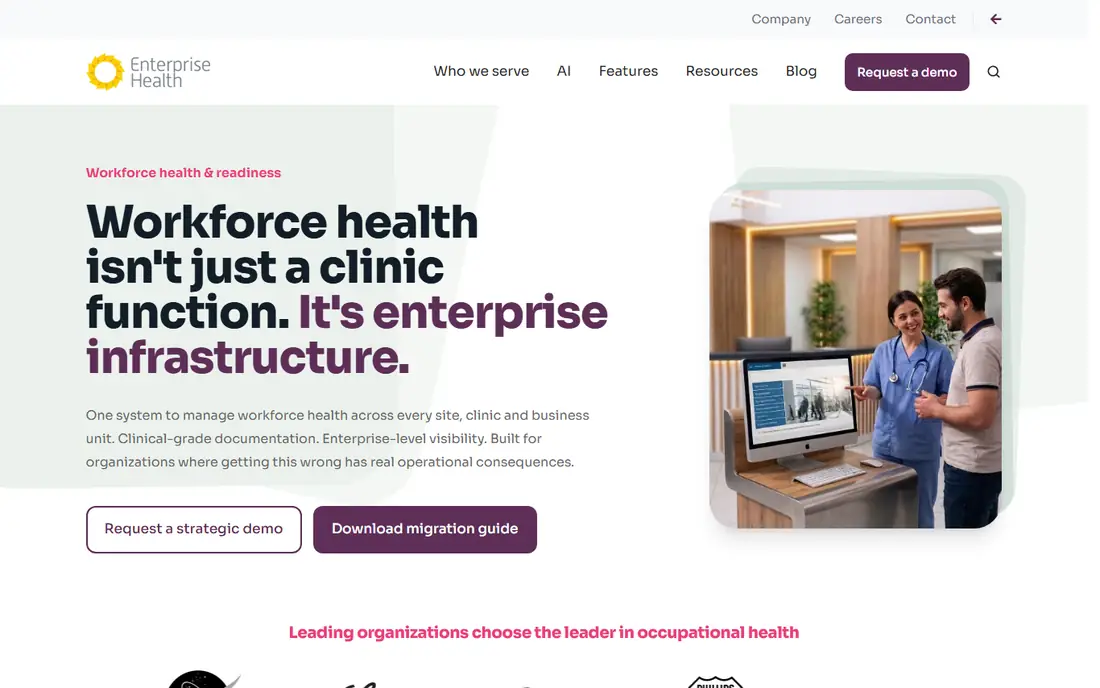
Enterprise Health is a certified EHR for occupational and employee health, used by large employers, health systems and government organizations. It covers medical surveillance, injury and illness tracking, fitness-for-duty evaluations and return-to-work case management, with compliance reporting across multiple sites. Because it is built as a clinical record rather than a general safety tool, it fits employers that run their own clinic and need longitudinal health records for each employee. The trade-off is access: there is no public price and no self-serve trial, so a buyer must go through a sales conversation to learn the cost and see the product. That is normal for enterprise clinical software, but it means budgeting takes longer. See Enterprise Health for product details.
What we like- Certified EHR built for occupational and employee health
- Covers medical surveillance, injury tracking and return-to-work case management in one system
Watch out for- Enterprise-only by design, with no self-serve trial or price before a sales conversation
#2Cority
Best for: Large employers that need occupational health inside a broader EHS platform3.9/5 on
G2 (78 reviews, checked Oct 2026)
Visit cority.com
Starting priceQuote (pricing page publishes no figure)
Free planNone, no trial
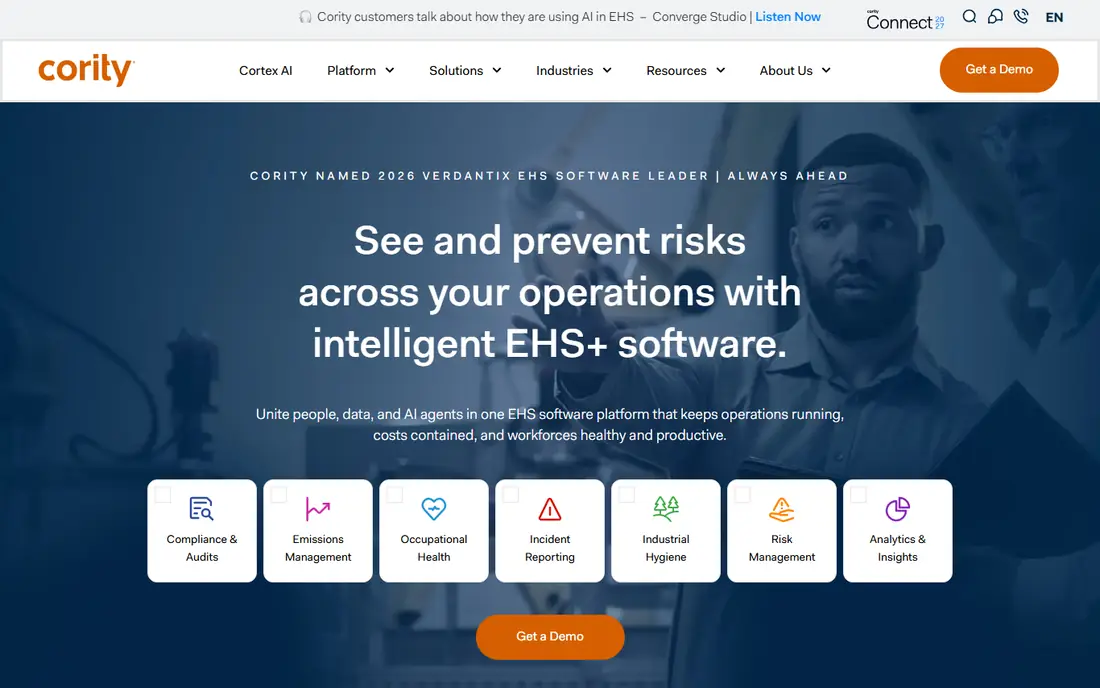
Cority is an enterprise EHS platform whose Health Cloud covers occupational health, industrial hygiene, medical surveillance, employee health records, exposures, exams, incidents and OSHA recordkeeping. That breadth suits a large employer that wants one system for safety and health rather than a separate clinic EHR plus a separate safety tool. The platform is aimed at large and complex organizations, so smaller employers may find the scope and the implementation effort more than they need. Pricing is quote only, and the vendor pricing page at Cority pricing publishes no figure. Buyers should ask for the three-year term, the annual uplift and the implementation fee in writing before signing. See Cority for product details.
What we like- Enterprise EHS platform with a dedicated Health Cloud
- Covers occupational health, industrial hygiene, medical surveillance and OSHA recordkeeping
Watch out for- Initial three-year term with annual uplift, and implementation as a separate scoped project fee
#3Intelex
Best for: Mid-size EHS teams that want published pricing and offline mobile capture4.1/5 on
G2 (67 reviews, checked Oct 2026)
Visit intelex.com
Starting priceFrom $44 per user per month, 25-user minimum, billed annually ($13,200 per year floor)
Free planNone, free trial offered for Safety Essentials
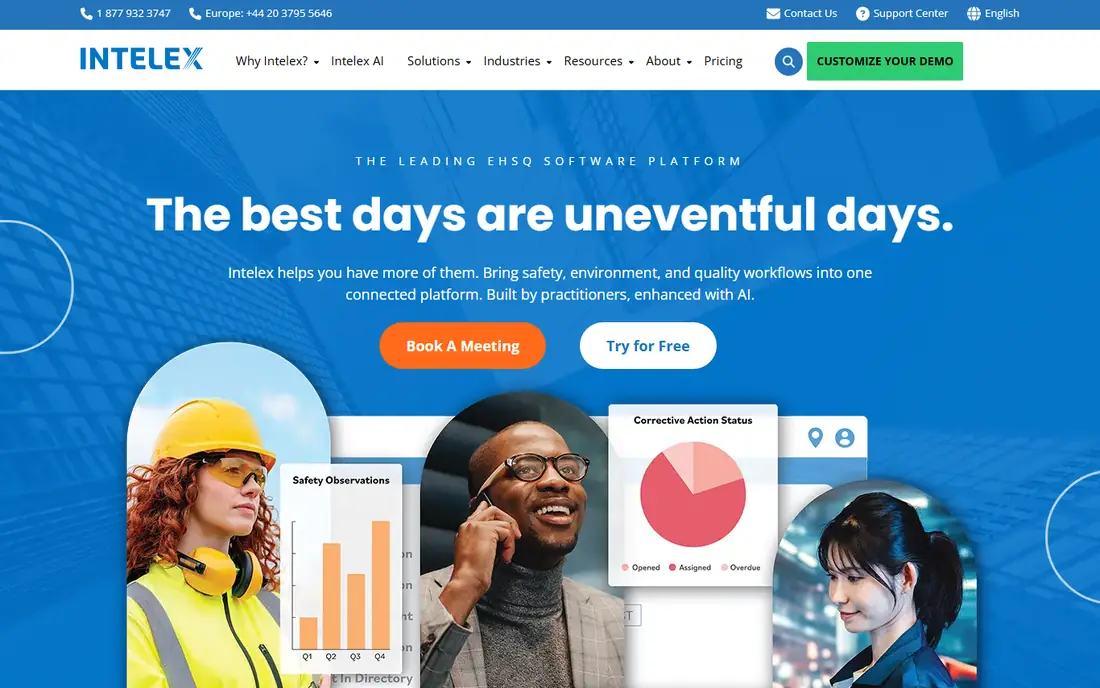
Intelex is an EHSQ platform that covers injury and illness tracking, OSHA 300, 300A and 301 forms, incidents, inspections, corrective actions and medical surveillance, with offline mobile capture for field work. It is the only tool in this guide with a published starting price, from $44 per user per month with a 25-user minimum billed annually. That transparency helps buyers budget, but the minimum seat count is a real constraint for small teams, since a five-person team still pays the $13,200 per year floor. Note that the vendor pricing page at Intelex pricing returned a 404 on 22 Nov 2026 after a site change, so confirm the $44 figure and the trial length at publication. See Intelex for product details.
What we like- Published starting price
- Covers injury and illness tracking, OSHA 300, 300A and 301 forms, inspections and corrective actions
- Mobile app works offline
Watch out for- The 25-user minimum forces even a five-person team to pay for 25 seats
#4VelocityEHS
Best for: Employers that want a connected EHS platform with exposure and ergonomics tracking4.4/5 on
G2 (186 reviews, checked Oct 2026)
Visit ehs.com
Starting priceQuote (no price published)
Free planNone, trial unconfirmed
VelocityEHS is a connected EHS platform that covers exposure and industrial hygiene tracking, incident and injury reporting and ergonomics assessments. It suits an employer that wants safety and health data in one connected system rather than separate point tools. The main drawback is transparency: the vendor site publishes no price, plan name or seat rate, and no trial is confirmed, so a buyer cannot build even a rough budget before talking to sales. That is a practical problem for teams that need a shortlist with costs attached. Ask the vendor for a written quote with the seat rate, minimum seats and contract term, and compare it against the Intelex floor of $13,200 per year. See VelocityEHS for product details.
What we like- Connected EHS platform covering exposure and industrial hygiene tracking, incident and injury reporting, and ergonomics assessments
Watch out for- No published price, plan name or seat rate anywhere on the vendor site, so a buyer cannot budget before a sales conversation
#5Sphera
Best for: Large industrial operators unifying EHS, sustainability and operational risk5.0/5 on
Capterra (1 reviews, checked Oct 2026)
Visit sphera.com
Starting priceQuote (no US price published; UK G-Cloud list figures are in pounds and are not a US price)
Free planNone, no trial
Sphera is an operational intelligence platform that unifies EHS, sustainability, operational risk and product stewardship for large industrial operators. Its scale suits organizations that run complex plants and need one system across safety, environment and risk, rather than a standalone occupational health tool. The cost structure reflects that scale: modules are sold in minimum bundles of 250 named users, and setup starts from 45,000 pounds per core module on the vendor UK list. Those UK figures are not a US price and should not be quoted as one. Smaller employers will find the minimum bundle far larger than their workforce, so Sphera fits best where the headcount and the industrial footprint justify an enterprise platform. See Sphera for product details.
What we like- Operational intelligence platform unifying EHS, sustainability, operational risk and product stewardship for large industrial operators
Watch out for- Modules sold in minimum bundles of 250 named users, with setup from 45,000 pounds per core module on the vendor UK list
#6EHS Insight
Best for: Small to mid-size EHS teams that want a modular cloud platform with a free trial4.6/5 on
G2 (83 reviews, checked Oct 2026)
Visit ehsinsight.com
Starting priceQuote (pricing page shows Custom quote for Standard and Advanced plans)
Free planNone, two-week free trial offered
EHS Insight is a cloud EHS platform with more than 30 modules, covering incident and injury tracking, corrective actions, compliance scheduling and a mobile app that works offline. The modular design lets a smaller team start with the modules it needs rather than buying a full enterprise suite, and the two-week free trial is a real advantage in a category where most vendors offer no trial at all. Pricing is quote only: the vendor pricing page at EHS Insight pricing shows Custom quote for Standard and Advanced plans, with no published per-seat rate. Contracts run annually by default, so buyers should confirm the term and the renewal terms before committing. See EHS Insight for product details.
What we like- Cloud EHS platform with more than 30 modules
- Covers incident and injury tracking, corrective actions and compliance scheduling
- Mobile app works offline
Watch out for- Annual contracts by default, with no published per-seat rate, so quotes vary by headcount and modules
#7
Origami Risk
Best for: Employers that want risk management, EHS and insurance administration in one platform
Visit origamirisk.com
Starting priceQuote
Free planNone, no trial
Origami Risk is a cloud platform that combines risk management, EHS and insurance administration, with occupational health features covering ergonomics assessments, medical surveillance with reminders, vaccination and exposure tracking, and industrial hygiene. That combination suits an employer that already manages insurance and claims and wants health data in the same system. The trade-off is scope: a buyer that only wants a dedicated occupational health EHR will be implementing a much larger platform than it needs, with the extra modules, training and change management that implies. Pricing is quote only and no trial is offered, so a demo and a written quote are the way to judge fit. See Origami Risk for product details.
What we like- Cloud platform combining risk management, EHS and insurance administration
- Covers ergonomics assessments, medical surveillance with reminders, vaccination and exposure tracking, and industrial hygiene
Watch out for- Occupational health is one module inside a broad risk, insurance and claims platform, so buyers wanting a dedicated occupational health EHR get a much larger system to implement
#8
Cority Meddbase
Best for: Occupational health providers delivering services to other employers under contract
Visit meddbase.com
Starting priceQuote
Free planNone, demo only
Cority Meddbase is a cloud-native clinical and practice management platform that Cority acquired in Jan 2025. It covers employer contracts, health surveillance schedules, case management, clinical records, booking and billing, employer portals and SLA tracking, which is exactly the workflow of a provider that delivers occupational health services to other employers. That makes it the strongest fit in this guide for a service provider, but a weaker fit for an employer running its own clinic. It is also UK-origin, so a US employer should confirm US compliance and hosting fit before shortlisting it. Pricing is quote only and the vendor offers a demo rather than a trial. Medgate is not listed separately here, because Medgate rebranded as Cority in 2017. See Cority Meddbase for product details.
What we like- Cloud-native clinical and practice management platform
- Covers employer contracts, health surveillance schedules, case management, clinical records, booking and billing, employer portals and SLA tracking
Watch out for- Built for occupational health providers serving other employers, not for an in-house employer clinic, and UK-origin, so a US employer should confirm US compliance and hosting fit
Frequently asked questions
What is occupational health software?
Occupational health software is a system that manages employee health at work, including medical surveillance, pre-employment and periodic exams, injury and illness tracking, fitness-for-duty evaluations and return-to-work case management. It keeps clinical records separate from general HR data, schedules exams before they fall due, and produces compliance reports by site, job and exposure type for employers, clinics and regulators.
How much does occupational health software cost?
Most occupational health software is quote only, with no published starting price. Seven of the eight tools in this guide publish no price, and buyers learn the cost only after a sales conversation. Intelex is the exception, starting from $44 per user per month with a 25-user minimum billed annually, a floor of $13,200 per year. Always ask for the subscription, implementation fee, contract term and annual uplift in writing.
What is the difference between occupational health software and EHS software?
Occupational health software focuses on clinical records, medical surveillance, exams and return-to-work cases for individual employees. EHS software covers the wider safety picture, including incidents, inspections, audits, industrial hygiene and environmental compliance. Many EHS platforms include an occupational health module, and our guide to the best safety management software covers that side of the market in more depth.
Do any occupational health tools offer a free trial?
Very few do. EHS Insight offers a two-week free trial, and Intelex offers a free trial for its Safety Essentials product, though the trial length should be confirmed at publication because the vendor pricing page returned a 404 on 22 Nov 2026. The other six tools offer no trial, and Cority Meddbase offers a demo only. Expect a guided demo and a written quote for most vendors in this category.
Which occupational health software is best for a small employer?
A small employer should start with EHS Insight or Intelex. EHS Insight offers a two-week free trial and a modular platform, so a small team can start with the modules it needs. Intelex publishes its starting price, which makes budgeting possible, but its 25-user minimum means a small team still pays for 25 seats. Enterprise Health and Cority suit larger employers with a clinic or a multi-site EHS program.
How We Picked
We checked each vendor pricing page and product page on 22 Nov 2026, using the vendor published price where one exists and recording quote only where the vendor publishes no figure. We did not use third-party price estimates. We compared clinic focused EHR tools against broader EHS platforms, and we recorded one real con for every product. The Intelex pricing page returned a 404 on 22 Nov 2026 after a site change, so its $44 per user per month figure is flagged for a spot check at publication. Last verified: 22 Nov 2026.
Sources we checked (11)
- https://www.enterprisehealth.com/
- https://www.cority.com/
- https://www.cority.com/pricing
- https://www.intelex.com/
- https://www.intelex.com/pricing
- https://www.ehs.com/
- https://www.sphera.com/
- https://www.ehsinsight.com/
- https://www.ehsinsight.com/solutions/platform/pricing
- https://www.origamirisk.com/
- https://www.meddbase.com/
Is your product missing or out of date?
We review this list regularly. Vendors can request a listing, send updated pricing or ask about featured placement.

Shihab Mia · Founder, Rankite
Shihab has 5+ years in B2B and SaaS SEO. He writes Rankite's software buying guides from pricing pages, documentation and public user reviews. More about Shihab.