How we make this list: we compare pricing pages, product documentation and public user reviews. Rankite is independent; if a vendor ever pays for a featured spot, that listing is clearly labeled Partner.
Key takeaways
- SafetyCulture is the easiest starting point for small teams, with a free plan for up to 10 users and paid plans at $24 per user per month billed annually.
- VelocityEHS, Cority, Intelex, and Benchmark Gensuite are built for larger or multi-site operations; expect custom pricing and a longer rollout.
- EHS Insight and KPA offer full-suite EHS at prices and complexity levels that fit mid-size companies better than the enterprise suites.
- Every tool on this list covers incident management, audits, and corrective actions. The real differences are mobile quality, configurability, and how much hand-holding you get during setup.
- If your team works in the field without reliable internet, test offline mode before you commit. It varies more than vendors admit.
Quick comparison
| Tool | Best for | Starting price | Free plan |
|---|
 SafetyCulture SafetyCulture | frontline inspections and audits | $24 per user/month (billed annually) | Yes |
 VelocityEHS VelocityEHS | multi-site EHS programs | See website | No |
 Intelex Intelex | configurable EHS and quality workflows | See website | Free trial |
 Cority Cority | complex occupational health needs | See website | No |
 Benchmark Gensuite Benchmark Gensuite | unified EHS plus ESG reporting | See website | No |
 EHS Insight EHS Insight | full-suite EHS on a mid-size budget | See website | Free trial |
 Evotix Evotix | preconfigured EHS for mid-size firms | See website | No |
 KPA KPA | EHS software bundled with training | See website | No |
Is your product missing or out of date?
We review this list regularly. Vendors can request a listing, send updated pricing or ask about featured placement.
The best ehs software
Starting price$24 per user/month (billed annually)
Free planYes
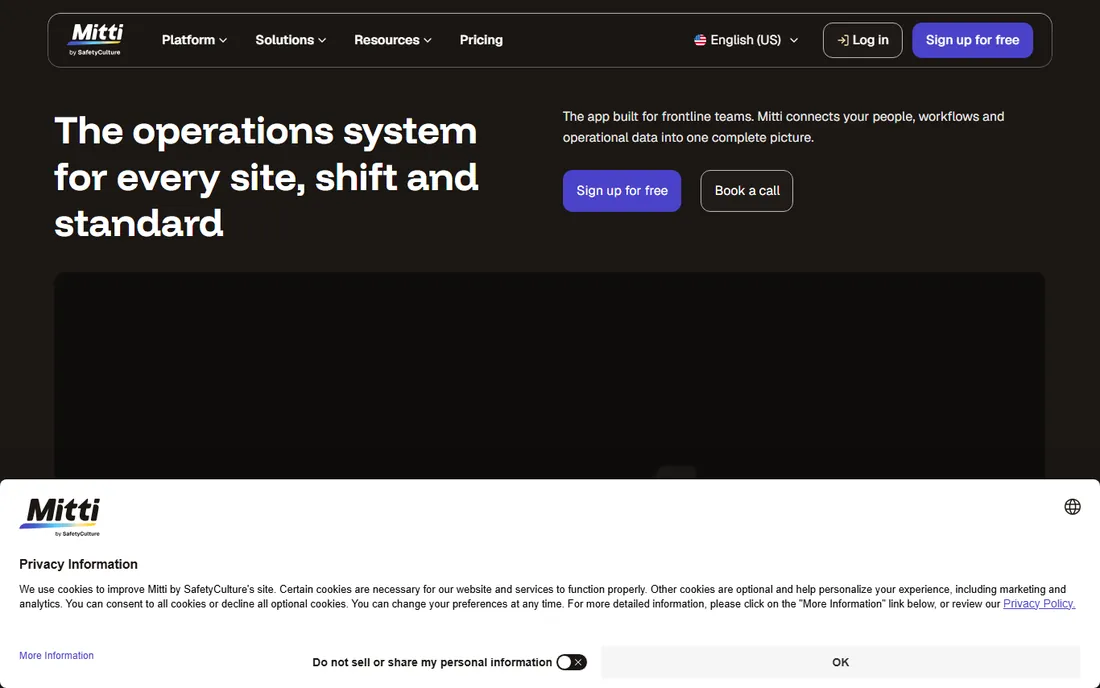
SafetyCulture began as iAuditor, a mobile checklist app, and that origin is still its greatest strength. Nobody beats it for getting frontline workers to actually complete inspections, report hazards, and close out corrective actions from a phone. The free plan covers up to 10 users, which makes it the rare EHS tool a small company can start using this week without a procurement process. The company has recently rebranded the platform as Mitti, but the product and pricing structure remain familiar to longtime users.
The honest catch is depth. SafetyCulture handles inspections, incidents, training, and asset tracking well, but its analytics and regulatory reporting are lighter than what a multi-site manufacturer needs for OSHA 300 logs or ISO 45001 audits. It also prices per user, so costs climb as you add office staff who only need occasional access. Start here if your biggest problem is getting consistent data from the field. Move up to an enterprise suite when your reporting requirements outgrow it.
What we like- Generous free plan for up to 10 users
- Excellent mobile app that works offline
- Huge template library for inspections and checklists
Watch out for- Reporting is basic compared with enterprise suites
- Advanced features like sensors and asset management add cost quickly
Starting priceSee website
Free planNo
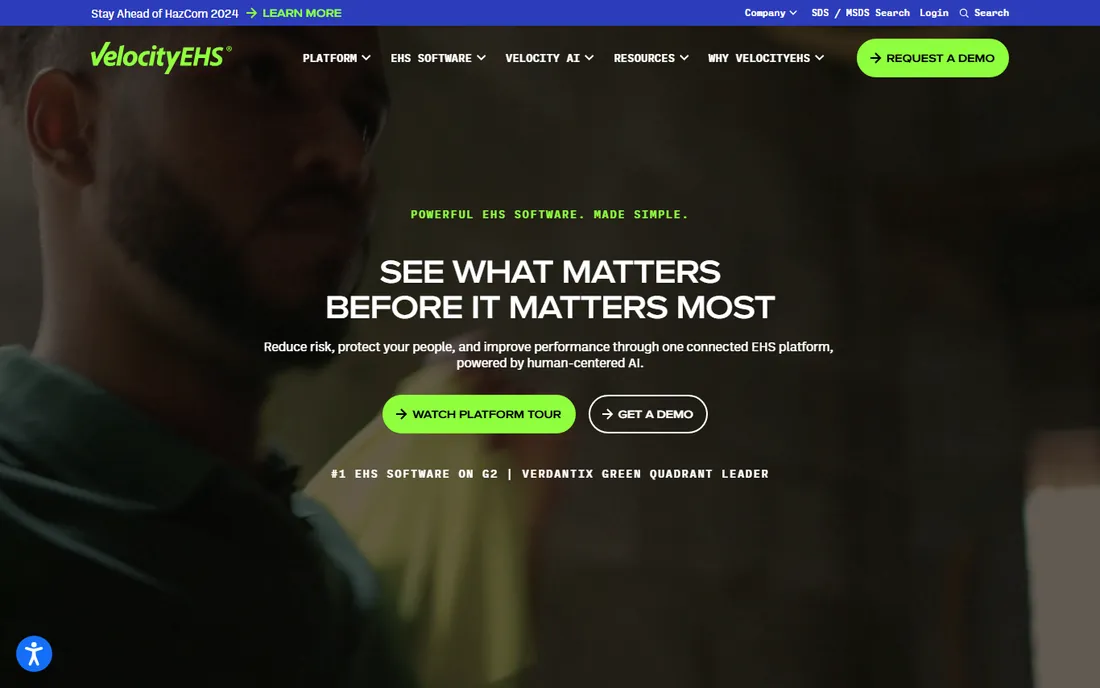
VelocityEHS runs its Accelerate platform across safety management, industrial ergonomics, chemical management, operational risk, contractor safety, and environmental compliance. That breadth is the point. Instead of stitching together an incident tool, an SDS library, and an ergonomics assessment app, you get one vendor and one data model. Its chemical management heritage (MSDSonline) and ergonomics offering (Humantech) are genuinely strong, and the company reports protecting more than 10 million workers across 140 countries.
The trade-off is that this is enterprise software with enterprise timelines. Pricing is quote-based, and a full rollout across several modules can take months of configuration and training. Smaller companies often find they are paying for capability they will not use for years. VelocityEHS fits best when you have multiple sites, dedicated EHS staff, and a compliance burden that justifies the investment.
What we like- Broad module coverage from safety to ergonomics to chemical management
- Strong compliance content built in
- Mobile apps designed for field workers
Watch out for- Quote-based pricing with no public numbers
- Implementation takes longer than simpler tools
Starting priceSee website
Free planFree trial
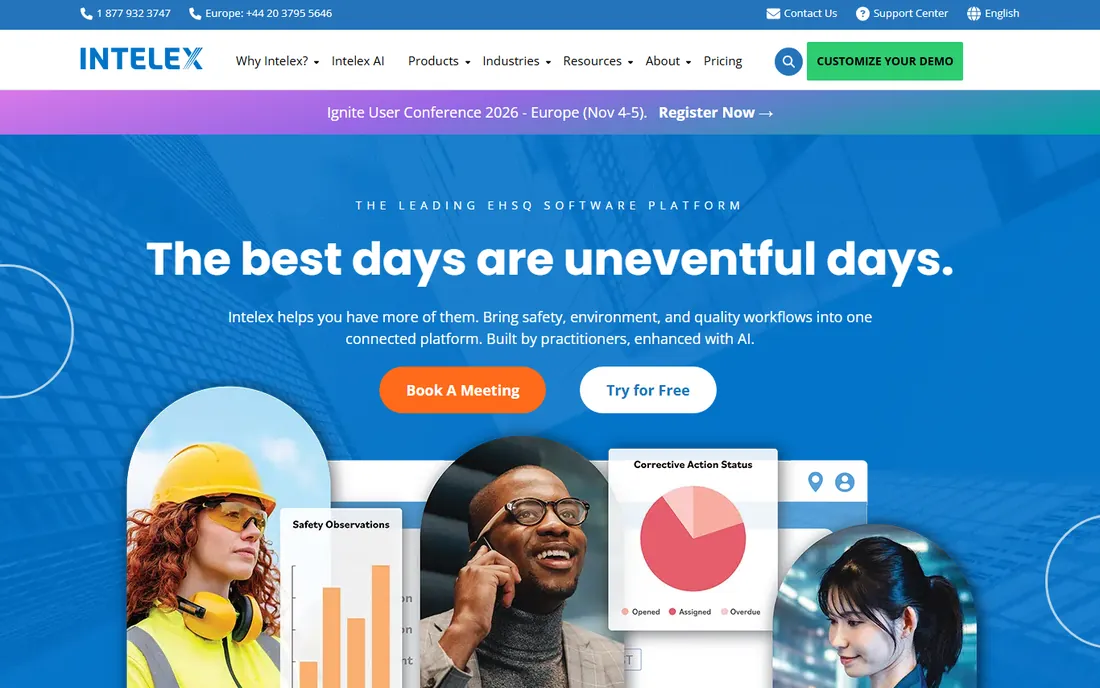
Intelex has been in the EHSQ space since 1992, and it shows in the maturity of the platform. Its standout feature is an application builder that lets safety and quality teams shape workflows, forms, and dashboards to match how their sites actually operate, without waiting on vendor developers. The library of pre-built applications covers incidents, audits, training, document control, and more, so you are configuring rather than building from zero. It is now part of Industrial Scientific, which gives it backing for long-term development.
The catch with all that configurability is governance. Without a clear admin owner, different sites can drift into inconsistent processes, which defeats the purpose of a standard system. Intelex also keeps pricing behind a sales conversation. It suits manufacturing and multi-site organizations that treat quality and safety as one discipline and have someone to own the system.
What we like- Deep configurability without heavy custom code
- Strong pre-built application library
- Combines EHS and quality in one platform
Watch out for- Flexibility demands good internal governance
- Pricing is quote-only
Starting priceSee website
Free planNo
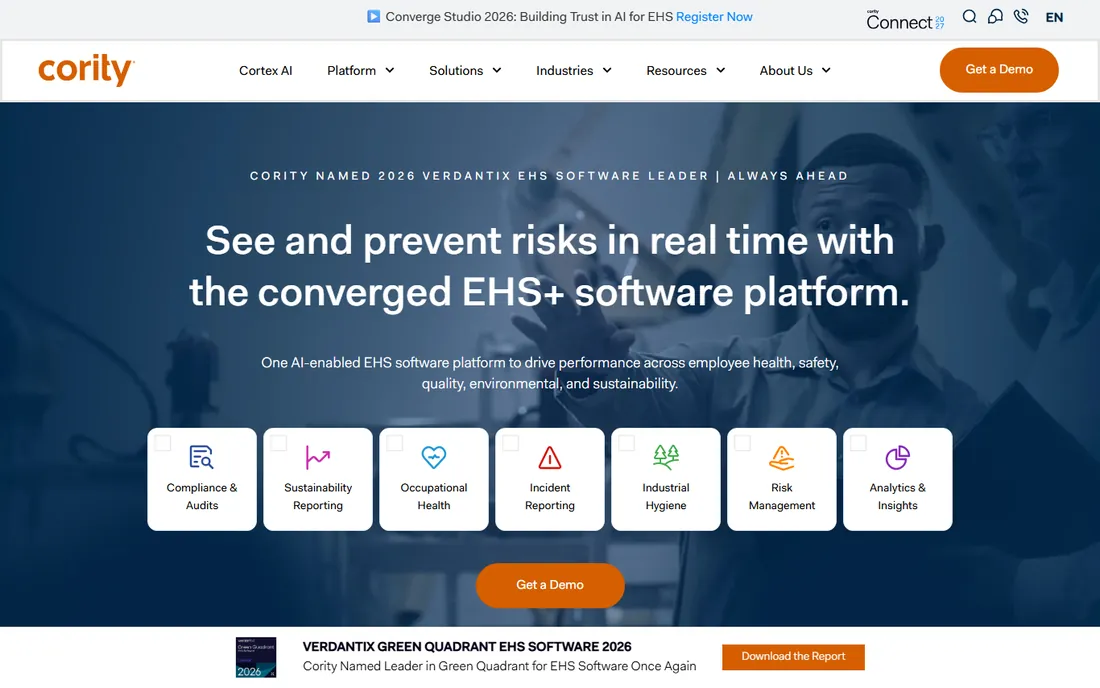
Cority, formerly Medgate, is the choice when occupational health is central to your EHS program rather than an afterthought. Its CorityOne platform unites safety, health, environmental, quality, and sustainability data, and its clinical depth for employee health records, medical surveillance, and industrial hygiene is unmatched in this list. The company has operated for 40 years, serves more than 1,500 organizations, and holds FedRAMP Ready status, which matters if you work with federal agencies or contractors.
That depth comes with complexity. Expect a longer implementation and a real learning curve for administrators. This is not the tool you buy to digitize checklists next week. It is the tool you buy when you have occupational health nurses, industrial hygienists, or complex regulatory reporting and you need one system of record for all of it.
What we like- Deepest occupational health and industrial hygiene modules in the category
- FedRAMP ready for government-adjacent work
- Strong analytics and AI features
Watch out for- Steeper learning curve than lighter tools
- Implementation timelines run long
Starting priceSee website
Free planNo
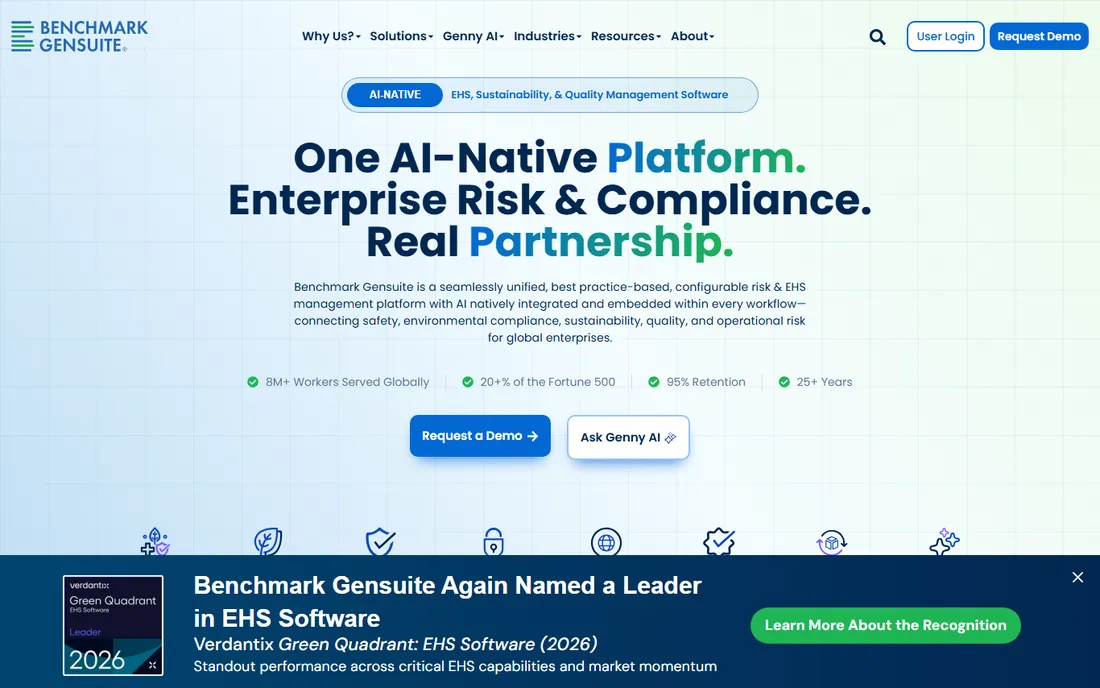
Benchmark Gensuite pitches itself as one AI-native platform rather than a bundle of acquired products, and the architecture backs that up. Safety, environmental compliance, sustainability, quality, and operational risk share one data layer, so reporting across functions does not require fragile integrations. Its Genny AI assistant is embedded in daily workflows, and the company reports more than 8 million workers on the platform. The single-version software model means every subscriber runs the same current release, which avoids the upgrade-cycle pain common in enterprise EHS.
The obvious downside is fit. This is built for global enterprises with complex programs, and the sales process and pricing reflect that. A 50-person company will find it oversized. It earns its place for organizations that need EHS and ESG disclosure reporting in one system and have the team to run it.
What we like- Single architecture across EHS, sustainability, and quality with no integration gaps
- AI assistant built into workflows
- Strong subscriber community
Watch out for- Enterprise-grade pricing and sales process
- More platform than a small team needs
Starting priceSee website
Free planFree trial
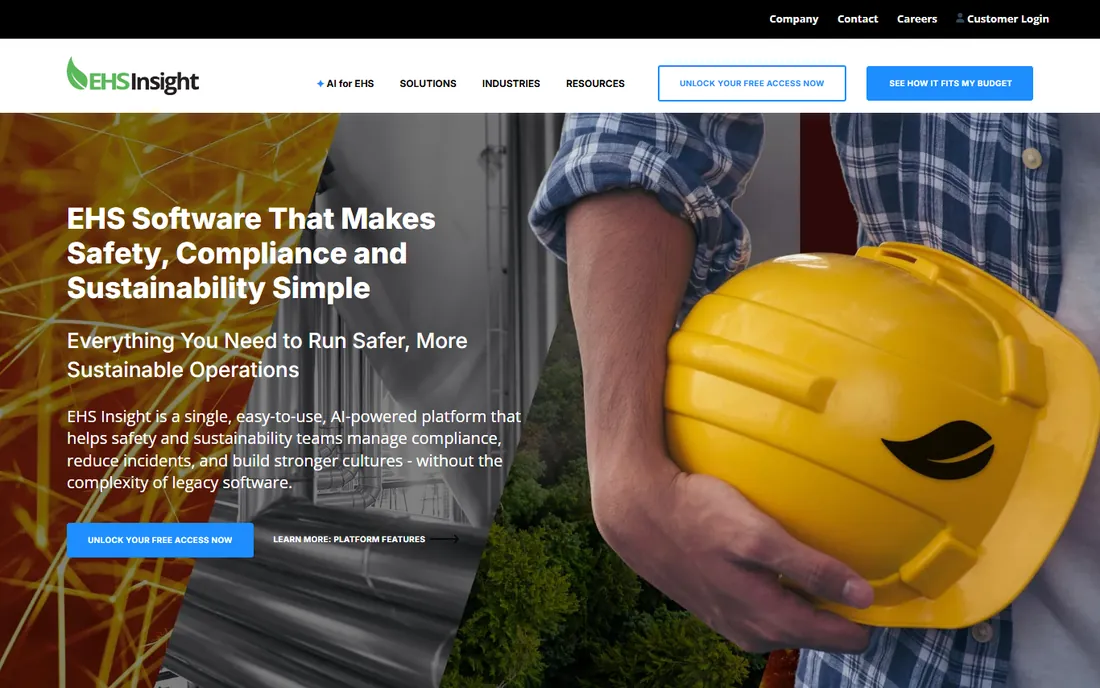
EHS Insight, based in Houston, has positioned itself as the value play in full-suite EHS software since 2009. You get incident management, audits and inspections, training, risk assessment, and ESG reporting in one platform with an interface that does not require a week of training to understand. The mobile app works offline, which matters for construction, energy, and field services teams. Recent additions include an MCP connector that lets teams query their EHS data through AI assistants they already use.
The compromise is ecosystem. With 100 to 200 employees, EHS Insight is far smaller than Cority or VelocityEHS, so the integration marketplace and partner network are thinner. If you need deep connections to HR, ERP, or specialized industrial hygiene systems, confirm they exist before signing. For mid-size companies that want one capable system without enterprise overhead, it is a strong fit.
What we like- Full incident, audit, training, and ESG coverage at a mid-market price point
- Modern interface with low training burden
- Mobile app with offline mode
Watch out for- Smaller vendor with fewer third-party integrations
- Advanced analytics lag the enterprise suites
Starting priceSee website
Free planNo
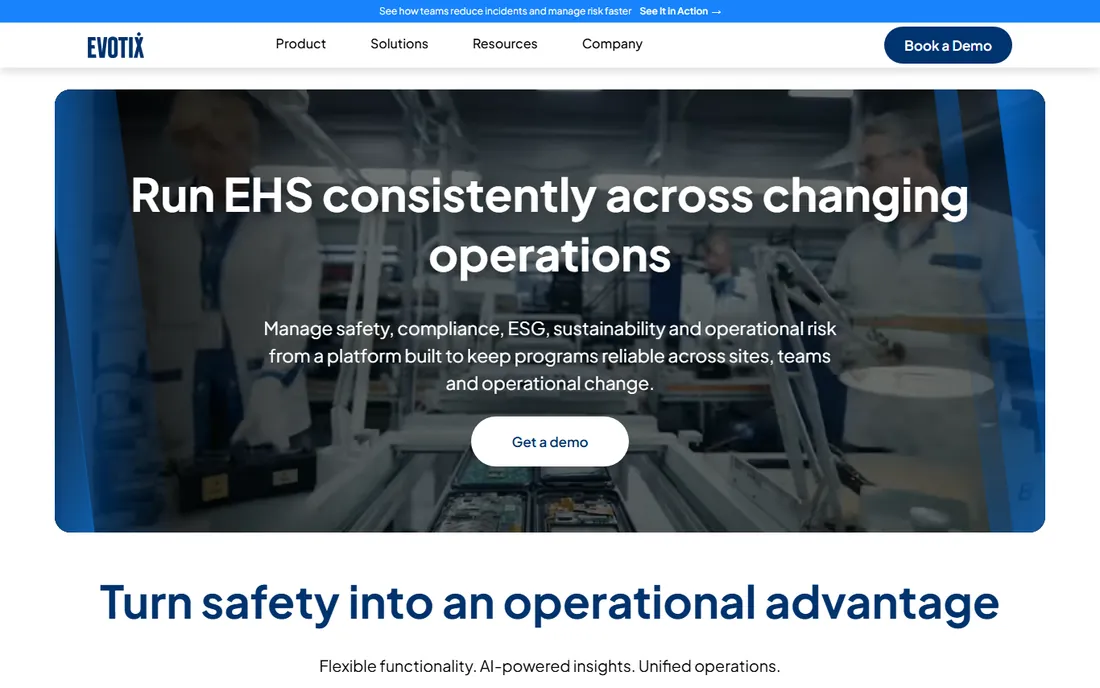
Evotix, headquartered in Chicago and formerly known as SHE Software, targets mid-size and enterprise companies that want structure without a year-long implementation. Its Assure platform ships with preconfigured EHS workflows for incidents, audits, inspections, and risk, plus no-code tools so your own team can adjust forms and automations. The mobile app AssureGO+ includes QR code reporting, so a worker can file a near miss in under a minute. The company serves more than 650 clients and holds ISO 27001 and SOC 2 Type II credentials.
The main friction is the buying process. Pricing is quote-based and the sales cycle is consultative, which is normal for the category but slower than product-led tools. US buyers should also know the brand is better known in the UK and Europe, though the Chicago headquarters anchors North American support. It fits companies that want a guided, structured rollout rather than a blank canvas.
What we like- Preconfigured workflows shorten time to value
- No-code self-configuration for forms and processes
- QR code incident reporting for frontline staff
Watch out for- Quote-based pricing
- Less brand recognition in the US than larger rivals
#8
KPA
Best for: EHS software bundled with training
Visit kpa.io
Starting priceSee website
Free planNo
KPA takes a different angle from everyone else on this list. Its Flex platform pairs EHS software with an integrated learning management system holding more than 1,000 compliance courses, plus consulting services. For companies in regulated industries like automotive dealerships, construction, and manufacturing, that bundle solves two problems at once: the system to track safety and the training content to keep workers compliant. The platform covers incidents, inspections, audits, risk, and corrective actions, with a mobile app built for field reporting.
The catch is that you are buying into an ecosystem. If you already have a training provider or an LMS you like, part of KPA's value proposition is redundant. Pricing is also quote-based, so budget planning requires a sales conversation. KPA makes most sense for small to mid-size companies that want one partner for software, training, and compliance guidance.
What we like- Combines EHS software with a large compliance training library
- Mobile-first design for field teams
- Configurable forms and dashboards
Watch out for- Pricing is quote-based
- Training content quality matters more here than with pure software vendors
How we put this list together
We started with the EHS category leaders recognized by analysts and public review sites, then checked each vendor's own website, pricing pages, documentation, and recent company announcements. We read user reviews on G2, Capterra, and Reddit to see where each product actually shines and where buyers complain. We weighted mobile quality, offline capability, incident and audit depth, configurability, and fit for small and mid-size US companies. We did not test the software hands-on, and we did not accept vendor placements. Prices shown come from vendor-published pages; where vendors keep pricing behind a quote, we say so instead of guessing.
What to check before you sign a contract
Start with your incident workflow, not the feature list. Map how an incident goes from first report to closed corrective action today, then ask each vendor to walk that exact path in a demo. If they cannot show it cleanly, the feature list does not matter.
Ask about user licensing carefully. Most EHS tools price per user, but definitions vary. Some count only active reporters, others count everyone with login access. Get the definition in writing and model the cost at twice your current headcount, because adoption usually expands.
Confirm offline capability on the devices your team actually uses. A mobile app that needs a constant connection is useless in a basement, a rural jobsite, or a plant with dead zones. Ask for a live offline demo, not a slide.
Check the implementation plan and who does the work. Enterprise suites often need weeks of configuration, data migration from spreadsheets, and training. Ask for a written timeline with named responsibilities. If the vendor does all the configuration, ask what happens when you need changes six months later and whether your team can make them.
Finally, ask about regulatory content updates. OSHA recordkeeping rules, EPA reporting formats, and state requirements change. Good vendors update their forms, reports, and training content as regulations change. Ask how often that happens and whether it costs extra.
Rolling it out without losing your team
The best EHS software fails when frontline workers do not use it. Roll out to one site or one crew first, and pick the workflows that remove paperwork rather than add it. If the app makes reporting a hazard faster than the old paper form, adoption takes care of itself. If it adds five minutes to every inspection, no amount of management pressure will fix it.
Name one internal owner for the system. Every successful EHS rollout we have seen has a person whose job includes keeping forms current, training new hires, and pulling the monthly reports. Without that owner, the system slowly goes stale and people revert to spreadsheets.
Frequently asked questions
How much does EHS software cost?
It ranges widely. SafetyCulture starts at $24 per user per month billed annually with a free tier for small teams. Mid-market suites like EHS Insight are typically priced per site or per user in the low hundreds per month. Enterprise platforms such as Cority, Intelex, VelocityEHS, and Benchmark Gensuite use quote-based pricing that usually runs into five or six figures annually depending on modules and user counts.
Will EHS software keep us OSHA compliant?
It helps a great deal but does not guarantee compliance. Good EHS software gives you OSHA 300 logs, incident tracking, audit trails, and training records in one place, which is most of what an inspection asks for. You still need correct procedures, trained people, and timely reporting. Think of the software as the filing cabinet and the reminder system, not the safety program itself.
How long does implementation take?
Simple tools like SafetyCulture can be running in days. Mid-market platforms typically take four to twelve weeks including configuration, data migration, and training. Enterprise suites can take three to nine months for a full multi-module rollout. Ask every vendor for a written timeline before you sign.
Do we need EHS software if we already use spreadsheets?
Spreadsheets work until they do not. The breaking points are usually version confusion across sites, missing corrective actions with no follow-up, and the scramble to assemble records during an audit or inspection. If you have more than one location or more than about 50 employees, dedicated software usually pays for itself in avoided admin time alone.
What is the difference between EHS and EHSQ software?
EHS covers environment, health, and safety. EHSQ adds quality management to the same platform. Vendors like Intelex, Cority, and Benchmark Gensuite sell the combined version because many manufacturers manage safety incidents and quality defects with similar corrective-action workflows. If quality is handled elsewhere, a pure EHS tool is simpler and cheaper.
Can field workers use these tools without internet?
Most of the mobile-first tools on this list, including SafetyCulture, EHS Insight, KPA, and Evotix, offer offline modes that sync when connectivity returns. Always verify this on your actual devices during the trial, since offline reliability varies by platform and by feature.
Sources we checked (9)
- https://safetyculture.com/
- https://safetyculture.com/apps/5-whys-software
- https://www.ehs.com/
- https://www.intelex.com
- https://cority.com/
- https://benchmarkgensuite.com/
- https://ehsinsight.com/
- http://evotix.com/
- https://kpa.io/ehs-software/
Is your product missing or out of date?
We review this list regularly. Vendors can request a listing, send updated pricing or ask about featured placement.

Shihab Mia · Founder, Rankite
Shihab has spent more than a decade helping SaaS and e-commerce brands grow through search. He writes Rankite's software buying guides from pricing pages, documentation and public user reviews. More about Shihab.