How we make this list: we compare pricing pages, product documentation and public user reviews. Rankite is independent; if a vendor ever pays for a featured spot, that listing is clearly labeled Partner.
Key takeaways
- PRTG publishes the clearest entry price at $200 per month (PRTG 500, billed annually), with a free 100-sensor edition. Datadog lists Network Device Monitoring from $7 per device per month.
- Zabbix and Nagios Core are genuinely free and open source, which makes them the budget floor for large device counts, at the cost of setup effort.
- SolarWinds NPM, ManageEngine OpManager, LogicMonitor, Auvik, Nagios XI and Dynatrace keep pricing behind quotes or calculators, so plan for a sales cycle.
- Match the architecture to your estate: agentless SNMP tools for network gear, observability platforms for cloud-native shops, and all-in-one suites for mixed environments.
Quick comparison
| Tool | Best for | Starting price | Free plan |
|---|
 SolarWinds NPM SolarWinds NPM | Large multi-vendor on-prem networks | See website (custom quote) | No (free trial) |
 Datadog Datadog | Cloud-native shops wanting network plus full observability | $7/device/month (Network Device Monitoring, billed annually) | No (14-day free trial) |
 PRTG PRTG | Mid-size IT teams wanting fast setup | $200/month (PRTG 500, billed annually) | Yes (Freeware: 100 sensors) |
 Zabbix Zabbix | Enterprises wanting free, scalable open-source monitoring | Free (open source) | Yes |
 ManageEngine OpManager ManageEngine OpManager | Device-based licensing without per-metric fees | From $245 (per vendor site) | No (30-day free trial) |
 Nagios XI Nagios XI | Teams standardizing on the Nagios ecosystem | See website | Yes (free tier; Nagios Core open source) |
 LogicMonitor LogicMonitor | SaaS-first hybrid infrastructure monitoring | See website | No (free trial) |
 Auvik Auvik | Automated mapping with minimal setup | See website (per-device subscription) | No (free trial) |
 Dynatrace Dynatrace | AI-driven root cause across full-stack estates | From $29/host/month (Infrastructure Monitoring) | No (free trial) |
Is your product missing or out of date?
We review this list regularly. Vendors can request a listing, send updated pricing or ask about featured placement.
The best network monitoring software for enterprise
An hour of network downtime costs more than a year of monitoring licenses, and everyone in IT knows it the week after an outage. Enterprise network monitoring is about seeing the failure before users feel it: the saturated link, the dying switch fan, the latency spike between data centers. These nine tools cover the real enterprise market, from old-guard SNMP suites to cloud observability platforms, with prices only where vendors publish them.
Starting priceSee website (custom quote)
Free planNo (free trial)
SolarWinds Network Performance Monitor is the incumbent in enterprise network monitoring. It discovers and maps multi-vendor networks automatically, tracks fault, availability and performance across routers, switches, firewalls and wireless, and layers on NetPath visualizations that show exactly where latency or packet loss appears along a path. PerfStack correlates metrics across the stack so a slow application can be traced to the congested interface underneath it. Add-on modules extend into NetFlow analysis, configuration management and IP address management.
The honest catch is the buying and running of it. NPM pricing is quote-based and licensed by elements, which makes budgeting an exercise in counting interfaces. The platform is on-premises and needs proper sizing, database care and maintenance. For large enterprises with heterogeneous networks and a dedicated NetOps team, it remains the reference product. Smaller shops should look at the SaaS options below first.
What we like- Deep multi-vendor device monitoring with NetPath hop-by-hop analysis and PerfStack correlation
- Intelligent alerts with dynamic baselines
- Mature ecosystem of add-on modules for traffic, config and IP management
Watch out for- No published NPM pricing, everything goes through sales
- The on-prem platform demands real infrastructure and care to scale
#2
Datadog
Best for: Cloud-native shops wanting network plus full observability
Visit datadoghq.com
Starting price$7/device/month (Network Device Monitoring, billed annually)
Free planNo (14-day free trial)
Datadog approaches the network as one more telemetry source in a unified observability platform. Network Device Monitoring polls switches, routers and firewalls over SNMP with out-of-the-box metrics, interface bandwidth visualization and hardware health, priced from $7 per device per month billed annually. Around it sit cloud network monitoring, NetFlow, DNS monitoring and network path tests, all correlated with the infrastructure metrics, traces and logs your teams already use. For organizations standardized on Datadog, adding the network is a natural extension.
The catch is the meter. Pricing is usage-based across hosts, devices and data, and enterprise bills can surprise teams that monitor broadly. Network Device Monitoring also requires Datadog infrastructure hosts to do the polling. If your world is cloud and containers with a network underneath, Datadog's unified view is hard to beat. If you only need the network, the platform overhead is real.
What we like- Network Device Monitoring from $7 per device per month with published pricing
- Unified with infrastructure, APM, logs and cloud monitoring in one platform
- Flow, DNS and path analysis included
Watch out for- Network monitoring assumes Datadog infrastructure hosts for polling
- Total cost climbs as hosts, devices and data volume grow together
Starting price$200/month (PRTG 500, billed annually)
Free planYes (Freeware: 100 sensors)
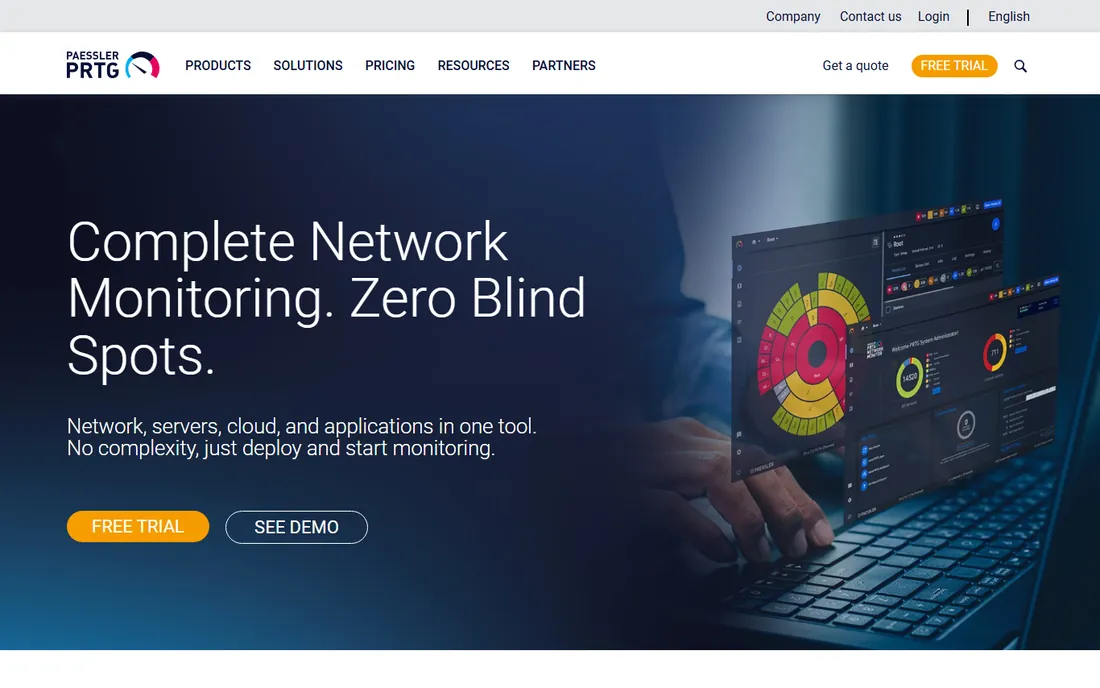
PRTG, from Paessler, is the pragmatic pick. Auto-discovery finds your devices, preconfigured sensors start monitoring immediately, and the pricing page publishes every tier: PRTG 500 at $200 per month billed annually covers about 50 devices, scaling up to PRTG 10000. The freeware edition monitors 100 sensors free forever, which suits small sites and labs. Bandwidth, uptime, server health and application sensors all live in one console with alerting and reporting.
The honest catch is the sensor math. Everything is a sensor, and a busy switch consumes many, so license sizing needs thought. The core server runs on Windows, which can complicate shops standardized on Linux. For mid-size IT teams that want monitoring running this week at a known price, PRTG's transparency is refreshing.
What we like- Published pricing from $200 per month with a free 100-sensor edition
- Auto-discovery with over 200 prebuilt sensor types
- Runs on a single server with fast time to value
Watch out for- Sensor-based licensing needs careful planning as estates grow
- The core server is Windows-based, which matters for Linux-standard shops
#4
Zabbix
Best for: Enterprises wanting free, scalable open-source monitoring
Visit zabbix.com
Starting priceFree (open source)
Free planYes
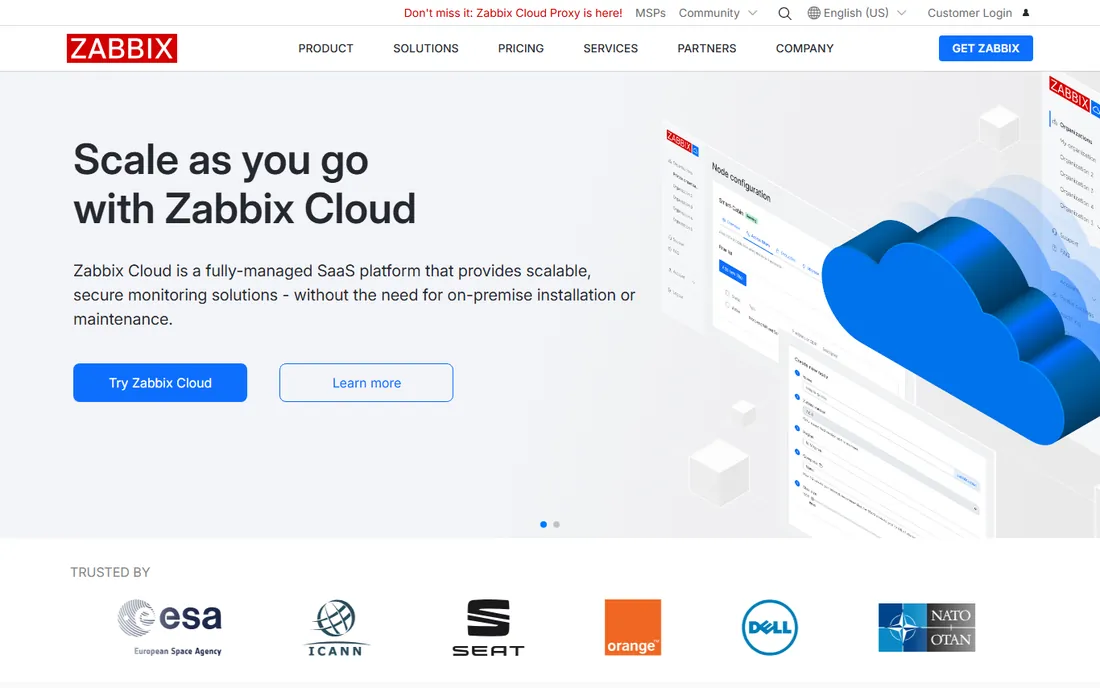
Zabbix is the open-source enterprise standard. It monitors networks, servers, cloud and applications with agents or agentless protocols, offers distributed monitoring for global estates, and charges nothing per device, which makes it the cheapest option at scale by a wide margin. The vendor sells support and training rather than licenses, so the software itself stays free. Large telcos, banks and public-sector organizations run it across tens of thousands of devices.
The catch is the labor. Zabbix rewards expertise and punishes dabbling: templates, triggers, proxies and upgrades need someone who knows the system. The UI has improved but still trails commercial polish. If you have the engineers and want to eliminate license costs permanently, Zabbix is the answer. If you do not, the commercial tools below buy back that time.
What we like- No license fees and no per-device charges at any scale
- Agent and agentless monitoring with flexible alerting and strong visualization
- Proven in very large enterprise and service-provider deployments
Watch out for- Setup, tuning and upgrades demand real expertise
- The interface and configuration model feel dated next to commercial SaaS
Starting priceFrom $245 (per vendor site)
Free planNo (30-day free trial)

ManageEngine OpManager prices the way network engineers think: per device, with all its interfaces, ports and metrics included. The vendor's own comparison materials put the starting price at $245, undercutting per-element and per-sensor rivals on paper. Discovery and classification run across 11,000-plus templates, and the platform covers fault, performance, traffic analysis and server monitoring. Add-ons extend into configuration management, firewall analysis and IP address management.
The honest catch is the add-on stack. The base price covers the core; the full picture that rivals SolarWinds needs the extras. The console is dense, and first-time admins face a learning curve. For cost-conscious enterprises that want commercial support without per-metric metering, OpManager's device licensing is the most predictable model here.
What we like- Device-based licensing covers all interfaces and sensors on the device
- Over 11,000 device templates with automated discovery
- Vendor-published starting price of $245
Watch out for- Advanced features arrive as add-ons that raise the total
- The interface packs in a lot and takes learning
#6
Nagios XI
Best for: Teams standardizing on the Nagios ecosystem
Visit nagios.com
Starting priceSee website
Free planYes (free tier; Nagios Core open source)
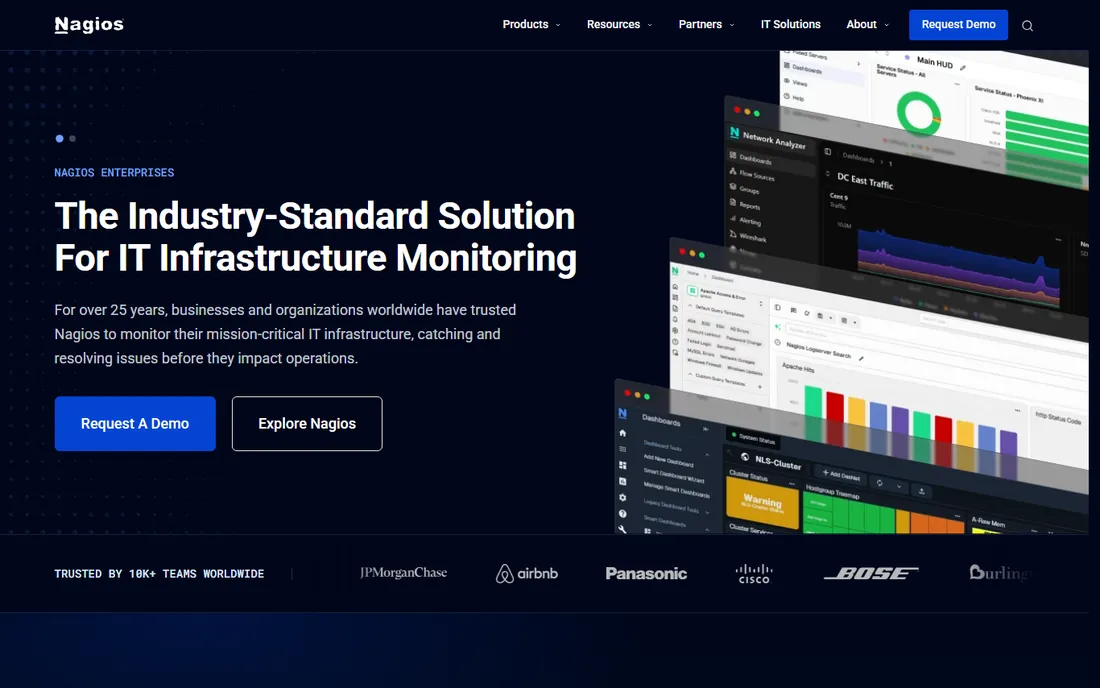
Nagios XI is the commercial distribution of the monitoring tool that defined the category. The plugin architecture means virtually anything can become a check, and the community Exchange holds thousands of them. Licensing is by node count with terms fixed at purchase, so costs do not climb with metric volume, and because it runs on your hardware, regulated and air-gapped environments stay compliant. A free tier and the open-source Nagios Core lower the entry barrier.
The catch is operational. Nagios rewards the team that learns it and frustrates the team that will not: configuration, while wizard-assisted in XI, still demands understanding of hosts, services and contacts. The UI is functional rather than beautiful. For organizations already invested in Nagios knowledge, XI is the supported, enterprise-ready path.
What we like- The industry-standard monitoring engine with thousands of community plugins
- Node-based licensing fixed at purchase, not metered by data volume
- Runs fully on your own infrastructure including air-gapped sites
Watch out for- Configuration is file- and wizard-driven rather than truly simple
- The interface shows its age and the learning curve is real
Starting priceSee website
Free planNo (free trial)
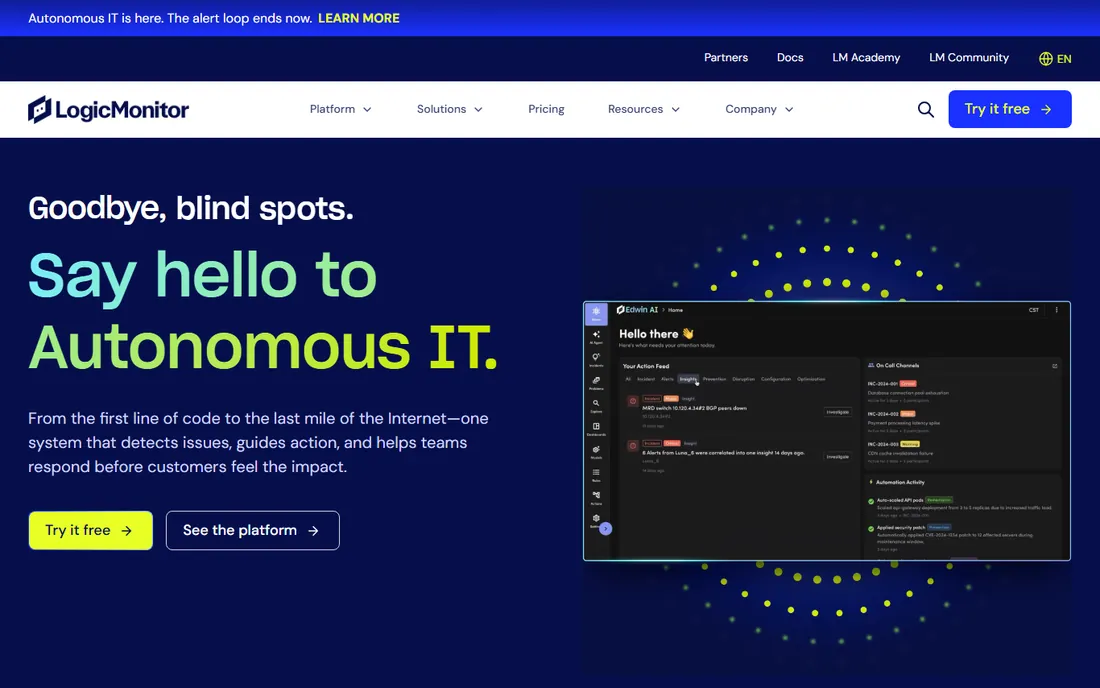
LogicMonitor is the SaaS answer to enterprise monitoring. Collectors sit in your environment while the platform runs in the cloud, auto-discovery builds the inventory, and thousands of LogicModules cover devices, cloud services, databases and applications out of the box. Edwin AI adds correlation and noise reduction on top. There is no server to size, patch or back up, which is the whole appeal for lean teams managing hybrid estates.
The honest catch is the bill and its opacity. Core platform pricing is not published with a headline number, and per-device costs compound across large networks. Cloud-heavy estates also pay attention to data-source polling costs. For enterprises that want monitoring without infrastructure and will pay SaaS rates for it, LogicMonitor's automation is excellent.
What we like- Fully SaaS with automated discovery and zero on-prem infrastructure
- Over 3,000 prebuilt integrations and modules
- AIOps features for alert correlation and anomaly detection
Watch out for- No public starting price for the core platform
- Per-device economics add up fast in large estates
Starting priceSee website (per-device subscription)
Free planNo (free trial)
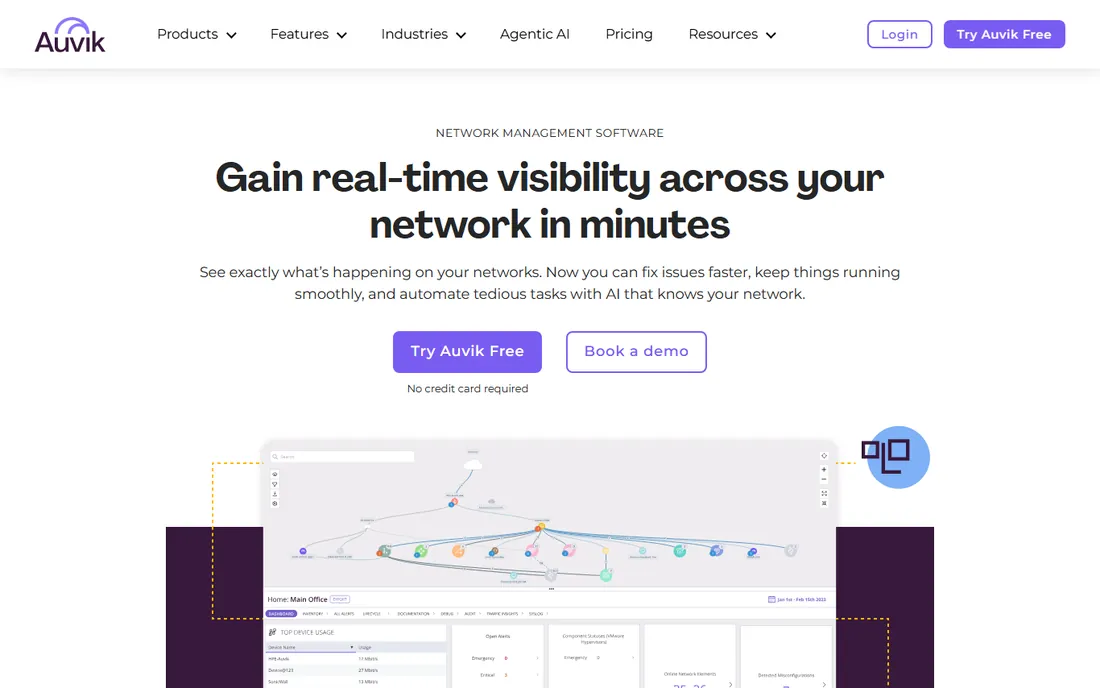
Auvik's demo moment is the map. Install the collector, and the platform discovers the network and draws a live topology that updates as things change, with traffic analysis, config backups and alerting on top. Deployment is cloud-based and genuinely fast, and the interface is simple enough for junior techs while staying useful for senior engineers. Billing is per managed device on subscription, with a free trial requiring no credit card.
The catch is the quote wall: no public pricing, so budgeting means a sales call. Auvik also grew up serving MSPs and mid-market IT, and the very largest enterprises may find the depth thinner than SolarWinds or Datadog. For organizations that want the network documented and monitored without a project plan, Auvik's automation-first approach is the fastest path.
What we like- Automated network mapping that stays current as the network changes
- Cloud-based deployment with visibility in under an hour for most networks
- Automated config backups and 700-plus vendor device support
Watch out for- Per-device subscription pricing with no public numbers
- The sweet spot is mid-market and MSP, less proven at the largest enterprise scale
Starting priceFrom $29/host/month (Infrastructure Monitoring)
Free planNo (free trial)
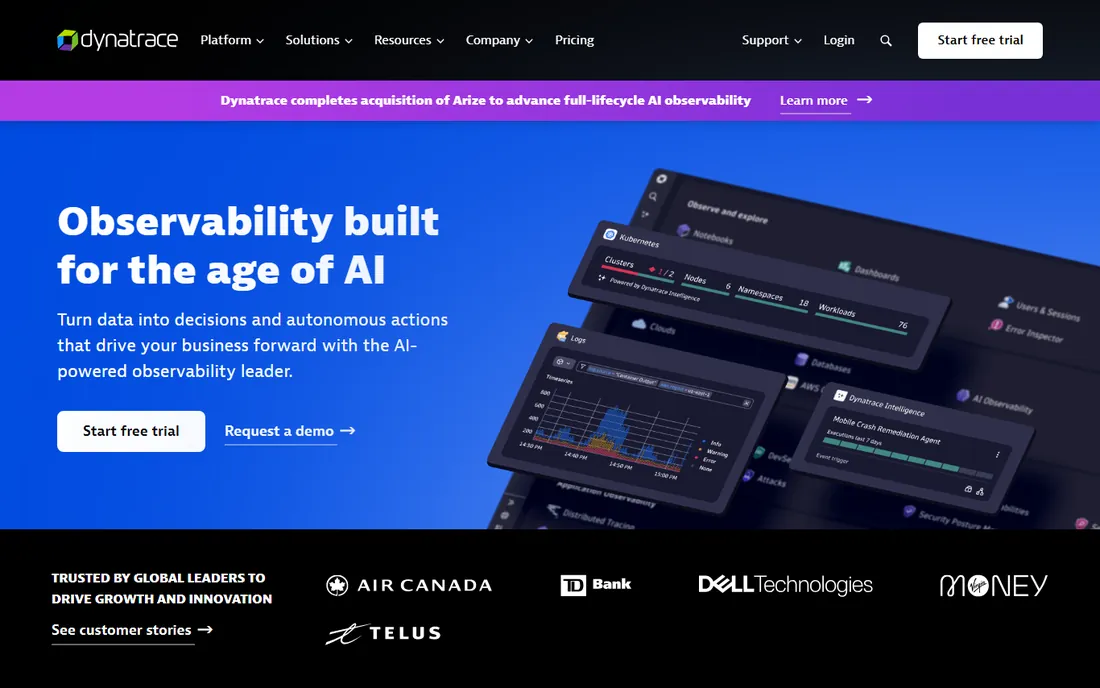
Dynatrace brings AI-first observability to the network question. OneAgent auto-discovers hosts, services and dependencies, and the Davis AI engine correlates problems to root causes instead of firing isolated alerts. Infrastructure monitoring starts at $29 per host per month billed hourly, with full-stack monitoring above that. For enterprises where network issues surface as application problems, the automatic causality is the differentiator: the platform tells you the why, not just the what.
The honest catch is pricing complexity. The consumption model spans hosts, memory, sessions and data, and finance teams need the pricing page open during planning. It is also priced for enterprises that use the full platform; network-only buyers pay for breadth they may not need. For large organizations standardizing on AI-driven operations, Dynatrace is the premium pick.
What we like- Davis AI delivers automated root-cause analysis across infrastructure, apps and network
- Published pricing from $29 per host per month for infrastructure monitoring
- Single-agent deployment with automatic discovery
Watch out for- Consumption-based pricing gets complex across capabilities
- Costs scale steeply in large dynamic environments
Agent-based vs. agentless: a practical split
Network gear does not run agents. Switches, routers and firewalls expose SNMP, NetFlow and APIs, so every tool here monitors them agentlessly. The split matters for servers and cloud: Zabbix, Nagios and PRTG use agents or agentless protocols you choose per device, while Datadog and Dynatrace deploy their own agents as the standard path.
The practical rule: if your estate is mostly network hardware, agentless SNMP tools (SolarWinds, PRTG, OpManager, Auvik, LogicMonitor) fit naturally. If servers, containers and cloud services dominate, the agent-based observability platforms (Datadog, Dynatrace) give richer data. Mixed estates end up with a primary platform plus a specialist, which is why integration lists matter.
What enterprise network monitoring should cost
There are three pricing religions here. Per-device or per-node (OpManager from $245, Auvik per managed device, Nagios XI by node) is the most predictable: count devices, multiply, done. Per-sensor or per-element (PRTG from $200 per month, SolarWinds by element) rewards careful scoping and punishes sprawl. Consumption-based (Datadog from $7 per device per month, Dynatrace from $29 per host per month) scales smoothly but needs active cost management.
Free exists at the floor: Zabbix costs nothing but engineering time, and PRTG's freeware covers 100 sensors. The honest enterprise budget for a mid-size network lands in the low thousands per year for commercial tools, scaling with device count. Whatever the model, get the renewal terms in writing: the second-year price is where monitoring contracts traditionally bite.
How we chose
We verified each vendor's homepage and pricing page on 2026-10-14, and we only report prices the vendor itself publishes; everything else is marked See website. We compared discovery, alerting, flow and path analysis, dashboarding, scalability architecture and API depth against public reviews on G2, Capterra and Reddit threads from network engineers. Company-size fit set the order: established enterprise suites first, transparent mid-market tools next, the AI observability platforms last.
Frequently asked questions
How much does enterprise network monitoring cost?
Published entry points: PRTG from $200 per month, Datadog Network Device Monitoring from $7 per device per month, Dynatrace from $29 per host per month, OpManager from $245. SolarWinds, LogicMonitor, Auvik and Nagios XI are quote-based. Zabbix is free. Expect low thousands per year for a mid-size commercial deployment.
Should we use open-source or commercial monitoring?
Open source (Zabbix, Nagios Core) eliminates license fees but demands engineering time for setup, tuning and upgrades. Commercial tools buy back that time with support, polished UIs and faster deployment. The breakeven usually favors commercial for small teams and open source for large estates with dedicated staff.
What is the difference between SNMP monitoring and flow analysis?
SNMP polls devices for health metrics like CPU, memory, interface status and bandwidth counters. Flow analysis (NetFlow, sFlow, IPFIX) records who talks to whom, revealing top talkers and traffic patterns. SNMP tells you a link is saturated; flows tell you what is saturating it. Enterprise tools do both.
Can these tools monitor cloud and hybrid networks?
Yes, with varying depth. Datadog and Dynatrace are strongest in cloud-native environments. SolarWinds, PRTG, OpManager, LogicMonitor and Auvik cover hybrid estates with cloud integrations alongside on-prem SNMP. Zabbix and Nagios handle both with the right configuration and plugins.
Do we still need network monitoring if we have APM?
Yes. APM shows application performance; network monitoring shows the infrastructure underneath it. When an app slows down, APM blames the network and the network team needs its own data to answer. The best setups correlate both, which is exactly what the observability platforms sell.
Sources we checked (13)
- https://www.solarwinds.com/
- https://datadoghq.com/
- https://paessler.com/
- https://www.zabbix.com
- https://manageengine.com/
- https://nagios.com/
- https://logicmonitor.com/
- https://www.auvik.com
- https://dynatrace.com/
- https://www.datadoghq.com/pricing/
- https://www.paessler.com/pricing
- https://www.g2.com/categories/network-monitoring
- https://www.capterra.com/network-monitoring-software/
Is your product missing or out of date?
We review this list regularly. Vendors can request a listing, send updated pricing or ask about featured placement.

Shihab Mia · Founder, Rankite
Shihab has spent more than a decade helping SaaS and e-commerce brands grow through search. He writes Rankite's software buying guides from pricing pages, documentation and public user reviews. More about Shihab.