How we make this list: we compare pricing pages, product documentation and public user reviews. Rankite is independent; if a vendor ever pays for a featured spot, that listing is clearly labeled Partner.
Key takeaways
- Enterprise IPAM is quote-only: SolarWinds, Infoblox, BlueCat and EfficientIP price by IPs or scope, so budget with a sales quote.
- Open source covers the basics free: phpIPAM and NetBox (self-hosted) handle subnet and address tracking at zero license cost.
- ManageEngine OpUtils at $138 a year is the cheapest commercial option with a free version, aimed at SMB networks.
- Device42 at $1,449 for up to 1K IPs bridges IPAM with full IT discovery for hybrid infrastructure.
- Confirm DNS and DHCP integration during the trial: every tool here tracks IPv6, but DDI depth and automation vary between open source and enterprise tiers.
Quick comparison
| Tool | Best for | Starting price | Free plan |
|---|
 SolarWinds IP Address Manager SolarWinds IP Address Manager | Orion-based network shops | See website | Free trial |
 Infoblox Infoblox | Enterprise DDI at scale | See website | Free trial |
 ManageEngine OpUtils ManageEngine OpUtils | SMBs wanting cheap IPAM | $138/year | Free plan |
 BlueCat BlueCat | Enterprise DDI platform | See website | Free trial |
 EfficientIP EfficientIP | DNS-DHCP-IPAM with security | See website | Free trial |
 NetBox NetBox | Open-source source of truth | Free (self-hosted) | Free plan |
 phpIPAM phpIPAM | Free lightweight IPAM | Free (open source) | Free plan |
 Device42 Device42 | IPAM plus IT discovery | $1,449 (Core, up to 1K IPs) | Free trial |
Is your product missing or out of date?
We review this list regularly. Vendors can request a listing, send updated pricing or ask about featured placement.
The best IPAM software
Starting priceSee website
Free planFree trial
SolarWinds IP Address Manager is priced by managed IP count with a free trial available; published list pricing has shifted over the years, so current figures come from a sales quote. It automatically discovers IPv4 addresses, supports IPv6 subnet creation through a step-by-step wizard, and continuously scans managed subnets via ICMP, SNMP and neighborhood scanning, logging MAC addresses, hostnames and address status (reserved, transient, in use, available) with full history.
The Orion integration is the draw. If you already run SolarWinds NPM, IPAM slots into the same web console with shared alerting, reporting and API access, and the free IP Address Tracker tool gives small teams a starting point. Conflict detection and historical IP records speed troubleshooting.
The honest caveats: pricing is opaque and the platform is Windows-server centric; it is overkill for a single subnet. For SolarWinds shops that want IPAM without a second vendor, it is the natural add-on.
What we like- Tight Orion integration
- Automated scanning and alerts
- IPv6 support
Watch out for- Quote-based pricing
- Windows-centric
- Heavy for small networks
Starting priceSee website
Free planFree trial
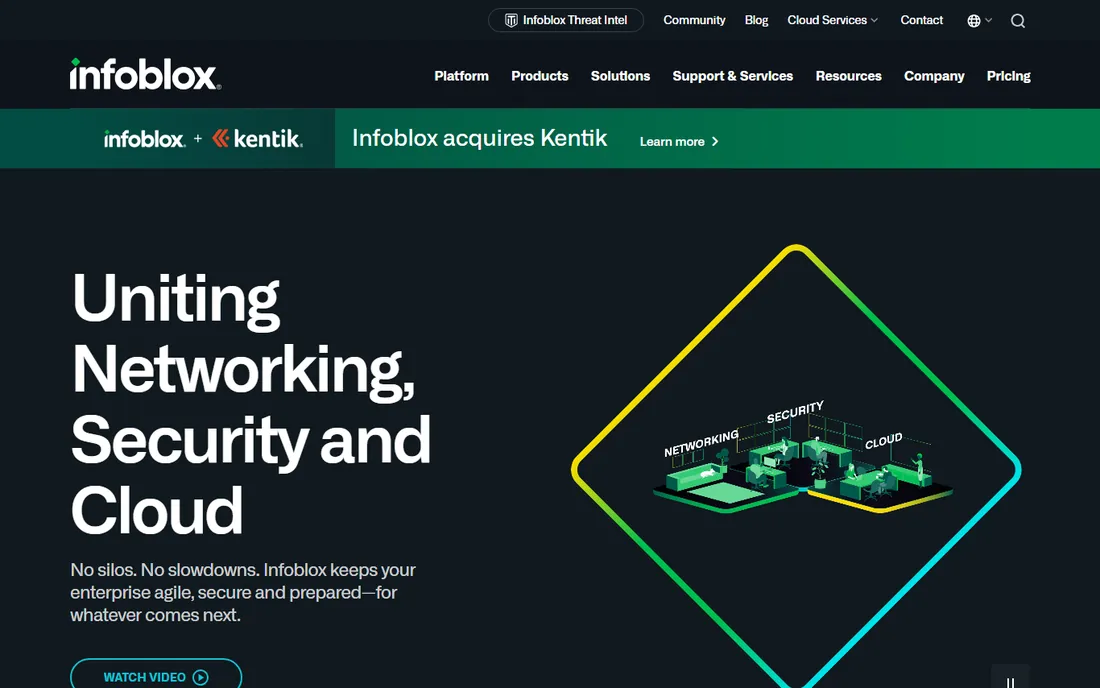
Infoblox is quote-based, sold as NIOS appliances or the Universal DDI SaaS suite with a free trial available. Its Universal IPAM provides a single control point for IP addresses across on-premises networks, AWS, Azure and Google Cloud, unified with DNS and DHCP management, threat intelligence and automation via Terraform, Ansible and a full API.
The enterprise pedigree is unmatched. Global organizations run their entire DDI on Infoblox grids, with features like IP discovery, DNS security, cloud integrations and identity mapping that smaller tools cannot touch. NIOS-X as a Service removes the appliance footprint for distributed sites.
The honest reality: this is premium enterprise software with enterprise pricing and complexity; small teams should look elsewhere. For organizations where IP addressing underpins the business, Infoblox is the reference standard.
What we like- DDI market leader
- Universal DDI for hybrid cloud
- Deep automation
Watch out for- Enterprise pricing
- Complex licensing
- Needs skilled admins
Starting price$138/year
Free planFree plan

ManageEngine OpUtils starts at $138 per year with a free version and free trial available. The IP Address Manager module covers subnet visualization, IP scanning, allocation workflows, Active Directory integration, rogue device detection and DHCP scope monitoring, alongside switch port mapping and more than 30 network utilities (ping, traceroute, port scanner, SNMP tools).
The value is hard to beat. SMB network admins get real IPAM plus switch port mapping and a troubleshooting toolkit for less than most tools charge per month. Rogue detection integrated with AD automatically flags unauthorized devices.
The honest caveats: the interface shows its age; initial discovery and setup take time; and it is Windows-server oriented. For budget-conscious teams that need commercial IPAM without enterprise pricing, OpUtils is the pragmatic pick.
What we like- Cheapest commercial IPAM
- Free version
- 30-plus network tools included
Watch out for- Interface feels dated
- Setup takes effort
- Windows-oriented
Starting priceSee website
Free planFree trial

BlueCat is quote-based with a free trial available, offering two paths: Integrity, a full appliance-based DDI platform with Address Manager at its core, and Micetro, an overlay that manages existing DNS and DHCP infrastructure without replacement. Both unify DNS, DHCP and IPAM with a RESTful OpenAPI, role-based access and cloud discovery.
The flexibility suits enterprises mid-modernization. Micetro gives immediate control over fragmented Microsoft and BIND infrastructure without rip-and-replace; Integrity consolidates everything onto one resilient hub-and-spoke platform with automated failover for IPv4 and IPv6. One appliance can manage thousands of DNS/DHCP servers.
The honest reality: quote-only enterprise pricing and a sales-led process; pure IPAM needs do not require this much platform. For enterprises unifying DDI across hybrid estates, BlueCat is Infoblox's strongest rival.
What we like- Integrity and Micetro options
- Strong automation API
- Resilient architecture
Watch out for- Quote-only
- Enterprise sales cycle
- Heavier than pure IPAM
Starting priceSee website
Free planFree trial

EfficientIP's SOLIDserver is quote-based with a free trial available, unifying DNS, DHCP and IPAM with a security-first design: DNS firewall, threat intelligence and encrypted communications are built into the appliances and virtual editions. It targets organizations where DDI is a security control plane, not just plumbing.
The security angle differentiates it. Where competitors bolt security onto DDI, EfficientIP designs around it, with features for DNS data protection, adaptive countermeasures and compliance reporting. It has strong traction with European enterprises, telcos and governments.
The honest caveats: pricing is opaque and the US footprint is smaller than Infoblox or BlueCat; the appliance heritage shows. For security-conscious organizations that want DDI with defenses built in, EfficientIP deserves the shortlist.
What we like- Security-hardened DDI
- SOLIDserver appliances
- Strong European presence
Watch out for- Quote-based
- Smaller US footprint
- Appliance-centric
Starting priceFree (self-hosted)
Free planFree plan

NetBox is free open source under Apache 2.0 for self-hosting, with NetBox Cloud (hosted, with intro, standard and enterprise plans) for teams that want it managed. It combines IPAM (aggregates, prefixes, IP ranges, VLANs, VRFs, ASNs) with full DCIM (sites, racks, devices, cabling, circuits), serving as the network source of truth with a powerful REST API and plugin architecture.
The automation story is why network engineers love it. NetBox models the intended state of the network and feeds provisioning, monitoring and config management through its API, replacing spreadsheets with a versioned, extensible database. Tens of thousands of enterprise installs and a huge integration ecosystem back it.
The honest caveats: you host and maintain it (or pay for Cloud); it does not serve DNS or DHCP itself; and it rewards teams with automation skills. For NetDevOps teams that want a free, extensible source of truth, NetBox is the standard.
What we like- Free and open source
- IPAM plus DCIM
- API-first for automation
Watch out for- Self-hosting burden
- Not a DHCP/DNS server
- Needs NetDevOps skills
Starting priceFree (open source)
Free planFree plan
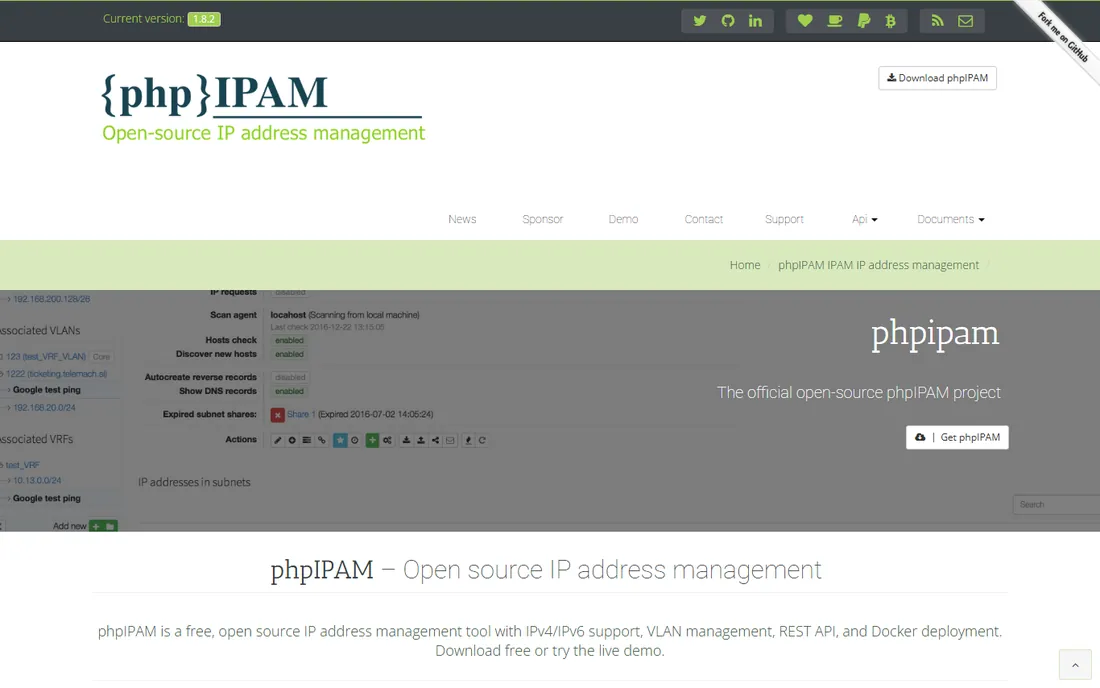
phpIPAM is free open source software for IP address management, covering IPv4 and IPv6 subnets, address tracking, VLAN and VRF management, user permissions and basic discovery. It installs on a standard LAMP stack in minutes and runs happily for small to mid-size networks.
The simplicity is the point. Teams that just need to stop tracking IPs in spreadsheets get subnet visualization, address status, search and API access without budget approval or vendor calls. It has served the community for years as the go-to free IPAM.
The honest reality: community support only, a utilitarian interface, and no DNS/DHCP serving or enterprise automation. For small networks that need free IPAM today, phpIPAM remains the fastest answer.
What we like- Completely free
- Quick to deploy
- IPv4 and IPv6
Watch out for- Community support only
- Basic UI
- Limited enterprise features
Starting price$1,449 (Core, up to 1K IPs)
Free planFree trial
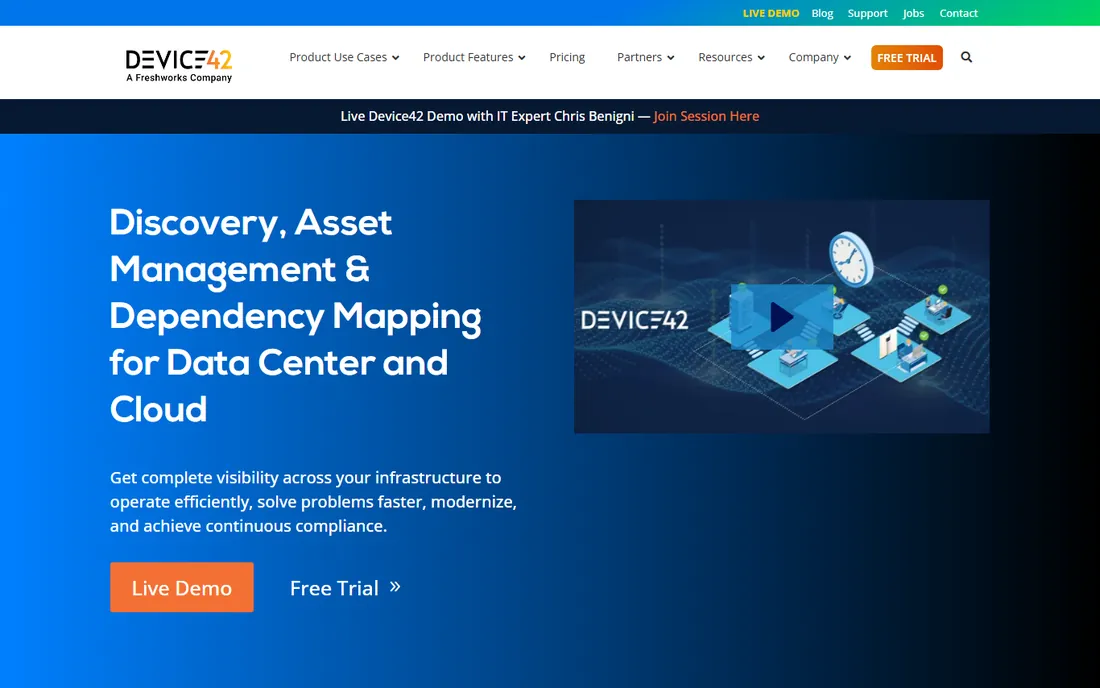
Device42, now part of Freshworks, lists Core from $1,449 for 1 to 100 devices and up to 1K IPs, scaling through tiers to 25K-plus IPs, with a free trial available. Its agentless discovery continuously maps infrastructure, applications and dependencies across data centers and cloud, with IPAM built into a full CMDB rather than standing alone.
The discovery angle sets it apart. Instead of manually maintaining IP records, Device42 finds devices, tracks their addresses and maps relationships automatically, which keeps IPAM accurate in dynamic hybrid environments. SaaS deployment pricing is negotiated per customer.
The honest caveats: $1,449 is a lot if you only want IPAM; the platform's breadth means a learning curve; and pure-play IPAM tools are simpler. For IT teams that want IPAM inside a living map of their infrastructure, Device42 earns its price.
What we like- Agentless auto-discovery
- IPAM plus CMDB
- Hybrid IT coverage
Watch out for- $1,449 entry is steep for IPAM alone
- Broader than pure IPAM
- Learning curve
What to compare before you buy
IPAM-only versus DDI suites
Pure IPAM tools (phpIPAM, NetBox, OpUtils, SolarWinds IPAM) track addresses; DDI suites (Infoblox, BlueCat, EfficientIP) unify DNS, DHCP and IPAM with security and automation. Buy the suite if DNS and DHCP sprawl is your problem; buy IPAM if spreadsheets are.
Discovery and automation depth
The value gap is automation: agentless discovery (Device42), cloud sync (Infoblox, BlueCat) and API-first sources of truth (NetBox) keep records accurate without manual entry. Manual IPAM tools decay; automated ones stay trustworthy.
How we chose
We compared IPAM tools across the spectrum from free open source to enterprise DDI, prioritizing tools that are live today with documented capabilities. Quote-only enterprise platforms are marked "See website". We did not run hands-on trials; this guide reflects each vendor's published feature set and pricing.
Frequently asked questions
What is IPAM software?
IP address management software tracks, plans and administers IP address space: subnets, allocations, DHCP scopes, DNS records and device assignments. It replaces spreadsheets with a searchable, auditable system of record for who owns which address.
What is the best free IPAM software?
phpIPAM is the simplest free open-source IPAM; NetBox is the most powerful, adding DCIM and automation APIs. ManageEngine OpUtils offers a free version of its commercial tool. All three beat spreadsheets for networks of any size.
How much does enterprise IPAM cost?
Enterprise DDI from Infoblox, BlueCat and EfficientIP is quote-based and typically runs into five figures annually for mid-size networks. SolarWinds IPAM prices by managed IP count. Device42 starts at $1,449 for up to 1K IPs. Budget with a vendor quote at your actual IP count.
Do I need IPAM if I have DHCP?
Yes, for anything beyond a trivial network. DHCP assigns addresses dynamically, but IPAM tracks the plan: which subnets exist, what is reserved, what is static, and who owns what. Without IPAM, troubleshooting address conflicts and planning growth becomes guesswork.
What is the difference between IPAM and DDI?
IPAM manages IP address space. DDI unifies DNS, DHCP and IPAM into one managed platform with shared data, automation and security. IPAM is a component; DDI is the full stack of core network services.
Can IPAM handle IPv6?
All the tools here support IPv6: SolarWinds, Infoblox, BlueCat, EfficientIP, NetBox, phpIPAM, OpUtils and Device42 all track IPv6 prefixes and addresses. Confirm prefix planning and DHCPv6 support if IPv6 is in active deployment.
Sources we checked (8)
- https://www.solarwinds.com/ip-address-manager/pricing
- https://www.infoblox.com/products/universal-ddi-management/
- https://www.manageengine.com/products/oputils/
- https://bluecatnetworks.com/products/integrity/
- https://efficientip.com/products/solidserver/
- https://netboxlabs.com/products/netbox/
- https://phpipam.net/
- https://www.device42.com/device42-pricing/
Is your product missing or out of date?
We review this list regularly. Vendors can request a listing, send updated pricing or ask about featured placement.

Shihab Mia · Founder, Rankite
Shihab has spent more than a decade helping SaaS and e-commerce brands grow through search. He writes Rankite's software buying guides from pricing pages, documentation and public user reviews. More about Shihab.