How we make this list: we compare pricing pages, product documentation and public user reviews. Rankite is independent; if a vendor ever pays for a featured spot, that listing is clearly labeled Partner.
Key takeaways
- MLflow and Kubeflow cost nothing to run and suit teams that want full control of their infrastructure.
- Weights & Biases, Neptune.ai, and Comet focus on experiment tracking and model registries, with free plans that small teams can actually use.
- ClearML offers the broadest open-core full-lifecycle option, starting at $15 per user per month.
- SageMaker and Vertex AI make sense when your cloud is already AWS or Google Cloud, but their usage-based pricing needs careful watching.
- Pick tracking-first if your pain is lost experiments; pick a full-lifecycle suite if your pain is getting models into production.
Quick comparison
| Tool | Best for | Starting price | Free plan |
|---|
 Weights & Biases Weights & Biases | collaborative experiment tracking | See website | Yes |
 MLflow MLflow | open-source experiment tracking and model registry | $0 (open source) | Yes |
 Neptune.ai Neptune.ai | high-scale metadata tracking | $49/month (Team plan) | Yes |
 Comet Comet | experiment tracking plus LLM observability | $19/user/month (Pro) | Yes |
 ClearML ClearML | open-core full-lifecycle MLOps | $15/user/month (Pro) | Yes |
 Amazon SageMaker Amazon SageMaker | end-to-end ML on AWS | See website (usage-based) | Free trial |
 Kubeflow Kubeflow | DIY MLOps on Kubernetes | $0 (open source) | Yes |
 Google Cloud Vertex AI Google Cloud Vertex AI | managed ML on Google Cloud | See website (usage-based) | Free trial |
Is your product missing or out of date?
We review this list regularly. Vendors can request a listing, send updated pricing or ask about featured placement.
#1
Weights & Biases
Best for: collaborative experiment tracking
Visit wandb.ai
Starting priceSee website
Free planYes
If your data scientists already know one name in this space, it is probably Weights & Biases. The platform is the default choice for teams that log many training runs and need to compare them, share charts, and reproduce results without building their own tooling. Its dashboards are genuinely pleasant to use, and the integration libraries for PyTorch, TensorFlow, and other frameworks take only a few lines of code to set up.
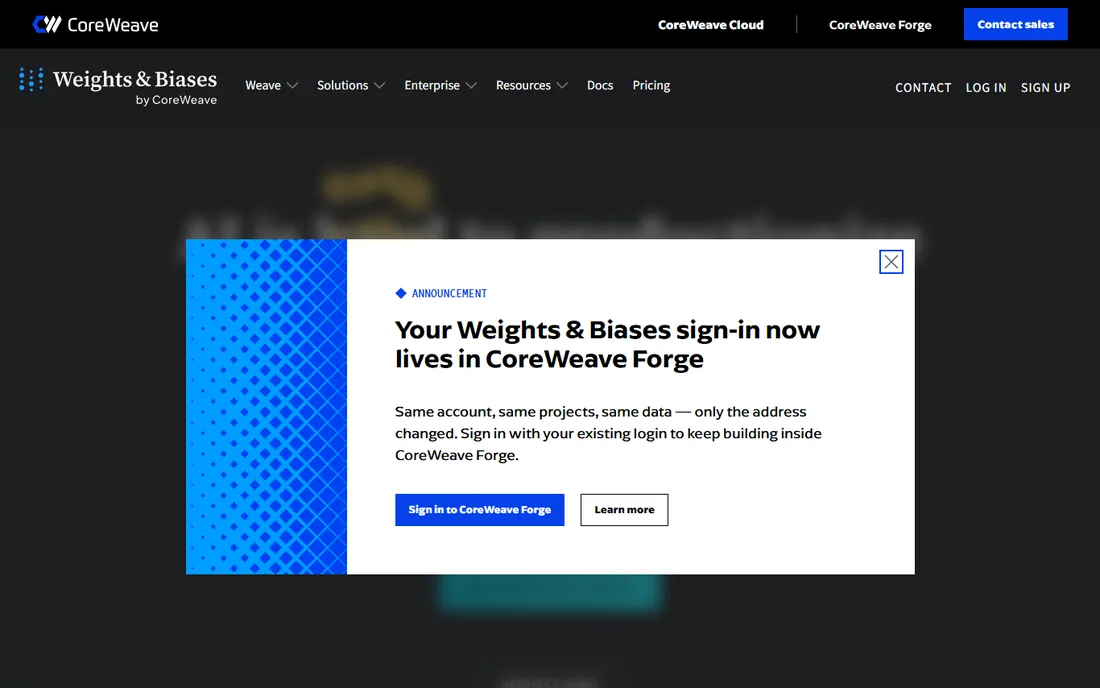
Sweeps, the built-in hyperparameter search, is a strong differentiator. It turns a weekend of manual grid search into a scheduled sweep with visualization of which parameters matter. Model registry features let you promote winning versions to staging and production with an audit trail. The product is now part of CoreWeave, which has not changed how teams use it day to day.
The catch is cost transparency. Weights & Biases does not publish its cloud pricing, so you cannot budget from the website; you need to talk to sales. The free plan is generous for individual experimentation but limited enough that a growing team will need a paid plan sooner than it expects.
What we like- Polished dashboards and run comparison
- Built-in Sweeps hyperparameter search
- Deep integrations with popular frameworks
Watch out for- Cloud pricing is not published
- Free tier has usage limits
- Advanced governance costs more
#2
MLflow
Best for: open-source experiment tracking and model registry
Visit mlflow.org
Starting price$0 (open source)
Free planYes
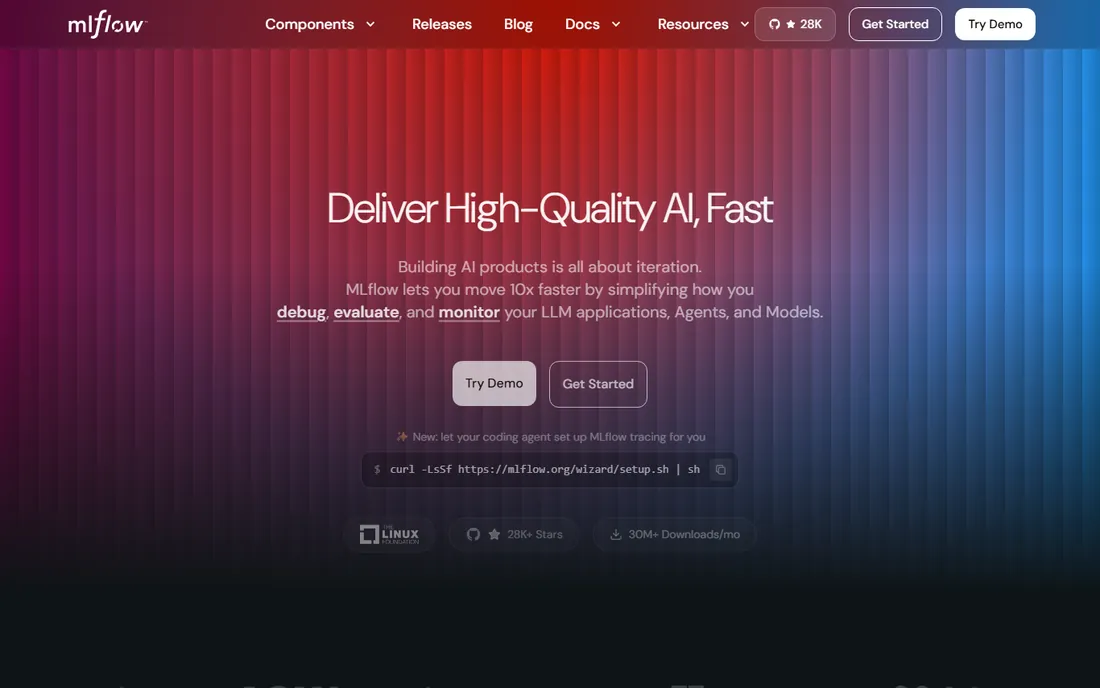
For teams that would rather own their stack than rent it, MLflow is the default open-source answer. It covers experiment tracking, a model registry, and model deployment metadata under one Apache-licensed roof. You can log parameters, metrics, and artifacts with a few lines of Python, then browse runs in a local or self-hosted interface.
The ecosystem is MLflow's real strength. Nearly every framework, cloud vendor, and third-party tool integrates with it, and Databricks offers a managed MLflow as part of its platform if you later want hosting without building it yourself. Because it is open source, there is no seat licensing, no usage metering, and no vendor lock-in.
The honest catch is operational. MLflow gives you building blocks, not a finished service. Running a tracking server, a model registry database, and artifact storage at team scale is your job. Small teams often start with MLflow and migrate to a managed tracker once the maintenance burden outweighs the savings.
What we like- Completely free and open source
- Tracking, registry, and deployment in one
- Enormous community and integration ecosystem
Watch out for- Basic interface compared with commercial tools
- You handle hosting, scaling, and maintenance
- Collaboration features are thin
Starting price$49/month (Team plan)
Free planYes
Neptune.ai takes a narrower bet than the full-lifecycle suites: it wants to be the best place your experiment metadata lives. The product is built for scale. Teams can log thousands of metrics per run, including per-layer losses and gradients for foundation-model training, then search and visualize them without the interface slowing down. That focus has earned it users training very large models.
Enterprise teams get features that matter in regulated environments: audit logs, role-based access control, single sign-on, and a 99.9% uptime SLA. You can also self-host Neptune on your own infrastructure or private cloud via a Kubernetes Helm chart, which appeals to teams with strict data policies.
The trade-off is scope and price. Neptune is an experiment tracker and model registry, not a pipeline orchestrator or deployment platform, so you will pair it with other tools. And the $49 per month Team plan is a higher floor than several competitors, which matters for budget-conscious small teams.
What we like- Fast querying across thousands of experiments
- Deploys on your own infrastructure
- SOC 2 Type 2 and GDPR compliance
Watch out for- Team plan starts higher than most rivals
- Tracking-focused, not an end-to-end suite
- Smaller integration ecosystem
#4
Comet
Best for: experiment tracking plus LLM observability
Visit comet.com
Starting price$19/user/month (Pro)
Free planYes
Comet pairs classic experiment tracking with a newer angle: LLM observability through its Opik product line. On the MLOps side, you get run tracking, dataset management, a model registry, and production monitoring. On the GenAI side, Opik traces LLM calls, scores agent behavior, and helps you evaluate prompts. Few competitors cover both worlds in one account.
The free tier is genuinely usable: one team member, 100GB of storage, tracking, datasets, and the registry included. That makes Comet a reasonable way to try a full-featured platform before spending anything. The Pro plan at $19 per user per month adds team members, 1,500 training hours, and more storage.
Watch the metered limits. Training hours and storage overages are billed per unit, so heavy workloads can push costs above the sticker price. Teams that train infrequently will never notice; teams training daily should model their usage before committing.
What we like- Generous free tier with 100GB storage
- Model registry and production monitoring included
- Opik covers LLM tracing and evaluation
Watch out for- Pro plan caps training hours
- Interface carries a lot of features
- Enterprise pricing is custom-only
Starting price$15/user/month (Pro)
Free planYes
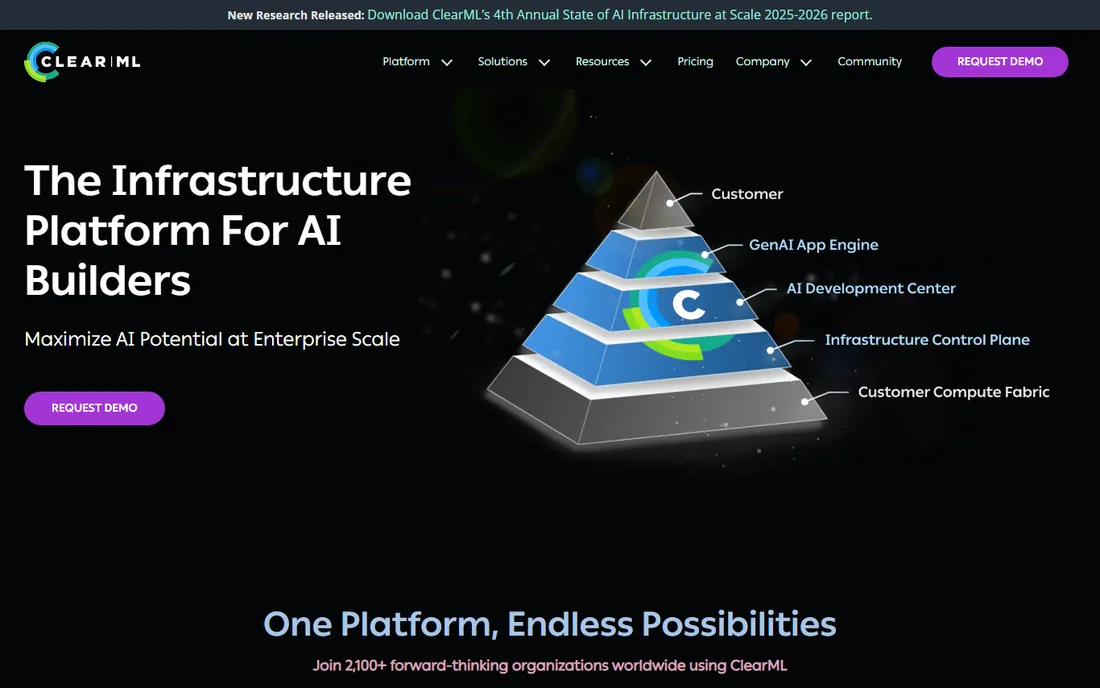
ClearML goes further than tracking. It is an open-core platform that aims to run your whole AI workflow: experiment management, pipeline orchestration, data versioning, remote execution, and model serving. If your complaint is that tracking alone does not get models to production, ClearML is built for exactly that gap.
The open-source core means you can self-host without paying, and the hosted cloud plan stays free for up to three team members with 100GB of storage. Experiment logging is close to automatic: attach ClearML to existing training code and it captures parameters, metrics, and artifacts with minimal changes.
The honest catch is complexity. ClearML is powerful but not simple, and its breadth means there is more to learn than with a pure tracker. Pricing for the hosted Pro plan starts at $15 per user per month, but add-ons and support are quoted separately, so confirm the full picture before budgeting.
What we like- Covers orchestration, serving, and data, not just tracking
- Free for teams up to 3 members
- Near-automatic experiment logging
Watch out for- Noticeable learning curve
- Hosted plan prices add-ons separately
- Documentation sometimes lags new features
Starting priceSee website (usage-based)
Free planFree trial
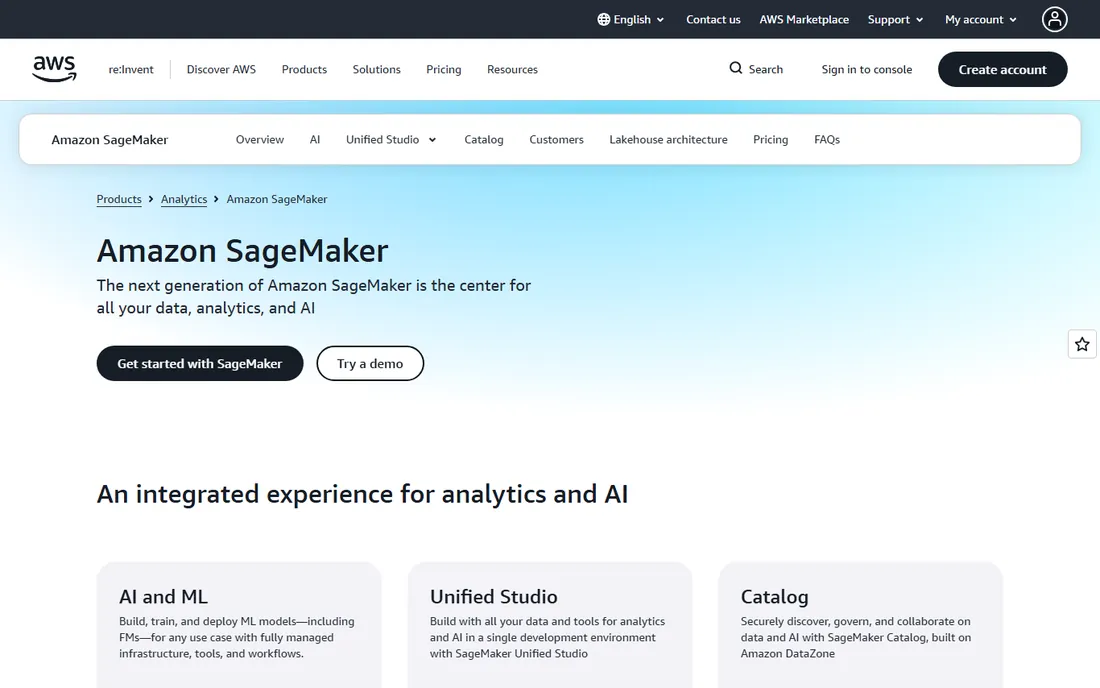
When your infrastructure already lives in AWS, SageMaker is the path of least resistance. It covers data preparation, training, tuning, deployment, and monitoring without leaving the AWS ecosystem. SageMaker Unified Studio adds a collaborative workspace, and integrations with S3 data lakes, Redshift warehouses, and Bedrock foundation models come naturally.
The managed angle is the real selling point. You do not maintain clusters or schedulers; you pick instance types and SageMaker handles the rest. For teams that already pay for AWS and understand its billing, adding ML capacity is straightforward.
The catch is the pricing model. SageMaker bills by instance-hours and feature usage across many services, which makes costs hard to predict and easy to overshoot. It also ties your ML workflow to AWS. Teams that want cloud portability or a simple seat-based price will be happier elsewhere.
What we like- Full lifecycle inside one AWS service
- Managed infrastructure and scaling
- Tight integration with S3, Bedrock, and other AWS services
Watch out for- Complex metered pricing
- Strong AWS lock-in
- Overkill for teams with simple needs
Starting price$0 (open source)
Free planYes
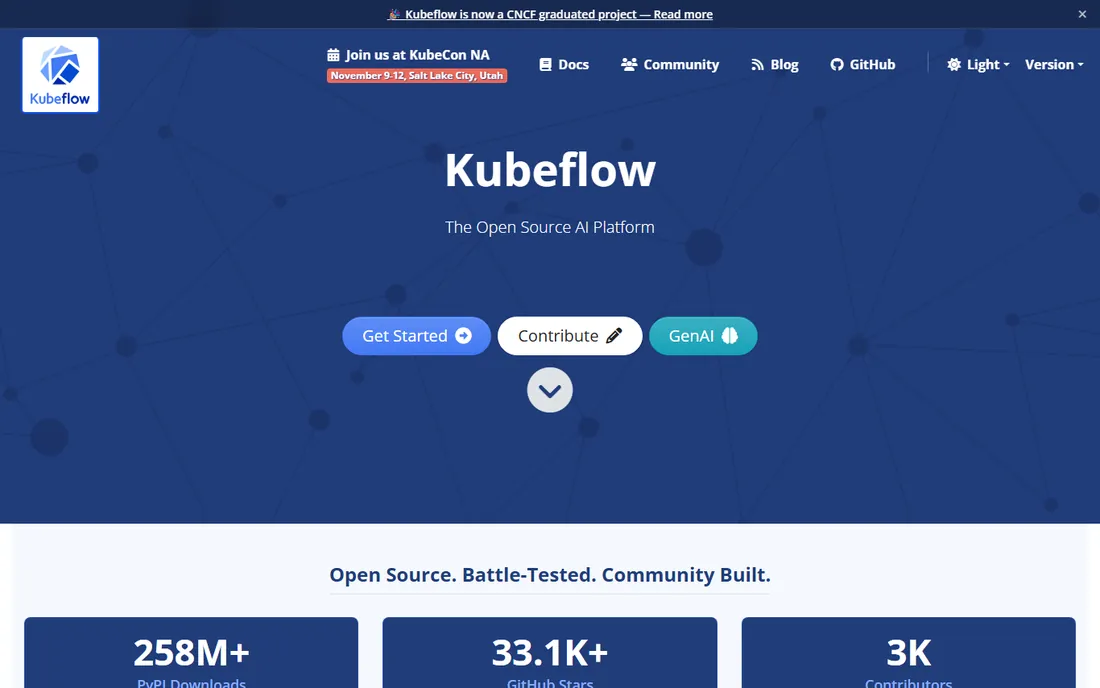
Kubeflow is not a product you buy. It is an open-source toolkit you assemble on Kubernetes, with modular components for notebooks, training, pipelines, hyperparameter tuning, serving, and a model registry. Because it is a CNCF graduated project with a broad contributor base, it is the most vendor-neutral option on this list.
The modular design is a genuine advantage. You do not have to adopt everything; a team can start with Kubeflow Pipelines for workflow automation and add Katib for hyperparameter tuning later. The same setup runs on a laptop, on-prem, or any cloud, which no managed service can match.
The honest catch is the operating burden. Kubeflow assumes you have Kubernetes skills on staff and a willingness to run infrastructure. For a small team without platform engineers, the learning curve and maintenance work can exceed the value. It shines for organizations already standardized on Kubernetes, not as a first MLOps step.
What we like- Vendor-neutral CNCF graduated project
- Modular components you can adopt piecemeal
- Portable across clouds and on-prem
Watch out for- Requires real Kubernetes expertise
- Heavy to operate
- Installation can be rough
Starting priceSee website (usage-based)
Free planFree trial
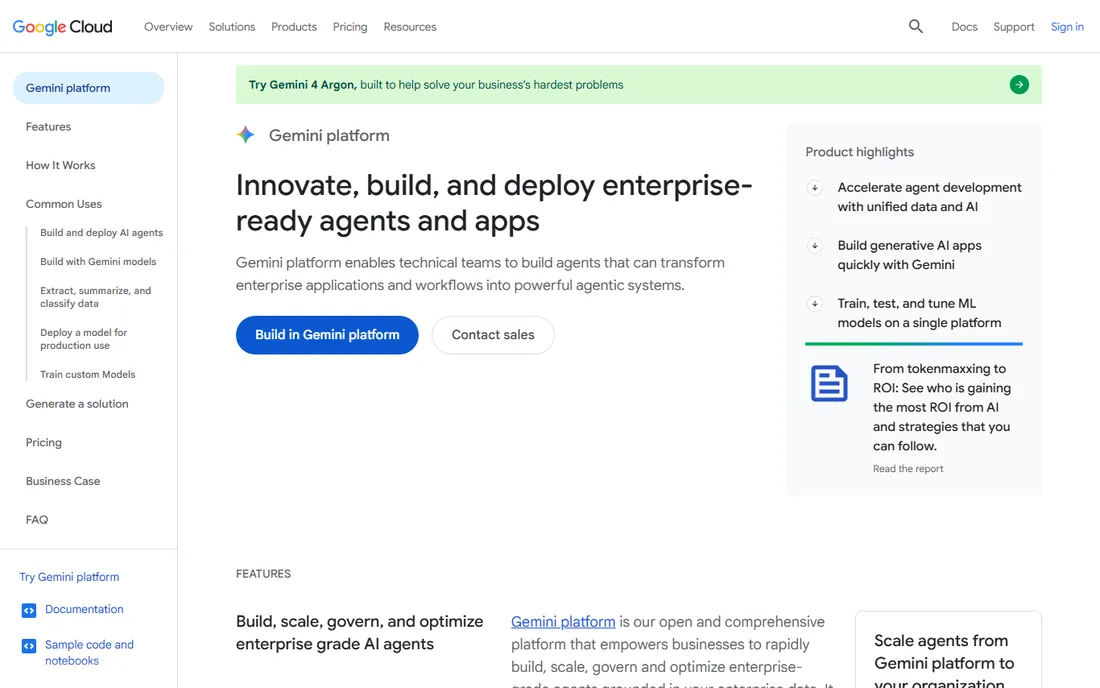
Google's answer to MLOps is Vertex AI, a managed platform that bundles custom training, deployment, pipelines, a model registry, and generative AI tooling under one roof. AutoML lets teams build models without deep ML expertise, while Model Garden offers pre-trained and open models to start from. New customers get $300 in credits to experiment.
For teams standardized on Google Cloud, the integration story is strong: data in BigQuery, training on managed infrastructure, and deployment with monitoring, all billed through one account. The platform has also become Google's home for agent and generative AI development, so it keeps gaining features there.
The catch mirrors SageMaker's. Pricing is usage-based across compute, storage, predictions, and API calls, which makes budgeting an exercise in estimation. Note also that Google is rebranding this surface under the Gemini platform name, so expect documentation and console labels to keep shifting.
What we like- Unified platform with Model Garden and AutoML
- Strong generative AI tooling
- $300 in new-customer credits
Watch out for- Usage-based pricing is hard to forecast
- Deep Google Cloud lock-in
- Branding is shifting toward the Gemini platform name
Tracking experiments is only half the job
It helps to separate two problems that MLOps platforms solve. Experiment tracking answers: which code, data, and parameters produced this model, and how did runs compare? Tools like MLflow, Weights & Biases, Neptune.ai, and Comet excel here. If your team loses track of experiments, start here.
The other half is production: pipelines that retrain on a schedule, a registry that governs which model goes live, serving infrastructure, and monitoring for drift and decay. ClearML, SageMaker, Vertex AI, and Kubeflow cover this ground. Many teams start with tracking and add the production half later. There is nothing wrong with that order, as long as it is deliberate.
A common mistake is buying the full suite when the actual pain is untracked experiments, or buying a tracker when the actual pain is deployment. Match the tool to the pain you feel today, and make sure the platform can grow into the pain you will feel next year.
Start from your team's skills, your cloud, and your budget. The differences below matter more than feature checklists.
Open source or managed
Open-source options like MLflow and Kubeflow cost nothing in licenses but cost engineering time to host, upgrade, and secure. Managed platforms like Weights & Biases, Comet, Neptune.ai, and ClearML's hosted plan trade a monthly bill for someone else handling operations. Small teams without DevOps support usually get more value from managed.
Hyperscaler or specialist
SageMaker and Vertex AI fit teams already committed to AWS or Google Cloud. Specialists like Weights & Biases, Neptune.ai, and Comet work across clouds and are often better at pure experiment tracking. If you might switch clouds or run multi-cloud, prefer the specialists.
Size the free tier honestly
Free plans are great for evaluation, but read the limits: storage caps, training-hour caps, and team-member caps. Map your actual weekly training hours and artifact sizes against them. A free plan that fits a prototype can break at the first production-scale retraining run.
How we chose
We compared pricing pages, product documentation, and public reviews from sources like G2, Capterra, and Reddit, alongside published feature lists, integration catalogs, and deployment options. We favored platforms with a clear home for experiment tracking or full-lifecycle MLOps, transparent pricing or honest free tiers, and a track record of serving small and mid-size teams as well as enterprises. We did not test the products ourselves; our judgments come from vendor-published material and public user feedback.
Frequently asked questions
What is an MLOps platform?
An MLOps platform is software that manages the machine learning lifecycle: tracking experiments, versioning data and models, running training pipelines, deploying models, and monitoring them in production. It brings software-engineering discipline to ML work, so results are reproducible and models behave reliably after deployment.
Is MLflow enough for a small team?
Often, yes. MLflow handles experiment tracking and a model registry for free, which covers the most common early pain: lost or unreproducible experiments. It falls short on hosted infrastructure, scheduled pipelines, and production monitoring, so teams usually add managed services or migrate when those needs appear.
What does an MLOps platform cost?
It ranges from free to thousands per month. Open-source tools cost nothing in licenses. Hosted trackers typically start around $15 to $50 per user per month. Hyperscaler platforms bill by usage, which can be cheap for light workloads and expensive for heavy training. Always model your actual training hours and storage before budgeting.
Should I choose open source or a managed platform?
Choose open source if you have engineers who can host and maintain it and you want full control of your data and costs. Choose managed if you want to start quickly and would rather pay a bill than maintain infrastructure. Many teams start managed, then move parts in-house as their usage grows.
Do I need Kubernetes to do MLOps?
No. Kubernetes-based options like Kubeflow suit teams already running Kubernetes, but most platforms on this list work without it. Managed trackers and hyperscaler platforms abstract the infrastructure away entirely. Only choose the Kubernetes route if your team already operates clusters.
Which MLOps platform is best for generative AI and LLM work?
Comet's Opik product line is built for LLM tracing and evaluation, and Vertex AI and SageMaker both have growing generative AI tooling. Weights & Biases also supports LLM evaluation workflows. If your work is mostly agents and prompts rather than model training, prioritize observability and evaluation features over training infrastructure.
Sources we checked (13)
- https://wandb.ai/site
- https://mlflow.org/
- https://neptune.ai/
- https://www.comet.com/
- https://www.comet.com/site/pricing/
- https://clear.ml/
- https://aws.amazon.com/sagemaker/
- https://aws.amazon.com/sagemaker/ai/pricing/
- https://www.kubeflow.org/
- https://cloud.google.com/vertex-ai
- https://www.openpr.com/news/4634377/machine-learning-operations-market-outlook-signals-expansion
- https://panoply.io/tools/comet/
- https://github.com/ishandutta2007/awesome-ml-metadata-store/blob/HEAD/README.md
Is your product missing or out of date?
We review this list regularly. Vendors can request a listing, send updated pricing or ask about featured placement.

Shihab Mia · Founder, Rankite
Shihab has spent more than a decade helping SaaS and e-commerce brands grow through search. He writes Rankite's software buying guides from pricing pages, documentation and public user reviews. More about Shihab.