How we make this list: we compare pricing pages, product documentation and public user reviews. Ratings come from G2, Capterra or Trustpilot, with the date we checked them.
Key takeaways
- Most buyers choose between Alation (deep enterprise governance, AI operating-system pitch) and Atlan (a modern interface business users actually open).
- Already on Azure or AWS? Microsoft Purview (pay per governed asset, with a free tier) and Amazon DataZone (pay per request and storage) are the cheapest on-ramps.
- On a budget: OpenMetadata is free and open source with 130+ connectors; Secoda and Coalesce Catalog (formerly CastorDoc) aim at smaller data teams with trials.
- data.world, now part of ServiceNow, takes a knowledge-graph approach instead of a conventional catalog, suiting teams that want search and AI answers over policy enforcement.
Quick comparison
| Tool | Best for | Starting price | Free plan |
|---|
 Alation Alation | Large enterprises building an AI-ready data foundation | See website (custom quote; Alation does not publish prices) | Free trial |
 Atlan Atlan | Mid-size to enterprise teams that want business users in the catalog | See website (custom quote; tier names published, rates are not) | Free trial |
 Collibra Collibra | Regulated enterprises that need governance first, catalog second | See website (custom quote; enterprise contracts only) | Free trial |
 Informatica Informatica | Enterprises already running Informatica for integration or MDM | See website (custom quote; consumption-based IPU model) | Free trial |
 Microsoft Purview Microsoft Purview | Organizations standardized on Azure and Microsoft 365 | Pay-as-you-go (billed per governed asset; Microsoft's example: 200 assets run about $100/month) | Free version (governance solutions with limited data sources) |
 Amazon DataZone Amazon DataZone | AWS-centric organizations that want governed data sharing | Pay-as-you-go ($10 per 100,000 requests; $0.40 per GB of metadata storage per month) | Free tier (4,000 requests and 20 MB of metadata storage per month) |
 data.world data.world | Data teams that want search-first discovery on a knowledge graph | See website (custom quote; plan tiers named, rates are not) | Free plan (community tier for open data) |
 Secoda Secoda | Small data teams that want a catalog running this week | See website (custom quote; pricing page does not publish rates) | Free trial |
 Coalesce Catalog Coalesce Catalog | Companies that want business users to find data in plain language | See website (custom quote) | Free trial (14 days) |
 OpenMetadata OpenMetadata | Technical teams that want a full catalog for the cost of infrastructure | Free (Apache 2.0 open source, self-hosted) | Yes (the open-source project is the free tier) |
Is your product missing or out of date?
We review this list regularly. Vendors can request a listing, send updated pricing or ask about featured placement.
Nobody buys a metadata management tool because they love metadata. They buy one because an analyst asked "where did this number come from" and nobody could answer with confidence. A data catalog fixes that failure: it indexes every table, dashboard, pipeline and glossary term, records who owns what, and shows how data flows from source to report. The tools below do that job across the modern data stack. The honest differences come down to price model, implementation effort and whether business users will touch the thing at all.
#1
Alation
Best for: Large enterprises building an AI-ready data foundation
Visit alation.com
Starting priceSee website (custom quote; Alation does not publish prices)
Free planFree trial

Alation invented the machine-learning data catalog category in 2012 and still sets the enterprise pace. The platform crawls warehouses, BI tools, ETL systems and file stores, then applies machine learning to suggest owners and surface related assets. Its 2026 "Intelligence Operating System" positioning folds AI governance and semantic modeling into the same platform.
The commercial reality is enterprise-grade in both directions. Alation publishes no prices, so expect a sales-led process with implementation services on top of the license, and rollouts measured in months. Named customers in Alation's own materials include Cisco, DocuSign, Nasdaq and Pfizer, which tells you exactly which market this serves. If you run a regulated enterprise with hundreds of data sources, start here. If you do not, keep reading.
What we like- Pioneer of the machine-learning data catalog with 100+ connectors
- All-inclusive packaging bundles AI governance and semantic modeling
- Strong lineage, stewardship workflows and policy management for regulated industries
Watch out for- No public pricing, and enterprise contracts are widely reported as six figures
- Implementation typically needs professional services and months of rollout
- The new AIOS positioning adds products some buyers will never use
#2
Atlan
Best for: Mid-size to enterprise teams that want business users in the catalog
Visit atlan.com
Starting priceSee website (custom quote; tier names published, rates are not)
Free planFree trial
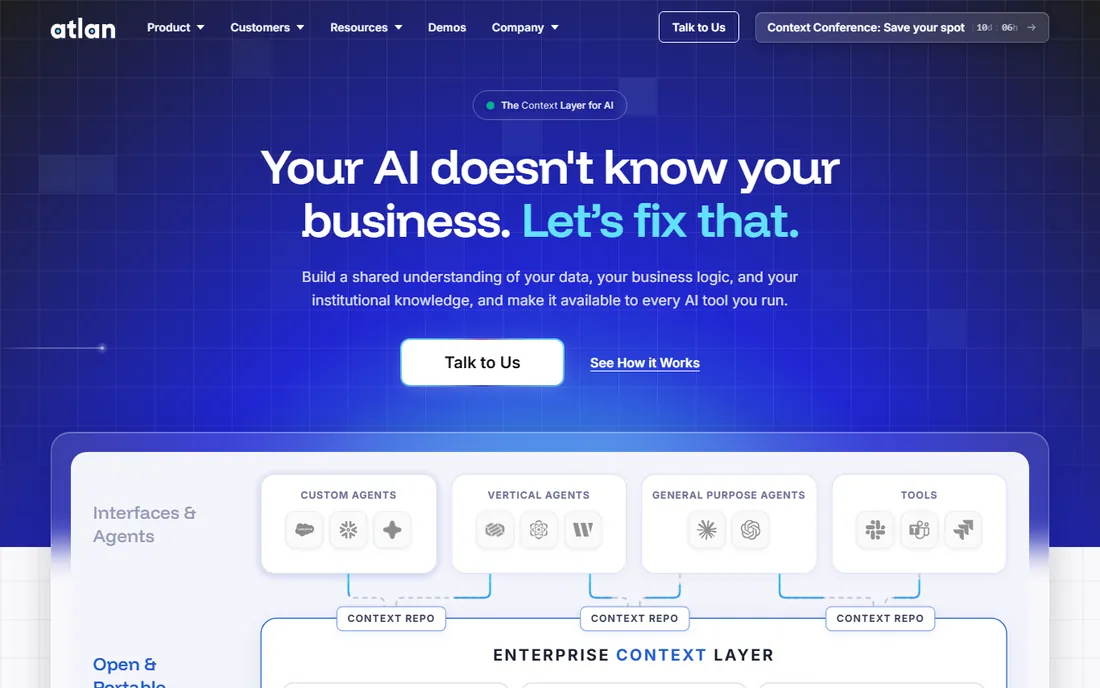
Where Alation leads with governance depth, Atlan leads with adoption. The interface looks like a consumer app, which is deliberate: catalogs die when only engineers use them, and Atlan's collaboration features (Slack and Jira embeds, an AI assistant that drafts descriptions) pull analysts and business stakeholders into documentation. Underneath, it is a serious platform: automated column-level lineage, data quality signals and policy controls.
The catch is the price tag. Atlan publishes plan names but no rates, and everything is negotiated by seats and connected sources, so small teams often find the entry point uncomfortable. Implementation runs weeks, not quarters, and the managed SaaS model means no servers to babysit. For a mid-size company on Snowflake, BigQuery or Databricks, Atlan is the most credible alternative to Alation.
What we like- Consumer-grade interface that non-technical users adopt without training
- Automated column-level lineage across warehouses, BI tools, dbt and orchestrators
- Managed SaaS with no infrastructure to run, plus a real API and Python SDK
Watch out for- Pricing is quote-only and reviewers describe list prices as steep for smaller organizations
- Advanced features carry a learning curve
- It documents existing assets rather than designing schemas
#3
Collibra
Best for: Regulated enterprises that need governance first, catalog second
Visit collibra.com
Starting priceSee website (custom quote; enterprise contracts only)
Free planFree trial
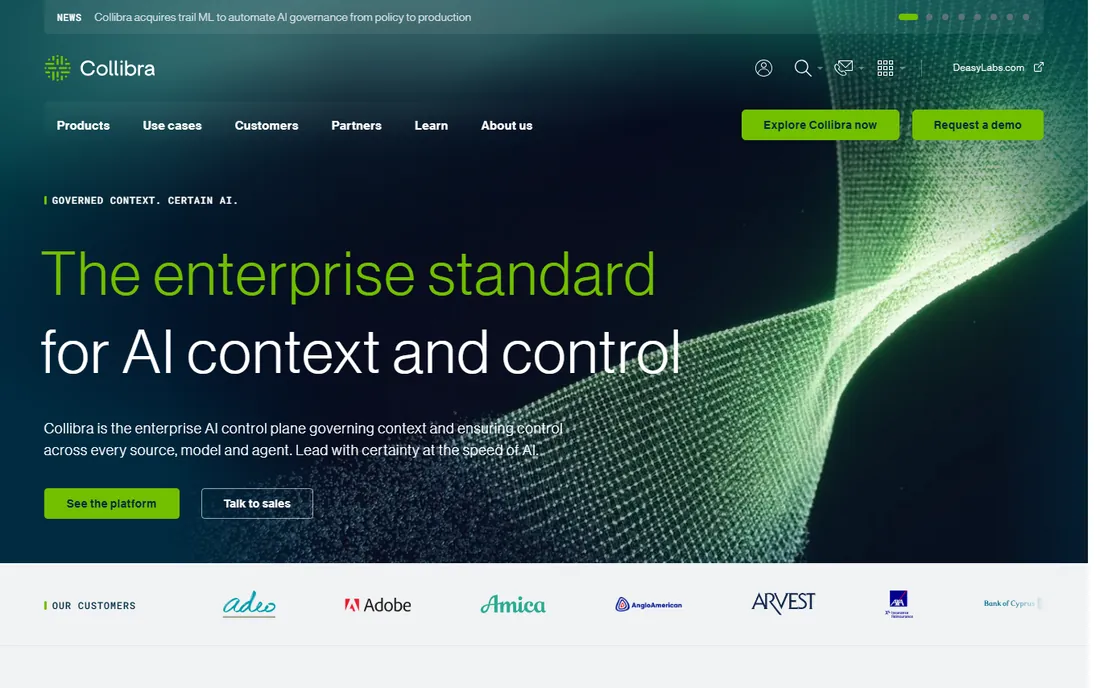
Collibra comes at the problem from the opposite direction of Atlan: governance first, catalog as one piece of it. The platform's core is a formal knowledge graph of business concepts and relationships (what Collibra calls an ontology), capturing how customers connect to contracts and products to policies in a way a glossary cannot. That foundation now extends to AI governance: registering models and agents and enforcing policy at runtime. For banks, insurers and healthcare organizations answering to regulators, that depth is the point.
Everything about Collibra signals enterprise. Pricing is quote-only, implementations are measured in quarters, and you will want dedicated internal ownership from day one. Collibra cites more than 700 customers and 78 of the Fortune 500, which is both a credential and a warning about fit. If your buying team includes a chief data officer and a compliance office, it belongs on the shortlist. If your team is three analysts and a dbt repo, it does not.
What we like- The deepest governance model in this list, built on 18 years of ontology engineering
- Now positioned as an AI control plane for governing models and agents
- Strong data quality, privacy and lineage in one platform
Watch out for- The priciest and heaviest option, with six-figure entry points widely reported
- Rollouts run five to six months per reviewer data
- Overkill for teams that mainly need discovery
#4
Informatica
Best for: Enterprises already running Informatica for integration or MDM
Visit informatica.com
Starting priceSee website (custom quote; consumption-based IPU model)
Free planFree trial
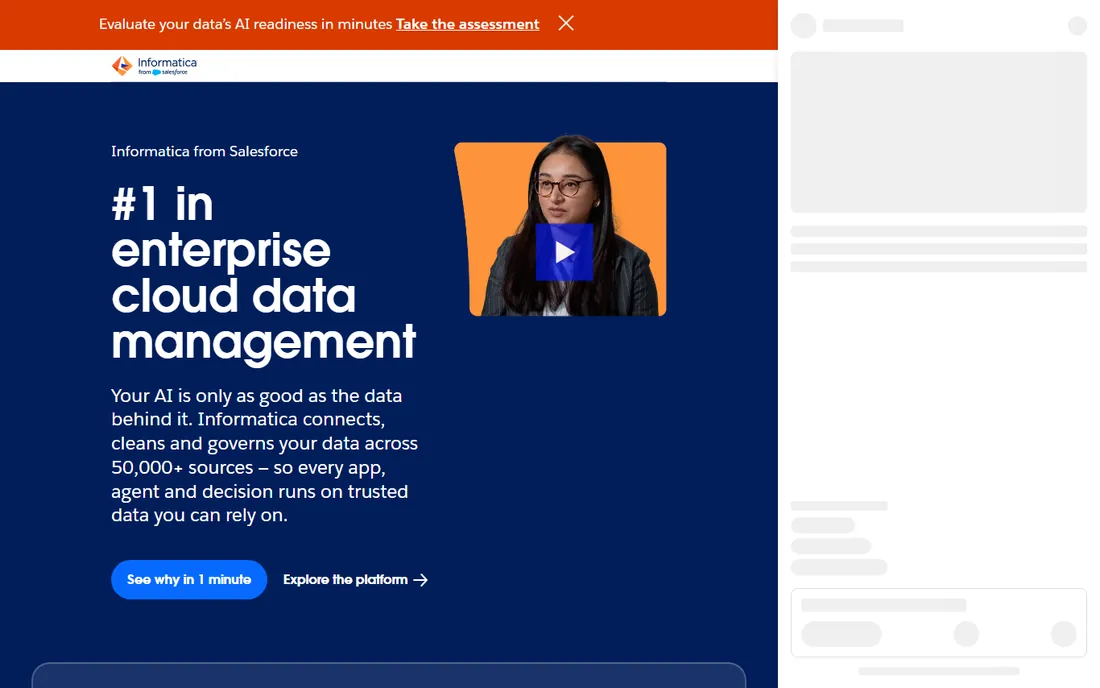
Informatica's Cloud Data Governance and Catalog is the catalog module of the Intelligent Data Management Cloud (IDMC), and that context decides everything. Bought alone, it is a capable enterprise catalog with AI-assisted classification, glossaries and lineage. Bought as part of IDMC, it becomes the metadata layer for Informatica's integration, quality and MDM services, so lineage follows data across the whole platform. Note that Salesforce is acquiring Informatica, so ask about roadmap continuity.
The pricing model is the thing to interrogate. Informatica bills IDMC on processing units, a consumption meter buyers consistently report is hard to model, and there is no self-serve tier. This is the right pick when the company already runs Informatica PowerCenter or IDMC services. As a standalone first catalog, it is heavier than most buyers need.
What we like- Catalog sits inside the Intelligent Data Management Cloud, so lineage spans integration, quality and MDM natively
- CLAIRE AI engine automates classification at enterprise scale
- Enormous connector library covering mainframe to SaaS
Watch out for- Pricing runs on Informatica Processing Units, a consumption meter buyers find hard to model
- The full platform is a large commitment, not a point tool
- Sales-led buying with no self-serve path
#5
Microsoft Purview
Best for: Organizations standardized on Azure and Microsoft 365
Visit microsoft.com
Starting pricePay-as-you-go (billed per governed asset; Microsoft's example: 200 assets run about $100/month)
Free planFree version (governance solutions with limited data sources)
Purview is the only option here where pricing rewards good governance habits. Since early 2025, the Unified Catalog bills on governed assets: scan 5,000 tables, attach 150 of them to data products, and you pay for 150. Microsoft's own pricing example puts 200 governed assets at about $100 per month, and scanned-but-ungoverned assets cost nothing. A free governance tier exists for eligible Azure and Microsoft 365 customers. For a Microsoft shop, this is dramatically cheaper than any seat-licensed catalog.
The tradeoffs are ecosystem-shaped. Lineage and classification are richest inside Azure, Fabric, SQL Server and Power BI; connecting Snowflake or a SaaS warehouse works but with less depth. Billing has a second meter for data-quality compute, so model both before committing. If your data lives on Azure, start here.
What we like- Scanned assets in the Data Map are free, and you pay only for assets you actively govern
- Native integration with Azure, Fabric, Power BI and Microsoft 365
- A free governance tier exists for eligible organizations
Watch out for- Two billing meters (governed assets plus processing units for quality rules) take study
- Non-Microsoft sources get thinner lineage
- The portfolio spans security and compliance too, so the portal can feel sprawling
#6
Amazon DataZone
Best for: AWS-centric organizations that want governed data sharing
Visit aws.amazon.com
Starting pricePay-as-you-go ($10 per 100,000 requests; $0.40 per GB of metadata storage per month)
Free planFree tier (4,000 requests and 20 MB of metadata storage per month)
DataZone answers a different question than most catalogs: not "where is our data" but "how do teams safely share data across boundaries." Producers publish data products; consumers search in business terms and request access through governed workflows. For an AWS shop with multiple teams passing data around, that framing fits better than a standalone catalog.
The pricing is the most transparent here and the most fiddly. AWS publishes every meter: $10 per 100,000 API requests, $0.40 per GB of metadata storage per month, $1.776 per compute unit, plus token pricing for AI recommendations, with a free tier covering 4,000 requests and 20 MB of storage. Small pilots cost pennies, but enterprise estates must model all four meters. The experience is designed for teams whose data already lives on AWS.
What we like- True pay-as-you-go with a usable free tier, so pilots cost almost nothing
- Built for governed data sharing across teams with fine-grained access controls
- Integrates with Glue, Lake Formation, Redshift and Athena natively
Watch out for- Four pricing dimensions (requests, storage, compute, recommendations) need a spreadsheet
- It is a data-sharing service first and a catalog second
- Thinner stewardship workflows than the governance-first tools
#7
data.world
Best for: Data teams that want search-first discovery on a knowledge graph
Visit data.world
Starting priceSee website (custom quote; plan tiers named, rates are not)
Free planFree plan (community tier for open data)
data.world is the odd one out architecturally, and that is its selling point. Instead of a conventional catalog, it stores everything in a knowledge graph, which makes search closer to Google for your data estate: ask for a metric, and the graph traverses relationships between tables, dashboards, owners and glossary terms to assemble the answer. Plans are named (Essentials, Standard, Enterprise, Enterprise+) but custom-quoted.
Two things to weigh. First, the knowledge-graph strength comes with a governance tradeoff: policy enforcement and quality monitoring are thinner than Collibra or Informatica, so some buyers pair it with a second tool. Second, data.world was acquired by ServiceNow, good for enterprise credibility but uncertain for near-term direction. It fits teams that value discovery speed and AI readiness over centralized policy control.
What we like- Knowledge-graph architecture makes search and relationship discovery unusually good
- Cloud-native SaaS with no infrastructure
- Now backed by ServiceNow, which changes the enterprise roadmap
Watch out for- Custom-quoted pricing like the other enterprise players
- Lighter on policy enforcement and data-quality monitoring than governance-first rivals
- The ServiceNow acquisition means the roadmap is in transition
#8
Secoda
Best for: Small data teams that want a catalog running this week
Visit secoda.co
Starting priceSee website (custom quote; pricing page does not publish rates)
Free planFree trial
Secoda built its name as the catalog for teams that found Alation too heavy and spreadsheets too thin: connect your warehouse, BI tool and dbt, and get automated column-level lineage, a searchable dictionary and documentation without a services engagement. The 2026 homepage leads with AI agents layered on a metadata control plane, which reflects where the whole category is moving. Git-backed version control for metadata changes is a useful touch for teams that treat docs like code.
The honest friction is commercial, not technical. Secoda's pricing page names plans without publishing rates, so budget approval starts with a call. For a startup or mid-size company with a modern stack and no governance team, Secoda's speed-to-value is the argument. For a regulated enterprise, the governance-first vendors above fit better.
What we like- Fast setup aimed at small teams, with automated lineage, a data dictionary and documentation in one place
- AI agents for search, documentation and monitoring
- Version-controlled metadata through Git integration
Watch out for- Pricing is not published on the vendor's site, so even the entry point needs a sales conversation
- The company has repositioned toward an AI analytics platform, so confirm the catalog roadmap
- Fewer deep enterprise governance workflows than the big four
#9
Coalesce Catalog
Best for: Companies that want business users to find data in plain language
Visit castordoc.com
Starting priceSee website (custom quote)
Free planFree trial (14 days)
If you searched for CastorDoc, you will now find Coalesce Catalog: the product rebranded under the Coalesce name, with homepage and docs mid-transition. It keeps the positioning that made CastorDoc popular: a catalog designed for everyone in the company, with plain-language search, AI-assisted documentation and automated lineage. Reviewers consistently rate it at the top of the category for ease of use and setup.
Pricing is quote-based, with tiered plans that cap users, integrations and data assets, so map your estate against those caps before signing. The 14-day trial is the practical evaluation path. During buying, confirm which entity contracts and invoices, since older reviews still say CastorDoc. For teams whose catalog failed because nobody outside engineering opened it, this is the usability-first alternative.
What we like- Built for full-company adoption, with natural-language search business users actually use
- Automated documentation and column-level lineage
- Strong ease-of-use scores from reviewers
Watch out for- Quote-based pricing with no public rates
- The CastorDoc-to-Coalesce rebrand means some reviews and docs reference the old name
- Asset and integration caps on lower tiers need checking against your estate size
#10
OpenMetadata
Best for: Technical teams that want a full catalog for the cost of infrastructure
Visit open-metadata.org
Starting priceFree (Apache 2.0 open source, self-hosted)
Free planYes (the open-source project is the free tier)
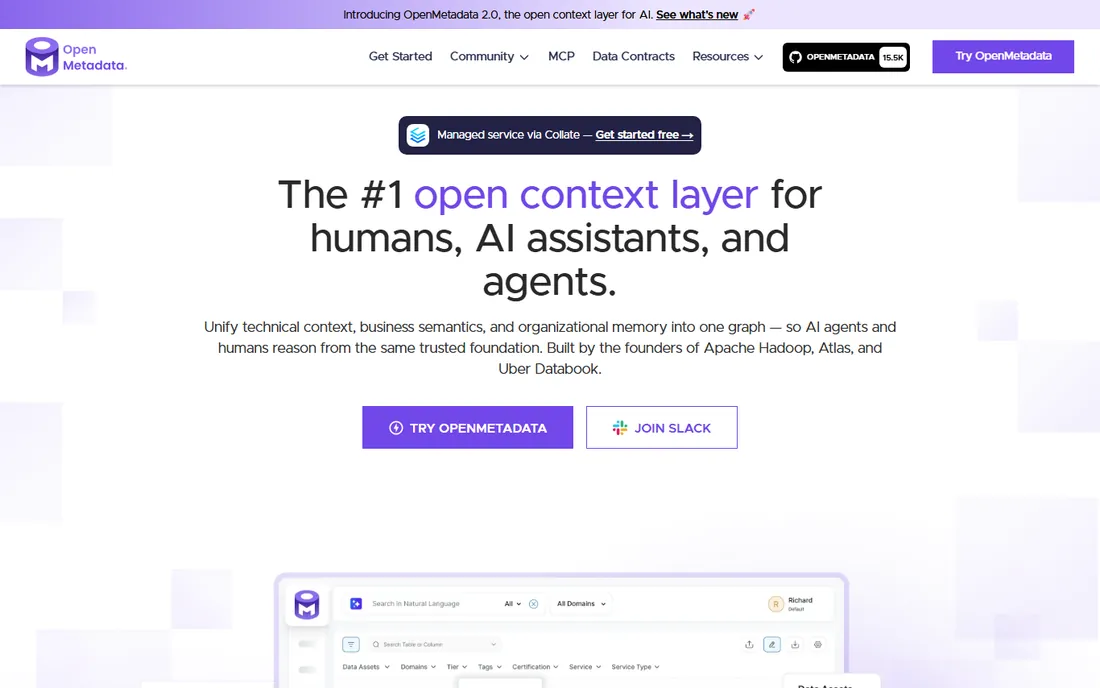
OpenMetadata is the answer to "what if the catalog were free." It is the largest open-source metadata project, with 130+ ingestion connectors, column-level lineage, business glossaries, data quality tests, and APIs for everything, all under Apache 2.0. The schema-first architecture makes it unusually programmable: teams wire it into CI/CD and feed its knowledge graph to AI agents through a native MCP server. One caution on URLs: openmetadata.org is an unrelated consulting firm; the project lives at open-metadata.org.
The price is infrastructure and engineering time, which is not zero. Expect to run upgrades and debug connectors yourself, and budget real ownership rather than assuming free means effortless. For a technical team with no budget for a six-figure catalog, it is the best value here by a wide margin.
What we like- Zero license cost with 130+ connectors, lineage, glossaries, data quality and role-based access
- Open JSON-schema metadata model and APIs make it programmable
- Large community means connectors keep coming
Watch out for- You operate it: upgrades, scaling and support are your team's job
- The UI and polish trail the commercial products
- Enterprise features like advanced SSO need the paid managed offering
What to look for before you buy
Start with the buying motion, because it splits this market in two. Alation, Collibra, Informatica, Atlan, data.world, Secoda and Coalesce Catalog all sell through sales teams with custom quotes. Purview and DataZone bill by usage on your existing cloud bill, and OpenMetadata costs engineering time. If you need a price this week to put in a budget, the second group is the only one that can give it to you.
Next, count what each vendor meters. Seat-licensed tools charge per user, which punishes the broad adoption catalogs are supposed to create. Purview charges per governed asset, so broad readership is free and curation is metered. DataZone charges per request and storage, which scales with activity. Model your shape (readers vs. curators vs. assets) against each meter before comparing headline prices.
Then check the connectors you actually need: lineage depth varies by source, so ask each vendor to name which of your systems get column-level lineage at the quoted tier, in writing. Finally, confirm the deployment model before the demo, not after: SaaS-only, your-cloud billing, self-hosted open source, or a choice.
Why most prices are hidden, and how to get a real quote
Seven of the ten tools here publish no prices, and that is not an accident. Enterprise catalog pricing depends on users, connectors, data volume, deployment and services, and vendors prefer to discover your budget in a sales call. The practical response is to force comparability: send every vendor the same brief and require itemized quotes for license, connectors, implementation services and first-year support.
Watch for three usual traps. First, connector pricing: some vendors charge per source or tier connectors, so the quote that looked fine for five sources doubles at twenty. Second, services: implementation for the governance-first platforms can rival the first-year license, and it is sometimes presented late. Third, the AI upsell: several vendors now bundle AI governance or agents into premium tiers; confirm the catalog you evaluated is the product you are being quoted. Get renewal terms in writing now: year-two increases are standard and negotiable only before you sign.
How we chose
We started with the searches buyers run: best metadata management tools, best data catalog tools, data catalog software and metadata management platform. For each candidate we opened the vendor's homepage to confirm the product exists and fits the category, checked the vendor's pricing page for published plans and free tiers, and cross-checked positioning against public reviews on G2 and Capterra and practitioner discussion on Reddit. Where a vendor publishes no price, we wrote "See website" rather than repeating third-party estimates. We mixed established enterprise platforms with cloud-native options, modern managed catalogs and the leading open-source project, so the list covers every budget and buying motion.
Frequently asked questions
What is the difference between a data catalog and metadata management?
Metadata management is the discipline of collecting, organizing and governing data. A data catalog is the product most teams buy: a searchable inventory of tables, dashboards, pipelines and terms, with ownership, lineage and documentation attached. Every tool here is a data catalog; the governance depth around it is what varies.
How much does metadata management software cost?
It spans from free (OpenMetadata, self-hosted) to six figures annually. The enterprise platforms are custom-quoted and typically start in the tens of thousands per year for mid-size deployments. Microsoft Purview and Amazon DataZone bill by usage, so small estates can run for tens to low hundreds of dollars a month. Most vendors publish no prices, so expect a sales process for the rest.
Can a small business use these tools, or are they enterprise-only?
OpenMetadata is free if you can self-host. Secoda and Coalesce Catalog are built for smaller data teams with fast setup and trials. Purview's free governance tier and pay-per-asset billing suit small Azure estates, and DataZone's free tier covers pilots. The governance-first platforms are designed for enterprises and priced accordingly.
Do we need a data governance program before buying a catalog?
No, and waiting is usually a mistake. A catalog often starts the governance program: once every dataset has a visible owner and lineage, conversations about standards get concrete. Start with discovery and documentation, add glossaries and stewardship workflows later.
Will a data catalog help with AI initiatives?
Yes, and this is now the main reason enterprises buy. AI models and agents are only as trustworthy as the data feeding them, and a catalog provides the governed context that keeps AI answers grounded. If AI agents will touch company data, evaluate the catalog's API and agent integrations, not just its search box.
Sources we checked (16)
- https://alation.com
- https://atlan.com
- https://www.collibra.com
- https://www.informatica.com
- https://www.microsoft.com/en-ww/security/business/microsoft-purview
- https://azure.microsoft.com/en-au/pricing/details/purview/
- https://learn.microsoft.com/en-us/purview/data-governance-free-version
- https://aws.amazon.com/datazone
- https://aws.amazon.com/datazone/pricing/
- https://data.world
- https://secoda.co/pricing
- https://castordoc.com
- https://open-metadata.org/
- https://www.decube.io/post/data-catalog-pricing
- https://erstudio.com/blog/data-catalog-tools/
- https://www.g2.com/compare/alation-vs-informatica-cloud-data-governance-and-catalog
Is your product missing or out of date?
We review this list regularly. Vendors can request a listing, send updated pricing or ask about featured placement.

Shihab Mia · Founder, Rankite
Shihab has 5+ years in B2B and SaaS SEO. He writes Rankite's software buying guides from pricing pages, documentation and public user reviews. More about Shihab.