How we make this list: we compare pricing pages, product documentation and public user reviews. Rankite is independent; if a vendor ever pays for a featured spot, that listing is clearly labeled Partner.
Key takeaways
- Metadata software catalogs your data assets, tracks lineage, and enforces governance across the whole data stack.
- Atlan, Alation, and Collibra lead the enterprise market; all three are quote-based.
- OpenMetadata and DataHub are strong open source options with free self-hosting for engineering-led teams.
- Secoda and Coalesce Catalog target mid-market teams with faster setup and friendlier pricing.
- Coalesce Catalog starts at $150 per user per month billed annually, which is the only transparent price in this roundup.
Quick comparison
| Tool | Best for | Starting price | Free plan |
|---|
 Atlan Atlan | Modern metadata platform | See website | No |
 Alation Alation | Enterprise data catalog | See website | No |
 Collibra Collibra | Enterprise governance | See website | No |
 Secoda Secoda | Mid-market data teams | See website | No |
 Coalesce Catalog Coalesce Catalog | Catalog with transformation | $150 per user/month (billed annually) | No |
 OpenMetadata OpenMetadata | Open source catalog | Free | Yes |
 DataHub DataHub | Open source metadata | Free | Yes |
Is your product missing or out of date?
We review this list regularly. Vendors can request a listing, send updated pricing or ask about featured placement.
Starting priceSee website
Free planNo
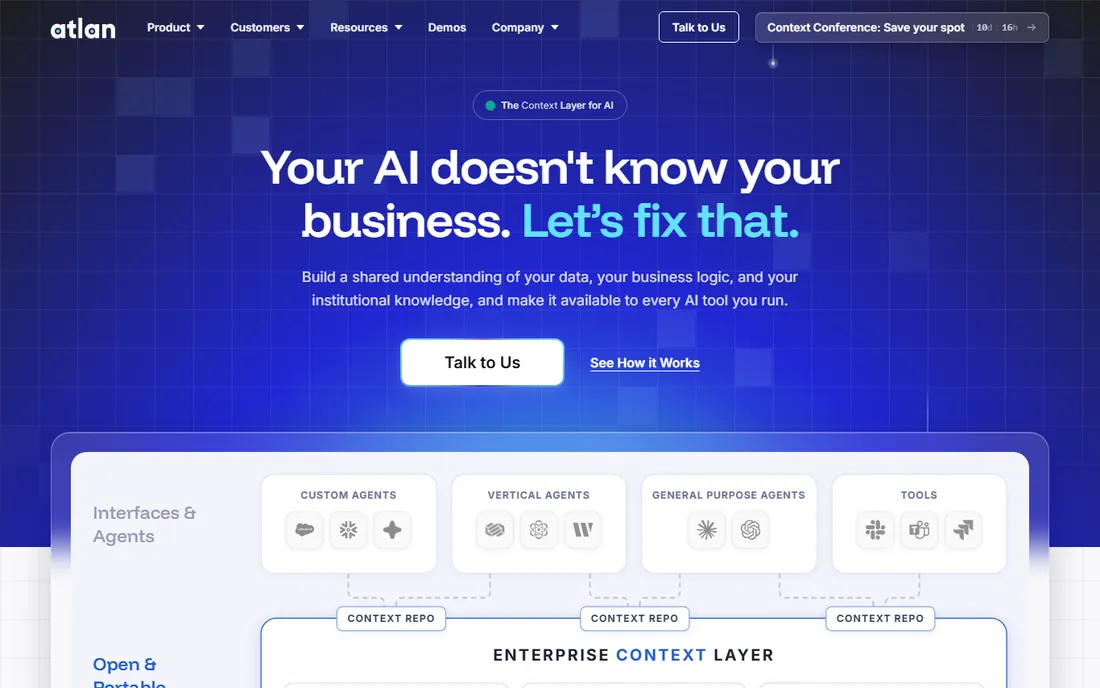
Atlan positions itself as an active metadata platform rather than a passive catalog: tags propagate across lineage paths, governance context embeds into tools like Snowflake and dbt, and deployment runs in weeks rather than months. It is built for teams treating metadata as infrastructure for AI as well as analytics. The active metadata concept is the key differentiator: instead of a static catalog that decays, metadata flows and updates automatically as data moves through the stack.
Pricing is quote-based and aimed at the enterprise. Data teams on modern stacks who want fast time to value consistently shortlist it. The DIY setup model also appeals to teams that have been burned by year-long catalog implementations that nobody adopted.
What we like- Active metadata automation
- 100+ native connectors
- Gartner and Forrester Leader recognition
Watch out for- Enterprise pricing is quote-based
- Best fit for larger data teams
- Learning curve for stewards
Starting priceSee website
Free planNo

Alation started the machine learning data catalog category and remains a standard choice for enterprises that want strong search, stewardship workflows, and BI documentation. Its Intelligence Operating System framing extends the catalog toward AI governance and governed analytics. For organizations already invested in Alation, that continuity matters: the catalog becomes the control layer for AI agents, not just a documentation site.
Deployments typically take three to nine months with professional services, and pricing is quote-based. SQL-heavy analytics organizations with established data teams are its sweet spot. Its long track record means deep integrations and a large pool of consultants who know the platform.
What we like- Pioneer of the ML data catalog category
- Strong search and stewardship
- Five-time Gartner Leader
Watch out for- Deployment can take months with services
- Data quality needs separate licensing
- Quote-based pricing
Starting priceSee website
Free planNo
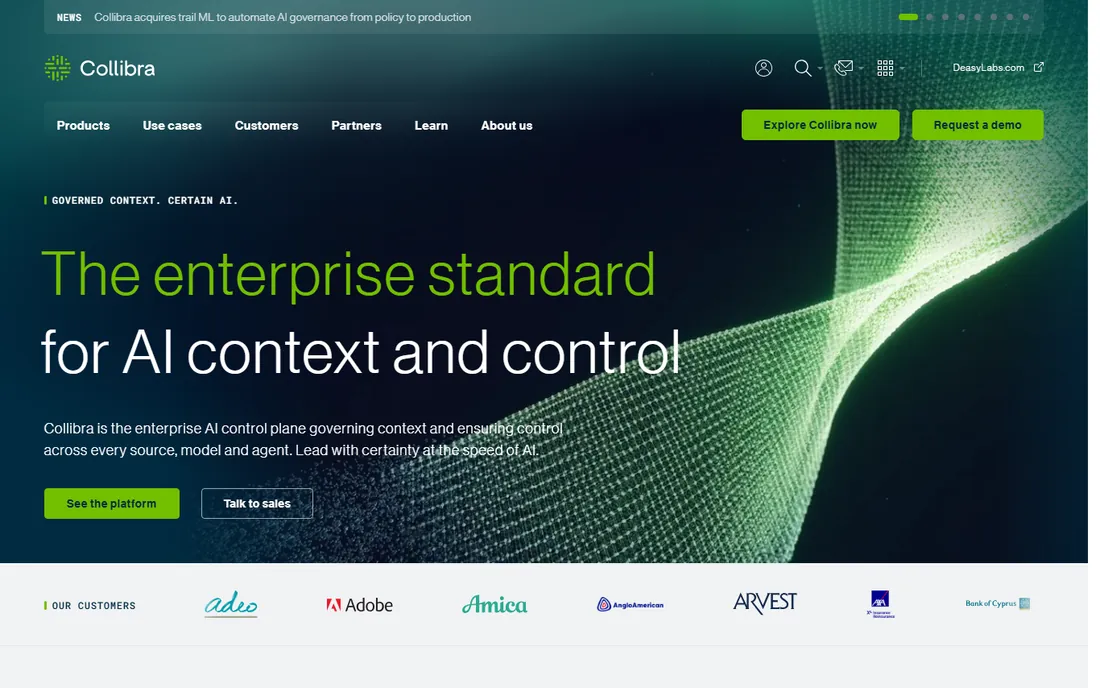
Collibra is the enterprise governance standard: ontology-based context management, automated governance workflows, and compliance reporting across complex organizations. Its AI control plane positioning reflects where the category is heading. Eighteen years of ontology engineering give it a depth of semantic modeling that newer vendors are still building toward.
Total cost of ownership includes licenses, implementation services, and ongoing configuration headcount, so it suits regulated enterprises with dedicated governance teams. Quote-based pricing. Organizations in banking, insurance, and healthcare choose it precisely because auditors and regulators already know the name.
What we like- Deep governance and policy modeling
- Ontology-based context
- Strong regulatory compliance support
Watch out for- Configuration-heavy setup
- Higher total cost of ownership
- Enterprise-focused
Starting priceSee website
Free planNo
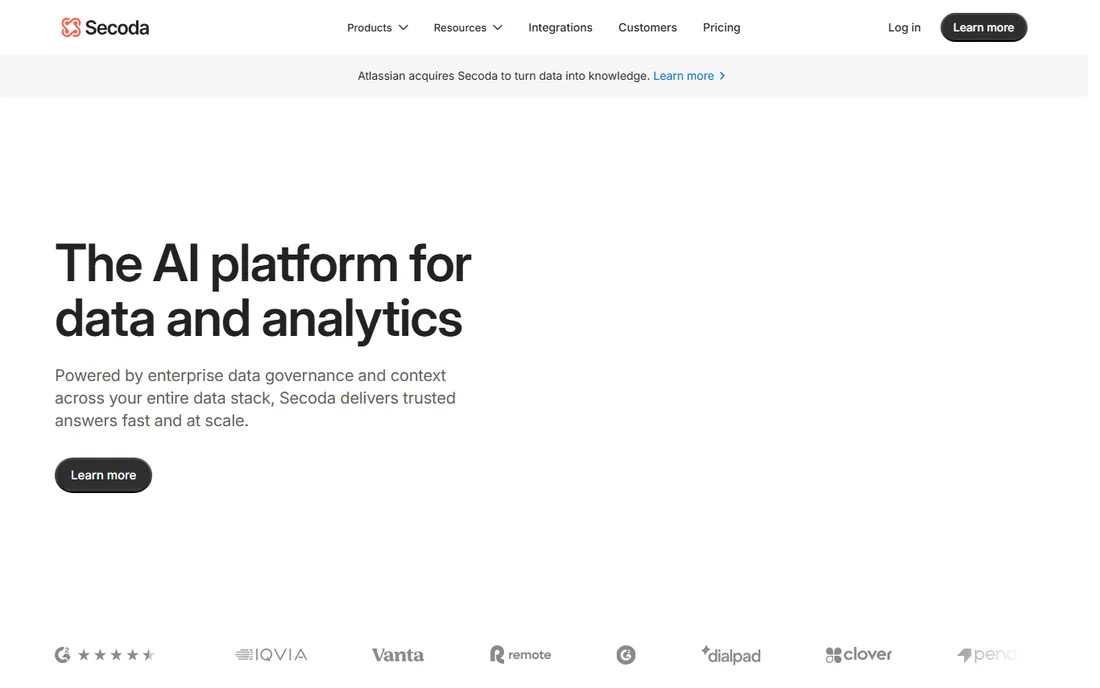
Secoda targets the gap between spreadsheets and enterprise suites: a data catalog with AI agents that auto-generate documentation, search in natural language, and monitor data health. It consolidates metadata into one control panel with integrations across the modern stack. The design clearly prioritizes the analyst experience: search feels like a consumer product, which is exactly what drives the daily usage that catalogs live or die by.
Mid-market teams get going fast with less consulting. Pricing is not public, so budget planning requires a sales conversation. The AI documentation agents are the real draw: they generate descriptions and flag issues automatically, which is how small teams keep a catalog alive.
What we like- Fast setup and intuitive interface
- AI agents for documentation and search
- Strong Slack and dbt integrations
Watch out for- Less depth than enterprise suites
- Pricing not public
- Smaller analyst footprint
Starting price$150 per user/month (billed annually)
Free planNo
Coalesce Catalog (formerly CastorDoc) lives inside the Coalesce data transformation platform, which is its differentiator: lineage, documentation, and governance come from the pipelines themselves rather than being maintained separately. Starter is $150 per user per month billed annually.
Teams already transforming data in Coalesce get a catalog almost for free. Pure-play catalog buyers may prefer a standalone tool. The transparent $150 per user per month Starter pricing is refreshing in a category where almost everyone hides behind sales calls. Note the free Developer tier exists but does not include Catalog, so budget for Starter if the catalog is the goal.
What we like- Catalog built into transformation platform
- Live lineage
- Transparent pricing
Watch out for- Tied to the Coalesce platform
- Catalog features newer than specialists
- Free tier excludes Catalog
Starting priceFree
Free planYes
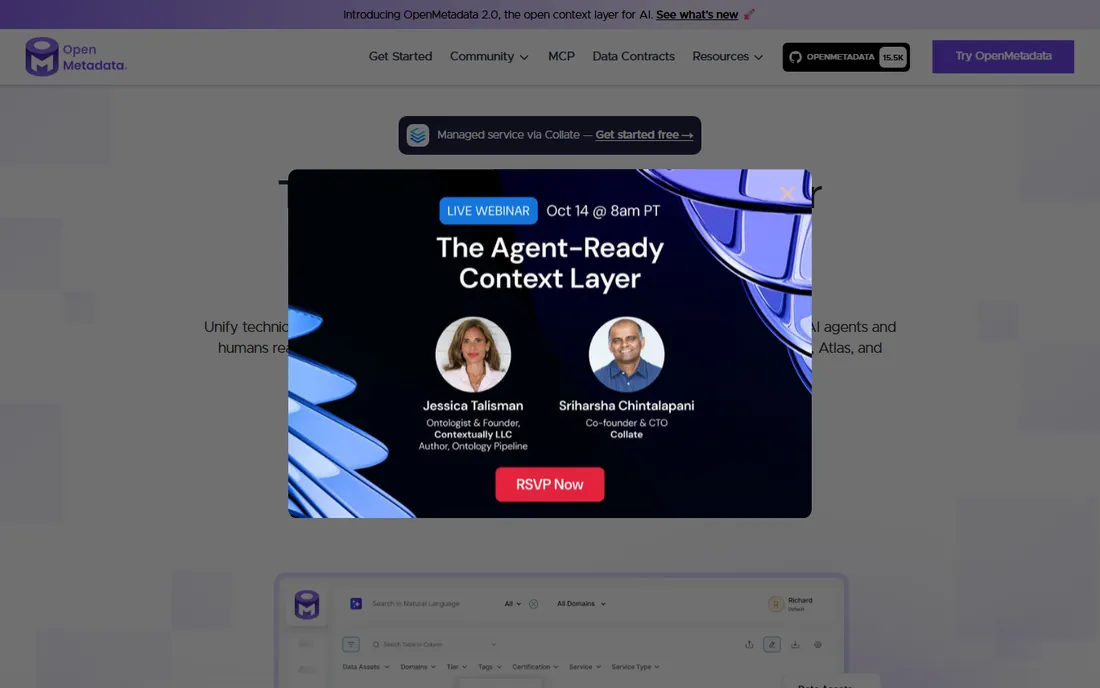
OpenMetadata is the leading open source metadata platform: a knowledge graph of schemas, lineage, glossaries, and quality signals with 130-plus connectors and thousands of deployments. Its API-first, schema-first design makes metadata programmable.
Free to self-host, with commercial support available. Engineering-led teams comfortable running infrastructure get enterprise-grade cataloging at zero license cost. The 130-plus connectors mean most stacks are covered out of the box, and the open specification lets teams extend the metadata model to fit their own conventions. The 15,000-plus GitHub stars and 450-plus contributors signal a project with real momentum, not a hobby effort.
What we like- Free and open source with 130+ connectors
- 4,000+ enterprise deployments
- API-first architecture
Watch out for- Self-hosting needs engineering effort
- Support via community or paid tiers
- UI less polished than commercial tools
Starting priceFree
Free planYes
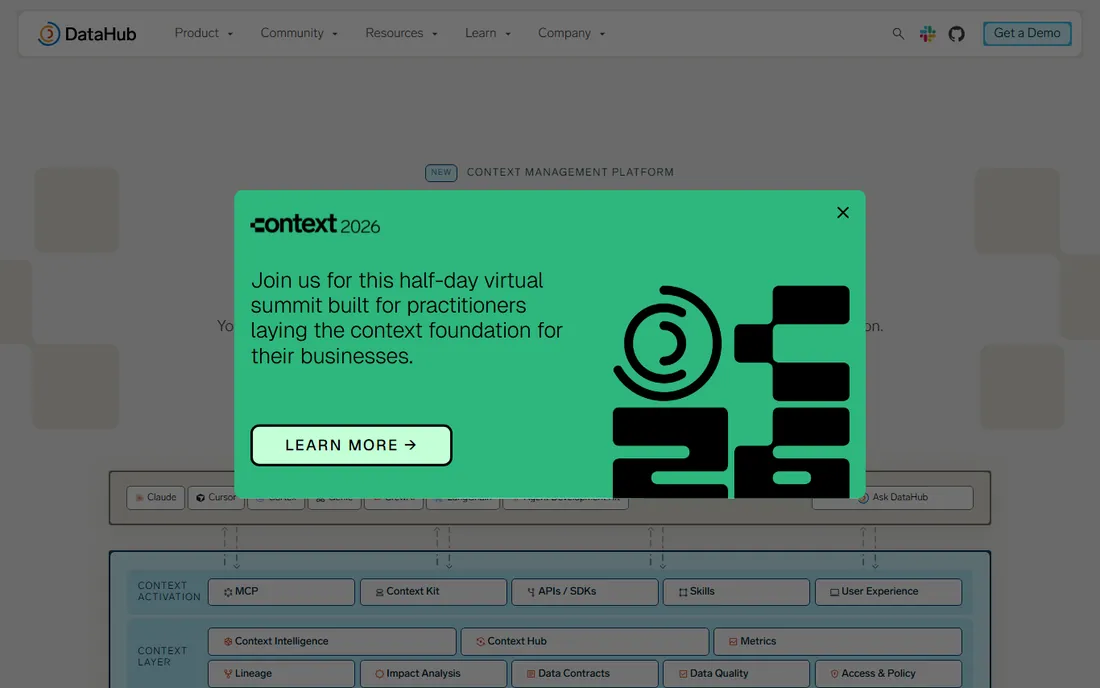
DataHub claims the title of the most popular open source metadata platform, with 16,000-plus members and millions of monthly downloads. It offers trusted lineage, data quality signals, and MCP-native integration for AI agents, plus a managed cloud edition for teams that do not want to self-host.
Like OpenMetadata, it trades license cost for engineering effort. The choice between the two often comes down to stack fit and team preference. DataHub Cloud exists for teams that want the platform without operating it, which is worth pricing against the engineer-hours of self-hosting. With 3 million-plus monthly downloads, it has the largest community of any option here, which shows up in forum answers and third-party integrations.
What we like- Massive open source community
- 3M+ monthly downloads
- Managed cloud option available
Watch out for- Self-hosting complexity
- Enterprise features in paid cloud
- Documentation varies by version
How we chose
We reviewed vendor product pages, analyst reports (Gartner, Forrester), and public user reviews (G2, Capterra) to compare cataloging depth, lineage, governance features, connectors, deployment models, and pricing transparency. Every tool had to be currently available. We did not claim hands-on testing.
Enterprise buyers with compliance requirements should shortlist Collibra and Alation: they have the governance workflows, audit trails, and analyst recognition that legal and compliance teams trust. Budget for services and internal headcount, not just licenses.
Involve compliance early. The requirements that matter, data retention rules, access controls, audit logging, should be defined before vendor demos, not discovered during implementation. A tool that cannot satisfy your auditor is a wasted purchase no matter how good its lineage graphs look.
Modern data teams on Snowflake, dbt, and Databricks usually prefer Atlan or Secoda: faster deployment, better adoption by analysts, and active metadata that does work rather than just documenting it. Open source fans with engineering capacity should trial OpenMetadata and DataHub side by side.
Run a proof of concept with your real data, not a vendor demo dataset. Connect two or three of your actual sources, invite five analysts, and measure whether they find answers faster after two weeks. The tool that wins that test is the right one, regardless of analyst rankings. Vendors perform best on their own datasets; yours will reveal the real gaps. Bring your messiest data source to the trial, not the cleanest one.
The adoption problem
Every metadata tool fails the same way: nobody uses it. Catalogs die when documentation is a chore and the data is stale. Favor tools that automate metadata collection from your pipelines, meet users where they work (Slack, BI tools), and make search genuinely useful. A catalog people open daily always beats a perfect one they never visit.
Assign ownership from day one. Every critical dataset needs a named owner responsible for its documentation and quality signals. Without owners, even the best platform becomes an expensive empty library. Start with your twenty most-queried tables: documenting those delivers most of the value with a fraction of the effort. Momentum beats completeness, and a catalog that grows visibly each month keeps executive sponsors happy and justifies the renewal conversation later.
Frequently asked questions
What is metadata software?
Metadata software catalogs an organization's data assets, what they mean, where they come from, and who owns them. It typically includes data discovery, lineage tracking, business glossaries, and governance workflows.
How much does metadata software cost?
Enterprise platforms like Atlan, Alation, and Collibra are quote-based, typically six figures annually for mid-size deployments. Always negotiate multi-year terms, and ask which implementation services are truly required versus optional add-ons. Coalesce Catalog starts at $150 per user per month. OpenMetadata and DataHub are free to self-host.
What is the difference between a data catalog and metadata management?
A data catalog is the searchable inventory of your data assets. Metadata management is the broader discipline: collecting, governing, and activating metadata across the entire organization. Most modern tools do both jobs at once.
Is open source metadata software good enough?
For engineering-led teams, yes. OpenMetadata and DataHub power thousands of production deployments. The trade is engineering time for hosting and maintenance instead of license fees. Do the math honestly: a quarter of a data engineer's time can exceed a commercial license.
What connectors should we check?
Always verify your specific stack before buying. Every vendor lists impressive connector counts, but what matters is whether your warehouse, BI tool, and orchestration platform are supported natively. Ask for the connector list in writing during the trial.
How long does implementation take?
Cloud-native tools like Atlan and Secoda can deploy in weeks. Traditional enterprise platforms like Alation and Collibra typically take three to nine months with professional services involved.
Sources we checked (8)
- https://atlan.com/
- https://www.alation.com/
- https://collibra.com/
- https://www.secoda.co/
- https://coalesce.io/
- https://open-metadata.org/
- https://datahubproject.io/
- https://coalesce.io/product/pricing/
Is your product missing or out of date?
We review this list regularly. Vendors can request a listing, send updated pricing or ask about featured placement.

Shihab Mia · Founder, Rankite
Shihab has spent more than a decade helping SaaS and e-commerce brands grow through search. He writes Rankite's software buying guides from pricing pages, documentation and public user reviews. More about Shihab.