How we make this list: we compare pricing pages, product documentation and public user reviews. Rankite is independent; if a vendor ever pays for a featured spot, that listing is clearly labeled Partner.
Key takeaways
- NVivo, ATLAS.ti, and MAXQDA are the established leaders in qualitative data analysis, each with decades of development behind it.
- Dedoose ($17.95 per active month) is the best web-based mixed methods option for budget-conscious teams.
- Taguette is free and open source for straightforward highlight-and-tag coding on a zero budget.
- Examine and Quirkos prioritize simplicity and fast learning curves for students and small teams.
- QDA Miner offers the deepest computer-assisted coding and text mining, including statistical integration.
Quick comparison
| Tool | Best for | Starting price | Free plan |
|---|
 NVivo NVivo | Industry-standard QDA | See website | Free trial |
 ATLAS.ti ATLAS.ti | AI-powered coding | See website | Free trial |
 MAXQDA MAXQDA | Cross-platform research | See website | Free trial (14 days) |
 Dedoose Dedoose | Web-based mixed methods | $17.95 per active month | No |
 Examine Examine | Simple AI-assisted coding | See website | Free trial |
 Quirkos Quirkos | Beginner-friendly QDA | See website | Free trial |
 QDA Miner QDA Miner | Advanced text analysis | See website | Free trial |
 Taguette Taguette | Free open source coding | Free | Yes |
Is your product missing or out of date?
We review this list regularly. Vendors can request a listing, send updated pricing or ask about featured placement.
The best research management software
Starting priceSee website
Free planFree trial
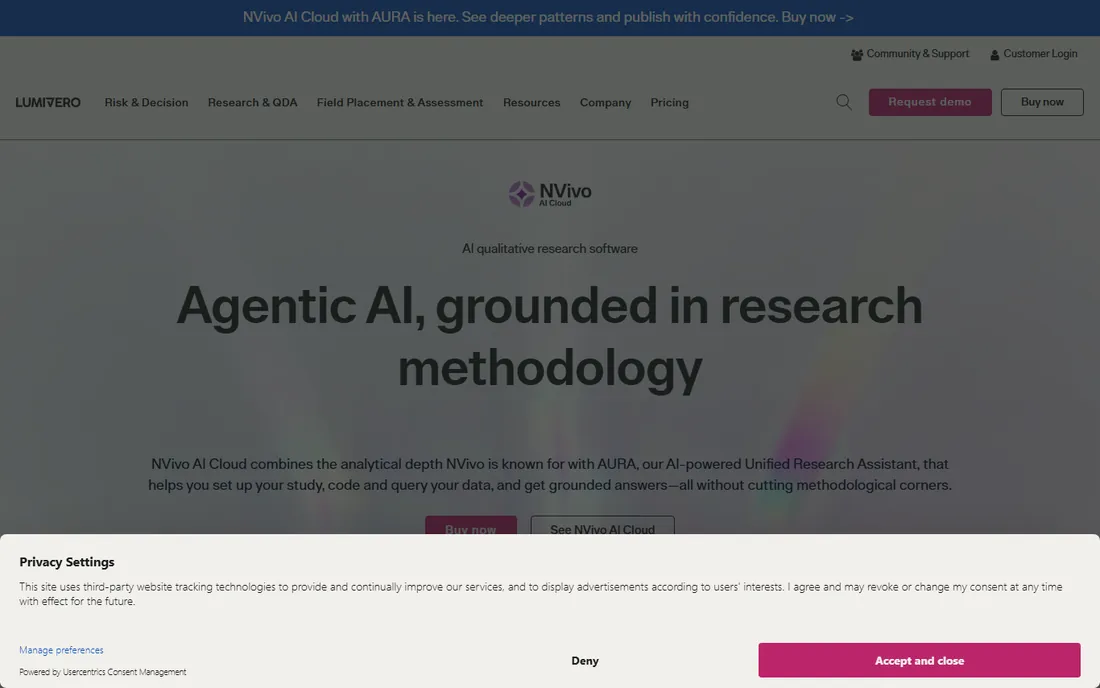
NVivo has been the default qualitative data analysis choice for over twenty years, and Lumivero is now modernizing it with NVivo AI Cloud: an agentic AI assistant grounded in research methodology, with transparent audit trails behind every single AI-assisted step. The desktop version remains the deep, established workhorse that generations of researchers learned on.
Pricing is not public and teams should expect enterprise-style quotes. For dissertations and publications where methodological rigor must be defensible, it remains the safe choice. Universities often hold site licenses, so check with your institution before paying for an individual license.
What we like- Two decades of feature depth
- New AI Cloud with AURA assistant
- Strong mixed methods support
Watch out for- Desktop version is expensive
- Learning curve
- Teams waitlist for AI Cloud collaboration
Starting priceSee website
Free planFree trial
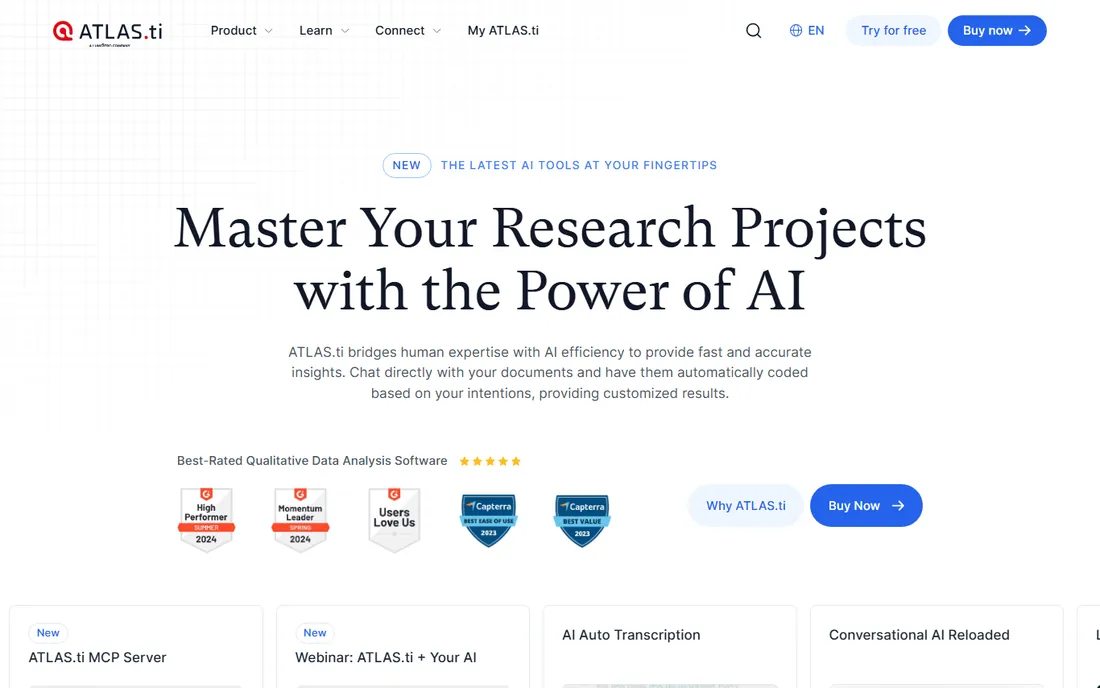
ATLAS.ti leans hardest into AI: automatic AI coding using GPT models, sentiment analysis, and opinion mining across documents. It handles text, audio, video, and images in one place, with Windows, Mac, and web versions plus multi-user collaboration for distributed teams.
The AI acceleration is real, but researchers should review AI-applied codes carefully. Pricing is quote-based; free trials let teams test the AI workflows first. Its network visualizations and Sankey diagrams also make it a strong choice when findings need to be presented visually to non-research audiences.
What we like- GPT-powered automatic coding
- Works on Windows, Mac, and web
- Strong visualizations
Watch out for- Pricing not public
- AI features need review
- Can feel feature-heavy
Starting priceSee website
Free planFree trial (14 days)
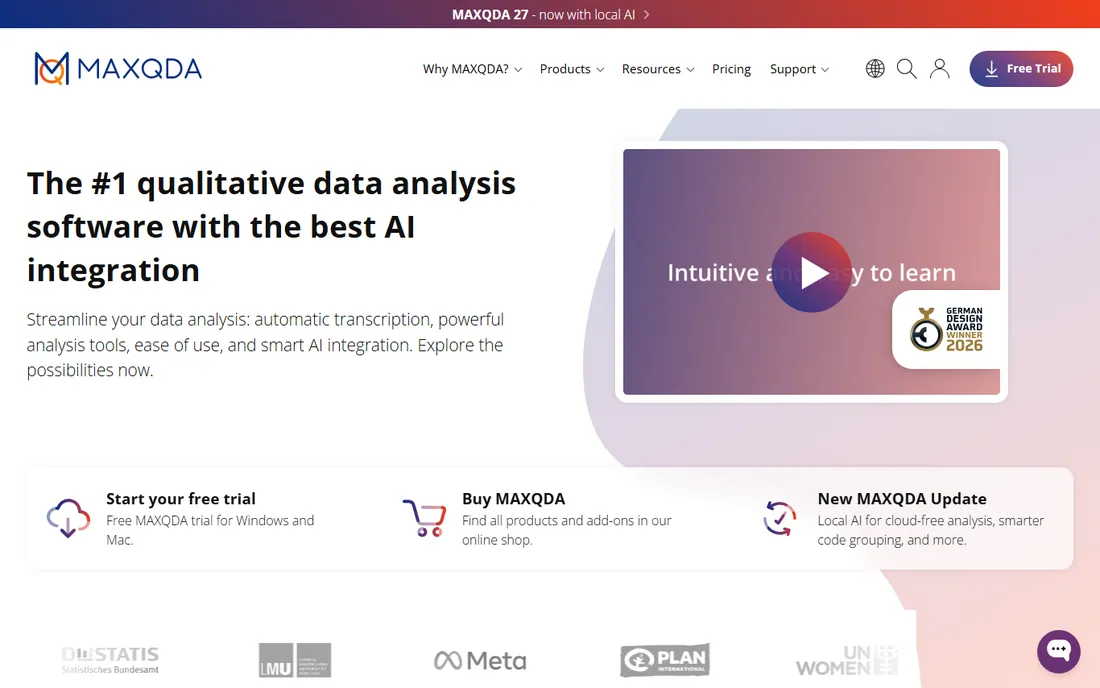
MAXQDA is the only top-tier QDA tool with a completely identical experience on Windows and Mac, which matters for teaching and mixed-device teams. MAXQDA 27 adds local AI that runs right on your computer with no cloud required, plus the GDPR-compliant AI Assist for cloud-based help.
The 14-day free trial is generous. Researchers handling sensitive data appreciate the privacy-first AI approach and EU data handling. The identical Windows and Mac experience also makes it the easiest choice for methods courses where students bring their own devices.
What we like- Identical on Windows and Mac
- Local AI with no cloud required
- GDPR-compliant AI Assist
Watch out for- Pricing not public
- Menu-rich interface takes learning
- Add-ons cost extra
Starting price$17.95 per active month
Free planNo
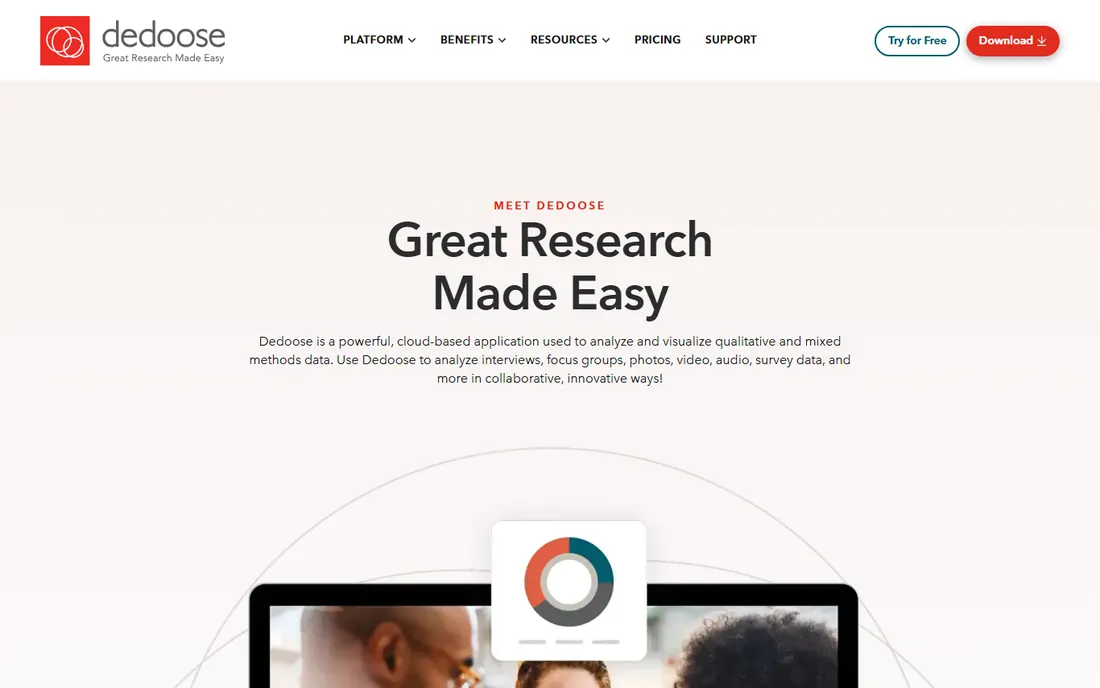
Dedoose is the practical web-based choice: analyze interviews, focus groups, survey data, and media in a browser, collaborate with anyone at no extra cost, and pay $17.95 per active month for individuals only when you use it. Built by social scientists, it handles qualitative and quantitative data together naturally instead of treating them as separate worlds.
It lacks the depth of NVivo or MAXQDA, but for mixed methods teams and students, the price and simplicity win. The pay-only-for-active-months model is genuinely student-friendly: you are not paying during the months you spend writing instead of coding.
What we like- Fully cloud-based, no install
- Pay only for active months
- Built for mixed methods
Watch out for- Less deep than desktop tools
- Internet required
- Interface shows its age
Starting priceSee website
Free planFree trial
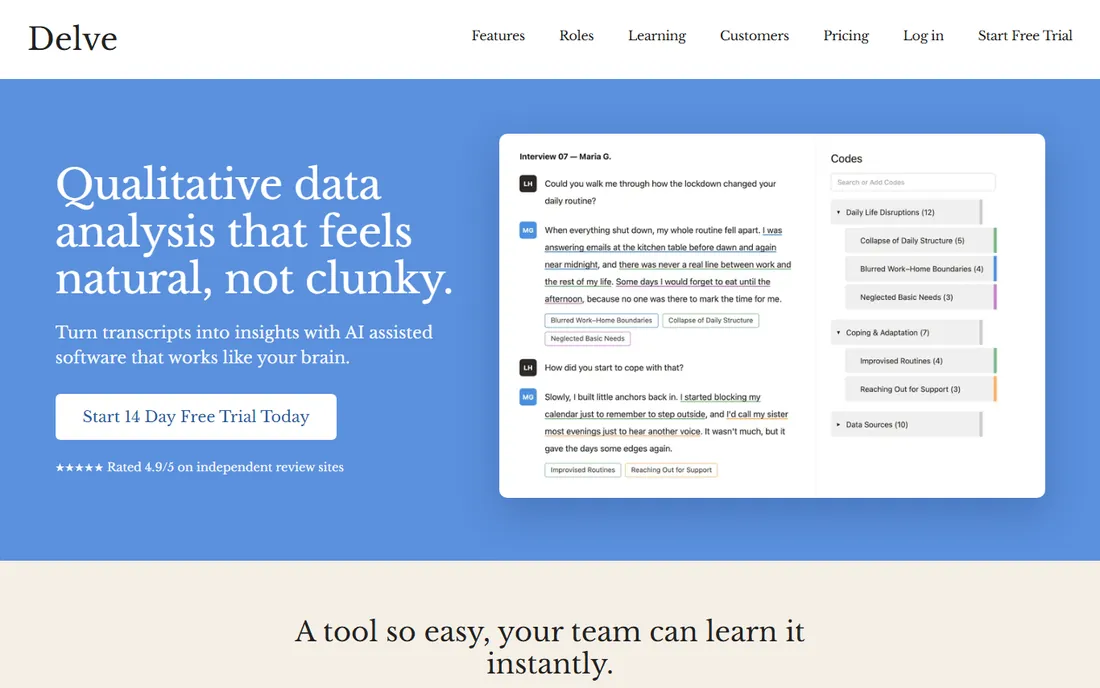
Examine is the anti-complexity option: intuitive AI-assisted coding that doctoral students can learn in an afternoon. The AI acts as a peer debriefer, suggesting codes you may have missed and explaining its reasoning, while the actual interpretation stays human-driven.
It is ideal for dissertations and small projects rather than large lab corpora. The focused feature set is a genuine feature, not a limitation, for its audience. Doctoral students consistently praise how fast they can go from transcripts to a coded project without watching hours of tutorials.
What we like- Learn it instantly
- AI assistant as peer debriefer
- Great for dissertations
Watch out for- Less depth for large projects
- Newer vendor
- Pricing not public
Starting priceSee website
Free planFree trial
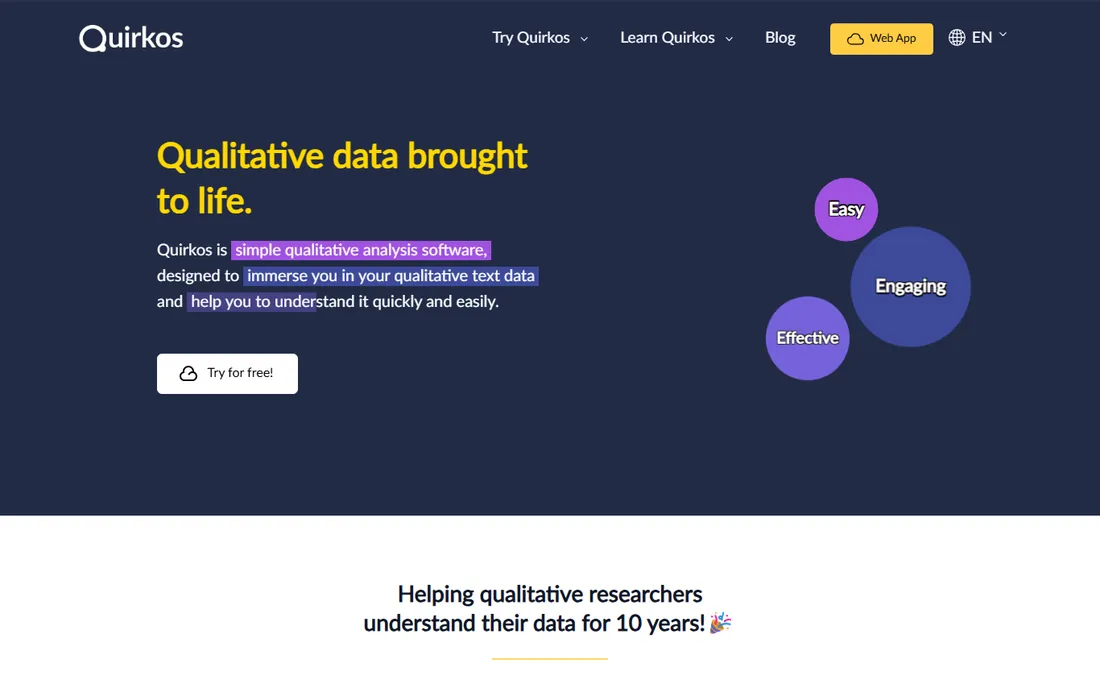
Quirkos makes qualitative analysis visual and approachable, with word clouds, theme hierarchies, and real-time cloud collaboration. It deliberately avoids AI analysis, which appeals to researchers who want complete human control over every analytical decision and maximum data privacy.
Often half the price of alternatives, with discounts for students and nonprofits. Small datasets and teaching contexts are its sweet spot. The visual coding canvas also makes it popular in workshops, where participants can see themes emerge in real time.
What we like- Visual and intuitive
- Affordable with student discounts
- No AI by design, privacy-first
Watch out for- Geared to smaller datasets
- Fewer advanced analytics
- Pricing page needed for exact numbers
Starting priceSee website
Free planFree trial
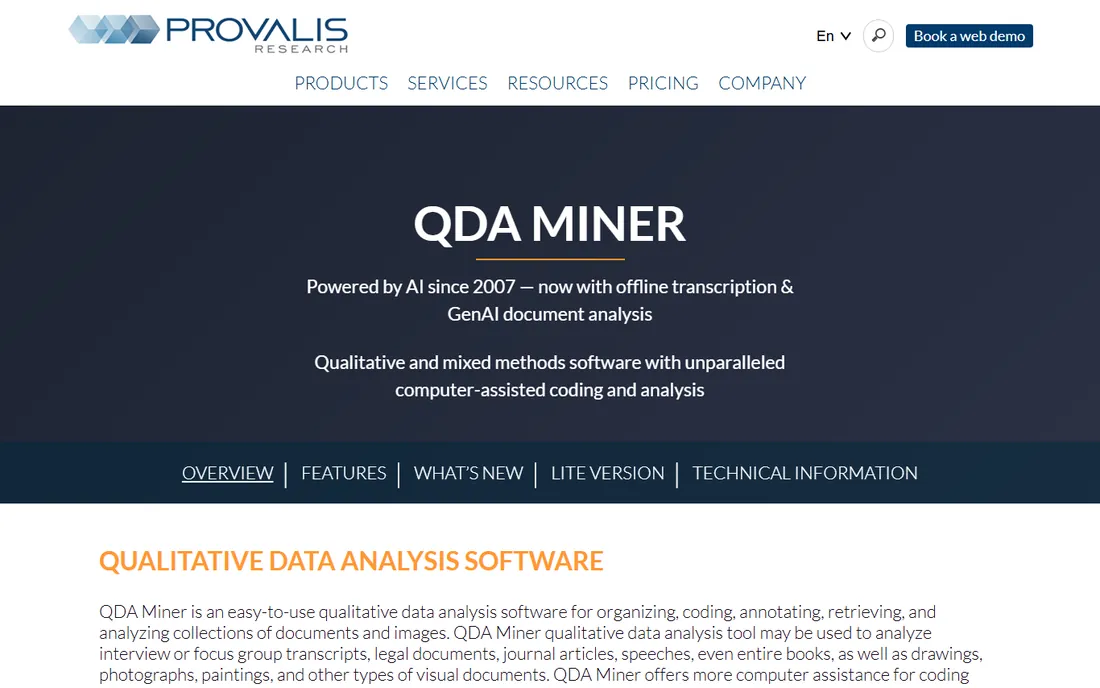
QDA Miner offers more computer-assisted coding than any competitor, with seven-plus text search tools, cluster extraction, and AI-assisted coding suggestions that explain their reasoning. Integration with WordStat for text mining and SimStat for statistics makes it a full mixed methods platform in one purchase.
The interface is powerful rather than pretty. Researchers doing serious text mining and statistical integration get the most from it. The inter-rater agreement module is a standout for team projects where coding reliability must be measured and reported.
What we like- Deepest computer-assisted coding
- Integrates with WordStat and SimStat
- GIS and timeline analysis
Watch out for- Windows-focused
- Steeper learning curve
- Pricing not public
Starting priceFree
Free planYes
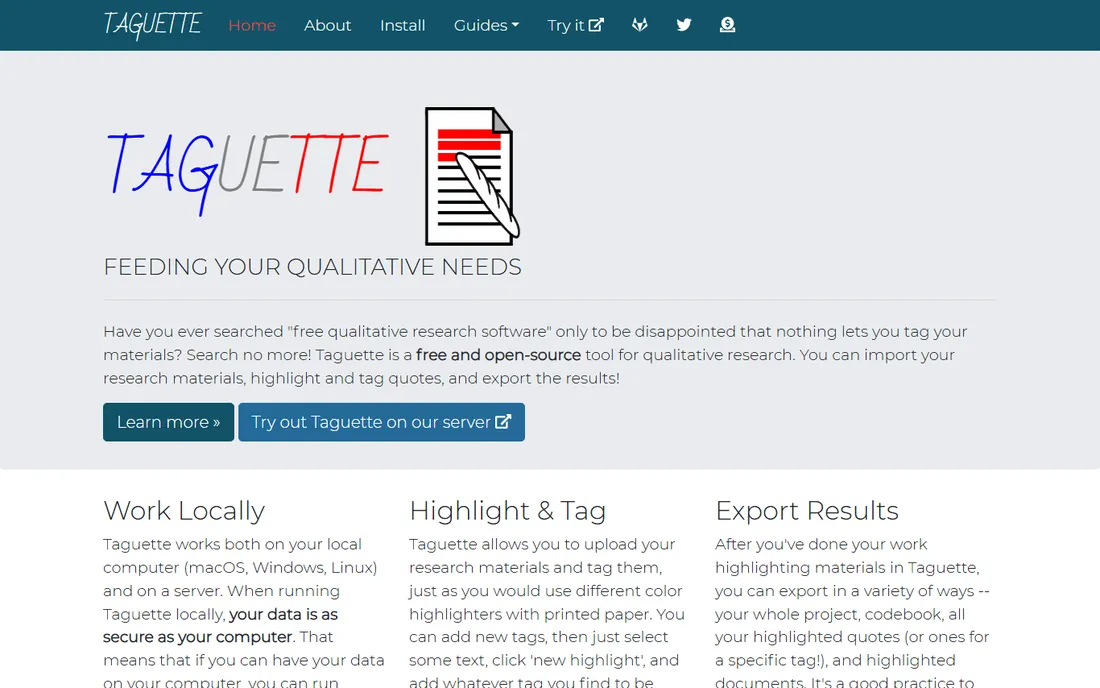
Taguette is the free, open source qualitative coding tool: upload materials, highlight passages, tag them, and export your codebook. It runs locally on Mac, Windows, and Linux, so your research data never leaves your own computer.
It will not replace NVivo for complex projects, but for straightforward coding with zero budget, it is honest, capable software. Because it is open source, methods instructors can show students exactly how the tool works under the hood.
What we like- Completely free and open source
- Runs locally for data security
- Simple highlight-and-tag workflow
Watch out for- Basic feature set
- No AI
- Small development team
How we chose
We reviewed vendor product pages, pricing pages, and researcher community discussion across forums and review sites (G2, Capterra), comparing coding depth, AI features, collaboration, platform support, pricing, and fit for students versus institutions. Every tool had to be currently available. We did not claim hands-on testing. Where possible, trial two finalists with a sample of your actual data before committing to a license, and involve the people who will do the daily coding work.
Picking by project type
Dissertation students should start with Examine, Quirkos, Dedoose, or Taguette: affordable, learnable, and sufficient for a single project. Labs and institutions with ongoing programs get more from NVivo, ATLAS.ti, or MAXQDA, where the depth pays off across many projects.
Check institutional licenses first. Many universities hold site licenses for NVivo or MAXQDA that students can use for free, which changes the math completely. Your library or IT department usually knows what is available.
Mixed methods researchers should weight Dedoose, MAXQDA, and QDA Miner highest: they handle quantitative data alongside qualitative coding natively. Teams with sensitive data should prefer MAXQDA's local AI or Quirkos's no-AI approach.
Consider your data types honestly. If your project is mostly interview transcripts, any tool here works. If you need video analysis, GIS mapping, or statistical integration, the field narrows fast, and QDA Miner or MAXQDA pull ahead.
The AI question in research
AI coding assistants are the biggest shift in this category, and they demand care. Every AI-applied code should be reviewable and reversible, with reasoning visible. For sensitive data or strict protocols, choose tools with local processing or no AI at all. Your ethics board and your methodology chapter will both thank you for the caution.
Document your AI use explicitly in your methods section. Journals and committees increasingly ask exactly how AI contributed to your analysis. Tools with audit trails, like NVivo AI Cloud and QDA Miner's explained suggestions, make that disclosure straightforward rather than awkward.
Frequently asked questions
What is the best qualitative data analysis software?
NVivo, ATLAS.ti, and MAXQDA lead the field. NVivo is the long-standing standard, ATLAS.ti leads on AI coding, and MAXQDA wins on cross-platform consistency and privacy. Your choice should follow your methodology and your institution's existing licenses.
How much does qualitative research software cost?
Dedoose charges $17.95 per active month for individuals. Taguette is free. NVivo, ATLAS.ti, MAXQDA, Examine, Quirkos, and QDA Miner use quote or tiered pricing, generally with student discounts. Always ask about educational pricing: academic discounts are often substantial but not advertised prominently.
Can I collaborate with my team in these tools?
Yes. Dedoose, Examine, and Quirkos Cloud are built for real-time collaboration, with multiple researchers coding simultaneously. NVivo AI Cloud plans team features, while ATLAS.ti, MAXQDA, and QDA Miner support teamwork through multi-user licenses and merge features.
Is there free qualitative data analysis software?
Yes. Taguette is free and open source. Dedoose, Examine, Quirkos, and QDA Miner offer free trials, and most commercial tools have student pricing.
Can I use AI for qualitative coding?
Yes, with care. ATLAS.ti, NVivo AI Cloud, MAXQDA, and Examine offer AI-assisted coding that can accelerate the tedious first pass. Always review AI-applied codes, keep the reasoning visible, and check your institution's ethics requirements before you begin coding.
What software do universities use for qualitative research?
NVivo, ATLAS.ti, and MAXQDA dominate university licenses, and campus IT can usually install them on lab machines. Many also support Dedoose and Quirkos for students, and Taguette appears in methods courses teaching qualitative fundamentals. Ask your department what is already covered before spending your own money.
Sources we checked (9)
- https://lumivero.com/products/nvivo/
- https://atlasti.com/
- https://www.maxqda.com/
- https://dedoose.com/
- https://delvetool.com/
- https://www.quirkos.com/
- https://provalisresearch.com/products/qualitative-data-analysis-software/
- https://www.taguette.org/
- https://jmsdevlab.com/blog/nvivo-alternatives-qualitative-research
Is your product missing or out of date?
We review this list regularly. Vendors can request a listing, send updated pricing or ask about featured placement.

Shihab Mia · Founder, Rankite
Shihab has spent more than a decade helping SaaS and e-commerce brands grow through search. He writes Rankite's software buying guides from pricing pages, documentation and public user reviews. More about Shihab.