How we make this list: we compare pricing pages, product documentation and public user reviews. Ratings come from G2, Capterra or Trustpilot, with the date we checked them.
Direct answer
RELEX Solutions is the top pick for retail chains that need demand, merchandise, supply chain and operations planning in one system. It suits chains with seasonal ranges and markdown pressure. Buyer's Toolbox AP is the clearer mid-market alternative, with Advanced Planning starting at $995 a month and a free working proof of concept in 1 to 2 weeks.
Key takeaways
- Retail chains with seasonal ranges should start with RELEX Solutions, which states demand forecasts capture hundreds of demand drivers in 1 planning system.
- Mid-market retailers that need a public price can check Buyer's Toolbox AP, where Advanced Planning starts at $995 a month.
- Fashion brands that want merchant-run planning can compare Toolio, which states planning grids with 250 plus metrics.
- Large retailers linking finance to execution can look at Blue Yonder, which states AI analyzes 100 plus demand signals.
- Brands aligning assortment and pricing can check Centric Planning & Pricing, whose homepage states 20,000 plus brands and 60 plus countries.
Quick comparison
| Tool | Best for | Starting price | Free plan |
|---|
 RELEX Solutions | Chains unifying demand, merchandise, supply chain | See website | None found on vendor page |
 Buyer's Toolbox AP | Mid-market retailers needing OTB and forecasting | Advanced Planning starts at $995 a month | Free working proof of concept on your data in 1 to 2 weeks; no free plan stated |
 Toolio | Fashion brands needing merchant-run planning | See website | None found on vendor page |
 Anaplan Retail Planning | Enterprises connecting merchandise and finance plans | See website | None found on vendor page |
 Blue Yonder Retail Planning | Large retailers linking finance to execution | See website | None found on vendor page |
 Centric Planning & Pricing | Brands aligning assortment, pricing, allocation | See website | None found on vendor page |
 o9 Solutions | Large multinationals with complex planning | See website | None found on vendor page |
 Oracle Retail | Large chains already using Oracle Retail | See website | None found on vendor page |
 ToolsGroup retail planning | Retailers needing assortment, allocation, replenishment | See website | None found on vendor page |
 Quant Retail | Retailers tying assortments to store space | See website | None found on vendor page |
Is your product missing or out of date?
We review this list regularly. Vendors can request a listing, send updated pricing or ask about featured placement.
The best merchandise planning software
Merchandise planning decides how much stock to buy, where it should go, and when price action should clear it. The work links financial targets, open-to-buy budgets, assortment choices, allocation and markdowns. A weak plan creates two losses at once: empty shelves in strong stores and clearance stock in weak ones. This list ranks tools by merchandise planning fit first, then by assortment, allocation and pricing depth on vendor pages. Enterprise platforms rank high for complex chains. Focused tools rank high for mid-market and fashion teams. Prices are stated only where vendor pages publish them.
Starting priceSee website
Free planNone found on vendor page
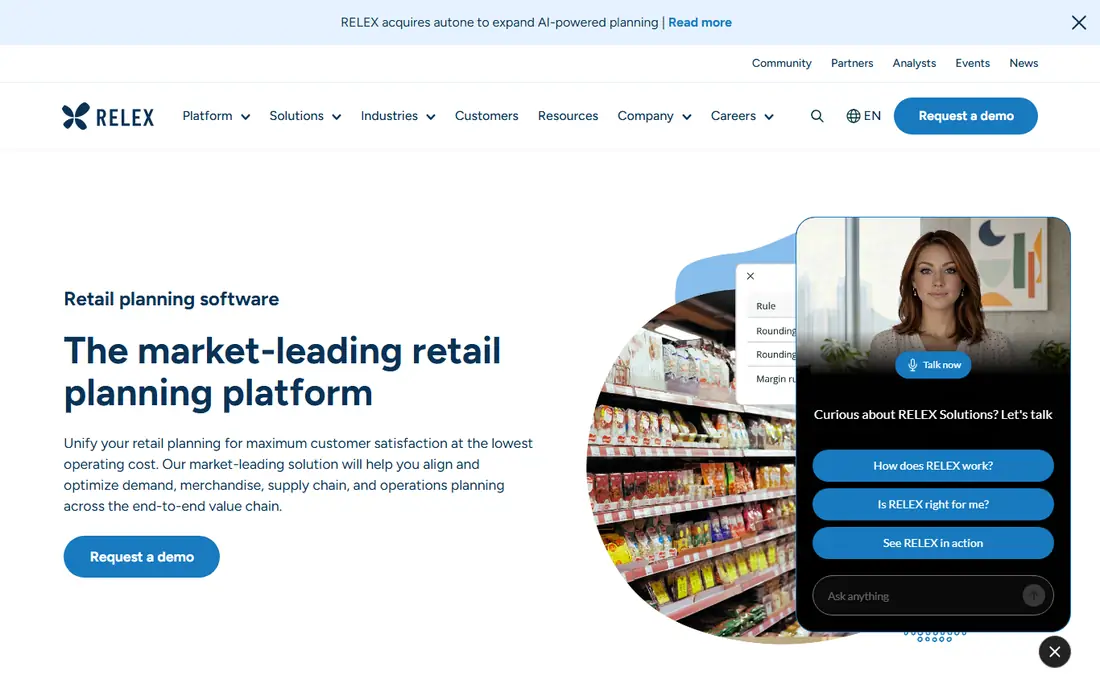
RELEX Solutions is built for chains that want merchandise planning connected to demand, supply chain and store operations. Its retail planning page states alignment across demand, merchandise, supply chain and operations planning. The seasonal cycle combines pre-season ordering, allocation, replenishment, clearance and markdowns, which matches how seasonal retail actually runs. Demand forecasts capture weekdays, price, promotions, cannibalization, holidays, local events and weather. The vendor states forecasts capture hundreds of demand drivers. It suits chains where a buying decision in one category affects space, stock and markdowns in another. Seasonal teams gain one view of stock risk.
The catch is scope and price access. RELEX lists no price on the retail planning page checked, and its breadth spans merchandising to store operations. A retailer that only needs open-to-buy planning may buy a wider platform than the problem requires. Pick RELEX if planning must connect across departments and stores. Look elsewhere if you need a published price or a narrow merchandise financial planning tool.
What we like- Aligns demand, merchandise, supply chain, and operations planning
- Seasonal cycle combines pre-season ordering, allocation, replenishment, clearance, and markdowns
- Demand forecasts capture weekdays, price, promotions, cannibalization, holidays, local events, and weather
Watch out for- No price listed on opened retail planning page
- Breadth spans merchandising to store operations, so module scope needs vendor scoping
#2
Buyer's Toolbox AP
Best for: Mid-market retailers needing OTB and forecasting
Visit antusa.com
Starting priceAdvanced Planning starts at $995 a month
Free planFree working proof of concept on your data in 1 to 2 weeks; no free plan stated
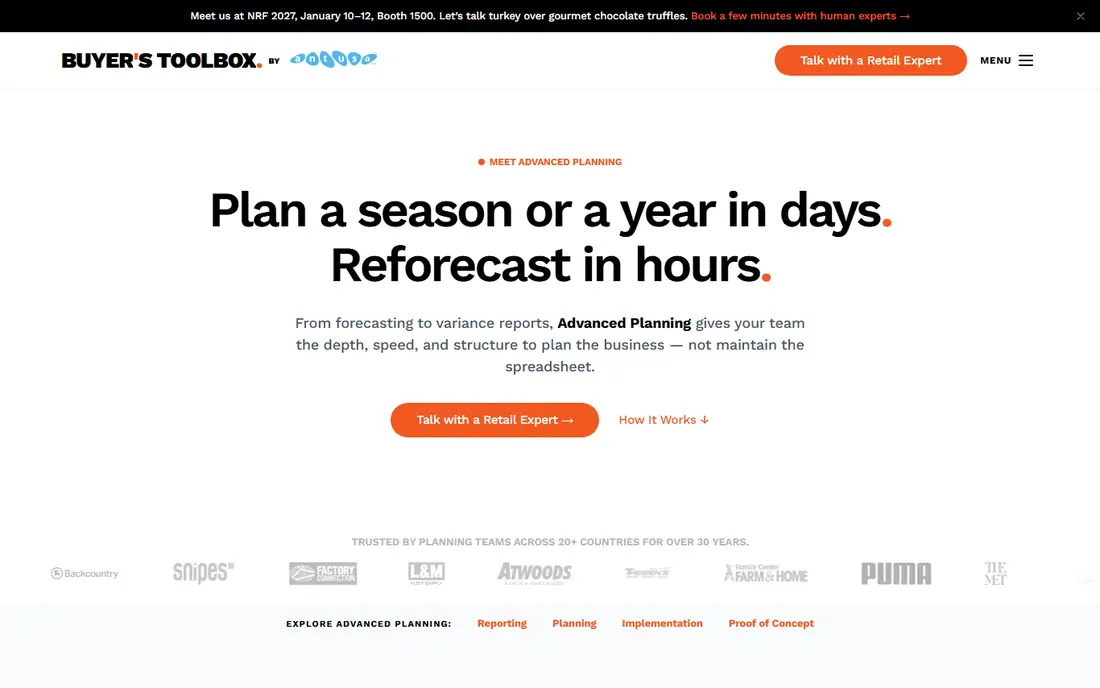
Buyer's Toolbox AP is the clearest mid-market option in this list. It states merchandise financial planning, open-to-buy, forecasting, category and WSSI planning, vendor planning, collections and key items in one product. Planning can run top-down, bottom-up and middle-out at item, week and location level. Deployment can be cloud, on-premise or hybrid. Advanced Planning starts at $995 a month on the vendor comparison page opened, and the vendor offers a free working proof of concept on your data in 1 to 2 weeks. It suits retailers leaving spreadsheets who still need weekly trading control.
The catch is that some depth sits in extensions. Allocation, data science and Exception Intelligence are extensions, so the $995 starting price may not cover the full need. The price was read on a vendor comparison page because a dedicated pricing page did not surface in search. Pick Buyer's Toolbox AP for mid-market open-to-buy control with a stated price. Look elsewhere if allocation must be in the base product.
What we like- MFP, OTB, forecasting, category/WSSI, vendor planning, collections, and key items in one product
- Top-down, bottom-up, and middle-out planning at item/week/location
- Cloud, on-premise, or hybrid deployment stated
Watch out for- Allocation, data science, and Exception Intelligence are extensions
- Dedicated pricing page URL did not surface in search, price was read on the vendor comparison page opened
#3
Toolio
Best for: Fashion brands needing merchant-run planning
Visit toolio.com
Starting priceSee website
Free planNone found on vendor page
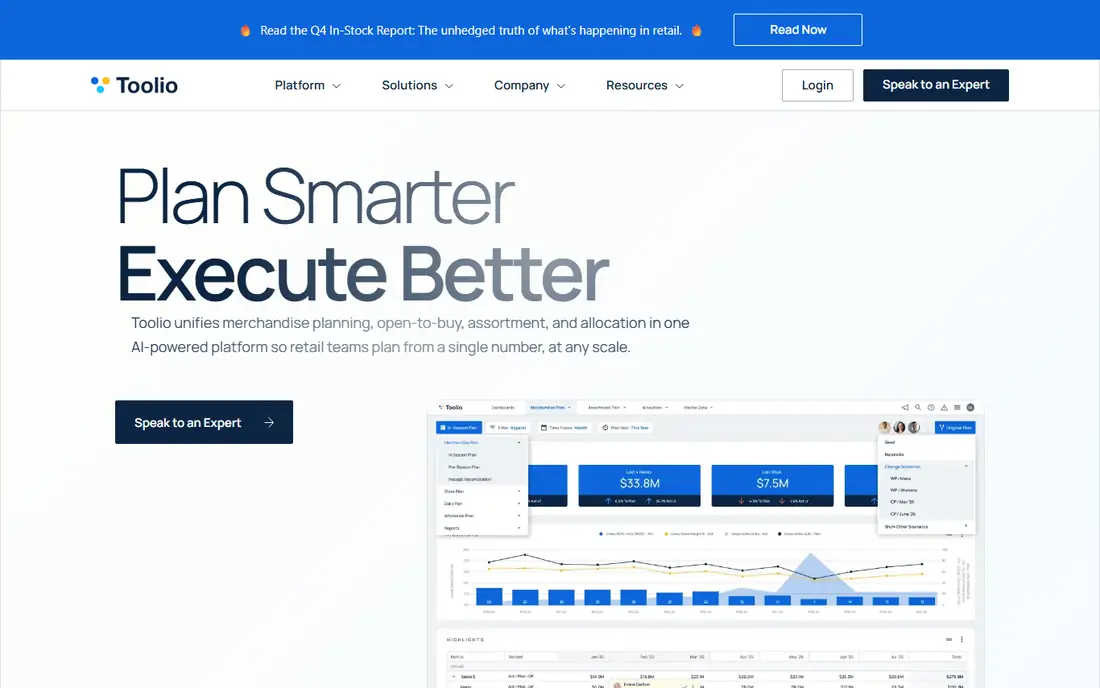
Toolio is aimed at fashion brands and merchant teams that run planning themselves. It states merchandise planning, assortment and allocation in one connected system. Weekly open-to-buy runs with top-down and bottom-up reconciliation, which helps merchants compare financial targets with item-level plans. Tournament forecasting tests multiple models and selects per category or product. The vendor states planning grids with 250 plus metrics on its demo page. Toolio suits brands where merchants need speed and detail without a large enterprise planning program. Its fashion focus is a strength for apparel teams. Merchants can test plans before orders are placed.
The catch is buying access. Toolio lists no price on the homepage or merchandise planning page checked, and the page directs buyers to start a conversation rather than self-serve signup. Budget comparison therefore starts later than with Buyer's Toolbox AP. Pick Toolio if merchant-run fashion planning is the priority. Look elsewhere if you need a public price or a broad enterprise planning platform.
What we like- Merchandise planning, assortment, and allocation in one connected system
- Weekly open-to-buy with top-down and bottom-up reconciliation
- Tournament forecasting tests multiple models and selects per category or product
Watch out for- No price listed on opened homepage or merchandise planning page
- Page directs buyers to start a conversation rather than self-serve signup
#4
Anaplan Retail Planning
Best for: Enterprises connecting merchandise and finance plans
Visit anaplan.com
Starting priceSee website
Free planNone found on vendor page
Anaplan Retail Planning suits enterprises that connect merchandise plans with finance plans. It states merchandise financial planning, assortment planning, size optimization and allocation applications. A unified view covers physical stores, online and wholesale channels. Scenario modeling lets teams test choices before inventory or capital is committed, which matters when open-to-buy decisions lock cash for a season. Anaplan fits retailers with several channels and a finance team that plans in the same model as merchants. It is a platform choice, not a small standalone planning app. Finance teams can review the same plan.
The catch is enterprise scope. No public pricing page was found in site search, and model setup scope must be checked before budgeting. A mid-market retailer may find the platform heavier than the planning problem. Pick Anaplan if merchandise, finance and channel plans must share one model. Look elsewhere if you need a stated starting price or fast merchant-led setup.
What we like- MFP, assortment planning, size optimization, and allocation applications
- Unified view across physical stores, online, and wholesale
- Scenario modeling before inventory or capital is committed
Watch out for- No public pricing page found in site search
- Platform is positioned as enterprise planning, so model setup scope must be checked before budgeting
#5
Blue Yonder Retail Planning
Best for: Large retailers linking finance to execution
Visit blueyonder.com
Starting priceSee website
Free planNone found on vendor page
Blue Yonder Retail Planning fits large retailers that link financial budgets to assortment and allocation execution. Sales, inventory and open-to-buy budgets flow into assortment and allocation. Scenario planning adjusts sales, pricing, promotions or inventory, so merchants can test trade-offs before committing stock. The merchandise operations page covers item data, vendor terms, pricing, costs and inventory in one foundation. The vendor states AI analyzes 100 plus demand signals. It suits chains where item data quality and vendor terms shape planning accuracy as much as forecast models. Planners can test budget changes before buying.
The catch is cost visibility. Blue Yonder lists no price on the merchandise or financial planning pages checked. Implementation and optimization services are part of the offer, so services scope must be priced separately from licenses. Pick Blue Yonder if finance-to-execution planning at large scale is the need. Look elsewhere if you want a focused tool with a published monthly price.
What we like- Sales, inventory, and Open-to-Buy budgets flow into assortment and allocation
- Scenario planning adjusts sales, pricing, promotions, or inventory
- Merchandise operations page covers item data, vendor terms, pricing, costs, and inventory in one foundation
Watch out for- No price listed on opened merchandise or financial planning pages
- Implementation and optimization services are part of the offer, so services scope must be priced separately
Starting priceSee website
Free planNone found on vendor page
Centric Planning & Pricing suits brands that align assortment, pricing and allocation in one workflow. The vendor states it connects planning, pricing and inventory, with demand-led planning and in-season allocation. That pricing link matters for fashion and seasonal brands, where the right assortment at the wrong price still fails. The homepage states 20,000 plus brands and 60 plus countries. Centric fits brands already interested in product lifecycle tools, since planning sits inside a broader product platform. It is strongest where assortment decisions and price decisions are made by the same team.
The catch is platform breadth. Planning sits inside a wider platform with PLM, market intelligence, visual boards and PXM, so buyers should confirm module scope. No price was listed on the homepage or planning page checked. Pick Centric if assortment, pricing and allocation must move together in writing. Look elsewhere if you only need merchandise financial planning without product platform tools.
What we like- Connects planning, pricing, and inventory
- Aligns assortment, pricing, and allocation
- Demand-led planning and in-season allocation are stated on the homepage
Watch out for- No price listed on opened homepage or planning page
- Planning sits inside a broader product platform with PLM, market intelligence, visual boards, and PXM
Starting priceSee website
Free planNone found on vendor page
o9 Solutions is an enterprise planning platform for large multinationals. Its core solutions list includes Merchandise Planning and Assortment Planning. Integrated planning spans supply chain, commercial and financial functions, so merchandise choices can be tested against supply and finance constraints. The vendor states pricing factors include industry complexity, users, functions, solutions and implementation approach. It serves 30 plus industry verticals, per the vendor page. o9 suits retailers with complex networks, many markets and planning teams that need one model across functions. It is not a light tool for a small chain.
The catch is fit and price access. o9 states pricing is not published, and it states it is not typically positioned for small businesses, startups or single-site operations. A demo page states 30 minutes, tailored, with no commitment, but that is not a trial. Pick o9 for complex multinational planning. Look elsewhere if you run a small or single-site retail business.
What we like- Core solutions list includes Merchandise Planning and Assortment Planning
- Integrated planning spans supply chain, commercial, and financial functions
- Pricing factors are stated as industry complexity, users, functions, solutions, and implementation approach
Watch out for- Vendor states pricing is not published
- Vendor states it is not typically positioned for small businesses, startups, or single-site operations
#8
Oracle Retail
Best for: Large chains already using Oracle Retail
Visit oracle.com
Starting priceSee website
Free planNone found on vendor page
Oracle Retail suits large chains already using Oracle Retail systems. The merchandising page states a single central source for merchandising information and perpetual inventory. Allocation can use hierarchy, item groups, orders, ASNs, transfers, stock on hand, demand forecasts, or plan and history. It integrates with Oracle Retail supply chain, planning, omnichannel and financials. Retail Home features thousands of preintegrated metrics, per the vendor page. Oracle fits chains where merchandising data discipline is the main problem and existing Oracle systems already hold item and inventory records. Central data reduces conflicting item records.
The catch is module scope. The opened page centers merchandising foundation, allocation, pricing and insights, so merchandise financial planning module scope needs confirmation before purchase. No price was listed on the merchandising page checked. Pick Oracle Retail if your chain already runs Oracle Retail and needs central merchandising data. Look elsewhere if you need a standalone planning tool with clear MFP scope.
What we like- Single central source for merchandising information and perpetual inventory
- Allocation can use hierarchy, item groups, orders, ASNs, transfers, stock on hand, demand forecasts, or plan and history
- Integrates with Oracle Retail supply chain, planning, omnichannel, and financials
Watch out for- No price listed on opened merchandising page
- Opened page centers merchandising foundation, allocation, pricing, and insights, so MFP module scope needs confirmation
#9
ToolsGroup retail planning
Best for: Retailers needing assortment, allocation, replenishment
Visit toolsgroup.com
Starting priceSee website
Free planNone found on vendor page
ToolsGroup retail planning covers forecasting, inventory allocation, assortment planning and replenishment. Connected workflows align buying, merchandise planning and store planning, which suits retailers that plan ranges and store stock together. The vendor index lists merchandise financial planning and assortment planning pages, and states 400 plus brands across 45 plus countries. ToolsGroup fits retailers whose main gap is allocation and replenishment after the range is chosen. It can sit between financial planning and store execution, rather than replacing every planning function at once. Store teams see allocation effects sooner during range reviews.
The catch is packaging clarity. No price was listed on the retail planning or demo page checked. Portfolio names include SO99+, JustEnough and Decion, so current packaging needs confirmation before comparing modules. Pick ToolsGroup if assortment, allocation and replenishment must connect in writing before signing. Look elsewhere if you need a public price or one clearly named merchandise planning product.
What we like- Retail planning covers forecasting, inventory allocation, assortment planning, and replenishment
- Connected workflows align buying, merchandise planning, and store planning
- Vendor index lists merchandise financial planning and assortment planning pages
Watch out for- No price listed on opened retail planning or demo page
- Portfolio names include SO99+, JustEnough, and Decion, so current packaging needs confirmation
Starting priceSee website
Free planNone found on vendor page
Quant Retail suits retailers that tie assortments to store space. Its solutions list category management, demand forecasting and planning, planograms, store-specific planograms, automatic replenishment and floor planning. Store-specific planograms are generated from template rules, and automatic replacements can be specified by replacement and condition. That space link helps chains where the same assortment cannot fit every store format. A vendor case study page quotes 132 plus active stores and 70 plus display categories for Keells. Quant fits space-led assortment work more than financial open-to-buy planning. Space limits become visible before orders ship.
The catch is planning scope. The opened solutions page is space and planogram led, with no merchandise financial planning module named. An official pricing page was not found in search, and third-party price figures conflicted, so this guide lists See website. Pick Quant if store space and planograms drive assortment choices. Look elsewhere if merchandise financial planning and open-to-buy budgets are the core need.
What we like- Solutions list category management, demand forecasting and planning, planograms, store-specific planograms, automatic replenishment, and floor planning
- Store-specific planograms are generated from template rules
- Automatic replacements can be specified by replacement and condition
Watch out for- Official pricing page was not found in search, and third-party price figures conflicted, so no price is listed here
- Opened solutions page is space and planogram led, with no merchandise financial planning module named
How much does merchandise planning software cost?
Most merchandise planning software does not publish a price. In this list, only Buyer's Toolbox AP states a starting price on an opened vendor page: Advanced Planning starts at $995 a month. The other nine tools say See website because opened vendor pages listed no starting price. Budget for scope, not only licenses. Allocation, data science and Exception Intelligence are extensions for Buyer's Toolbox AP. Blue Yonder services scope must be priced separately. o9 states pricing factors include industry complexity, users, functions, solutions and implementation approach. Ask each vendor which modules are included before comparing quotes. At $995 a month, Buyer's Toolbox AP costs $11,940 over 12 months before extensions. An enterprise quote can change with users, functions and implementation approach, as o9 states. Compare 3-year cost with services included, not the first license line alone. Include training, data cleanup and module extensions in every quote you compare.
What is the difference between merchandise planning and assortment planning?
Merchandise planning sets the financial frame: sales, inventory, open-to-buy budgets and markdown plans by category and period. Assortment planning chooses the items, sizes, colors and store clusters inside that frame. Blue Yonder states sales, inventory and open-to-buy budgets flow into assortment and allocation. Toolio states merchandise planning, assortment and allocation in one connected system. A retailer can have a sound assortment plan and still overspend if open-to-buy control is weak. Judge tools on both layers.
Toolio and Centric Planning & Pricing fit fashion brands best in this list. Toolio states weekly open-to-buy with top-down and bottom-up reconciliation and planning grids with 250 plus metrics. Centric aligns assortment, pricing and allocation with demand-led planning and in-season allocation. Buyer's Toolbox AP also states collections and key items planning. Fashion teams should test size, color and in-season allocation depth before buying. Enterprise platforms such as Anaplan fit larger fashion groups with several channels.
Do small retailers need merchandise planning software?
Small retailers need merchandise planning discipline, but not always enterprise software. o9 states it is not typically positioned for small businesses, startups or single-site operations. Buyer's Toolbox AP states a $995 monthly starting price and a free working proof of concept in 1 to 2 weeks, which fits mid-market teams better. A single-store retailer can often manage with disciplined open-to-buy spreadsheets. Multi-store retailers with seasonal stock should compare Toolio and Buyer's Toolbox AP before enterprise platforms.
Frequently asked questions
What is the best merchandise planning software for mid-market retailers?
Buyer's Toolbox AP is the clearest mid-market pick because Advanced Planning starts at $995 a month and the vendor offers a free working proof of concept in 1 to 2 weeks. It states MFP, OTB, forecasting, category planning, vendor planning, collections and key items. Toolio fits fashion-led mid-market brands that want merchant-run planning.
Which merchandise planning tools publish pricing?
Only Buyer's Toolbox AP published an exact starting price on an opened vendor page in this research: Advanced Planning starts at $995 a month. RELEX, Toolio, Anaplan, Blue Yonder, Centric, o9, Oracle Retail, ToolsGroup and Quant Retail are marked See website. o9 states pricing is not published and lists pricing factors instead.
What is open-to-buy in merchandise planning?
Open-to-buy is the budget available for new stock purchases in a period after planned sales, markdowns and inventory targets are set. Buyer's Toolbox AP states OTB planning with top-down, bottom-up and middle-out planning at item, week and location level. Toolio states weekly open-to-buy with top-down and bottom-up reconciliation. Blue Yonder states open-to-buy budgets flow into assortment and allocation.
Should retailers choose RELEX or Blue Yonder for merchandise planning?
Choose RELEX if demand, merchandise, supply chain and operations planning must align in one seasonal cycle. Choose Blue Yonder if sales, inventory and open-to-buy budgets must flow into assortment and allocation at large scale. Both list See website for pricing. Blue Yonder services scope must be priced separately, while RELEX module scope needs vendor scoping.
What should buyers check before signing a merchandise planning contract?
Check module scope first: MFP, assortment, allocation, pricing and markdowns may sit in different modules. Buyer's Toolbox AP lists allocation as an extension. Oracle Retail MFP scope needs confirmation from the merchandising page checked. Confirm price, implementation scope and data feeds in writing before comparing enterprise quotes.
What to look for before you buy
First, confirm whether the tool covers merchandise financial planning, assortment, allocation and markdowns, or only part of that chain. Second, check open-to-buy depth at item, week and location level, as stated by Buyer's Toolbox AP. Third, ask which modules cost extra, since allocation can be an extension. Fourth, test scenario planning with price, promotion and inventory changes before committing capital. Fifth, require a written price and services scope, since nine of these 10 tools list See website.
How we chose
We built a candidate list of merchandise, assortment and retail planning tools, then kept 10 with live official planning pages. Prices and trial terms were checked on vendor pages on 2026-11-27. Only Buyer's Toolbox AP published an exact starting price. No hands-on testing was done. Strengths and weaknesses point to vendor page facts, such as stated modules, pricing factors and planning scope.
Sources we checked (10)
- https://www.relexsolutions.com/solutions/retail-planning/
- https://antusa.com/why-us/vs-s5-stratos/
- https://www.toolio.com/merchandise-planning
- https://www.anaplan.com/solutions/retail-planning/
- https://blueyonder.com/solutions/retail-planning/merchandise
- https://www.centricsoftware.com/?p=618910
- https://o9solutions.com/ai-info
- https://www.oracle.com/ch-fr/retail/merchandising/cloud/
- https://toolsgroup.com/solutions/retail-planning/
- https://www.quantretail.com/en/solutions
Is your product missing or out of date?
We review this list regularly. Vendors can request a listing, send updated pricing or ask about featured placement.

Shihab Mia · Founder, Rankite
Shihab has 5+ years in B2B and SaaS SEO. He writes Rankite's software buying guides from pricing pages, documentation and public user reviews. More about Shihab.