How we make this list: we compare pricing pages, product documentation and public user reviews. Rankite is independent; if a vendor ever pays for a featured spot, that listing is clearly labeled Partner.
Key takeaways
- MentorcliQ is the enterprise pick for large mentoring and ERG programs, with published entry pricing at $9,900 per year for up to 100 employees.
- Mentorloop at $299 per month is the most transparent option for small to mid-size programs that want a price before a sales call.
- Together and Chronus lead on matching quality and program analytics, but both price by quote, so expect an enterprise sales cycle.
- PushFar is the only name here with a genuinely free tier for individual users, which makes it a low-risk pilot option.
- Most vendors charge annually per participant, so negotiate the participant definition before signing: some count every enrollee, others only matched pairs.
Quick comparison
| Tool | Best for | Starting price | Free plan |
|---|
 Together Together | HR-led mentoring with strong analytics | See website | No |
 MentorcliQ MentorcliQ | Enterprise mentoring and ERG programs | $9,900/year (CliQ Start, up to 100 employees) | No |
 Chronus Chronus | Highly customized enterprise programs | See website | No |
 Qooper Qooper | AI-assisted matching at scale | See website | No |
 Mentorloop Mentorloop | Small to mid-size programs with flat pricing | $299/month (Pro) | Free trial |
 PushFar PushFar | Career development with free individual tier | See website | Yes |
 Guider Guider | AI-driven inclusive development programs | See website | No |
 10KC 10KC | Informal networking and coffee chats | See website | No |
 Mentornity Mentornity | Smaller programs with entry pricing | See website | Free trial |
Is your product missing or out of date?
We review this list regularly. Vendors can request a listing, send updated pricing or ask about featured placement.
The best best mentoring software
What happens to your mentoring program after the kickoff meeting? That is the question that decides whether you need software at all. Most companies can match mentors and mentees with a spreadsheet. What they cannot do with a spreadsheet is keep three hundred pairs meeting regularly, measure whether anyone benefited, and prove the program reduced turnover.
The second question is who the program serves. A graduate onboarding program needs structured cohorts and milestones. An ERG mentoring initiative needs self-matching and community features. A leadership pipeline needs goal tracking and executive reporting. The platforms below cover that range, from informal networking tools to enterprise systems with AI matching and ROI dashboards.
Pricing in this category is famously opaque, with most vendors quoting by participant count and program scope. Where a vendor publishes pricing, it is noted below. Everywhere else, budget for a sales conversation and compare at least three vendors on total annual cost.
Starting priceSee website
Free planNo
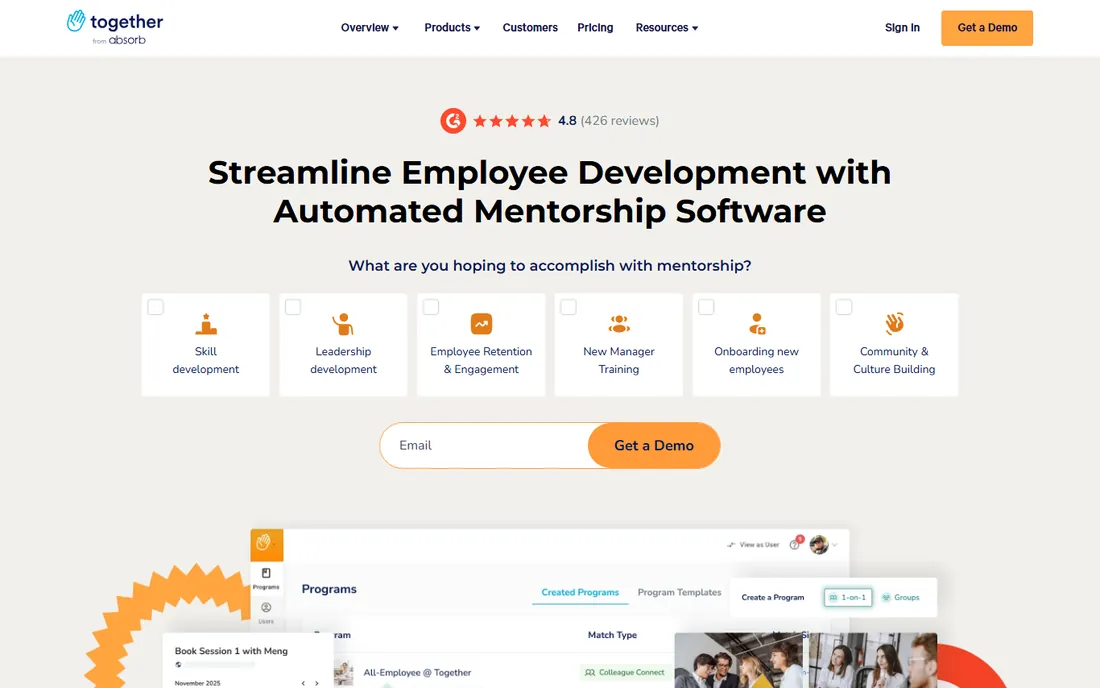
Together is one of the most established names in corporate mentoring software, built specifically for HR teams running formal programs. Registration, matching, goal setting, and progress tracking all live in one platform, with integrations into the HRIS and communication tools employees already use.
The matching engine is the core strength. Admins can run algorithm-assisted matching based on skills, goals, and development areas, or let participants self-select from suggested profiles. Program dashboards track meeting frequency, goal completion, and satisfaction, which gives L&D teams the data they need to defend the program budget.
The friction is pricing. Together does not publish rates, and third-party listings suggest entry pricing around $10,000 per year, which puts it firmly in the mid-market and enterprise bracket. If you run a program under fifty participants, the sales process may feel heavy for what you need.
What we like- Purpose-built for HR and L&D teams
- Strong pairing algorithms
- Clear program reporting
Watch out for- Quote-only pricing with no published tiers
- Enterprise sales process for mid-size buyers
Starting price$9,900/year (CliQ Start, up to 100 employees)
Free planNo
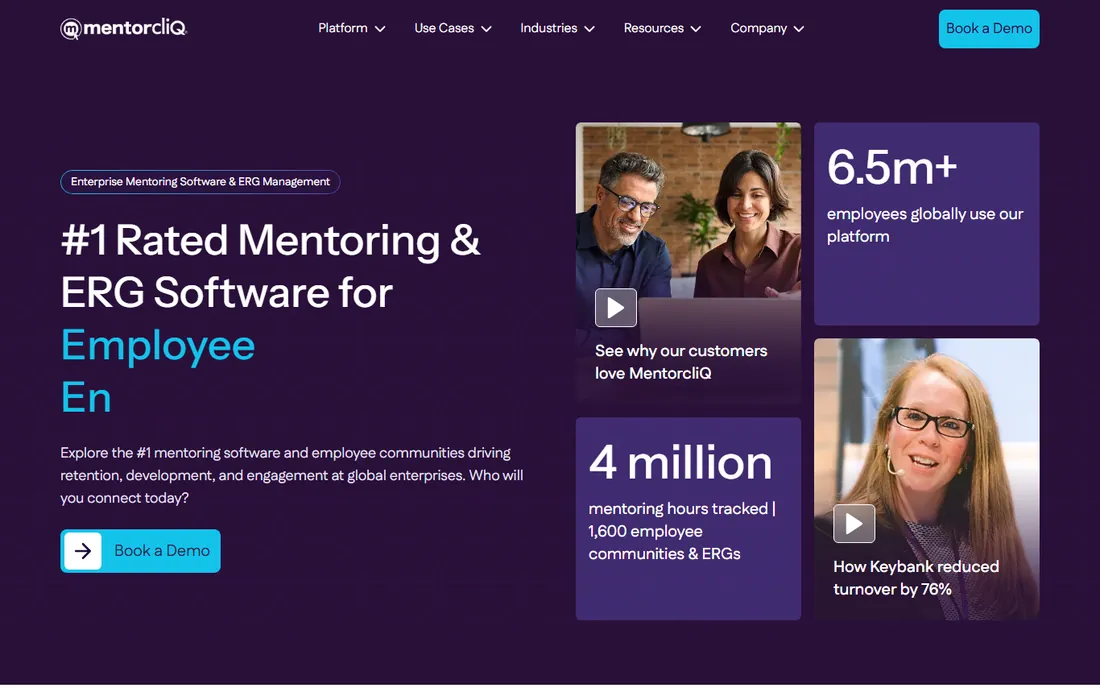
MentorcliQ stands out in this category for publishing a starting price: $9,900 per year for the CliQ Start plan covering up to 100 employees. That transparency is rare here and makes it the easiest enterprise mentoring platform to budget for. Higher tiers, CliQ Plus and CliQ Complete, add a dedicated success coach and AI assistance but move to custom pricing.
The platform's SMART Matching technology offers four matching styles, from fully admin-driven to self-matching, which suits companies running several program types at once. A companion product, CommunityCliQ, handles employee resource group management alongside mentoring, making MentorcliQ a natural pick for DEI-adjacent programs.
The honest trade-off is the per-employee pricing model. At scale, the annual cost climbs well past the entry figure, and there is no free trial to validate the fit before the sales conversation. For companies under 100 participants that want an enterprise-grade platform with a known starting price, it is the most straightforward option.
What we like- Published entry pricing
- SMART Matching with four matching modes
- Dedicated success coaching on higher tiers
Watch out for- No free trial
- Upper tiers are quote-only
- Per-employee model gets expensive at scale
Starting priceSee website
Free planNo
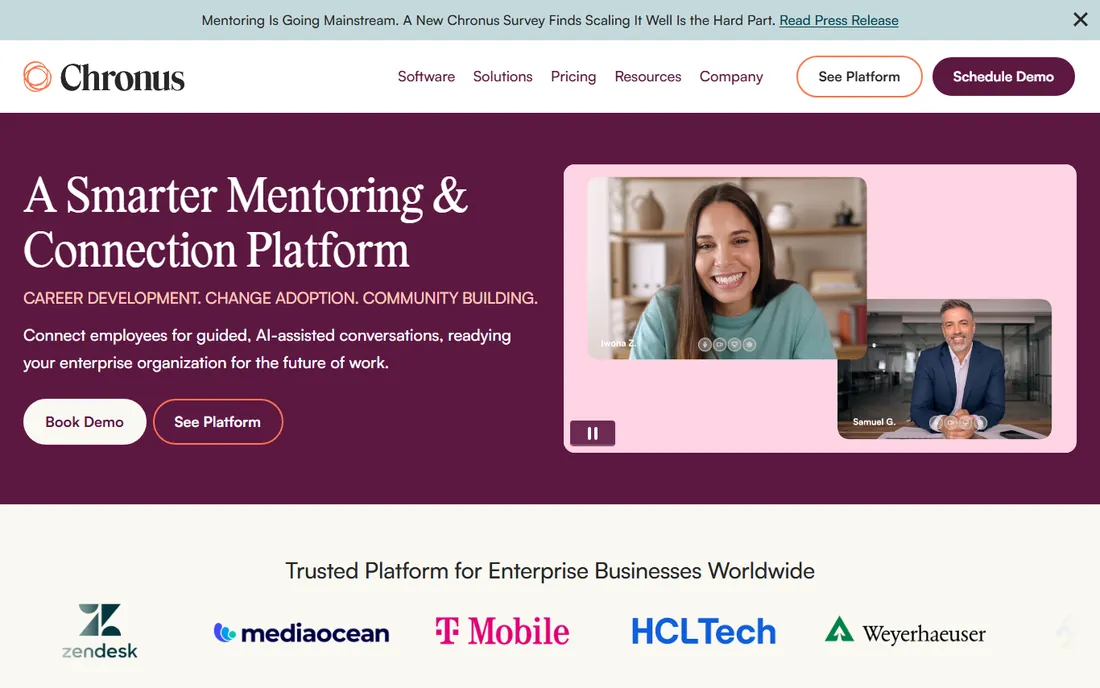
Chronus is the veteran of enterprise mentoring software, with a platform designed around customization. Matching algorithms, program workflows, surveys, and reports can all be tailored to how a specific company runs its programs, which is why large organizations with complex requirements keep choosing it.
The reporting depth is the practical advantage. For companies that need to show mentoring's impact on retention, promotion rates, and engagement across business units, Chronus provides the analytics layer that simpler tools lack. It supports every common mentoring model: one-to-one, group, peer, reverse, and onboarding programs.
The cost of that flexibility is implementation time. Chronus is not a tool you deploy in a week; it is a platform you configure with the vendor's help. Pricing is entirely quote-based and sits at the enterprise end. Smaller companies will find the process disproportionate to their needs.
What we like- Deep customization of matching and workflows
- Strong reporting for large programs
- Long enterprise track record
Watch out for- Quote-only pricing
- Implementation takes longer than simpler tools
- Best value at enterprise scale
Starting priceSee website
Free planNo
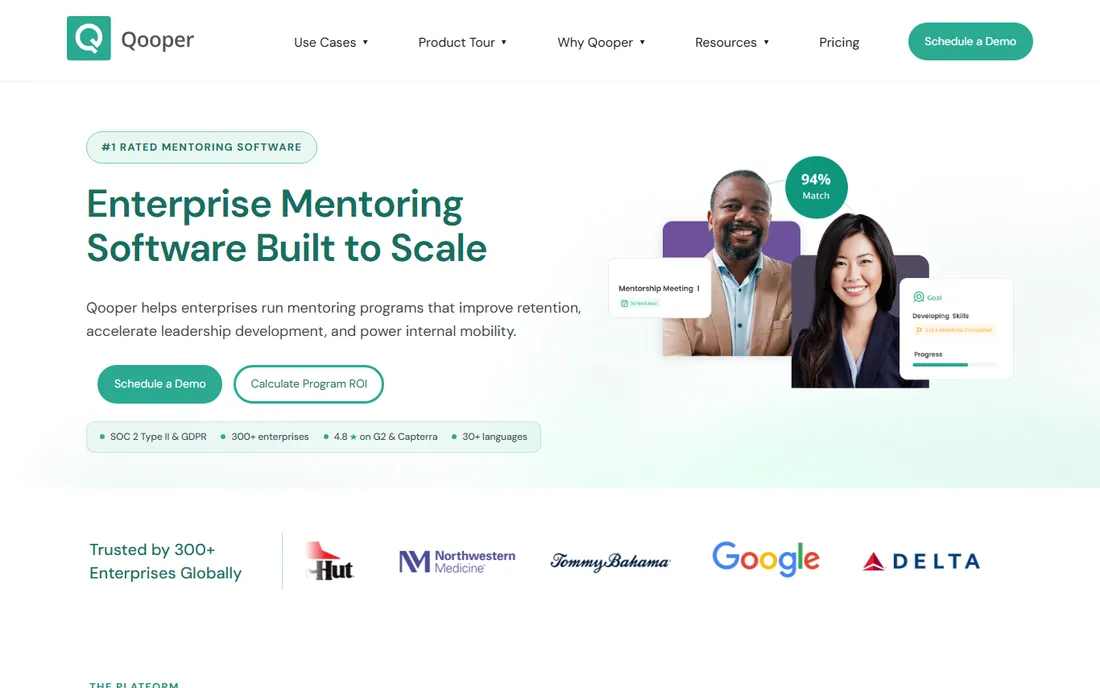
Qooper positions itself as the automation-first mentoring platform. AI-assisted matching handles the pairing work that consumes program managers' time, and the platform scales from a single cohort to company-wide programs without adding administrative headcount. It suits organizations running several mentoring formats simultaneously.
Customization runs deep: program structures, matching criteria, communication flows, and reporting can all be adapted. That flexibility appeals to companies with unusual program designs, such as cross-functional mentoring combined with learning paths or ERG initiatives with their own governance.
The downside mirrors the upside. The breadth of options means first-time administrators face a learning curve, and the quote-based pricing keeps the true cost hidden until late in the sales process. Qooper fits mid-size to enterprise companies that know what they want to automate; it is more than most small programs need.
What we like- Highly customizable program design
- AI matching reduces admin workload
- Good for diverse program types
Watch out for- Quote-only pricing
- Feature breadth can overwhelm first-time admins
- Enterprise-oriented sales process
Starting price$299/month (Pro)
Free planFree trial
Mentorloop is the approachable option in a category full of enterprise sales processes. The Pro plan costs $299 per month as a flat rate, which means no per-participant calculations and no surprise invoices when enrollment grows. That pricing honesty has made it popular with associations, nonprofits, and mid-size companies.
The platform covers the essentials well: matching, goal setting, meeting scheduling, messaging, and program reporting, all in an interface that participants actually use without training. It supports multiple program models including one-to-one, group, and reverse mentoring, and it handles cohort-based programs cleanly.
The honest limitation is analytical depth. Mentorloop reports on participation and engagement, but it does not match the ROI modeling of MentorcliQ or Chronus. Larger enterprises tend to outgrow it. For programs under a few hundred participants that want software working this month, the flat price and free trial make it an easy test.
What we like- Flat monthly pricing with no per-user math
- Easy for participants to use
- Good for community and association programs
Watch out for- Less depth in enterprise analytics
- Advanced features reserved for the enterprise tier
- Smaller vendor
Starting priceSee website
Free planYes
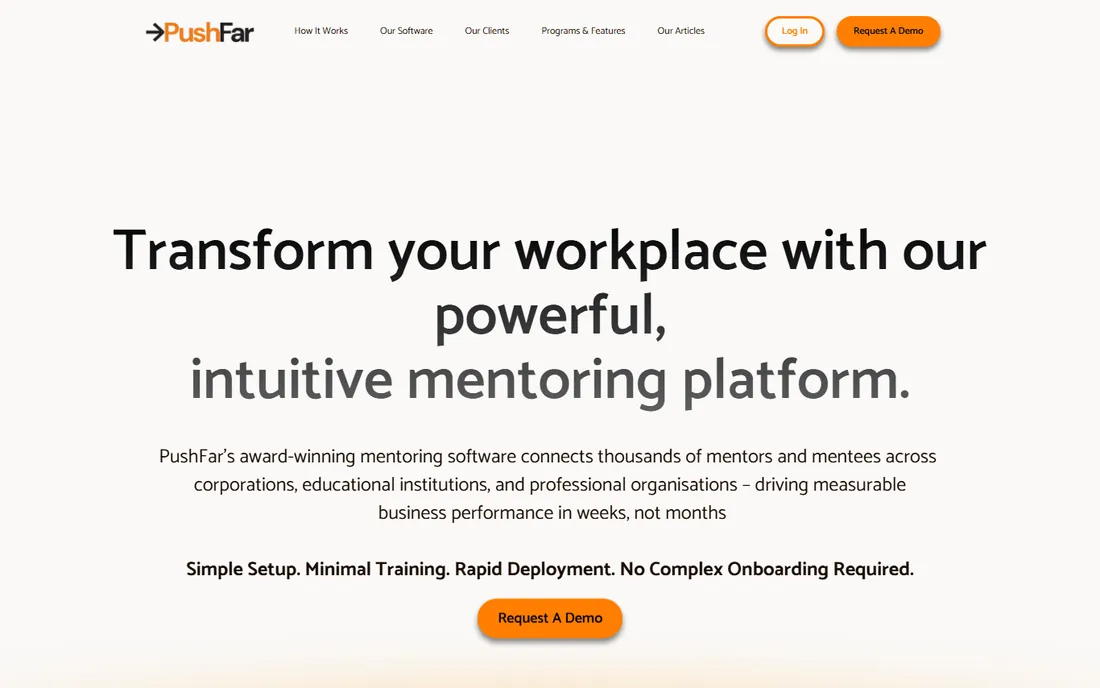
PushFar takes a different angle from the HR-platform vendors: it frames mentoring as part of career development, with goal tracking, skill development, and progression planning built around the mentoring relationship. Individuals can join the platform's network for free, which creates a built-in community of mentors and mentees beyond any single company.
For organizations, PushFar offers branded mentoring programs with matching, analytics, and administration, priced by custom quote. The career development framing resonates with companies that want mentoring tied to retention and internal mobility rather than run as a standalone HR initiative.
The catch is transparency. Organizational pricing is not published, and the product's mentoring-specific depth varies by tier. It is also better known in the UK market than in the US, which can matter for support hours and reference customers. The free individual tier makes it cheap to pilot before committing the company.
What we like- Free tier for individual users
- Combines mentoring with career progression tools
- Global mentor network
Watch out for- Organizational pricing is custom and opaque
- Mentoring depth varies by plan
- Brand less known in the US
Starting priceSee website
Free planNo
Guider, styled as Guider AI, builds its pitch around inclusive development: AI-driven matching designed to give every employee access to mentoring, not just the high potentials who already have networks. That positioning has won it traction with companies where mentoring is part of a diversity and inclusion strategy.
The participant experience is modern, with guided programs, goal tracking, and nudges that keep pairs meeting. Admins get program-level reporting on participation and engagement. The AI matching considers development goals and backgrounds to create pairings that a manual process might miss.
The honest caveats are youth and opacity. Guider is newer than Together or Chronus, so the reference customer base is smaller, and pricing is quote-only. Companies that need a decade of case studies to satisfy procurement may struggle. For organizations that buy into the AI-matching story and want a fresh interface, it is worth a demo.
What we like- AI matching focused on equitable outcomes
- Strong DEI positioning
- Modern participant experience
Watch out for- Quote-only pricing
- Newer vendor with smaller reference base
- Analytics less proven at scale
Starting priceSee website
Free planNo
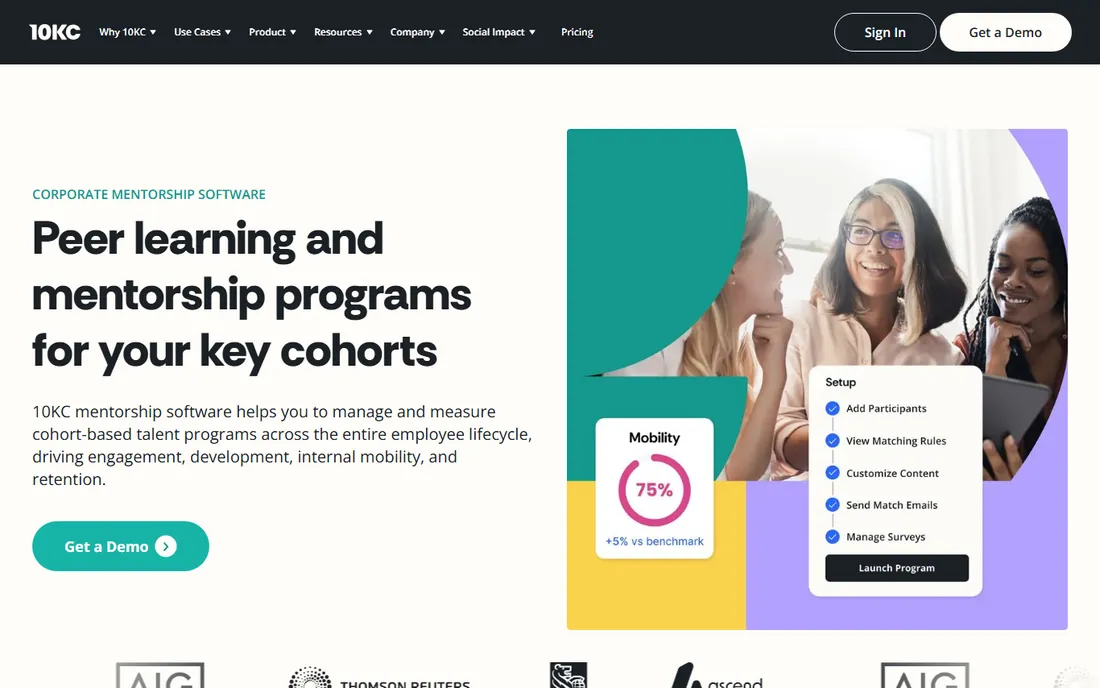
Ten Thousand Coffees, known as 10KC, is not really mentoring software in the formal sense. It is a connectivity platform that matches employees for informal conversations: coffee chats, onboarding introductions, and cross-team networking. Smart matching pairs people based on interests, roles, and goals.
That informality is the point. Formal mentoring programs suffer from drop-off when busy employees skip scheduled sessions; a 30-minute coffee chat has a lower bar and higher completion rates. Companies use 10KC for onboarding cohorts, ERG networking, and breaking down silos between departments.
The limitation is structure. If you need goal tracking, milestone management, and ROI reporting on formal mentoring relationships, 10KC does not provide it. It complements a mentoring program rather than replacing one. Pricing is quote-based, so budget for a sales conversation even though the product feels lightweight.
What we like- Smart matching for informal connections
- Low-friction format employees enjoy
- Good for culture and onboarding
Watch out for- Not a structured mentoring platform
- Limited goal tracking and analytics
- Quote-only pricing
Starting priceSee website
Free planFree trial
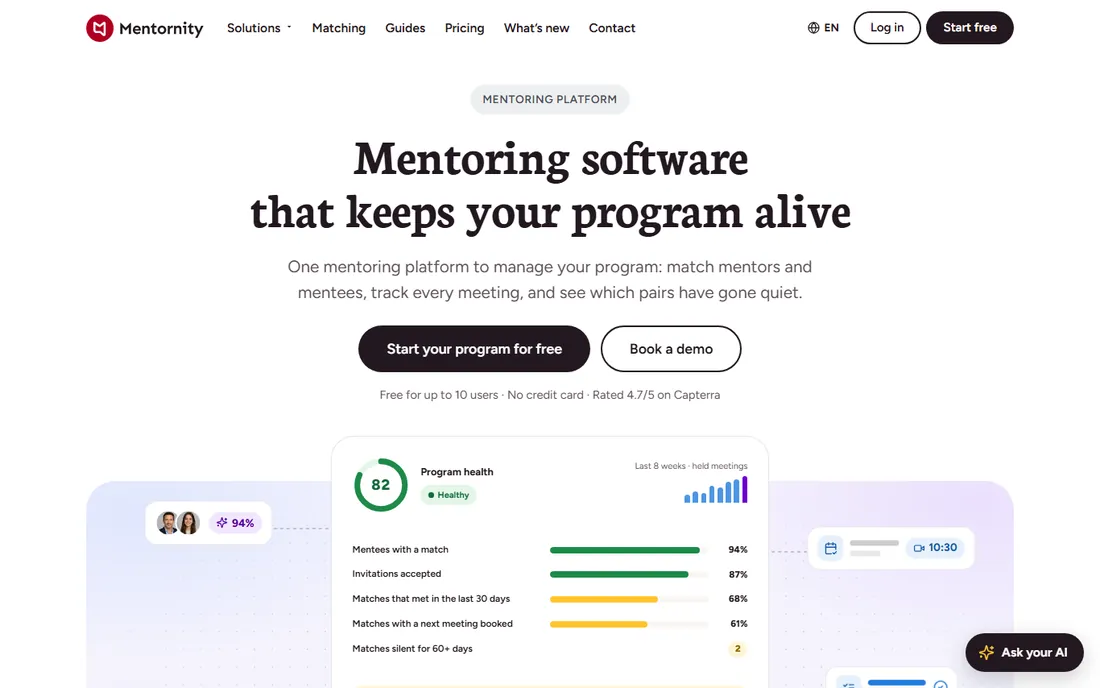
Mentornity targets the gap between free tools and enterprise platforms: small to mid-size mentoring programs that need real software but cannot justify five-figure annual contracts. The vendor publishes entry-level pricing, which immediately separates it from most competitors in this list.
The platform covers the core workflow: participant enrollment, matching, meeting tracking, goal setting, and basic reporting. Setup is straightforward enough that a small HR team can launch without vendor professional services. A free trial lets you validate the experience before paying.
The honest trade-off is scale and ecosystem. Integrations are fewer than the enterprise platforms offer, and the analytics do not go as deep. Mentornity is the right choice when the alternative is a spreadsheet, not when the alternative is Chronus. For programs under a hundred participants, that is exactly the right comparison.
What we like- Published entry-level pricing aimed at smaller programs
- Straightforward setup
- Covers core matching and tracking
Watch out for- Smaller vendor with limited integrations
- Enterprise features are thinner
- Less analyst recognition
How mentoring pricing actually works
Almost every mentoring platform charges per participant per year, and the definition of participant is where the money hides. Some vendors count every enrolled employee. Others count only actively matched pairs. A program with 500 enrolled employees but 200 matched pairs can cost half as much under the second definition, so get the counting rule in writing before you sign.
Published prices cluster in two bands. Entry-level enterprise plans start around $9,900 per year for up to 100 employees, which is MentorcliQ's published floor. Mid-market flat-rate tools like Mentorloop charge a few hundred dollars per month regardless of headcount. Above those bands, everything is quoted, and large programs routinely land in the tens of thousands per year.
Negotiate on term length and participant tiers rather than the headline rate. Vendors discount multi-year contracts and often include the first program's implementation support if you ask. Also confirm what happens to pricing when the program grows mid-contract: some vendors true-up quarterly, others lock the rate for the term.
Questions to ask on the vendor demo
Ask who does the matching work. Some platforms automate matching completely, some require the admin to approve every pair, and some leave it to participants. The right answer depends on your team: a 50-person program can use self-matching, while a 2,000-person program needs automation or the admin becomes a full-time matchmaker.
Ask what happens when pairs go quiet. The best platforms detect stalled relationships and nudge participants or alert the admin. The worst ones show you a dashboard of dead pairings three months later. Engagement tooling, reminders, meeting guidance, and re-matching workflows are what separate software from a database.
Ask for the reporting you will actually need. If the CFO wants retention impact, confirm the platform can connect mentoring participation to HRIS outcomes. If the ERG lead wants participation by group, confirm the segmentation exists. Generic engagement dashboards impress in demos and disappoint in board meetings.
How we assembled this shortlist
We started with the platforms that appear most often in buyer shortlists and review categories for mentoring software: Together, MentorcliQ, Chronus, and Qooper, plus the mid-market and community names reviewers recommend, including Mentorloop, PushFar, Guider, 10KC, and Mentornity. We reviewed current pricing pages, product documentation, and public review summaries on G2, Capterra, and SoftwareWorld.
Mentoring software pricing is mostly quote-based, so vendors without published pricing are marked as See website rather than estimated. We did not run hands-on trials of any platform; this guide reflects documentation, published pricing, and aggregated user feedback. Confirm participant counting rules and contract terms directly with each vendor before purchasing.
Frequently asked questions
What is mentoring software?
Mentoring software helps organizations run formal mentoring programs: enrolling participants, matching mentors with mentees, tracking meetings and goals, and reporting on outcomes. It replaces the spreadsheets and email threads that break down once a program grows past a few dozen pairs.
How much does mentoring software cost?
Entry-level enterprise plans start around $9,900 per year for up to 100 employees, while mid-market tools charge a few hundred dollars per month as a flat rate. Most vendors quote by participant count and program scope, and large programs typically cost tens of thousands per year. Always clarify how participants are counted before comparing quotes.
What is the difference between mentoring software and coaching platforms?
Mentoring software manages relationships between employees, usually a more experienced mentor guiding a less experienced mentee, with the organization administering the program. Coaching platforms typically provide external professional coaches for individual sessions. Mentoring builds internal knowledge transfer; coaching buys outside expertise.
Can small companies use mentoring software?
Yes, though most enterprise platforms are priced for larger programs. Tools with flat monthly pricing or published entry tiers suit programs under a hundred participants. Very small teams can also start with informal networking tools and graduate to a structured platform when the program proves its value.
How do you measure the ROI of a mentoring program?
Common measures include retention rates of participants versus non-participants, promotion rates, engagement survey scores, and goal completion rates. The stronger platforms connect mentoring data to HRIS outcomes for credible reporting. Define the metrics before launch so the program is designed to produce measurable results.
Should mentors and mentees choose each other or be matched by the system?
Both approaches work, and most platforms support both. Self-matching gives participants ownership and tends to produce more committed pairs. Algorithm-assisted matching scales better and can create more diverse pairings. Many successful programs use suggested matches that participants confirm, combining both advantages.
Sources we checked (11)
- https://www.togetherplatform.com/pricing/
- https://www.mentorcliq.com/pricing/
- https://www.chronus.com/pricing/
- https://www.qooper.io/pricing/
- https://www.mentorloop.com/pricing/
- https://www.pushfar.com/pricing/
- https://www.guider-ai.com/pricing/
- https://www.10kc.com/pricing/
- https://www.mentornity.com/pricing/
- https://www.softwareworld.co/top-mentoring-software/
- https://www.g2.com/compare/mentorcliq-vs-mentorloop-mentoring-software
Is your product missing or out of date?
We review this list regularly. Vendors can request a listing, send updated pricing or ask about featured placement.

Shihab Mia · Founder, Rankite
Shihab has spent more than a decade helping SaaS and e-commerce brands grow through search. He writes Rankite's software buying guides from pricing pages, documentation and public user reviews. More about Shihab.