How we make this list: we compare pricing pages, product documentation and public user reviews. Rankite is independent; if a vendor ever pays for a featured spot, that listing is clearly labeled Partner.
Key takeaways
- Klaviyo (Email from $20/month) remains the default for Shopify stores that live on segmentation and flows, but its contact-based pricing climbs fast as lists grow.
- Omnisend (Standard from $16/month) is the value pick: ecommerce-native automation, a real free plan, and slower price growth than Klaviyo.
- Brevo (Starter from $9/month) wins on raw send volume for big lists with light sending, since it bills by emails rather than contacts.
- Attentive is the SMS specialist for high-volume DTC brands, but pricing is custom-quoted with real minimums, so small stores should start elsewhere.
- Yotpo is not an email platform anymore: it sunset email and SMS at the end of 2025 and now covers reviews, loyalty and user-generated content.
Quick comparison
| Tool | Best for | Starting price | Free plan |
|---|
 Klaviyo Klaviyo | Shopify and DTC stores that live on segmentation and flows | $20/month (Email plan, 500 profiles) | Yes (250 profiles, 500 sends/month) |
 Omnisend Omnisend | Stores that want ecommerce automation without Klaviyo prices | $16/month (Standard plan, 500 contacts) | Yes (250 contacts, 500 emails/month) |
 Mailchimp Mailchimp | Businesses doing general marketing beyond the store | $13/month (Essentials, 500 contacts) | Yes (250 contacts, 500 sends/month) |
 Drip Drip | DTC brands that want deep behavioral automation in one plan | $39/month (up to 2,500 contacts) | Free trial (14 days) |
 ActiveCampaign ActiveCampaign | Lifecycle marketing with serious automation logic | $15/month (Starter, annual billing, 1,000 contacts) | Free trial (14 days) |
 HubSpot HubSpot | Stores that want marketing, CRM and sales in one system | $20/seat/month (Marketing Hub Starter) | Yes (free CRM and marketing tools) |
 Attentive Attentive | High-volume DTC brands where SMS is a major revenue channel | See website (custom quote) | Free trial (available for eligible businesses) |
 Yotpo Yotpo | Stores investing in reviews, loyalty and user-generated content | $15/month (Reviews Starter) | Yes (Reviews free up to 50 orders/month) |
 Brevo Brevo | Stores with big lists and moderate sending who want the lowest bill | $9/month (Starter, 5,000 emails) | Yes (300 emails/day) |
Is your product missing or out of date?
We review this list regularly. Vendors can request a listing, send updated pricing or ask about featured placement.
Picture a Tuesday morning. Your store did $4,000 yesterday. Sixty carts were abandoned overnight. Your list of 8,000 subscribers got one generic newsletter last month, and nobody can tell you which emails actually produced revenue. The platform you pick decides whether that changes or repeats.
The best marketing platform for ecommerce is not the one with the most features. It is the one that connects to your store, tracks what shoppers do, and turns that behavior into automated emails and texts that recover carts and bring buyers back. These nine tools cover the real options in 2026, from ecommerce-native email platforms to SMS specialists and retention suites.
#1
Klaviyo
Best for: Shopify and DTC stores that live on segmentation and flows
Visit klaviyo.com
Starting price$20/month (Email plan, 500 profiles)
Free planYes (250 profiles, 500 sends/month)
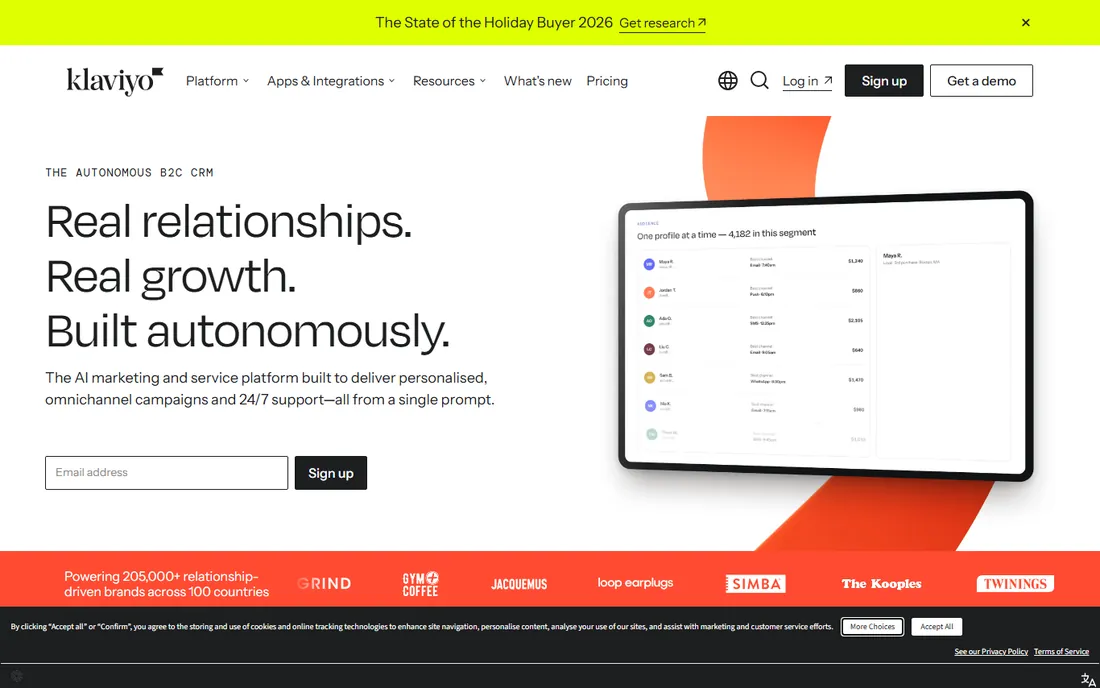
Klaviyo earned its default status the hard way: it treats your store's data as the product. Browse abandonment, cart abandonment, post-purchase and win-back flows all run off live Shopify events, and the segmentation goes deeper than any rival here. The Email plan starts at $20 per month for 500 active profiles with 5,000 sends, and you pay for active profiles, not total contacts, so suppressed and unsubscribed profiles do not inflate the bill.
The honest math is the growth curve. At 1,000 profiles you pay about $30, at 5,000 about $100, at 10,000 about $150, and it keeps climbing. Stores with big lists and low send frequency overpay relative to send-based pricing like Brevo's. If email drives serious revenue and you will use the segmentation, Klaviyo earns its premium. If you send two campaigns a month, you are paying for depth you never touch.
What we like- Deep Shopify integration with real-time behavioral data
- Segmentation and predictive analytics (churn risk, next order date) usable directly in flows
- Every plan includes the full feature set with no gating
Watch out for- Contact-based pricing scales aggressively: 10,000 profiles costs about $150/month
- SMS is a separate credit-based cost on top of email
- Free plan is genuinely small for any real store
#2
Omnisend
Best for: Stores that want ecommerce automation without Klaviyo prices
Visit omnisend.com
Starting price$16/month (Standard plan, 500 contacts)
Free planYes (250 contacts, 500 emails/month)
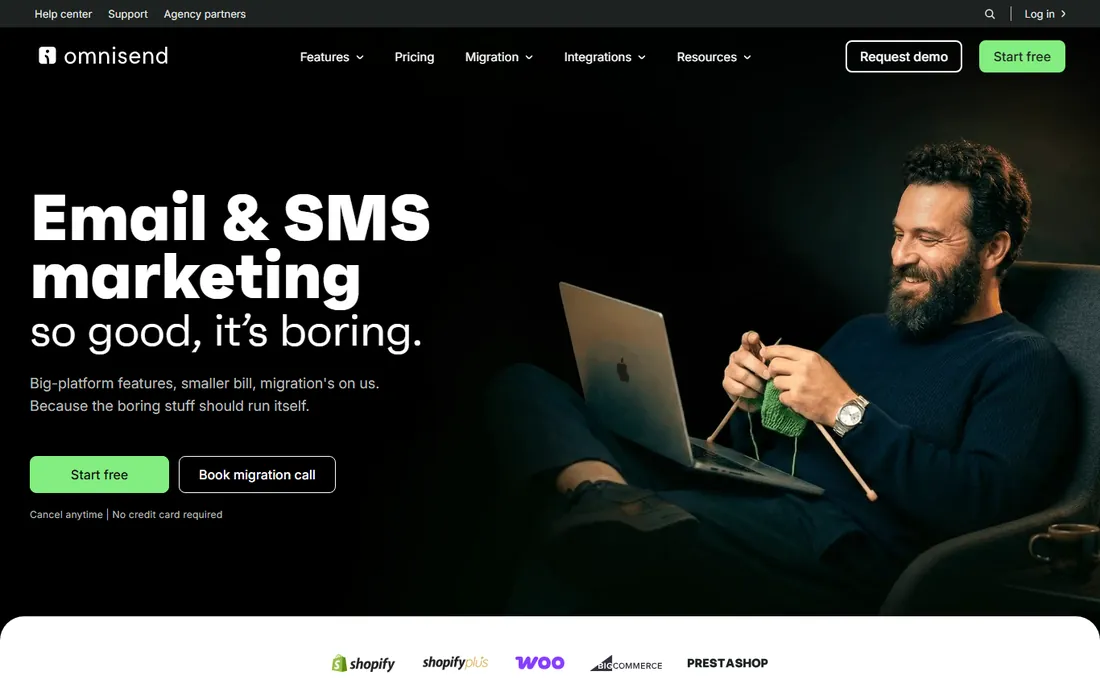
Omnisend is the pragmatic Klaviyo alternative that keeps showing up in store-owner recommendations. The Standard plan starts at $16 per month for 500 contacts with 6,000 emails, and the Pro plan at $59 per month adds unlimited emails plus SMS credits equal to the plan cost. Setup is fast: connect Shopify, WooCommerce or BigCommerce, activate the pre-built automation workflows, and the standard flows are live the same day.
Where it wins is the total package for smaller stores. The free plan covers 250 contacts with full automation, and support answers around the clock even if you pay nothing. The 2026 SMS change is the wrinkle to know: new customers need Pro plus a paid SMS subscription to text, which narrows the price gap with Klaviyo for SMS-heavy stores. For email-first stores watching every dollar, it is the value pick.
What we like- Purpose-built for ecommerce with pre-built cart, welcome and post-purchase workflows
- The free plan includes all features with no gating
- 24/7 live chat and email support on every plan including free
Watch out for- Contact-based pricing still climbs with list growth, just slower than Klaviyo
- SMS now requires the Pro plan plus a separate SMS subscription for new customers
- Reporting depth trails Klaviyo
Starting price$13/month (Essentials, 500 contacts)
Free planYes (250 contacts, 500 sends/month)
Mailchimp is the generalist on this list. Essentials starts at $13 per month for 500 contacts, Standard at $20 adds the Journey Builder with multi-branch automation, and Premium at $350 targets large teams. For a business that does email marketing alongside content, events or services, Mailchimp's breadth of templates, landing pages and integrations is genuinely useful.
The ecommerce-specific weaknesses are real. Product recommendations and abandoned cart flows exist, but the behavioral depth does not match the ecommerce-native tools. And the billing quirk bites: Mailchimp counts unsubscribed contacts toward your plan, so list hygiene is a manual chore with direct cost consequences. It fits stores whose marketing extends well beyond the checkout, not stores optimizing every flow.
What we like- The most recognizable name with the broadest template and integration library
- Standard plan ($20/month) includes multi-step journeys and predictive segmentation
- Pay-as-you-go credits suit occasional senders
Watch out for- Counts unsubscribed contacts toward billing unless you archive them manually
- The free plan shrank to 250 contacts with minimal automation
- Ecommerce depth trails Klaviyo and Omnisend
#4
Drip
Best for: DTC brands that want deep behavioral automation in one plan
Visit drip.com
Starting price$39/month (up to 2,500 contacts)
Free planFree trial (14 days)
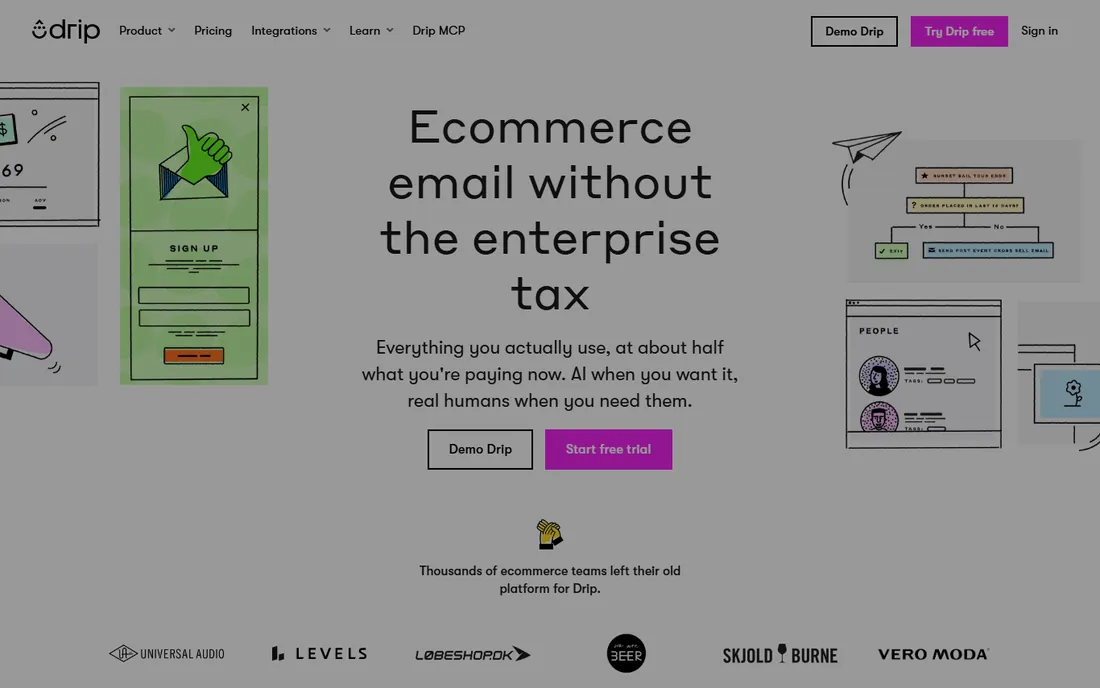
Drip's pitch is simplicity with depth. One plan, priced only by contact count, starting at $39 per month for up to 2,500 contacts with unlimited email sends. Every feature is included at every tier: visual automation builder, dynamic segmentation, product recommendations, popups and on-site campaigns. The revenue reporting shows exactly which flows produced which sales, which is the metric that matters.
The catch is the entry ticket. With no free plan and a $39 floor, Drip asks for commitment before you have sent a single email, though a 14-day trial softens that. Past 10,000 contacts the price climbs toward $154 and beyond, where Klaviyo's deeper segmentation starts looking competitive. It suits DTC brands sure enough of email to pay for the real thing from the start.
What we like- Single-plan pricing where every tier includes every feature and unlimited sends
- Revenue attribution tied directly to each campaign and flow
- Strong native Shopify integration with full historical sync
Watch out for- No free tier, so testing costs $39 from day one
- Price scales steeply past 10,000 contacts
- Email template design options are limited versus Klaviyo
Starting price$15/month (Starter, annual billing, 1,000 contacts)
Free planFree trial (14 days)
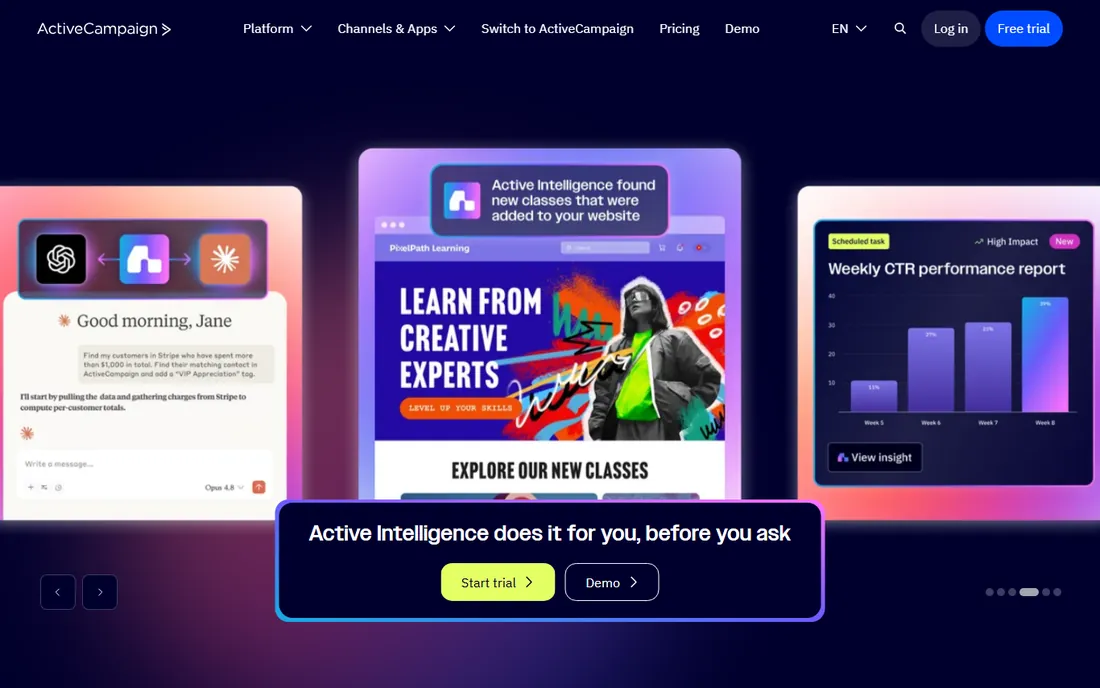
ActiveCampaign is an automation platform that sends email, rather than an email tool with automation added. The builder handles multi-step journeys with conditions, goals, lead scoring and CRM actions that the ecommerce-native tools cannot match. Plans run Starter at $15, Plus at $49, Pro at $79 and Enterprise at $145 per month for 1,000 contacts on annual billing.
Read the Starter limits before buying. Five actions per automation with no branching means a real abandoned-cart sequence needs Plus at $49, which is the realistic entry price. For stores whose marketing is genuinely lifecycle-driven, with lead nurturing and sales follow-up, that Plus tier earns its keep. For straightforward promotional email, it is more machine than the job needs.
What we like- The best visual automation builder in this price range, with branching, goals and split tests
- Built-in CRM on higher tiers for marketing-to-sales handoff
- Predictive sending and win probability on Pro
Watch out for- No free plan
- The Starter plan caps automations at 5 actions per workflow with no branching, which most real flows exceed
- Pricing is annual-billing-first, with monthly costing more
#6
HubSpot
Best for: Stores that want marketing, CRM and sales in one system
Visit hubspot.com
Starting price$20/seat/month (Marketing Hub Starter)
Free planYes (free CRM and marketing tools)
HubSpot plays the long game. The free tools cover CRM, email, forms and live chat with no card, which is enough for a new store to run basic marketing. Marketing Hub Starter at $20 per seat per month adds automation and more sends with 1,000 marketing contacts included. Everything shares one contact record, so a purchase updates the CRM, the segment and the workflow at once.
The pricing cliff is the thing everyone warns about. Professional starts around $800 per month with a $3,000 onboarding fee, and once you need features that only exist there, the jump is roughly fortyfold. HubSpot fits stores building toward a full go-to-market operation with sales involvement. If email and SMS are the whole job, the specialists above do it cheaper.
What we like- The free tier is genuinely generous: CRM, email marketing and forms at $0
- Marketing automation reads and writes real CRM data like lifecycle stage and deal value
- The ecosystem of integrations is enormous
Watch out for- The jump from Starter to Professional (from $800/month) is one of the steepest cliffs in software
- Marketing contacts billing means list growth raises the bill
- Onboarding fees apply on Professional and above
#7
Attentive
Best for: High-volume DTC brands where SMS is a major revenue channel
Visit attentive.com
Starting priceSee website (custom quote)
Free planFree trial (available for eligible businesses)
Attentive does not publish prices, and that tells you who it is for. Third-party reporting puts entry around a few hundred dollars a month in platform fees plus per-message costs, with quarterly minimums of $2,000 to $3,000 and six-to-twelve-month contracts. In exchange, enterprise DTC brands get the most sophisticated SMS program in ecommerce: behavioral triggers, AI-driven personalization, list growth tools and revenue attribution.
The math only works at volume. Attentive earns its premium when SMS drives a serious share of revenue and monthly turnover justifies the commitment. Smaller stores get equivalent results from Klaviyo SMS, Omnisend or a dedicated low-cost SMS tool at a fraction of the commitment. Do not start here; graduate here if SMS becomes your best channel.
What we like- Purpose-built for ecommerce SMS with AI personalization and send-time optimization
- Two-tap signup units grow subscriber lists fast
- Strong deliverability and carrier relationship management
Watch out for- No published pricing: expect custom quotes with quarterly minimums in the low thousands
- Annual contracts are the norm
- Overkill and overpriced for stores sending occasional texts
#8
Yotpo
Best for: Stores investing in reviews, loyalty and user-generated content
Visit yotpo.com
Starting price$15/month (Reviews Starter)
Free planYes (Reviews free up to 50 orders/month)
Yotpo is a retention platform, not an email platform, and that distinction matters since it ended its standalone email and SMS products on December 31, 2025. What remains is reviews and user-generated content plus loyalty and referrals. Reviews Starter starts at $15 per month, scaling with order volume, with a free tier for stores under 50 orders a month. The syndication network is the real asset: reviews flow to Google Shopping and retail partners automatically.
Budget carefully because the modules bill separately. A store running Reviews Pro and Loyalty Pro at meaningful volume can pay several hundred dollars a month before overages. For stores where social proof and repeat purchase drive growth, Yotpo is the category leader. Just do not buy it expecting email marketing; that product is gone.
What we like- The deepest review syndication in ecommerce: Google Shopping, Meta, TikTok Shop and retail partners
- Loyalty and referrals in the same platform as reviews
- AI summaries and review analytics on paid tiers
Watch out for- Pricing is modular, so reviews plus loyalty means two bills that both scale with order volume
- The free tier caps at 50 orders a month
- Email and SMS products were sunset at the end of 2025
#9
Brevo
Best for: Stores with big lists and moderate sending who want the lowest bill
Visit brevo.com
Starting price$9/month (Starter, 5,000 emails)
Free planYes (300 emails/day)
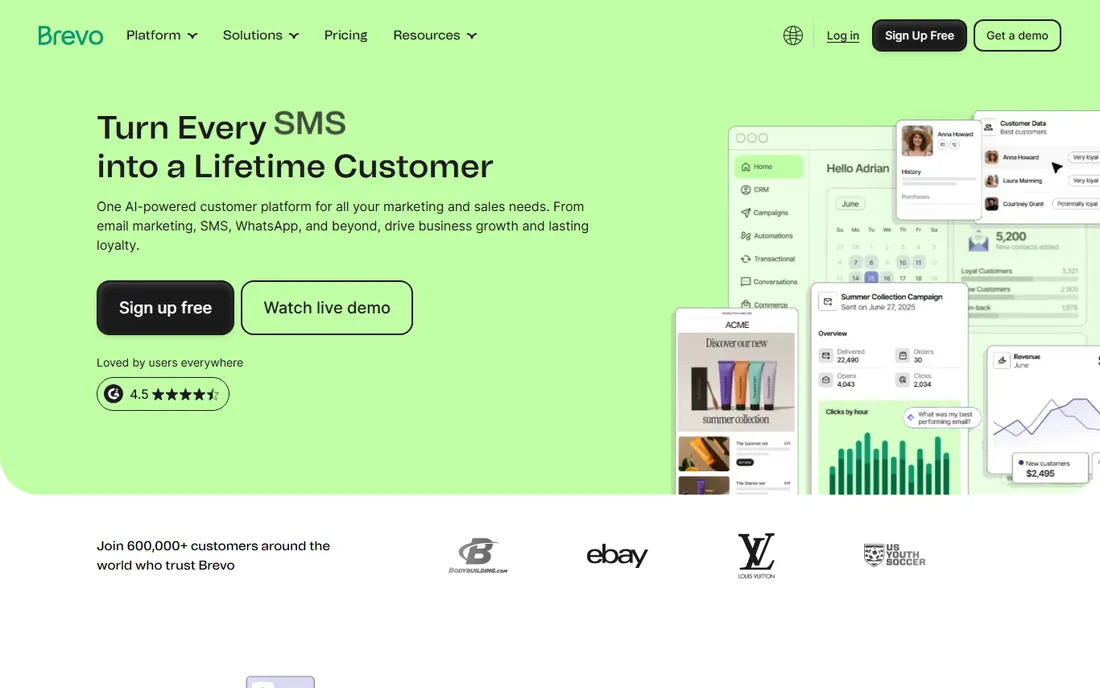
Brevo's pricing model flips the usual math. Instead of charging per contact, it charges per email sent: Starter from $9 per month for 5,000 emails, Standard from $18 with automation included. A store with 50,000 contacts sending 40,000 emails a month can pay under $60, where contact-based tools charge hundreds. The free plan's unlimited contact storage with 300 emails a day is among the most generous free tiers anywhere.
The trade is ecommerce depth. Brevo is a general email platform with solid automation, not a store-native tool, so behavioral triggers and product feeds take more setup. And note the Starter trap: no automation at $9 means the real starting price for a store is Standard at $18. For big-list, low-frequency senders, though, nothing here touches the price.
What we like- Send-based pricing with unlimited contacts, so large lists cost little if you send selectively
- The free plan stores unlimited contacts
- Automation, landing pages and SMS available on paid tiers
Watch out for- Starter excludes automation entirely: you need Standard from $18/month for workflows
- The 300-email daily cap makes the free plan awkward for campaign blasts
- Ecommerce integrations are thinner than Klaviyo or Omnisend
How we chose
We started with the marketing platforms ecommerce store owners actually compare: the ecommerce-native email tools, the automation platforms, the SMS specialist, the reviews and loyalty leader, and the volume-priced alternative. For each candidate we opened the vendor's own pricing page or official pricing documentation to verify current prices, plan names and free tiers, ignoring promotional rates.
We checked list-size pricing at common contact counts, since headline prices hide the growth curve that decides the real bill. We also verified product status as of October 2026, which mattered for Yotpo: its standalone email and SMS products were sunset at the end of 2025, so it is listed here for reviews and loyalty, not messaging. Claims were checked against public reviews on G2 and Capterra.
What to look for before you buy
Start with your store platform and your list size today, not the list you hope to have. Klaviyo, Omnisend and Drip integrate deepest with Shopify; WooCommerce and BigCommerce stores should confirm the specific integration covers historical order sync, not just new orders. Then price your actual contact count on each vendor's pricing page, because the $16 to $39 headline prices describe small lists.
Next, decide which channels you actually need. If SMS matters, compare the total: Klaviyo and Omnisend bundle or add SMS to email plans, while Attentive is a separate custom-quoted commitment. If reviews and loyalty matter, that is a separate budget line with Yotpo regardless of your email choice. Buying one platform for everything usually means overpaying for channels you barely use.
Finally, test the automation that earns the money. Before committing, build one abandoned-cart flow and one post-purchase flow in the trial. Time how long it takes, check whether revenue attribution is built in, and confirm the flow triggers off your store's real events. The platform that makes those two flows easy is the platform that will pay for itself.
The pricing traps that inflate your bill
The first trap is contact-based billing on a dirty list. Klaviyo, Omnisend, Mailchimp, Drip and ActiveCampaign all price by contacts, so unsubscribed, bounced and duplicate contacts cost you money every month. Klaviyo excludes suppressed profiles from billing, which helps; Mailchimp counts unsubscribed contacts unless you archive them, which hurts. Clean the list before you compare prices.
The second trap is the automation paywall. Brevo's $9 Starter has no automation, ActiveCampaign's $15 Starter caps workflows at 5 actions with no branching, and Mailchimp's cheaper tiers lack multi-step journeys. The plan with the features you need is usually one tier above the headline price. Price that tier, not the cheapest one.
The third trap is the annual-billing discount that locks you in. Several vendors show annual prices prominently while monthly costs 20 to 25 percent more. Start monthly until the platform proves itself, then switch to annual once the flows are running and the list is stable. And watch auto-upgrades: most platforms move you to a higher contact tier automatically when your list grows past the limit.
Frequently asked questions
Which marketing platform is best for a Shopify store?
Klaviyo is the most common answer because of its deep Shopify integration and segmentation, starting at $20 per month. Omnisend is the value alternative at $16 per month with faster setup. Stores with very large lists and light sending should price Brevo, which bills by emails rather than contacts.
How much should a small store budget for email marketing?
For lists under 2,000 contacts, $16 to $39 per month covers the serious options: Omnisend Standard, Mailchimp Standard or Drip. Free plans from Klaviyo, Omnisend, Mailchimp, Yotpo and Brevo all work for testing, but their limits arrive fast once you start sending regularly.
Is SMS marketing worth it for ecommerce?
For stores with engaged mobile audiences, SMS consistently produces the highest engagement rates of any channel, especially for cart recovery and flash sales. Start with SMS bundled into your email platform before considering a dedicated tool like Attentive, which only makes sense at high volume with custom-quoted minimums.
Can I use Yotpo for email marketing?
No. Yotpo sunset its standalone email and SMS products on December 31, 2025. It now covers reviews, user-generated content, loyalty and referrals, and points users to integration partners like Klaviyo, Omnisend and Attentive for messaging.
What is the cheapest way to email a large list?
Brevo's send-based pricing is usually cheapest for large lists with moderate frequency: a 50,000-contact list sending 40,000 emails a month can cost under $60. Contact-based tools charge for the list size regardless of how often you send, which punishes big, quiet lists.
Do free plans really work for a real store?
They work for testing and for very small stores. Klaviyo, Omnisend, Mailchimp and Brevo all offer usable free tiers, but limits on contacts, sends or features arrive within weeks for an active store. Treat free as a trial with no expiry date, and budget for the first paid tier from the start.
Sources we checked (9)
- https://www.klaviyo.com/
- https://www.omnisend.com/
- https://www.mailchimp.com/
- https://www.drip.com/
- https://www.activecampaign.com/
- https://www.hubspot.com/
- https://www.attentive.com/
- https://www.yotpo.com/
- https://www.brevo.com/
Is your product missing or out of date?
We review this list regularly. Vendors can request a listing, send updated pricing or ask about featured placement.

Shihab Mia · Founder, Rankite
Shihab has spent more than a decade helping SaaS and e-commerce brands grow through search. He writes Rankite's software buying guides from pricing pages, documentation and public user reviews. More about Shihab.