How we make this list: we compare pricing pages, product documentation and public user reviews. Rankite is independent; if a vendor ever pays for a featured spot, that listing is clearly labeled Partner.
Key takeaways
- Clio Manage is the default pick for small to mid-size firms that want billing inside a full practice management suite, with trust accounting built in.
- TimeSolv gives firms dedicated legal billing with native LEDES export at a lower price than the full practice management suites.
- Bill4Time is the cheapest straightforward option for solos who need time entries and invoices without case management.
- CosmoLex suits firms that want accounting and three-way trust reconciliation in one system instead of syncing with QuickBooks.
- Smokeball and LeanLaw fit specific workflows: passive automatic time capture, or billing built directly on QuickBooks Online.
Quick comparison
| Tool | Best for | Starting price | Free plan |
|---|
 Clio Manage Clio Manage | full practice management with billing built in | $49 per user/month (billed annually) | Free trial |
 MyCase MyCase | small firms wanting cases, billing and payments in one login | $59 per user/month (billed annually) | Free trial |
 TimeSolv TimeSolv | dedicated legal billing with native LEDES export | $39.95 per user/month (billed annually) | Free trial |
 Bill4Time Bill4Time | solos needing simple time and billing | $27 per user/month (billed annually) | Free trial |
 CosmoLex CosmoLex | accounting plus trust compliance without QuickBooks | $99 per user/month (billed annually) | Free trial |
 PracticePanther PracticePanther | budget-conscious all-in-one platform | $59 per user/month (billed annually) | Free trial |
 Smokeball Smokeball | automatic time capture for small firms | See website | Free trial |
 LeanLaw LeanLaw | billing built natively on QuickBooks Online | $74.95 per user/month (billed annually) | Free trial |
 Rocket Matter Rocket Matter | attorneys who work heavily from mobile | $49 per user/month (billed annually) | Free trial |
Is your product missing or out of date?
We review this list regularly. Vendors can request a listing, send updated pricing or ask about featured placement.
The best legal time and billing software
Research cited by the American Bar Association found that attorneys who delay their time entries can lose between 10% and 70% of billable revenue (Timing, 2026). That single number explains why time and billing software matters more to a law firm than almost any other system. Every unbilled hour is money the firm already earned and then quietly gave away.
The hard part is not finding software that tracks time. It is finding software that tracks time the way lawyers actually work: six-minute increments, matter-based entries, trust accounting that satisfies state bar rules, and invoice formats that corporate clients accept. LEDES electronic billing and UTBMS task codes are requirements, not extras, for firms that bill insurance carriers or large corporate clients.
The nine tools below cover both paths. Some are full practice management suites with billing included. Others do one thing, time and billing, and do it well. Prices shift often in this market, so treat the figures as starting points and confirm on each vendor's pricing page before you commit.
#1
Clio Manage
Best for: full practice management with billing built in
Visit clio.com
Starting price$49 per user/month (billed annually)
Free planFree trial
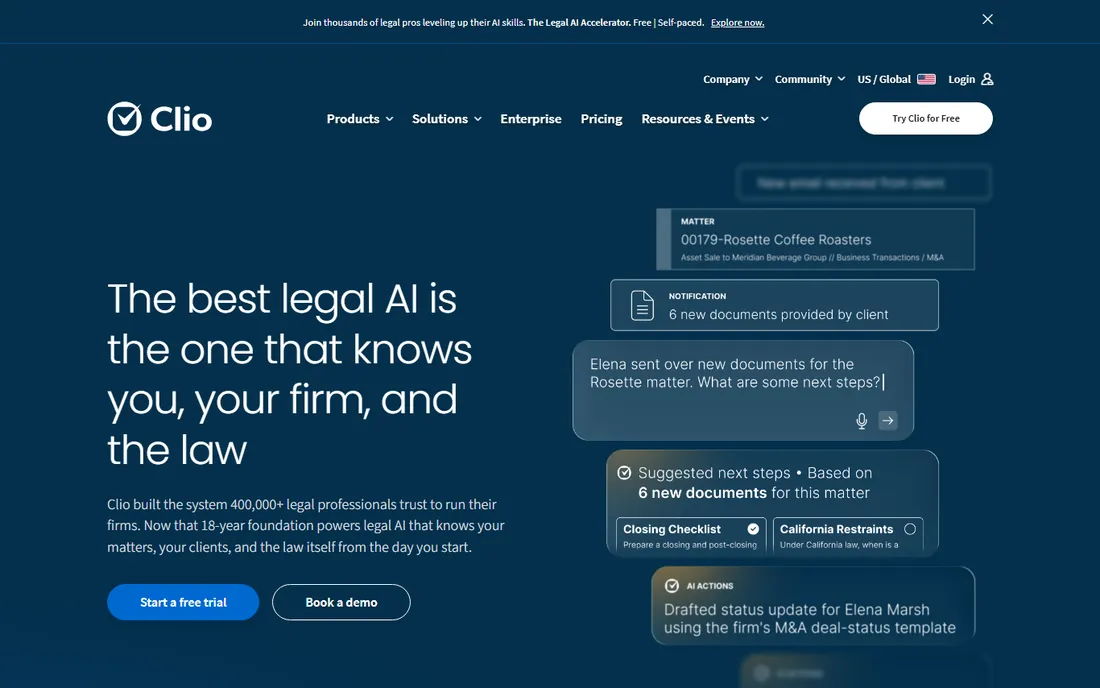
Clio is the best-known name in legal practice management, and for most small to mid-size firms it is the safe default. Time tracking, invoicing, trust accounting, calendaring, and document management all live in one system. The EasyStart plan at the entry price covers the basics, though firms that need advanced reporting or more automation will land on the higher tiers quickly.
The trust accounting is genuinely built in rather than bolted on, which matters for firms in states with strict three-way reconciliation expectations. Clio also connects with LawPay for compliant online payments, and its integration catalog is the largest in the category. The honest catch is cost at scale. A ten-person firm on a mid-tier plan is spending well over a thousand dollars a month, and the QuickBooks sync is one-way, so firms with a bookkeeper who lives in QuickBooks should plan around that.
What we like- Trust accounting built in
- Native LEDES export
- Large integration ecosystem
Watch out for- Price climbs steeply on higher tiers
- One-way QuickBooks sync only
#2
MyCase
Best for: small firms wanting cases, billing and payments in one login
Visit mycase.com
Starting price$59 per user/month (billed annually)
Free planFree trial
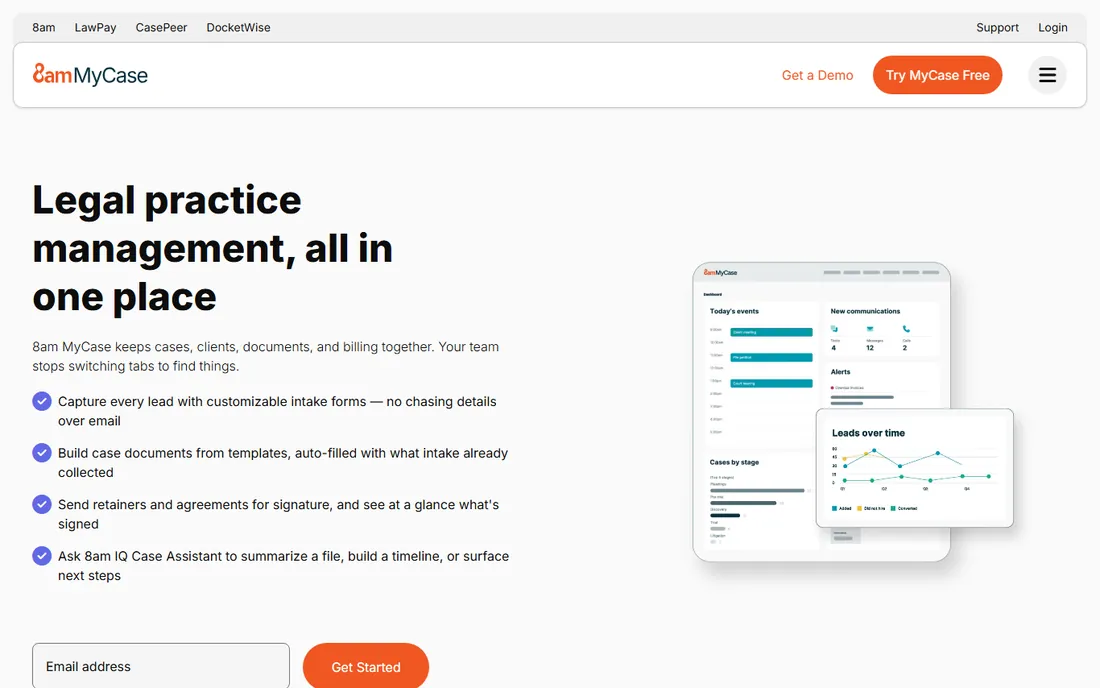
MyCase aims at the same buyer as Clio: the small firm that wants one system instead of five. Time tracking comes with built-in timers, rate rules by matter type, and invoicing that pulls entries straight into bills. Client communication runs through a portal, which keeps the email chaos down on active matters.
Payments are a strength. MyCase is part of the same company as LawPay, so trust-compliant online payments are native rather than integrated. That makes collection faster for consumer-facing practices like family law or personal injury. The tradeoff is depth. Reporting and customization do not match Clio, and firms that bill corporate clients should note that LEDES export requires the Pro tier or higher, which raises the real price for those firms.
What we like- Case management, billing and client portal in one login
- Built-in timers and rate rules
- Native LawPay integration
Watch out for- LEDES export only on Pro and above
- Reporting is thinner than Clio
Starting price$39.95 per user/month (billed annually)
Free planFree trial
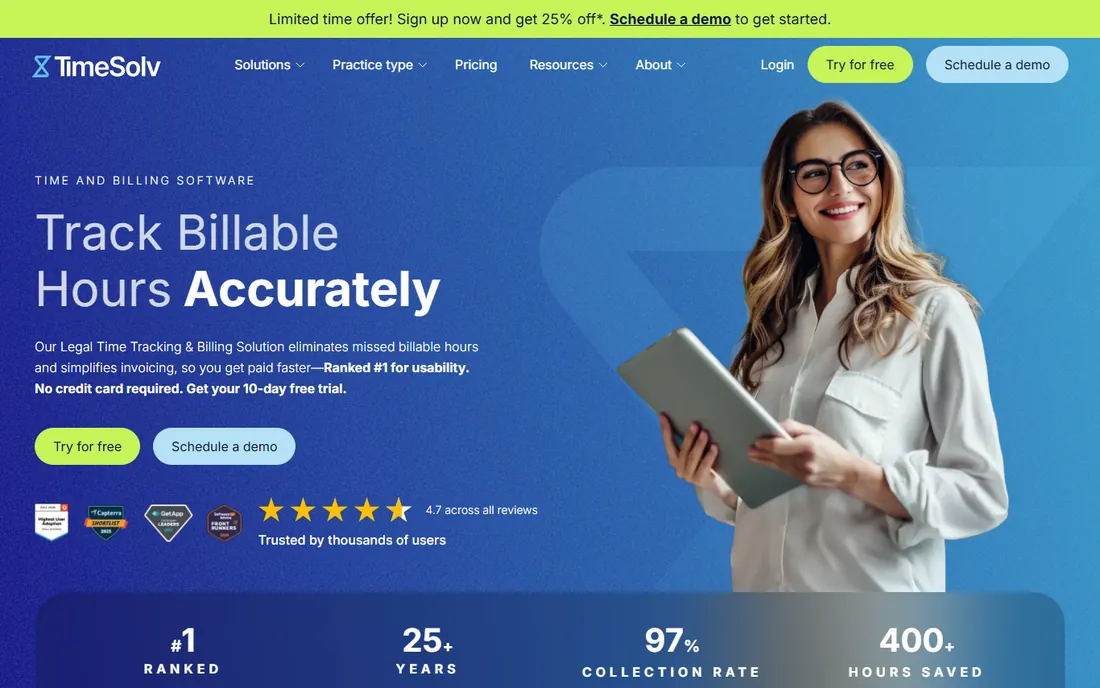
TimeSolv is for firms that already have their practice management sorted and just need billing done right. It is a dedicated time and billing product, and that focus shows in the details: native LEDES 1998B export, UTBMS codes, flexible rate structures, and trust accounting are all in the base product rather than gated behind tiers.
The pricing undercuts the full suites by a clear margin, which makes it attractive for firms that use something else for matter management and do not want to pay for a second one. Desktop timers, batch billing, and budget tracking cover the day-to-day workflow. The catch is that it is only billing. If your firm also needs calendaring, document management, or a client portal, you will be running a second system, and the interface has not kept pace visually with Clio or MyCase.
What we like- Native LEDES 1998B export on all plans
- Trust accounting included
- Lower price than full suites
Watch out for- No case management
- Interface feels dated next to newer tools
Starting price$27 per user/month (billed annually)
Free planFree trial
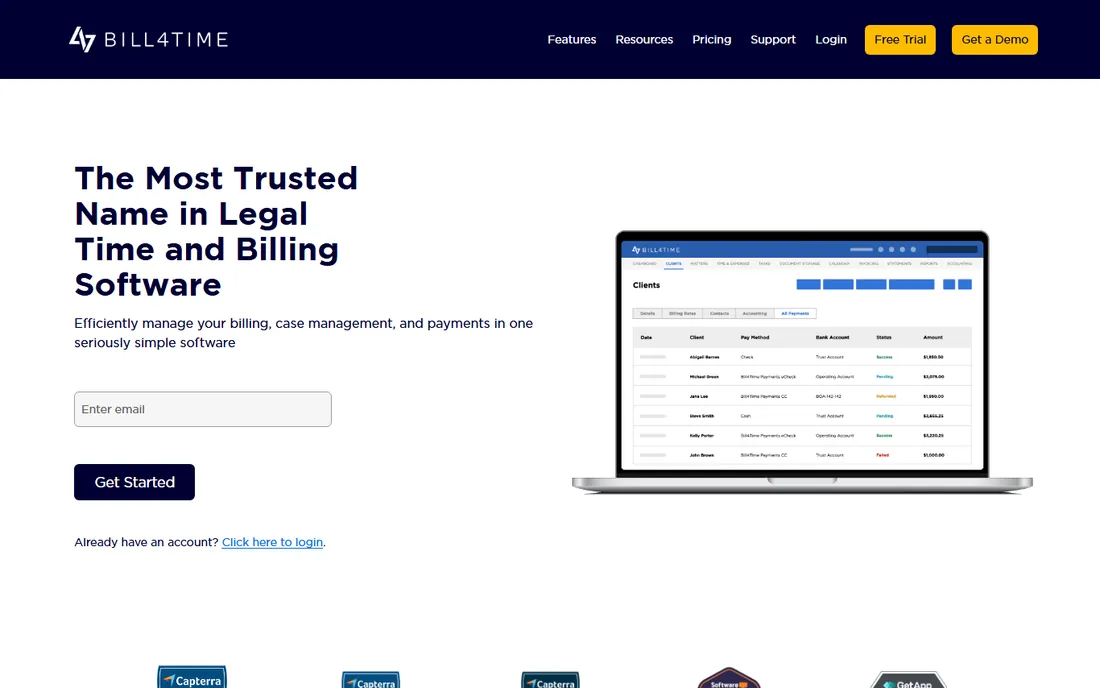
Bill4Time keeps the promise in its name: track time, send bills, get paid. Solo attorneys and two-person firms that find the big suites bloated tend to land here. Setup takes hours rather than days, the mobile app covers time entry on the go, and the entry price is the lowest on this list.
Trust accounting and LEDES export exist but sit on the higher Legal Pro plans, so solos who handle retainers or bill corporate clients need to price the right tier rather than the headline tier. Reporting is basic. For a solo billing hourly work to individual clients, though, it is hard to argue with the value. Firms that outgrow it usually graduate to Clio or MyCase rather than sideways to another simple tool.
What we like- Lowest starting price in this list
- Trust accounting on higher plans
- Quick to set up
Watch out for- Feature depth lags the suites
- LEDES only on Legal Pro
#5
CosmoLex
Best for: accounting plus trust compliance without QuickBooks
Visit cosmolex.com
Starting price$99 per user/month (billed annually)
Free planFree trial
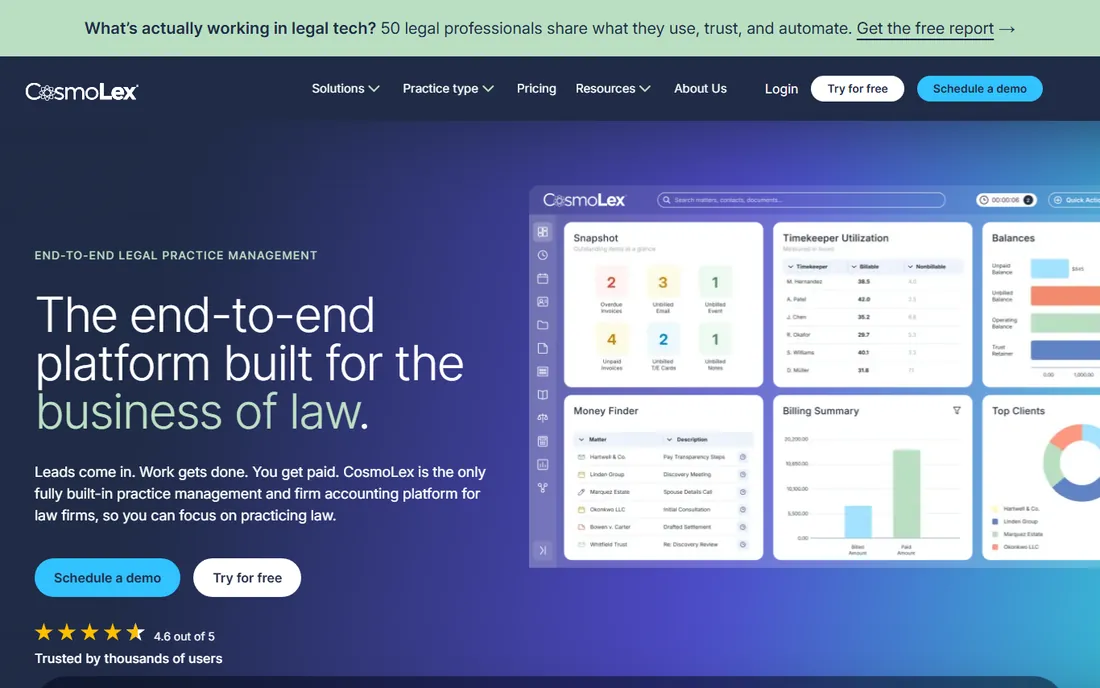
CosmoLex takes a different position from everyone else on this list: it replaces your accounting system instead of syncing with it. The product includes a full general ledger, operating and trust accounting, and native three-way reconciliation of trust accounts. For firms in states with aggressive trust account audit rules, that built-in compliance is the whole pitch.
Because bookkeeping lives inside CosmoLex, there is no QuickBooks sync to break and no double entry between systems. Time tracking and billing feed directly into the firm's books. The price reflects that scope, and it is the highest starting price on this list. Firms should also think about their bookkeeper. If your bookkeeper works in QuickBooks for other clients, moving the firm onto CosmoLex changes their workflow, and that conversation needs to happen before the purchase, not after.
What we like- Full accounting with native three-way trust reconciliation
- No QuickBooks needed
- Strong compliance posture
Watch out for- Highest starting price here
- Replacing QuickBooks means changing bookkeeper workflows
Starting price$59 per user/month (billed annually)
Free planFree trial
PracticePanther competes directly with Clio and MyCase on the all-in-one promise, usually at a slightly friendlier price. Time tracking, invoicing, trust accounting, and online payments come with matter management, task workflows, and email integration that files client emails to the right matter automatically.
The kanban-style task views give it a more modern feel than some older legal tools, and small firms like the automation for intake and follow-ups. LEDES export requires the Business plan, so corporate billing firms should check that tier's price rather than the entry price. Trust accounting is present and functional but not as deep as CosmoLex or Clio for firms with complex retainer structures.
What we like- Practice management, billing and payments in one
- Kanban task workflows
- Email integration
Watch out for- LEDES only on Business plan
- Trust features less deep than CosmoLex
Starting priceSee website
Free planFree trial

Smokeball's standout feature is automatic time capture. Instead of relying on attorneys to start timers, it records activity across Word, Outlook, and other applications passively, then suggests time entries. For firms where the partners simply will not use timers, this recovers billable hours that no manual system would catch.
Invoicing is largely automated once time is captured, and the client portal handles file sharing and communication. The product targets small firms in high-volume practice areas like family law, conveyancing, and personal injury. Pricing is quote-based, which makes comparison shopping harder and usually signals a sales-led process. Firms that want transparent per-user pricing up front may prefer TimeSolv or Bill4Time.
What we like- Passive automatic time tracking
- Auto-generated invoices
- Secure client file sharing
Watch out for- Quote-based pricing with no public rates
- Smaller integration ecosystem
Starting price$74.95 per user/month (billed annually)
Free planFree trial

LeanLaw is built for firms whose financial life already runs on QuickBooks Online. Rather than syncing with it awkwardly, LeanLaw treats QuickBooks as its accounting core, with real-time two-way sync and legal-specific billing layered on top. Time entries, invoices, and trust transactions flow into the firm's books without re-entry.
The three-way trust reconciliation is native, and the reporting leans toward financial accuracy rather than practice analytics. This is the right tool for firms with a bookkeeper or CPA who insists on QuickBooks, which is a lot of firms. The requirement cuts both ways: if your firm does not use QuickBooks Online, LeanLaw is not an option at all. Case management features are lighter than Clio or MyCase, so firms needing deep matter workflows will pair it with something else or look elsewhere.
What we like- Real-time two-way QuickBooks Online sync
- Native three-way trust reconciliation
- Built for accounting accuracy
Watch out for- Requires QuickBooks Online
- Less case management than the suites
Starting price$49 per user/month (billed annually)
Free planFree trial
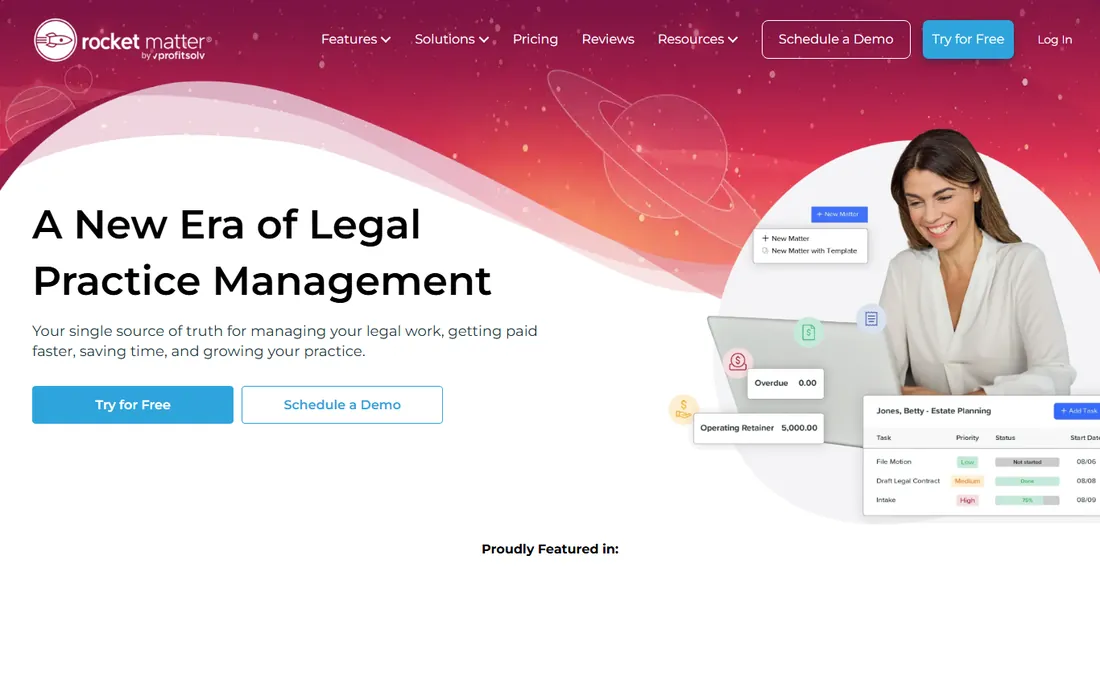
Rocket Matter has been around longer than most tools on this list and has a loyal base among attorneys who bill from courtrooms, client sites, and cars. The mobile experience is genuinely good: one-click timers, quick time entry, and matter access that does not feel like a shrunken desktop site.
Kanban boards organize matters visually, and trust accounting plus LEDES support cover the compliance basics. It is a solid mid-market option for firms that value mobility over ecosystem size. The tradeoff is scale of the platform around it. The integration catalog is smaller than Clio's, and reporting is functional rather than impressive. Firms that run on integrations should check the list before committing.
What we like- Strong mobile time tracking
- Kanban matter workflows
- Trust accounting included
Watch out for- Smaller vendor with fewer integrations
- Reporting less advanced than Clio
How we built this shortlist
We compared legal time and billing products using their public pricing pages, feature documentation, and review data from G2, Capterra, and legal technology publications. We weighted matter-based time capture, trust accounting depth, LEDES and UTBMS support, QuickBooks integration quality, and fit for firm size, from solos to mid-size firms. We did not run hands-on trials, so workflow details come from documentation and verified user reviews rather than our own use.
What to check before you sign a contract
Start with your billing structures, not the feature list. List every way the firm bills today: hourly, flat fee, contingency, subscription, hybrid. Then confirm each one is supported natively in the plan you would actually buy, not just the top tier. LEDES export and UTBMS codes matter if any client is an insurer or a large corporation. Ask for a sample LEDES file before you sign.
Trust accounting rules are state-specific, and marketing pages gloss over the differences. If your state requires three-way reconciliation, confirm the product does it natively and ask how the reconciliation report looks. A tool that exports data for your bookkeeper to reconcile elsewhere is not the same as a tool that reconciles itself.
Check the QuickBooks story honestly. Some firms need two-way sync because the bookkeeper lives in QuickBooks. Some are happy to leave QuickBooks entirely for a tool like CosmoLex. A one-way export sits in the middle and creates monthly reconciliation work that nobody mentions during the sales demo. Ask who does that work and how long it takes.
Contract length and user minimums deserve a direct question. Legal software vendors often discount annual contracts and add implementation fees quietly. Ask for the total first-year cost for your exact headcount, including any onboarding or data migration charges. Ask how you export your data if you leave, and in what format. Time entries and matter financials are the firm's records, and leaving them trapped in a closed system is a risk you should price before you need it.
Billing details that separate the good from the adequate
Six-minute versus fifteen-minute rounding sounds trivial until you multiply it across a year of entries. Confirm the increment options and whether they can differ by matter. Rate structures matter too: firms with tiered rates by attorney seniority, or different rates for the same attorney across matters, need that flexibility built in rather than hacked through custom fields.
Write-downs and write-offs need a clean workflow. Partners adjust bills constantly, and the software should record the original entry, the adjustment, and who approved it. That audit trail protects the firm when a client disputes a bill six months later. Batch billing, invoice templates with the firm's branding, and online payment links round out the daily workflow. None of these are exciting, but together they decide whether billing day takes an afternoon or a week.
Frequently asked questions
Do I need practice management software or just time and billing?
If your firm already runs cases, calendars, and documents in another system, a dedicated billing tool like TimeSolv or Bill4Time is cheaper and simpler. If you are starting from spreadsheets, an all-in-one suite like Clio Manage or MyCase removes the integration work between systems.
What is LEDES billing and does my firm need it?
LEDES is a standard electronic format for legal invoices. Insurance companies and large corporate clients usually require it. If any client asks for electronic invoices with task codes, you need LEDES export and UTBMS code support, which rules out the simplest tools.
How does trust accounting software keep my firm compliant?
It separates client funds from firm funds, tracks every movement of trust money, and produces reconciliation reports. States require regular, often three-way, reconciliation of trust accounts. Tools like CosmoLex and Clio do this natively, while simpler tools handle it through invoicing workflows that need more manual oversight.
Can these tools replace QuickBooks?
CosmoLex replaces QuickBooks with its own general ledger. LeanLaw keeps QuickBooks as the accounting core with deep two-way sync. Clio, MyCase, and PracticePanther sync or export to QuickBooks with varying quality. Decide which model fits your bookkeeper before you buy.
What does legal billing software cost for a small firm?
Entry prices in 2026 run from about $27 per user per month for simple tools like Bill4Time to about $99 for accounting-heavy tools like CosmoLex, with most all-in-one suites between $49 and $74. Multiply by your headcount and add any implementation fees to get the real first-year number.
Is there a free legal billing option?
Most legal-specific tools offer free trials rather than free plans. Solos with simple needs sometimes use general tools like Harvest or Toggl Track, which have free tiers, but those lack trust accounting and LEDES support, so they only fit firms that bill individuals directly.
Sources we checked (5)
- https://www.leanlaw.co/blog/best-legal-billing-software/
- https://learn.g2.com/best-legal-billing-software
- https://timingapp.com/blog/lawyer-time-tracking-software/
- https://agiled.app/blog/best-time-tracking-software-for-legal-professionals
- https://zipdo.co/best/legal-time-and-billing-software/
Is your product missing or out of date?
We review this list regularly. Vendors can request a listing, send updated pricing or ask about featured placement.

Shihab Mia · Founder, Rankite
Shihab has spent more than a decade helping SaaS and e-commerce brands grow through search. He writes Rankite's software buying guides from pricing pages, documentation and public user reviews. More about Shihab.