How we make this list: we compare pricing pages, product documentation and public user reviews. Rankite is independent; if a vendor ever pays for a featured spot, that listing is clearly labeled Partner.
Key takeaways
- Most firms land on Clio Manage, PracticePanther, MyCase or CosmoLex: all start near $49 to $50 per user per month, and the real fight is between Clio's ecosystem and CosmoLex's built-in legal accounting.
- Entry-tier pricing hides the true cost: payment processing fees, add-on modules, implementation and annual renewals push a $49 headline to something much higher at 10 seats.
- Personal injury and high-volume litigation firms get better workflows from Filevine or Litify, but both are quote-only, so budget approval takes longer.
- Smaller practices that bill mostly on time should compare PracticePanther's transparent four tiers against Smokeball's automatic time capture before committing.
Quick comparison
| Tool | Best for | Starting price | Free plan |
|---|
 Clio Manage Clio Manage | Any firm size, largest integration ecosystem | $49 per user/month (Starter plan) | Free trial (7 days) |
 PracticePanther PracticePanther | Firms wanting transparent, tiered pricing | $49 per user/month (Solo, billed annually) | Free trial |
 MyCase MyCase | Solos and small firms that want one simple bill | $50 per user/month (Basic, billed annually) | Free trial |
 CosmoLex CosmoLex | Firms where trust accounting is the pain point | $49 per user/month (Launch plan) | No |
 Smokeball Smokeball | Firms that bill by time and live in documents | See website | Free trial |
 LEAP LEAP | Firms wanting deep all-in-one automation | See website | No |
 Rocket Matter Rocket Matter | Firms that think in visual workflows | $59 per user/month (Essentials plan) | Free trial |
 Zola Suite Zola Suite | Midsize firms wanting CRM and accounting together | $59 per user/month (Core plan) | Free trial |
 Filevine Filevine | Litigation and high-volume personal injury firms | See website | No |
 Litify Litify | Larger firms already on Salesforce | See website | No |
Is your product missing or out of date?
We review this list regularly. Vendors can request a listing, send updated pricing or ask about featured placement.
The best legal matter management software
Most firms pick legal software the wrong way: they shop features first and pricing math last. Matter management tools are priced per user, per month, and a five-person firm on a $50 plan is really committing to $3,000 a year before payment processing, add-ons and renewal increases. The software matters less than the contract. Get the pricing model clear before you fall in love with a demo.
The honest structure of this market is three tiers. At the entry level sit Clio Manage, PracticePanther, MyCase and CosmoLex, all hovering near $50 per user per month, competing on ecosystem size, billing strength and accounting depth. In the middle are Rocket Matter, Zola Suite, Smokeball and LEAP, which justify higher or quote-based pricing with automation, visual workflows and built-in accounting. At the top are Filevine and Litify, quote-only platforms for litigation shops and larger firms where customization is the product.
This guide compares all ten with current pricing verified against vendor pages where possible. Quote-only vendors are marked honestly, because a comparison that invents their numbers would be worse than useless.
#1
Clio Manage
Best for: Any firm size, largest integration ecosystem
Visit clio.com
Starting price$49 per user/month (Starter plan)
Free planFree trial (7 days)

Clio is the default answer in legal practice management for a reason. The Starter plan at $49 per user per month covers matters, contacts, documents, calendaring, time tracking, billing and trust accounting, and its integration marketplace is by far the largest in the category. If a specialized tool exists for intake, dialing, document automation or reporting, it connects to Clio first. That ecosystem depth is why so many firms standardize here.
The catch is price opacity above the entry tier. Clio publishes only the Starter price; Core, Signature and Elite are quote-led, and comparison sites carry stale numbers from retired plan names. Implementation, migration, training and payment processing usually sit outside the per-seat figure. Clio suits firms that value flexibility and want to build a best-of-breed stack around one hub. Solos who want everything in one bill may find CosmoLex or MyCase simpler.
What we like- 250+ app integrations
- Built-in trust and operating accounting
- Client portal and Clio Payments
Watch out for- Only the Starter price is published, higher tiers need quotes
- Add-ons and payment processing raise real cost
- Per-seat cost climbs fast at scale
Starting price$49 per user/month (Solo, billed annually)
Free planFree trial
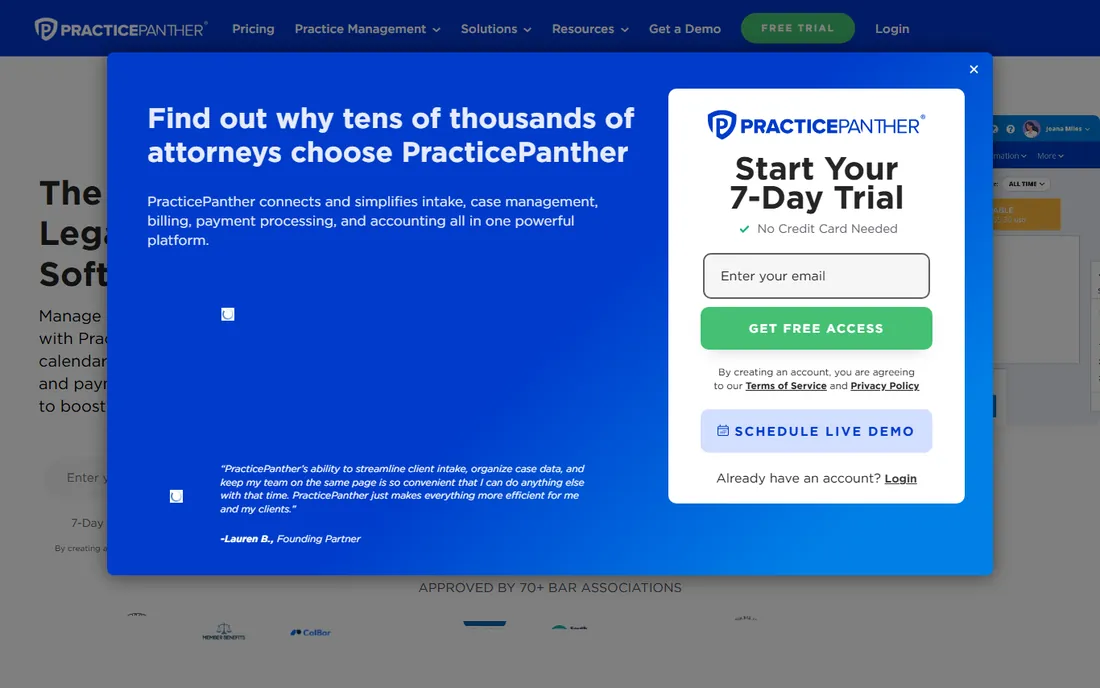
PracticePanther is the easiest legal platform in this list to budget for. It publishes four per-user tiers: Solo at $49, Essential at $69, Business at $89 and Business Pro at $114 per month on annual billing. Even the entry tier includes document templates, task and event workflows, trust account ledgering, unlimited storage and a client portal. The Business plan adds intake forms, native two-way texting, LEDES billing and free data migration.
That transparency is the selling point, but the jumps between tiers are real: a firm that starts on Solo for $49 may need Business at $89 to get intake and LEDES. Business Pro at $114 brings full trust and operating accounting with guided three-way reconciliation. PracticePanther fits small to midsize firms that want automation without a quote dance. It is also one of the few vendors whose own blog explains its pricing plainly, which tells you something about its buyer.
What we like- Four clearly published plans ($49 to $114)
- Native two-way texting and eSignature
- Strong workflow automation
Watch out for- Higher tiers needed for LEDES billing and full accounting
- Onboarding and training depth varies by plan
- Pricing reflects annual billing
#3
MyCase
Best for: Solos and small firms that want one simple bill
Visit mycase.com
Starting price$50 per user/month (Basic, billed annually)
Free planFree trial
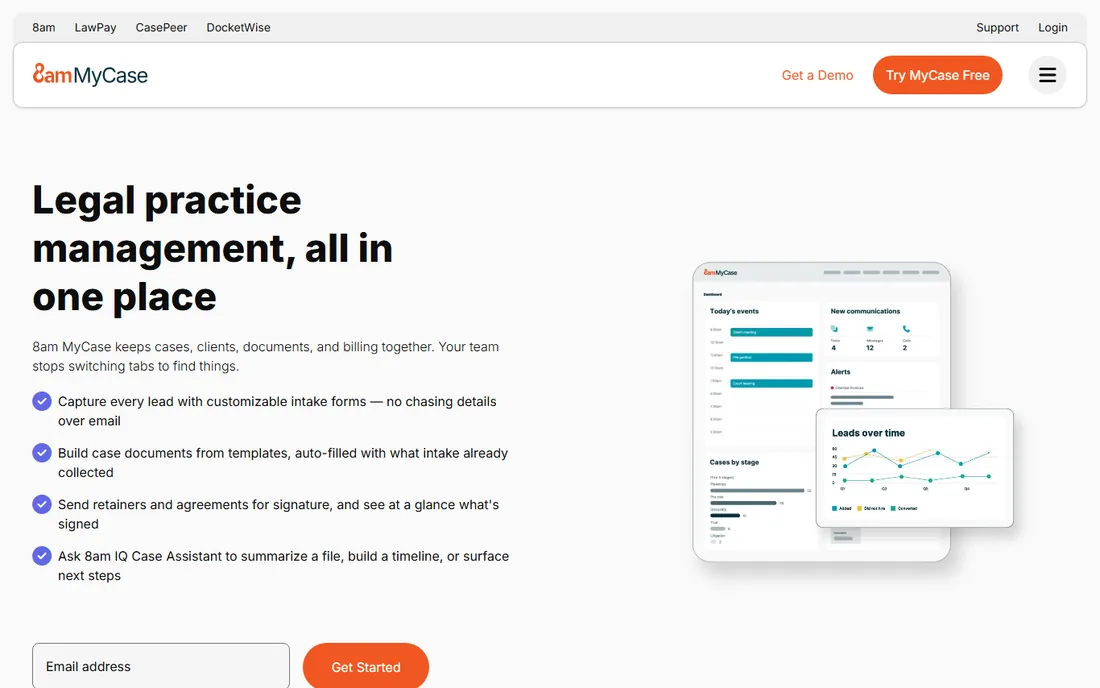
MyCase pitches itself to the solo attorney and the two-attorney shop, and the pricing reflects it. Basic sits at $50 per user per month on annual billing, with Pro and Advanced stepping up to $100 and $130 for AI features, automations and API access. There is no setup fee and no long-term contract, which makes it low-risk to try. The client portal, messaging and e-signature workflow are genuinely strong for the price.
The honest limits show up as you grow. The accounting add-on costs another $39 per user per month rather than coming built in, and API access requires the Advanced tier, which matters if you ever want to integrate a document system or intake tool. Reporting and customization lag Clio. MyCase is best for new firms that want one vendor, one login and one invoice, with the understanding that a growing practice may eventually graduate to a deeper platform.
What we like- Clean client portal with messaging and texting
- No setup fee or long-term contract
- Predictable small-firm pricing
Watch out for- Basic plan lacks AI features and API access
- Accounting is a separate $39/month add-on
- Reporting is thinner than Clio
Starting price$49 per user/month (Launch plan)
Free planNo
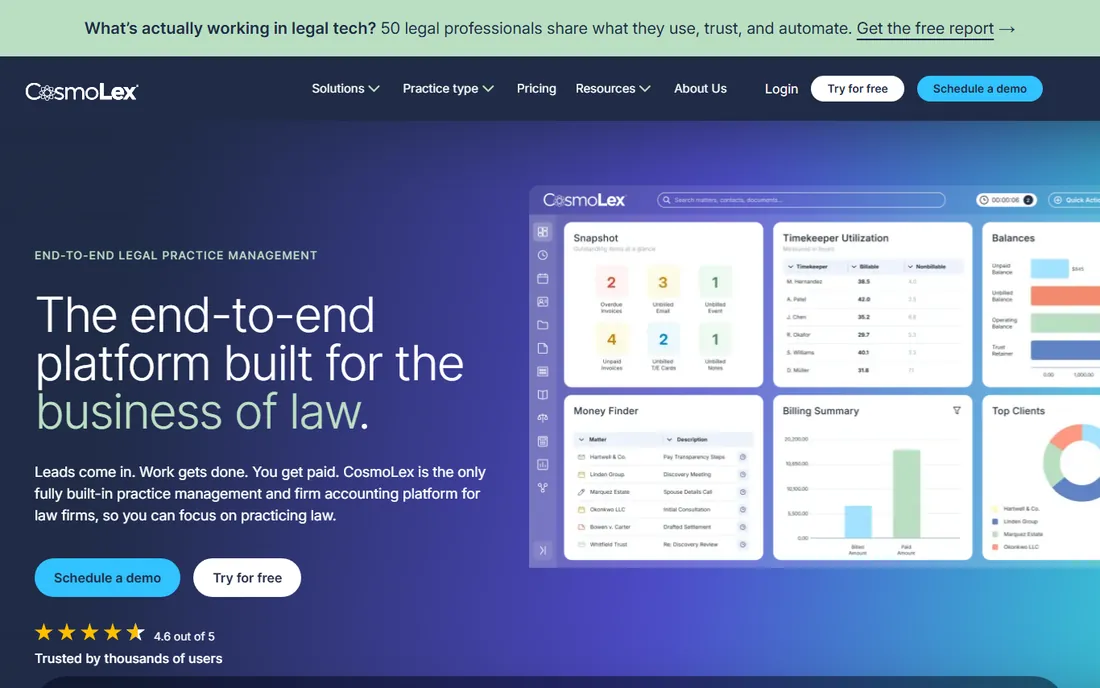
CosmoLex is built around one conviction: a law firm's accounting should not live in a separate product. Practice management and legal accounting share one cloud ledger, so trust deposits, fee transfers and journal entries are one traceable record with native three-way reconciliation. Plans run from Launch at $49 to Core at $99 and Pro at $129 per user per month, and one subscription covers both sides of the practice.
That design wins for firms with heavy IOLTA volume, multi-state compliance exposure or a prior audit scare. Outside accounting, the feature set is narrower than Clio's and the integration catalog is smaller. There is no free trial, so evaluation means a demo and a pilot rather than self-serve testing. Choose CosmoLex if trust accounting drives the purchase; choose Clio if integrations and workflow breadth matter more.
What we like- True native legal accounting with three-way reconciliation
- One ledger for trust and operating activity
- All-in-one subscription
Watch out for- No self-serve free trial
- Narrower feature set outside accounting
- Smaller third-party integration catalog
Starting priceSee website
Free planFree trial

Smokeball's core promise is capturing billable time you would otherwise lose. It automatically records activity in Smokeball, Outlook and Word, pairs that with document automation built on hundreds of pre-built matter types and tens of thousands of court forms, and targets small firms in people-law practices like family, personal injury and estate planning. Firms that bill hourly often recover the subscription cost in recaptured time alone.
The friction is commercial. Smokeball does not publish pricing; plans are quote-based with reported ranges from around $49 to over $200 per user per month depending on tier and options. That means every evaluation starts with a sales conversation. Reviewers also note occasional bugs and slowdowns, and setup can be involved. Smokeball rewards firms willing to do the sales dance for automation depth; time-conscious firms should still quote PracticePanther for comparison.
What we like- Automatic time and activity capture
- Large library of pre-built matter types and court forms
- Strong document automation
Watch out for- No published pricing, quote-only sales process
- Upper tiers reach well above entry pricing
- Migration can be complex
#6
LEAP
Best for: Firms wanting deep all-in-one automation
Visit leap.us
Starting priceSee website
Free planNo

LEAP is one of the most complete platforms in this list, combining time tracking, document and email management, automated legal forms, accounting, billing and CRM in a single product. Its form automation is deep, particularly for firms in high-volume practice areas, and its AI drafting tools now ship inside the standard subscription. Users with a decade on the platform praise its value relative to the billable hour it replaces.
The buying experience is the opposite of transparent. LEAP publishes no pricing; independent estimates put it in the $65 to $165 per user per month range, with onboarding fees reported between $3,000 and $10,000. There is no free trial, only a demo. LEAP suits firms with the budget for a comprehensive platform and the patience for a quote-led sales process. If you want pricing clarity, start with PracticePanther or Clio first and use LEAP as the premium comparison.
What we like- Comprehensive matter, document, accounting and CRM in one system
- Extensive automated legal forms
- Strong in specific practice areas
Watch out for- No published pricing anywhere
- Implementation and onboarding fees reported as significant
- Lock-in risk with an all-in-one suite
Starting price$59 per user/month (Essentials plan)
Free planFree trial
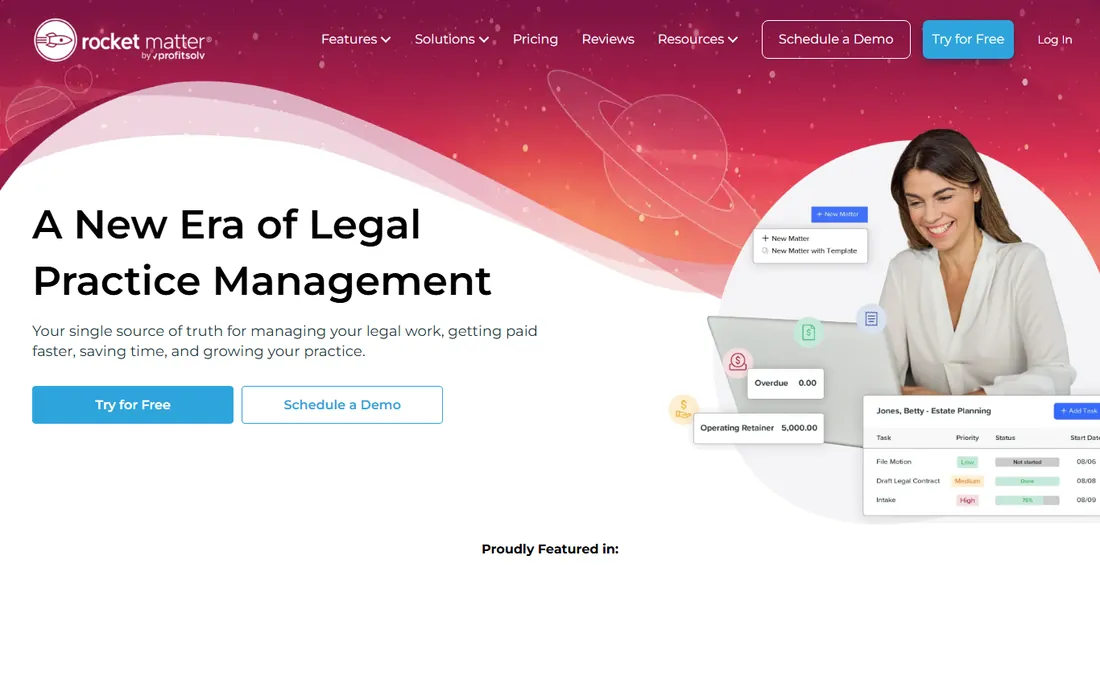
Rocket Matter organizes matters on kanban boards, which sounds like a small detail but changes how a firm sees its pipeline. Plans are published: Essentials at $59, Pro at $89, Premier at $109 and Elite at $139 per user per month. All tiers include client and matter trust accounting, batch billing, document storage and integrated payments, which makes the entry price more complete than it looks.
The visual project-management approach appeals to firms that manage matters like projects, and the billing tools are well regarded. CRM functionality and a turnkey website are add-ons rather than included, so firms that want intake marketing built in should budget for extras. Rocket Matter fits small to midsize firms that want visual matter management with honest published pricing.
What we like- Kanban boards for matter tracking
- Published pricing from $59
- Trust accounting and billing included on all plans
Watch out for- Essentials tier is basic
- Higher tiers push past $100 per user
- CRM and website features cost extra as add-ons
Starting price$59 per user/month (Core plan)
Free planFree trial
Zola Suite positions itself as the end-to-end practice management platform, with CRM, matter management, billing, accounting and email unified in one cloud system. Plans run from Core around $59 to Enterprise near $79 and Elite around $89 per user per month, with a free trial available for evaluation. Its email management and rules-based calendaring are stronger than most entry competitors.
The breadth cuts both ways. Reviewers praise the all-in-one design but note the learning curve and pricing that runs higher than simpler rivals. Zola Suite fits midsize firms that want one system covering intake through accounting without stitching together integrations. Solos will likely find it more platform than they need.
What we like- Full CRM plus accounting in one platform
- Published plan structure
- Strong matter management and email integration
Watch out for- Considered pricey against leaner competitors
- Learning curve from the extensive feature set
- Migration support quality varies
Starting priceSee website
Free planNo

Filevine is the platform litigation shops graduate to. Its customization depth, document assembly, custom workflows and reporting go well beyond what entry tools offer, and it is purpose-built for personal injury, mass tort and high-volume litigation work. Firms that live in complex matter types find the flexibility worth the cost.
Everything about buying Filevine is custom. Pricing is quote-only, with entry tiers reported in the $49 to $87 range and real costs climbing with implementation, modules and AI or intake scope. There is no free trial; evaluation runs through demos and pilots. Filevine suits firms whose workflows genuinely do not fit standard software. If your matters are straightforward, the customization premium buys little.
What we like- Deep customization and workflow automation
- Strong document assembly and reporting
- Built for litigation complexity
Watch out for- Quote-only pricing with implementation costs
- Steeper learning curve
- Smaller third-party integration ecosystem than Clio
Starting priceSee website
Free planNo

Litify takes a different architectural bet from everyone else on this list: it is built on Salesforce. That gives it configurable workflows, real-time dashboards and analytics at a scale smaller platforms cannot match, plus a "legal front door" for in-house legal teams. Midsize to large firms and legal departments with high-volume casework are its natural audience.
The price of that power is complexity and cost. Pricing is quote-only, with independent estimates starting around $150 per user per month and implementation ranging from $5,000 to six figures. There is no free trial. Litify makes sense when your firm already runs on Salesforce or needs enterprise-grade analytics. For everyone else, it is the most expensive way to manage matters on this list.
What we like- Built natively on Salesforce
- Powerful analytics and dashboards
- Configurable workflows at enterprise scale
Watch out for- Quote-only with significant onboarding costs
- Salesforce learning curve and licensing implications
- Overkill for small firms
How this shortlist was actually built
We started from the legal practice management market as buyers see it: solo attorneys, small firms, midsize practices and larger litigation shops. We checked vendor pricing pages directly for every published price, used independent buyer guides only to confirm plan structures, and marked quote-only vendors honestly rather than repeating stale third-party figures. We weighed review sentiment from G2 and Capterra, integration breadth, trust accounting depth, contract terms and free trial availability. We did not claim hands-on testing; nobody's two-week trial substitutes for a firm's real migration, and this guide does not pretend otherwise.
The per-seat math matters more than the brochure price
A $49 headline is never $49. Multiply by seats and months, then add payment processing (typically 2.9% plus a per-transaction fee on client payments), any accounting add-on, implementation or migration fees, and the renewal increase most vendors apply annually. A five-attorney firm with staff can easily spend five figures a year on a platform whose pricing page shows a two-digit number.
Three specifics to nail down before you sign. First, ask whether the quoted price is monthly or annual billing, and what the renewal rate will be. Second, price the payment processing separately; it is often the largest hidden line item. Third, confirm data export terms and migration assistance in writing. Switching costs in legal software are high because your matters, documents and trust ledgers live in the system. The cheapest plan with the worst export terms is the most expensive decision you can make.
Before you sign: a buyer's checklist for matter management
Start with your non-negotiables. Trust accounting depth matters most for firms with IOLTA accounts; CosmoLex leads here, while Clio and PracticePanther handle standard needs well. Client communication tools (portal, texting, e-signature) matter most for consumer-facing practices; MyCase and PracticePanther are strong. Customization matters most for litigation; Filevine and Litify are built for it.
Then check the commercial terms. Favor vendors that publish pricing and offer free trials, because opacity at the buying stage predicts opacity at renewal. Confirm support hours and whether onboarding is included or billed. Ask which integrations are native and which require paid connectors. Finally, run the three-year total cost at your actual seat count, including processing fees, before comparing feature lists. The best software is the one your firm can afford to keep.
Frequently asked questions
How much does legal matter management software cost?
Entry plans for the major platforms run $49 to $59 per user per month, with published tiers reaching $114 to $139. Quote-only platforms like Filevine, Smokeball, LEAP and Litify typically cost more once implementation is included. Budget for payment processing fees and annual renewals on top of the license.
Do I need separate legal accounting software?
Not necessarily. CosmoLex and PracticePanther's top tier include full legal accounting with trust reconciliation built in. Clio offers built-in accounting for small firms. MyCase charges a separate $39 per user per month for its accounting add-on. Firms with complex books often still pair their practice tool with QuickBooks.
What is the difference between Clio Manage and Clio Grow?
Clio Manage handles matters, billing, documents and trust accounting; Clio Grow handles client intake, CRM and marketing. The top-tier Elite plan bundles both. Firms can also add Grow to lower plans. If intake is a separate pain point, price both products together.
Which platform is best for personal injury firms?
Filevine and Litify are built for litigation complexity, with deep customization and reporting. Smokeball suits PI firms that bill hourly and want automatic time capture. CASEpeer is a PI-specific option worth adding to a shortlist. The right choice depends on whether you need customization depth or billing automation more.
Can I migrate my data from another legal platform?
Most vendors offer migration assistance, often free on higher tiers; PracticePanther advertises free data migration on its Business plan. Ask specifically about matter history, documents, trust balances and time entries, and get the scope in writing. Confirm you can export your own data cleanly before you sign.
Are there free plans for legal matter management software?
No major platform on this list offers a permanent free plan. Several offer free trials: Clio (7 days), PracticePanther, MyCase, Smokeball, Rocket Matter and Zola Suite. CosmoLex, LEAP, Filevine and Litify evaluate through demos instead. A trial is short for software this sticky, so use it to test trust accounting and billing specifically.
Sources we checked (12)
- https://www.clio.com/pricing/
- https://www.practicepanther.com/pricing/
- https://www.mycase.com/pricing/
- https://www.cosmolex.com/pricing/
- https://www.smokeball.com/
- https://www.leap.us/
- https://www.rocketmatter.com/pricing/
- https://www.zolasuite.com/
- https://www.filevine.com/
- https://www.litify.com/
- https://costloop.app/blog/case-management-software-pricing/
- https://ailawyer.pro/blog/legal-case-management-software
Is your product missing or out of date?
We review this list regularly. Vendors can request a listing, send updated pricing or ask about featured placement.

Shihab Mia · Founder, Rankite
Shihab has spent more than a decade helping SaaS and e-commerce brands grow through search. He writes Rankite's software buying guides from pricing pages, documentation and public user reviews. More about Shihab.