How we make this list: we compare pricing pages, product documentation and public user reviews. Rankite is independent; if a vendor ever pays for a featured spot, that listing is clearly labeled Partner.
Key takeaways
- A learning experience platform (LXP) personalizes learning around skills and interests, while an LMS administers training. Most tools here now blend both, so buy for your primary use case: skills strategy, compliance, onboarding, customer education or frontline training.
- Docebo is the only platform in this roundup that publishes a starting price on its own site: $9 per user with a 250-user minimum. Everything else is quote-based enterprise pricing.
- Frontline and deskless workforces need a different tool than office workers: Axonify and Thrive are built for retail, hospitality and field teams, while Degreed and Cornerstone serve enterprise knowledge workers.
- WorkRamp was acquired by Learning Pool in 2025 and is not listed here. If you are evaluating it, confirm the product roadmap with Learning Pool directly.
Quick comparison
| Tool | Best for | Starting price | Free plan |
|---|
 Degreed Degreed | Enterprises that want skills intelligence driving workforce transformation | See website (custom quote) | No |
 Cornerstone Cornerstone | Large organizations that want learning inside a full talent suite | See website (custom quote) | No |
 Docebo Docebo | Companies that train employees, customers and partners from one platform | $9/user (250-user minimum; custom for complex enterprises) | No |
 360Learning 360Learning | Mid-market companies that want employees creating courses, not just taking them | See website (custom quote) | No |
 Valamis Valamis | Regulated industries that need compliance evidence plus skills development | See website (custom quote) | No |
 LearnUpon LearnUpon | Organizations running employee, customer and partner training from one LMS | See website (custom quote) | No |
 Thrive Thrive | Deskless and frontline workforces in retail, hospitality and field services | See website (custom quote) | No |
 Axonify Axonify | Large frontline workforces in retail, grocery, logistics and financial services | See website (custom quote) | No |
Is your product missing or out of date?
We review this list regularly. Vendors can request a listing, send updated pricing or ask about featured placement.
Companies now spend more on learning technology than ever, yet employees still say they cannot find the right training when they need it. The learning experience platform exists to fix that discovery problem: instead of a course catalog nobody opens, an LXP recommends personalized learning, tracks skills and connects development to real work. These eight cover the serious end of the market, from enterprise skills intelligence to frontline microlearning.
#1
Degreed
Best for: Enterprises that want skills intelligence driving workforce transformation
Visit degreed.com
Starting priceSee website (custom quote)
Free planNo
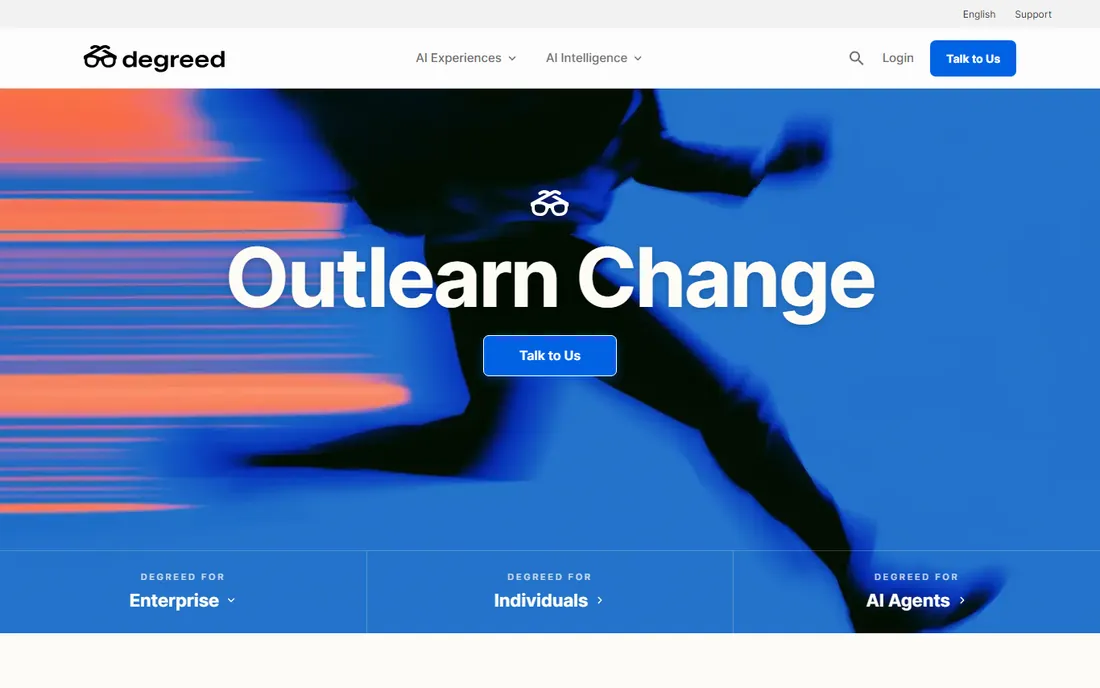
Degreed defined the LXP category and still sets its agenda. The platform builds a living skill profile for every employee, pulls learning content from internal and external sources into personalized pathways, and gives leaders analytics on workforce capability. Its newer Maestro AI layer adds adaptive coaching, role-play practice and real-time skill feedback, plus integrations that bring Degreed intelligence into tools like ChatGPT and Claude.
The buyer is the enterprise L&D or talent leader tasked with upskilling at scale, usually in companies with thousands of employees and a formal skills strategy. Degreed is quote-only and implementation-heavy, and it works best alongside an LMS or HRIS rather than replacing them. Smaller companies will find the platform and the price more than they need; this is a tool for organizations where workforce transformation is a board-level topic.
What we like- Deep skills taxonomy and benchmarking with AI-native personalization
- Aggregates learning from every source into one skill record
- Strong enterprise customer base with proven scale
Watch out for- Enterprise-only pricing and implementation
- The breadth of the platform demands dedicated L&D resources to run well
Starting priceSee website (custom quote)
Free planNo
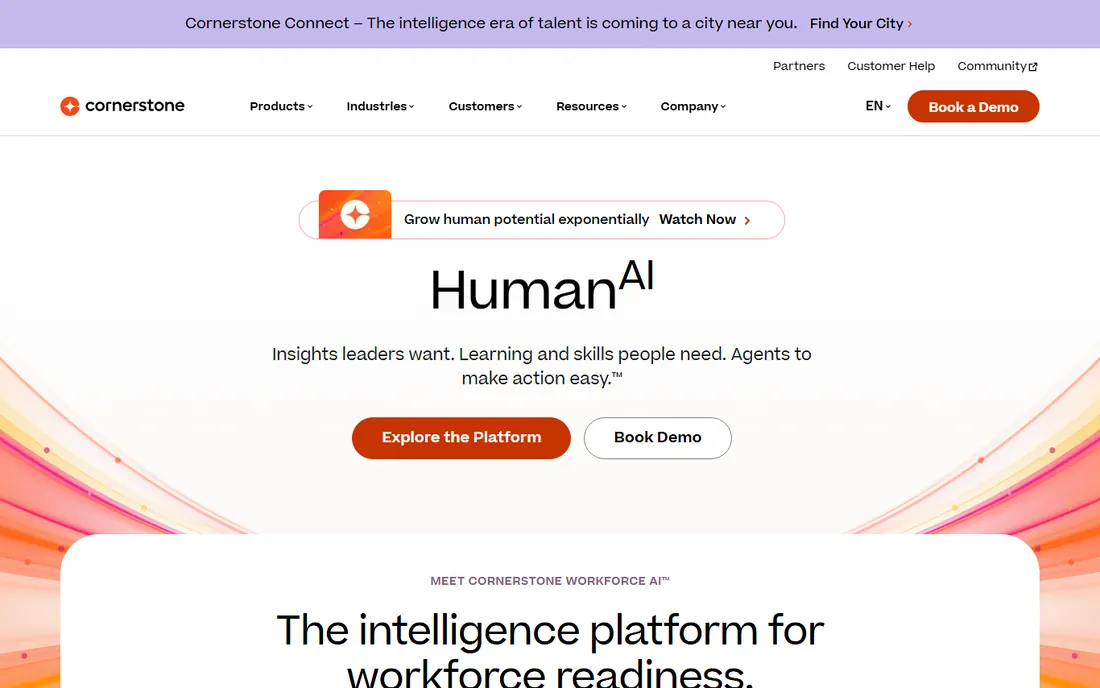
Cornerstone comes at learning from the talent-suite side. Where Degreed leads with skills intelligence, Cornerstone Galaxy leads with an integrated platform: the LMS and LXP sit alongside performance management, recruiting, succession and workforce planning, all sharing one data layer. Its Workforce AI maps skills people have against skills the organization needs and targets learning accordingly, and the content catalog spans more than 27,000 courses and 53,000 skills from 200-plus partners.
The fit is the enterprise that wants one talent vendor rather than best-of-breed point tools. That consolidation is also the tradeoff: buyers report that matching Cornerstone to specific learning workflows takes configuration work, and the platform's HR-suite heritage shows. If your primary need is pure learning experience rather than talent management, a focused LXP may serve you better. But for global enterprises standardizing talent processes, Cornerstone's scale is unmatched.
What we like- Complete platform spanning learning, performance, recruiting and workforce planning
- Massive content ecosystem with 200-plus partners and tens of thousands of courses
- Strong compliance and certification capabilities for regulated industries
Watch out for- The suite's breadth means complex configuration and long rollouts
- Pricing is entirely custom and the platform can feel heavy for learning-only use cases
#3
Docebo
Best for: Companies that train employees, customers and partners from one platform
Visit docebo.com
Starting price$9/user (250-user minimum; custom for complex enterprises)
Free planNo
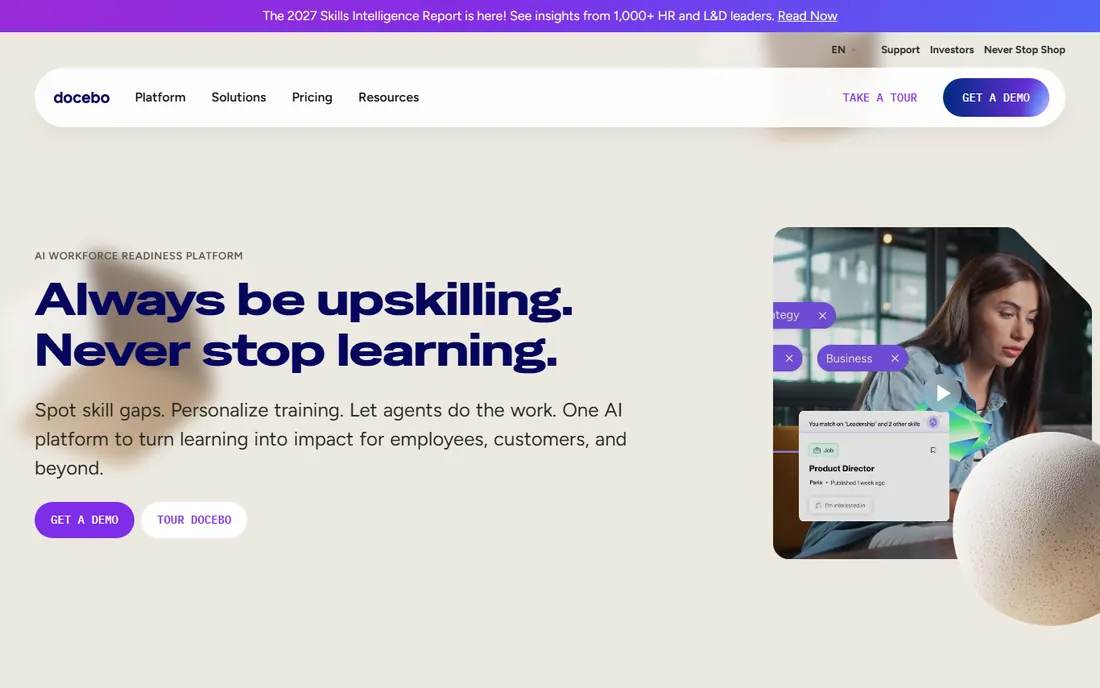
Docebo is the rare enterprise learning platform that tells you what it costs. Its own FAQ puts the main tier at $9 per user with a 250-user minimum, including integrations, custom dashboards, automation and multi-audience training, with custom pricing for complex enterprises. The platform blends LMS administration with LXP-style personalization, and its standout strength is extended enterprise: training customers, partners and resellers alongside employees from one system.
That multi-audience capability is the buying criterion. If you only train employees, several tools here do that well. If you also need customer education academies, partner certification and branded portals, Docebo's architecture is built for it. Implementation runs 4 to 20 weeks depending on scope, and the content marketplace plus AI authoring tools reduce the content burden. For mid-market and enterprise companies with external audiences, it is the most practical pick in this roundup.
What we like- Publishes a starting price, rare in this category
- Strong multi-audience support for employee, customer and partner training
- 30,000-course content marketplace plus AI course creation with Docebo Creator
Watch out for- The $9 tier has a 250-user minimum, so small teams pay more per head in practice
- Advanced use cases push you into custom enterprise pricing quickly
#4
360Learning
Best for: Mid-market companies that want employees creating courses, not just taking them
Visit 360learning.com
Starting priceSee website (custom quote)
Free planNo
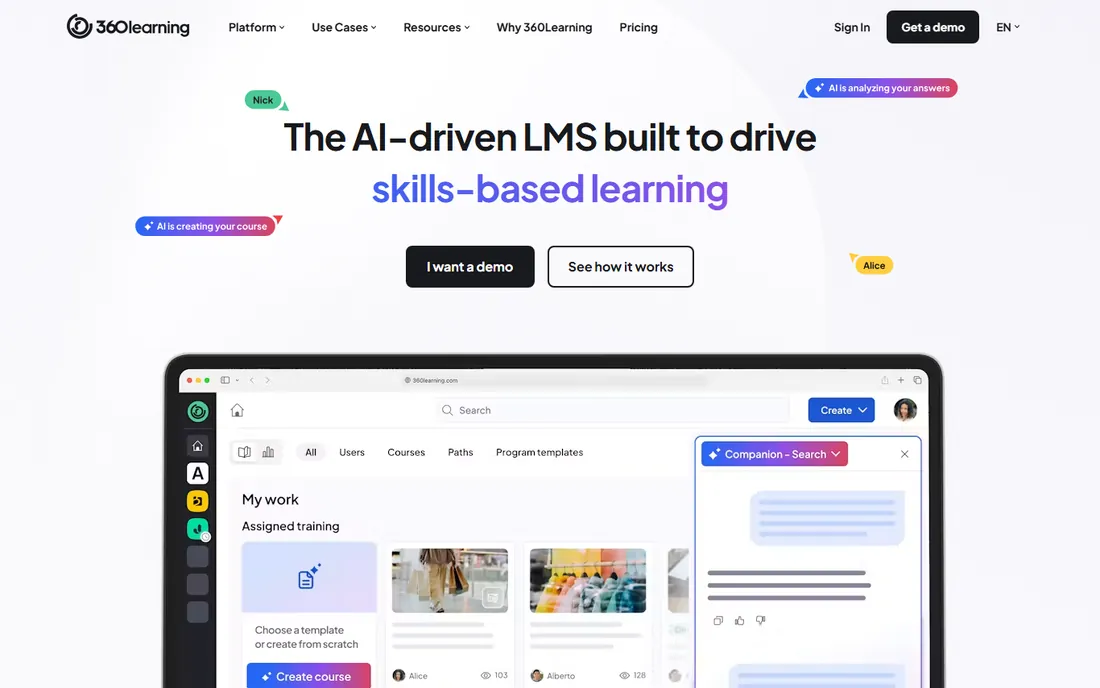
360Learning bets that the best training content already exists inside your company. Its collaborative learning platform lets subject-matter experts turn documents into interactive courses in seconds, with AI handling authoring, translation and review feedback. The result is onboarding, compliance and upskilling content that reflects how your company actually works, rather than generic off-the-shelf courses.
The model only works if your experts participate, which makes this as much a culture purchase as a software one. Companies with strong knowledge-sharing cultures report fast adoption and high engagement; companies expecting L&D to produce everything centrally get less value. Pricing is quote-based despite the mid-market positioning. For growing companies where tribal knowledge is the training gap, 360Learning's approach is the most direct fix.
What we like- Collaborative learning model turns internal experts into course authors with AI assistance
- Fast course creation from documents with translation into 67 languages
- Strong G2 and Capterra ratings for usability
Watch out for- No published pricing, so budget planning requires a sales conversation
- The collaborative model needs cultural buy-in, since subject-matter experts must actually contribute
#5
Valamis
Best for: Regulated industries that need compliance evidence plus skills development
Visit valamis.com
Starting priceSee website (custom quote)
Free planNo
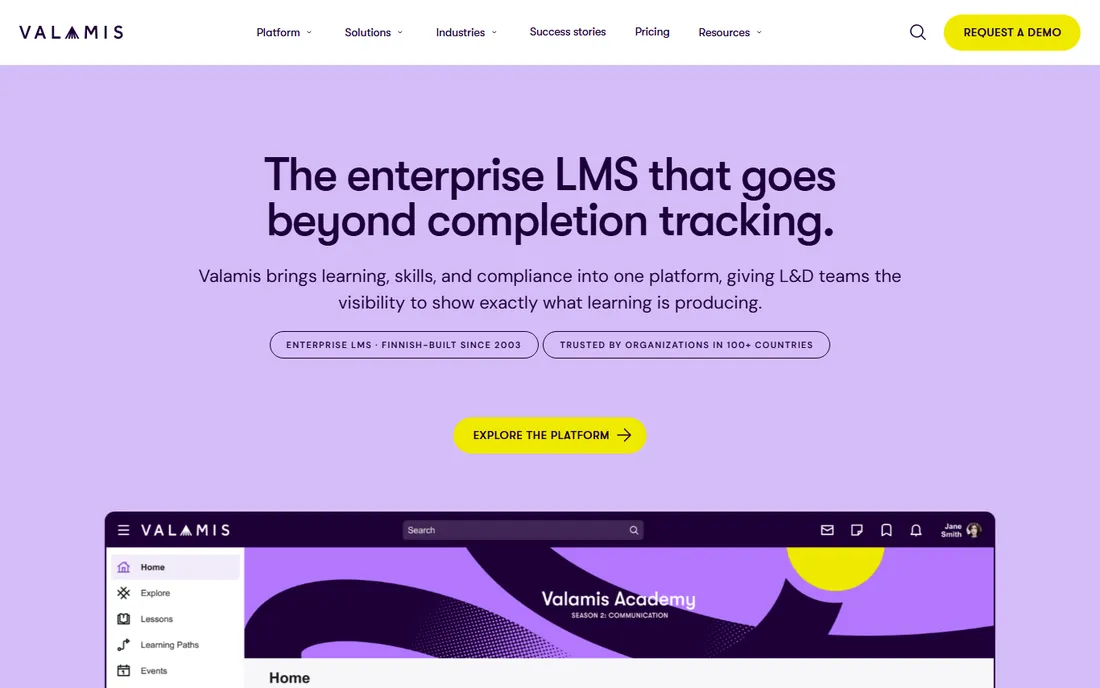
Valamis is built for the L&D team that has to prove learning worked. The Finnish platform combines course delivery, skills mapping, compliance workflows and analytics, with the emphasis on evidence: certifications, completions and skill gains are recorded, searchable and auditable, so compliance questions get answered with a report instead of a spreadsheet hunt. Leaders get a single view of workforce capability by role, team and location.
That compliance-plus-skills combination is the niche. Heavily regulated industries, finance, pharma, energy, get both the audit trail and the development experience in one contract. The platform serves 2 million-plus learners across 100-plus countries, so global deployment is proven. The tradeoff is market familiarity: Valamis is better known in Europe than in the US, and the sales process is enterprise-traditional. For compliance-driven buyers, the audit readiness justifies it.
What we like- Combines compliance tracking, skills mapping and learning analytics in one platform
- Audit-ready reporting that satisfies regulators
- 22-plus years of learning technology experience with 500-plus integrations
Watch out for- Quote-only pricing with an enterprise sales process
- The Finnish vendor has less North American market presence than US competitors
#6
LearnUpon
Best for: Organizations running employee, customer and partner training from one LMS
Visit learnupon.com
Starting priceSee website (custom quote)
Free planNo
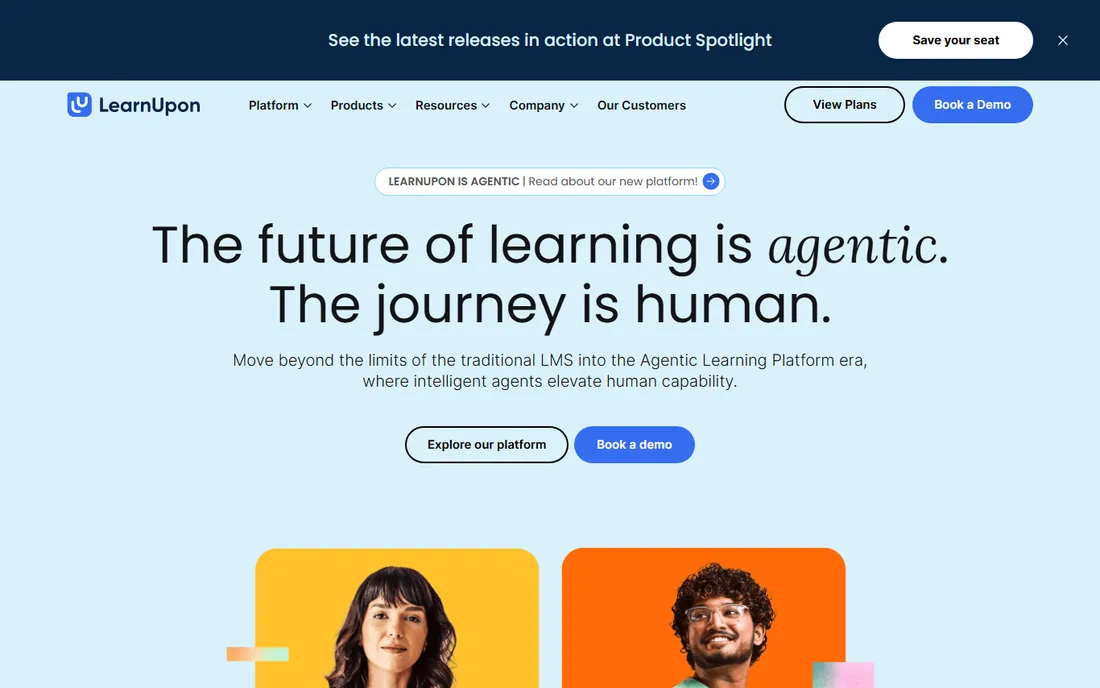
LearnUpon has rebuilt itself around agentic AI. The platform's pitch is that learning teams should lead strategy while AI agents handle the operational grind: content creation, enrollment, compliance chasing and personalization run through LearnUpon IQ and its hub architecture. The long-standing strength underneath is multi-audience training: learning portals let you operate distinct branded environments for employees, customers, partners and associations from a single account.
The buyer is typically a mid-market or enterprise company where training serves revenue, not just HR: customer onboarding academies, partner certification, association member education. The 2025 acquisition of Courseau added AI-assisted course authoring to the stack. As with most of this category, pricing is quote-only. If your learning program touches external audiences and your L&D team is drowning in administration, LearnUpon's automation-first approach deserves a demo.
What we like- Multi-tenancy portals let you run separate branded academies for each audience
- Agentic AI automates admin workflows and personalizes delivery
- Strong customer education heritage with 1,700-plus organizations
Watch out for- No published pricing
- The agentic platform repositioning is new, so validate the roadmap against your timeline
Starting priceSee website (custom quote)
Free planNo
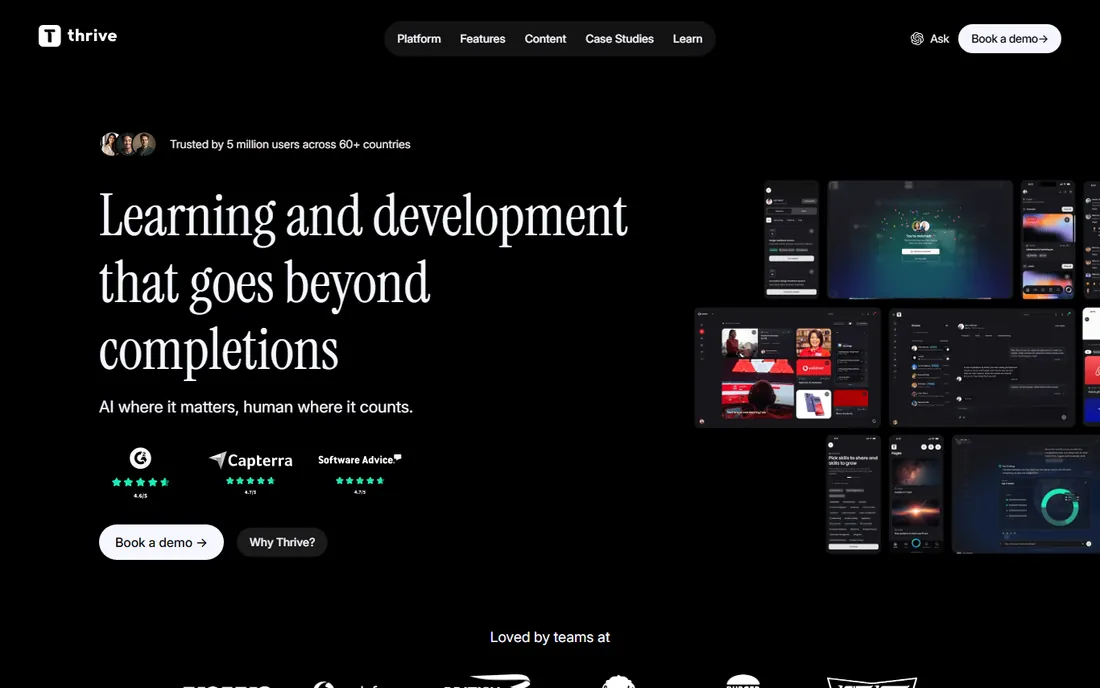
Thrive is designed for the employees most learning platforms forget: the people behind the till, in the warehouse and on the road. The UK-based platform combines an LMS with skills mapping, mentoring, social communities, internal communications and an AI agent called Kiki that creates content, automates admin and surfaces analytics. Everything is included in the subscription rather than sold as add-ons, which simplifies both buying and adoption.
The customer proof skews toward deskless workforces: retail chains, hospitality groups and franchise operations report high adoption and completion rates, which is exactly where traditional LMS platforms struggle. The platform is ISO 27001 and SOC 2 certified with 74-language support, so global rollout is viable. The watch-out is overlap: if you already run separate comms, mentoring and knowledge tools, map carefully against what Thrive would replace before adding another platform.
What we like- Built for engagement with social learning, mentoring, comms and gamification in one app
- AI agent Kiki handles content creation, admin and analytics
- Strong adoption metrics with retail and hospitality brands
Watch out for- UK-headquartered with less US enterprise penetration than Cornerstone or Degreed
- The all-in-one scope can overlap with existing comms and HR tools
#8
Axonify
Best for: Large frontline workforces in retail, grocery, logistics and financial services
Visit axonify.com
Starting priceSee website (custom quote)
Free planNo
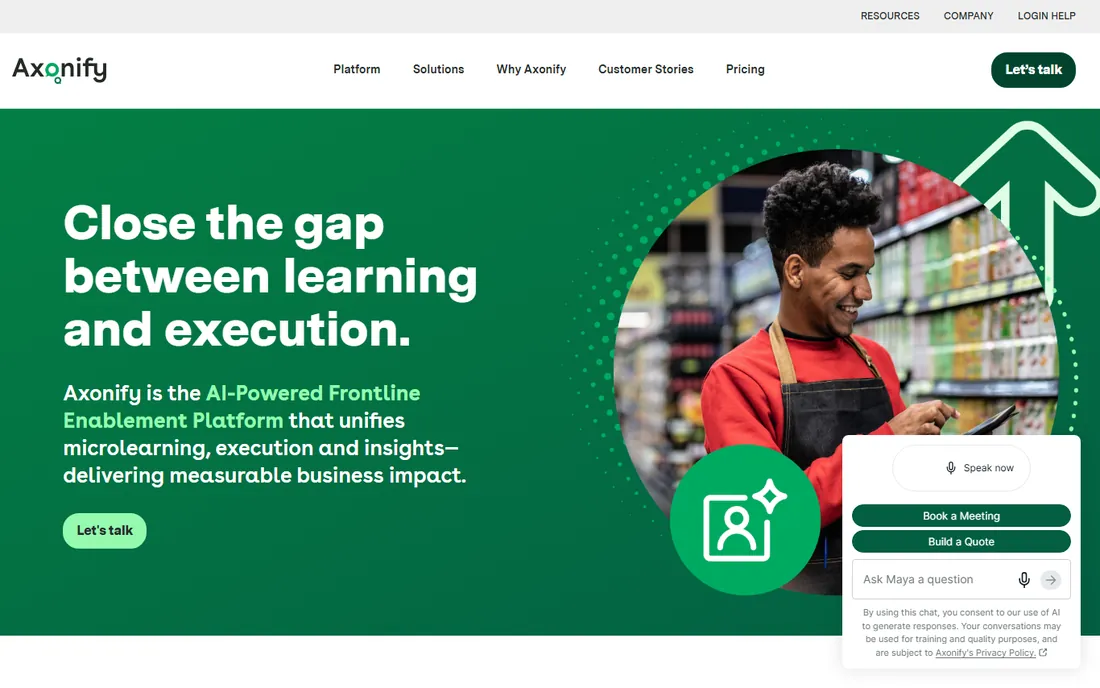
Axonify is the specialist's specialist. The platform delivers a few minutes of personalized microlearning per shift, using spaced repetition and gamification to build knowledge that sticks, and pairs it with guided execution tools: communications, task management and AI guidance for frontline managers. The analytics go beyond completions to measure confidence and readiness, connecting learning to business outcomes like sales lift and reduced handle time.
The customer base tells the story: some of the world's largest retail, grocery and logistics employers run Axonify for millions of frontline workers across 160-plus countries. This is not a general-purpose LXP; it is a frontline enablement platform, and office workers would find it limiting. But if your workforce is mostly deskless and your problem is consistent execution across hundreds of locations, nothing else in this roundup is built as specifically for that job.
What we like- Science-backed microlearning delivered in minutes per day with proven knowledge lift
- Combines training with task management and communications for frontline managers
- Deep frontline analytics including confidence and readiness scores
Watch out for- Purpose-built for frontline workers, so office and knowledge-worker use cases fit poorly
- Enterprise pricing with no public tiers
Budget in annual contracts, not monthly seats. Docebo publishes $9 per user with a 250-user minimum; every other platform here prices by quote, typically scaled on user count, modules and services. Third-party estimates for enterprise LXPs commonly land between $5 and $15 per user per month at volume, but treat those as rumors until you have a proposal.
The bigger budget line is implementation and content. Platform rollouts run 4 to 20 weeks depending on scope, and services, integrations, data migration and admin training are quoted separately. Content is the hidden cost: a platform without courses is an empty shell, so budget for the content marketplace subscription, AI authoring tools or internal production time. Negotiate a pilot with success criteria tied to adoption and skill growth, not just logins, before committing to a multi-year term.
LXP vs LMS: which one do you actually need
The honest answer is that the categories have merged. Degreed, Docebo, 360Learning and LearnUpon all blend LMS administration with LXP personalization, and Cornerstone sells both inside its suite. The useful distinction is your primary problem. If it is compliance tracking, certifications and mandatory training records, buy LMS-first: Valamis, Docebo or Cornerstone. If it is skills gaps, personalized development and learning discovery, buy LXP-first: Degreed, 360Learning or Thrive.
Then match the audience. Frontline and deskless workers need mobile-first microlearning built for short attention windows: Axonify or Thrive. External audiences, customers and partners, need branded portals and multi-tenancy: Docebo or LearnUpon. Regulated industries need audit trails: Valamis or Cornerstone. Start from the audience and the compliance burden, and the shortlist writes itself.
How we chose
We started with the searches buyers run: learning experience platform, best LXP and corporate learning platform. For each candidate we opened the vendor's own site, checked for published pricing, read product documentation and practitioner discussion on Reddit and G2, and compared skills intelligence, content capabilities, AI features, audience fit and company-size fit. Every price shown comes from the vendor's own pages; where pricing is quote-only we wrote "See website" rather than repeating third-party estimates. WorkRamp was removed from the list after its acquisition by Learning Pool.
Frequently asked questions
What is a learning experience platform?
A learning experience platform is software that delivers personalized learning to employees, usually organized around skills rather than course catalogs. It recommends content, tracks skill development and often aggregates learning from many sources. Modern LXPs blend into LMS functionality, adding administration, compliance tracking and reporting.
What is the difference between an LXP and an LMS?
An LMS administers training: enrollments, completions, certifications and compliance records. An LXP personalizes the learning experience: recommendations, skills tracking and content discovery. Most platforms in this roundup do both now, so evaluate vendors on your primary use case rather than the label.
Do small businesses need a learning experience platform?
Usually not. Companies under a few hundred employees get more from a simple LMS or even a well-organized course library. LXPs pay off when you have enough employees for skills data to matter, multiple audiences to serve or a formal upskilling strategy. Docebo's 250-user minimum is a reasonable signal of where the category starts.
How do LXPs handle learning content?
Three ways, often combined: content marketplaces with tens of thousands of ready-made courses, integrations with providers like LinkedIn Learning and Udemy, and AI authoring tools that turn your documents into courses. 360Learning and LearnUpon emphasize AI-assisted creation from internal expertise, while Docebo and Cornerstone lean on large content catalogs.
How long does implementation take?
It varies widely. Simpler rollouts for frontline tools like Axonify can launch in weeks. Mid-market platforms like 360Learning and LearnUpon typically take one to three months. Enterprise deployments of Degreed, Cornerstone or Valamis with HRIS integrations run three to six months or more. Ask every vendor for a phased plan with a pilot group before full rollout.
Sources we checked (8)
- https://degreed.com/
- https://www.cornerstoneondemand.com/
- https://www.docebo.com/
- https://360learning.com/
- https://www.valamis.com/
- https://www.learnupon.com/
- https://www.thrivelearning.com/
- https://axonify.com/
Is your product missing or out of date?
We review this list regularly. Vendors can request a listing, send updated pricing or ask about featured placement.

Shihab Mia · Founder, Rankite
Shihab has spent more than a decade helping SaaS and e-commerce brands grow through search. He writes Rankite's software buying guides from pricing pages, documentation and public user reviews. More about Shihab.