How we make this list: we compare pricing pages, product documentation and public user reviews. Ratings come from G2, Capterra or Trustpilot, with the date we checked them.
Key takeaways
- Khan Academy Kids, Duolingo ABC, and PBS-style free apps offer strong free learning, while ABCmouse, Reading Eggs, and Homer add structured curricula behind subscriptions.
- Systematic phonics matters most: apps that teach letter sounds, blending, and decoding build real reading, while picture-guessing games do not.
- Reading Eggs and Homer suit families wanting guided, personalized reading paths, while Starfall suits early phonics at a low yearly cost.
- Check privacy and ad policies before handing an app to a child, and prefer apps with no third-party ads, no chat features, and clear parental controls.
- Children privacy note: check COPPA-relevant privacy policies, supervise use, and do not allow in-app purchases without parental permission.
Quick comparison
Is your product missing or out of date?
We review this list regularly. Vendors can request a listing, send updated pricing or ask about featured placement.
The best learn to read apps for kids
Starting priceFree
Free planYes
Khan Academy Kids comes from a nonprofit and costs nothing, with no ads or subscriptions, covering reading, language, math, social-emotional skills, and more for ages 2 to 8. Its early literacy content includes stories, vocabulary, letter recognition, and phonics exposure, making it the best free starting point for families that want broad early learning without cost. The app format suits tablets and Chromebooks with Google Play, and its nonprofit backing means no upselling or in-app purchase pressure.
Khan Academy Kids is an app only, with no web version, so families without a tablet or compatible Chromebook cannot use it on a computer. Reading depth is also lighter than focused phonics apps such as Teach Your Kid to Read or Hooked on Phonics, so children needing systematic decoding practice should pair it with a phonics-first tool. For families starting out at no cost, Khan Academy Kids is the best first app, and its breadth covers more than reading alone.
What we like- Completely free with no ads or subscriptions
- Covers reading, math, and social-emotional skills
- Ages 2 to 8
Watch out for- App only, no web version
- Reading depth lighter than focused phonics apps
- Needs a tablet or Chromebook
Starting price$14.99 per month
Free planNo
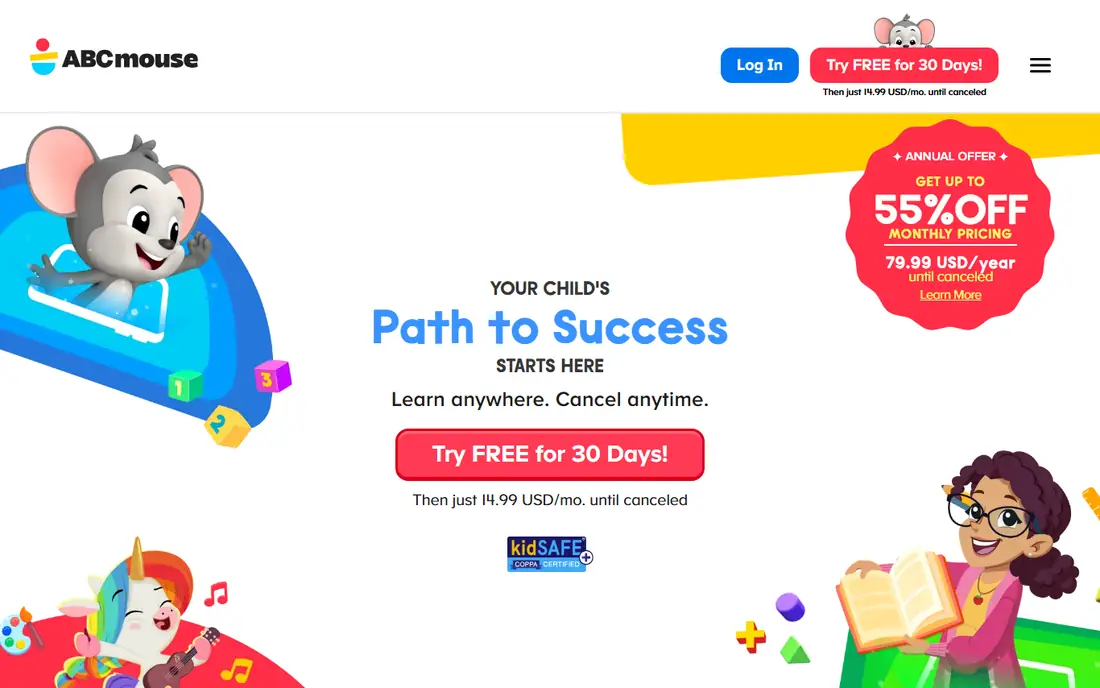
ABCmouse offers a large guided curriculum for ages 2 to 8, with more than 13,000 learning activities across reading, math, science, and art, following one long path through many subjects. Premium covers up to three children with no ads, and its strength is volume and structure for a child who likes following a set sequence. Monthly pricing is listed at $14.99 per month in current guides, with annual pricing varying from $45 to $79.99 by offer, so check the current deal before subscribing.
Broad focus dilutes reading depth compared with phonics-first apps, and monthly pricing is higher than Starfall or Teach Your Kid to Read for reading alone. For families wanting maximum content volume across subjects with a guided path, ABCmouse is the best structured pick, while families focused only on reading should compare Reading Eggs or Hooked on Phonics first.
What we like- Large guided curriculum with 13,000 plus activities
- Ages 2 to 8
- Covers reading, math, science, and art
- Up to 3 children
Watch out for- Monthly price higher than focused reading apps
- Annual price varies $45 to $79.99 by offer
- Broad focus dilutes reading depth
Starting price$99.99 per year
Free planNo
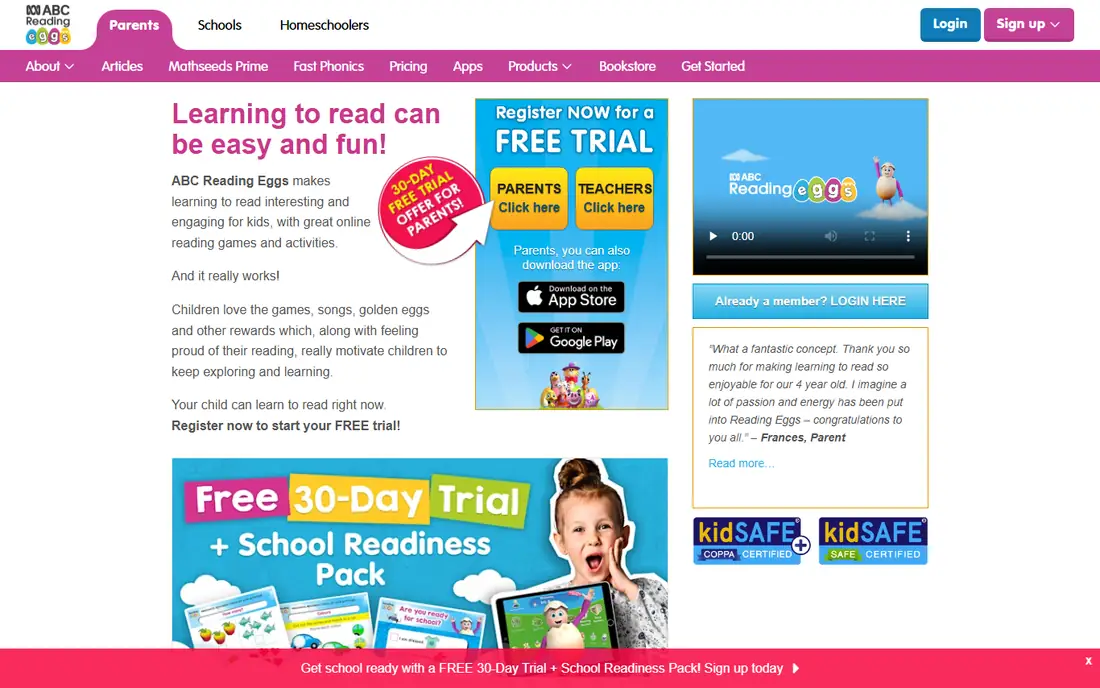
Reading Eggs teaches phonics, sight words, stories, and games in a guided program for ages 4 to 7, with levels that progress as children master sounds and words. Its game-based motivation suits children who need rewards to keep practicing, and its structured path helps parents track progress without designing lessons themselves. Current guides cite $99.99 per year, with pricing varying by plan and region, so verify the current subscription before buying.
There is no free tier beyond trials, and game rewards can distract from decoding practice if children chase points rather than reading words. For families wanting a guided reading program with games and motivation built in, Reading Eggs is the best pick, and its level structure suits children who thrive on clear progression and rewards.
What we like- Phonics, sight words, stories, and games
- Guided levels for ages 4 to 7
- Motivation through rewards
Watch out for- Paid subscription with no free tier
- Price varies by plan
- Rewards can distract from decoding practice
Starting price$9.99 per month
Free planNo
Homer built its reputation on personalized reading instruction, with adaptive lessons that meet each child where they are, wrapped in content reflecting their interests. For phonics and early literacy, few apps match its depth and personalization, and its adaptive path adjusts difficulty as children progress. Pricing is listed at $9.99 per month in current guides, with no free tier beyond trials.
Homer remains reading-centric despite adding math and other subjects, with limited science exploration, creative expression, and social-emotional learning compared with broader apps such as Khan Academy Kids or ABCmouse. At premium pricing, families wanting comprehensive early education may find its narrow scope limiting. For families prioritizing reading depth and personalization above breadth, Homer is the best pick, and its adaptive lessons suit children at different reading levels.
What we like- Personalized adaptive lessons
- Deep phonics and early literacy
- Content matched to child interests
Watch out for- Reading-centric, limited science and creative coverage
- $9.99 per month for partial curriculum
- No free tier
Starting priceFree
Free planYes
Duolingo ABC teaches letter sounds, tracing, and early decoding in short, game-like lessons for ages 3 to 6, completely free with no subscription. Its bite-sized format suits beginners and short attention spans, with tracing and sound practice building early phonics foundations. Like Khan Academy Kids, it removes cost barriers for families testing whether a child engages with reading apps.
Depth is lighter than paid phonics programs, with limited progression tracking and less systematic decoding practice for children past the beginner stage. For beginners ages 3 to 6 who need free, short, engaging letter and sound practice, Duolingo ABC is the best free phonics pick, and it pairs well with Khan Academy Kids for broader learning.
What we like- Completely free
- Letter sounds, tracing, and early decoding
- Short lessons for ages 3 to 6
Watch out for- Lighter depth than paid phonics programs
- Limited progression tracking
- Best for beginners only
Starting price$35 per year
Free planYes
Starfall is known for phonics, with its learn-to-read program available free and a home membership at $35 per year for one household on computers and mobile devices, covering pre-K to 3rd grade. Its phonics-first approach suits early readers whose main goal is decoding, with simple, focused lessons that avoid distraction. The low yearly cost makes it the best value pick for families wanting phonics without a monthly subscription.
The interface is simpler than modern apps such as ABCmouse or Reading Eggs, with fewer games and rewards, which may engage some children less. Membership also covers one household only, so multi-household use needs separate plans. For families prioritizing early phonics at the lowest yearly cost, Starfall is the best value pick, and its free learn-to-read program lets families test before paying.
What we like- Learn-to-read program free
- Home membership $35 per year
- Strong phonics focus
- Pre-K to 3rd grade
Watch out for- Interface simpler than modern apps
- Fewer games and rewards
- Membership covers one household only
Starting priceSee website
Free planNo
Hooked on Phonics offers sequential phonics lessons with videos and practice for ages 4 to 8, following a structured progression from letter sounds through blending to reading sentences. Its long track record in phonics instruction gives parents confidence in its method, and its lesson sequence suits children who benefit from clear, step-by-step teaching rather than open exploration. Practice activities reinforce each lesson before moving on, building decoding skill systematically.
Pricing varies by plan and is not listed as a single figure in current guides, so this article lists the price as See website, and there is no free tier beyond trials. Game variety trails Reading Eggs, which may matter for children motivated by games. For families wanting sequential, video-supported phonics lessons with a proven method, Hooked on Phonics is a strong pick, and its structure suits children who need explicit teaching.
What we like- Sequential phonics lessons with videos and practice
- Ages 4 to 8
- Structured progression
- Long track record
Watch out for- Pricing varies by plan
- No free tier
- Less game variety than Reading Eggs
Starting price$9.95 per month
Free planTrial only
Teach Your Kid to Read focuses where reading instruction matters most: systematic phonics, letter sounds, blending, and decoding, with practice that builds independence and stops picture-guessing. Lesson one is free with no card and nothing to cancel, and from lesson two the program offers a 7-day free trial, then $9.95 per month. That focus makes it the top pick in current guides for children who guess words, since it forces children to look at every letter, say every sound, and blend left to right rather than using pictures as a cheat sheet.
Its narrow focus means it covers phonics only, without the breadth of ABCmouse or Khan Academy Kids, and game variety is limited compared with Reading Eggs. For children ages 4 to 7, especially those guessing words instead of decoding, Teach Your Kid to Read is the best focused pick, and parents should sit beside the child and require left-to-right blending during lessons for best results.
What we like- Systematic phonics with sound-by-sound decoding
- Lesson one free with no card
- Best for children who guess words
Watch out for- $9.95 per month after 7-day trial
- Narrow focus on phonics only
- Less game variety than broader apps
How we chose
We compared apps on phonics depth, age fit, price transparency, free-tier availability, and child safety, weighting systematic decoding over game variety or content volume. We favored apps with published pricing where available, and we marked Hooked on Phonics as See website where pricing varies by plan rather than guessing a figure. Prices come from vendor pages and current guides, and they vary by offer and region, so verify current pricing before subscribing. We did not test any app hands-on with children, and we did not list apps without reading-specific features.
Buying guide
Start free: try Khan Academy Kids and Duolingo ABC first to see whether your child engages with reading apps at all, then add a focused phonics app if decoding needs work. If your child guesses words, prioritize Teach Your Kid to Read or Hooked on Phonics for systematic phonics, and sit beside them during lessons requiring left-to-right blending. If your child needs motivation through games, try Reading Eggs, and if you want broad curriculum plus reading, compare ABCmouse and Homer by breadth versus personalization.
Before handing any app to a child, check four things: whether the app has third-party ads, chat features, or external links that a child could follow, whether parental controls let you limit time and purchases, whether the privacy policy explains data collection in COPPA-relevant terms, and whether in-app purchases require parental permission. Prefer apps with no third-party ads and clear parental controls, supervise use, and never allow in-app purchases without permission. Finally, remember that apps support reading but do not replace reading together: read physical books with your child daily, since shared reading builds vocabulary and love of stories that no app alone provides.
Frequently asked questions
What is the best learn to read app for kids overall?
Khan Academy Kids is the best free overall pick, with broad learning at no cost, while Teach Your Kid to Read is the best focused phonics pick for children who need systematic decoding. Reading Eggs suits families wanting guided gamified reading, and Starfall suits budget phonics.
Are free reading apps good enough?
Yes, for many children. Khan Academy Kids and Duolingo ABC cover early literacy well at no cost, and Starfall learn-to-read program is free. Paid apps add structured progression, personalization, and tracking that free apps offer less of, so upgrade when a child needs those features.
What age should children start reading apps?
Most reading apps target ages 2 to 8, with Duolingo ABC and Khan Academy Kids starting at ages 2 to 3, and Reading Eggs, Homer, and Teach Your Kid to Read focusing on ages 4 to 7. Match the app to your child reading stage, not just age, since children develop at different rates.
How do I know if my child is guessing words instead of reading?
Guessing readers use pictures, patterns, or first letters to predict words rather than decoding every letter. If your child reads a word correctly on one page but not the next, or substitutes a similar word, switch to a systematic phonics app and require left-to-right blending.
Are reading apps safe for children?
Safety depends on the app: prefer apps with no third-party ads, no chat features, and clear parental controls, and check COPPA-relevant privacy policies before use. Supervise sessions, limit screen time by age, and block in-app purchases without parental permission.
Should reading apps replace books?
No. Apps support phonics practice and motivation, but shared physical book reading builds vocabulary, comprehension, and love of stories that apps alone do not provide. Use apps for practice and books for shared reading time together.
Sources we checked (0)
Is your product missing or out of date?
We review this list regularly. Vendors can request a listing, send updated pricing or ask about featured placement.

Shihab Mia · Founder, Rankite
Shihab has 5+ years in B2B and SaaS SEO. He writes Rankite's software buying guides from pricing pages, documentation and public user reviews. More about Shihab.
 Khan Academy Kids
 ABCmouse
 Reading Eggs
 Homer
 Duolingo ABC
 Starfall
 Hooked on Phonics
 Teach Your Kid to Read