How we make this list: we compare pricing pages, product documentation and public user reviews. Ratings come from G2, Capterra or Trustpilot, with the date we checked them.
Key takeaways
- Khan Academy Kids and Zearn are the best free starting points, with no ads and a full early-learning or K-8 curriculum.
- Prodigy and SplashLearn turn practice into games, which suits kids who resist worksheets but need daily repetition.
- IXL and Mathletics give the deepest curriculum coverage and progress reporting, making them strong picks for homeschool families.
- DragonBox suits younger kids learning numbers and algebra concepts through play, while Duck Duck Moose suits preschoolers best.
Quick comparison
| Tool | Best for | Starting price | Free plan |
|---|
 Khan Academy Kids | Free early learning for ages 2 to 8 | Free | Yes |
 Prodigy Math | Game-based math practice for grades 1 to 8 | Free | Yes |
 IXL Math | Deep curriculum coverage and detailed reporting | See website | No |
 SplashLearn | Games, worksheets and lesson plans for Pre-K to grade 5 | See website | See website |
 Mathletics | A school-style math program for ages 5 to 16 | See website | Free trial |
 Zearn Math | Free K-8 math that reinforces classroom teaching | Free | Yes |
 DragonBox | Play-based numbers and algebra for ages 4 and up | See website | No |
 Duck Duck Moose | Preschool math play from an award-winning studio | See website | See website |
Is your product missing or out of date?
We review this list regularly. Vendors can request a listing, send updated pricing or ask about featured placement.
The best apps for kids to learn math
Starting priceFree
Free planYes
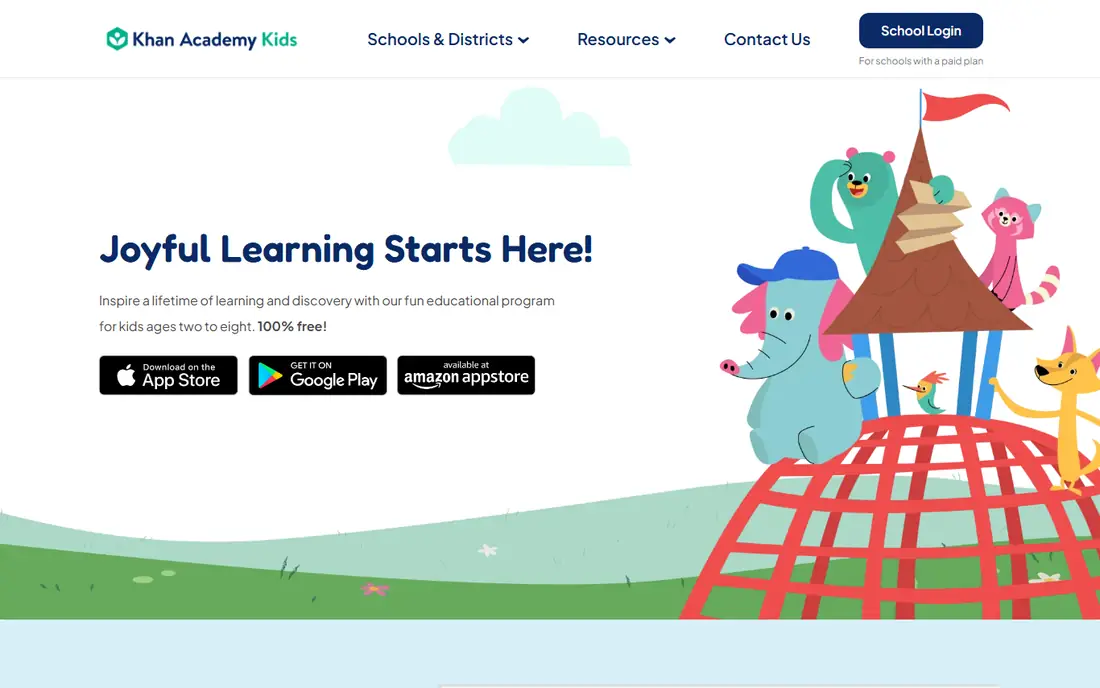
Khan Academy Kids is the free early-learning app from the nonprofit behind Khan Academy, built for children ages 2 to 8. It teaches early math skills such as counting, shapes, comparing numbers and simple addition through interactive stories, games and activities, alongside reading and social-emotional learning. Because it is a nonprofit product, there are no ads and no in-app purchases, which is rare and valuable for a kids app.
One transparency note: the Khan Academy Kids page returned only a client-challenge screen during this research, so this entry rests on search evidence and was not retried. The domain is confirmed as the product's official site. For parents of preschool and early elementary kids, this remains the first app to try, and it costs nothing.
What we like- Completely free with no ads or in-app purchases
- Covers math, reading and social skills
- Designed by education experts
Watch out for- Homepage showed only a bot-check screen during research, so details rest on search evidence
- Aimed at younger kids only
Starting priceFree
Free planYes
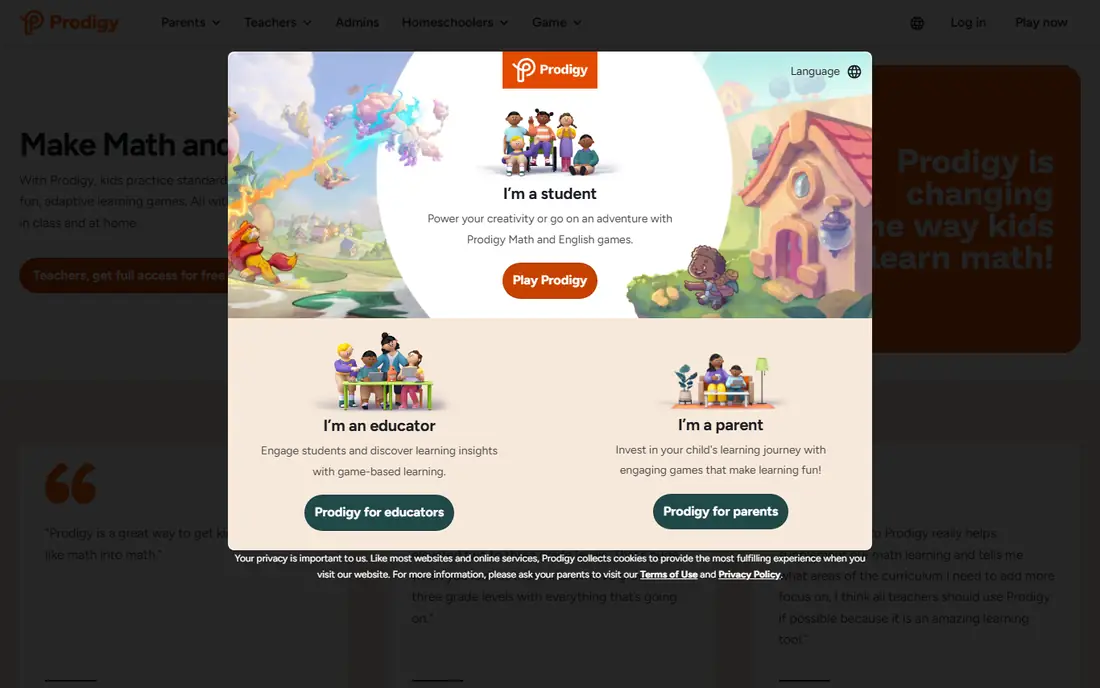
Prodigy Math turns math practice into a role-playing game where kids battle monsters, complete quests and earn rewards by answering math questions. The questions adapt to each child's level and align to school standards, so a third grader sees third-grade skills and a sixth grader sees sixth-grade skills. Teachers use it free in classrooms, with tools to set assignments and track progress, and parents get reports on their child's learning.
Prodigy says 91 percent of parents reported their children enjoy using it, and that nearly one million teachers use it at no cost. The core game content is free, with optional parent memberships funding the service and adding extra features. If your child resists worksheets but loves games, Prodigy is the most proven way to turn screen time into math practice.
What we like- All standards-aligned math and English content is free
- Adaptive questions match each child's level
- Teacher and parent tools included
Watch out for- Optional paid memberships add extras that kids may ask for
- Game elements can distract from practice
#3
IXL Math
Best for: Deep curriculum coverage and detailed reporting
Visit ixl.com
Starting priceSee website
Free planNo
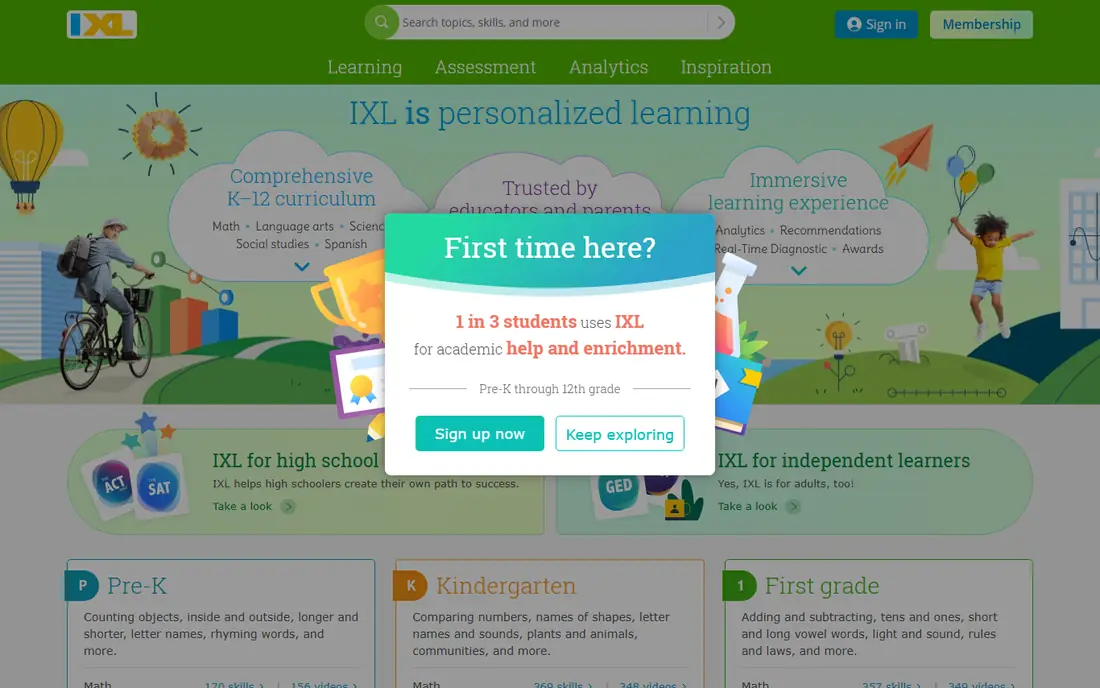
IXL is the most comprehensive practice platform on this list, covering math, language arts, science and social studies from Pre-K through grade 12. Its math skills are matched to state standards, textbooks and major assessments, so parents can find exactly the skill a child is studying in class. The platform adapts as children answer, offering easier or harder problems based on performance, and parents get detailed reports on strengths and gaps.
The trade-off is style: IXL feels more like a workbook than a game, which suits focused learners but may bore kids who need more play. Pricing is not shown on the homepage, so check the membership page for current family rates. For homeschool families or parents who want precise curriculum coverage, IXL is hard to beat.
What we like- Covers Pre-K through grade 12 with skills matched to state standards
- Adapts to each learner
- Detailed progress reports for parents
Watch out for- No free plan beyond a limited trial
- Drill-style format may feel less playful than game apps
Starting priceSee website
Free planSee website
SplashLearn offers a full library of math and English games, worksheets, lesson plans and teaching tools for preschool through grade 5. Parents can browse by grade, subject or topic, from counting and addition to fractions and geometry, and teachers get classroom tools, lesson plans and progress tracking. The homepage emphasizes learning that feels like play, with hundreds of games designed to teach specific skills.
SplashLearn's library is one of the largest for early grades, and the worksheet collection is useful for offline practice. Pricing is not visible on the homepage, so confirm current family pricing before subscribing. For kids in preschool through fifth grade, SplashLearn pairs well with a free option such as Khan Academy Kids.
What we like- Hundreds of games plus worksheets and lesson plans
- Organized by grade and topic
- Parent and teacher tools
Watch out for- Pricing not shown on the homepage
- Aimed at younger kids, ending at grade 5
Starting priceSee website
Free planFree trial
Mathletics calls itself the world's leading online math program, used by more than 3 million students, more than 200,000 teachers and more than 14,000 schools. It combines personalized learning paths, games such as Multiverse and Rainforest Math, and mastery challenges, with certificates and rewards to keep kids motivated. The program is designed by educators, aligned to state standards, and certified under ESSA Level II for evidence of effectiveness.
Mathletics suits families who want a structured program that mirrors school, with automatic grading and progress reports for parents. A free trial is offered, with pricing confirmed at signup. For kids who thrive on clear goals and rewards, Mathletics offers more structure than Prodigy or SplashLearn.
What we like- Aligned to US state standards with ESSA Level II certification
- Used by more than 3 million students
- Games, rewards and certificates
Watch out for- Pricing not shown on the homepage
- More structured and school-like than game-first apps
#6
Zearn Math
Best for: Free K-8 math that reinforces classroom teaching
Visit zearn.org
Starting priceFree
Free planYes
Zearn Math is a nonprofit K-8 math learning platform designed to reinforce teacher-led instruction and help all students succeed in grade-level math. Students learn with pictures, visual models and real-life examples, and the platform is free for students and teachers. Zearn is widely used in US schools, which means your child's classroom may already use it, making home practice consistent with schoolwork.
The homepage is mainly a login screen, but it confirms the core promise: learning that helps math make sense, free of charge. For families looking for a free, classroom-aligned option beyond the early grades, Zearn is the strongest choice after Khan Academy Kids.
What we like- Free for students and teachers
- Top-rated K-8 platform
- Teaches with pictures, visual models and real-life examples
Watch out for- Homepage is mainly a login page, so detail is limited
- Classroom-focused rather than game-first
Starting priceSee website
Free planNo
DragonBox, now a Kahoot company, makes award-winning math games that teach deep concepts through play. Its flagship Algebra 5+ teaches children as young as 5 the process needed to solve basic linear equations, without ever feeling like a lesson. Other apps cover numbers for ages 4 to 8, big numbers and long addition and subtraction, geometry through Euclidean proofs, and multiplication tables through more than 20 mini games.
Press praise has been strong, with Forbes calling one app the first thing to download on a tablet for kids 4 to 8. The trade-off is pricing: apps are sold individually in app stores, so buying several adds up. For parents who want their child to truly understand math concepts rather than memorize procedures, DragonBox is worth the cost.
What we like- Teaches algebra concepts to kids as young as 5 through play
- Award-winning games
- Now part of Kahoot
Watch out for- Apps are sold individually, so costs add up
- No single subscription covering all games
Starting priceSee website
Free planSee website
Duck Duck Moose makes award-winning educational apps for children, including Moose Math, which teaches early math skills such as counting, addition, subtraction and sorting through playful activities. The studio is known for simple, child-friendly design with no advertising pressure, making its apps a safe choice for preschoolers and early elementary kids.
The homepage itself is thin, showing only the brand description and a newsletter signup, so pricing and current app details should be confirmed in the app store before downloading. For parents of the youngest learners, Duck Duck Moose apps are a gentle, well-designed starting point alongside Khan Academy Kids.
What we like- Award-winning educational apps for young children
- Simple, playful design suited to preschoolers
- Trusted kids brand
Watch out for- Homepage is thin, showing only a newsletter signup and brand description
- Aimed at younger kids only
How we chose
We opened each app's homepage in October 2026 to confirm it loads and belongs to the product named, with two flagged exceptions: Khan Academy Kids showed only a bot-check screen and is kept on search evidence, and Duck Duck Moose has a thin homepage confirming only the brand and its educational focus. We weighed age range, curriculum depth, free options, game quality and parent tools, and favored apps with no ads for young children.
What to look for in a kids math app
Start with your child's age and grade. Preschoolers need counting, shapes and simple addition, while elementary kids need multiplication, fractions and problem solving, and middle schoolers need pre-algebra and ratios. An app aimed at the wrong age will either bore or frustrate your child, so check the stated age range first.
Next, check whether the app teaches or only drills. Games that explain concepts with visual models, like Zearn and DragonBox, build understanding that lasts, while pure drill apps build speed. The best mix is an app that teaches a concept, then gives plenty of practice.
Finally, protect your child's attention and privacy. Prefer apps with no ads and no in-app purchase pressure, especially for kids under 8. Set a daily time limit, sit with younger kids for the first sessions, and use the parent reports to spot weak areas rather than pushing for longer sessions.
Frequently asked questions
What is the best free math app for kids?
Khan Academy Kids for ages 2 to 8, and Zearn Math for kindergarten through grade 8. Both are free, nonprofit products with no ads, making them the best starting points for most families.
Are math apps better than worksheets?
Neither is better alone. Apps give instant feedback and adapt to your child's level, while worksheets build written working and focus. Many families use both, with an app for daily practice and worksheets for homework support.
How much screen time is right for a math app?
Most experts suggest short, regular sessions of 15 to 30 minutes for elementary kids. Consistency matters more than length: a short daily session beats a long weekend session.
Does Prodigy Math really teach math?
Yes. Prodigy questions align to school standards and adapt to each child's level, and teachers use it as classroom practice. The game layer motivates practice, but parents should check progress reports to confirm learning.
What age should kids start using math apps?
Simple counting and shape apps suit ages 3 to 4, structured practice apps suit kindergarten onward, and curriculum platforms such as IXL and Mathletics suit ages 5 and up. Start simple and move up as skills grow.
Sources we checked (8)
- https://www.khanacademy.org/kids
- https://www.prodigygame.com
- https://www.ixl.com
- https://www.splashlearn.com
- https://www.mathletics.com
- https://www.zearn.org
- https://www.dragonbox.com
- https://www.duckduckmoose.com
Is your product missing or out of date?
We review this list regularly. Vendors can request a listing, send updated pricing or ask about featured placement.

Shihab Mia · Founder, Rankite
Shihab has 5+ years in B2B and SaaS SEO. He writes Rankite's software buying guides from pricing pages, documentation and public user reviews. More about Shihab.