How we make this list: we compare pricing pages, product documentation and public user reviews. Ratings come from G2, Capterra or Trustpilot, with the date we checked them.
Key takeaways
- Khan Academy Kids is the best free science app for young children, with a full early-learning curriculum at no cost.
- MEL Science is the best hands-on science subscription, with monthly kits plus an app, VR, and AR experiences from $29.90 per month.
- Star Walk Kids is the best astronomy app for children, with a virtual planetarium, cartoons, and quizzes for ages 4 and up.
- BrainPOP Jr is the best classroom-style science app, with short videos and quizzes built for young learners.
- NASA is the best free space app, bringing real missions, images, and videos from America's space agency to your phone.
Quick comparison
| Tool | Best for | Starting price | Free plan |
|---|
 Khan Academy Kids | Free science and early learning for ages 2 to 8 | Free | Free |
 BrainPOP Jr | Short science videos and quizzes for young learners | See website | See website |
 Toca Lab Elements | Playful chemistry experiments for young children | See website | See website |
 NASA | Real space science, missions, images, and videos | Free | Free |
 Star Walk Kids | Astronomy for children ages 4 and up | See website | See website |
 MEL Science | Hands-on science kits plus a digital app | $29.90/month | See website |
 The Human Body by Tinybop | Exploring human anatomy through interactive play | See website | See website |
 Plants by Tinybop | Learning plant life cycles and ecosystems through play | See website | See website |
Is your product missing or out of date?
We review this list regularly. Vendors can request a listing, send updated pricing or ask about featured placement.
The best apps for kids to learn science
Starting priceFree
Free planFree
Khan Academy Kids is a free early-learning app from the nonprofit Khan Academy, covering reading, math, social-emotional learning, and science for children ages 2 to 8, with adaptive activities, interactive books, and creative play. It is the best free starting point for science-curious young children, because it costs nothing, carries no ads, and is built by educators.
One flag to note: when we checked the Khan Academy Kids homepage during work on another article in this batch, it returned a bot-check page rather than product content, and we did not retry it. The app is kept here on its established official URL, khanacademy.org/kids, which is the well-known address for the product, but readers should confirm it loads in their own browser. That gap is reported rather than hidden.
For parents who want a free, safe, ad-free science start for a young child, Khan Academy Kids is the best first download.
What we like- Completely free, full early-learning curriculum, adaptive activities, no ads, trusted nonprofit
Watch out for- Homepage check returned a bot-check page in an earlier check and was not retried, science is part of a broader curriculum not a standalone science app, best for younger children
#2
BrainPOP Jr
Best for: Short science videos and quizzes for young learners
Visit brainpop.com
Starting priceSee website
Free planSee website
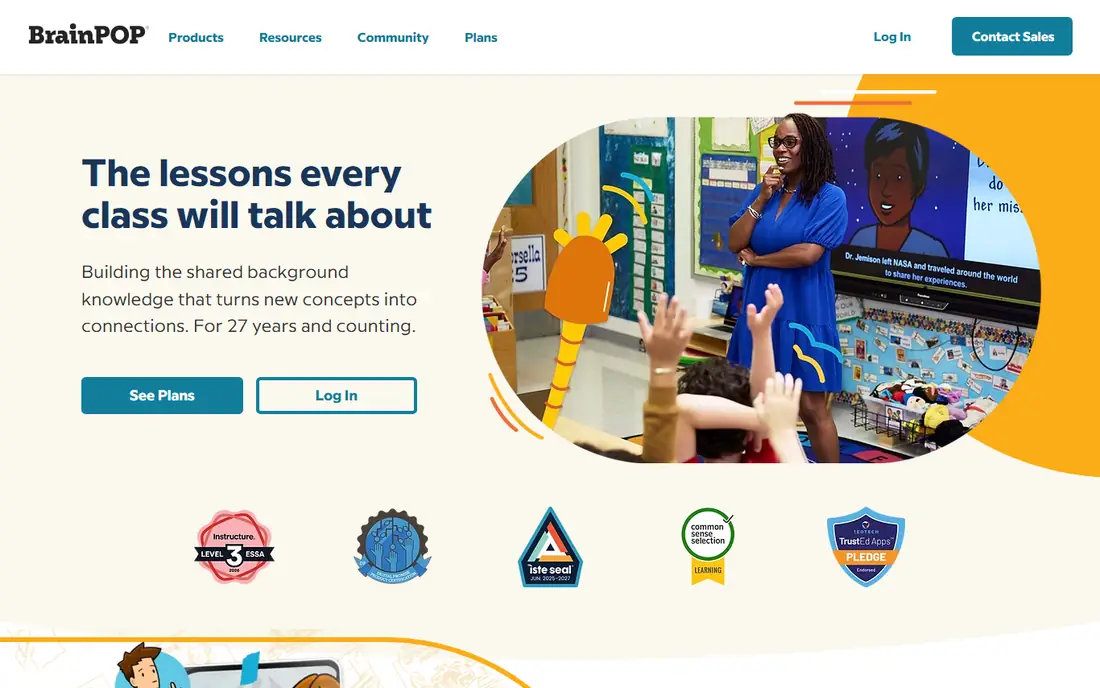
BrainPOP Jr is the younger-learner version of BrainPOP, the classroom platform known for short animated videos that explain science topics in plain language, followed by quizzes, games, and activities that check understanding. Topics span life science, earth science, physical science, and health, all pitched at early elementary reading levels.
During our homepage check, brainpop.com returned only a loading page with the BrainPOP title, so we count it on domain and title, consistent with how we treat thin homepage loads elsewhere in this batch. The product itself is well established in schools, but readers should confirm current pricing and BrainPOP Jr availability on the site before subscribing, since the homepage did not show a plain price.
For families who want school-style science lessons at home, BrainPOP Jr is a strong choice.
What we like- Classroom-trusted content, short animated videos, quizzes and activities, covers many science topics, used in schools
Watch out for- Homepage returned only a loading page during our check, pricing not shown plainly, subscription needed for full access
#3
Toca Lab Elements
Best for: Playful chemistry experiments for young children
Visit tocaboca.com
Starting priceSee website
Free planSee website
Toca Lab Elements turns the periodic table into a playground: children collect all 118 elements, drop them into lab machines, and watch what happens as elements change state, combine, and react, with no rules, no scores, and no pressure. It is chemistry as play, and it works because children learn by experimenting rather than memorizing.
Toca Boca's homepage confirms the studio behind the app, a kids games and digital play studio with a long record of child-friendly design, though it does not highlight Toca Lab specifically on the page we checked. We list Toca Lab Elements with the vendor homepage, tocaboca.com, and recommend checking the app stores for current pricing and availability, since the vendor site did not show a plain price for this app.
For young children who learn best by playing, Toca Lab Elements is the most fun chemistry app available.
What we like- Play-based chemistry with all 118 elements, no rules or scores, encourages experimentation, from trusted kids developer Toca Boca
Watch out for- Vendor homepage does not highlight Toca Lab specifically, pricing not shown on vendor site, best for younger children
#4
NASA
Best for: Real space science, missions, images, and videos
Visit nasa.gov
Starting priceFree
Free planFree
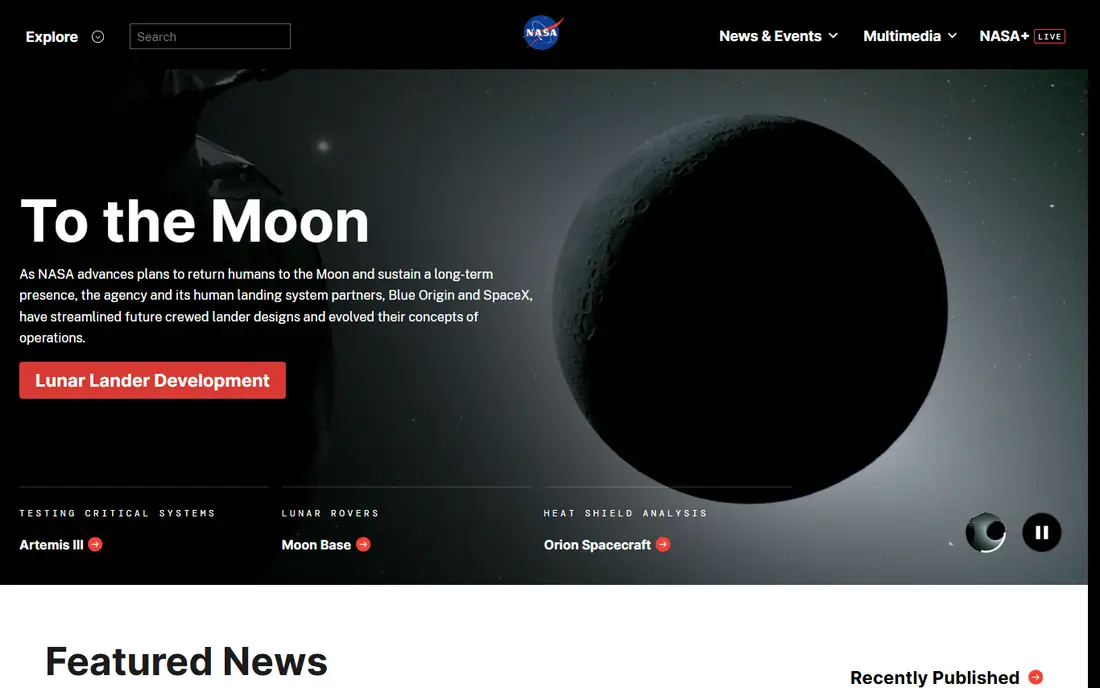
NASA's website and app bring the latest news, images, and videos from America's space agency, pioneering the future in space exploration, scientific discovery, and aeronautics research. Recent featured stories include the Roman Space Telescope entering its final commissioning phase, Hubble charting a path for Roman with gravitational lenses, and October 2026 skywatching tips, alongside an image of the day from RS-25 engine tests at Stennis Space Center.
For children, NASA is a window onto real science as it happens: rockets, rovers, telescopes, and astronauts, not cartoons about them. The content ranges from simple picture stories to advanced articles, so younger children will get most from it with a parent or teacher guiding them, while older children can explore on their own. The NASA app itself is free and available through the app stores, with nasa.gov as the agency's official home.
For families who want real space science for free, NASA is unbeatable.
What we like- Free, real mission news and images, videos and articles, content for all ages, from America's space agency
Watch out for- Agency homepage rather than a dedicated kids app page, content ranges from simple to advanced, younger children may need guidance
Starting priceSee website
Free planSee website
Star Walk Kids is a children's version of the famous astronomical application Star Walk, and a perfect educational tool for exploring space by young astronomy enthusiasts. It encourages free exploration with a virtual planetarium where children can learn fun facts by watching animations and listening to brief explanations, voiced by professional actors.
Children can play an astronomical game and learn comprehensible information about space, listen to interesting facts and watch funny educational cartoons, test knowledge with short self-check quizzes, enjoy bright colorful illustrations, explore the universe step by step and unlock new levels, get information about sky objects, point their device at the sky to enjoy stars, planets, and constellations, and visit the virtual planetarium for a trip to outer space. Reviewers praise it: the creators used colorful images and friendly narrators so kids as young as four can begin to recognize constellations and planets, and Forbes calls it a must-have for kids curious about all that surrounds our planet.
For a child who looks up at the night sky and asks questions, Star Walk Kids is the best astronomy app.
What we like- Children's version of the famous Star Walk app, virtual planetarium, funny educational cartoons, quizzes, point device at the sky to explore, praised by Forbes and Engadget
Watch out for- Pricing not shown plainly on vendor page, astronomy focus only, needs a device with sky view for full effect
Starting price$29.90/month
Free planSee website
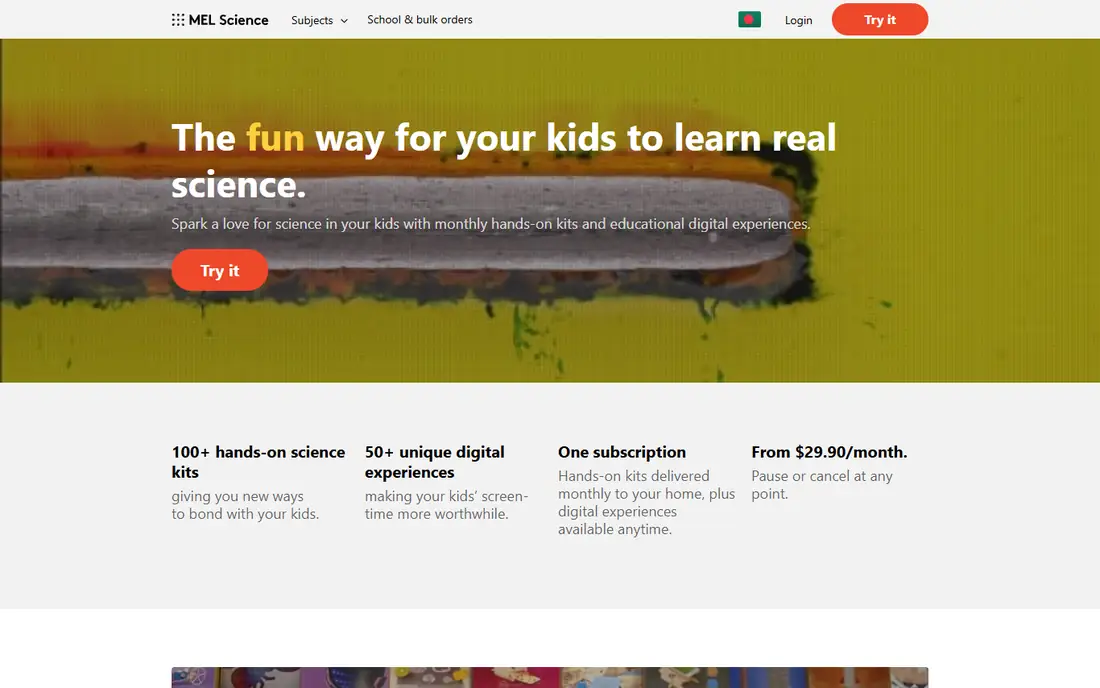
MEL Science sparks a love for science in kids with monthly hands-on kits and educational digital experiences, giving families new ways to bond and making screen time more worthwhile. With over 100 hands-on science kits, children can assemble an eco-friendly microscope, launch digital space rockets from the couch, create models of everyday devices and rediscover physics with virtual reality, and run their first chemistry lab while traveling inside molecules with virtual reality.
The subscription starts at $29.90 per month, with hands-on kits delivered monthly plus digital experiences available anytime, and you can pause or cancel at any point. All kits are tested in labs and certified as child-friendly and safe for home use, complying with US CPSC requirements for educational sets, with detailed visual step-by-step instructions led by the app. MEL Science reports over 3 million followers sharing their scientific experiences, and praise from the American Chemical Society.
For families who want science children can touch, not just watch, MEL Science is the best subscription.
What we like- Over 100 hands-on science kits, app with interactive instructions, VR and AR experiences, lab-tested and child-safe, pause or cancel anytime, 3 million plus followers
Watch out for- Subscription cost adds up, kits are physical so shipping and storage matter, some subjects suit older children better
#7
The Human Body by Tinybop
Best for: Exploring human anatomy through interactive play
Visit tinybop.com
Starting priceSee website
Free planSee website
The Human Body by Tinybop lets children explore the human body by tapping, dragging, and experimenting: feed a character, watch digestion, see the heart pump, and learn how systems connect, all through play rather than memorization. Tinybop's design philosophy is that children grasp concepts through play and experimentation, and The Human Body is its flagship example.
Tinybop's homepage confirms the studio and its awards, including ALSC ALA Notable Children's Digital Media in 2022 for The Human Body and Parents Magazine Best App for Families, alongside praise from Wired and Fast Company for apps that give children intellectual credit. We list the app with the vendor homepage, tinybop.com, and recommend checking the app stores for current pricing, since the vendor site did not show a plain price for this app.
For a child fascinated by how bodies work, The Human Body is the best anatomy app.
What we like- Award-winning app, ALSC Notable Children's Digital Media 2022, Parents Magazine Best App for Families, no-facts-memorization design, encourages experimentation
Watch out for- Vendor homepage lists awards rather than a dedicated product page, pricing not shown on vendor site, single-topic app
#8
Plants by Tinybop
Best for: Learning plant life cycles and ecosystems through play
Visit tinybop.com
Starting priceSee website
Free planSee website
Plants by Tinybop applies the same play-first design to botany: children plant seeds, water them, watch them grow through seasons, explore roots, stems, leaves, and flowers, and see how plants fit into ecosystems, learning life cycles by doing rather than reading. It pairs naturally with The Human Body for a child building a science app collection across life science topics.
As with The Human Body, we list Plants with the vendor homepage, tinybop.com, since the vendor site confirms the studio and its award-winning approach but does not highlight Plants specifically on the page we checked. Check the app stores for current pricing and availability before buying.
For a young gardener or nature lover, Plants by Tinybop is a lovely, calm science app.
What we like- Same award-winning Tinybop design, interactive plant life cycles, seasons and ecosystems, encourages experimentation, no ads or in-app pressure
Watch out for- Vendor homepage does not highlight Plants specifically, pricing not shown on vendor site, single-topic app
How we chose
We compared science apps for children that are actively offered and usable in 2026, with real educational content and verified vendor homepages, not just app-store listings with no vendor behind them. We checked each vendor homepage to confirm the product exists and matches its description, and we used published prices where the vendor shows them plainly. Where a homepage did not show a clear price, we wrote "See website" rather than inventing one. Apps were kept only if they are actively offered and usable for children learning science, not just similar in name. Safety note: check age ratings, ad policies, and in-app purchases before handing any app to a child, and supervise younger children during hands-on kit experiments.
Pick by your child's age and interests
If you want a free start for a young child, download Khan Academy Kids. If you want classroom-style lessons, BrainPOP Jr fits. If your child learns by playing, Toca Lab Elements is the most fun chemistry app. If your child loves space, NASA is free and real, while Star Walk Kids makes astronomy playful. If you want hands-on science, MEL Science delivers kits plus an app from $29.90 per month. And if your child loves the human body or plants, Tinybop's two apps are the calmest, most beautiful choices. Try one free option first, watch how your child uses it, then add a paid app or kit only if the interest sticks.
Frequently asked questions
What is the best app for kids to learn science?
Khan Academy Kids is the best free option for young children, MEL Science is the best hands-on subscription, Star Walk Kids is the best astronomy app, and NASA is the best free source of real space science. The right choice depends on your child's age and interests.
Are these science apps safe for children?
Khan Academy Kids is ad-free and built by a nonprofit. Tinybop apps are designed without ads or pressure. MEL Science kits are lab-tested and certified child-safe. Always check age ratings, ad policies, and in-app purchases before downloading, and supervise younger children.
How much does MEL Science cost?
MEL Science subscriptions start at $29.90 per month, with monthly hands-on kits plus digital experiences, and you can pause or cancel at any time. Other apps on this list are free or priced on their app-store pages.
What age are these science apps for?
Khan Academy Kids suits ages 2 to 8, Star Walk Kids suits ages 4 and up, Toca Lab Elements and Tinybop apps suit younger children, BrainPOP Jr suits early elementary learners, and NASA suits all ages with guidance for younger children.
Do kids need a subscription to learn science?
No. Khan Academy Kids and NASA are free and cover a wide range of science topics. Paid apps and kits add depth, hands-on experiments, or a specific topic such as astronomy or anatomy, but a free start is enough to spark interest.
Can these apps replace school science?
No. These apps supplement school science with play, videos, and experiments, but they do not replace a curriculum, a teacher, or hands-on classroom labs. Use them to spark curiosity and reinforce what children learn at school.
Sources we checked (0)
Is your product missing or out of date?
We review this list regularly. Vendors can request a listing, send updated pricing or ask about featured placement.

Shihab Mia · Founder, Rankite
Shihab has 5+ years in B2B and SaaS SEO. He writes Rankite's software buying guides from pricing pages, documentation and public user reviews. More about Shihab.