How we make this list: we compare pricing pages, product documentation and public user reviews. Ratings come from G2, Capterra or Trustpilot, with the date we checked them.
Key takeaways
- Match the app to the child's age first: Little Pim suits ages 0 to 6, Lingokids suits ages 2 to 8, and Duolingo suits readers aged 10 and up.
- Dinolingo covers the widest language choice for kids, with more than 50 languages for ages 2 to 14.
- Short daily sessions beat long ones for young learners, so look for apps with 5 to 15 minute lessons and offline options.
- Check ads, chat features and in-app purchases before handing an app to a child, and use parent dashboards where available.
Quick comparison
| Tool | Best for | Starting price | Free plan |
|---|
 Dinolingo | Widest language choice for kids | $19 per month | No |
 Duolingo ABC | Early literacy and first words | Free | Yes |
 Lingokids | Games and songs for ages 2 to 8 | Free | Yes |
 Gus on the Go | First vocabulary for ages 2 to 6 | $3.99 per language | No |
 Studycat | Preschool songs and accents | $3.99 per language | No |
 Little Pim | Very young learners ages 0 to 6 | $9.99 per month | No |
 Mondly Kids | Voice recognition and rarer languages | $9.99 per month | Yes |
 Lingopie Kids | Stories and video immersion | See website | No |
Is your product missing or out of date?
We review this list regularly. Vendors can request a listing, send updated pricing or ask about featured placement.
The best language app for kids
Starting price$19 per month
Free planNo
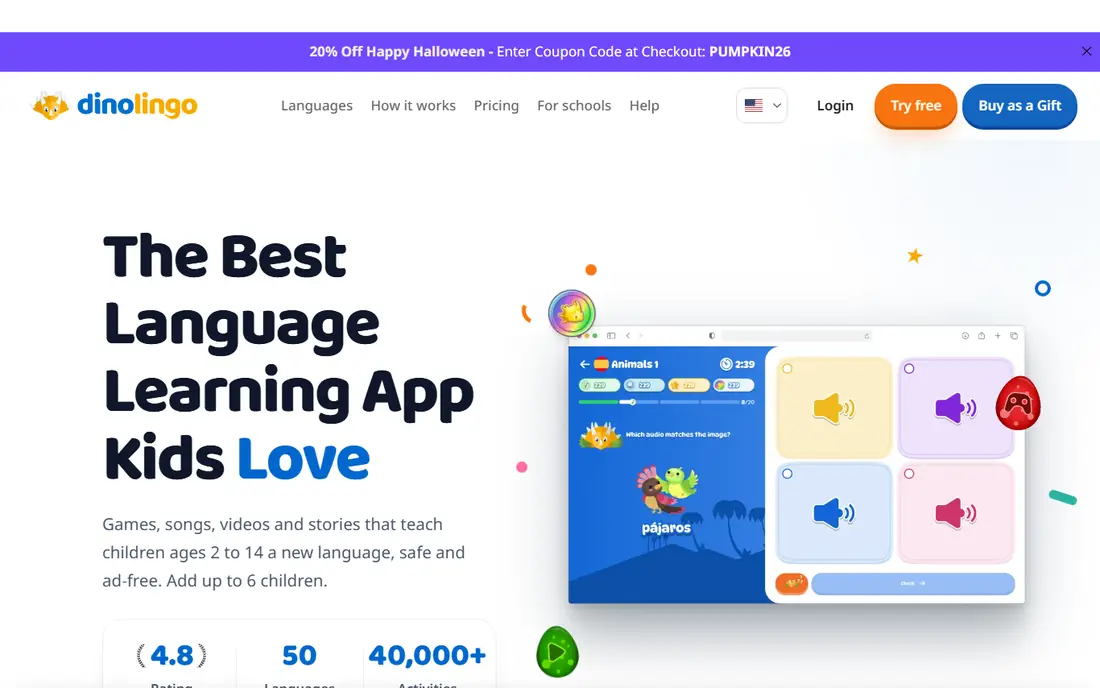
Dinolingo is the widest language app for kids, covering more than 50 languages for ages 2 to 14 with videos, songs, games and printable worksheets. Age-specific paths split the experience sensibly: ages 2 to 5 for pre-readers, 6 to 10 for elementary learners and 11 to 14 for middle and early high school. That structure helps families with children of different ages share one subscription, and it suits heritage-language learning where the goal is keeping a home language alive.
The price starts from $19 per month with no free tier, which is higher than many rivals, though a free trial is offered. Gamification is gentler than Duolingo's streak system, which some older kids may find less exciting. For families exploring multiple languages or raising bilingual children, Dinolingo's breadth and age structure make it the strongest overall pick.
What we like- More than 50 languages for ages 2 to 14
- Age-specific paths for pre-readers, elementary and middle school
- Videos, songs, games and worksheets
Watch out for- From $19 per month with no free tier
- Less gamified than Duolingo for older kids
- Worksheet printing needs a printer
Starting priceFree
Free planYes
Duolingo ABC focuses on early literacy and first language steps, with short, playful lessons built for younger learners. The clean design and gentle repetition suit children just starting to read, and the Duolingo family connection means an older sibling can use the main Duolingo app, with more than 40 languages, while a younger child uses ABC. Lessons cover foundational skills with speaking, listening and reading in small steps.
The limits are scope: ABC is an early literacy app, not a full language course, and language coverage is narrower than Dinolingo's 50-plus list. The main Duolingo app carries ads on its free tier, so parents should check settings before handing a device over. For a free first step into letters, sounds and first words, Duolingo ABC is the easiest place to start.
What we like- Free with short playful lessons
- Gentle repetition for early readers
- Clean design
- Part of the Duolingo family for older kids
Watch out for- Language coverage is narrower than Dinolingo
- Best for early literacy rather than full language courses
- Ads appear in the main Duolingo app
Starting priceFree
Free planYes
Lingokids combines educational games, videos and songs in a playful format for ages 2 to 8, with parent progress tracking and badges that reward completing activities. The English focus suits families learning English as a second language, with select support in Spanish and other languages, and the content quality is high, with songs and characters that younger children return to willingly.
The main limit is language scope: families wanting French, German or a heritage language beyond English and Spanish will find Dinolingo or Gus on the Go better. Full content also needs a paid plan beyond the limited free tier. For English learning through play for ages 2 to 8, Lingokids is the most polished app on this list.
What we like- Games, videos and songs in a playful format
- Parent progress tracking
- Badges and challenges keep kids engaged
- English-focused with some Spanish support
Watch out for- Primarily English-focused, so other languages are limited
- Full content needs a paid plan
- Screen time needs parent limits
Starting price$3.99 per language
Free planNo
Gus on the Go teaches first vocabulary through interactive stories and mini-games, with more than 30 languages and a design simple enough for toddlers yet engaging for early elementary kids. The one-time price of $3.99 per language is unusually fair: no subscription, no ads inside the learning flow, and a clear cost per language for families learning one or two tongues.
The scope is deliberately narrow: vocabulary first, with less grammar and sentence building than fuller courses, and older kids may outgrow it fast. There is no free tier to test before buying, though the low one-time price softens that risk. For a first language app for ages 2 to 6, especially a less common language, Gus on the Go is excellent value.
What we like- More than 30 languages
- Interactive stories and mini-games
- Simple enough for toddlers
- One-time $3.99 per language
Watch out for- No free tier
- Vocabulary focus means less grammar
- Older kids may outgrow it fast
Starting price$3.99 per language
Free planNo
Studycat, also listed as Study Cat, focuses on preschool and early elementary learners aged 3 to 8, with songs, games and accent exposure across English, Spanish, French, German and Chinese. Songs are the standout: children learn pronunciation and rhythm through music, which sticks better than flashcards for this age group. Offline use helps on car trips and flights, and some listings price it at $3.99 per language.
The language list is small, around 5 languages, so families wanting a rarer language should look at Dinolingo or Gus on the Go. There is no free tier in most listings, so parents buy on reputation. For ages 3 to 8 learning a major European language or Chinese through songs, Studycat is a charming and effective pick.
What we like- Songs and games for ages 3 to 8
- Accent exposure across languages
- Offline use
- One-time $3.99 per language in some listings
Watch out for- Only about 5 languages
- No free tier in most listings
- Narrower scope than Dinolingo
Starting price$9.99 per month
Free planNo
Little Pim is designed for the youngest learners, ages 0 to 6, using short video episodes to introduce first words in 12 languages. The gentle pace suits toddlers and preschoolers with short attention spans, and the episode format works well as a calm screen activity rather than a fast game. For families starting a second language before school, Little Pim's age focus is unmatched.
Pricing starts from $9.99 per month with a 7-day free trial, and the episode format is more passive than the games in Lingokids or Dinolingo, so older kids will outgrow it quickly. Language choice is also narrower at 12 languages. For babies, toddlers and preschoolers, Little Pim is the best first screen-based language introduction available.
What we like- Designed for ages 0 to 6
- Short video episodes
- 12 languages
- Gentle pace for toddlers
Watch out for- From $9.99 per month with only a 7-day free trial
- Episode format suits passive watching more than interaction
- Older kids outgrow it
Starting price$9.99 per month
Free planYes
Mondly Kids brings the adult Mondly platform's strengths to children: 27 languages including less common choices, voice recognition that listens to a child's pronunciation, and a colorful game format that keeps ages 5 and up engaged. The voice recognition is the differentiator, since most kids apps focus on listening and tapping rather than speaking aloud.
Full access starts from $9.99 per month, with limited free content for trying it, and the app suits ages 5 and up rather than toddlers, who will do better with Little Pim or Gus on the Go. Depth for young kids is thinner than Dinolingo's structured paths. For a school-age child who wants to speak, not just recognize words, and for less common languages, Mondly Kids is a strong choice.
What we like- 27 languages including less common ones
- Voice recognition for speaking practice
- Limited free content
- Colorful game format
Watch out for- From $9.99 per month for full access
- Best for ages 5 and up, not toddlers
- Depth is thinner than Dinolingo for young kids
Starting priceSee website
Free planNo
Lingopie Kids uses stories and videos for immersive language learning, aimed at ages 4 and up, building listening comprehension through narrative rather than drills. Children follow characters through stories, hearing natural speech patterns and everyday phrases in context, which suits kids who love shows more than games. The catalog is growing, and the format works well as a bridge from app games to real media in another language.
Pricing needs a website check and there is no free tier beyond a trial, so parents should confirm the current plan before subscribing. Interactive games are fewer than in Lingokids or Dinolingo, so kids who need game rewards may engage less. For story-loving children ready for video immersion, Lingopie Kids offers a different and valuable path.
What we like- Immersive learning through stories and videos
- Suits ages 4 and up
- Story format builds listening comprehension
- Growing kids catalog
Watch out for- Pricing needs a website check
- Free trial only, no free tier
- Fewer interactive games than rivals
How we chose
We matched apps to age first, then to language coverage, lesson length and parent controls, using published 2026 kids language guides. Dinolingo leads on breadth with 50-plus languages for ages 2 to 14, Little Pim leads for ages 0 to 6, Lingokids leads for English play at ages 2 to 8, and Duolingo ABC leads for free early literacy. Prices come from those guides: Dinolingo from $19 per month, Little Pim and Mondly Kids from $9.99 per month, and Gus on the Go and Studycat at $3.99 per language in several listings.
We also weighed safety: ads, chat features and in-app purchases matter more for kids apps than for adult tools, so apps with parent dashboards and limited free tiers earned extra weight. No app here was tested hands-on with children for this guide; the picks rest on published age ranges, language counts, pricing and documented features.
What to check before you subscribe
Start with age and language, not price. A free app in the wrong language or for the wrong age teaches nothing, while a paid app that matches both gets used daily. Check the language list carefully: Dinolingo covers 50-plus, Gus on the Go covers 30-plus, and Lingokids is mainly English, so the right app depends entirely on the target language.
Then check the safety settings. Turn off in-app purchases or require a password, review ad settings, confirm there is no open chat with strangers, and set a daily time limit that fits your family's screen rules. Use the parent dashboard where available to track progress, and pair the app with real conversation: a few minutes of speaking the language at home beats an hour of tapping alone.
Frequently asked questions
What is the best language app for a 4-year-old?
Lingokids for English play, Gus on the Go for first vocabulary in 30-plus languages, and Little Pim for gentle video episodes all suit age 4. Dinolingo also covers ages 2 to 5 with a pre-reader path. Pick by target language first, then by whether your child prefers games, stories or songs.
Which kids language app has the most languages?
Dinolingo, with more than 50 languages for ages 2 to 14, covers the widest choice, including many heritage and less common languages. Gus on the Go follows with more than 30 languages, and Mondly Kids offers 27. For a rare language, check Dinolingo's list first.
Are there free language apps for kids?
Yes. Duolingo ABC is free for early literacy, Lingokids offers a limited free plan, and Mondly Kids offers limited free content. Dinolingo, Gus on the Go, Studycat and Little Pim are paid, though several offer trials or one-time per-language prices.
How much screen time should language apps take?
Short daily sessions of 10 to 20 minutes work best for young children, with longer sessions for older kids who enjoy the app. Pair app time with real conversation, songs or books in the target language, and use parent controls to enforce limits that fit your family's rules.
Do kids language apps work without a parent?
They help, but they work best with a parent nearby, especially for speaking practice and for keeping sessions regular. Apps teach vocabulary and listening well, while conversation with a parent, tutor or native speaker builds the speaking confidence that apps alone cannot.
Can one app serve two children of different ages?
Dinolingo's age-specific paths for ages 2 to 5, 6 to 10 and 11 to 14 make it the best single subscription for siblings of different ages. Otherwise, pair a younger child's app, such as Lingokids or Gus on the Go, with an older child's app, such as Duolingo, under separate profiles.
Sources we checked (0)
Is your product missing or out of date?
We review this list regularly. Vendors can request a listing, send updated pricing or ask about featured placement.

Shihab Mia · Founder, Rankite
Shihab has 5+ years in B2B and SaaS SEO. He writes Rankite's software buying guides from pricing pages, documentation and public user reviews. More about Shihab.