How we make this list: we compare pricing pages, product documentation and public user reviews. Ratings come from G2, Capterra or Trustpilot, with the date we checked them.
Key takeaways
- No single app delivers fluency, so combine apps by phase: Duolingo for habit, WaniKani for kanji, Bunpro for grammar, and italki for speaking.
- WaniKani scores highest for kanji mastery at 9.5 out of 10 in one 2026 ranking, with levels 1 to 3 free and about $9 per month after.
- Bunpro is the grammar pick at about $5 per month, with spaced repetition grammar from N5 to N1 and example sentences.
- Renshuu offers the most complete free tier for grammar and JLPT preparation, making it the best free step after Duolingo.
Quick comparison
| Tool | Best for | Starting price | Free plan |
|---|
 WaniKani | Kanji mastery | $9 per month | Yes |
 Bunpro | JLPT grammar SRS | $5 per month | No |
 Duolingo | Free habit builder | Free | Yes |
 LingoDeer | All-round structured course | $11.99 per month | Yes |
 Pimsleur | Speaking and pronunciation | $14.99 per month | No |
 JapanesePod101 | Audio lessons on the go | $4 per month | Yes |
 Renshuu | Free JLPT grammar and kanji | Free | Yes |
 italki | Live conversation practice | See website | No |
Is your product missing or out of date?
We review this list regularly. Vendors can request a listing, send updated pricing or ask about featured placement.
The best japanese learning apps
Starting price$9 per month
Free planYes
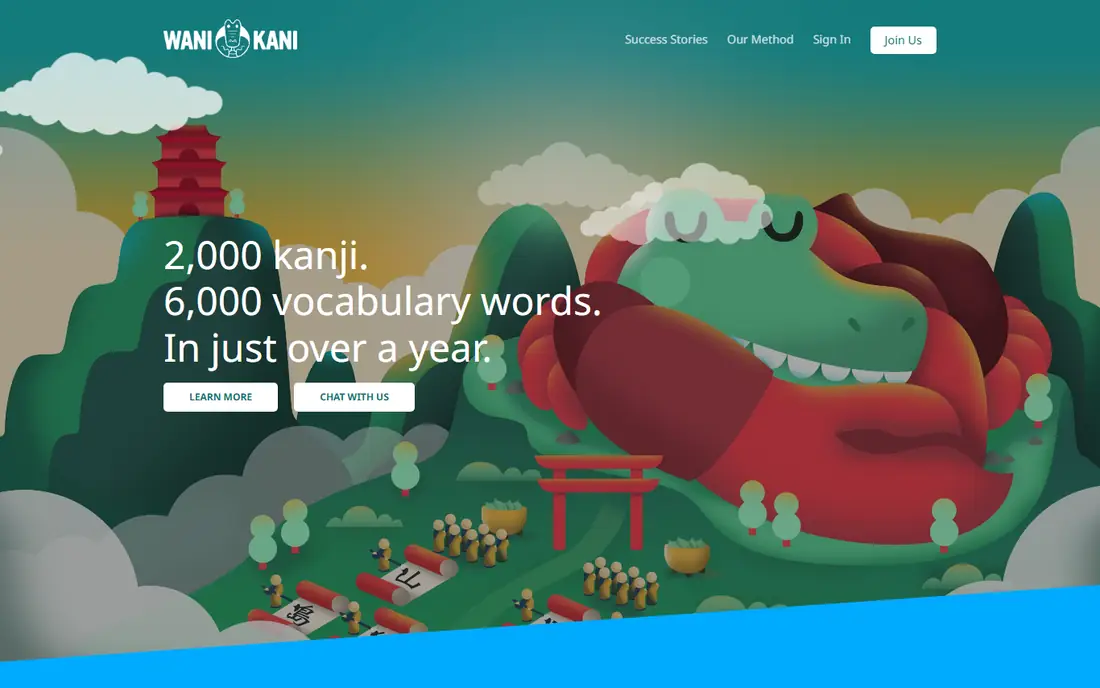
WaniKani splits kanji into radicals and attaches mnemonics to them, using spaced repetition to build reading vocabulary through a clear, level-by-level system covering more than 2,000 kanji. Levels 1 to 3 are free, so you can test the visual system before paying, with monthly pricing at $9, annual at $89 and lifetime at $299 in published guides.
The limits are scope: no speaking, listening or writing practice, and the strict review schedule can feel rigid for casual learners. For kanji mastery, though, no other app matches its systematic approach, and it pairs naturally with Bunpro for grammar and italki for speaking.
What we like- Highest kanji score at 9.5 out of 10 in one 2026 ranking
- SRS radicals and kanji with mnemonics
- Clear level-by-level progression through 2,000 plus kanji
- Levels 1 to 3 free
- Lifetime option at $299
Watch out for- Very limited grammar or speaking practice
- Strict review schedule can feel rigid
- Best used alongside a broader course, not standalone
Starting price$5 per month
Free planNo
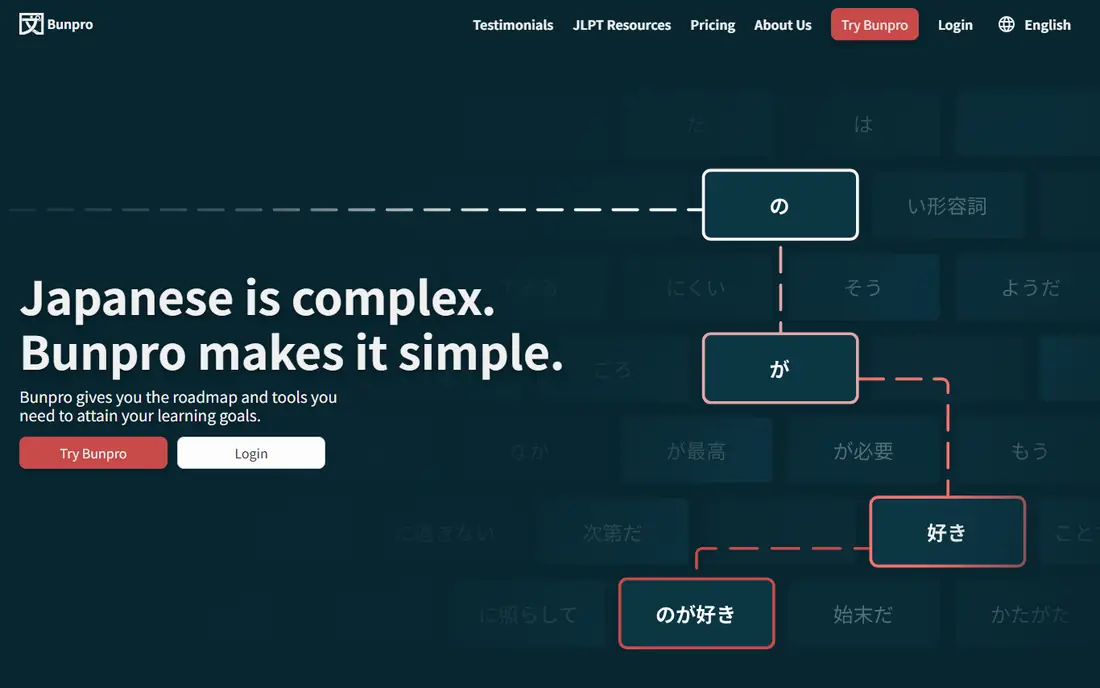
Bunpro keeps grammar at the center, linking grammar points to spaced repetition reviews and giving learners a defined structure instead of a loose collection of lessons. Coverage runs N5 to N1 with example sentences, and the August 2026 Decks Redesign beta should make weak patterns easier to isolate without digging through unrelated vocabulary.
It lacks full speaking and production practice and needs a supplement for conversation, with only a trial available rather than a permanent free tier. Pricing runs about $5 per month in most guides, up to $7 in one. For JLPT grammar mastery, Bunpro is the most systematic app available.
What we like- Grammar at the center with SRS reviews
- N5 to N1 example sentences
- Defined structure instead of loose lessons
- August 2026 Decks Redesign beta isolates weak patterns
- About $5 to $7 per month
Watch out for- Lacks full speaking and production practice
- Needs a supplement for conversation
- Trial only, no permanent free tier
#3Duolingo
Best for: Free habit builder4.5/5 on
G2 (145 reviews, checked Oct 2026)
Visit duolingo.com
Starting priceFree
Free planYes
Duolingo is a good app for building a daily study habit at the absolute-beginner stage, with bite-size drills, gamified streaks and free access with ads. For a learner starting from zero, it makes the first weeks of hiragana, katakana and basic vocabulary painless and regular.
It does not teach complex sentence structures, most intermediate learners outgrow it within a few months, and grammar depth and kanji learning are weak. Treat Duolingo as step one, then move to Renshuu or Bunpro for grammar and WaniKani for kanji.
What we like- Free with ads
- Bite-size gamified drills
- Good for building a daily study habit at the absolute-beginner stage
- Scores 6.5 out of 10 in one 2026 ranking
Watch out for- Does not teach complex sentence structures
- Most intermediate learners outgrow it within a few months
- Limited grammar depth and weak kanji learning
Starting price$11.99 per month
Free planYes
LingoDeer is the all-round course pick, with grammar notes, drills and a review system built specifically for Asian languages, scoring 9 out of 10 in one 2026 ranking. Step-by-step lessons with native audio suit structured learners who want a clear path from beginner to intermediate, and some units are free to test the format.
Real speaking practice with native output is thinner than italki or HelloTalk, and pricing varies from $11.99 to $14.99 per month across guides. For a structured course after Duolingo, LingoDeer is the best single-app path.
What we like- All-round course with grammar notes, drills and review system
- Strong structure for Asian languages
- Good grammar explanations
- Scores 9 out of 10 in one 2026 ranking
- Some units free
Watch out for- Less real speaking practice with native output
- Pricing varies from $11.99 to $14.99 per month across guides
- Colorful chart explanations suit some learners more than others
#5Pimsleur
Best for: Speaking and pronunciation4.3/5 on
G2 (2 reviews, checked Oct 2026)
Visit pimsleur.com
Starting price$14.99 per month
Free planNo
Pimsleur uses spaced repetition through audio, with dialogues and a car mode, so commuters can study while their eyes are occupied. It scores 9 out of 10 in one 2026 ranking for speaking and pronunciation, and its audio-first design builds listening and speaking confidence faster than screen-based drills.
Pricing varies from $14.99 to $19.99 per month in one guide and $20.95 for All Access in another, with only a limited trial. Reading and kanji need other apps. For auditory learners and commuters, Pimsleur is the best speaking-first app.
What we like- Audio lessons with spaced recall, dialogues and car mode
- Scores 9 out of 10 in one 2026 ranking
- Study without staring at a screen
- Good for commuters
Watch out for- Pricing varies from $14.99 to $20.95 per month across guides
- Limited trial only
- Audio focus means reading and kanji need other apps
Starting price$4 per month
Free planYes
JapanesePod101 offers hundreds of audio and video lessons organized by level, from absolute beginner to advanced, in a podcast-style format covering vocabulary, grammar and conversation. Lessons fit commutes and workouts, with downloadable content for offline use and a free plan to start.
It can feel disorganized without a clear learning path, interactive lessons and speaking practice are limited, quality varies across lesson series, and premium plans run from $8 to $47 per month. For flexible on-the-go listening across all levels, JapanesePod101 has the largest audio library here.
What we like- Hundreds of audio and video lessons from absolute beginner to advanced
- Podcast-style format for commutes
- Free plan available
- Basic tier from $4 to $8 per month
- Downloadable content for offline use
Watch out for- Can feel disorganized without a clear learning path
- Limited interactive lessons or speaking practice
- Quality varies across lesson series
- Premium plans run to $47 per month
Starting priceFree
Free planYes
Renshuu has the most complete free tier in the category for grammar and JLPT preparation, with gamified SRS quizzes across kanji, vocabulary and grammar and JLPT-tagged vocabulary lists tied to a curriculum. For learners moving past Duolingo, Renshuu is the natural free next step alongside Bunpro, and it covers the full grammar-plus-vocabulary loop without a subscription.
The interface is less polished than Duolingo's or LingoDeer's, Pro features need payment, and there is no live conversation practice. For free structured study after the beginner stage, Renshuu is the best value app on this list.
What we like- Most complete free tier in the category for grammar and JLPT preparation
- Gamified SRS quizzes across kanji, vocabulary and grammar
- JLPT-tagged vocabulary lists tied to a curriculum
- Free plus Pro
Watch out for- Interface is less polished than Duolingo or LingoDeer
- Pro features need payment
- No live conversation practice
#8italki
Best for: Live conversation practice3.8/5 on
G2 (19 reviews, checked Oct 2026)
Visit italki.com
Starting priceSee website
Free planNo
italki is the conversation pick, offering live 1-on-1 tutors with flexible session rates, including 25-minute sessions that turn passive knowledge into real spoken Japanese. Personalized lessons and JLPT preparation suit learners who have studied grammar and kanji but cannot yet speak confidently.
There is no free tier, per-lesson pricing adds up with frequent sessions, and tutor quality varies, so trial lessons matter. No flashcard app substitutes for talking with native speakers, so italki is the essential final piece of any serious Japanese study stack.
What we like- Live 1-on-1 tutors with flexible session rates
- 25-minute tutor sessions for speaking practice
- Personalized lessons and JLPT preparation
- Turns passive knowledge into real spoken Japanese
Watch out for- No free tier
- Per-lesson pricing adds up with frequent sessions
- Tutor quality varies, so trial lessons matter
How we chose
We ranked apps by learning phase first, since beginners, grammar students, kanji students and speakers need different tools, then by structure, price and evidence. WaniKani leads kanji at 9.5 out of 10, LingoDeer and Pimsleur lead structured and audio courses at 9 out of 10, Bunpro leads grammar SRS at 8.5, and Duolingo leads free habit building at 6.5 in the 2026 ranking used here.
We also weighed the combination principle: no single app delivers fluency, so the best stack combines Duolingo or LingoDeer for structure, WaniKani for kanji, Bunpro or Renshuu for grammar, and italki or HelloTalk for conversation. Prices are current list prices as of 2026, with free tiers carrying real limits. No app here was used hands-on for a full JLPT preparation cycle for this guide.
What to check before you commit
Start with your phase, not the app store ranking. Absolute beginners should start with Duolingo for habit or LingoDeer for structure. Learners past the basics should add WaniKani for kanji and Bunpro or Renshuu for grammar. Learners who can read but cannot speak should add italki immediately, since speaking practice cannot wait until you feel ready.
Then check the free tier honestly: WaniKani levels 1 to 3 are free, Renshuu's free tier is the most complete in the category, Duolingo is free with ads, and Bunpro offers only a trial. Test the review schedule too, since WaniKani's strict schedule and Bunpro's SRS reviews demand daily consistency. Pick the stack you can sustain daily, since the best value is the tool whose demands you can actually keep.
Frequently asked questions
What is the best app to learn Japanese?
It depends on your phase. WaniKani is best for kanji, Bunpro is best for grammar, LingoDeer is best for a structured all-round course, Pimsleur is best for speaking, and italki is best for live conversation. Most learners need a combination, not one app.
Is Duolingo good for learning Japanese?
Duolingo is good for building a daily habit at the absolute-beginner stage, with free bite-size drills. It does not teach complex sentence structures, and most intermediate learners outgrow it within a few months, so move to Renshuu or Bunpro for grammar and WaniKani for kanji next.
How much does WaniKani cost?
WaniKani costs about $9 per month, $89 per year, or $299 for a lifetime plan, with levels 1 to 3 free. The free levels let you test the radical and mnemonic system before paying.
What is the best free Japanese learning app?
Renshuu offers the most complete free tier for grammar and JLPT preparation, with gamified SRS quizzes across kanji, vocabulary and grammar. Duolingo is free with ads for beginners, and WaniKani offers levels 1 to 3 free for kanji.
Can I learn Japanese only with apps?
Apps build vocabulary, grammar and reading well, but no flashcard app substitutes for talking with native speakers. Add italki or HelloTalk for conversation, plus immersion reading and listening, to turn app knowledge into real fluency.
How long does it take to learn Japanese with apps?
It varies by daily time and consistency. Daily study with a combined stack of structure, kanji, grammar and conversation typically takes one to two years to reach intermediate level, with JLPT N5 to N3 as common milestones. Consistency matters more than any single app choice.
Sources we checked (0)
Is your product missing or out of date?
We review this list regularly. Vendors can request a listing, send updated pricing or ask about featured placement.

Shihab Mia · Founder, Rankite
Shihab has 5+ years in B2B and SaaS SEO. He writes Rankite's software buying guides from pricing pages, documentation and public user reviews. More about Shihab.