How we make this list: we compare pricing pages, product documentation and public user reviews. Rankite is independent; if a vendor ever pays for a featured spot, that listing is clearly labeled Partner.
Key takeaways
- The hyperscale defaults: AWS IoT Core for teams already on AWS, Azure IoT Hub for Microsoft-centric and industrial deployments.
- For product teams shipping hardware: Particle bundles device hardware, connectivity and cloud in one platform.
- Budget-friendly and developer-friendly: TagoIO publishes transparent pricing (free for 5 devices, Starter $49/month), Ubidots targets SMB dashboards, and ThingsBoard offers a free open-source Community Edition.
- Low-code builders: Losant's visual workflow engine suits enterprises, while Blynk's drag-and-drop app builder suits mobile-first products.
An IoT cloud platform is the backend your devices talk to: it ingests telemetry, manages device identities and firmware, runs rules and alerts, and serves dashboards. Pick wrong and you pay twice, once in platform fees and once in engineering time working around limits. These eight cover the spectrum from hyperscale clouds to maker-friendly dashboards.
#1
AWS IoT Core
Best for: Enterprises already on AWS connecting large device fleets
Visit aws.amazon.com
Starting priceSee website (pay-as-you-go, per-message pricing)
Free planSee website
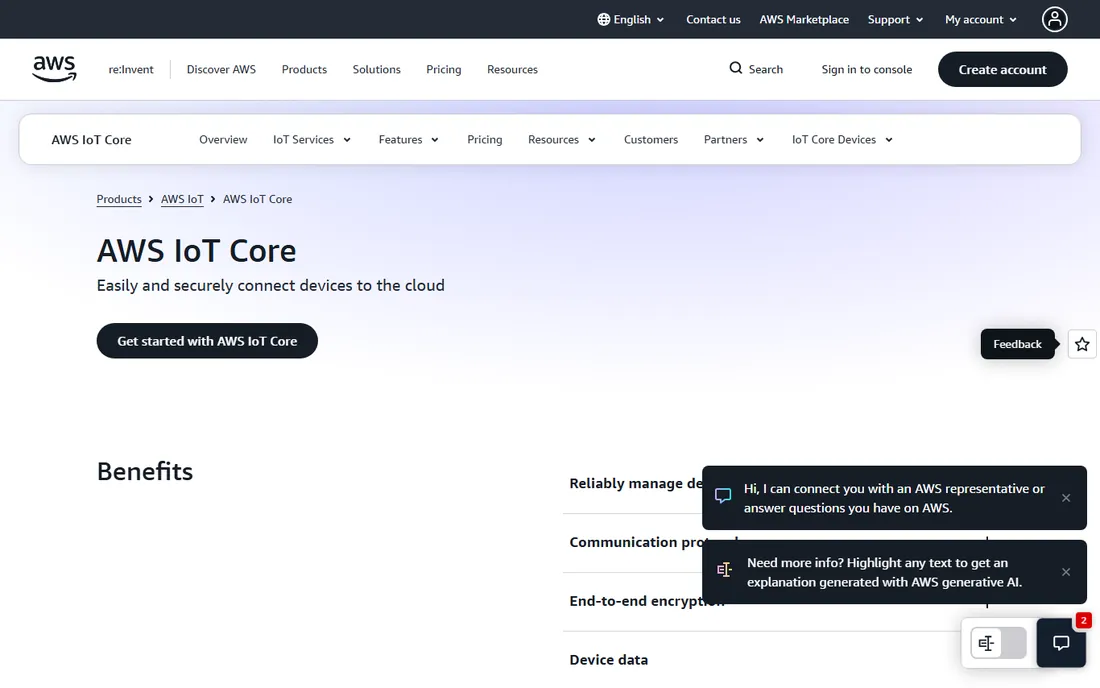
AWS IoT Core is the managed message broker and device gateway for the AWS ecosystem. Devices connect over MQTT, MQTT over WebSockets, HTTPS or LoRaWAN; the rules engine routes data to Lambda, Kinesis, S3, DynamoDB and the rest of AWS. Device Defender, Device Management and Jobs add security monitoring, fleet management and OTA updates.
The catch is cost modeling. Per-message pricing looks cheap until millions of devices report every minute, and the bill has many line items. Teams also need real AWS skills: this is infrastructure, not a dashboard product. If your stack already runs on AWS and you have cloud engineers, IoT Core is the natural and powerful choice.
What we like- Massive scale (billions of devices, trillions of messages) with deep AWS service integration
- Strong security model with per-device certificates and policies
- MQTT, HTTPS and LoRaWAN support
Watch out for- Pricing is complex and message-based costs surprise teams at scale
- The learning curve is steep and the console assumes cloud expertise
Starting priceSee website (tiered, per-message pricing)
Free planSee website
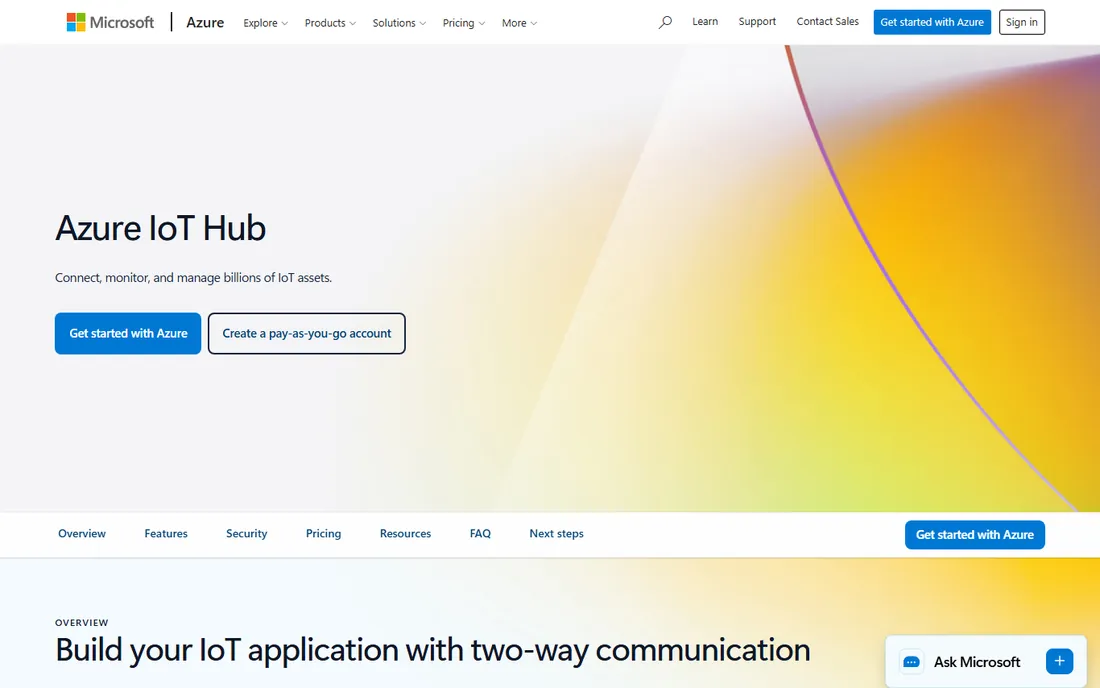
Azure IoT Hub is Microsoft's device connectivity backbone: bi-directional messaging between devices and the cloud, per-device authentication, device twins for state management, and direct methods for commands. It speaks MQTT, AMQP and HTTPS, and pairs with Azure IoT Operations for edge and industrial scenarios.
Like AWS, pricing is metered and tiered, so model your message volume before committing. The platform shines for organizations standardized on Azure and for industrial buyers who need the edge-to-cloud story. If you run on Microsoft 365 and Azure already, the integration and single-vendor support argument is strong.
What we like- Tight integration with Azure services (Stream Analytics, Digital Twins, Defender for IoT)
- Mature device management with device twins and direct methods
- Strong industrial and edge story with Azure IoT Operations
Watch out for- Tier and message-metering complexity rivals AWS
- Best value requires committing to the Azure ecosystem
#3
Particle
Best for: Product teams shipping connected hardware without building infrastructure
Visit particle.io
Starting priceSee website
Free planSee website
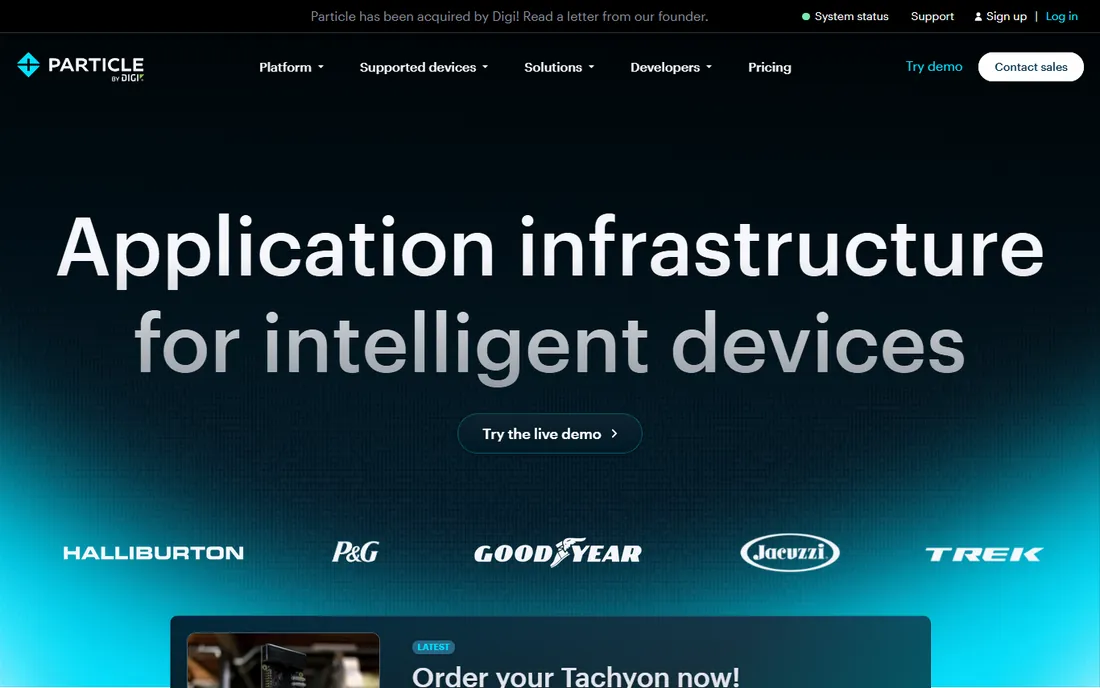
Particle sells the shortcut: certified cellular and Wi-Fi hardware modules, global connectivity, and a device cloud with OTA updates, fleet health and integrations, all from one vendor. Thousands of companies use it to ship connected products without hiring embedded and cloud teams. The platform handles provisioning, security and lifecycle management.
The tradeoff is commitment. Particle's modules and SIMs tie your hardware design to their platform, and migrating later means hardware changes, not just code changes. Price per device per month across a growing fleet, including data, before you commit. For teams whose product is the device, the speed to market usually justifies it.
What we like- End-to-end platform covering hardware modules, cellular connectivity, device cloud and management
- Developer-friendly APIs and strong documentation
- Scales from prototype to production on one platform
Watch out for- Hardware and connectivity lock-in: leaving means redesigning
- Pricing scales with device count and data, so model fleet growth

#4
Losant
Best for: Enterprises building custom IoT applications with visual workflows
Visit losant.com
Starting priceSee website
Free planSee website
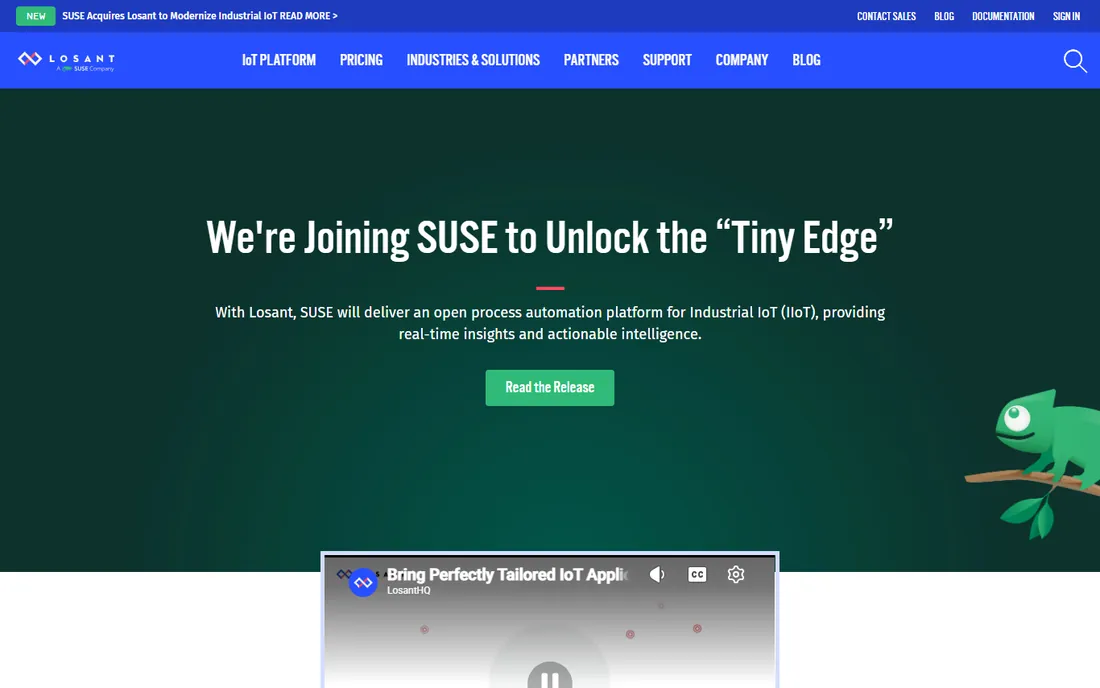
Losant is an application enablement platform: connect devices over MQTT, HTTP or edge agents, process data in a drag-and-drop workflow engine, and build dashboards and branded end-user experiences on top. It targets enterprises and OEMs building connected products, with features like multi-tenancy and white-labeling.
Expect a sales conversation for pricing, which suits enterprise buyers and frustrates small teams. The platform's strength is time-to-solution for custom applications: if you need bespoke dashboards and logic without building a backend team, Losant delivers. Makers and tiny startups will find cheaper, simpler options elsewhere on this list.
What we like- Visual workflow engine for device logic without heavy coding
- Strong dashboards, alerting and end-user experience tooling
- Flexible deployment including on-premises options
Watch out for- Enterprise positioning means pricing is quote-driven
- Smaller teams may find it more platform than they need

#5
Ubidots
Best for: Small and mid-size businesses that want IoT dashboards without developers
Visit ubidots.com
Starting priceSee website
Free planSee website
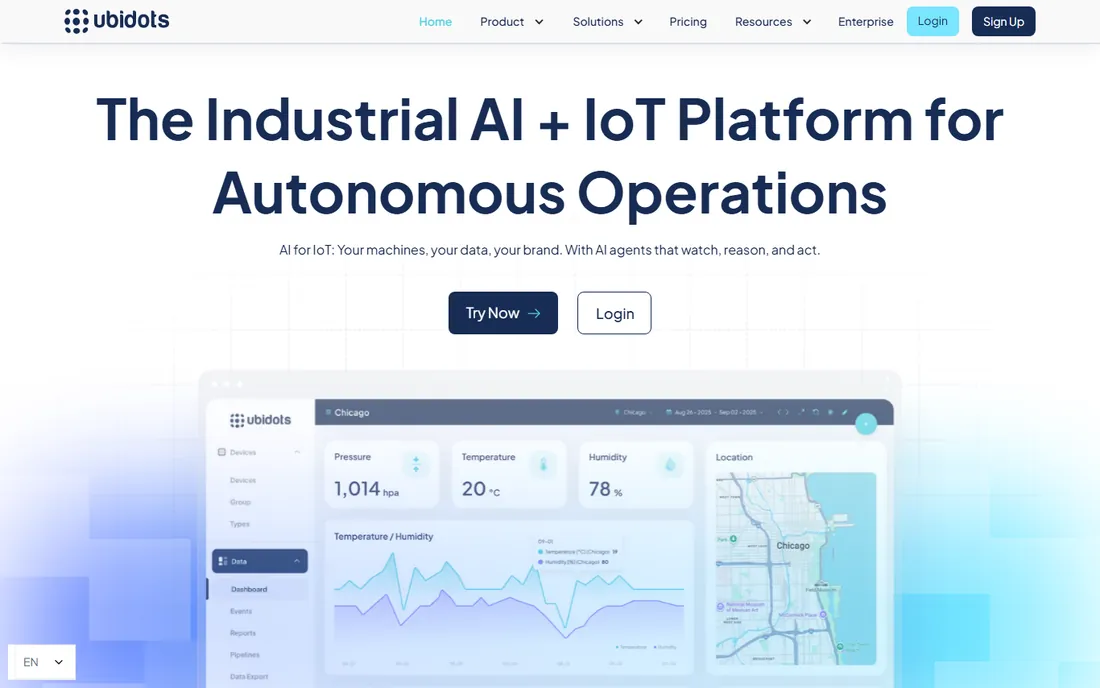
Ubidots focuses on getting sensor data onto a dashboard quickly. Devices send data over HTTP or MQTT, and users build real-time dashboards, alerts and reports without writing backend code. It is popular with SMBs, agriculture, logistics and facilities teams that need visibility, not a platform engineering project.
Scale is the boundary. Ubidots handles thousands of devices comfortably but is not built for millions, and heavy custom processing belongs on Losant, AWS or Azure. For the common case, a few dozen to a few thousand sensors feeding dashboards and alerts, it is one of the fastest paths from hardware to insight.
What we like- Fast time-to-dashboard with drag-and-drop widgets and prebuilt integrations
- Approachable pricing for SMBs
- Good documentation and support for non-experts
Watch out for- Less suited to massive fleets or complex custom logic
- Advanced features and white-labeling sit on higher tiers

#6
Blynk
Best for: Makers and businesses building mobile-first IoT apps quickly
Visit blynk.io
Starting priceSee website
Free planSee website
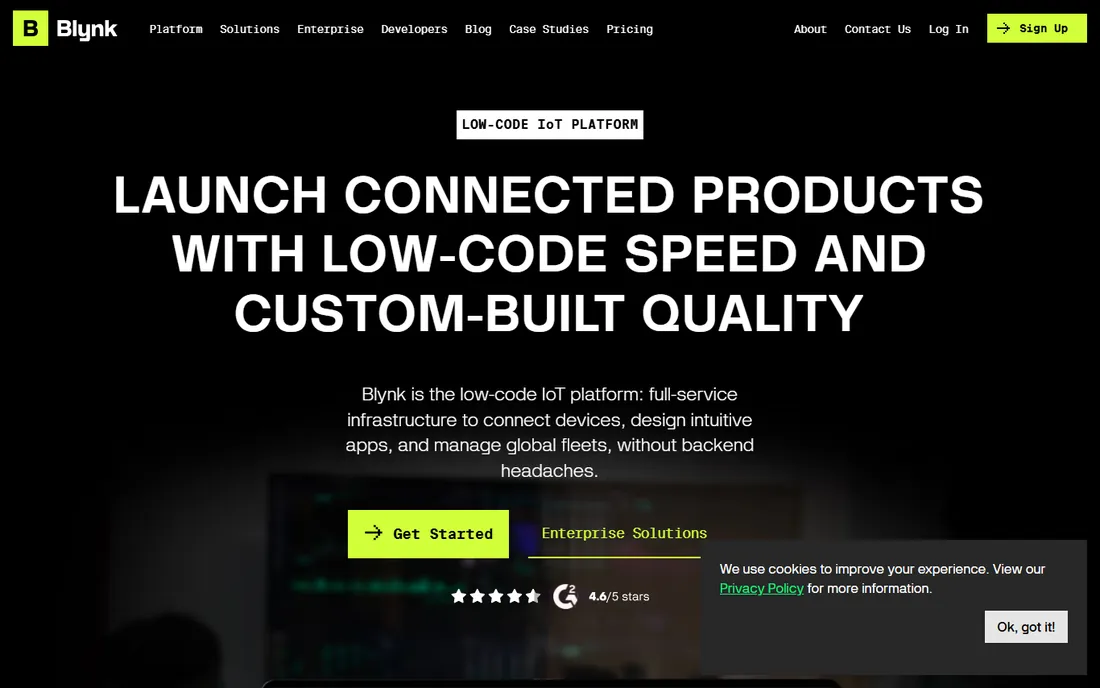
Blynk pioneered no-code IoT apps: connect your hardware, drag widgets onto a mobile dashboard, and control devices from your phone in an afternoon. It supports over 400 hardware models, handles device provisioning and OTA updates, and offers white-labeled apps for businesses shipping connected products.
The model is per-device SaaS, so commercial fleets need careful math. And while the app builder is fast, products with unusual UX or complex logic eventually need custom development. Blynk is ideal for prototypes, consumer gadgets, HVAC, agriculture pilots and any project where the mobile app is the product surface.
What we like- Drag-and-drop mobile and web app builder with no coding required
- Supports hundreds of hardware models through Blynk.Edgent libraries
- White-label options for commercial products
Watch out for- Per-device pricing adds up at commercial scale
- The no-code approach limits deep customization for complex products

#7
ThingsBoard
Best for: Teams that want open-source flexibility with a managed cloud option
Visit thingsboard.io
Starting priceSee website
Free planYes (free Community Edition, open source)
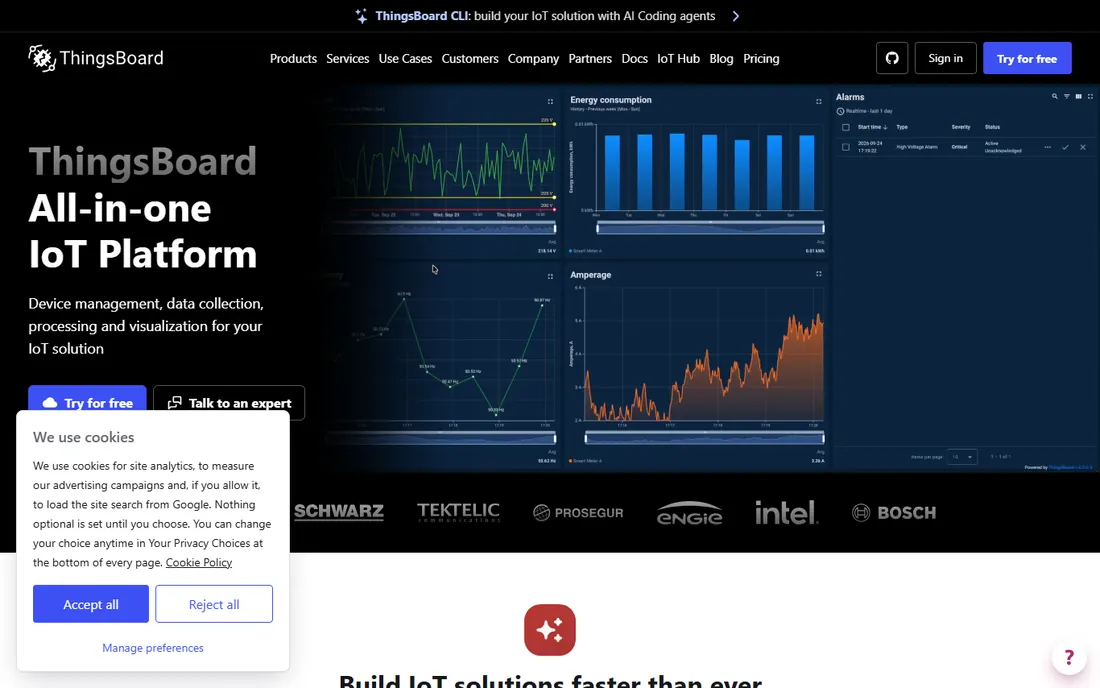
ThingsBoard is the leading open-source IoT platform: multi-tenant device management, a visual rule engine, real-time dashboards, alarms and integrations, all free under Apache 2.0 in the Community Edition. Teams can self-host on their own servers or use the managed ThingsBoard Cloud. It speaks MQTT, CoAP and HTTP out of the box.
Running it yourself is the deal and the duty: no per-device fees, but you handle scaling, backups and security. The managed cloud removes that burden at commercial rates. For cost-sensitive projects, privacy-conscious deployments and teams with DevOps skills, ThingsBoard delivers enterprise features without enterprise licensing.
What we like- Full-featured open-source core: device management, rule engine, dashboards and alarms
- Self-hosting avoids per-device fees entirely
- Active community and extensive documentation
Watch out for- Self-hosting means you operate the infrastructure
- The professional managed cloud and advanced features cost extra
- UI polish trails commercial rivals

#8
TagoIO
Best for: Developers who want transparent pricing and a genuinely useful free tier
Visit tago.io
Starting price$49/month (Starter plan)
Free planYes (free forever for up to 5 devices and 5 dashboards)
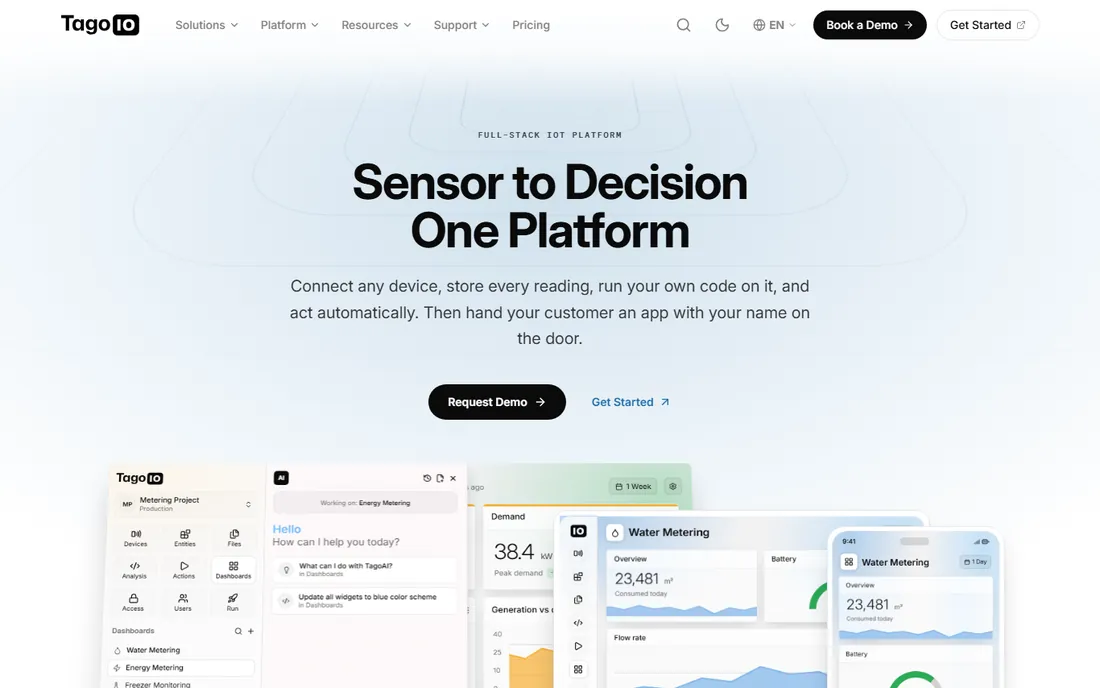
TagoIO stands out by publishing its prices: free forever for 5 devices and 5 dashboards, Starter at $49 per month (100 devices per profile), Scale at $199, and TagoDeploy from $850 for dedicated enterprise instances, per its own pricing page. The platform covers device management, data storage, dashboards, analysis scripts, alerts and user management through a full REST API.
It is a developer-friendly middle ground: more structured than self-hosted open source, far cheaper and simpler than the hyperscalers. The community is smaller, so expect fewer Stack Overflow answers than for AWS or ThingsBoard. For startups and SMBs that want predictable IoT costs without infrastructure work, TagoIO is the most transparent option here.
What we like- Transparent published pricing, rare in this category
- Free tier covers real prototyping with no credit card
- Full API, analysis scripts and white-label options
Watch out for- Smaller ecosystem and community than AWS, Azure or ThingsBoard
- Scaling to very large fleets needs the enterprise TagoDeploy tier
Pricing models: pay-per-message vs. per-device
IoT platforms bill in two fundamentally different ways, and the difference decides your bill at scale. AWS IoT Core and Azure IoT Hub charge per message (and per connection time, registry operations and rules actions), which means costs scale with how chatty your devices are. A sensor reporting every second costs roughly 60 times more than one reporting every minute, so telemetry frequency is a budget decision, not just an engineering one.
The others charge per device per month: Particle, Blynk, Ubidots and TagoIO publish per-device or tiered pricing that stays flat regardless of message volume. This is easier to budget and favors chatty devices, but penalizes large fleets of quiet sensors. Before choosing, estimate both: devices multiplied by messages per day for the hyperscalers, devices multiplied by per-device fees for the SaaS platforms. The crossover point usually sits in the low thousands of devices.
Quick comparison
| Tool | Best for | Starting price | Free plan |
|---|
| AWS IoT Core | Enterprises already on AWS connecting large device fleets | See website (pay-as-you-go, per-message pricing) | See website |
 Azure IoT Hub Azure IoT Hub | Microsoft-centric organizations and industrial IoT deployments | See website (tiered, per-message pricing) | See website |
| Particle | Product teams shipping connected hardware without building infrastructure | See website | See website |
| Losant | Enterprises building custom IoT applications with visual workflows | See website | See website |
| Ubidots | Small and mid-size businesses that want IoT dashboards without developers | See website | See website |
| Blynk | Makers and businesses building mobile-first IoT apps quickly | See website | See website |
| ThingsBoard | Teams that want open-source flexibility with a managed cloud option | See website | Yes (free Community Edition, open source) |
| TagoIO | Developers who want transparent pricing and a genuinely useful free tier | $49/month (Starter plan) | Yes (free forever for up to 5 devices and 5 dashboards) |
Is your product missing or out of date?
We review this list regularly. Vendors can request a listing, send updated pricing or ask about featured placement.
Protocols and connectivity checklist
Every platform here speaks MQTT, the lingua franca of IoT messaging, and most add HTTPS for constrained or firewall-heavy environments. Beyond that, check your specific needs: LoRaWAN for long-range low-power sensors (AWS IoT Core and several gateways support it), CoAP for very constrained devices (ThingsBoard), and AMQP for enterprise messaging (Azure). Cellular connectivity is a separate decision: Particle bundles it, others expect you to bring your own SIMs or use a connectivity partner.
Also confirm device provisioning at scale. Fleet provisioning, per-device certificates and OTA firmware updates separate serious platforms from dashboard toys: AWS, Azure, Particle and ThingsBoard all handle them; simpler dashboard tools may not. If you plan to grow past a pilot, verify these before your devices are in the field, because retrofitting provisioning later is painful.
How we chose
We started with the categories buyers search: IoT cloud platforms, best IoT platform and IoT device management platform. For each candidate we opened the vendor's own homepage and pricing pages, checked features against public reviews on G2 and Capterra and practitioner discussion on Reddit, and compared scalability, pricing models, protocol support and fit for teams from startups to enterprises. Where a price could not be verified on the vendor's own page we wrote "See website" rather than guessing.
Frequently asked questions
What is an IoT cloud platform?
It is the cloud backend your connected devices talk to. It handles device connectivity and identity, ingests telemetry data, runs rules and alerts, manages firmware updates, and serves dashboards. Without one, you would build all of that yourself on raw cloud infrastructure.
How much does an IoT platform cost?
It depends on the pricing model. Hyperscalers (AWS IoT Core, Azure IoT Hub) charge per message, so costs scale with telemetry volume. SaaS platforms charge per device: TagoIO starts at $49/month, while Particle, Blynk and Ubidots publish per-device tiers. Open-source ThingsBoard is free if you self-host.
Is there a free IoT platform?
ThingsBoard's Community Edition is free and open source. TagoIO is free forever for up to 5 devices. Most commercial platforms also offer trials or developer sandboxes. Start free, then price your real device count and message volume.
AWS IoT Core vs. Azure IoT Hub: which should I choose?
Choose the one matching your existing cloud. AWS IoT Core integrates deepest with AWS services; Azure IoT Hub integrates deepest with Azure and has the stronger industrial edge story. Both scale massively and both bill per message. Switching clouds later is expensive, so decide with your infrastructure team.
Do I need hardware from the platform vendor?
No, except with Particle, whose modules and connectivity are part of the value proposition. The rest are hardware-agnostic: any device that speaks MQTT, HTTPS or CoAP can connect. Check your specific radio needs (LoRaWAN, NB-IoT, Wi-Fi) against the platform's protocol support before buying hardware.
Sources we checked (10)
- https://aws.amazon.com/iot-core/
- https://azure.microsoft.com/en-us/services/iot-hub/
- https://www.particle.io/
- https://www.losant.com/
- https://ubidots.com/
- https://blynk.io/
- https://thingsboard.io/
- https://tago.io/
- https://www.g2.com/categories/iot-platforms
- https://www.capterra.com/iot-software/
Is your product missing or out of date?
We review this list regularly. Vendors can request a listing, send updated pricing or ask about featured placement.

Shihab Mia · Founder, Rankite
Shihab has spent more than a decade helping SaaS and e-commerce brands grow through search. He writes Rankite's software buying guides from pricing pages, documentation and public user reviews. More about Shihab.