How we make this list: we compare pricing pages, product documentation and public user reviews. Ratings come from G2, Capterra or Trustpilot, with the date we checked them.
Key takeaways
- Wholesale inventory differs from retail: B2B pricing, bulk orders, warehouse routing, and distributor portals matter more than storefront features.
- Cin7 publishes a starting price of $349 a month, while NetSuite, Fishbowl, and most rivals here are priced by quote, so budget for implementation as well as licences.
- Fishbowl and Cin7 suit wholesalers who also manufacture or need deep accounting links, while Linnworks and Finale suit multichannel sellers adding wholesale channels.
- NetSuite is the only full ERP here, so it fits larger distributors that want finance, CRM, and inventory in one suite rather than a standalone tool.
Quick comparison
| Tool | Best for | Starting price | Free plan |
|---|
 Oracle NetSuite | Large distributors needing full ERP | See website | No |
 Cin7 | Growing wholesalers with manufacturing | From $349/month | No |
 Zoho Inventory | Small wholesalers on a budget | See website | No |
 Fishbowl | QuickBooks and Xero users with warehouses | See website | No |
 inFlow Inventory | Small teams wanting simple inventory | See website | No |
 Katana | Product businesses with production | See website | No |
 Descartes Finale | Multichannel sellers adding wholesale | See website | No |
 Linnworks | Multichannel order and inventory control | See website | No |
Is your product missing or out of date?
We review this list regularly. Vendors can request a listing, send updated pricing or ask about featured placement.
The best inventory management software for wholesale
#1Oracle NetSuite
Best for: Large distributors needing full ERP4.1/5 on
G2 (4,969 reviews, checked Oct 2026)
Visit netsuite.com
Starting priceSee website
Free planNo
NetSuite is Oracle's cloud ERP, and its homepage presents it as the number-one AI cloud ERP, connecting data across ERP and financials, CRM, ecommerce, and more in one suite. Its newest release, NetSuite Next, adds conversational intelligence, agentic workflows, and natural-language search, with a free 3-day test drive offered to try it.
For a wholesale distributor, NetSuite's value is that inventory, orders, purchasing, finance, and customer management live in one system, removing the sync problems that come from stitching tools together. The cost is scale: NetSuite is priced by quote and implemented as an ERP project, so it suits distributors with the volume and complexity to justify it. Smaller wholesalers will find Cin7, Fishbowl, or Zoho Inventory faster and cheaper to run.
What we like- Full cloud ERP covering financials, CRM, ecommerce, and inventory
- AI-powered suite with a single source of truth
- Free 3-day test drive of NetSuite Next
Watch out for- Enterprise pricing by quote
- Implementation is a major project, not a quick setup
#2
Cin7
Best for: Growing wholesalers with manufacturing
Visit cin7.com
Starting priceFrom $349/month
Free planNo
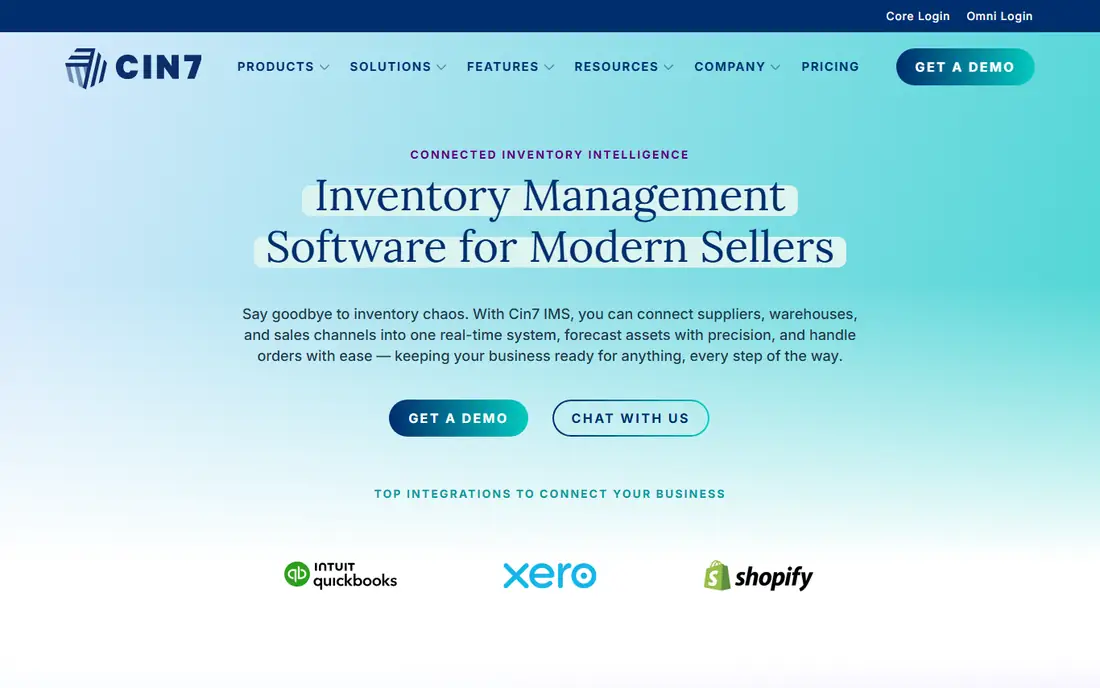
Cin7 is inventory management software and small business ERP in one, and its homepage answers the pricing question directly: plans start at $349 a month, accommodating up to 6 ecommerce and app integrations, with more available for purchase. Its feature set covers order management, stock visibility, manufacturing, and sales logistics, with real-time visibility across every product and component, plus cost tracking and reporting through Xero and QuickBooks integrations.
Cin7's own FAQ notes that wholesale distributors need advanced order management, warehouse routing, and B2B portal capabilities, which is exactly the gap between retail inventory tools and full ERP. For a growing wholesaler that also assembles or manufactures products, Cin7 hits the sweet spot between a simple tracker and NetSuite. The main caution is integration limits on the entry plan, so count your channels before buying.
What we like- Real-time stock visibility across products and components
- Manufacturing and assembly tools
- Accounting integrations with Xero and QuickBooks
- Published starting price
Watch out for- Starting price covers limited integrations, with more available for purchase
- Larger distributors may still need a full ERP
#3Zoho Inventory
Best for: Small wholesalers on a budget4.4/5 on
G2 (91 reviews, checked Oct 2026)
Visit zoho.com
Starting priceSee website
Free planNo
Zoho Inventory is the inventory app inside Zoho's cloud software suite, which serves more than 150 million users across 150-plus countries with 60-plus products built over 30-plus years. It covers sales and purchase orders, stock tracking, warehouse management, and shipping integrations, and it connects with Zoho Books for accounting and Zoho CRM for customer management, giving small wholesalers a connected system at a low price point.
Its limits are depth: multi-warehouse automation, advanced manufacturing, and B2B portal features are thinner than at Cin7 or Fishbowl, and we verified it through Zoho's vendor homepage rather than a dedicated Inventory product page. For a small wholesaler that already uses Zoho apps, or one that wants capable inventory software without ERP cost, Zoho Inventory is the best value pick here.
What we like- Part of Zoho's 50-plus app suite with 150 million-plus users
- Order, stock, and shipping management in one low-cost package
- Strong value for small teams
Watch out for- Verified through Zoho's vendor homepage rather than a dedicated Inventory page
- Depth is less than Cin7 or Fishbowl for complex warehouses
Starting priceSee website
Free planNo
Fishbowl calls itself the number-one inventory and manufacturing software for QuickBooks and Xero, and its homepage backs that with customer results: 18 percent lower inventory costs, 35 percent fewer stockouts, and 99 percent on-time delivery for featured customers. Its Fishbowl AI plans the day, fills capacity gaps, executes purchase, manufacturing, and work orders, and flags shortages, margin leaks, and tariff hits before dates slip. Barcode scanning through Fishbowl GO covers receiving, picking, packing, and shipping, with multi-warehouse tracking and landed-cost accounting.
Fishbowl suits a wholesaler or manufacturer already running QuickBooks or Xero, since its accounting-first sync keeps cost of goods sold, landed costs, and close processes clean. Pricing is straightforward per-user pricing based on warehouse count and user needs, quoted rather than published, with in-house implementation in 2 to 6 weeks. For an accounting-centered wholesaler, Fishbowl is the strongest fit here.
What we like- Number-one inventory and manufacturing software for QuickBooks and Xero
- AI-driven replenishment and order execution
- Barcode scanning with Fishbowl GO
- Trusted by over 6,000 businesses
Watch out for- Pricing by quote based on warehouses and users
- Implementation typically takes 2 to 6 weeks
Starting priceSee website
Free planNo
inFlow makes inventory management easy, in its own words, for teams moving off spreadsheets or an expensive ERP. Its homepage stresses ease of use, with customers reporting they use it without training or tutorials, and it serves teams from solo entrepreneurs to 50-person operations in over 90 countries. Built-in AI features include an AI report assistant for fast answers about orders and inventory, plus MCP support for creating orders or updating pricing by chatting with Claude. Support comes from in-house teams in Toronto and Lisbon, with guided onboarding from a customer success manager.
inFlow suits a small wholesaler that wants to stop using spreadsheets this week rather than run a months-long ERP project. Its trade-off is depth: large multi-warehouse distributors with complex B2B portals will outgrow it faster than Cin7 or NetSuite. For a small team that values simplicity above all, inFlow is the easiest starting point here.
What we like- Easiest system to learn on this list, usable without training
- AI report assistant and MCP support for chat-based orders
- Used by over 50,000 businesses in 90-plus countries
Watch out for- Simplicity means less depth for large multi-warehouse operations
- Pricing not shown on the homepage
#6Katana
Best for: Product businesses with production4.4/5 on
G2 (117 reviews, checked Oct 2026)
Visit katanamrp.com
Starting priceSee website
Free planNo
Katana is cloud inventory management software for product businesses, built around one shared system for stock, orders, and production. Its homepage promises full visibility across every location, synced sales across channels, end-to-end manufacturing visibility, demand forecasting, and barcode-enabled warehousing, with more than 1,500 product businesses using it. It connects with Shopify, Amazon, and WooCommerce, tracks lot and serial numbers for recall-ready traceability, and offers an open API plus AI chats through Katana MCP.
Katana suits a wholesaler that also makes products, since production and inventory stay aligned in one view, and many teams begin using it in a single day through self-serve setup, with guided onboarding reaching full visibility in about six weeks. Its pricing is quote-based, and pure distributors without production may find its manufacturing focus more than they need. For a make-and-sell wholesaler, Katana is a strong modern choice.
What we like- Real-time stock, order, and production visibility in one system
- Multi-channel order sync with Shopify and Amazon
- Lot and serial traceability
- Fast self-serve setup
Watch out for- Pricing is quote-based under its Advantage plan
- Wholesale-specific B2B portals are not its headline feature
Starting priceSee website
Free planNo
Descartes Finale is cloud-based inventory management software for growing ecommerce brands, now under the Descartes name, and its homepage states plainly that it suits teams expanding warehouse operations and supporting profitable wholesale and B2B channels. It keeps inventory accurate across Shopify, Amazon, eBay, Walmart, and 25-plus channels, with barcode-driven receiving, putaway, picking, packing, and cycle counts across multiple warehouses, plus margin insight through landed costs and COGS tracking with QuickBooks Online and Xero integrations.
Finale's wholesale relevance is explicit: its feature list includes bill of lading support for wholesale, distributor, and B2B orders, and its customers include brands that grew from a few thousand SKUs to nearly a million. Onboarding is guided and measured in weeks, not months. For a multichannel seller adding wholesale as a growth channel, Finale bridges retail and B2B better than most tools here.
What we like- Real-time inventory accuracy across Shopify, Amazon, Walmart, and 25-plus channels
- Barcode-driven warehouse operations
- Margin, landed cost, and COGS visibility
- Wholesale and B2B bill of lading features
Watch out for- Ecommerce-first, so pure wholesale distributors should confirm B2B portal depth
- Pricing by quote
#8Linnworks
Best for: Multichannel order and inventory control4.3/5 on
G2 (117 reviews, checked Oct 2026)
Visit linnworks.com
Starting priceSee website
Free planNo
Linnworks is multichannel inventory and order management software that connects inventory, orders, warehouses, listings, and shipping carriers across 100-plus marketplaces, including Amazon, eBay, Walmart, Shopify, TikTok Shop, and Wayfair. Its homepage reports more than 4,000 active customers, 52-plus hours saved per month on average through automation, and 2.1 million daily decisions automated, with inventory accuracy cited as the number-one value by 87 percent of customers. Rules-based automation handles carrier selection, label printing, and order routing, whether fulfillment runs from an own warehouse, a 3PL, or dropship suppliers.
Linnworks suits a wholesaler that also sells across many retail channels and wants one source of truth for stock and orders, with new channels launched in days rather than months. Pricing depends on order volume and features rather than channel count, and is quoted per operation. Pure wholesale distributors should confirm B2B portal features before choosing it, since its headline strength is multichannel retail.
What we like- Connects inventory, orders, warehouses, listings, and shipping across 100-plus marketplaces
- Rules-based order routing and carrier selection
- 4,000-plus active customers
Watch out for- Pricing depends on order volume and features, quoted per operation
- Ecommerce-first, so wholesale depth should be confirmed
How we chose
We compared inventory software with real wholesale relevance: bulk and B2B orders, multi-warehouse stock, purchasing and replenishment, barcode operations, and accounting integration, and we opened each vendor homepage to confirm it loads and belongs to that product. We weighed wholesale fit, warehouse depth, channel coverage, and price, using only prices confirmed on vendor homepages and listing "See website" elsewhere. Zoho Inventory was verified through Zoho's vendor homepage rather than a dedicated product page, as noted above.
Buying guide: how to pick wholesale inventory software
Start with your order profile. A distributor selling bulk B2B orders needs customer-specific pricing, volume discounts, and distributor portals, while a multichannel seller adding wholesale needs channel sync first. Match the tool to the larger share of your revenue, not the smaller one.
Next, map your warehouses and fulfillment: how many locations, whether you use a 3PL, how receiving, picking, and cycle counts work today, and which accounting system must stay in sync. A tool that cannot mirror your warehouse flow will create manual workarounds that defeat the purchase.
Then count the full cost: licences, implementation, training, and integrations, plus the cost of migrating SKUs, customers, and history. Run a pilot with real products and real orders across at least two warehouses, and confirm that stock counts, landed costs, and B2B pricing all behave correctly before committing the whole business.
Frequently asked questions
What is wholesale inventory management software?
It is software that tracks stock, bulk orders, purchasing, and fulfillment for businesses selling to other businesses, with features such as B2B pricing, multi-warehouse stock, and distributor order management that retail tools often lack.
How is wholesale inventory different from retail inventory?
Wholesale deals in larger order quantities, customer-specific pricing, bulk discounts, and distributor relationships, while retail focuses on individual consumers and storefront sales. Wholesale tools therefore emphasize B2B portals, volume pricing, and warehouse routing.
How much does wholesale inventory software cost?
Costs range from low-cost plans at Zoho Inventory to Cin7's published starting price of $349 a month, up to quote-based ERP pricing at NetSuite. Implementation, training, and integrations add to the licence cost.
Do I need an ERP or standalone inventory software?
A standalone tool suits most small and mid-size wholesalers, since it deploys faster and costs less. A full ERP such as NetSuite suits larger distributors that also need finance, CRM, and ecommerce in one system.
Can inventory software prevent stockouts?
It reduces them sharply through reorder points, demand forecasting, and real-time stock visibility, but it cannot remove them entirely. Supplier lead times, demand spikes, and data errors still require human judgment and safety stock.
Sources we checked (0)
Is your product missing or out of date?
We review this list regularly. Vendors can request a listing, send updated pricing or ask about featured placement.

Shihab Mia · Founder, Rankite
Shihab has 5+ years in B2B and SaaS SEO. He writes Rankite's software buying guides from pricing pages, documentation and public user reviews. More about Shihab.