How we make this list: we compare pricing pages, product documentation and public user reviews. Ratings come from G2, Capterra or Trustpilot, with the date we checked them.
Key takeaways
- Integration software is the most overbought category in business software. Teams buy enterprise iPaaS platforms for problems a $30 automation tool would solve. Match the tool to the complexity, not the ambition.
- Almost nobody publishes prices. Nine of ten tools here are quote-based; only Fivetran and Pabbly Connect show real numbers. Budget for demos, annual contracts and a procurement cycle.
- The category splits three ways: enterprise iPaaS (MuleSoft, Boomi, Celigo, Jitterbit, SnapLogic, Tray.ai), data integration for analytics (Fivetran, Informatica, Talend), and budget app connectors (Pabbly Connect).
- Consolidation is reshaping the list: Informatica now operates under Salesforce and Talend is part of Qlik. Confirm product roadmaps before signing multi-year deals.
- Fivetran is the pricing transparency outlier: a Free Plan, a 14-day trial, a $5 base charge per connection and usage-based MAR billing, all published on its pricing page.
Quick comparison
| Tool | Best for | Starting price | Free plan |
|---|
 MuleSoft MuleSoft | Enterprises running API-led integration at scale | See website (custom quote) | Free trial (test drive available) |
 Boomi Boomi | Cloud-native iPaaS for large integration estates | See website (custom quote) | No |
 Celigo Celigo | Mid-market iPaaS, especially NetSuite-centric operations | See website (custom quote) | Free trial (30 days, full platform access) |
 Jitterbit Jitterbit | Teams that want fast implementation plus EDI | See website (custom quote) | No |
 SnapLogic SnapLogic | Data and application integration with AI agent ambitions | See website (custom quote) | No |
 Informatica Informatica | Enterprise data integration, quality and governance | See website (custom quote) | No |
 Tray.ai Tray.ai | AI-native integration for agent-era technology stacks | See website (custom quote) | No |
 Fivetran Fivetran | Automated data pipelines into your warehouse | See website (usage-based, billed per monthly active rows) | Yes (Free Plan for low data volumes) |
 Talend Talend | Data integration and quality inside the Qlik ecosystem | See website (custom quote) | Free trial (Qlik Talend Cloud trial) |
 Pabbly Connect Pabbly Connect | Budget app-to-app automation with lifetime pricing | See website (subscription tiers plus one-time lifetime plans) | Yes (100 tasks/month, no credit card required) |
Is your product missing or out of date?
We review this list regularly. Vendors can request a listing, send updated pricing or ask about featured placement.
The best integration software
Integration software is the most overbought category in business software. Somewhere between the demo and the contract, a team that needed three systems to talk to each other ends up with an enterprise platform, a six-figure quote and a nine-month implementation. The honest truth: most companies need one of two things. They need data flowing into their warehouse for analytics, or they need applications talking to each other in real time. The ten tools below cover both jobs, from the platforms that run global enterprises to the budget connector that costs less than a team lunch.
Starting priceSee website (custom quote)
Free planFree trial (test drive available)
MuleSoft, part of Salesforce, is the reference architecture for enterprise integration. The philosophy is API-led: instead of point-to-point connections, you build reusable APIs in layers, so the hundredth integration is cheaper than the first. Anypoint Platform covers design, deployment, policy enforcement and monitoring, and the 2026 story adds Agent Fabric, a control plane for finding, governing and cost-managing AI agents across the enterprise.
The catch is fit. MuleSoft assumes an integration team, an architecture practice and the budget to match. Buyers consistently report steep pricing and difficult negotiations. It earns its place when you have hundreds of integrations, hybrid infrastructure and compliance requirements. For connecting a CRM to an accounting tool, it is ten times the platform you need.
What we like- API-led connectivity with reusable API layers keeps large integration estates maintainable
- Full API lifecycle management from design to monitoring
- Agent Fabric extends the platform to governing AI agents and MCP servers
Watch out for- Quote-only pricing aimed at enterprise budgets
- Heavyweight for simple app-to-app syncs
- Contract negotiations are a known pain point among buyers
#2
Boomi
Best for: Cloud-native iPaaS for large integration estates
Visit boomi.com
Starting priceSee website (custom quote)
Free planNo
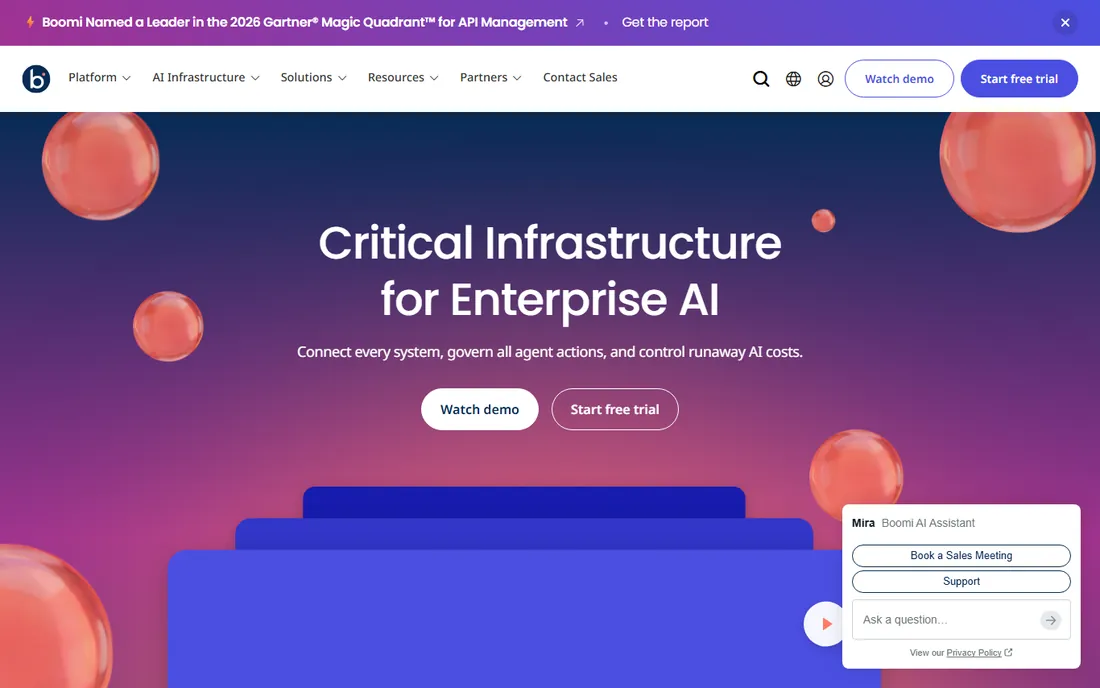
Boomi pioneered cloud iPaaS and still defines the category for many buyers. The platform connects applications, data and APIs across hybrid cloud and on-premises estates with a low-code builder, and the 2026 positioning wraps in AI agent management, API governance and data management on the same runtime. The crowdsourced mapping suggestions, learned from thousands of customers' integrations, genuinely speed up building.
Like MuleSoft, Boomi is quote-first with no free tier, and the sales motion is enterprise from the start. The platform has also drifted upmarket over the years; small teams find the pricing and process heavy. Shortlist it when integration is a program, not a project: dozens of systems, multiple clouds, governance requirements. Otherwise the mid-market tools below do the job with less ceremony.
What we like- Cloud-native from day one, with no infrastructure to manage
- Drag-and-drop mapping with crowdsourced intelligence from a huge user base
- Broad platform covering integration, API management, data and AI agent lifecycle
Watch out for- No published pricing and no self-serve tier
- Enterprise sales process from the first call
- Overkill for teams with a handful of integrations
#3
Celigo
Best for: Mid-market iPaaS, especially NetSuite-centric operations
Visit celigo.com
Starting priceSee website (custom quote)
Free planFree trial (30 days, full platform access)
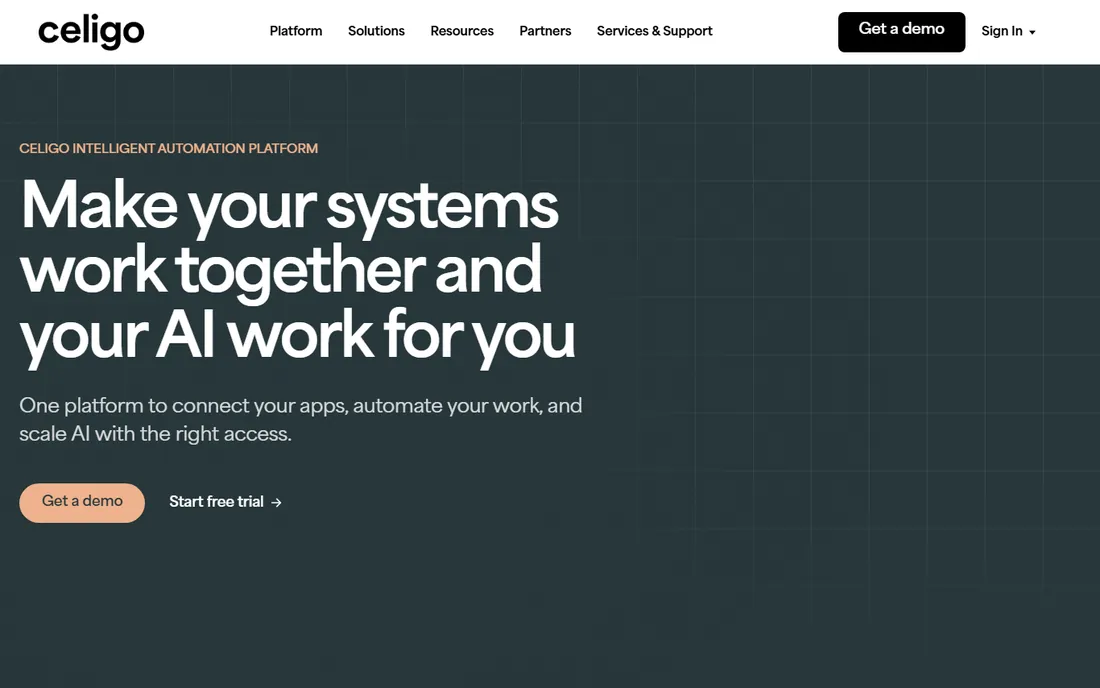
Celigo sits in the gap between Zapier-style simplicity and MuleSoft-grade power. It grew up in the NetSuite ecosystem, and that shows in the best way: pre-built integration apps for order-to-cash, procure-to-pay and marketplace flows that understand NetSuite's quirks. The current platform adds full API management, EDI and AI agents under one governance model, plus Ora, a natural-language interface for building and fixing flows.
The honest catch is that the NetSuite DNA cuts both ways. For ERP-centric commerce and finance operations, Celigo is often the fastest path. For general enterprise integration across arbitrary systems, the bigger suites have broader connector depth. Pricing is quoted, though the 30-day trial with full access is genuinely useful for evaluation. It fits mid-market companies whose operations revolve around their ERP.
What we like- Deep NetSuite expertise with pre-built integration apps for ERP-centric flows
- Natural-language Ora assistant builds and troubleshoots flows
- 30-day full-access trial lets you test on real systems
Watch out for- Pricing is quoted per deal with no public figures
- NetSuite-centric heritage shows outside ERP scenarios
- Implementation of NetSuite integrations still typically takes weeks
Starting priceSee website (custom quote)
Free planNo
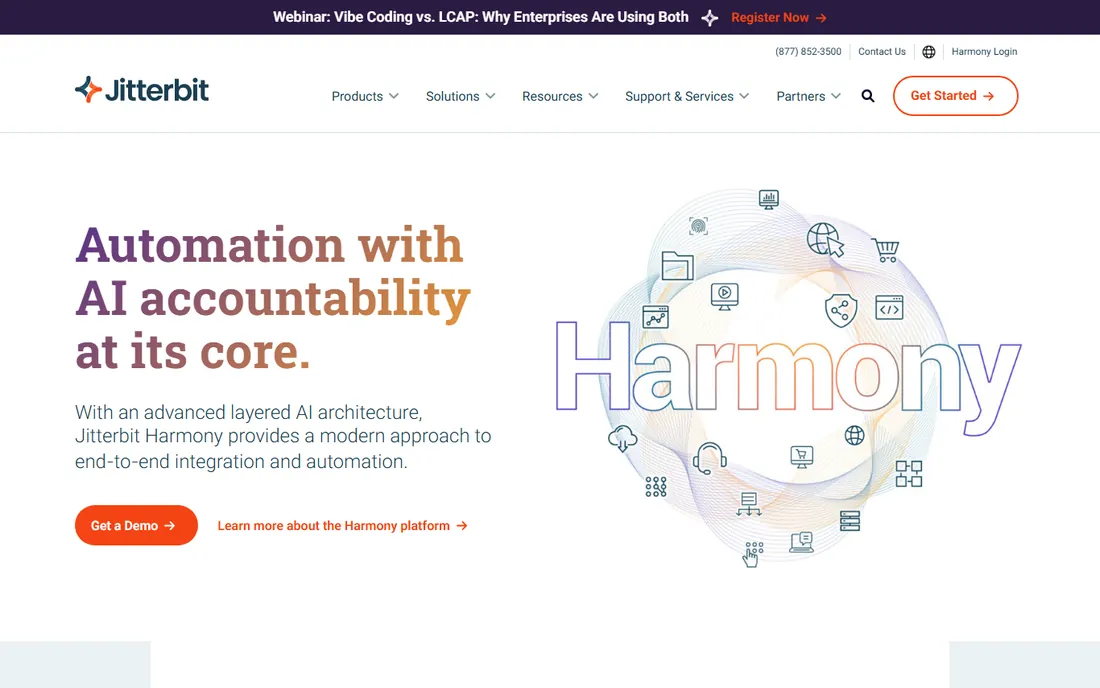
Jitterbit's calling card is time to value. It has topped G2's enterprise iPaaS implementation index for five straight quarters on measures like setup satisfaction and time to go-live, which is the metric buyers actually feel. The Harmony platform bundles iPaaS, API management, a low-code app builder and EDI, so trading-partner document exchange does not require a separate product.
The tradeoff is visibility and access. Pricing is quoted, there is no free tier, and the brand is less known than the two giants, which can matter for hiring and partner ecosystems. The EDI inclusion is a real differentiator for retail, manufacturing and logistics companies that exchange purchase orders and invoices electronically. If your integration list includes EDI, Jitterbit deserves a serious look; if not, compare it on implementation speed alone.
What we like- Consistently top-ranked for implementation speed in G2's enterprise iPaaS index
- Harmony unifies iPaaS, API manager, app builder and EDI on one platform
- AI-infused low-code approach suits mixed technical teams
Watch out for- Quote-only pricing with no free tier
- Smaller mindshare than MuleSoft or Boomi
- EDI strength matters little if you do not trade EDI documents
#5
SnapLogic
Best for: Data and application integration with AI agent ambitions
Visit snaplogic.com
Starting priceSee website (custom quote)
Free planNo
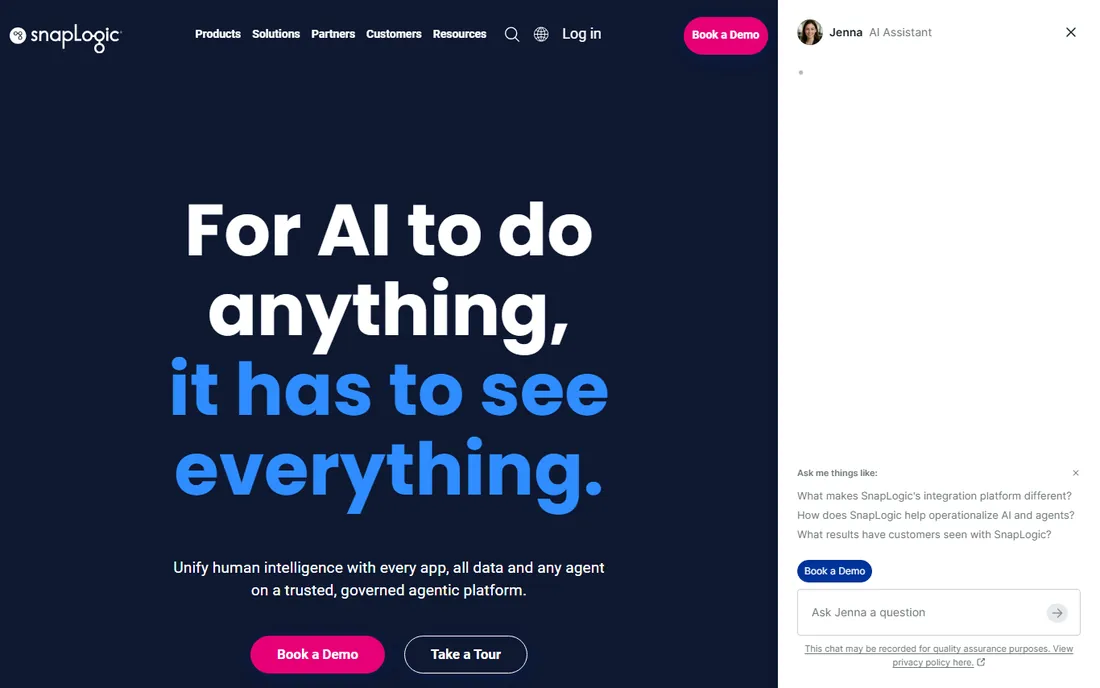
SnapLogic has always lived at the intersection of data integration and application integration, and that is exactly where AI agents now live too. The platform's 1,000-plus Snaps cover databases, SaaS apps and enterprise systems in a visual designer, while the newer AgentCreator, SnapGPT copilot and MCP server support let teams build governed agents on the same pipelines. For companies whose AI strategy depends on agents reaching across systems, that combination is coherent.
The caveats are familiar for the category: quote-only pricing, no free tier, and a learning curve on complex integrations. The agentic story is the newest paint on the platform, so ask for customer references running agents in production rather than demos. SnapLogic fits data-forward organizations that want one platform for pipelines, app integration and agent tooling.
What we like- 1,000+ pre-built Snaps with a visual pipeline designer
- Strong data integration heritage for analytics workloads
- AgentCreator and MCP support position it for the agentic era
Watch out for- No published pricing
- The agentic repositioning is new and still proving itself
- Reviewers note documentation gaps on complex topics
Starting priceSee website (custom quote)
Free planNo
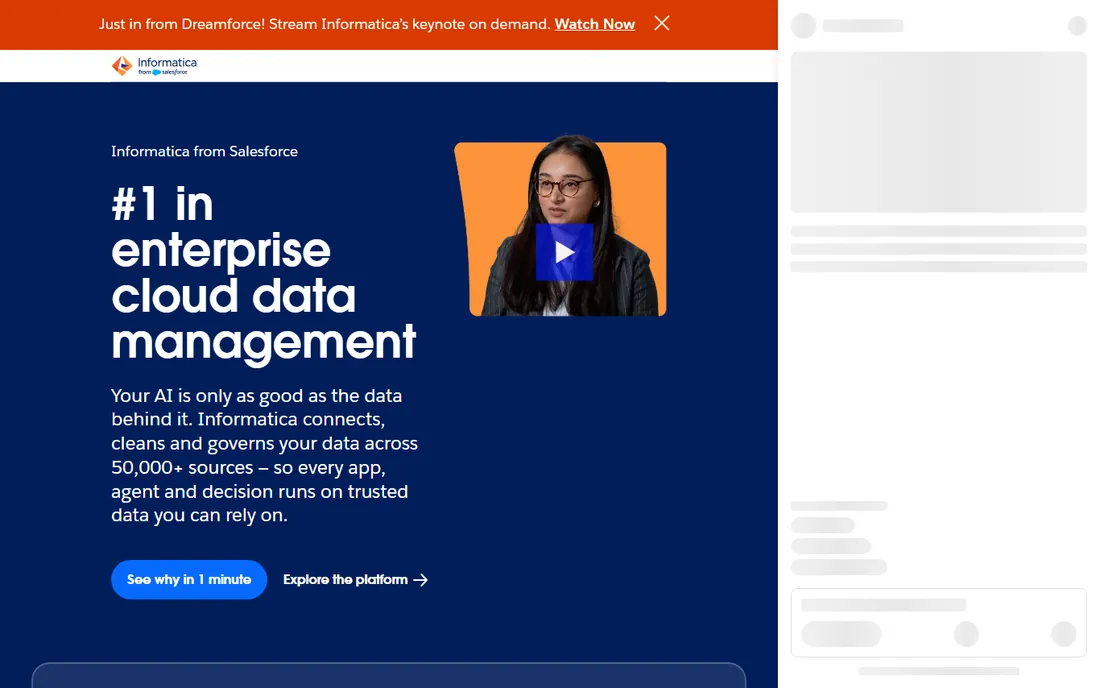
Informatica is the data side of integration: less about connecting apps in real time, more about making data trustworthy, governed and available everywhere. The Intelligent Data Management Cloud covers integration, data quality, master data management, governance and cataloging as one system, which is why regulated enterprises standardize on it. The 2026 headline is the Salesforce acquisition, now reflected in "Informatica from Salesforce" branding.
That acquisition is also the thing to diligence. Product roadmaps, packaging and support structures change after deals like this, so get written commitments on the products you are buying. Pricing is negotiated and enterprise-scale. Informatica fits organizations where data governance is non-negotiable: finance, healthcare, anyone with regulators. For simply loading a warehouse, Fivetran does it with less overhead.
What we like- The deepest data management platform here: integration, quality, MDM, governance and catalog in one
- 300+ connectors
- AI-ready data positioning matches where enterprise AI budgets are going
Watch out for- Now part of Salesforce, so roadmap and packaging are in flux
- Quote-only enterprise pricing
- Far more platform than analytics-only teams need
#7
Tray.ai
Best for: AI-native integration for agent-era technology stacks
Visit tray.ai
Starting priceSee website (custom quote)
Free planNo
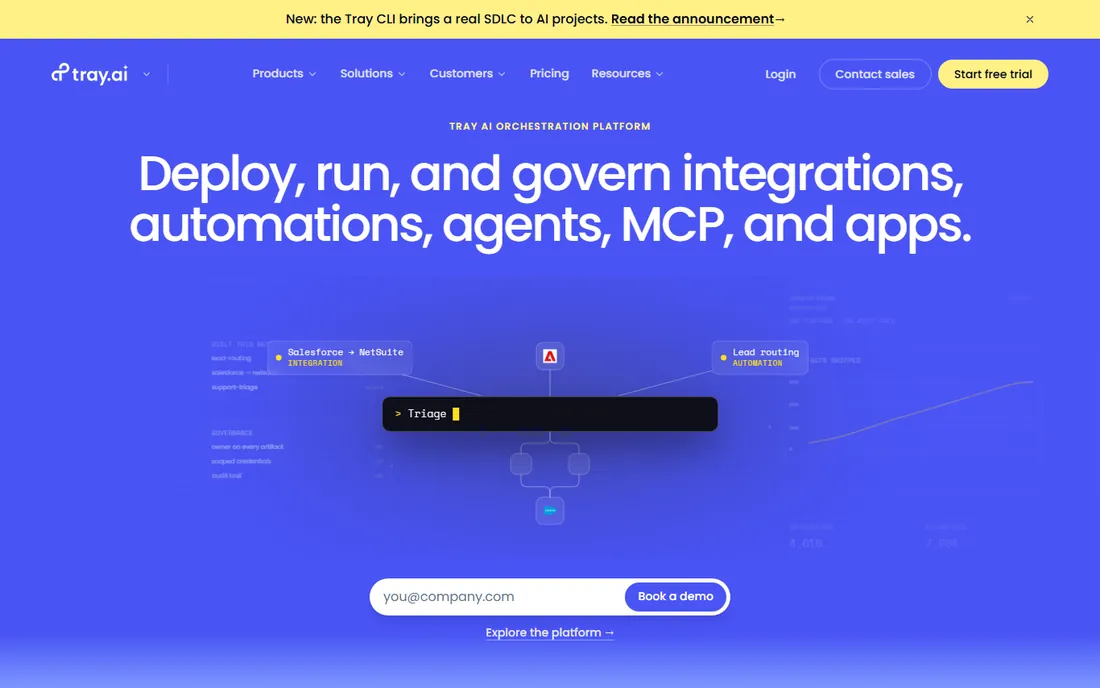
Tray.ai, formerly Tray.io, rebuilt its story around the AI era before most competitors. The platform combines integration, automation, AI agents and MCP governance in one place, with a serverless engine that processes millions of records in single operations instead of burning per-row credits. The pitch is consolidation: replace the stack of legacy iPaaS tools with one AI-native platform at lower cost.
The honest catch is maturity of the new story. The AI-native positioning is recent, and while the underlying integration engine is proven, the agent-era claims deserve the same diligence you would give any vendor pivot. Pricing is quoted. Tray.ai fits technology-forward companies building AI agents that need governed access to enterprise systems, and teams looking to consolidate aging integration tooling.
What we like- Built AI-native rather than retrofitted, with Merlin agent builder and MCP gateway
- Serverless architecture with single-operation bulk processing for predictable costs
- Strong governance story for agent actions and tool calls
Watch out for- Quote-based pricing with no self-serve option
- The former Tray.io brand still causes confusion
- Newest positioning means fewer long-term references than legacy rivals
Starting priceSee website (usage-based, billed per monthly active rows)
Free planYes (Free Plan for low data volumes)
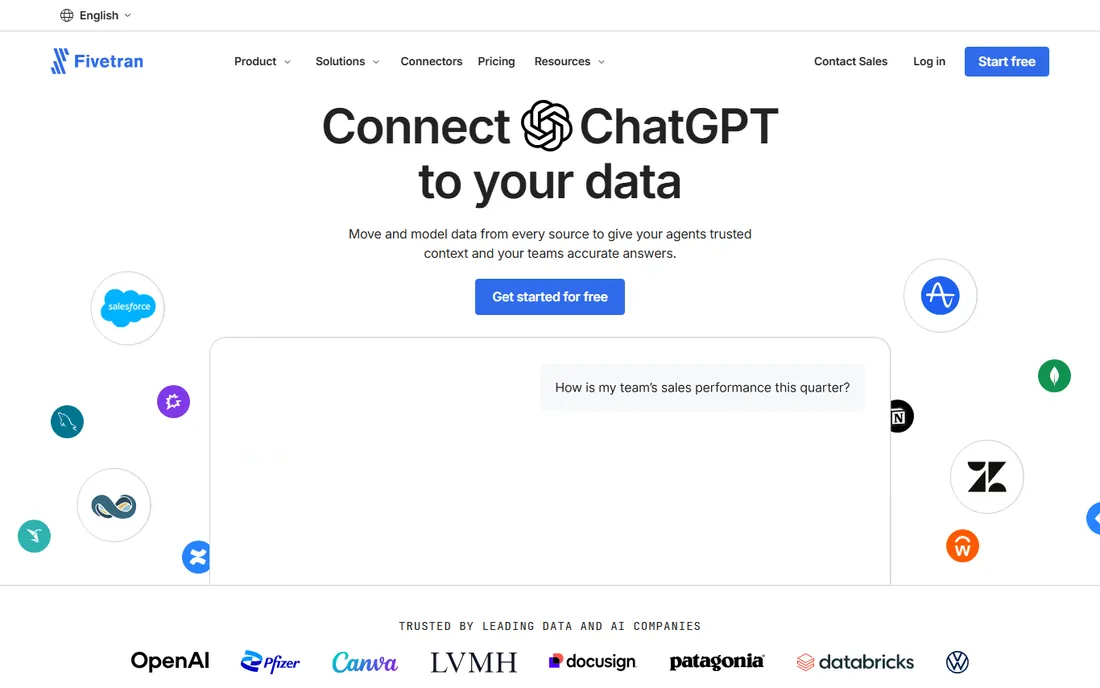
Fivetran does one job extremely well: it moves data from your applications into your warehouse automatically, handling schema changes, retries and API quirks so your data team does not have to. With 700-plus managed connectors and 15-minute syncs on Standard, it is the default choice for analytics engineering. It is also the transparency outlier in this list: the pricing page spells out the Free Plan, the 14-day trial on every new connection, the $5 base charge and the annual discounts.
The catch is the billing change. Since March 2026, MAR tiering applies per connection rather than per account, which raised costs for teams with many similar-sized connectors. Model your real connector mix in the pricing estimator before committing, and remember transformations are a separate meter. Fivetran fits any team that wants warehouse data without building pipelines; it is not an app-to-app integration tool.
What we like- Pricing page publishes the actual model: Free Plan, 14-day trial, $5 base charge per connection, annual contracts saving up to 22%
- 700+ fully managed connectors with 15-minute syncs
- No pipeline maintenance for your team
Watch out for- Usage-based MAR billing punishes multi-connector setups after the 2026 move to per-connection tiering
- Real-time 1-minute syncs need Enterprise
- No built-in visual transformations, so dbt or SQL skills required
#9
Talend
Best for: Data integration and quality inside the Qlik ecosystem
Visit talend.com
Starting priceSee website (custom quote)
Free planFree trial (Qlik Talend Cloud trial)
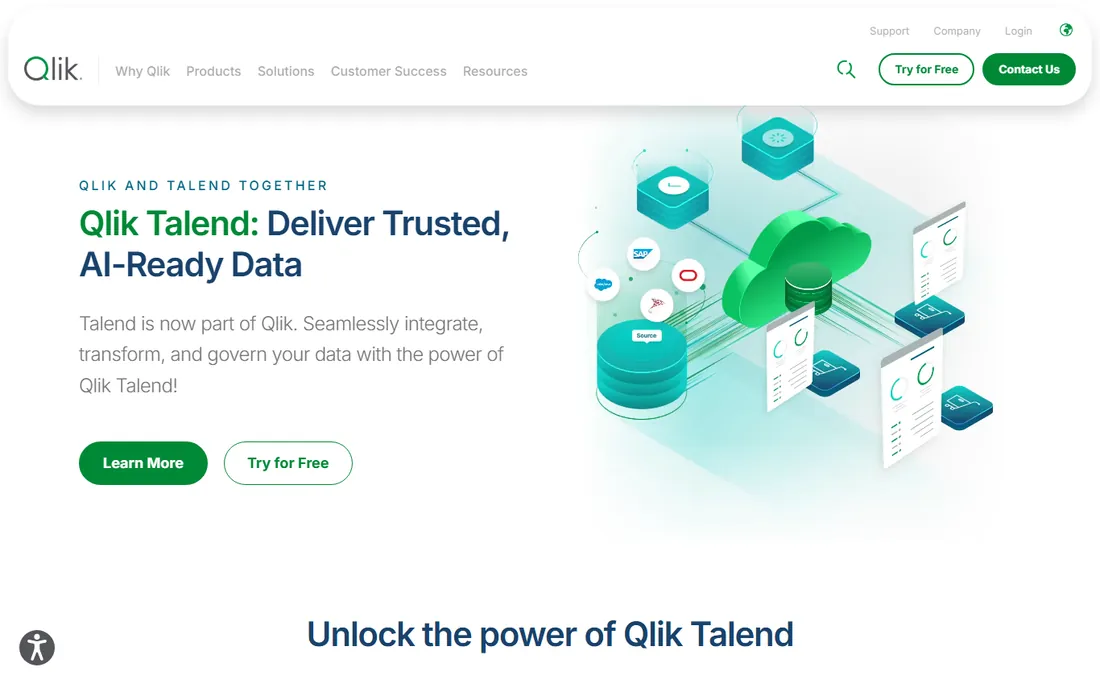
Talend built its name on data integration with an open-source heart, and today it lives on as Qlik Talend Cloud. The platform covers integration, transformation, data quality and governance across cloud, on-premises and hybrid deployments, serving every role from data engineer to steward. Under Qlik, the natural pairing is with Qlik analytics: integrate and govern the data, then analyze it in the same ecosystem.
The brand transition is the thing to watch. Talend.com now presents Qlik Talend Cloud, and buyers should confirm exactly which products, contracts and support structures apply to them. Pricing is quoted with a trial available. Talend fits data teams standardizing on Qlik, and organizations that need serious data quality alongside integration. Pure-play ETL buyers should compare Fivetran's operational simplicity first.
What we like- Unified platform for integration, data quality and governance, cloud or on-prem
- Strong heritage in ETL with tools for every data role
- Qlik ownership pairs integration with a leading analytics platform
Watch out for- Talend is now part of Qlik, so the standalone brand is fading
- Quote-only pricing
- The open-source community edition story has thinned under commercial ownership
#10
Pabbly Connect
Best for: Budget app-to-app automation with lifetime pricing
Visit pabbly.com
Starting priceSee website (subscription tiers plus one-time lifetime plans)
Free planYes (100 tasks/month, no credit card required)
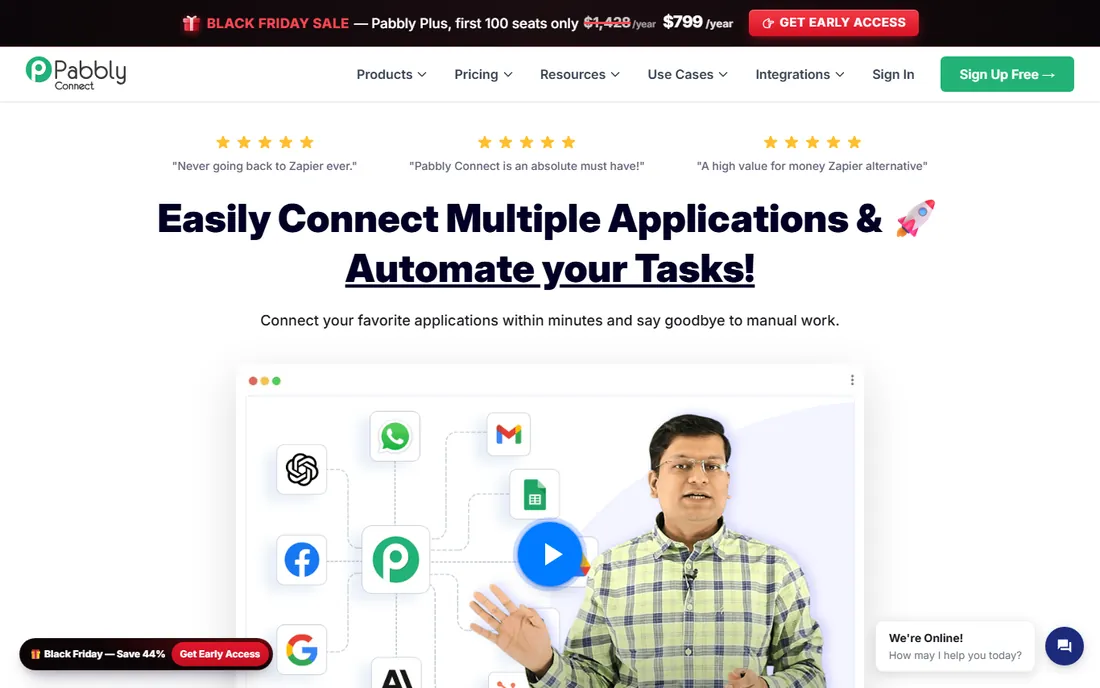
Pabbly Connect is the price disruptor of app integration. The model is deliberately Zapier-inverted: triggers and internal steps like filters, routers and formatters are free, and only action steps on external apps consume tasks, so the same workflow costs fewer tasks than on Zapier or Make. Paid tiers offer unlimited workflows and team members, and the famous one-time lifetime plans mean never paying a subscription again.
The catches are in the fine print. Lifetime plans cannot be upgraded or stacked later, so buy for the volume you expect in two years, not today. Support options are limited compared to enterprise vendors, and the pricing page's monthly figures did not render as text during research. Pabbly Connect fits freelancers, agencies and SMBs automating app-to-app flows on a budget. It is not a substitute for governed enterprise iPaaS.
What we like- Triggers and internal steps do not consume tasks, only action steps do
- One-time lifetime plans eliminate subscriptions entirely
- 2,000+ integrations with unlimited workflows on paid tiers
Watch out for- Exact monthly prices render as images on the pricing page, so confirm at checkout
- Support is thinner than enterprise vendors
- The lifetime deal cannot be upgraded later, so size it for future volume
How we chose
We started from the searches buyers run: integration software, iPaaS platforms, data integration tools and ETL software. For each candidate we opened the vendor's homepage directly and copied the website URL from the browser address bar after redirects. We opened pricing pages where they exist and recorded only figures the vendor itself publishes: Fivetran's Free Plan, trial terms, $5 base charge and annual discounts, and Pabbly Connect's free 100 tasks and lifetime plan structure. Everywhere else we wrote "See website" rather than repeating estimated figures from third-party trackers. We verified two major market changes live: Informatica now brands as part of Salesforce, and Talend has become Qlik Talend Cloud. Positioning was cross-checked against public reviews on G2 and practitioner discussion on Reddit.
The questions that actually decide the purchase
Vendors will happily demo for an hour. These five questions cut through it.
What are we integrating, really? Data into a warehouse is Fivetran, Talend or Informatica territory. Apps talking to each other in real time is iPaaS: MuleSoft, Boomi, Celigo, Jitterbit, SnapLogic, Tray.ai. Simple app syncs on a budget is Pabbly Connect. Buying the wrong category is the costliest mistake here.
Who builds and maintains the integrations? MuleSoft and Informatica assume integration specialists. Boomi, Celigo and Jitterbit target mixed teams with low-code builders. Fivetran assumes a data team but removes pipeline maintenance. Pabbly Connect assumes whoever is available. An integration nobody maintains rots fast.
How is it priced, in our numbers? Nine of ten vendors quote custom deals, so make them quote against your actual connector count, data volume and sync frequency. For Fivetran, model per-connection MAR under the 2026 tiering. For Pabbly Connect, size the lifetime tier for future volume since it cannot be upgraded.
What happens when the vendor gets acquired? Informatica and Talend both changed owners recently. Ask about product roadmap commitments, contract protections and support continuity before signing multi-year deals in a consolidating market.
Can we try it on our systems? Celigo offers a 30-day full-access trial, Fivetran gives every new connection 14 free days, MuleSoft and Talend offer test drives and trials, and Pabbly Connect's free tier needs no credit card. A trial on your real systems beats any demo.
Buying integration software without the regret
The pattern repeats across companies: the evaluation starts with features and ends with a surprise about price, ownership or effort. A few practical rules prevent it.
Start with the smallest tool that solves the problem. If three SaaS apps need syncing, Pabbly Connect or a workflow tool handles it; an iPaaS platform is a career decision, not a purchase. Reserve MuleSoft, Boomi and Informatica for genuine enterprise estates: dozens of systems, hybrid infrastructure, regulatory oversight.
Price the second year, not the first. Integration costs grow with data volume, connector count and sync frequency. Fivetran's MAR model, Pabbly's task tiers and the enterprise vendors' consumption elements all expand as usage does. Ask every vendor to model year-two costs at double your current volume, in writing.
Count the people, not just the licenses. Enterprise iPaaS deals routinely need implementation partners, training and dedicated administrators. A platform that costs $50,000 in licenses can cost $150,000 in its first year once services are included. Ask for reference customers at your company size and call them.
Plan the exit before the entrance. Ask how you export integration definitions, what happens to your data on termination, and what contract terms protect you if the product is acquired or sunset. In a market where two major vendors changed hands recently, this is not paranoia.
Frequently asked questions
What is integration software?
Integration software connects applications, data and systems so they work together. iPaaS platforms connect apps in real time, data integration tools move data into warehouses for analytics, and API management tools govern the interfaces between systems. Many vendors now bundle all three.
What is iPaaS?
Integration Platform as a Service: cloud software for building, deploying and managing integrations between applications without managing infrastructure. MuleSoft, Boomi, Celigo, Jitterbit, SnapLogic and Tray.ai are iPaaS vendors. It differs from workflow automation tools like Zapier in depth: iPaaS handles complex data mapping, error handling, governance and high volumes.
How much does integration software cost?
Mostly quote-based. Enterprise iPaaS deals are negotiated annually and typically run from tens of thousands to six figures depending on connectors, volume and services. Fivetran publishes usage-based pricing with a Free Plan and a $5 base charge per connection. Pabbly Connect is the budget end with a free tier and one-time lifetime plans. Always get year-two cost models in writing.
Is there free integration software?
Fivetran offers a Free Plan for low data volumes, and Pabbly Connect gives 100 free tasks a month with no credit card. Celigo, MuleSoft and Talend offer trials. The enterprise iPaaS vendors generally do not offer free tiers. Open-source options exist for data integration but require self-hosting and maintenance.
Fivetran vs iPaaS: which do I need?
Fivetran moves data from applications into your data warehouse for analytics; it does not connect apps to each other in real time. iPaaS platforms connect applications bidirectionally with complex logic and governance. Many companies use both: Fivetran for analytics pipelines, an iPaaS for operational integrations.
What should SMBs use for integration?
Start with the problem size. A handful of app syncs: Pabbly Connect or a workflow automation tool. ERP-centric operations like NetSuite: Celigo's trial is worth testing. Data into a warehouse: Fivetran's Free Plan. Enterprise iPaaS only makes sense when integration becomes a program with dozens of systems and governance needs.
Sources we checked (11)
- https://www.mulesoft.com
- https://boomi.com/
- https://www.celigo.com
- https://jitterbit.com/
- https://www.snaplogic.com
- https://www.informatica.com
- https://tray.ai/
- https://fivetran.com
- https://fivetran.com/pricing
- https://talend.com/
- https://www.pabbly.com/connect/
Is your product missing or out of date?
We review this list regularly. Vendors can request a listing, send updated pricing or ask about featured placement.

Shihab Mia · Founder, Rankite
Shihab has 5+ years in B2B and SaaS SEO. He writes Rankite's software buying guides from pricing pages, documentation and public user reviews. More about Shihab.