How we make this list: we compare pricing pages, product documentation and public user reviews. Rankite is independent; if a vendor ever pays for a featured spot, that listing is clearly labeled Partner.
Key takeaways
- Large global enterprises should shortlist Workday HCM, SAP SuccessFactors and Oracle HCM: all are quote-based, all need multi-quarter implementations.
- Companies with big hourly workforces should look at UKG Pro for scheduling and time compliance depth.
- Tech-driven mid-market companies should price Rippling ($10/user/month reported) against BambooHR for a modern HRIS without enterprise weight.
- Six of these eight platforms publish no prices: budget a sales process and get implementation costs in writing, not just licenses.
Quick comparison
| Tool | Best for | Starting price | Free plan |
|---|
 Workday HCM Workday HCM | Large global enterprises over 1,000 employees | See website (custom quote; implementations run six to seven figures) | No |
 SAP SuccessFactors SAP SuccessFactors | SAP-based global enterprises, especially manufacturing | See website (custom quote) | No |
 Oracle HCM Oracle HCM | Large enterprises already on Oracle financials | See website (custom quote based on modules and headcount) | No |
 UKG Pro UKG Pro | Large firms with big hourly and frontline workforces | See website (custom quote by workforce size and modules) | No |
 Rippling Rippling | Tech-driven companies wanting HR plus IT provisioning in one system | $10/user/month (reported starting price) | No (demo; trial availability varies) |
 BambooHR BambooHR | SMBs prioritizing ease of use and fast adoption | See website (third-party comparisons report roughly $8/user/month) | No (trial offered) |
 HiBob HiBob | Modern, scaling, multinational companies wanting one HRIS | See website (pricing not public) | No |
 ADP Workforce Now ADP Workforce Now | Mid-market to large companies with complex multi-jurisdiction payroll | See website (quote-based) | No |
Is your product missing or out of date?
We review this list regularly. Vendors can request a listing, send updated pricing or ask about featured placement.
The best human resources management software
HR software fails in two ways: it is too small for the company's complexity, or too big for the team's patience. A 60-person startup does not need a multi-quarter Workday rollout, and a 5,000-person manufacturer cannot run on a tool built for fifty. The right HRMS matches your headcount, your countries, and how much of HR you actually want to systematize. These eight platforms span that range, from SMB-friendly to global enterprise.
#1
Workday HCM
Best for: Large global enterprises over 1,000 employees
Visit workday.com
Starting priceSee website (custom quote; implementations run six to seven figures)
Free planNo
Workday is the system of record for the world's largest employers, and the single data model is why. HR and finance share one source of truth, so headcount planning, compensation and workforce analytics run on the same numbers the CFO uses. For a global enterprise with complex structures, that unity is hard to replicate.
The commitment is enormous. Licenses are quote-based, implementations run into six or seven figures, and rollouts are measured in quarters with specialist partners. This is overkill for anything under a thousand employees. Buy Workday when HR needs one global system of record and the budget matches; otherwise the modern tools below do more for less.
What we like- Single data model unifies HR and finance
- Built for complex global enterprises
- Strong workforce planning and analytics
Watch out for- High cost and long, complex rollouts
- Heavy for mid-market needs
- Customization requires specialists
#2
SAP SuccessFactors
Best for: SAP-based global enterprises, especially manufacturing
Visit sap.com
Starting priceSee website (custom quote)
Free planNo
SuccessFactors is the HR suite for companies that already run SAP. Talent management runs from recruiting through succession on one platform, and the integration with S/4HANA means HR data flows into the ERP without middleware projects. Global compliance tooling suits manufacturers with workforces across dozens of countries.
Outside SAP houses, the value drops fast. The platform is complex, parts of the interface feel dated next to Workday or HiBob, and implementation costs are high regardless of your ERP. If you run SAP, this is the default shortlist alongside Workday. If you do not, there is little reason to start here.
What we like- Deep talent lifecycle coverage from hire to retire
- Natural fit for SAP ERP shops
- Strong global compliance tooling
Watch out for- Complex and heavy for smaller teams
- Parts of the UX feel dated
- Implementation costs are high
#3
Oracle HCM
Best for: Large enterprises already on Oracle financials
Visit oracle.com
Starting priceSee website (custom quote based on modules and headcount)
Free planNo
Oracle Fusion Cloud HCM ties HR directly to Oracle financials, which makes workforce costing and planning unusually strong for finance-led organizations. The analytics and AI recruiting features suit the largest global enterprises managing tens of thousands of employees across regions.
The price floor is high and the sales cycle is long. Implementation is a major multi-phase program, and the platform's best value is reserved for companies already on Oracle ERP. Everyone else pays enterprise prices without the integration payoff. Shortlist Oracle HCM when the ERP decision is already made; otherwise compare Workday first.
What we like- HR data tied directly to Oracle ERP
- Advanced analytics and AI recruiting
- Strong for the largest global enterprises
Watch out for- High minimums and implementation complexity
- Best value only for Oracle shops
- Long sales and rollout cycles
#4
UKG Pro
Best for: Large firms with big hourly and frontline workforces
Visit ukg.com
Starting priceSee website (custom quote by workforce size and modules)
Free planNo
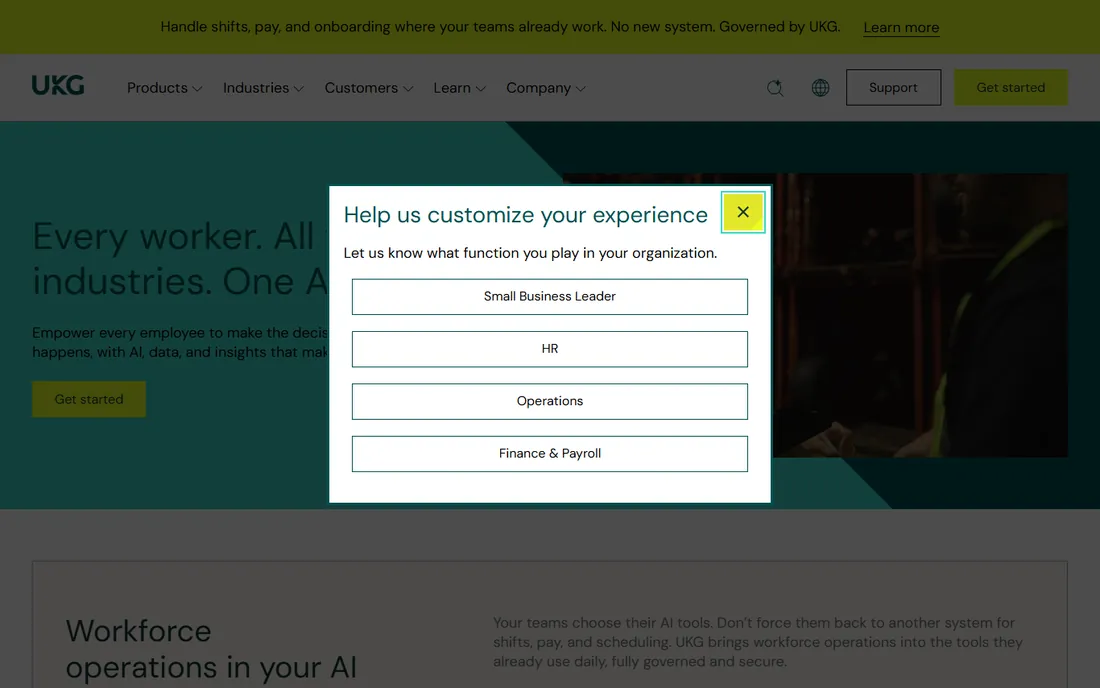
UKG Pro is built for the frontline: retail, healthcare, hospitality and manufacturing workforces where scheduling, time tracking and labor compliance are the daily reality. The workforce management depth, from shift scheduling to compliance automation, exceeds what the generalist HR suites offer for hourly workers.
It is not a small-team tool. Complexity overwhelms smaller HR departments, reviewers report slow support response times, and quote-based pricing means you will not know the cost until late in the process. Implementation is a phased rollout over months. If your workforce is mostly salaried and under a thousand people, the modern tools below fit better. If it is mostly hourly and large, UKG deserves the first demo.
What we like- Deep workforce management for shift and hourly workforces
- Strong time, scheduling and compliance automation
- People analytics focus
Watch out for- Complexity for smaller teams
- Reviewers cite slow support response times
- Quote-based pricing hides real cost
#5
Rippling
Best for: Tech-driven companies wanting HR plus IT provisioning in one system
Visit rippling.com
Starting price$10/user/month (reported starting price)
Free planNo (demo; trial availability varies)
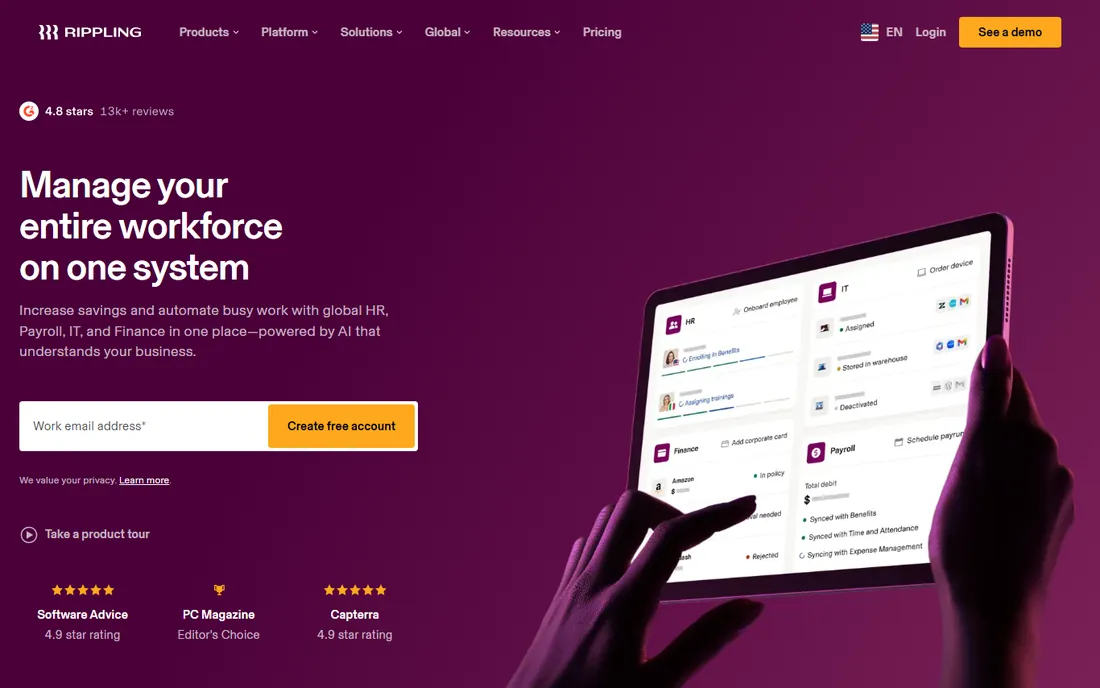
Rippling's pitch is that onboarding should not require five tools. One system provisions the employee record, the laptop, the apps and the payroll, so a new hire is productive on day one without IT tickets. The modern interface and fast onboarding make it the easiest enterprise-capable HRIS to adopt.
The $10 per user starting price excludes the modules most teams actually need, so price the real configuration, not the headline. HR depth is secondary to its IT automation roots; pure HR teams sometimes find the talent features thinner than BambooHR or HiBob. And the breadth means a learning curve. For a tech-driven company scaling from dozens to thousands, the unified model is compelling. For a traditional HR department, compare HiBob first.
What we like- Unifies HR, IT and finance workflows with cross-department automation
- Modern UX with fast onboarding
- Scales from 2 to 2,000 employees
Watch out for- Steep learning curve given its breadth
- HR depth secondary to its IT automation roots
- Add-on modules raise the real price
Starting priceSee website (third-party comparisons report roughly $8/user/month)
Free planNo (trial offered)
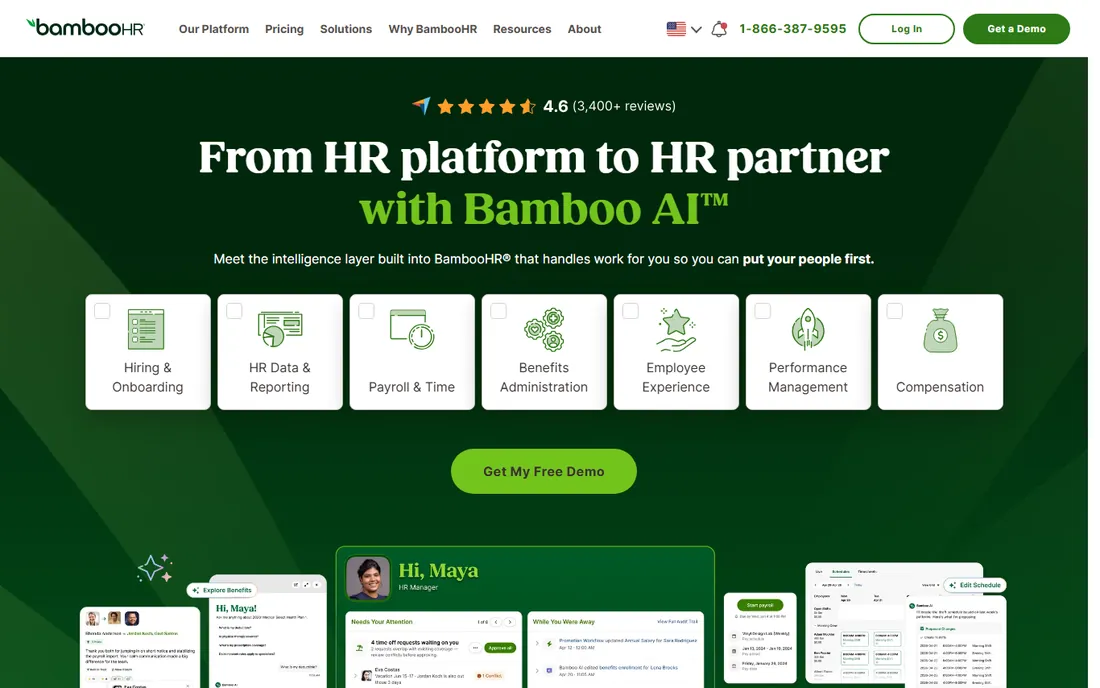
BambooHR wins on usability. HR teams actually use it, managers approve things without training, and employees complete self-service tasks instead of emailing HR. Implementation takes days with guided onboarding, which is unheard of in this category. For a growing SMB that needs HR organized without an IT project, this is the fastest path.
The ceiling is real. Past about 500 employees the reporting gets rigid, payroll is a US-only add-on, and multi-country complexity is not its game. Pricing is not published, so confirm the per-user number on a demo. Buy BambooHR when ease and speed matter more than enterprise depth; plan the migration path for when you outgrow it.
What we like- Among the easiest HR platforms to use, driving fast adoption
- Quick implementation and onboarding
- Clean employee self-service
Watch out for- Gets limiting past about 500 employees with rigid reporting
- Payroll is a US-only add-on
- Not built for multi-country complexity
#7
HiBob
Best for: Modern, scaling, multinational companies wanting one HRIS
Visit hibob.com
Starting priceSee website (pricing not public)
Free planNo
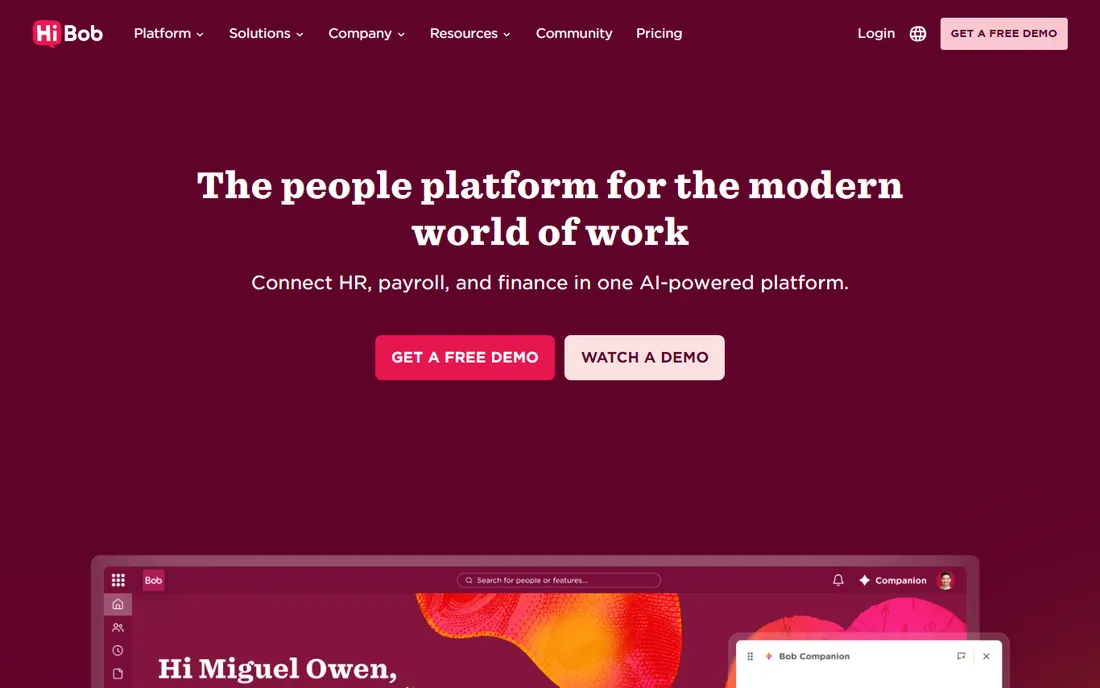
HiBob (Bob) is the modern answer to Workday for companies that want enterprise depth without the 2010 interface. The platform scales from mid-market to enterprise, handles multinational workforces well, and consolidates the HR suite on a contemporary core that employees do not hate using.
Two things to verify early. Pricing is not public, so get the quote before you fall in love. Native payroll covers the UK and US, with other countries handled through partners. The ecosystem of integrations and consultants is newer than Workday's or SAP's. For a scaling multinational that wants one modern HRIS, HiBob belongs on the shortlist next to Rippling.
What we like- Modern interface that scales from mid-market to enterprise
- Strong for multinational workforces
- Full-suite consolidation on a modern core
Watch out for- No public pricing
- Native payroll limited to UK and US
- Newer ecosystem than Workday or SAP
#8
ADP Workforce Now
Best for: Mid-market to large companies with complex multi-jurisdiction payroll
Visit adp.com
Starting priceSee website (quote-based)
Free planNo
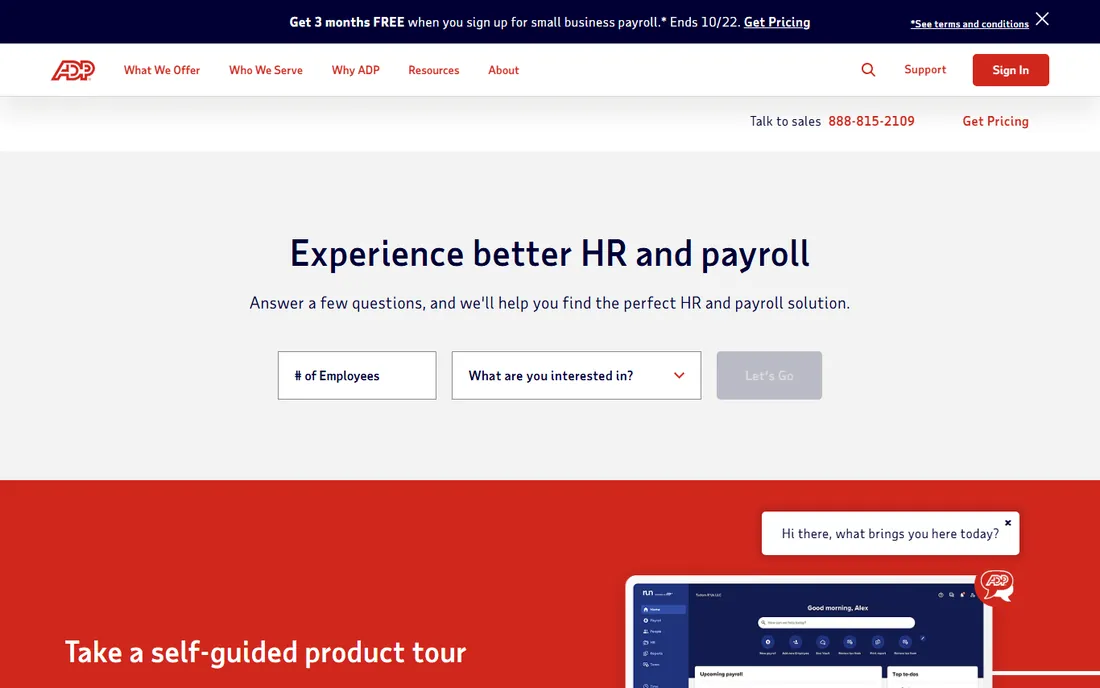
ADP Workforce Now sells payroll reliability first and HR second. For a mid-market company operating across many states or countries, ADP's compliance depth and payroll track record are the reasons to buy; the HR modules come along for the ride. Benefits administration is broad, and the brand carries weight with finance teams.
The experience shows its age next to Rippling or HiBob, packaging leans toward upsells, and reviewers report inconsistent support. Pricing is quote-based with per-employee fees on top of base plans. Buy ADP when payroll complexity is the problem and HR is secondary. Buy a modern HRIS when the employee experience matters more than the payroll engine.
What we like- Payroll and compliance expertise across jurisdictions
- Trusted by mid-market to large employers
- Broad benefits administration
Watch out for- UI feels dated next to modern rivals
- Upsell-heavy packaging
- Support quality inconsistent per reviewers
Frequently asked questions
What is the difference between HRMS, HRIS and HCM?
Almost nothing in practice. HRIS (human resource information system), HRMS (management system) and HCM (human capital management) all describe software that manages employee data, payroll, benefits and talent processes. HCM tends to label the enterprise suites; HRIS the mid-market tools. Treat them as the same category.
How much does HRMS software cost?
It splits in two. Modern tools publish or report $8 to $12 per user per month (BambooHR around $8, Rippling from $10). Enterprise suites are quote-based and cost far more: six-figure annual contracts plus six-to-seven-figure implementations for Workday, SAP and Oracle. Always price implementation separately from licenses.
Which HRMS is best for a 200-person company?
Rippling, BambooHR or HiBob. All three handle a few hundred employees well without enterprise implementation weight. Rippling if you want HR plus IT provisioning, BambooHR if ease of use is the priority, HiBob if you are multinational or planning to be. Revisit Workday or ADP when you pass a thousand employees or payroll gets complex.
Do I need HR software or just payroll?
Payroll pays people and files taxes; HR software manages the employee lifecycle around it. If you need onboarding, time off, performance, benefits and compliance in one place, you need HR software. Many companies run both: a payroll engine plus an HRIS, or a unified platform like Rippling that does both.
How long does HRMS implementation take?
Days for BambooHR, weeks for Rippling and HiBob, months for UKG and ADP Workforce Now, and multiple quarters for Workday, SAP SuccessFactors and Oracle HCM. The timeline follows the complexity: data migration, integrations and change management, not the software install.
The implementation question
Licenses are the smaller half of enterprise HR software cost. A Workday or SAP rollout needs specialist partners, data migration, integration work and change management across every department that touches HR. Get the implementation estimate in the same proposal as the licenses, from the same vendor, before you compare anything. For the modern tools, ask for the onboarding scope instead: what data they migrate, which integrations they configure, and what happens after go-live. The vendor that answers precisely is usually the safer bet.
How we chose
We started with the categories buyers search: human resources management software, HRMS, and HR systems for large companies. For each candidate we checked the vendor's own product and pricing pages, cross-checked capabilities and costs against public reviews on G2 and Capterra and practitioner discussion on Reddit, and compared suite breadth, company-size fit and implementation weight. Where a price could not be verified on the vendor's page we wrote "See website" rather than guessing. The shortlist spans enterprise suites to modern mid-market tools, because a 100-person startup and a 10,000-person enterprise are not buying the same thing.
Sources we checked (10)
- https://www.workday.com/en-us/products/human-capital-management.html
- https://www.sap.com/products/hcm.html
- https://www.oracle.com/human-capital-management/
- https://www.ukg.com/
- https://www.rippling.com/pricing
- https://www.bamboohr.com/pricing/
- https://hibob.com/
- https://www.adp.com/what-we-offer/products/adp-workforce-now.aspx
- https://www.g2.com/categories/hrms
- https://www.capterra.com/human-resource-software/
Is your product missing or out of date?
We review this list regularly. Vendors can request a listing, send updated pricing or ask about featured placement.

Shihab Mia · Founder, Rankite
Shihab has spent more than a decade helping SaaS and e-commerce brands grow through search. He writes Rankite's software buying guides from pricing pages, documentation and public user reviews. More about Shihab.