How we make this list: we compare pricing pages, product documentation and public user reviews. Rankite is independent; if a vendor ever pays for a featured spot, that listing is clearly labeled Partner.
Quick comparison
| Tool | Best for | Starting price | Free plan |
|---|
 BambooHR BambooHR | Small and mid-sized businesses that want one complete HR platform | See website | No |
 Rippling Rippling | Companies that want HR, IT and finance running on one data layer | See website | No |
 Deel Deel | Companies hiring employees and contractors across borders | See website | No |
 Gusto Gusto | US small businesses that want payroll done right first | See website | No |
 HiBob HiBob | Mid-market companies that treat culture as a competitive advantage | See website | No |
 Personio Personio | European SMBs that need GDPR-first HR software | From €7.60 per employee/month | No |
 Paylocity Paylocity | US companies that want HR software employees open every day | See website | No |
 Namely Namely | Mid-sized companies that want managed HR services with their software | See website | No |
Is your product missing or out of date?
We review this list regularly. Vendors can request a listing, send updated pricing or ask about featured placement.
Key takeaways
- There is no single best HRMS; the right pick depends on company size, country footprint, and whether you need payroll built in or just HR records.
- BambooHR and Gusto are the safest starting points for US small businesses; Deel is the default for international hiring.
- Personio is the strongest option for European SMBs, with pricing starting from €7.60 per employee per month.
- Most vendors in this category do not publish prices, so expect a sales conversation; budget for per-employee monthly pricing.
The best HRMS software
HRMS buying is one of the most expensive software decisions a growing company makes, and it is also one of the hardest to reverse. An HRMS holds your employee records, payroll, benefits, time tracking and performance data; switching means migrating all of it. The eight platforms below are the ones that actually win deals in 2026, each with a clear reason to exist.
#1
BambooHR
Best for: Small and mid-sized businesses that want one complete HR platform
Visit bamboohr.com
Starting priceSee website
Free planNo
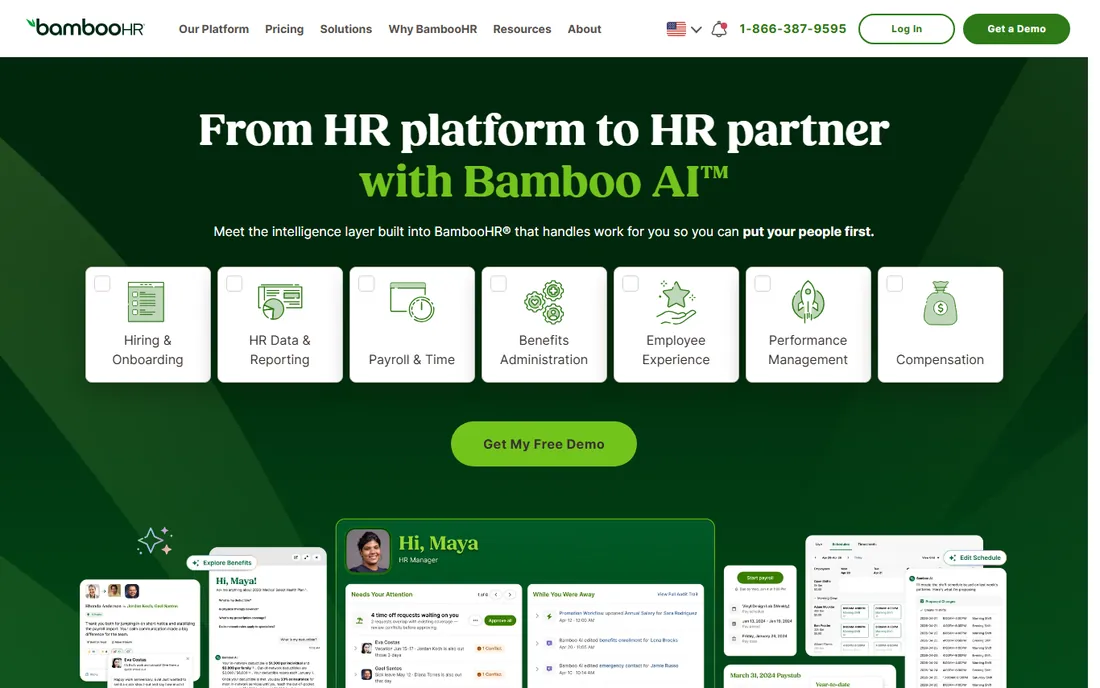
BambooHR is the default answer for US SMBs that have outgrown spreadsheets and a payroll-only tool. It serves over 30,000 businesses with a genuinely complete platform: applicant tracking, onboarding, HR data and reporting, payroll, time tracking, benefits enrollment, performance management and compensation planning. The data flows between modules without double entry, which is where the real time savings come from.
The honest catch is that "complete" cuts both ways. Pricing varies by employee count and selected features and requires a quote call. And a platform this broad needs an owner inside your company; bought without an implementation plan, it becomes an expensive filing cabinet. Bought with one, customers report saving hundreds of hours and cutting HR costs substantially.
What we like- Covers hiring, onboarding, payroll, time, benefits and performance in one system
- 150+ integrations
- In-house support team with strong satisfaction ratings
Watch out for- Pricing is quote-based, not published
- The breadth of modules means implementation takes real planning
#2
Rippling
Best for: Companies that want HR, IT and finance running on one data layer
Visit rippling.com
Starting priceSee website
Free planNo
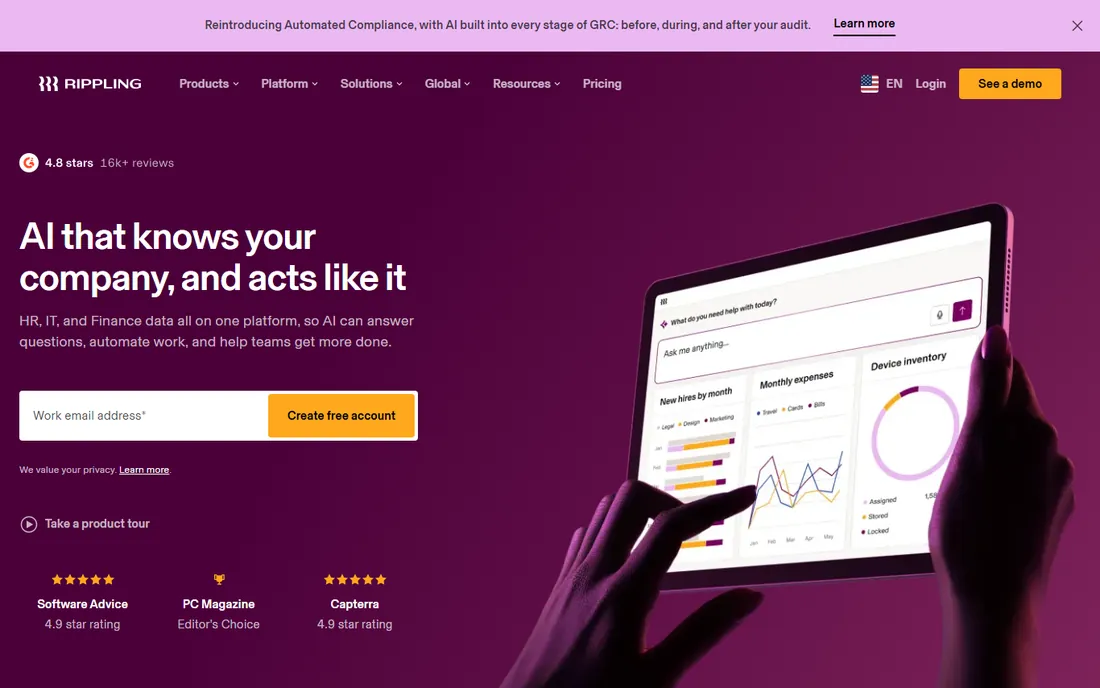
Rippling's pitch is that every other "all-in-one" platform just bundles separate tools, while Rippling built HR, IT and finance on one shared data foundation. In practice that means onboarding a hire once and having payroll, benefits, device provisioning, app access and corporate cards all trigger automatically. The reporting layer spans departments, which finance teams appreciate.
The honest catch is scope discipline. Rippling is most valuable when you run several of its apps together; if you only need core HR, you are paying for architecture you will not use. Pricing is custom. For companies between 50 and 1,000 employees that want IT and finance unified with HR, it is the strongest option in the category.
What we like- Unified employee data across HR, IT and finance
- Automates device provisioning, app access and payroll from one change
- Strong ratings across review sites
Watch out for- Quote-based pricing
- The platform's power rewards companies that actually use multiple modules, which raises the effective cost
#3
Deel
Best for: Companies hiring employees and contractors across borders
Visit deel.com
Starting priceSee website
Free planNo
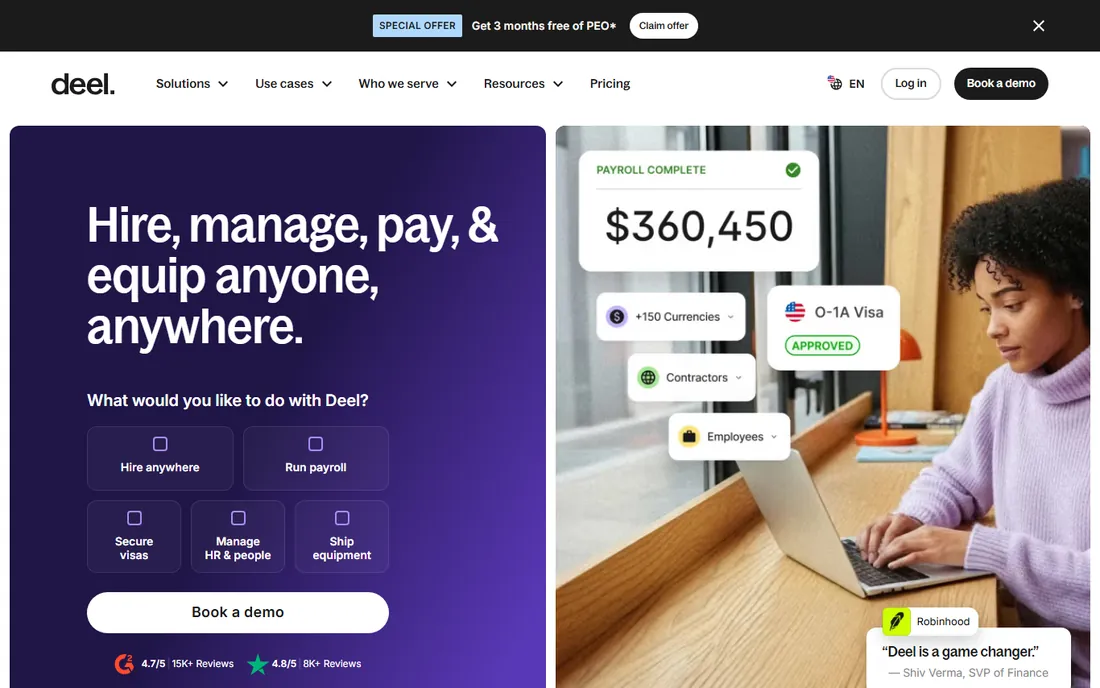
Deel is the global people platform, full stop. It handles hiring, payroll, compliance, immigration support and equipment across more than 150 countries, processing over $20B in global payroll. For a company with employees in five countries, Deel replaces a tangle of local payroll providers, EOR contracts and compliance lawyers with one dashboard.
The honest catch is fit. If your whole team is in one US state, Deel's global machinery is overkill and you will pay for it. Pricing depends on countries, worker types and headcount. But the moment you hire your first person abroad, Deel usually becomes the cheapest compliant option versus setting up entities yourself.
What we like- The deepest global footprint (150+ countries) with compliant payroll and EOR
- One-currency funding with local-currency payouts
- Strong enterprise NPS
Watch out for- Quote-based pricing that scales with countries and headcount
- US-only companies get little of what makes Deel special
#4
Gusto
Best for: US small businesses that want payroll done right first
Visit gusto.com
Starting priceSee website
Free planNo
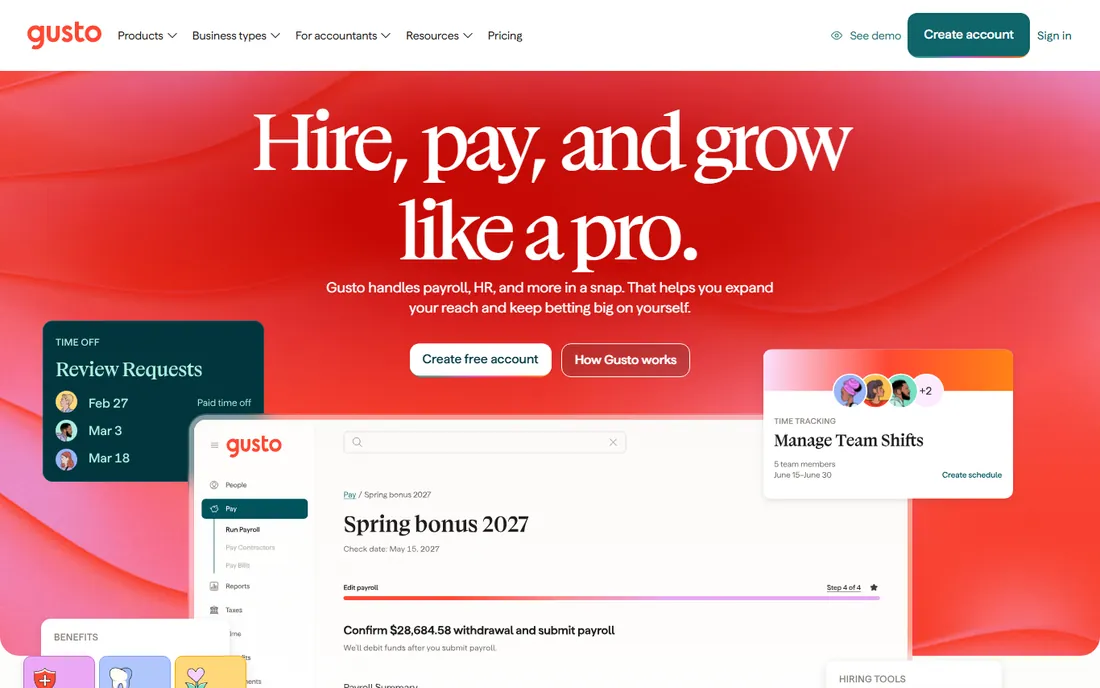
Gusto built its reputation on one thing: making payroll painless for small businesses. AutoPilot runs payroll automatically, taxes are filed, and compliance trainings, benefits enrollment and onboarding grow around that core. With over 500,000 businesses on the platform, it is the most proven option for companies under 100 employees that just need HR to work.
The honest catch is ceiling. Gusto is US-only, and companies that grow past a few hundred employees or need sophisticated performance management eventually graduate to BambooHR or Rippling. Pricing is plan-based rather than published flat. For a small business choosing its first real HR platform, though, Gusto remains the easiest yes.
What we like- The simplest payroll run in the category with AutoPilot
- Handles taxes, compliance, benefits and onboarding
- 500,000+ businesses on the platform
Watch out for- US-only
- Advanced HR features lag the mid-market platforms
- Pricing details require a plan comparison
#5
HiBob
Best for: Mid-market companies that treat culture as a competitive advantage
Visit hibob.com
Starting priceSee website
Free planNo
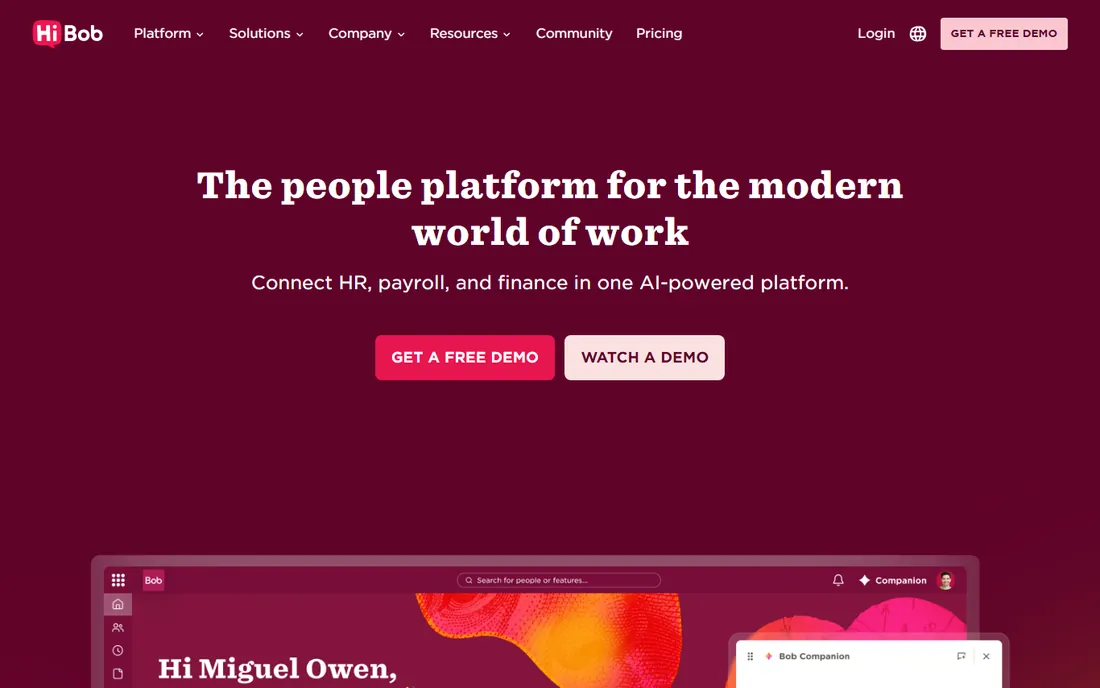
HiBob (the product is called Bob) is the HR platform for companies that have an HR team with opinions about culture. It covers core HR, talent management, payroll integrations, time tracking and workforce planning, with particular strength in performance reviews, engagement surveys and compensation cycles. The interface is the most modern in this list, which drives the adoption that makes HR data trustworthy.
The honest catch is payroll. Unlike Gusto or Rippling, HiBob integrates with payroll providers rather than running native payroll everywhere, so multi-country companies need to assemble the stack. Pricing is custom. For mid-market companies where HR is strategic rather than administrative, HiBob is the platform HR leaders ask for by name.
What we like- Modern interface employees actually use
- Strong performance, engagement and compensation modules
- 5,500+ companies on the platform
Watch out for- Quote-based pricing
- Payroll is handled through integrations rather than native in all regions
Starting priceFrom €7.60 per employee/month
Free planNo
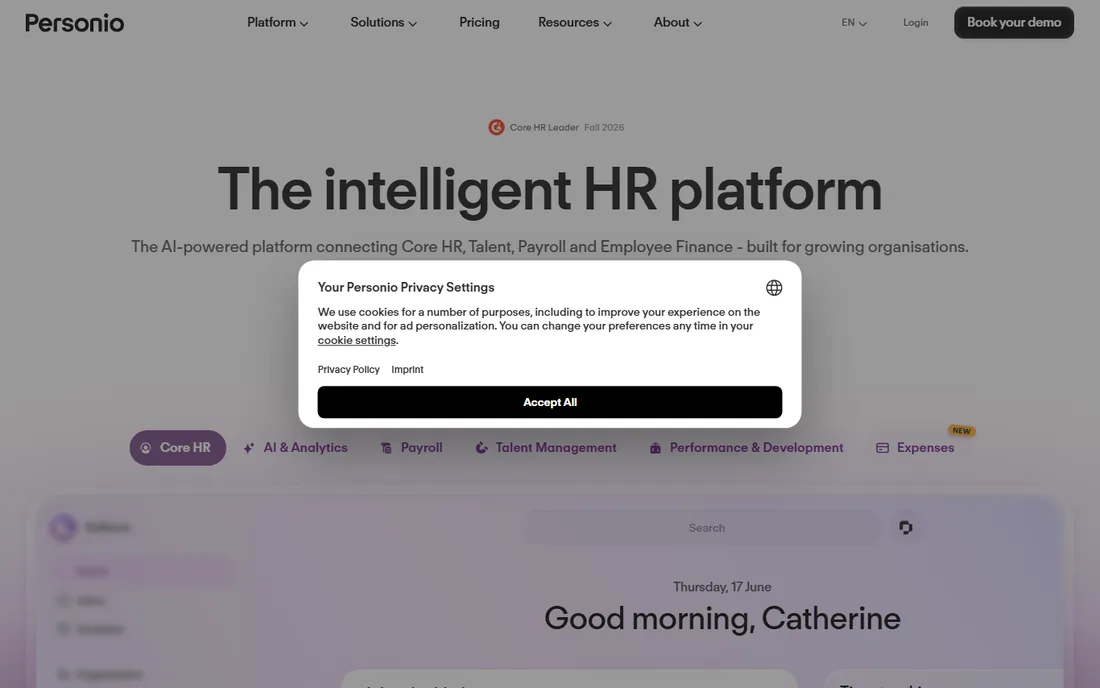
Personio is the European answer to BambooHR. It is an AI-powered platform connecting core HR, talent, payroll and employee finance, built for growing organizations with GDPR compliance, ISO 27001 and European data storage as first-class features. Pricing starts from €7.60 per employee per month for the Core plan, scaling through CorePro with position management, unlimited documents and API access.
The honest catch is geography. Personio's compliance strengths are European strengths; a US-only company gains less. The modular pricing is transparent at the entry level but the upper tiers need a personalized offer. For a European SMB choosing between Personio and a US platform with a European data center bolted on, Personio is the natural pick.
What we like- The rare vendor that publishes starting prices
- Built for European compliance with data stored in Europe
- Modular (start with Core, add apps)
Watch out for- Euro pricing and European focus make it a weaker fit for US-only companies
- Advanced tiers require personalized offers
#7
Paylocity
Best for: US companies that want HR software employees open every day
Visit paylocity.com
Starting priceSee website
Free planNo
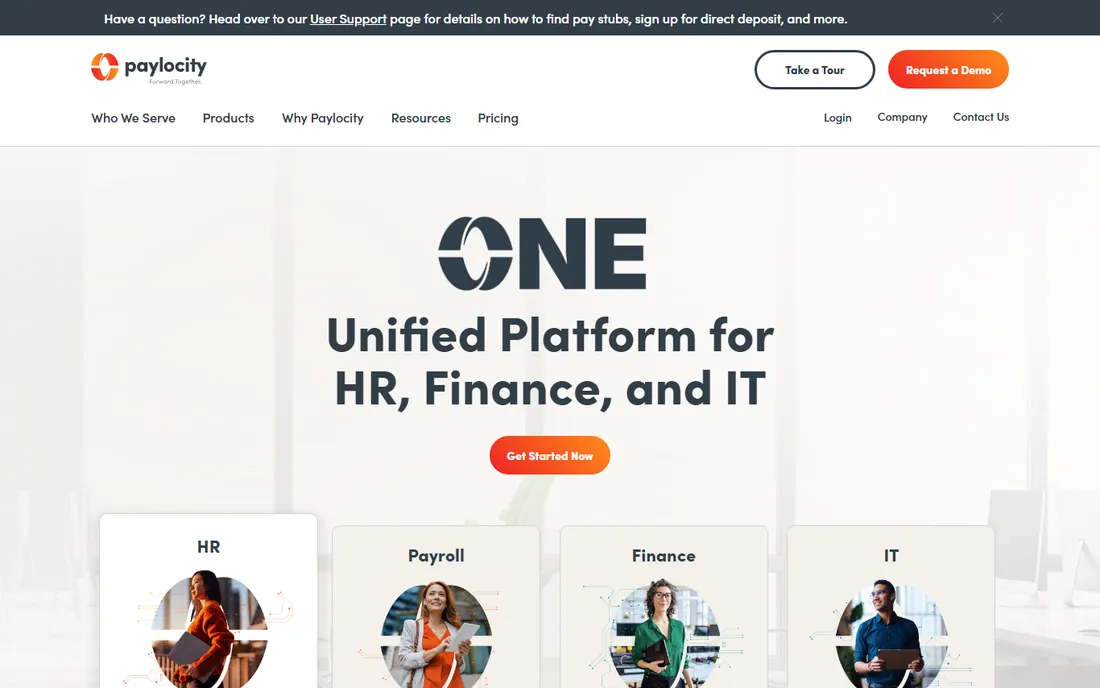
Paylocity's angle is that HR software should be a place employees visit, not a system they avoid. Beyond payroll, HR, time and benefits, it layers in communication tools, recognition and engagement features designed to make the platform part of daily work life. It explicitly serves small business (1-99), midsize (100-499) and enterprise (500+), which is a wider band than most competitors claim.
The honest catch is that engagement features only pay off with adoption, and adoption needs internal champions. Pricing requires a sales conversation. For US companies that have struggled with HR software nobody opens, Paylocity's engagement-first design is worth a demo against BambooHR.
What we like- Strong employee engagement and communication features alongside core HR and payroll
- Serves all company sizes from 1 to 5,000+ employees
- Modern mobile app
Watch out for- Quote-based pricing
- The engagement features are a differentiator only if your team actually uses them
#8
Namely
Best for: Mid-sized companies that want managed HR services with their software
Visit namely.com
Starting priceSee website
Free planNo
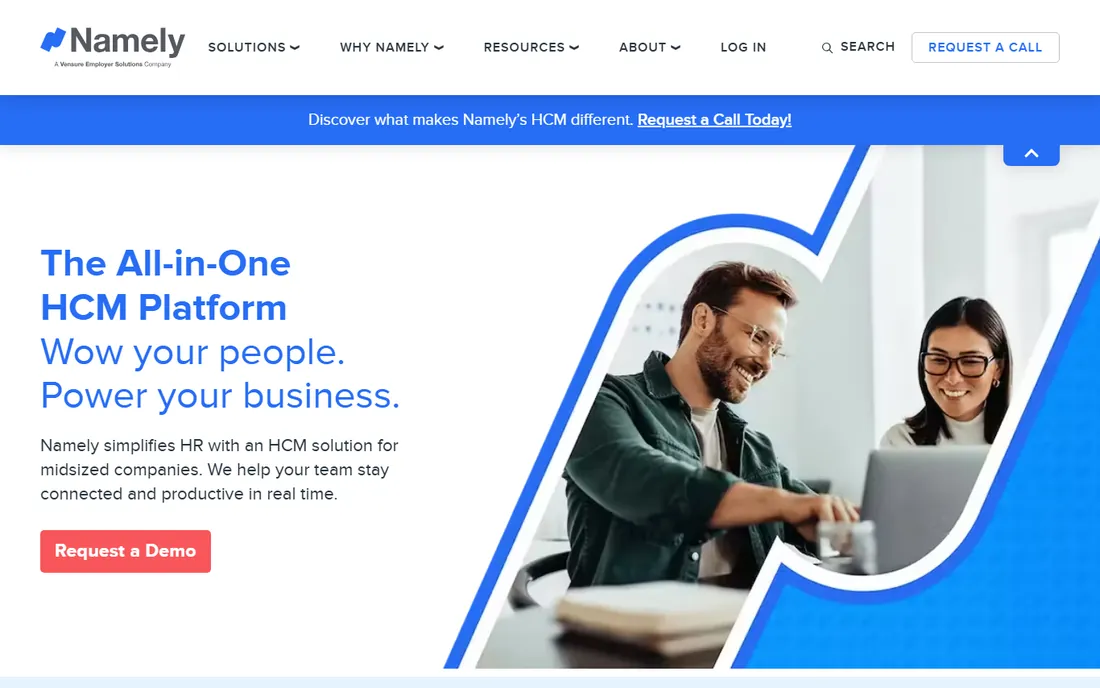
Namely pairs its HCM platform with something most competitors do not offer: managed services. Beyond core HR, payroll, time tracking and benefits, you can hand Namely your payroll admin, benefits management and even day-to-day HR work, with dedicated HR business partners. For a 150-person company with one HR generalist, that service layer is the product as much as the software.
The honest catch is cost structure. Managed services are not free, and a company with a full HR team may prefer pure software. Pricing is custom. But for the mid-sized company that needs HR outcomes without building an HR department, Namely's bundle is unique in this list.
What we like- Bundles software with managed payroll, benefits and HR services
- Dedicated HR business partners available
- Strong fit for companies without a deep HR bench
Watch out for- Quote-based pricing
- The service layer adds cost versus pure software
- Best suited to the mid-market, not tiny teams or enterprises
How we chose
We started from the platforms that actually appear in 2026 HRMS shortlists: vendor review volume, analyst coverage, and buyer search demand. For each, we opened the vendor's homepage, confirmed the product is current and aimed at HRMS buyers, and recorded published pricing where it exists. We marked "See website" everywhere pricing is quote-based rather than inventing numbers. Personio is the only vendor here that publishes a starting price, and we used it.
The pricing problem in HRMS
Almost nobody in this category publishes prices, and that is not an accident. HRMS pricing depends on employee count, modules, countries, implementation services and contract length, so vendors quote. What you should know going in: expect per-employee-per-month pricing, expect implementation fees for mid-market platforms, and expect the quote to move with negotiation. The published €7.60 per employee per month from Personio is a useful anchor for the European SMB segment; US vendors cluster in a similar band but will not say so publicly.
Get three quotes minimum. BambooHR, Rippling and one specialist (Deel if global, Gusto if small, HiBob if culture-driven) is a sensible shortlist for most US companies. Ask each vendor for total first-year cost including implementation, not just the per-employee rate. And get the renewal terms in writing: HRMS switching costs are high, which vendors know.
Implementation will make or break it
The difference between an HRMS that saves hundreds of hours and one that becomes shelfware is implementation. Assign an owner, clean your employee data before migration, and decide which modules go live on day one versus phase two. Rippling and HiBob go live in weeks with focused effort; broader rollouts take a quarter. Do not buy performance management and compensation modules in year one if your team will not use them until year two; you can add modules later on every platform here except where pricing penalizes it.
Pay special attention to payroll migration. Payroll has no tolerance for errors, so run the old and new systems in parallel for at least one cycle. Deel and Gusto customers consistently report that payroll migration support is where vendor quality shows. Ask for named implementation support, not just documentation.
Frequently asked questions
What is HRMS software?
HRMS (Human Resource Management System) software centralizes employee records, payroll, benefits, time tracking, hiring and performance management in one platform. It replaces spreadsheets and disconnected tools with a single system of record for workforce data.
How much does HRMS software cost?
Most vendors use per-employee-per-month pricing and do not publish rates; expect a quote-based sales process. Personio publishes pricing from €7.60 per employee per month. Budget for implementation fees on top of the subscription, and get total first-year cost in writing.
What is the difference between HRMS, HRIS and HCM?
The terms overlap heavily. HRIS traditionally emphasizes the system of record, HCM (Human Capital Management) emphasizes talent strategy, and HRMS sits between them. In 2026 vendor marketing they are largely interchangeable; evaluate features, not labels.
Which HRMS is best for a small business?
Gusto is the simplest starting point for US small businesses, especially payroll-first buyers. BambooHR is the step up when you need hiring, performance and a fuller HR platform. Both are proven at under 100 employees.
Which HRMS is best for international teams?
Deel, with compliant hiring and payroll in 150+ countries. If you only hire contractors abroad, simpler options exist, but for employees across borders Deel is the default shortlist entry.
Is BambooHR or Rippling better?
BambooHR is the safer pick for HR-led buyers who want a complete, proven HR platform. Rippling is better for companies that also want IT and finance unified on the same data layer. Get demos of both; the right answer depends on whether you will use Rippling's IT and finance modules.
Sources we checked (8)
- https://www.bamboohr.com
- https://www.rippling.com
- https://www.deel.com
- https://gusto.com
- https://hibob.com/
- https://personio.com/
- https://paylocity.com/
- https://namely.com/
Is your product missing or out of date?
We review this list regularly. Vendors can request a listing, send updated pricing or ask about featured placement.

Shihab Mia · Founder, Rankite
Shihab has spent more than a decade helping SaaS and e-commerce brands grow through search. He writes Rankite's software buying guides from pricing pages, documentation and public user reviews. More about Shihab.