How we make this list: we compare pricing pages, product documentation and public user reviews. Rankite is independent; if a vendor ever pays for a featured spot, that listing is clearly labeled Partner.
Key takeaways
- Global payroll is two different jobs: EOR (the vendor employs your worker, $199-$699/employee/month) and consolidated payroll (you employ, they process, from ~$29/employee/month).
- Published EOR rates in 2026: Deel $599, Remote $599 annual or $699 monthly, Multiplier $459 annual, Papaya Global from $499, Oyster from $699, Remofirst $199.
- Budget EOR providers use in-country partners rather than owned entities; premium providers like Remote and Deel own their infrastructure in many markets.
- Rippling, Velocity Global and G-P do not publish EOR pricing; expect quote-based deals and negotiate annual discounts.
Quick comparison
| Tool | Best for | Starting price | Free plan |
|---|
 Deel Deel | Fast self-serve global hiring across many countries | $599/employee/month (EOR); global payroll from $29/employee/month | Free HRIS tier (up to 200 employees) |
 Remote Remote | Compliance-first teams that want owned entities | $599/employee/month EOR (annual billing); $699 month to month | No (demo available) |
 Multiplier Multiplier | Asia-strong EOR without premium pricing | $459/employee/month EOR (annual billing); $499 month to month | No (demo available) |
 Papaya Global Papaya Global | Finance-led teams treating payroll as a payments problem | EOR from $499/employee/month; Payroll Plus from $29/employee/month | No (demo available) |
 Oyster Oyster | Distributed teams with equity and benefits needs | From $699/employee/month EOR | No (demo available) |
 Remofirst Remofirst | First international hires on a tight budget | $199/employee/month EOR | No (demo available) |
 Rippling Rippling | Teams consolidating HR, IT and finance in one system | See website | No (demo available) |
 Velocity Global Velocity Global | Enterprise global workforce programs | See website | No (demo available) |
 G-P G-P | Enterprise EOR with maximum compliance assurance | See website | No (demo available) |
Is your product missing or out of date?
We review this list regularly. Vendors can request a listing, send updated pricing or ask about featured placement.
The best global payroll software for HR
Hiring your first employee in Berlin, Bangalore or Buenos Aires used to mean setting up a local entity, a six-month project. EOR and global payroll platforms compress that into weeks. The nine below cover the spectrum from budget EOR to enterprise payroll infrastructure, with the published rates HR teams actually pay.
#1
Deel
Best for: Fast self-serve global hiring across many countries
Visit deel.com
Starting price$599/employee/month (EOR); global payroll from $29/employee/month
Free planFree HRIS tier (up to 200 employees)
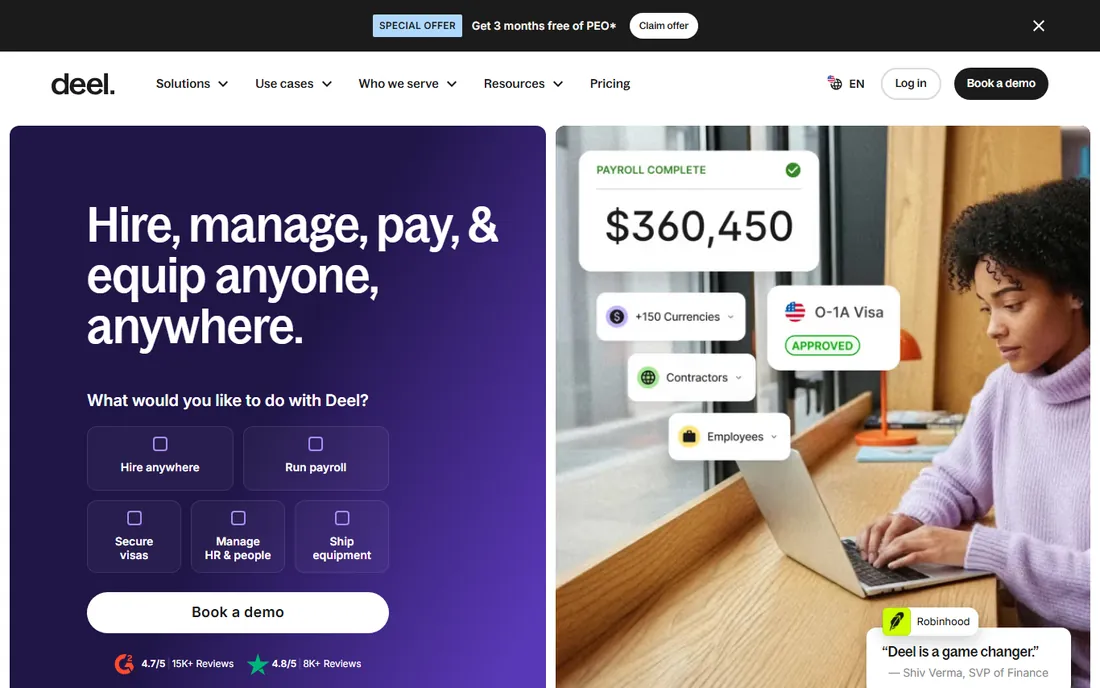
Deel is the most complete all-in-one in the category: EOR, contractor management, global payroll, HRIS, IT provisioning and immigration support in one dashboard. The $599 EOR rate is published, contractors run $49 a month, and global payroll starts at $29 per employee for companies with their own entities. Onboarding flows are genuinely fast.
The trade-offs are price and structure. At $599 per employee, a ten-person team pays $71,880 a year in platform fees before salaries. Deel mixes owned entities with third-party partners depending on the country, which matters for compliance-sensitive hires. For speed and breadth, Deel leads; for owned-entity purity, Remote is the alternative.
What we like- Widest self-serve hiring workflow with 150+ country coverage
- Free HRIS for teams up to 200 employees
- Contractors from $49/month with fast onboarding
Watch out for- EOR at $599 is expensive for small teams
- Hybrid entity model mixes owned and partner infrastructure
- Some pricing requires a sales conversation
#2
Remote
Best for: Compliance-first teams that want owned entities
Visit remote.com
Starting price$599/employee/month EOR (annual billing); $699 month to month
Free planNo (demo available)
Remote's differentiator is structural: where competitors use local partners in many countries, Remote owns its entities everywhere it offers EOR. That means consistent compliance, direct IP assignment and no partner you cannot name. EOR is $599 a month on annual billing, $699 month to month; contractors are $29 a month.
The owned model costs coverage: fewer EOR countries than Deel's 150+. The integration catalog is smaller. But for HR leaders who lose sleep over misclassification and IP leakage, Remote's structure is worth the trade. The annual billing discount is substantial, so commit only when headcount plans are firm.
What we like- 100% owned-entity model with stronger IP protection than partner-based rivals
- Contractors from $29/month, cheaper than Deel
- No deposit required
Watch out for- $699 monthly billing is steep without the annual commitment
- EOR country coverage (80+ owned) is narrower than Deel's headline 150+
- Integrations are essentials-focused
Starting price$459/employee/month EOR (annual billing); $499 month to month
Free planNo (demo available)
Multiplier undercuts the premium tier by about $140 a month per employee: $459 on annual billing, $499 monthly, as published in August 2026. Its network is Asia-strong, a real advantage for teams hiring across India, Singapore and Southeast Asia. Contractor management runs $40 per active contract.
Watch the pricing confusion: many comparison tables list $400, which is the Contractor of Record rate, not the EOR rate. Model with $459. The brand is smaller than Deel or Remote, so diligence on your specific countries matters. For cost-conscious teams with Asian headcount, the savings compound fast: ten employees save roughly $16,800 a year versus Deel.
What we like- Published EOR rate well below Deel and Remote
- Strong Asia compliance network
- Guided onboarding playbooks with operational clarity
Watch out for- The $400 figure in comparison tables is its Contractor of Record rate, not EOR
- Smaller brand than the big two
- Support quality varies by region
Starting priceEOR from $499/employee/month; Payroll Plus from $29/employee/month
Free planNo (demo available)

Papaya Global is payroll-first where Deel is hiring-first. Its unique asset is owned payments infrastructure: same-day payroll in 130+ currencies with transparent fees, which matters enormously at enterprise scale. EOR starts around $499 to $599 per employee; Payroll Plus, for companies with their own entities, starts at $29. The analytics dashboards are unmatched for CFOs managing 15+ countries.
The catch is enterprise weight: setup fees, two-year contracts and a long implementation. This is not a startup tool. For large HR and finance teams consolidating fragmented country payrolls into one reporting layer, Papaya is the strongest option. Smaller teams should look at Deel or Multiplier.
What we like- Own payments network with same-day payments and no FX leakage
- Best-in-class BI and analytics for workforce costs
- 160+ country coverage
Watch out for- Premium pricing with setup fees and typical two-year contracts
- 8-12 week implementation is the longest among majors
- Support consistency varies
Starting priceFrom $699/employee/month EOR
Free planNo (demo available)
Oyster positions around the distributed-team experience: equity support, localized benefits guidance and tooling built for remote-first companies. Contractors run $29 a month. But the EOR rate, from $699 per employee per month, is $100 above Deel for the same headline job, which adds $1,200 a year per employee.
Annual billing softens the number. Teams that value Oyster's equity and benefits depth may find it worth the premium. Purely on EOR price, though, Deel, Remote and Multiplier all beat it. Price your actual headcount before falling for the brand.
What we like- Strong equity and benefits tooling for distributed teams
- Contractors from $29/month
- Thoughtful distributed-work culture features
Watch out for- At $699 it is the priciest published EOR rate here
- Annual discounts exist but the base is high
- Partner-based in many countries
Starting price$199/employee/month EOR
Free planNo (demo available)
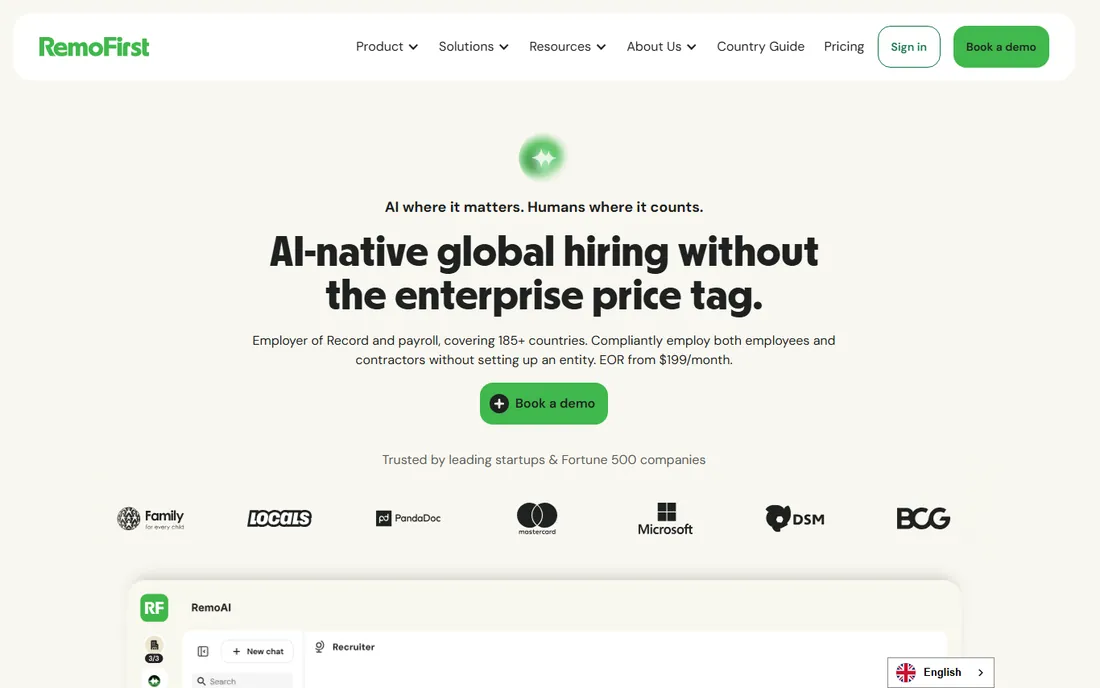
Remofirst and Skuad publish $199 a month EOR, the budget tier of the market. For a startup hiring one remote developer who knows exactly whom to hire, that is a rational trade: the employment paperwork exists, quickly, at a third of Deel's price. The model is partner-based: vetted local firms handle payroll and compliance.
Know what you are trading. There is no owned office, no local HR team, and compliance questions get answered at the speed of whichever partner holds the contract this year. For low-risk hires in straightforward jurisdictions, that is fine. For complex terminations or tricky labor law, the premium tier earns its fee.
What we like- Lowest published EOR rate among credible platforms
- Straightforward pricing
- Viable for startups testing international hiring
Watch out for- Works through vetted in-country partners, not owned entities
- Thinner platform than the premium tier
- Support depth reflects the price
#7
Rippling
Best for: Teams consolidating HR, IT and finance in one system
Visit rippling.com
Starting priceSee website
Free planNo (demo available)

Rippling is the platform play: one system of record for HR, IT, finance and now global employment. Companies already running Rippling for US HR can add EOR in 80 countries without a second vendor. Reported EOR pricing runs $499 to $599 per employee on top of the mandatory base fee.
The quote-only pricing makes comparison shopping harder, and the base fee means the true cost exceeds the EOR number. For teams standardizing everything on Rippling, the consolidation value is real. For pure global payroll needs, the published-rate competitors are easier to evaluate.
What we like- Deepest all-in-one platform with device, app and finance management
- EOR reportedly $499-$599 on top of a base platform fee
- Strong automation
Watch out for- EOR pricing is quote-only
- The base platform ($35/month plus $8/user) stacks on top of EOR fees
- EOR country coverage is narrower at 80 countries
Starting priceSee website
Free planNo (demo available)

Velocity Global is one of the original EOR providers, built for enterprises running complex multi-country programs with immigration, benefits and expansion services attached. The compliance infrastructure is deep and the service model is high-touch.
Everything is quote-based with enterprise sales cycles, and the platform feels older than Deel or Remote. Small and mid-size teams will find the process slow and the price high. For large companies with dedicated global mobility programs, the maturity matters more than the software.
What we like- Long-standing enterprise EOR with deep compliance infrastructure
- Immigration and expansion services beyond payroll
- Strong for complex multi-country programs
Watch out for- Quote-only pricing with enterprise sales cycles
- Overkill and overpriced for small teams
- Platform experience lags the SaaS-native vendors
Starting priceSee website
Free planNo (demo available)
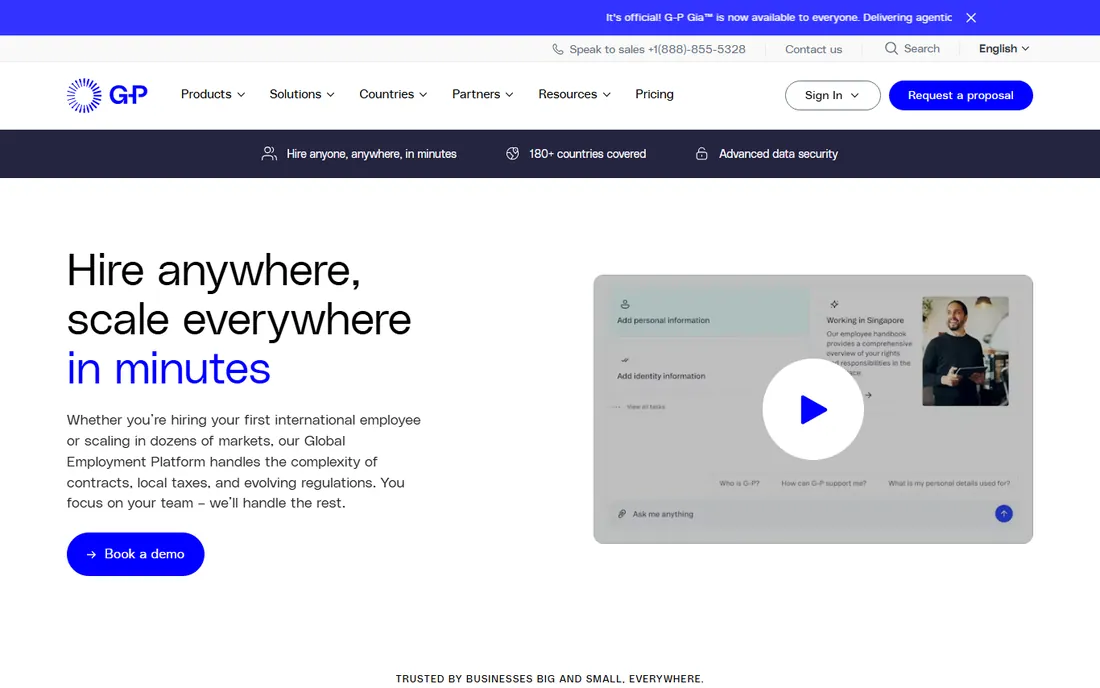
G-P, formerly Globalization Partners, invented the EOR category and still runs one of the largest owned-entity networks at 180+ countries. For enterprises where compliance assurance outweighs software elegance, that track record carries weight. The legal and HR infrastructure is genuinely deep.
Pricing is quote-only and premium, the sales process is enterprise-grade, and the platform experience lags Deel and Remote. Mid-market teams usually get better value from published-rate vendors. G-P fits multinationals standardizing global employment on a single accountable provider.
What we like- Pioneer of the EOR model with owned entities in 180+ countries
- Deep compliance and legal infrastructure
- Strong enterprise references
Watch out for- Premium quote-only pricing
- Sales-led process with long cycles
- Platform UX trails the newer SaaS vendors
EOR vs global payroll vs contractors: pick the right model
These tools sell three different things and the wrong choice wastes money. EOR means the vendor becomes the legal employer in the worker's country: you pay $199 to $699 per employee per month for compliance without an entity. Global payroll means you already employ the worker (through your own entity or an EOR) and the vendor processes compliant payroll across countries: roughly $29 per employee per month. Contractor management means paying freelancers compliantly: $29 to $49 per contractor per month. The decision tree: hiring 1-5 people in a country with no long-term commitment, use EOR. Committed to 10+ in one country, set up your own entity and buy global payroll. Short-term or project work, use contractor management. Mixing the models across countries is normal; few companies need only one.
The true cost math HR teams miss
The EOR fee is never the whole invoice. On top of the $459 to $699 per employee per month, budget for the salary itself, statutory employer contributions (which run 20-40 percent of salary in many European and Latin American countries), deposits (Deel requires one month's salary per employee; Remote requires none), setup fees (Papaya charges them), and percentage-based admin fees (Deel adds 0.60 percent on some contracts). A $599 EOR fee on a $4,000 salary in a high-contribution country can mean $6,500+ in true monthly cost. Model three scenarios before signing: the published fee, the fee plus statutory costs, and the annual-billing versus monthly-billing spread, which runs $1,200 a year per employee at Remote. The vendors will happily quote the first number; your CFO will ask about the other two.
How we chose
We built this list from vendor pricing pages, EOR pricing studies and 2026 global payroll comparisons, checked in October 2026. A tool made the cut only if it is actively sold today and serves real international employment or payroll work. Published rates reflect August 2026 vendor disclosures: Deel $599 EOR and $29 payroll, Remote $599 annual or $699 monthly, Multiplier $459 annual or $499 monthly, Papaya Global from $499 EOR and $29 Payroll Plus, Oyster from $699, Remofirst $199. Rippling, Velocity Global and G-P do not publish EOR pricing, so their entries show "See website" per our pricing rule. We did not run hands-on trials. The trade-offs reflect consistent analyst and reviewer feedback.
Frequently asked questions
What is the difference between EOR and global payroll?
An Employer of Record becomes the legal employer of your worker in their country, handling contracts, taxes, benefits and compliance, for $199 to $699 per employee per month. Global payroll software processes payroll for workers you already employ through your own entities, typically around $29 per employee per month. Use EOR when you have no local entity; use global payroll when you do.
How much does global payroll software cost?
EOR pricing in 2026 runs $199 to $699 per employee per month: Remofirst $199, Multiplier $459 annual, Papaya Global from $499, Deel $599, Remote $599 annual or $699 monthly, Oyster from $699. Consolidated global payroll for your own entities runs about $29 per employee per month. Contractor management runs $29 to $49 per contractor per month. Salaries and statutory contributions sit on top of all of these.
When should we set up our own entity instead of using EOR?
The usual rule: 1-5 employees in a country with uncertain commitment favors EOR (fast, 2-4 weeks, higher per-head cost). Ten or more employees with long-term commitment favors your own entity plus global payroll (slow, 6-12 months to establish, lower per-head cost at scale). Between 5 and 10, model both: the EOR premium often still beats entity setup costs for the first year or two.
Do we need EOR for international contractors?
Usually not. Contractors are not employees, so compliant contractor management ($29-$49/month) covers contracts, payments and tax forms. EOR becomes relevant when a contractor should legally be an employee: many countries reclassify long-term exclusive contractors, and Germany introduced a 50,000 euro penalty per misclassification in 2025. When in doubt, get local counsel before the hire, not after an audit.
Which global payroll provider has the most countries?
G-P and Remote each claim 180+ countries, Deel 150+, Papaya Global 160+, Multiplier 150+, Oyster 120+, Rippling 80. Headline counts hide methodology: some are owned entities, some are partner networks. Ask each vendor which of your specific countries are owned versus partner-served before deciding; the compliance quality differs.
Can we switch EOR providers later?
Yes, but plan for it: employee transfers between EORs require new contracts, re-registration with local authorities and sometimes a payroll gap of one cycle. Notice periods in EOR contracts run 30-90 days. The cleanest switches happen at contract renewal with a 60-day overlap plan. Keep employee records exportable and never let a single vendor hold your only copy of employment documentation.
Sources we checked (9)
- https://sourcefit.com/blog/eor-pricing-philippines-explained/
- https://demostack.net/deel-review/
- https://www.wisemonk.io/blogs/deel-vs-multiplier
- https://www.globalsolo.global/blog/deel-vs-oyster-vs-remote-eor-comparison-2026
- https://www.wisemonk.io/blogs/deel-vs-remote
- https://www.secondtalent.com/alternatives/remote/
- https://www.wisemonk.io/blogs/papaya-vs-deel-a-detailed-payroll-software-comparison
- https://www.usemultiplier.com/compare/review-of-papaya-global-eor
- https://www.globalsolo.global/blog/gusto-vs-deel-vs-remote-payroll-eor-solo-founder-2026
Is your product missing or out of date?
We review this list regularly. Vendors can request a listing, send updated pricing or ask about featured placement.

Shihab Mia · Founder, Rankite
Shihab has spent more than a decade helping SaaS and e-commerce brands grow through search. He writes Rankite's software buying guides from pricing pages, documentation and public user reviews. More about Shihab.