How we make this list: we compare pricing pages, product documentation and public user reviews. Ratings come from G2, Capterra or Trustpilot, with the date we checked them.
Key takeaways
- Fiverr is the easiest start if your service can be packaged with a fixed scope and price.
- Upwork suits beginners who can write strong proposals and want longer contracts.
- Contra charges freelancers 0% commission, with platform fees on its free plan.
- Guru offers the lowest fees among traditional marketplaces at 5% to 9%.
- FlexJobs suits job seekers who want screened remote jobs rather than gig bidding.
Quick comparison
| Tool | Best for | Starting price | Free plan |
|---|
 Upwork | Long-term contracts | Free to join; 0% to 15% fee per contract | Yes |
 Fiverr | Packaged gigs | Free to join; 20% seller fee | Yes |
 Freelancer.com | Competitive bidding | Free to join; 10% fee or $5 minimum | Yes |
 Contra | Portfolio-first freelancers | Free; 0% commission | Yes |
 PeoplePerHour | UK and EU market | Free to join; 20% to 3.5% tiered fee | Yes |
 Guru | Lowest traditional fees | Free; 5% to 9% fee by membership | Yes |
 FlexJobs | Screened remote jobs | From $9.95 per week | Free trial |
 99designs | Designers and contests | Free to join; 5% to 15% by level | Yes |
Is your product missing or out of date?
We review this list regularly. Vendors can request a listing, send updated pricing or ask about featured placement.
#1Upwork
Best for: Long-term contracts4.5/5 on
G2 (3,234 reviews, checked Oct 2026)
Visit upwork.com
Starting priceFree to join; 0% to 15% fee per contract
Free planYes
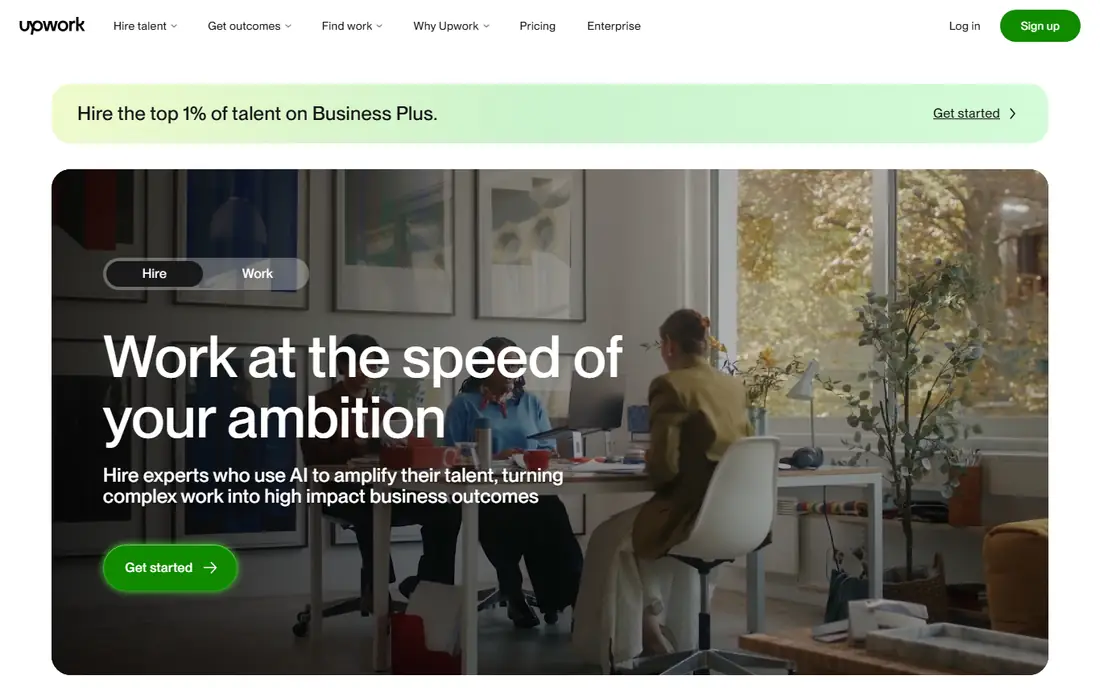
Upwork is the largest freelance marketplace and the best route to long-term contracts. Clients post jobs across writing, design, development, marketing, and admin, and freelancers apply with proposals. Hourly contracts track time through the app, fixed-price contracts use milestones, and escrow holds client funds before work starts, which protects both sides.
Fees changed in May 2025 to a variable 0% to 15% per contract, set when you propose, with most freelancers around 10%. Proposal Connects cost money, so applying widely gets expensive. Competition for entry-level jobs is fierce, and a new profile needs strong proposals and a few early wins to gain traction. For a beginner who can write well and wants ongoing clients rather than one-off gigs, Upwork is the strongest platform.
What we like- Largest freelance marketplace
- Hourly and fixed-price contracts
- Escrow payment protection
- Long-term client relationships
Watch out for- Variable fee set per contract
- Proposal Connects cost money
- High competition for entry-level jobs
#2Fiverr
Best for: Packaged gigs4.3/5 on
G2 (464 reviews, checked Oct 2026)
Visit fiverr.com
Starting priceFree to join; 20% seller fee
Free planYes
Fiverr flips the discovery model. Instead of bidding on jobs, you create gigs, fixed service packages with a scope and price, and buyers come to you. That means no Connect costs, no cold proposals, and no bidding wars. With over 700 categories, from logo design to voiceover to data entry, most packageable services fit somewhere.
The 20% seller fee is the highest on this list, and earnings clear after 14 days. Saturated gigs push prices down, and negotiating outside package tiers is hard. For a beginner with a clearly defined service who wants inbound leads, Fiverr is genuinely faster to first sale than Upwork.
What we like- Buyers come to your gig
- No proposal costs
- 700+ categories
- Structured packages simplify pricing
Watch out for- 20% commission is the highest here
- 14-day payment clearance
- Race-to-bottom pricing in saturated gigs
#3Freelancer.com
Best for: Competitive bidding4.2/5 on
G2 (217 reviews, checked Oct 2026)
Visit freelancer.com
Starting priceFree to join; 10% fee or $5 minimum
Free planYes
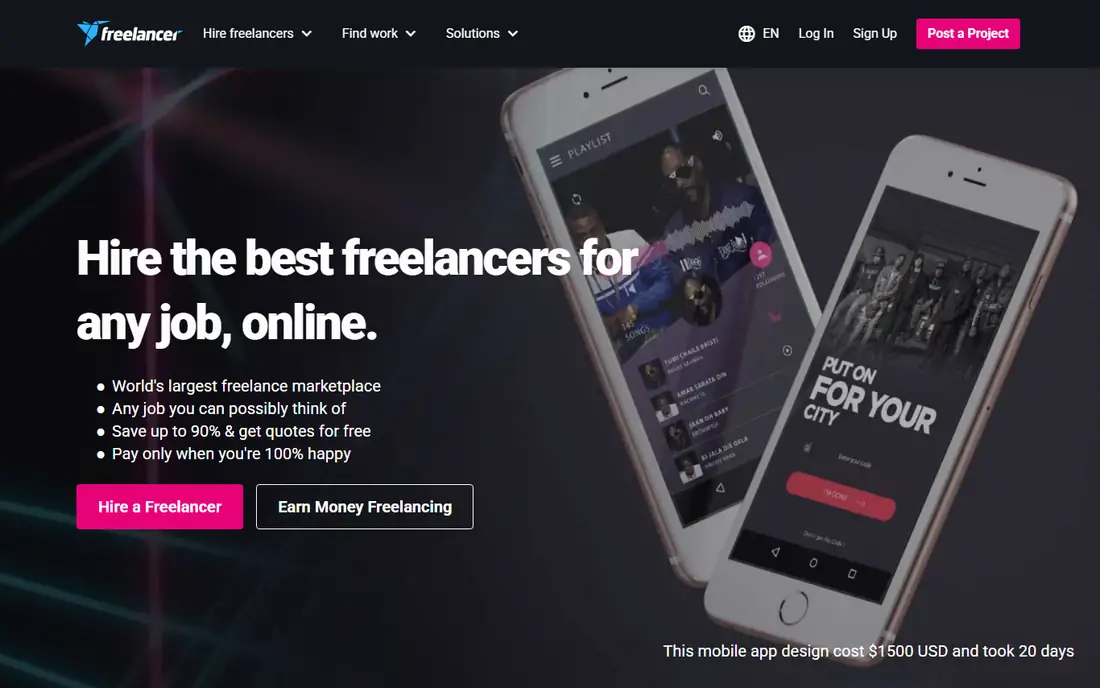
Freelancer.com offers huge job volume and a bidding model similar to Upwork, plus contests where designers and writers compete for a prize. Milestone payments hold funds as work progresses, and the global client base means jobs post around the clock. For a beginner willing to bid actively, the sheer volume creates chances.
The fee runs 10% or $5, whichever is greater, on fixed-price work, and the free plan limits monthly bids, so paid memberships tempt heavy bidders. Low-quality postings need filtering, and scam awareness matters. For a beginner who wants maximum job volume and does not mind bidding, Freelancer.com is a solid second marketplace.
What we like- Huge job volume
- Contests for designers and writers
- Milestone payment protection
- Global clients
Watch out for- 10% fee with $5 minimum
- Free plan limits bids
- Some low-quality postings need filtering
#4Contra
Best for: Portfolio-first freelancers4.9/5 on
G2 (21 reviews, checked Oct 2026)
Visit contra.com
Starting priceFree; 0% commission
Free planYes
Contra charges freelancers 0% commission, which makes it the cheapest headline option. Profiles lead with a portfolio, so visual and creative freelancers present work first, and contracts and invoicing are built into the platform, which matters if you want one system for the paperwork. There is no bidding: clients contact you or you share your profile.
The free plan charges a platform fee of $15 per payment up to $500 or $29 above that, waived on Pro at $29 a month or $199 a year, plus payment processing. The buyer pool is smaller than Upwork or Fiverr. For a portfolio-led freelancer who wants to keep more of each payment, Contra is the best low-fee start.
What we like- 0% commission on earnings
- Portfolio-first profiles
- Contracts and invoicing built in
- No bidding
Watch out for- Free-plan platform fee of $15 to $29 per payment
- Smaller buyer pool than Upwork
- Pro costs $29 a month
Starting priceFree to join; 20% to 3.5% tiered fee
Free planYes
PeoplePerHour is strongest in the UK and Europe, where its client base concentrates. Fees are tiered per buyer: 20% on early billings, falling to 7.5% and then 3.5% once you have billed a single client about £5,000. Escrow protects payments, and Hourlies let sellers package fixed-price services like Fiverr gigs.
The 20% early rate stings, and US presence is smaller than Upwork. Proposal credits limit free applications. For a beginner in the UK or EU, or one targeting European clients, PeoplePerHour offers a strong regional marketplace with fees that reward repeat work.
What we like- Strong UK and EU client base
- Escrow protection
- Fees fall as you bill a client more
- Hourlie packaged services
Watch out for- 20% on early work with a client
- Smaller US presence
- Proposal credits limit free applications
#6Guru
Best for: Lowest traditional fees4.7/5 on
G2 (2,345 reviews, checked Oct 2026)
Visit guru.com
Starting priceFree; 5% to 9% fee by membership
Free planYes
Guru offers the lowest fees among traditional marketplaces, at 5% to 9% depending on membership tier, with paid plans from free basic up to about $49.95 for Executive. SafePay escrow holds funds, work rooms organize files and communication per project, and the platform covers writing, design, programming, and admin work.
The marketplace is smaller than Upwork or Fiverr, and membership tiers affect how many bids you get and what fee you pay. The interface feels dated next to newer rivals. For a beginner who wants traditional marketplace structure at the lowest fee, Guru is the value pick.
What we like- Lowest fees among traditional marketplaces
- SafePay escrow
- Work rooms for collaboration
- Free basic membership
Watch out for- Smaller marketplace than Upwork
- Membership tiers affect bids and fees
- Interface feels dated
Starting priceFrom $9.95 per week
Free planFree trial
FlexJobs is built differently: it lists remote and flexible jobs, and every listing is screened by a person, so there are no scams or junk postings. Job seekers pay from $9.95 a week, and FlexJobs takes no commission, since hiring is direct with the employer. That model suits beginners who want a remote job or steady part-time role rather than gig bidding.
The subscription is the catch: you pay to apply, and gig listings are fewer than on marketplaces. For a beginner who values safety and steady work over gig volume, FlexJobs is worth the subscription for a focused job hunt.
What we like- Every listing screened by a person
- No scams or junk postings
- Remote and flexible roles
- Direct hire, no commission
Watch out for- Job seekers pay a subscription
- Takes no commission but charges to apply
- Fewer gig listings than marketplaces
#899designs
Best for: Designers and contests4.0/5 on
G2 (32 reviews, checked Oct 2026)
Visit 99designs.com
Starting priceFree to join; 5% to 15% by level
Free planYes
99designs is the design-only marketplace. Clients run contests where designers submit concepts and the winner is paid, or hire designers 1-to-1 at higher levels. Fees run 5% to 15% by designer level, with entry designers at 15%, and contests carry a payment guarantee for winners. The design community and feedback culture help beginners improve fast.
Contest work is unpaid unless you win, so beginners should treat contests as portfolio building with a chance of payment, not reliable income. For a designer starting out, 99designs offers a focused market where design skill, not proposal writing, decides who gets work.
What we like- Design-only marketplace
- Contests guarantee payment to winners
- 1-to-1 projects at higher levels
- Strong design community
Watch out for- Contest work is unpaid unless you win
- Fees 15% at entry level
- Not for non-design freelancers
How we chose
We compared platforms on fees, job volume, payment protection, beginner friendliness, and scam safety, using vendor fee schedules and published comparisons from 2026. We favored platforms US beginners can join today with a distinct strength. We did not claim hands-on testing, and where fees varied by tier we quoted the range.
Start with how you want to find work. If your service packages cleanly, Fiverr and Contra bring buyers to you. If you prefer applying for posted jobs, Upwork, Freelancer.com, and PeoplePerHour fit better. If you want a steady remote job rather than gigs, FlexJobs screens the hunt for you. Most beginners do best on two platforms at most: one for inbound gigs and one for proposals, so neither profile starves.
Then compare total cost, not just the headline fee. Bidding costs, membership tiers, withdrawal fees, and payment processing all chip away at the advertised rate. A platform with a 10% fee but paid bids can cost more than a 20% platform with free applications at low volume. Read the actual fee schedule before committing to a platform as your primary income source, and track your effective take-home rate each month.
Scam safety deserves equal weight. Every platform here attracts bad-faith clients, and the signs are consistent: requests to move payment off-platform before work starts, free test work disguised as an unpaid trial, and jobs that require you to pay a fee upfront to be considered. Stick to built-in escrow or milestone systems even when a client suggests skipping them to save on fees, since that protection is the one freelancers are most often talked out of using. Start with small projects, build reviews, and raise rates as your profile proves itself.
Common mistakes slow beginners down. Many spread across five platforms and build no profile anywhere, so pick two and invest in them. Others price too low to win work and then cannot raise rates, so start at a fair rate with a strong portfolio piece rather than racing to the bottom. Finally, treat the first ten jobs as reputation building: deliver early, communicate clearly, and ask satisfied clients for reviews, since reviews drive the next fifty jobs.
Frequently asked questions
Is Upwork or Fiverr better for beginners?
Fiverr is easier if your service packages with a fixed scope and price, since buyers come to your gig. Upwork suits beginners who write strong proposals and want hourly or longer contracts.
Which freelance platform has the lowest fees?
Contra charges freelancers 0% commission, and Guru paid plans bring fees down to 5%. PeoplePerHour drops to 3.5% once you have billed a single client about £5,000.
Do freelance platforms take a cut of earnings?
Almost all do. Fiverr takes 20%, Upwork charges 0% to 15% per contract, Freelancer.com takes 10%, and Guru takes 5% to 9%. Contra and Toptal take 0% from freelancers and monetize the client side instead.
Can I use these platforms outside the US?
Upwork, Fiverr, Freelancer.com, and Guru operate globally, though payment methods and tax paperwork vary by country. PeoplePerHour is strongest in the UK and Europe.
Should I be on more than one platform?
Two is a good number: one for inbound gigs and one for proposals. More than that spreads your effort thin and no profile gains traction.
How do I avoid freelance scams?
Never move payment off-platform, never do unpaid test work for strangers, and never pay a fee to be considered. Use escrow or milestone systems for every project.
Sources we checked (8)
- https://www.upwork.com
- https://www.fiverr.com
- https://www.freelancer.com
- https://contra.com
- https://www.peopleperhour.com
- https://www.guru.com
- https://www.flexjobs.com
- https://99designs.com
Is your product missing or out of date?
We review this list regularly. Vendors can request a listing, send updated pricing or ask about featured placement.

Shihab Mia · Founder, Rankite
Shihab has 5+ years in B2B and SaaS SEO. He writes Rankite's software buying guides from pricing pages, documentation and public user reviews. More about Shihab.