How we make this list: we compare pricing pages, product documentation and public user reviews. Rankite is independent; if a vendor ever pays for a featured spot, that listing is clearly labeled Partner.
Key takeaways
- Most vendors in this category refuse to publish prices. FundCount (from $35,899/year for a single family office), Asora ($900/month) and Aleta (from $1,000/month) are the exceptions with prices on their own sites.
- Addepar charges based on assets on the platform, which penalizes growing portfolios. Masttro, Aleta and Asora all use flat subscriptions that do not scale with AUM.
- Implementation is the real cost after the license. Aleta and Asora quote 4 to 8 weeks; Addepar and Masttro routinely take 6 months or more.
- Buyers split into two camps: reporting-first platforms (Addepar, Masttro, Aleta, Asora) and accounting-first platforms (Archway, Eton Solutions, FundCount, Asset Vantage). Decide which camp you are in before taking demos.
Quick comparison
| Tool | Best for | Starting price | Free plan |
|---|
 Addepar Addepar | Large family offices and MFOs wanting institutional-grade investment analytics | See website (AUM-based subscription) | No |
 Masttro Masttro | Multi-jurisdiction families where privacy and entity mapping are non-negotiable | See website (flat annual subscription) | No |
 SEI Archway SEI Archway | Offices that want the accounting system and the outsourced team in one contract | See website (custom quote) | No |
 Eton Solutions (AtlasFive) Eton Solutions (AtlasFive) | Large single and multi-family offices replacing a patchwork of systems | See website (custom quote) | No |
 FundCount FundCount | Family offices that run partnership and fund-style accounting internally | $35,899/year (Single Family Office; Multi-Family Office from $26,950/year) | No |
 Asset Vantage Asset Vantage | Offices wanting accounting-grade books with modern dashboards | See website (custom quote) | No |
 Altoo Altoo | European and privacy-focused families wanting a Swiss-hosted wealth home | See website (yearly license plus per-banking-relationship fees) | No |
 Asora Asora | New and lean family offices moving off spreadsheets | $900/month (billed annually) | No |
 Aleta Aleta | Modern offices wanting open data, fast implementation and AI-ready reporting | From $1,000/month | No |
Is your product missing or out of date?
We review this list regularly. Vendors can request a listing, send updated pricing or ask about featured placement.
The best family office software
Most family offices buy wealth software twice. The first purchase follows the demo that impresses the principal. The second follows the discovery that nothing reconciles, the alts data lives in PDFs, and the one analyst who understood the system just resigned. This list exists to get you to the second purchase first. These nine platforms are the real market in 2026, grouped so you can tell which ones are built for reporting and which are built for accounting.
#1
Addepar
Best for: Large family offices and MFOs wanting institutional-grade investment analytics
Visit addepar.com
Starting priceSee website (AUM-based subscription)
Free planNo
Addepar is the industry default, and defaults matter. Founded in 2009, it is the platform most custodians, fund admins and wealth-tech vendors already connect to, which shortens the data-feed conversation. The analytics layer is the deepest here: performance attribution, exposure analysis and scenario modeling across any asset in any currency. For an office with an in-house investment team, that depth is the reason to buy.
The commercial terms deserve scrutiny. AUM-based pricing means your software bill grows every year your portfolio does, even if your headcount stays flat. Addepar also works best with dedicated operators, so factor in staffing or a managed-service partner. Implementation for complex structures is measured in months, not weeks. Buy Addepar when analytics is the job and you have the team to feed it.
What we like- Deepest analytics and performance attribution in the category
- Open API and a large ecosystem of data feeds and integrations
- Scales from single offices to global institutions
Watch out for- Pricing rises with assets on the platform, penalizing growth
- Implementations typically run 6 to 12 months
- Power-user interface that usually requires trained staff to operate
#2
Masttro
Best for: Multi-jurisdiction families where privacy and entity mapping are non-negotiable
Visit masttro.com
Starting priceSee website (flat annual subscription)
Free planNo
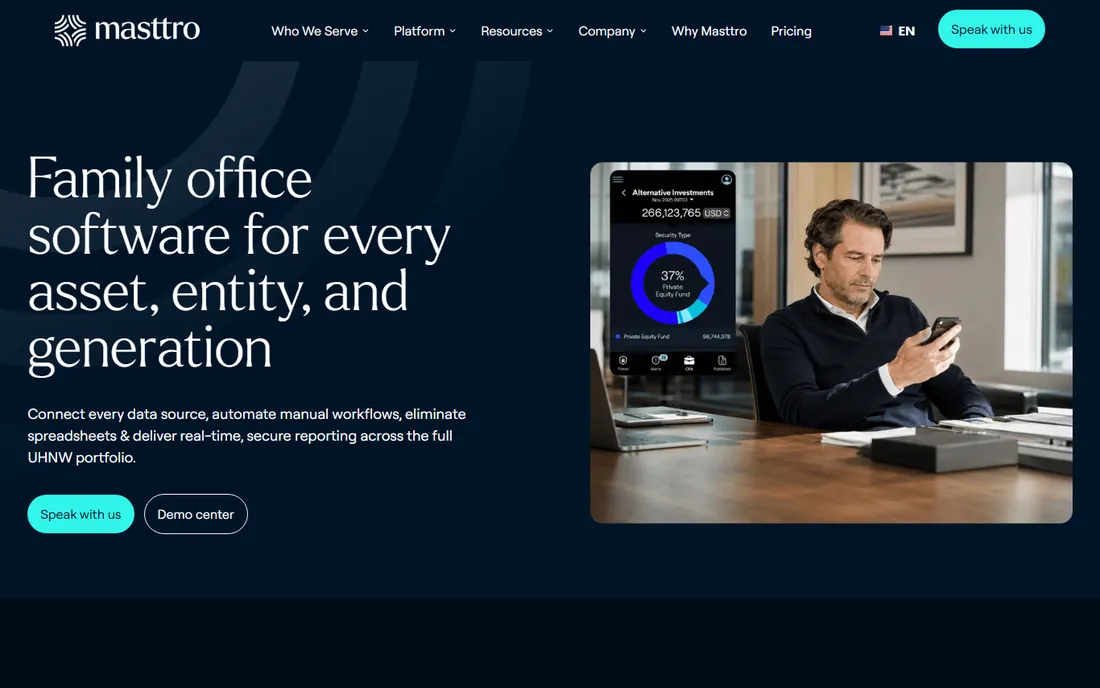
Masttro was founded in 2010 inside a complex multigenerational family office, and the product still reflects that origin. The Global Wealth Map shows entities, accounts, alternatives and ownership structures in one view, and the platform handles estate, trust and succession views that most competitors treat as add-ons. The security story is the strongest in the category: Swiss infrastructure, military-grade encryption, ISO 27001 certification, and an architecture where not even Masttro employees can access client data.
The trade is openness. Masttro keeps your data inside its own system, which limits how easily you can pipe reconciled data into your own BI tools or AI workflows. Compare it directly against Aleta if data control matters to you. The flat annual fee is a genuine advantage over AUM pricing for large portfolios, but you will negotiate it behind a sales process.
What we like- Flat subscription that does not scale with AUM
- Swiss-hosted infrastructure with client-controlled encryption keys
- 700+ direct custodian feeds with no third-party aggregators
Watch out for- Closed architecture with limited third-party data access
- Longer implementation (often 3 to 9 months)
- Pricing is custom and sits at the enterprise end of the market
#3
SEI Archway
Best for: Offices that want the accounting system and the outsourced team in one contract
Visit seic.com
Starting priceSee website (custom quote)
Free planNo
Archway is the most operations-heavy platform on this list, and that is its selling point. The platform books journal entries to a centralized general ledger automatically as you process portfolio transactions, move cash, gift securities or pay bills, so reporting and accounting stay in lock-step. On top of the software, SEI sells fully outsourced accounting, reporting and bill-pay services, which suits offices that want institutional operations without hiring for them.
SEI reports $720 billion on the Archway platform and names adoption by 10 of the top 25 wealthiest American families (per its own page, as of end-2024). This is not software you evaluate on price, because there is no published price. Shortlist Archway when you want accounting depth plus the option to hand the back office to the vendor, and budget for a full enterprise engagement.
What we like- Centralized general ledger built for partnership, trust and portfolio accounting
- Optional outsourced accounting and reporting services from the same vendor
- Long track record with 575+ UHNW families on the platform
Watch out for- Enterprise sales process with no published pricing
- Older interface next to the newer cloud platforms
- Bill pay and concierge services add cost on top of the license
#4
Eton Solutions (AtlasFive)
Best for: Large single and multi-family offices replacing a patchwork of systems
Visit eton-solutions.com
Starting priceSee website (custom quote)
Free planNo
AtlasFive is the closest thing this market has to an ERP for family offices. Where most platforms cover reporting and leave the rest to other tools, Eton bundles investment reporting, entity management, documents, workflows, accounting and tax-data coordination into one environment. The pitch is one source of truth instead of six systems and the spreadsheet that ties them together. The company says the platform manages over $936 billion, and it was created by family office leaders rather than a pure software team.
That scope has a cost in complexity. This is a platform you implement with the vendor's professional services, not a product you self-serve. Offices with simpler needs will find it heavy. Put AtlasFive on the shortlist when the problem is not reporting but the whole operating model: entities, documents, workflows, accounting and investments all living in separate places.
What we like- Full ERP scope (investments, accounting, entities, documents, workflows, tax-data coordination) in one platform
- Built by family office operators, not just software vendors
- AI engine (EtonGPT) layered across the platform
Watch out for- Enterprise scope means enterprise implementation effort
- No published pricing
- Overkill for offices under roughly $100M that do not need full ERP
#5
FundCount
Best for: Family offices that run partnership and fund-style accounting internally
Visit fundcount.com
Starting price$35,899/year (Single Family Office; Multi-Family Office from $26,950/year)
Free planNo
FundCount is the price-transparency outlier. Its pricing page lists starting annual prices for eight solutions: Single Family Office from $35,899, Multi-Family Office from $26,950, plus implementation and hosting fees. In a market where everyone else quotes behind closed doors, that alone is worth your attention. The product matches the pricing honesty with accounting substance: portfolio accounting, partnership accounting (contributions, distributions, waterfalls) and the general ledger on one real-time ledger, with reconciliation that the vendor claims runs up to 98 percent faster than manual processing.
Know what you are buying. FundCount is sophisticated investment accounting software, not a lightweight dashboard. Smaller offices with straightforward holdings will not need the full architecture, and the configuration effort is real. The fit is offices with partnership-heavy or alternative-heavy structures that want the books and the reporting to reconcile by construction.
What we like- Publishes starting prices for every solution, rare in this market
- Unified portfolio, partnership and general ledger architecture
- Multi-book accounting for IFRS and GAAP with multi-currency support
Watch out for- Accounting depth means serious configuration work during implementation
- Hosting and digital-transformation fees sit on top of the license
- Interface is functional rather than modern
#6
Asset Vantage
Best for: Offices wanting accounting-grade books with modern dashboards
Visit assetvantage.com
Starting priceSee website (custom quote)
Free planNo
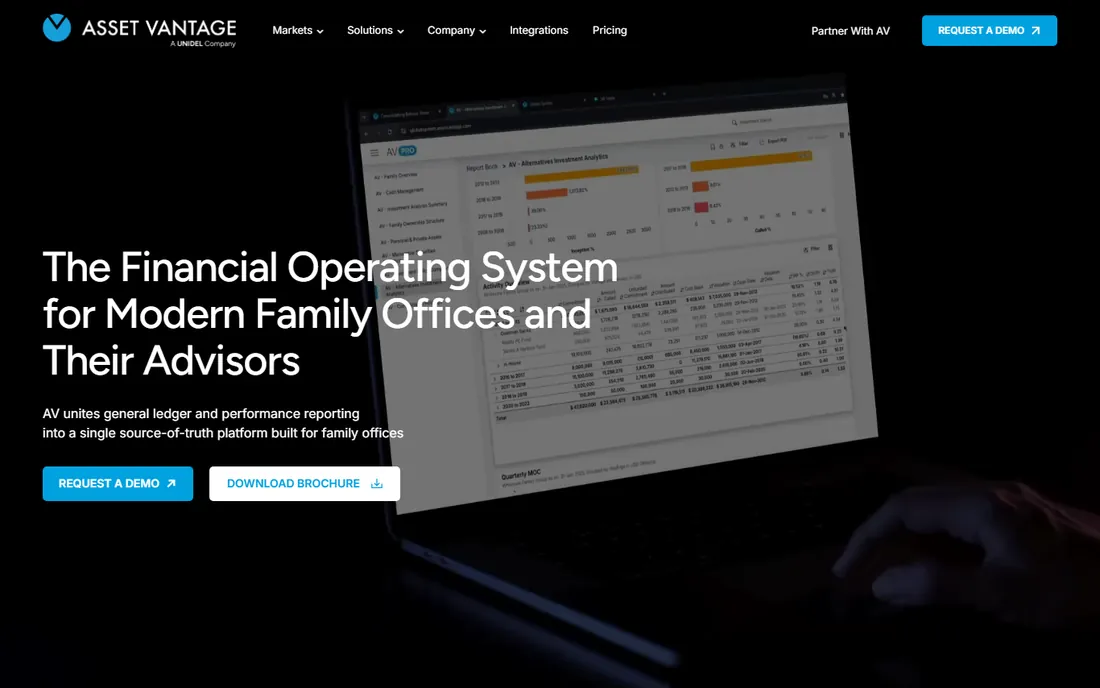
Asset Vantage was born inside the family office of a tech group that could not find the product it wanted, then built it. The architecture is accounting-first: every transaction posts to a general ledger, with separate custody, investment and accounting books of record kept in sync. Partnership accounting handles inter-entity transactions, side pockets and beneficial ownership across trusts. The document vault, check writing and bill pay round out an office that wants to run like a business.
Practical details from the vendor's own FAQ help the evaluation: unlimited user logins per license, role-based permissions for external advisors, data on AWS private cloud with manual encrypted backups, and iOS and Android apps with the full consolidated view. Pricing is custom, so treat the sales conversation as part of the diligence. Shortlist it against Archway and FundCount when accounting integrity is the priority.
What we like- Full general ledger (custody, investment and accounting books of record)
- Partnership accounting with dynamic ownership changes over time
- Unlimited user logins per license and a dedicated mobile app
Watch out for- No published pricing
- Implementation and data migration effort typical of GL-based systems
- Newer brand in the US market with a smaller public review footprint
#7
Altoo
Best for: European and privacy-focused families wanting a Swiss-hosted wealth home
Visit altoo.io
Starting priceSee website (yearly license plus per-banking-relationship fees)
Free planNo
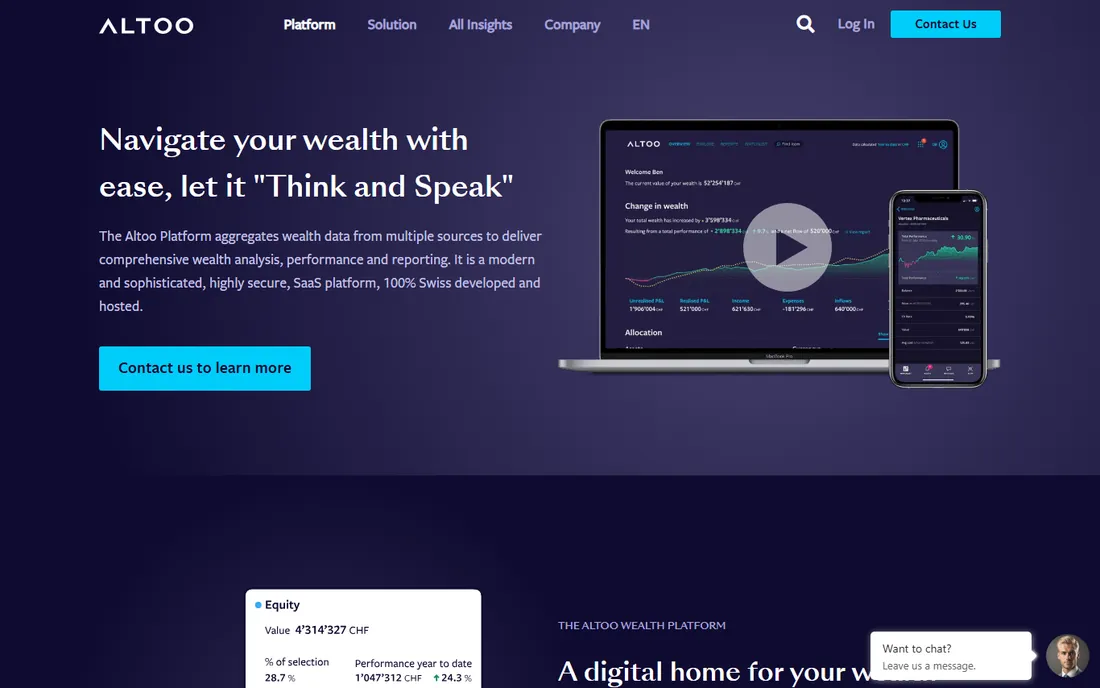
Altoo is the most principal-friendly platform in the accounting-adjacent tier. The interface is built for the wealth owner to understand at a glance, with automated monitoring and alerts on allocation, balances and performance, plus a mobile app that doubles as an authentication factor. Data aggregation covers 500+ custodians and thousands of non-custody banks, and the Curators team handles manual data work for non-bankable assets, which is where most platforms quietly leave you stranded.
The security posture is distinct: everything developed and hosted in Switzerland, in Altoo's own data center, with nothing outsourced. Pricing is a yearly license based on modules selected plus fees per banking relationship, so your quote depends on your bank count and asset complexity. It fits families who care as much about where data lives as what the dashboards show.
What we like- 100 percent Swiss developed and hosted, with its own data center and encryption modules
- Designed for the wealth owner, not the back office
- Human "Curators" who cleanse data on your behalf
Watch out for- Pricing depends on modules and banking relationships, so quotes vary
- European footprint is stronger than US
- No published starting price
#8
Asora
Best for: New and lean family offices moving off spreadsheets
Visit asora.com
Starting price$900/month (billed annually)
Free planNo
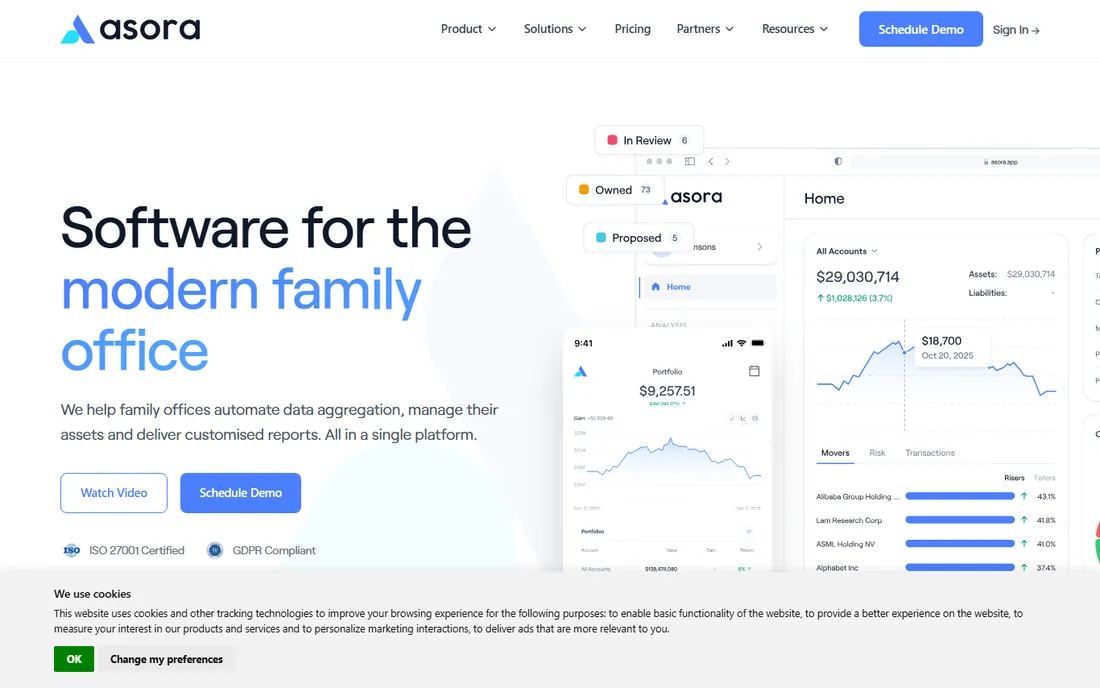
Asora is the entry point for offices modernizing from spreadsheet-based processes. The pricing page is the clearest in the category: from $900 per month billed annually, scaling with assets tracked, with every tier getting the full platform, unlimited users and a 90-day break option. Optional add-ons are priced too: $3,600 per year per extra pack of 20 investment accounts for data aggregation, $3,600 per year for alternative fund holdings via Canoe Intelligence, and $4,000 per year for private cloud.
The product covers the essentials well: automated data aggregation from banks and custodians, real-time performance with IRR and TWR, private asset registers with linked documents, a Wealth Map for ownership look-through, and ISO 27001 certification. It is aimed at single and multi-family offices managing roughly $30M to $1B. If your office is new, lean, or spreadsheet-based, start here and only move upmarket if you outgrow it.
What we like- Published tiered pricing with unlimited users and no feature gating
- 90-day break option is unusual in this market
- Live in 4 to 8 weeks with iOS and Android apps
Watch out for- Entry tier covers public markets
- Alternative-data add-ons cost extra
- Younger vendor (founded 2021) with a smaller installed base than the incumbents
#9
Aleta
Best for: Modern offices wanting open data, fast implementation and AI-ready reporting
Visit aleta.io
Starting priceFrom $1,000/month
Free planNo
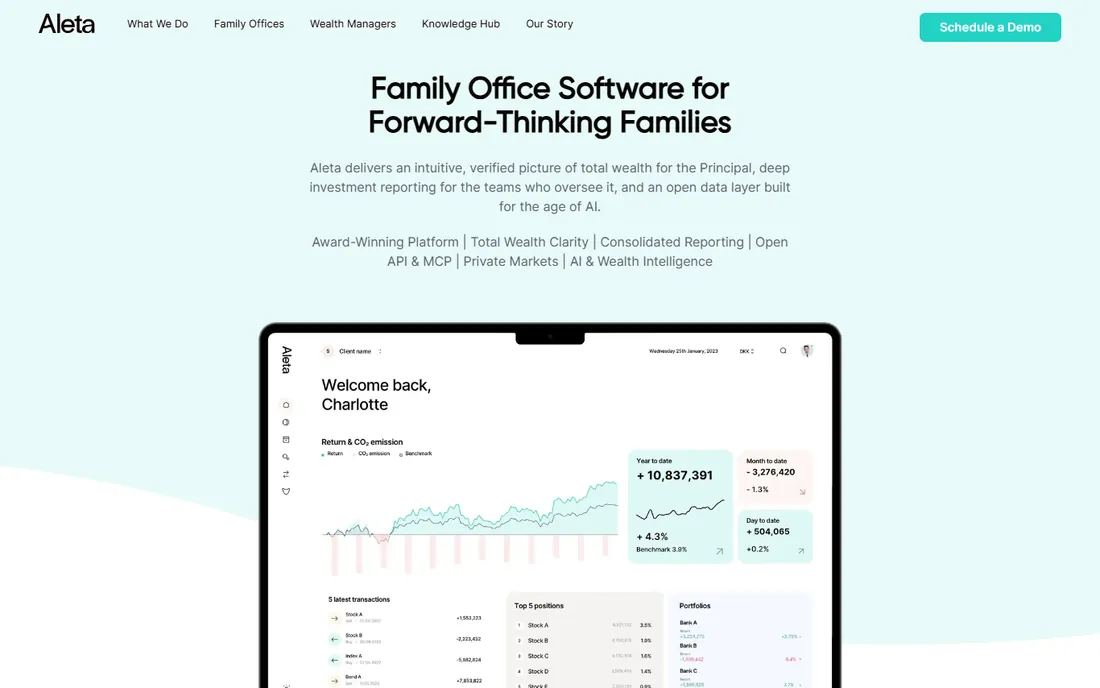
Aleta is the AI-forward pick. The architecture centers on an open data layer: an API, an MCP layer and a Data Cube that let you pipe reconciled wealth data into your own BI tools or AI infrastructure, plus Aleta Intelligence for document processing. Underneath sits a built-in double-entry investment general ledger, so the depth is real. The vendor reports $100B+ on the platform and 4 to 8 week go-lives, and its own site lists 2026 industry awards for data and consolidated reporting.
The pricing model is the anti-Addepar: from $1,000 per month based on platform scope, explicitly not based on assets under management. The principal-facing interface is genuinely zero-training, which matters if the person who owns the wealth will actually log in. The open question is longevity versus the incumbents. Evaluate Aleta against Masttro if data control matters, and against Asora if speed and published pricing are the priority.
What we like- Published pricing from $1,000 per month, not tied to AUM
- Open API, MCP layer and Data Cube for BI tools and AI agents
- Built-in investment general ledger with 4 to 8 week implementation
Watch out for- Newer brand (rebuilt on 15 years of reporting expertise) with a shorter platform track record
- 100+ bank integrations is fewer than the biggest aggregators
- Pricing scales with platform scope, so large deployments still need quotes
Reporting-led or accounting-led: pick your architecture first
The nine platforms split into two camps, and demos will not help you choose between camps. Only your operating model will. Reporting-led platforms (Addepar, Masttro, Aleta, Asora, Altoo) start from the portfolio view and work backward to the data. Accounting-led platforms (Archway, AtlasFive, FundCount, Asset Vantage) start from the general ledger and build reporting on top of reconciled books.
Reporting-led fits offices that already have accounting handled elsewhere, or that value speed and analytics over bookkeeping precision. Accounting-led fits offices that run the books in-house, manage partnerships and trusts directly, or answer to auditors and tax teams who need the ledger to be the source of truth. The worst outcome is buying a reporting platform and discovering you needed an accounting system, or vice versa. Decide this before you take a single demo, and you will eliminate half the list in an afternoon.
What to verify before you sign
Pricing pages in this market tell half the story. Ask every vendor for the total first-year number in writing: license, implementation, data migration, hosting, and the per-feed or per-account add-ons. FundCount publishes its add-on structure; most vendors do not. Masttro and Aleta both price independently of AUM, which protects growing portfolios. Addepar's AUM model does the opposite, so model the fee at your five-year asset target, not today's.
Then verify the data story. Ask which custodians connect via direct feeds versus third-party aggregators, how private fund documents (capital calls, K-1s) get processed, and who does the reconciliation work during onboarding. Ask for the implementation timeline in the contract, not the sales deck, and ask who staffs it. Finally, check the exit: can you export your full transaction history and documents in usable formats, and what happens to your data when the contract ends. In a category where implementations run six figures and months of work, the exit clause matters as much as the feature list.
How we chose
We started with the vendors family offices actually evaluate: the platforms named in 2026 buyer guides, industry awards and practitioner discussions on G2, Capterra and Reddit. For each candidate we opened the vendor's own site, checked whether pricing was published on a pricing page, and compared architecture (reporting-led versus accounting-led), implementation timelines, data aggregation methods and security posture. Where a vendor publishes no price, we wrote "See website" rather than repeating third-party estimates as fact. The nine that made the list cover both architectural camps and a real price range, from published monthly plans to enterprise platforms.
Frequently asked questions
How much does family office software cost?
Expect $900 to $1,000 per month at the entry end (Asora, Aleta, both published), $26,950 to $35,899 per year for FundCount's published starting tiers, and custom enterprise quotes above that for Addepar, Masttro, Archway, Eton Solutions and Asset Vantage. First-year totals usually add implementation, data migration and hosting on top of the license. Always get the all-in first-year number in writing.
How long does implementation take?
It depends on the architecture. Aleta and Asora quote 4 to 8 weeks. Archway, FundCount and Asset Vantage typically take 2 to 4 months. Addepar commonly runs 6 to 12 months for complex structures, and Masttro 3 to 9 months. The biggest driver is data: the number of custodians, entities and historical years you migrate.
Can family office software handle private equity and other illiquid assets?
The platforms on this list all claim it, but the methods differ. Aleta, Masttro and Asora use AI-assisted document processing for capital calls, distributions and K-1s. FundCount, Archway and Asset Vantage handle partnership accounting natively in the ledger. Ask for a live walkthrough using a real fund statement, not a slide, before you believe the claim.
Is our family data secure on these platforms?
Security is table stakes here and every vendor leads with it. Masttro and Altoo host in Switzerland with client-controlled encryption. Aleta, FundCount and Asora carry SOC 2 Type II or ISO 27001 certifications. The questions worth asking: who at the vendor can access your data, where exactly it is hosted, and whether you can export everything on exit.
Which platform is best for a new family office?
Asora, at $900 per month with a 90-day break option, is the lowest-risk start for a new or spreadsheet-based office. Aleta at $1,000 per month suits offices that want modern reporting and open data from day one. Move up to Addepar, Masttro or an accounting-led platform when complexity (entities, jurisdictions, partnerships) demands it.
Do we need accounting features, or is reporting enough?
If an accountant or fund administrator already keeps your books, a reporting-led platform is enough and you will go live faster. If your office runs accounting internally, manages partnerships and trusts, or needs audit-ready financials, buy an accounting-led platform (Archway, AtlasFive, FundCount, Asset Vantage). Buying the wrong architecture is the most expensive mistake in this category.
Sources we checked (17)
- https://addepar.com/
- https://masttro.com/
- https://masttro.com/lp/masttro-vs-addepar
- https://seic.com/archway
- https://www.eton-solutions.com
- https://www.businesswire.com/news/home/20250128915911/en/Eton-Solutions-the-Leading-WealthTech-Platform-Powered-by-AI-Partners-with-Trigen-Wealth-a-Newly-Launched-Full-Service-Multi-Family-Office-in-India
- https://fundcount.com/
- https://fundcount.com/pricing
- https://fundcount.com/pricing/family-office
- https://assetvantage.com/
- https://altoo.io
- https://asora.com/
- https://www.asora.com/pricing
- https://aleta.io/
- https://aleta.io/best-family-office-wealth-reporting-software
- https://www.techloy.com/best-wealth-reporting-software-for-family-offices-in-2026/
- https://azbigmedia.com/business/financial-management/addepar-vs-masttro-vs-aleta/
Is your product missing or out of date?
We review this list regularly. Vendors can request a listing, send updated pricing or ask about featured placement.

Shihab Mia · Founder, Rankite
Shihab has spent more than a decade helping SaaS and e-commerce brands grow through search. He writes Rankite's software buying guides from pricing pages, documentation and public user reviews. More about Shihab.