How we make this list: we compare pricing pages, product documentation and public user reviews. Rankite is independent; if a vendor ever pays for a featured spot, that listing is clearly labeled Partner.
Key takeaways
- Webcam-based tools like RealEye, GazeRecorder and Loceye run studies through a browser with no special hardware, which makes them the practical pick for remote UX and ad testing.
- Lab-grade systems from Tobii Pro, Smart Eye and iMotions deliver higher accuracy and sensor integration, but they are enterprise purchases with quote-based pricing.
- Gazepoint sits in the middle: affordable research-grade hardware aimed at marketers and universities that want real eye tracking without a five-figure budget.
- If you only need to know where attention lands on a design, predictive tools like EyeQuant give you an answer in seconds for a fraction of a lab study.
- Most vendors price by quote or contact sales, so budget for a sales conversation and a pilot study before committing.
Quick comparison
| Tool | Best for | Starting price | Free plan |
|---|
 Tobii Pro Tobii Pro | academic and commercial labs that need precision hardware | See website | No |
 RealEye RealEye | remote UX and ad testing without hardware | See website | Free trial (7 days) |
 iMotions iMotions | labs combining eye tracking with other biosensors | See website | No |
 GazeRecorder GazeRecorder | free and low-cost webcam eye tracking experiments | See website | Yes |
 Pupil Labs Pupil Labs | wearable eye tracking in real-world settings | See website | Yes |
 Smart Eye Smart Eye | automotive, aviation and large-scale applied research | See website | No |
 Gazepoint Gazepoint | budget-conscious labs and neuromarketing teams | See website | No |
 CoolTool CoolTool | automated consumer insights combining surveys and biometrics | See website | No |
 Loceye Loceye | marketers who want fast visual engagement reports | See website | Free trial |
 EyeQuant EyeQuant | instant attention prediction before launch | From $97/month | Free trial |
Is your product missing or out of date?
We review this list regularly. Vendors can request a listing, send updated pricing or ask about featured placement.
#1
Tobii Pro
Best for: academic and commercial labs that need precision hardware
Visit tobii.com
Starting priceSee website
Free planNo
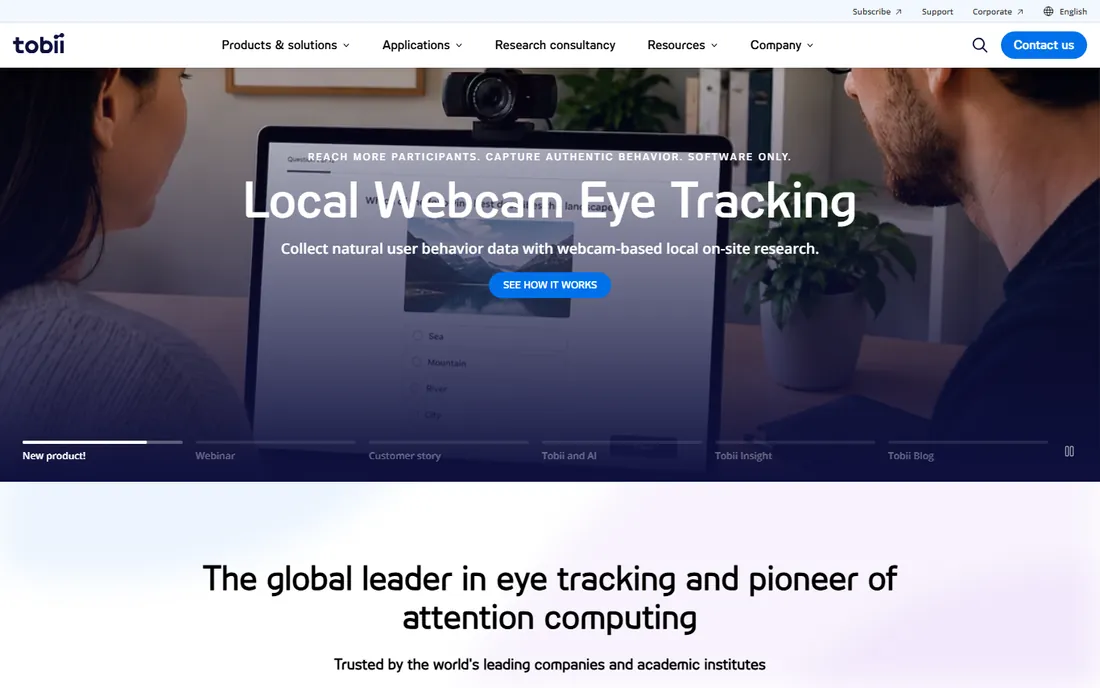
Tobii Pro is the name most researchers mention first, and for good reason. The company has spent over two decades building eye trackers for screen-based studies, wearable glasses for fieldwork, and analysis software like Tobii Pro Lab that handles everything from study design to statistics. Universities and large brands run serious attention research on this stack.
The catch is cost and complexity. Hardware plus software licenses put Tobii in enterprise territory, and pricing is quote-based, so small teams should expect a sales process. If your study needs millisecond-accurate gaze data synced with other sensors, this is the benchmark. If you want quick website heatmaps, look at the webcam tools below first.
What we like- The industry standard for research-grade eye tracking
- Wide hardware range from screen-based to wearables
- Deep analysis software with 15,000+ cited publications behind the ecosystem
Watch out for- Enterprise pricing with no public price list
- Overkill and overpriced if you only need basic heatmaps
Starting priceSee website
Free planFree trial (7 days)
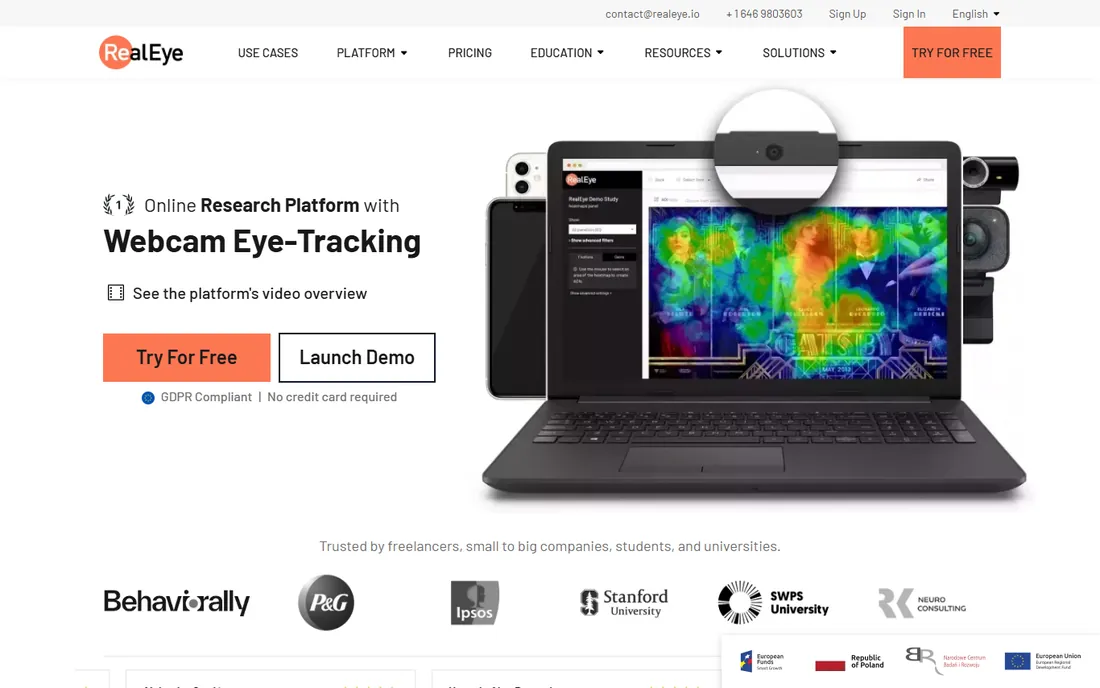
RealEye turns any laptop webcam into an eye tracker using a neural network that runs locally in the browser, so participants never install anything. You build a study, share a link or recruit from their panel, and get heatmaps and fixation data back in a dashboard. For remote usability testing and ad creative checks, that workflow is hard to beat.
The honest limitation is precision. RealEye publishes its own accuracy figures, and they are fine for page-level analysis but not for fine-grained reading research. Pricing is handled through sales, though a 7-day free trial lets you test the workflow first.
What we like- Runs entirely in the browser using a participant webcam
- Built-in panel of participants
- Heatmaps, gaze plots and AOI metrics with CSV and API export
Watch out for- Webcam accuracy (around 110 px per their own whitepaper) cannot match dedicated hardware
- Pricing is quote-based rather than self-serve
Starting priceSee website
Free planNo
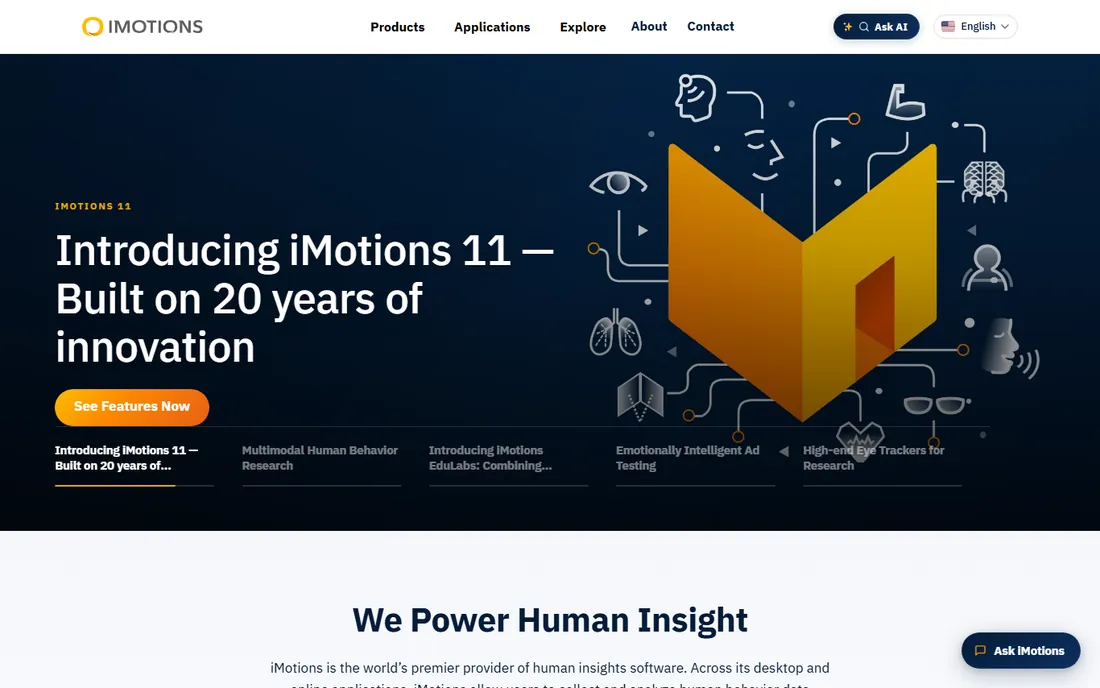
iMotions is less an eye tracker and more a mission control for human behavior research. It pulls gaze data together with heart rate, skin conductance, brain activity and facial expressions, all timestamped on one timeline. That makes it the default choice for psychology departments and human factors teams running multimodal studies.
This is not a tool you buy on a credit card. Expect an enterprise sales cycle and training time to match. For pure eye tracking studies, a dedicated vendor may be simpler and cheaper. For everything-at-once research, iMotions is the platform labs standardize on.
What we like- Synchronizes eye tracking with EEG, GSR, ECG, facial expression analysis and 50+ sensors in one platform
- Strong academic adoption
- Newer online module for remote studies
Watch out for- Built for labs, so the learning curve and price reflect that
- Public pricing starts around $2,900 per year per third-party listings but official pricing is quote-based
Starting priceSee website
Free planYes
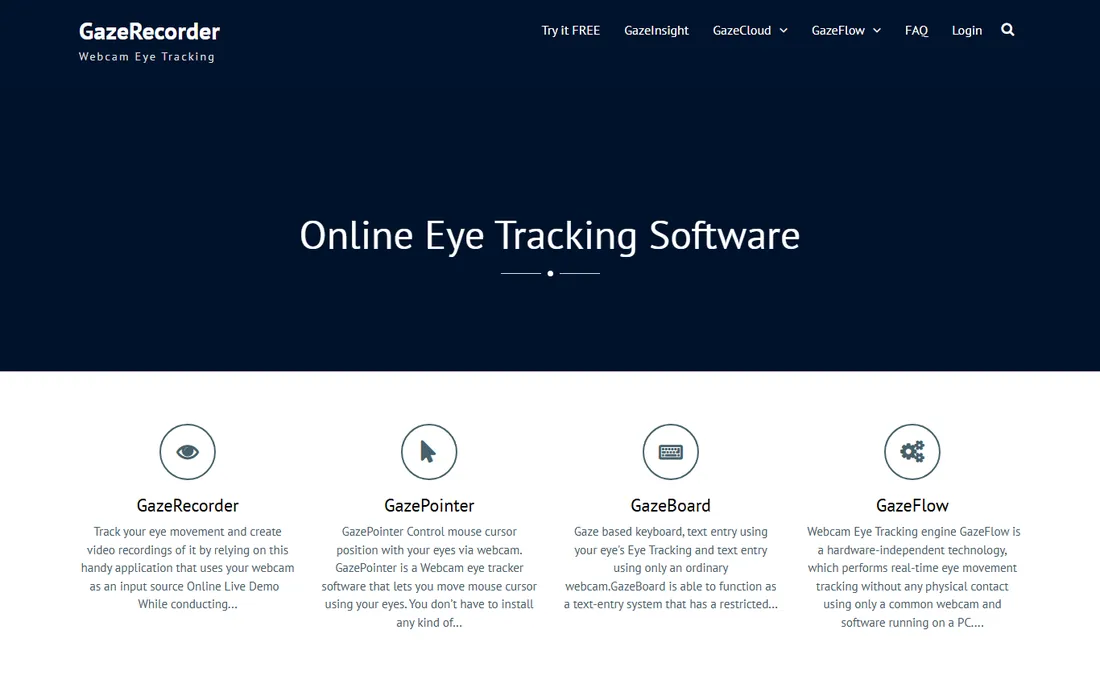
GazeRecorder has been around for years as a free way to experiment with webcam eye tracking. Install the app, calibrate with a webcam, and you get gaze recordings and heatmaps for usability tests or small studies. Developers can also tap the GazeFlow engine and cloud API to build gaze features into their own products.
Set expectations accordingly. This is a lightweight tool from a small team, not a polished research platform, and support is thin. But for students, indie researchers, or anyone validating an idea before spending money, the price (free) is right.
What we like- Free to try with no special hardware
- Generates gaze heatmaps from an ordinary webcam
- API and SDK options for developers
Watch out for- The interface and documentation feel dated
- The free version is limited to non-commercial use
Starting priceSee website
Free planYes
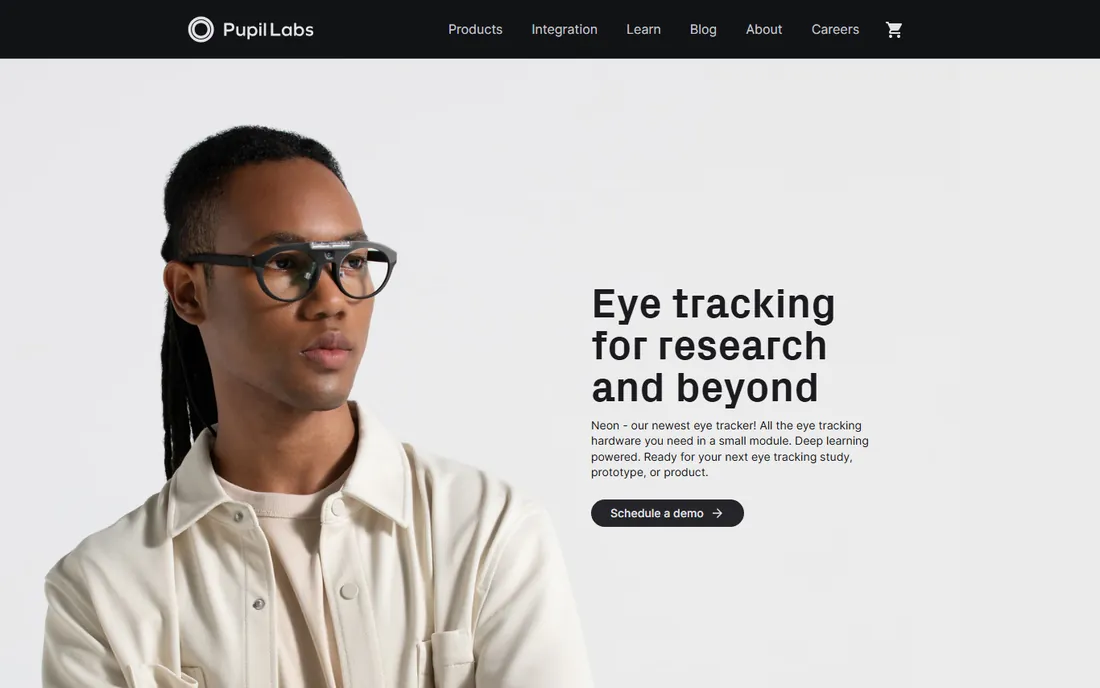
Pupil Labs takes the opposite approach from closed lab systems. Its wearable eye trackers, like Neon, work without calibration and handle sunlight, while the analysis software is open source with an active developer community. Researchers studying attention in sports, driving, or shopper behavior use Pupil gear in the field.
The tradeoff is that you are buying into a builder's ecosystem. The hardware costs real money, and while the software is free and hackable, teams without technical staff may miss the white-glove onboarding of bigger vendors. For field research and custom integrations, though, the openness is a genuine advantage.
What we like- Open-source software and open data formats
- Calibration-free wearable glasses that work outdoors
- Strong community and Python ecosystem
Watch out for- You still buy the hardware, which is a serious investment
- The DIY-friendly approach means less hand-holding than Tobii
#6
Smart Eye
Best for: automotive, aviation and large-scale applied research
Visit smarteye.se
Starting priceSee website
Free planNo
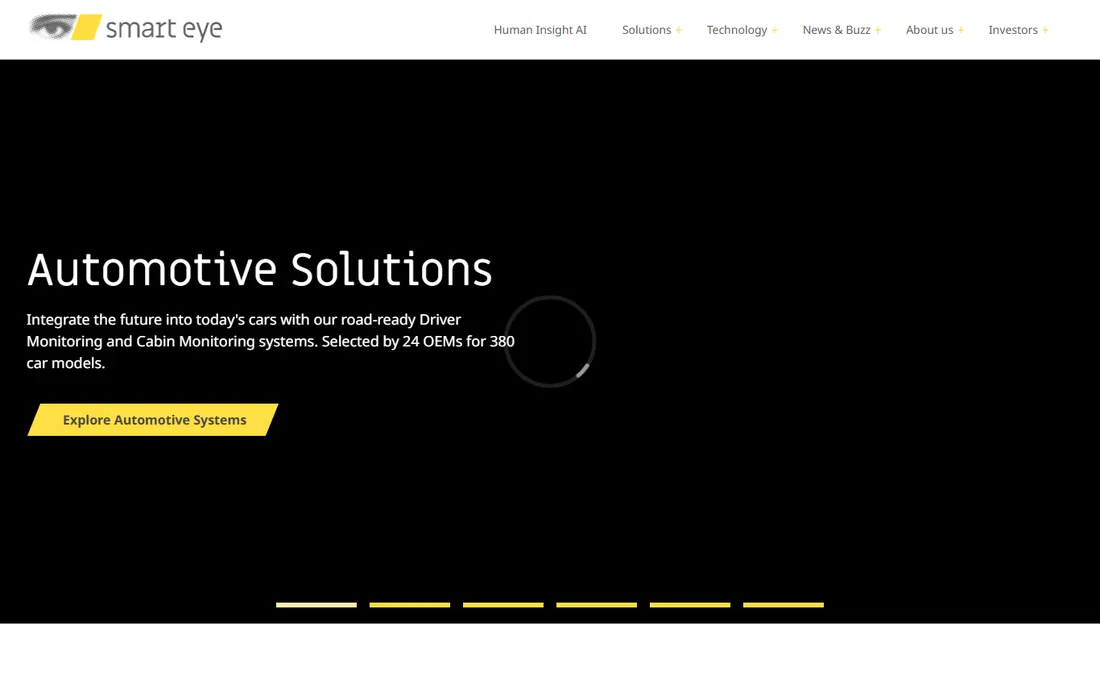
Smart Eye is the company behind driver monitoring systems in hundreds of car models, and its research division applies the same technology to labs studying attention and behavior. With iMotions and Affectiva under its roof, it covers the full pipeline from gaze capture to emotion AI.
This is not a self-serve product. If you are a carmaker, airline, or research institute running safety studies, Smart Eye is a top-tier partner. If you are a marketer who wants a heatmap by Friday, you will find the engagement model frustrating.
What we like- Deep expertise in driver monitoring and human factors
- Owns iMotions and Affectiva for a full behavioral AI stack
- Proven in safety-critical industries
Watch out for- Squarely enterprise, with pricing and engagement models to match
- Not designed for quick marketing studies
#7
Gazepoint
Best for: budget-conscious labs and neuromarketing teams
Visit gazept.com
Starting priceSee website
Free planNo
Gazepoint's pitch is simple: real eye tracking hardware without the enterprise invoice. Its GP3 system targets marketers, UX researchers and university labs that need genuine gaze data for usability and ad studies but cannot justify five figures. The software covers the essentials, including heatmaps and areas of interest.
You give up some precision and polish compared with Tobii or Smart Eye, and the integration ecosystem is smaller. For teaching labs, small agencies and neuromarketing boutiques, though, Gazepoint hits a sweet spot between webcam toys and lab instruments.
What we like- Research-grade hardware at a fraction of Tobii prices
- Bundles aimed at UX, marketing and academic use
- Heatmaps, AOIs and pupil metrics included
Watch out for- Lower sampling rates than premium systems
- Smaller ecosystem of integrations and third-party support
#8
CoolTool
Best for: automated consumer insights combining surveys and biometrics
Visit cooltool.com
Starting priceSee website
Free planNo
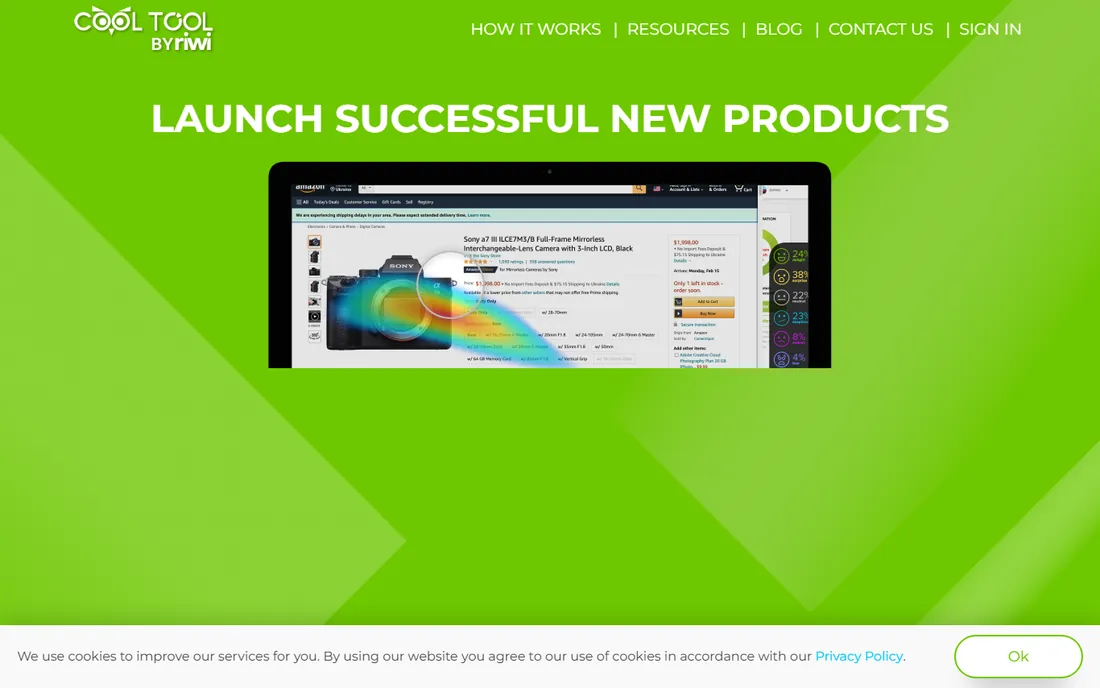
CoolTool is a consumer insights platform where webcam eye tracking is one module among many. You can run ad tests, package tests and shelf tests that combine what people look at with what they say in surveys and what implicit tests reveal about brand associations, then get automated reports.
That breadth is the selling point for market research teams that want one vendor for mixed-method studies. If you only need eye tracking, the platform may feel like more than you asked for, and pricing goes through sales. For insights teams, the all-in-one workflow saves real time.
What we like- Bundles eye tracking, emotion measurement and implicit testing with surveys in one platform
- Automated reporting with exportable data
- Built-in respondent panels
Watch out for- Enterprise-oriented with demo-led sales
- Broader than a pure eye tracking tool, which adds complexity if you only need gaze data
#9
Loceye
Best for: marketers who want fast visual engagement reports
Visit loceye.io
Starting priceSee website
Free planFree trial

Loceye pitches itself as eye tracking for people who do not think of themselves as researchers. Upload a landing page, email or ad creative, and the platform recruits participants, runs the study and returns a visual report with heatmaps. Marketing and CRO teams use it for pre-launch creative checks.
Note that Loceye was acquired by Neurons, so expect the product to evolve inside a larger attention-AI portfolio. For quick directional reads on creative, it remains one of the fastest options. For rigorous studies, pair it with a deeper platform.
What we like- Upload a design and get heatmaps back in under a day
- Remote participant recruiting built in
- Simple workflow aimed at non-researchers
Watch out for- Acquired by Neurons, so the long-term product direction is uncertain
- Less analytical depth than full research platforms
Starting priceFrom $97/month
Free planFree trial
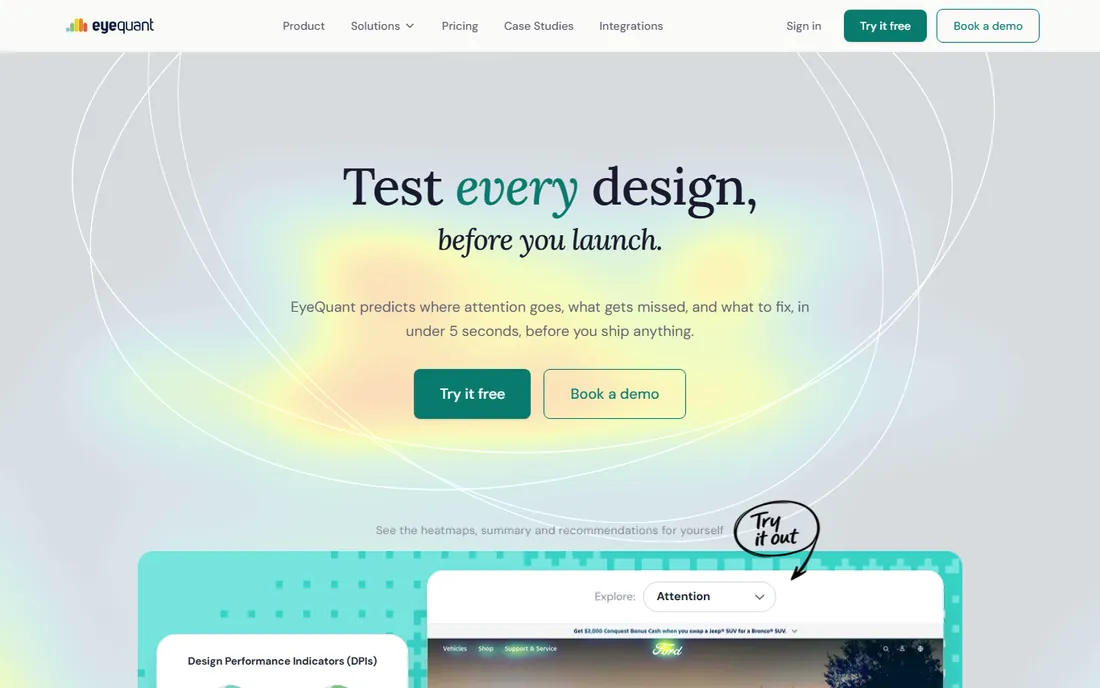
EyeQuant does not track anyone's eyes. Instead, its AI models, trained on eye-tracking research data, predict where viewers will look on your design within seconds of upload. For landing pages, ads and emails, you get attention maps, clarity scores and specific fixes before spending a dollar on traffic.
Treat it as a spell-checker for visual hierarchy rather than a replacement for user research: excellent for catching obvious misses early, not for validating truly novel layouts. Plans start from $97/month with a free trial, though detailed pricing goes through sales.
What we like- Predicts attention, clarity and engagement in seconds with no participants
- Figma, Photoshop and Chrome integrations
- Concrete design recommendations
Watch out for- It is prediction, not measurement, so it cannot replace real user testing for novel designs
- Plans require contacting sales despite the published starting price
How we chose
We compared tools across the main buying criteria for eye tracking: hardware versus webcam versus predictive approaches, published accuracy claims, study workflow (recruiting, stimuli, analysis, export), integrations, and pricing transparency. We read vendor homepages and pricing pages, product documentation, and public reviews on G2, Capterra and Reddit, and checked company news for acquisitions that affect product direction. We did not run hands-on tests; findings reflect vendor-published information and third-party reviewer consensus.
What to check before you buy eye tracking software
Start with the question your study must answer. If you need to know which headline variant grabs attention on a landing page, a webcam platform or even a predictive tool is enough. If you are publishing reading-behavior research or studying driver distraction, you need lab-grade hardware and should budget accordingly.
Then check the practical details. Ask about accuracy in pixels or degrees for your screen size, not just marketing claims. Confirm how participants are recruited, whether the tool works with your stimuli (live websites, video, mobile), and what the export looks like, since your analysis may live in SPSS, R or Python. For webcam tools, verify browser and lighting requirements with a pilot. For hardware, ask about calibration time per participant, because it multiplies across a 40-person study. Finally, confirm the pricing model: per project, per seat, or per participant can change the total by an order of magnitude.
Webcam, hardware, or AI prediction: which fits your study
Webcam eye tracking wins on speed and cost. You can field a remote study in days with no equipment, which suits agile UX teams and marketers. The price is lower accuracy and sensitivity to lighting and head movement.
Dedicated hardware wins on precision. Screen-based trackers and eye-tracking glasses deliver the sampling rates and accuracy that academic publishing and safety research demand. The price is money, lab space, and in-person participants.
AI prediction wins on immediacy. Tools like EyeQuant answer "where will they look" in seconds with no participants at all. The price is that predictions reflect average patterns from training data, so unusual designs and niche audiences can fool them. Many teams use prediction for early iteration and real eye tracking for validation.
Frequently asked questions
How accurate is webcam eye tracking compared to hardware?
Dedicated hardware typically measures gaze within a fraction of a degree, while webcam-based tools report accuracy around 100 pixels on a standard screen. Webcam tracking works well for page-level questions like which section drew attention, but hardware is needed for fine-grained reading or small-element studies.
Do participants need to install anything for webcam eye tracking studies?
Most modern platforms run entirely in the browser. Participants open a study link, grant webcam permission, complete a short calibration, and begin. This is why tools like RealEye and Loceye can recruit remote participants quickly.
How much does eye tracking software cost?
It ranges widely. Free tools like GazeRecorder cover basic experiments, webcam platforms typically price per project or via quote, predictive tools start around $97/month, and lab hardware systems from Tobii or Smart Eye run into five figures plus software licenses. Always get a quote for your specific study size.
Can eye tracking software measure emotions too?
Several platforms bundle facial expression analysis with gaze tracking, including RealEye, iMotions and CoolTool. These features estimate emotional responses from facial movements, which is useful for ad testing but should be treated as directional rather than clinical-grade data.
What is the difference between eye tracking and attention prediction?
Eye tracking measures where real people actually looked, using cameras. Attention prediction uses AI models trained on eye-tracking data to estimate where people would look, without any participants. Prediction is faster and cheaper; measurement is more trustworthy for unfamiliar designs.
Sources we checked (12)
- https://tobii.com/
- https://realeye.io/
- https://www.realeye.io/pricing
- https://imotions.com/
- https://gazerecorder.com
- https://pupil-labs.com/
- https://smarteye.se/
- https://gazept.com/
- https://cooltool.com
- https://loceye.io/
- https://eyequant.com/
- https://www.eyequant.com/pricing
Is your product missing or out of date?
We review this list regularly. Vendors can request a listing, send updated pricing or ask about featured placement.

Shihab Mia · Founder, Rankite
Shihab has spent more than a decade helping SaaS and e-commerce brands grow through search. He writes Rankite's software buying guides from pricing pages, documentation and public user reviews. More about Shihab.