How we make this list: we compare pricing pages, product documentation and public user reviews. Ratings come from G2, Capterra or Trustpilot, with the date we checked them.
What is event streaming software
Event streaming software is a platform that records events in an ordered, durable log and lets many applications read that log in real time. A data or platform engineer picks it when services need to share what happened, when it happened, in the order it happened, without calling each other directly. The best event streaming software in 2026 for most teams is Confluent, because it pairs managed Kafka with connectors and stream processing on one platform, starting at $0 per month on the Basic tier. Redpanda is the strongest alternative for teams that want Kafka compatibility with lower operating overhead, and Apache Kafka itself remains the right pick for teams that want full control and no license fee.
This guide compares eight platforms across the whole event streaming market. It is not a list of Kafka replacements. It covers managed Kafka, Kafka-compatible engines, cloud-native services, and open source projects.
How is event streaming different from a message queue
Event streaming is different from a message queue because a stream stores events and lets consumers replay them, while a queue delivers a message once and then deletes it. A queue answers the question of who should handle this task next. A stream answers the question of what happened, in order, and lets any number of consumers read the same history at their own pace. That difference decides which tool fits your system.
Use a message queue when a task must be processed exactly once by one worker, such as sending an email or charging a card. Use an event stream when several systems need the same facts, when you need to rebuild state from history, or when new consumers need to catch up on past events.
Choose an event streaming platform by matching four things: your protocol needs, your deployment model, your team size, and your retention needs. Start with protocol. If your producers and consumers already speak Kafka, a Kafka-compatible platform such as Confluent, Redpanda, or WarpStream avoids rewriting client code. If your team works mostly inside one cloud, a native service such as Amazon Kinesis or Azure Event Hubs removes broker operations entirely and bills by usage.
Next, decide who runs the brokers. Managed services handle patching, scaling, and replication for you, and they cost more per gigabyte. Self-hosted open source costs nothing in license fees but needs engineers who can run a distributed system in production. Small teams usually save money with managed services once staff time is counted. Then check retention and replay: how long the platform keeps events, and what it costs to keep data for weeks or months. Finally, test the free tier or trial with your real event shape, and measure the cost per gigabyte at your actual volume, not at the vendor example volume.
What does event streaming cost in 2026
Event streaming costs in 2026 range from free open source software to usage-based cloud services that start near zero and grow with volume. Managed services charge by compute units, throughput, or gigabytes moved, so a small test cluster can cost a few dollars a month while a production pipeline can cost thousands.
Watch for the meters that hide in the price. Confluent bills for compute, data in and out, and storage separately. Kinesis bills per shard-hour plus per million PUT units. Event Hubs bills per throughput unit-hour plus per million ingress events. Estuary bills per gigabyte captured and again per gigabyte delivered. WarpStream bills for writes and storage but not for reads. Add all the meters together before comparing two vendors. Prices below were checked on the vendor pricing pages on 21 Nov 2026.
| Tool |
Starting price (checked 21 Nov 2026) |
Best for |
Deployment |
| Confluent |
$0 per month (Basic tier) |
Managed Kafka with connectors and stream processing |
Managed cloud |
| Redpanda |
$0 (Serverless, pay as you go) |
Kafka compatibility with low operating overhead |
Cloud or self-hosted |
| Apache Kafka |
Free (open source) |
Full control over a proven streaming core |
Self-hosted |
| Amazon Kinesis |
$0.015 per shard-hour |
AWS-native real-time ingestion |
Managed AWS |
| Apache Pulsar |
Free (open source) |
Multi-tenant messaging and streaming in one system |
Self-hosted |
| WarpStream |
$0.01 per GiB written |
Kafka compatibility on object storage |
BYOC cloud |
| Estuary Flow |
Free (Developer tier, 10 GB per month) |
Real-time CDC pipelines to warehouses and streams |
Managed cloud |
| Azure Event Hubs |
$0.015 per hour per throughput unit (Basic tier) |
Azure-native ingestion with Kafka protocol support |
Managed Azure |
Quick comparison
| Tool | Best for | Starting price | Free plan |
|---|
 Confluent | Teams that want managed Kafka with connectors, stream processing, and governance on one platform | $0 per month (Basic tier, first eCKU free, then $0.14 per eCKU-hour; Standard from about $385 per month, checked 21 Nov 2026) | Basic tier starts at $0 per month, with the first eCKU free and usage-based charges for data and storage |
 Redpanda | Teams that want Kafka API compatibility in a single binary with no JVM and no ZooKeeper | $0 (Serverless, pay as you go; BYOC and Dedicated by quote, checked 21 Nov 2026) | Free Community Edition to self-host; Serverless starts at $0 with pay-as-you-go usage and a $100 trial credit |
 Apache Kafka | Teams that want full control over the most widely used streaming core, with no license fee | Free (open source under Apache License 2.0; you pay only for infrastructure and operations, checked 21 Nov 2026) | Free, unlimited self-hosted use under the Apache License 2.0 |
 Amazon Kinesis | Teams building real-time ingestion inside AWS, especially with Lambda and other AWS services | $0.015 per shard-hour (provisioned mode, US East, plus $0.014 per million PUT payload units, checked 21 Nov 2026) | No free tier for Kinesis Data Streams; on-demand Standard starts at $0.040 per stream-hour plus per-GB charges |
 Apache Pulsar | Teams that need multi-tenancy, geo-replication, and queue plus stream semantics in one system | Free (open source under Apache License 2.0; managed hosting and support come from third-party vendors, checked 21 Nov 2026) | Free, unlimited self-hosted use under the Apache License 2.0 |
 WarpStream | Teams that want Kafka compatibility with object storage costs and no local disks to manage | $0.01 per GiB written (first 50 TiB per month, plus cluster minutes from $0.0345 per 15 minutes on the Dev tier, checked 21 Nov 2026) | $400 in non-expiring credits with no card required; idle clusters scale to zero |
 Estuary Flow | Teams that want real-time change data capture pipelines from databases to warehouses and streams | Free (Developer tier, up to 10 GB per month and 2 connectors; Cloud from $0.50 per GB plus $100 per connector instance per month, checked 21 Nov 2026) | Developer tier is free for up to 10 GB a month and 2 connector instances, with no credit card and no time limit |
 Azure Event Hubs | Teams building real-time ingestion inside Azure, especially IoT and telemetry workloads | $0.015 per hour per throughput unit (Basic tier, plus $0.028 per million ingress events, checked 21 Nov 2026) | No free tier; Basic is the lowest paid entry, and Premium and Dedicated include ingress events in the capacity rate |
Is your product missing or out of date?
We review this list regularly. Vendors can request a listing, send updated pricing or ask about featured placement.
The eight platforms below.
#1Confluent
Best for: Teams that want managed Kafka with connectors, stream processing, and governance on one platform4.4/5 on
G2 (114 reviews, checked Oct 2026)
Visit confluent.io
Starting price$0 per month (Basic tier, first eCKU free, then $0.14 per eCKU-hour; Standard from about $385 per month, checked 21 Nov 2026)
Free planBasic tier starts at $0 per month, with the first eCKU free and usage-based charges for data and storage
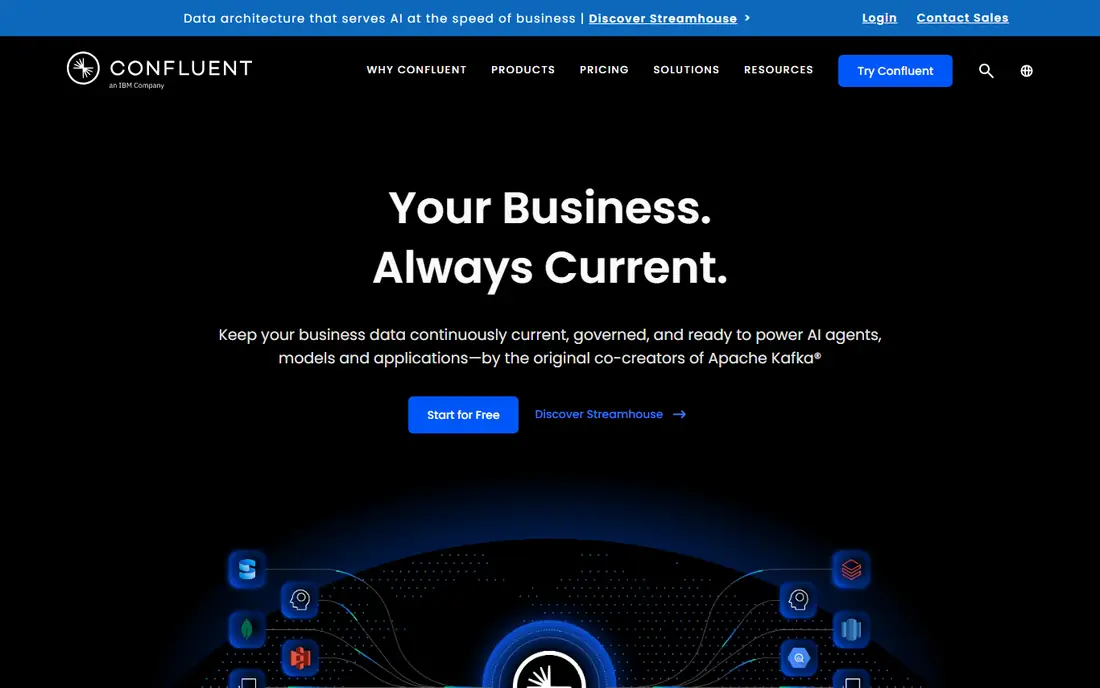
Confluent is the managed Kafka service from the company founded by the creators of Kafka. It runs serverless clusters that scale automatically, and it includes more than 80 fully managed connectors for databases, cloud storage, and SaaS tools, so a team can move data in and out without writing integration code. Confluent also adds Apache Flink for stream processing, a schema registry, and governance features that matter when many teams share topics. Pick Confluent when you want the widest connector catalog and the least custom code around Kafka.
What we like- Managed Kafka with fully managed connectors, serverless Flink stream processing, schema registry, and strong governance tooling
Watch out for- Costs rise fast at scale because compute, data transfer, and storage are billed as separate meters, so a production bill needs careful modelling
#2
Redpanda
Best for: Teams that want Kafka API compatibility in a single binary with no JVM and no ZooKeeper
Visit redpanda.com
Starting price$0 (Serverless, pay as you go; BYOC and Dedicated by quote, checked 21 Nov 2026)
Free planFree Community Edition to self-host; Serverless starts at $0 with pay-as-you-go usage and a $100 trial credit
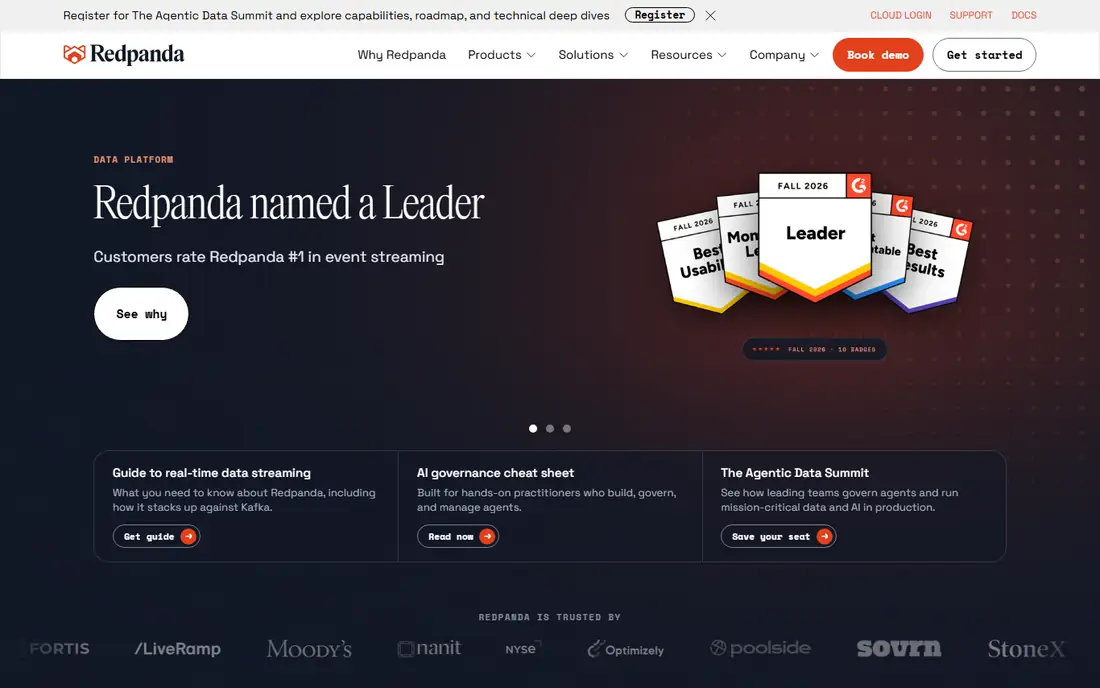
Redpanda is a Kafka-compatible streaming platform written in C++, with no JVM and no ZooKeeper to operate. That design gives it low latency and simpler operations than a standard Kafka cluster, because there are fewer moving parts to tune and monitor. The Community Edition is free to self-host under the Business Source License, and Redpanda Cloud offers Serverless, Dedicated, and BYOC deployments. Pick Redpanda when your clients already speak Kafka and you want simpler operations without rewriting producers or consumers.
What we like- Single C++ binary with low latency, built-in tiered storage, and a Kafka-compatible API that lets existing clients connect unchanged
Watch out for- BYOC and Dedicated prices are not published, so teams that need those deployments must go through sales for a quote
#3
Apache Kafka
Best for: Teams that want full control over the most widely used streaming core, with no license fee
Visit kafka.apache.org
Starting priceFree (open source under Apache License 2.0; you pay only for infrastructure and operations, checked 21 Nov 2026)
Free planFree, unlimited self-hosted use under the Apache License 2.0
Apache Kafka is the open source distributed event streaming platform that most of the market is built around. Producers append records to named topics, Kafka stores them in partitioned, replicated logs on brokers, and consumers read them back in order, at their own pace, as many times as they like until the data expires. Kafka is free under the Apache License 2.0, with no license fee for commercial use, so the cost is servers, storage, and staff time. Its ecosystem is the largest in streaming, with clients in every major language and Kafka Connect for integrations. Pick Kafka when your team can operate a distributed system, or when avoiding a vendor dependency matters more than managed convenience.
What we like- Proven at very large scale, the largest ecosystem of clients, connectors, and tooling, and no vendor lock-in
Watch out for- You run everything yourself, including broker upgrades, disk management, partition rebalancing, and incident response, which needs real platform skills
#4
Amazon Kinesis
Best for: Teams building real-time ingestion inside AWS, especially with Lambda and other AWS services
Visit aws.amazon.com
Starting price$0.015 per shard-hour (provisioned mode, US East, plus $0.014 per million PUT payload units, checked 21 Nov 2026)
Free planNo free tier for Kinesis Data Streams; on-demand Standard starts at $0.040 per stream-hour plus per-GB charges
Amazon Kinesis Data Streams is the AWS-native way to capture and store events in real time. A provisioned stream charges $0.015 per shard-hour in US East, with each shard accepting 1 MB per second or 1,000 records per second of writes, plus $0.014 per million 25 KB PUT payload units. On-demand Standard charges $0.040 per stream-hour plus $0.08 per GB written and $0.040 per GB read, which suits workloads with unknown or spiky traffic. Kinesis fits naturally with Lambda, Firehose, and AWS analytics, and it needs no broker operations at all. Pick Kinesis when your data and your consumers already live in AWS and you want streaming without managing clusters.
What we like- Fully managed inside AWS, deep integration with Lambda, Firehose, and analytics services, and on-demand capacity for unpredictable traffic
Watch out for- It runs only on AWS, so teams that need multi-cloud or on-premises streaming must look elsewhere, and on-demand per-GB rates add up fast at high volume
#5
Apache Pulsar
Best for: Teams that need multi-tenancy, geo-replication, and queue plus stream semantics in one system
Visit pulsar.apache.org
Starting priceFree (open source under Apache License 2.0; managed hosting and support come from third-party vendors, checked 21 Nov 2026)
Free planFree, unlimited self-hosted use under the Apache License 2.0
Apache Pulsar is an open source distributed messaging and streaming platform that separates the serving layer from the storage layer. Brokers handle traffic while Apache BookKeeper holds the data, so compute and storage scale independently and a cluster can support up to a million topics. Pulsar combines pub-sub and queue semantics in one system, with built-in multi-tenancy for teams or customers sharing a cluster, native geo-replication across regions, and tiered storage to object storage. Pick Pulsar when multi-tenancy or geo-replication is a core requirement, or when you need one system to serve both queue and stream workloads.
What we like- Separated compute and storage that scale independently, native multi-tenancy, built-in geo-replication, and support for very large topic counts
Watch out for- The ecosystem is smaller than Kafka, so fewer off-the-shelf connectors and tools exist, and hiring Pulsar experience is harder
#6
WarpStream
Best for: Teams that want Kafka compatibility with object storage costs and no local disks to manage
Visit warpstream.com
Starting price$0.01 per GiB written (first 50 TiB per month, plus cluster minutes from $0.0345 per 15 minutes on the Dev tier, checked 21 Nov 2026)
Free plan$400 in non-expiring credits with no card required; idle clusters scale to zero
WarpStream is a Kafka-compatible streaming platform built directly on S3-compatible object storage, with no local disks on the brokers. That design removes the two costs that dominate self-managed Kafka in the cloud: inter-zone networking between brokers and triply replicated cloud disks. BYOC clusters run the data plane in your cloud account and the control plane in WarpStream, so data never leaves your account and no cross-account access is needed. Pricing is usage-based: write throughput starts at $0.01 per GiB for the first 50 TiB per month and falls to $0.003 per GiB above 7,800 TiB, storage starts at $0.01 per GiB, and cluster minutes run from $0.0345 per 15 minutes on the Dev tier. Pick WarpStream when Kafka compatibility matters and your largest Kafka costs are disks and networking.
What we like- Diskless design on object storage removes inter-zone networking fees and disk costs, with usage-based pricing and no per-partition fees
Watch out for- It is a BYOC product, so you still run agent nodes in your own cloud account, and some third-party sources cite a $100 per month Dev base fee that the vendor pricing page does not show, so confirm the base fee before budgeting
#7
Estuary Flow
Best for: Teams that want real-time change data capture pipelines from databases to warehouses and streams
Visit estuary.dev
Starting priceFree (Developer tier, up to 10 GB per month and 2 connectors; Cloud from $0.50 per GB plus $100 per connector instance per month, checked 21 Nov 2026)
Free planDeveloper tier is free for up to 10 GB a month and 2 connector instances, with no credit card and no time limit
Estuary Flow is a managed data pipeline platform built for real-time change data capture. It reads changes from source databases such as Postgres, moves them through a durable log, and delivers them to warehouses, lakes, and streaming destinations, with exactly-once delivery and schema evolution handled by the platform. The Developer tier is free for up to 10 GB a month and 2 connector instances, with no credit card required. Past that, the Cloud plan costs $0.50 per GB plus $100 per connector instance per month for the first six instances and $50 after that, with a 30-day free trial when you pass the Developer limits. The gigabyte rate applies at capture and again at each materialization, so a gigabyte delivered to two destinations bills more than once. Pick Estuary when your main job is moving database changes into analytics in real time, rather than running a general purpose broker.
What we like- Real-time CDC from production databases, 200+ managed connectors, exactly-once delivery, and a Kafka-compatible API for downstream consumers
Watch out for- Each gigabyte is billed twice, once at capture and once at each materialization, so the effective cost per gigabyte is higher than the headline $0.50 rate
#8
Azure Event Hubs
Best for: Teams building real-time ingestion inside Azure, especially IoT and telemetry workloads
Visit azure.microsoft.com
Starting price$0.015 per hour per throughput unit (Basic tier, plus $0.028 per million ingress events, checked 21 Nov 2026)
Free planNo free tier; Basic is the lowest paid entry, and Premium and Dedicated include ingress events in the capacity rate
Azure Event Hubs is a fully managed real-time data ingestion service for Azure, built to take in millions of events per second from devices, applications, and services. The Basic tier costs $0.015 per hour per throughput unit, the Standard tier $0.03 per hour per throughput unit, and each throughput unit provides 1 MB per second of ingress and 2 MB per second of egress. Ingress events cost $0.028 per million events on Basic and Standard, where an event is a unit of 64 KB or less. Event Hubs also supports the Apache Kafka protocol, so Kafka producers and consumers can connect without code changes. Pick Event Hubs when your workloads and consumers already live in Azure.
What we like- Fully managed inside Azure, supports the Kafka protocol so existing Kafka clients can connect, and scales with throughput units up to large volumes
Watch out for- Retention is short on the lower tiers at one day on Basic and seven days on Standard, and Capture costs extra on Standard at $73 per month per throughput unit
Frequently asked questions
What is the best event streaming software for a small team
Confluent is the best pick for most small teams, because the Basic tier starts at $0 per month. A small team gets managed Kafka, connectors, and stream processing without hiring a platform engineer. If the team already lives in one cloud, Kinesis or Event Hubs is simpler still, because there are no brokers to size.
Is Apache Kafka free to use
Yes, Apache Kafka is free to use. It is open source under the Apache License 2.0, which allows free commercial and non-commercial use with no license fee. You still pay for the servers, storage, and networking that run the cluster, plus the staff time to operate it. Managed Kafka services such as Confluent Cloud charge for the same software plus operations, support, and extra features.
What is the difference between event streaming and a message queue
The difference is storage and replay. An event stream keeps events in an ordered, durable log, so many consumers can read the same history and new consumers can replay from the start. A message queue delivers each message to one consumer and deletes it after delivery, so there is no history to replay.
Which event streaming platform is cheapest for low volume
For low volume, the cheapest option is usually a free tier or a usage-based cloud service. Confluent Basic starts at $0 per month, Redpanda Serverless starts at $0 with pay-as-you-go billing, and Estuary Flow is free up to 10 GB a month.
Do I need Kafka compatibility, or can I use a native cloud service
Kafka compatibility matters when your producers and consumers already use Kafka clients, or when you may move clouds later. Confluent, Redpanda, WarpStream, and Event Hubs all speak the Kafka protocol, so existing clients connect without code changes. A native service such as Kinesis is simpler inside its own cloud, because it integrates with that cloud's functions, storage, and analytics.
Sources we checked (8)
- https://www.confluent.io/pricing/?session_ref=direct
- https://www.redpanda.com
- https://kafka.apache.org
- https://aws.amazon.com/kinesis/data-streams/pricing/
- https://pulsar.apache.org
- https://www.warpstream.com/pricing
- https://estuary.dev/pricing/
- https://azure.microsoft.com/en-in/pricing/details/event-hubs/
Is your product missing or out of date?
We review this list regularly. Vendors can request a listing, send updated pricing or ask about featured placement.

Shihab Mia · Founder, Rankite
Shihab has 5+ years in B2B and SaaS SEO. He writes Rankite's software buying guides from pricing pages, documentation and public user reviews. More about Shihab.