How we make this list: we compare pricing pages, product documentation and public user reviews. Ratings come from G2, Capterra or Trustpilot, with the date we checked them.
Key takeaways
- Deltek Vantagepoint is purpose-built for project businesses, including architecture, engineering, and government contractors, with DCAA-compliant timekeeping.
- Sage Intacct leads on financial depth, with a dimensional general ledger and automated ASC 606 and IFRS 15 revenue recognition.
- Oracle NetSuite is the default cloud suite for growing services firms, tying resource management, time and expense capture, and project billing directly to the ledger.
- Most firms above about 25 fee earners land on a services ERP or dedicated cloud accounting suite, since standalone accounting plus a PSA tool no longer meets their needs.
- Enterprise pricing is usually custom and quoted: services ERP annual costs run $20,000 to $190,000 plus in one comparison, and implementation often costs as much as a year of licensing, so get a written quote before committing.
Quick comparison
Is your product missing or out of date?
We review this list regularly. Vendors can request a listing, send updated pricing or ask about featured placement.

#1Deltek Vantagepoint
Best for: Project businesses4.1/5 on
G2 (700 reviews, checked Oct 2026)
Visit deltek.com
Starting priceSee website
Free planNo
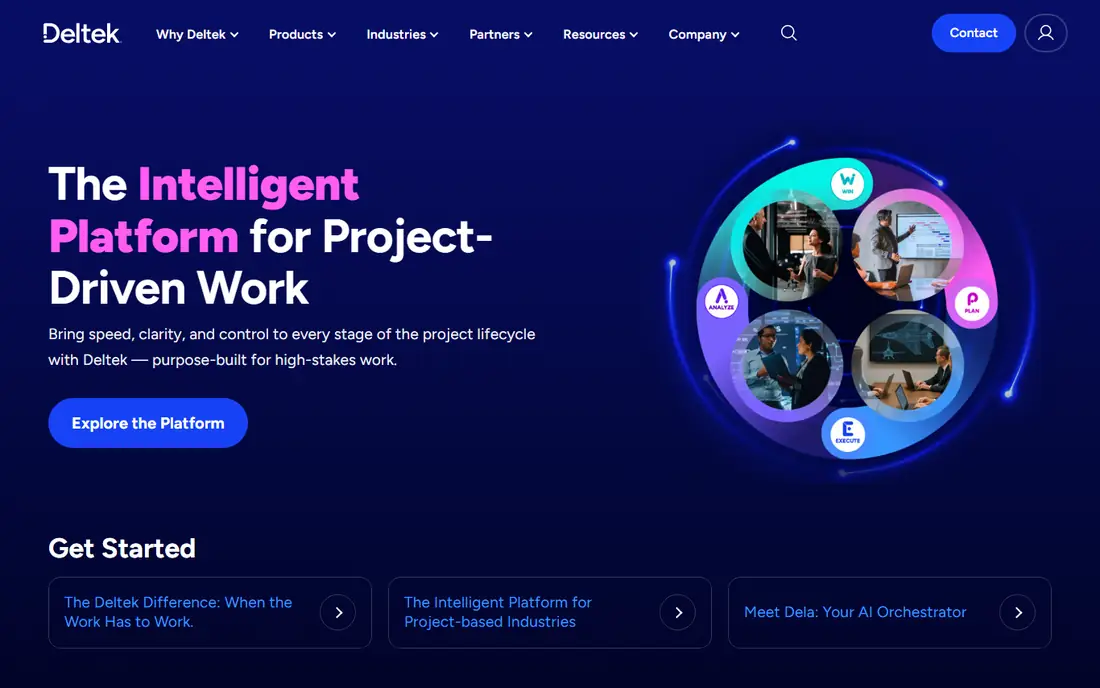
Deltek Vantagepoint is purpose-built for project businesses, including architecture, engineering, and government contractors, wrapping CRM, project planning, resource management, and DCAA-compliant timekeeping around the project lifecycle. It is the specialist choice where project accounting and contract compliance are non-negotiable, and it suits firms whose work is organized as projects with contracts, milestones, and billable time.
The trade off is project specialization against general finance breadth. Deltek handles project businesses better than any tool here, but its general finance depth is thinner than Sage Intacct. Deltek Vantagepoint fits architecture, engineering, and government contracting firms.
What we like- Purpose-built for project businesses
- CRM, project planning, and resource management around the project lifecycle
- DCAA-compliant timekeeping for government contractors
- Strong for architecture and engineering firms
- Specialist project accounting
Watch out for- Quote-based pricing, low-tier estimates at $5,000 to $30,000 per year for small operations
- Implementation adds cost
- Less general finance depth than Sage Intacct
- Best for project firms, not general services

#2Oracle NetSuite
Best for: Growing services firms4.1/5 on
G2 (4,969 reviews, checked Oct 2026)
Visit netsuite.com
Starting priceSee website
Free planNo
Oracle NetSuite is the default cloud suite for growing services firms, with SuiteProjects and project-accounting modules tying resource management, time and expense capture, and project billing directly to the ledger, so utilization and margin are visible in real time. It suits mid-market firms that want CRM, projects, and financials in one place, with multi-entity support for growing firms. Its pricing is quote-based, with a base estimated at about $999 per month plus users and modules, and per-user fees of $129 to $199 in third-party estimates.
The trade off is all-in-one breadth against total cost. NetSuite replaces multiple systems, but its implementations run 1 to 2 times annual license cost and unused modules inflate total cost. NetSuite fits mid-market services firms that want one cloud suite for finance and operations.
What we like- Default cloud suite for growing services firms
- SuiteProjects ties resource management, time and expense capture, and project billing to the ledger
- CRM, projects, and financials in one place
- Largest customer base at over 43,000 organizations
- Multi-entity and multi-subsidiary support
Watch out for- Quote-based pricing, base estimated at about $999 per month plus users and modules
- Implementations run 1 to 2 times annual license cost
- Per-user fees of $129 to $199 in third-party estimates
- Modules you never use can inflate total cost

#3Sage Intacct
Best for: Finance-led firms4.3/5 on
G2 (4,521 reviews, checked Oct 2026)
Visit sage.com
Starting priceSee website
Free planNo
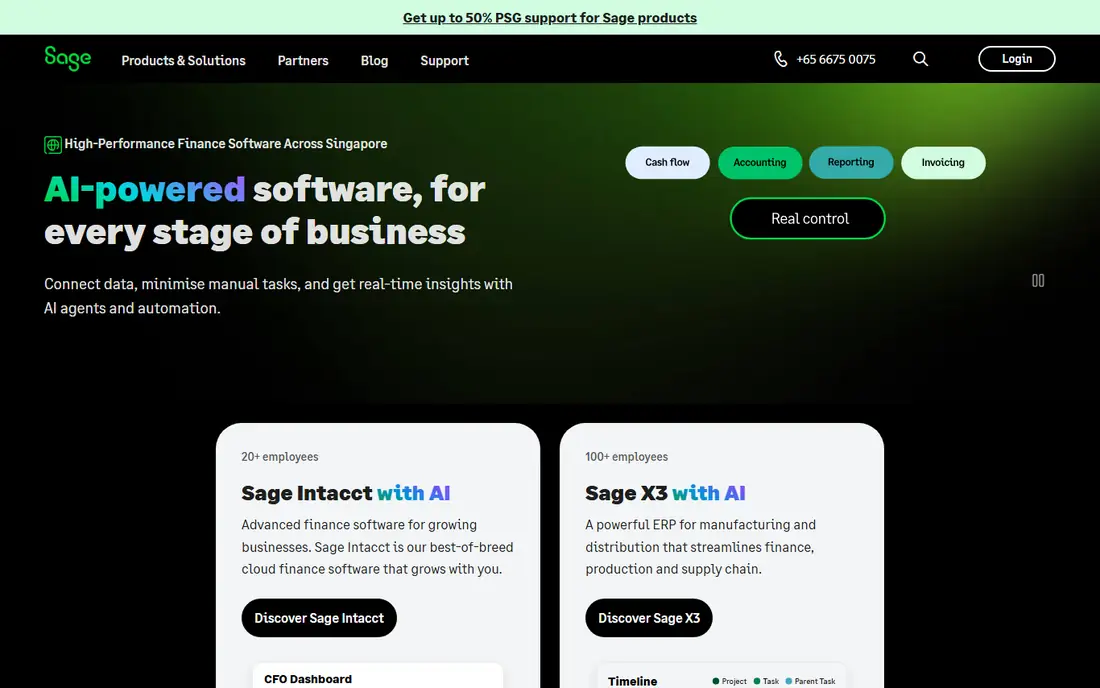
Sage Intacct leads on financial depth for services firms, with a dimensional general ledger that lets agencies, architects, and accountancy firms slice profitability by project, client, service line, or partner without a sprawling chart of accounts, plus a revenue-recognition engine that automates ASC 606 and IFRS 15. It suits finance-led firms that live in their numbers and want reporting flexibility above all, with a strong CPA-firm ecosystem for audit and IPO track firms.
The trade off is financial depth against scope. Sage Intacct reports better than any tool here, but its inventory and manufacturing features are thin. Sage Intacct fits finance-led services firms that prioritize reporting and revenue recognition.
What we like- Leads on financial depth
- Dimensional general ledger slices profitability by project, client, service line, or partner without a sprawling chart of accounts
- Automated ASC 606 and IFRS 15 revenue recognition
- Faster close
- Strong CPA-firm ecosystem
Watch out for- Quote-based pricing, typical estimates at $15,000 to $60,000 per year
- Per-user estimates at $200 to $400 per month plus base package
- Thin inventory and manufacturing
- Implementations of $15,000 to $75,000 for 100 users in third-party estimates

#4Workday Financial Management
Best for: Services plus HR4.2/5 on
G2 (513 reviews, checked Oct 2026)
Visit workday.com
Starting priceSee website
Free planNo
Workday Financial Management is the services plus HR pick, offering finance and human resources in one cloud system for large services firms, with unified financials, project accounting, and consolidation. It suits enterprise services firms that want finance and HR together, though its pricing is quote-based and high-tier estimates run $150,000 to $500,000 per year for large businesses.
The trade off is unified finance plus HR against enterprise cost. Workday unifies finance and HR at scale, but its pricing suits large firms, not small ones. Workday fits large services firms that want finance plus HR in one system.
What we like- Services firms get finance plus HR in one cloud system
- Strong for large services firms
- Unified financials, project accounting, and consolidation
- Enterprise scale
Watch out for- Quote-based enterprise pricing
- High-tier estimates at $150,000 to $500,000 per year for large businesses
- Implementation costs high
- Overkill for small firms
Starting priceSee website
Free planNo
Unit4 ERPx is the services and public sector pick, built for services firms, public sector organizations, and non-profits, with a people-centric design that suits organizations where staff time and projects drive revenue. It offers mid-market to enterprise scale on cloud deployment, and it suits firms that want an ERP designed around people and projects rather than inventory.
The trade off is services focus against ecosystem size. Unit4 fits services and public sector firms well, but its ecosystem is smaller than NetSuite. Unit4 fits services, public sector, and non-profit organizations.
What we like- Built for services, public sector, and non-profits
- Mid-market to enterprise scale
- Cloud deployment
- People-centric design for services firms
Watch out for- Quote-based pricing
- High-tier estimates at $150,000 to $500,000 per year for large businesses
- Smaller ecosystem than NetSuite
- Implementation costs significant
Starting priceSee website
Free planNo
Acumatica is the unlimited users pick, with consumption-based pricing and unlimited users, plus a flat base around $1,800 per month in third-party estimates, which suits user-heavy distributors, manufacturers, and project firms that would pay heavily per seat elsewhere. It offers cloud or on-premise deployment for mid-market firms, sold quote only through resellers.
The trade off is user freedom against volume cost. Acumatica lets every employee use the system without per-seat fees, but spend tracks transaction volume, so high volume raises cost. Acumatica fits user-heavy project firms that want to avoid per-seat pricing.
What we like- Consumption-based pricing with unlimited users
- Flat base around $1,800 per month in third-party estimates
- Good for user-heavy project firms
- Cloud or on-premise deployment
- Mid-market focus
Watch out for- Quote only through resellers
- Spend tracks transaction volume, so high volume raises cost
- Implementation of $50,000 to $200,000 in third-party estimates
- Smaller brand than NetSuite

#7Dynamics 365 Business Central
Best for: Microsoft 365 users4.0/5 on
G2 (917 reviews, checked Oct 2026)
Visit microsoft.com
Starting priceSee website
Free planNo
Dynamics 365 Business Central is the Microsoft 365 pick, with published per-user list pricing at $80 per month for Essentials and $110 for Premium, plus Microsoft 365 ecosystem integration and cloud or on-premise deployment. It suits small and mid-market firms already on Microsoft 365, with partner-led setup and a relatively affordable entry point for small teams.
The trade off is Microsoft integration against project depth. Business Central integrates with Microsoft 365 better than any tool here, but its project specialization is thinner than Deltek. Business Central fits Microsoft 365 firms that want an affordable mid-market ERP.
What we like- Published per-user list price at $80 and $110 per user per month for Essentials and Premium
- Microsoft 365 ecosystem integration
- Cloud or on-premise deployment
- Relatively affordable for small teams
- Partner-led setup
Watch out for- Manufacturing needs Premium tier
- Partner-led setup adds cost
- Per-user fees of $80 to $110 in list pricing, with Finance and SCM at $180 to $210 in enterprise tiers
- Less project specialization than Deltek

#8Odoo
Best for: Starting small and adding apps4.2/5 on
G2 (354 reviews, checked Oct 2026)
Visit odoo.com
Starting priceSee website
Free planYes
Odoo is the start small pick, with a free Community version and Enterprise per user pricing, letting firms start with a few apps and add more as they grow, across CRM, projects, accounting, and HR. It offers cloud or self-hosted deployment for small and mid-market firms, and it suits firms that want to grow into an ERP gradually rather than buying a full suite at once.
The trade off is gradual growth against out-of-the-box depth. Odoo grows with you at low cost, but its services depth out of the box is thinner than Deltek or Sage Intacct. Odoo fits small firms that want to start small and add ERP apps over time.
What we like- Community version free
- Enterprise per user pricing
- Start small and add apps as you grow
- Cloud or self-hosted deployment
- Broad app library covering CRM, projects, accounting, and HR
Watch out for- Enterprise pricing per user and quote-based for larger deployments
- Self-hosting needs technical skill
- Implementation quality varies by partner
- Less out-of-the-box services depth than Deltek or Sage Intacct
How we chose
We compared published feature lists and pricing estimates from 2026, favoring tools with distinct strengths: the best project specialization, the best all-in-one suite, the best financial depth, the best finance plus HR, the best public sector fit, the best unlimited user model, the best Microsoft integration, and the best gradual growth path. We wrote See website for all starting prices, since most vendors are quote-only and enterprise pricing varies by users, modules, and deployment, and we flagged third-party ranges separately. We favored tools with a current release and an active services firm user base, and we stressed implementation costs, since services often equal or exceed a year of licensing fees.
How to choose an ERP for professional services
Start with firm type: project businesses point to Deltek, finance-led firms point to Sage Intacct, growing multi-entity firms point to NetSuite, large firms wanting finance plus HR point to Workday, public sector firms point to Unit4, user-heavy firms point to Acumatica, Microsoft 365 firms point to Business Central, and small firms point to Odoo. Next, check the three things that decide fit: project accounting depth, revenue recognition automation for ASC 606 and IFRS 15, and multi-entity and multi-currency support. Then get total cost in writing: licenses plus implementation, which often equals a year of licensing, plus ongoing support, since the cheapest license can become the most expensive project. Finally, run a pilot with real projects before full rollout, since utilization and margin visibility only prove themselves on live data.
Frequently asked questions
What is the best ERP for professional services?
Deltek Vantagepoint is best for project businesses, Sage Intacct leads on financial depth, NetSuite is the default cloud suite for growing firms, and Workday suits large firms wanting finance plus HR.
How much does ERP for professional services cost?
Low-tier ERP runs $5,000 to $30,000 per year for small operations, mid-tier runs $30,000 to $150,000 per year, and high-tier runs $150,000 to $500,000 per year, with implementation often doubling the first year cost.
When should a services firm upgrade from QuickBooks to ERP?
Most firms above about 25 fee earners land on a services ERP or dedicated cloud accounting suite, since standalone accounting plus a PSA tool no longer meets their needs for project accounting, revenue recognition, and consolidation.
What is the difference between PSA and ERP?
A PSA tool covers resource planning, project economics, and time and expense for delivery-led firms, while an ERP unifies financials, project accounting, HR, and consolidation in one system for growing and large firms.
Does NetSuite or Sage Intacct handle revenue recognition better?
Both handle it fully: Sage Intacct automates ASC 606 and IFRS 15 with a dedicated revenue-recognition engine, while NetSuite handles it through its ARM module, so both suit firms with complex revenue rules.
Is Acumatica really unlimited users?
Yes, Acumatica charges by resources consumed rather than per seat, with unlimited users, though spend tracks transaction volume, so high volume raises cost.
Sources we checked (0)
Is your product missing or out of date?
We review this list regularly. Vendors can request a listing, send updated pricing or ask about featured placement.

Shihab Mia · Founder, Rankite
Shihab has 5+ years in B2B and SaaS SEO. He writes Rankite's software buying guides from pricing pages, documentation and public user reviews. More about Shihab.
 Unit4 ERPx
 Acumatica