How we make this list: we compare pricing pages, product documentation and public user reviews. Rankite is independent; if a vendor ever pays for a featured spot, that listing is clearly labeled Partner.
Key takeaways
- Culture Amp and Qualtrics lead on listening depth: benchmarks, driver analysis and enterprise scale. Both are custom-quoted.
- Lattice ($4/seat/month for Engagement) and 15Five ($4/user/month for Engage) tie surveys to performance management, which is where most midsize companies land.
- Bonusly ($3/user/month) is the cheapest credible entry with a free plan, but it is recognition-first, not a survey platform.
- Workleap moved to flat annual tiers from $4,999/year in 2026, a very different buy from its old per-seat pricing. Confirm the current model on a demo.
Quick comparison
| Tool | Best for | Starting price | Free plan |
|---|
 Culture Amp Culture Amp | Companies that want the deepest engagement science and benchmarks | See website (custom quote) | No |
 Qualtrics XM Qualtrics XM | Enterprises running experience research at scale | See website (custom quote) | No |
 Lattice Lattice | Companies that want engagement surveys tied to performance management | $4/seat/month (Engagement add-on) | No |
 15Five 15Five | Managers who want weekly signals, not annual reports | $4/user/month (Engage, annual billing) | Free trial |
 Leapsome Leapsome | European and global teams wanting one people platform | See website (custom quote) | No |
 Workday Peakon Workday Peakon | Large enterprises already running Workday | See website (custom quote) | No |
 Workleap Workleap | Teams that want pulse surveys running with minimal admin | $4,999/year (Standard Platform) | No |
 Achievers Achievers | Enterprises running recognition as a culture strategy | See website (custom quote) | No |
 Bonusly Bonusly | Small and midsize teams starting with recognition | $3/user/month (Team, annual billing) | Yes (free plan up to 8 users) |
 Quantum Workplace Quantum Workplace | Companies that want surveys wired to action planning | See website (custom quote) | No |
Is your product missing or out of date?
We review this list regularly. Vendors can request a listing, send updated pricing or ask about featured placement.
Replacing an employee costs somewhere between half and twice their annual salary, depending on whose estimate you trust. Surveys are cheap by comparison, which is why every company runs them. The problem is what happens after: results get presented, nodded at, and filed. The best employee experience platforms in 2026 are judged on the second half of that sentence, what managers actually do with the data. These ten cover the category from deep listening suites to recognition-led tools.
#1
Culture Amp
Best for: Companies that want the deepest engagement science and benchmarks
Visit cultureamp.com
Starting priceSee website (custom quote)
Free planNo
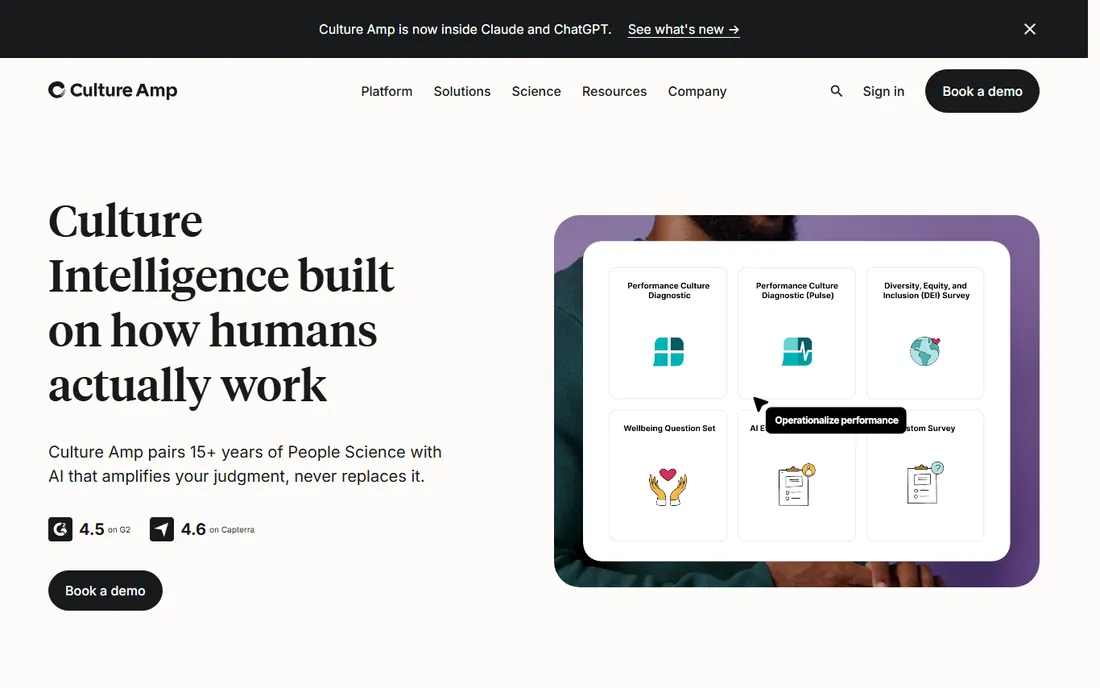
Culture Amp is the survey-first platform other vendors get compared to. Engagement, lifecycle and pulse surveys feed dashboards that separate what employees feel from what drives it, and the benchmark data tells you whether a score of 68 is good or alarming for your industry and size. HR teams that live in the data get more from Culture Amp than from any rival here.
The commercial reality is enterprise-shaped. Pricing is quote-based with a reported minimum annual commitment, implementation takes weeks, and smaller teams can find the platform heavier than they need. It also stays in the listening lane: performance reviews and goals exist but trail Lattice and 15Five. Buy Culture Amp when the question is "what is really happening in our culture," not when you need an all-in-one HR suite.
What we like- Benchmarks against thousands of companies for real context
- Driver analysis shows which factors actually move engagement
- Strong survey design grounded in people science
Watch out for- Custom pricing with no public numbers and a reported annual floor
- Onboarding takes weeks and the performance tools are thinner than dedicated rivals
Starting priceSee website (custom quote)
Free planNo
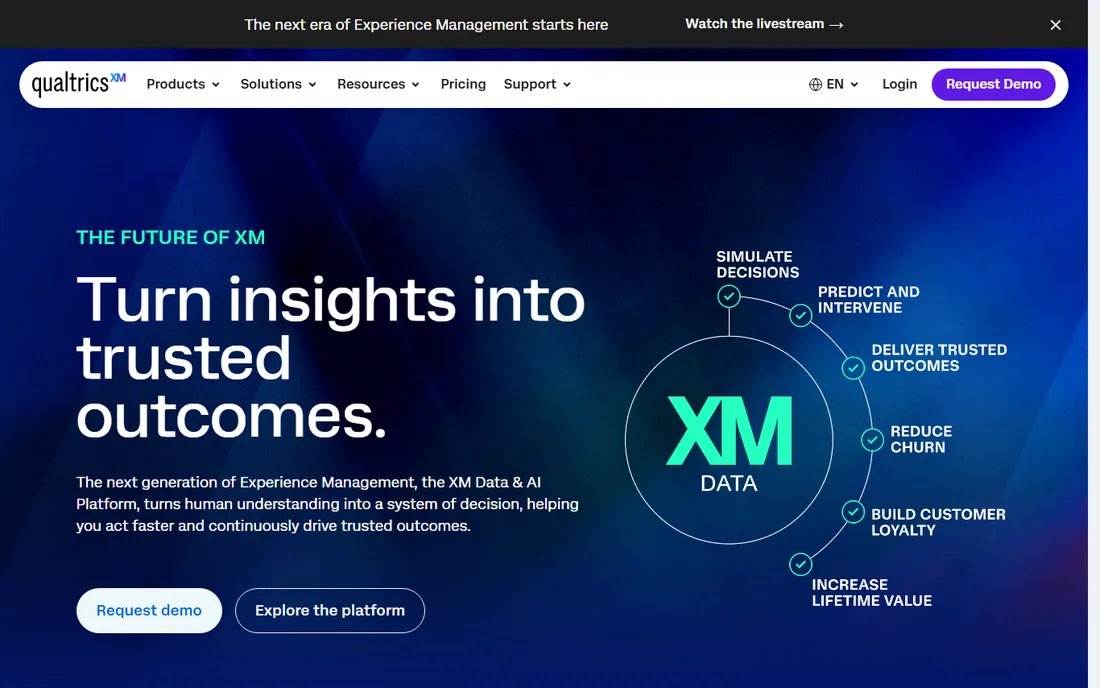
Qualtrics approaches employee experience as a research discipline. The platform handles any survey methodology you can design, analyzes open text at scale, and models the drivers of engagement, attrition and performance with statistical seriousness. For enterprises with people-analytics teams, it is the most capable instrument available, and it connects employee data with customer experience in ways no HR-native tool attempts.
Everyone else should think carefully. Qualtrics is priced and implemented for large organizations, and running a simple engagement survey on it is like using a laboratory instrument to check the weather. Midsize companies get more usable insight from Culture Amp, Lattice or 15Five at lower cost and effort. Qualtrics belongs on the shortlist when the buyer is a research function, not just an HR team.
What we like- The most powerful survey and analytics engine in the category
- Text analytics and driver modeling at serious depth
- Connects employee, customer and brand experience data
Watch out for- Enterprise pricing and complexity to match
- Overkill for companies that need a quarterly pulse survey
#3
Lattice
Best for: Companies that want engagement surveys tied to performance management
Visit lattice.com
Starting price$4/seat/month (Engagement add-on)
Free planNo
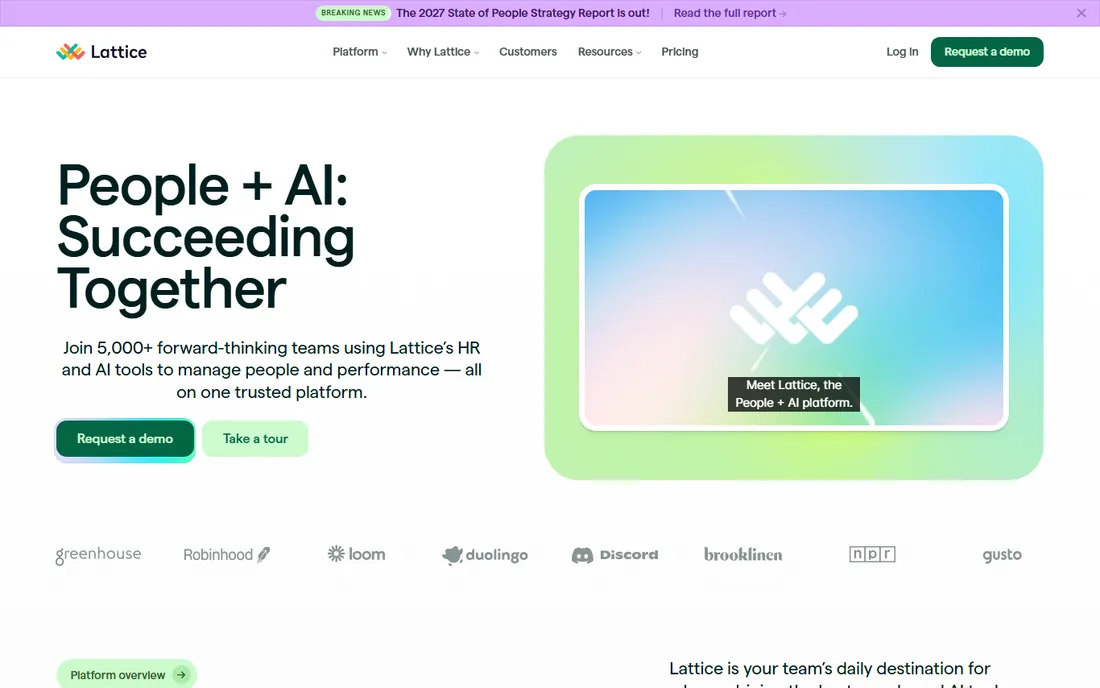
Lattice wins the midsize market by connecting the survey to the review. Engagement results sit next to performance data, goals and 1:1 notes, so managers see the whole person instead of a survey score in isolation. Pricing is published and modular: Engagement at $4 per seat per month as an add-on, with Performance, Goals and the Foundations bundle above it.
The modular model is both the appeal and the trap. A full setup with Compensation and Grow add-ons runs well past the headline $4, and the $4,000 annual minimum means small teams pay for scale they do not have. There is no free trial on the pricing page; evaluation runs through sales. For companies between 50 and 2,000 employees that want surveys plus performance in one place, Lattice is the default shortlist entry. Budget the modules, not the headline.
What we like- Published modular pricing
- Engagement surveys, reviews, goals and 1:1s in one system
- Analytics included with every base product
Watch out for- Modules stack up fast: Foundations at $13 plus Engagement, Compensation and Grow add-ons
- $4,000 annual minimum prices out small teams
- Annual billing only
#4
15Five
Best for: Managers who want weekly signals, not annual reports
Visit 15five.com
Starting price$4/user/month (Engage, annual billing)
Free planFree trial
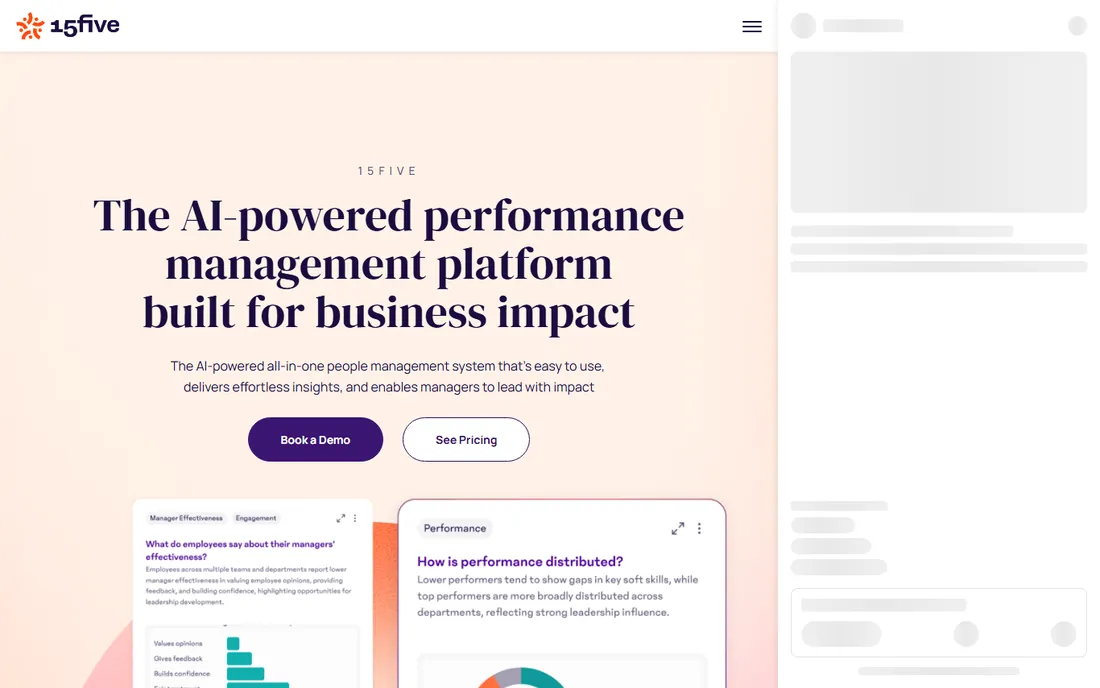
15Five built its name on the weekly check-in: a short rhythm of questions that keeps managers close to their teams between surveys. Engage at $4 per user per month (annual billing) covers surveys and check-ins; Perform at $11 adds reviews, OKRs and 360s; Total Platform at $16 combines everything with manager training. The philosophy is continuous conversation rather than periodic measurement.
The pricing is transparent but the stack grows. Add-ons for compensation, AI coaching and meeting assistance each add per-seat or per-manager fees, and reviewers note that renewal pricing can jump. The check-in format also demands manager discipline: the tool only works when both sides show up weekly. For companies that believe management is a weekly practice, 15Five is purpose-built. For annual-survey cultures, it will feel like overhead.
What we like- Published pricing across three clear tiers
- Weekly check-ins create a coaching habit, not a survey event
- Manager effectiveness tools and AI coaching add-ons
Watch out for- Annual billing on every plan
- Costs climb with add-ons like compensation and Kona coaching
- Check-in questions can feel repetitive without customization
#5
Leapsome
Best for: European and global teams wanting one people platform
Visit leapsome.com
Starting priceSee website (custom quote)
Free planNo
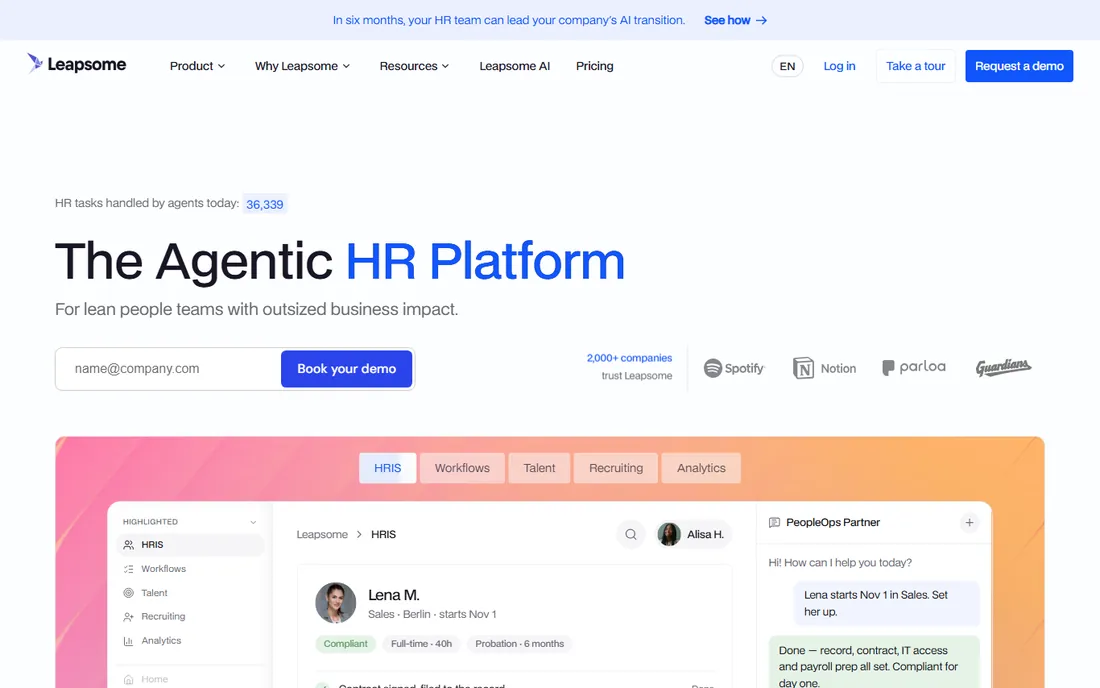
Leapsome is the all-in-one challenger: engagement and lifecycle surveys, performance reviews, goals, learning, and even HRIS and payroll-adjacent features, built in Europe with data protection as a first principle. For companies that want one vendor for the whole people stack, it covers more ground than Lattice or 15Five, and the development and career-pathing tools are genuinely strong.
The breadth has a price, literally. Leapsome quotes rather than publishes, and the modular structure means the full platform costs more than any single figure suggests. Companies should scope exactly which modules they need before the sales conversation, or the quote will scope it for them. For EU-based or privacy-conscious companies wanting breadth without American vendors, Leapsome is the natural first call.
What we like- Broad all-in-one scope: reviews, goals, surveys, learning and HRIS in one EU-built platform
- Strong on career frameworks and development
- GDPR-native posture
Watch out for- No published pricing, everything is quoted
- Per-module pricing can stack up for midsize budgets
#6
Workday Peakon
Best for: Large enterprises already running Workday
Visit workday.com
Starting priceSee website (custom quote)
Free planNo
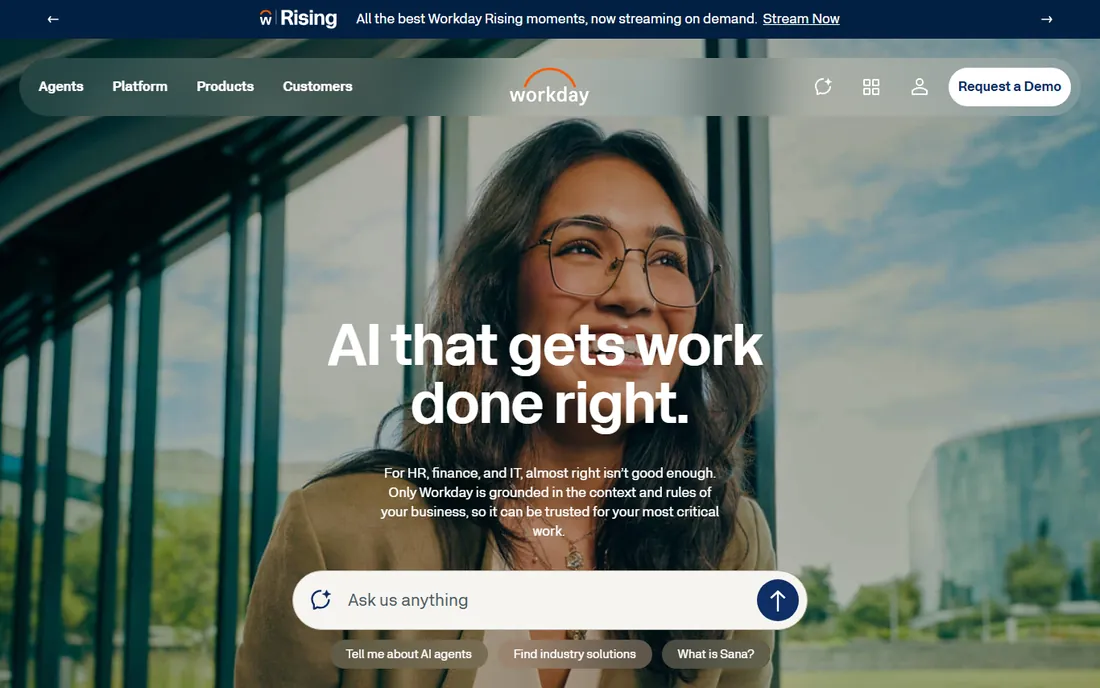
Peakon, now Workday Peakon Employee Voice, pioneered the always-on listening model: short frequent surveys instead of annual events, with dashboards managers can actually read. Inside a Workday shop, the integration is the selling point. Engagement data joins HR, performance and attrition data natively, so analysis runs across the whole employee lifecycle without exports or middleware.
Outside Workday, the case is harder to make. Pricing is enterprise and quoted, implementation is a program, and standalone buyers get similar listening from Culture Amp with less lock-in. This is a tool for Workday customers first and everyone else second. If Workday is your system of record, Peakon is the obvious listening layer. If it is not, shortlist the independent platforms.
What we like- Continuous listening with weekly micro-surveys and real-time dashboards
- Native Workday integration keeps people data in one place
- Strong benchmarking and driver analysis
Watch out for- Enterprise pricing by quote only
- The value is thinnest outside the Workday ecosystem
#7
Workleap
Best for: Teams that want pulse surveys running with minimal admin
Visit workleap.com
Starting price$4,999/year (Standard Platform)
Free planNo
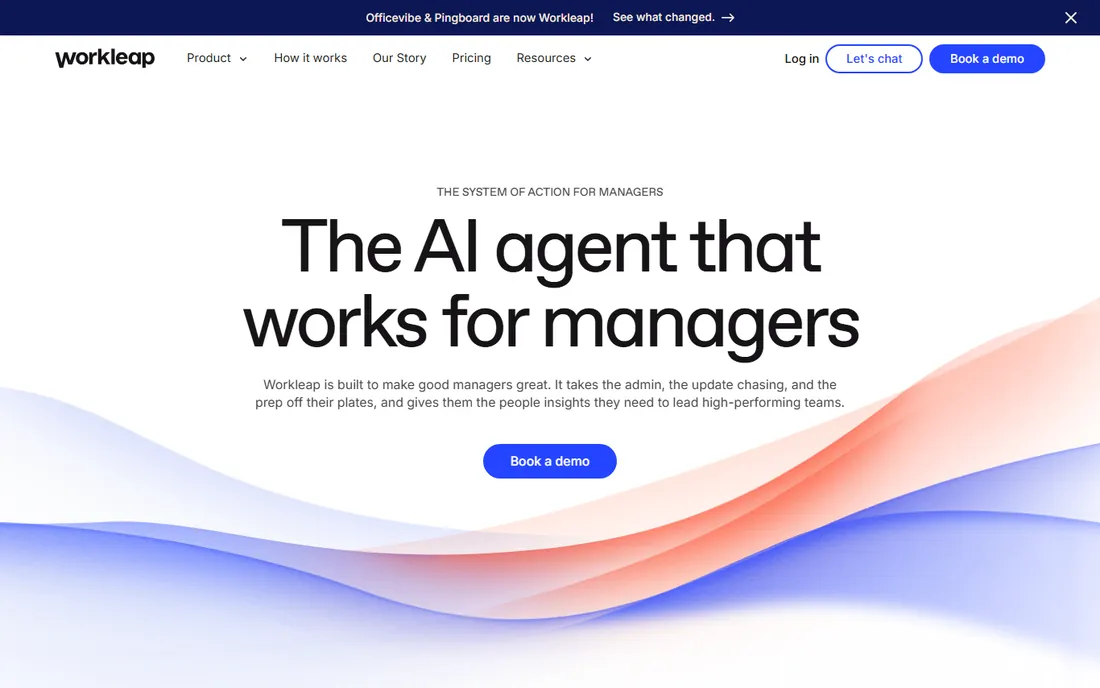
Workleap, formerly Officevibe, sells the low-admin survey: automated pulses, anonymous feedback and sentiment analysis that run themselves once configured. Delivery inside Slack and Teams meets employees where they already work, which is half the battle in survey response rates. For HR teams of one, the automation is the product.
The 2026 pricing change remade the buying math. Workleap moved from per-seat billing to flat annual tiers: Standard Platform at $4,999 per year, Pro at $11,999, Enterprise custom. For a 200-person company that is reasonable; for a 30-person team it is over $160 per head. There is no self-serve trial anymore. Buyers should confirm the current tiers on a demo and model the per-person cost at their headcount before anything else.
What we like- Automated pulse surveys with sentiment analysis that run without HR babysitting
- Native Slack and Teams delivery where employees already are
- Anonymous feedback workflows managers trust
Watch out for- Pricing changed in 2026 from per-seat to flat annual tiers starting at $4,999 per year, a steep floor for small teams
- No self-serve trial, every purchase starts with sales
#8
Achievers
Best for: Enterprises running recognition as a culture strategy
Visit achievers.com
Starting priceSee website (custom quote)
Free planNo
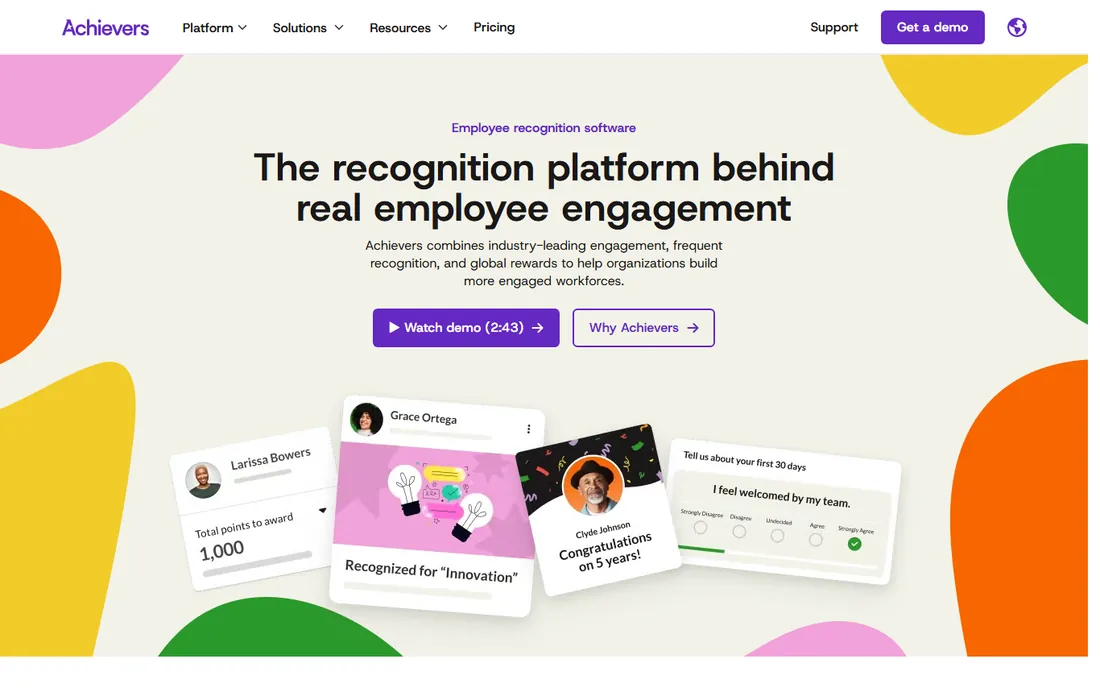
Achievers believes culture is built on recognition, and the platform is engineered around that belief: peer-to-peer recognition, points, rewards with global fulfillment, and analytics on who recognizes whom. Enterprises with distributed workforces use it to make appreciation systematic rather than accidental. The program design support helps large companies launch properly rather than just switching on software.
The purchase is enterprise in every dimension: custom quotes, no public numbers, and implementations measured in weeks with training and change management. It is also recognition-first, so companies that need deep survey analytics should pair it with a listening tool rather than expecting one platform to do both. For recognition-led culture programs at scale, Achievers is the category leader.
What we like- The deepest recognition and rewards platform in the category
- Global rewards fulfillment with local catalogs
- Strong adoption mechanics and program design support
Watch out for- No published pricing at all
- Implementation is a 6 to 12 week project
- Recognition-first, so survey depth trails the listening platforms
#9
Bonusly
Best for: Small and midsize teams starting with recognition
Visit bonusly.com
Starting price$3/user/month (Team, annual billing)
Free planYes (free plan up to 8 users)
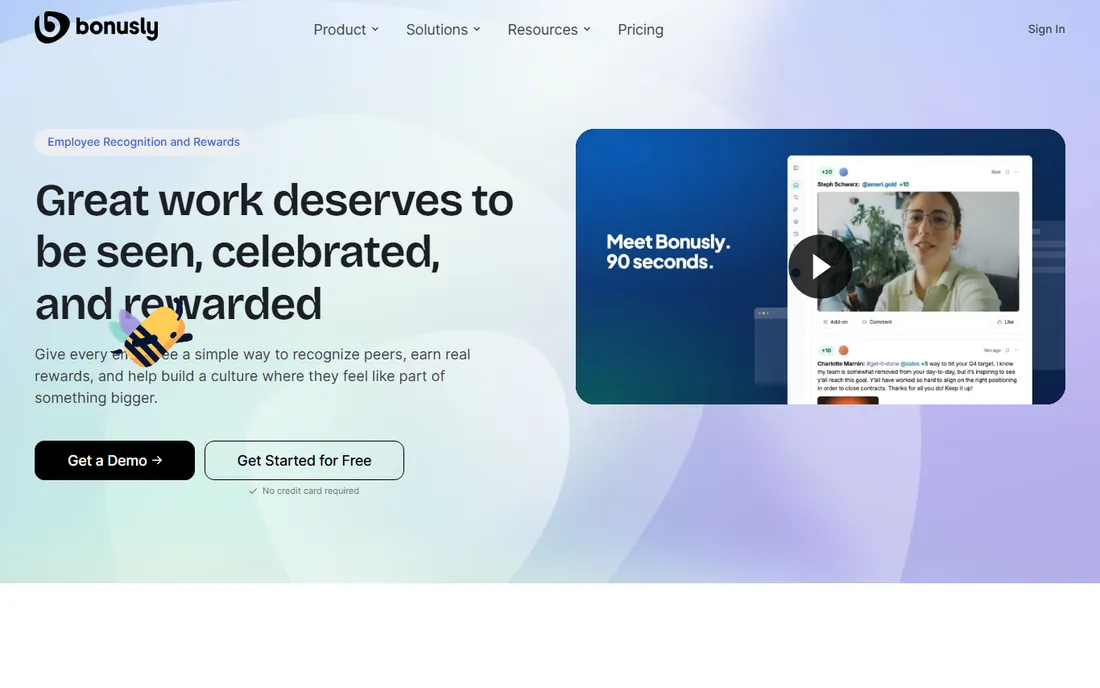
Bonusly is the affordable on-ramp: peer recognition, rewards and lightweight surveys with pricing anyone can read. Team at $3 per user per month (annual billing) covers recognition with milestones and analytics; the free plan handles up to 8 users; a 30-day trial needs no credit card. For a small company starting its first culture program, the combination of price and simplicity is unmatched.
The scope is narrower than the price suggests. Bonusly does recognition brilliantly and surveys adequately; it does not do the deep driver analysis or benchmarking of the listening platforms. Rewards money sits outside the subscription, so model that separately. But as the first EX tool a company buys, or the recognition layer alongside a survey platform, Bonusly's value is hard to argue with.
What we like- Published pricing, rare in this category
- Free plan for up to 8 users and a 30-day trial
- Recognition plus pulse surveys and analytics on one affordable platform
Watch out for- Recognition-first depth, so survey analytics trail Culture Amp and Lattice
- Rewards budgets are funded separately from the platform fee
Starting priceSee website (custom quote)
Free planNo
Quantum Workplace focuses on the step most platforms fumble: what happens after the survey. Results flow into action-planning workflows that hold managers accountable for follow-through, and the reporting is built for HR teams that need to show progress over time. It sits in the sensible middle: deeper than the recognition tools, more focused than the enterprise research platforms.
The buying experience is traditional mid-market SaaS: quoted pricing, demos, and a sales process. Companies that want published prices will prefer Lattice, 15Five or Bonusly. But for HR leaders whose last survey produced insight without action, Quantum Workplace's action-planning emphasis addresses the exact failure. Ask for the action workflow demo specifically; it is the differentiator.
What we like- Engagement surveys designed around manager action, not just measurement
- Strong reporting with team-level insights
- Good fit for midsize companies scaling their listening
Watch out for- Quote-based pricing with no public numbers
- Smaller ecosystem than the category leaders
What to run before you buy
Do not start with vendor demos. Start with one internal question: what decision will this data change? If the answer is vague, every platform will disappoint you, because software cannot fix an unclear purpose. The companies that get value from these tools name the decisions first: which managers need coaching, where attrition risk is rising, whether the new hybrid policy is working.
Then check your survey history honestly. If past surveys got low response rates, the problem is trust, not tooling, and no platform fixes that without a communication plan. If results were never shared with employees, expect cynicism about the new system. The best implementations start with a message from leadership: here is what we heard last time, here is what changed, here is what this tool measures next.
Finally, pilot with one department, not the whole company. Run two pulse cycles, share the results openly, and act on one finding visibly before expanding. The pilot proves the workflow: survey, analyze, act, communicate. Vendors will happily demo to executives; the pilot tells you whether managers will actually use it. Buy the platform that survives the pilot, not the one with the prettiest demo.
How we chose
We started with the searches HR buyers run: employee experience platform, employee engagement software, and pulse survey tools. For each candidate we checked the vendor's own pricing page, read public reviews on G2 and Capterra and practitioner discussion on Reddit and in HR communities, and compared survey depth, analytics, action workflows, recognition features and company-size fit. Where a vendor publishes no price we wrote "See website" rather than repeating estimates. Every tool here is a real product, available today.
The action-planning gap
Here is the industry's open secret: most engagement platforms measure well and act poorly. Dashboards get more engineering attention than the workflows that follow them, because measurement demos better than accountability. When evaluating, spend half the demo on what happens after results land. Can a manager build an action plan in the tool? Does anyone get reminded? Does leadership see follow-through rates?
The platforms handle this differently. Quantum Workplace and 15Five build action planning into the core workflow. Culture Amp offers it as part of the analytics suite. Recognition-led tools like Bonusly and Achievers act through a different mechanism entirely: the daily habit of appreciation rather than the quarterly plan. Neither approach is wrong, but they solve different problems. Survey-driven action fixes systemic issues; recognition fixes daily morale.
Set the expectation before launch that results will be shared and acted on, with names attached to actions. Anonymous data with accountable follow-up is the combination that works. The fastest way to kill an engagement program is a survey whose results disappear. The second fastest is action plans nobody checks. Buy the tool whose workflow makes both hard to skip, and assign one person to own the follow-through. Software enables accountability; it does not create it.
Frequently asked questions
What is an employee experience platform?
Software that measures how employees feel about work through surveys, then helps managers act on the results. The category includes listening-first suites (Culture Amp, Qualtrics, Peakon), performance-tied platforms (Lattice, 15Five, Leapsome), and recognition-led tools (Achievers, Bonusly). Most now combine surveys, feedback, goals and analytics in one place.
How much do employee experience platforms cost?
Published prices start at $3 per user per month (Bonusly), $4 (Lattice Engagement add-on, 15Five Engage), with Workleap from $4,999 per year on flat tiers. The enterprise listening tools (Culture Amp, Qualtrics, Peakon) are custom-quoted. Expect annual contracts everywhere except the smallest tiers, and model add-ons separately.
Which is better: Culture Amp or Lattice?
They solve different problems. Culture Amp leads on survey science, driver analysis and benchmarking: buy it when the question is understanding culture deeply. Lattice leads on connecting engagement to performance management: buy it when managers need surveys, reviews and goals in one workflow. Many midsize companies pick Lattice; many enterprises with people-analytics teams pick Culture Amp.
Do employee surveys actually improve engagement?
Only when results lead to visible action. Research consistently shows the survey itself changes nothing; the follow-through does. Companies that share results openly, pick a few actions, and report back see movement. Companies that file the report see cynicism rise. Buy the platform with the strongest action-planning workflow you will actually use.
Should we choose a recognition platform or a survey platform?
Recognition platforms (Bonusly, Achievers) build daily culture through appreciation; survey platforms (Culture Amp, Lattice, 15Five) diagnose systemic issues. Small teams often start with recognition because it is cheaper and immediately visible. Larger companies usually need both: recognition for morale, surveys for insight. Budget them as separate decisions.
How do we get employees to answer surveys?
Keep them short, share past results and what changed because of them, and deliver surveys where employees already work (Slack, Teams, mobile). Anonymity must be real and communicated. Response rates above 70 percent come from trust, not reminders. If trust is low, fix the communication before buying new software.
Sources we checked (2)
- https://www.g2.com/categories/employee-engagement
- https://www.capterra.com/employee-engagement-software/
Is your product missing or out of date?
We review this list regularly. Vendors can request a listing, send updated pricing or ask about featured placement.

Shihab Mia · Founder, Rankite
Shihab has spent more than a decade helping SaaS and e-commerce brands grow through search. He writes Rankite's software buying guides from pricing pages, documentation and public user reviews. More about Shihab.