How we make this list: we compare pricing pages, product documentation and public user reviews. Ratings come from G2, Capterra or Trustpilot, with the date we checked them.
Key takeaways
- An embedded integration platform lets your SaaS product offer native integrations to customers inside your own app, under your brand.
- Prismatic is the best embedded integration platform overall, with a visual builder, per customer deployment, and strong developer tooling.
- Paragon suits product teams that want a fast drop in Connect Portal with automatic OAuth refresh and AI agent support.
- Nango is the best code first choice, with a large connector catalog, open source components, and self hosting options.
- Workato Embedded suits enterprises already committed to Workato, with the largest connector catalog on this list.
- The right platform depends on whether your team prefers code first or low code building, and on how many connectors your customers need.
Quick comparison
| Tool | Best for | Starting price | Free plan |
|---|
 Prismatic | All round embedded iPaaS | See website | No |
 Paragon | Fast Connect Portal | See website | No |
 Nango | Code first embedding | Free | Yes |
 Workato Embedded | Enterprise embedding | See website | No |
 Pandium | Code first marketplace | See website | No |
 Cyclr | White label embedding | See website | No |
 Merge | Unified category APIs | See website | No |
 Tray Embedded | Workflow automation embedding | See website | No |
Is your product missing or out of date?
We review this list regularly. Vendors can request a listing, send updated pricing or ask about featured placement.
Starting priceSee website
Free planNo
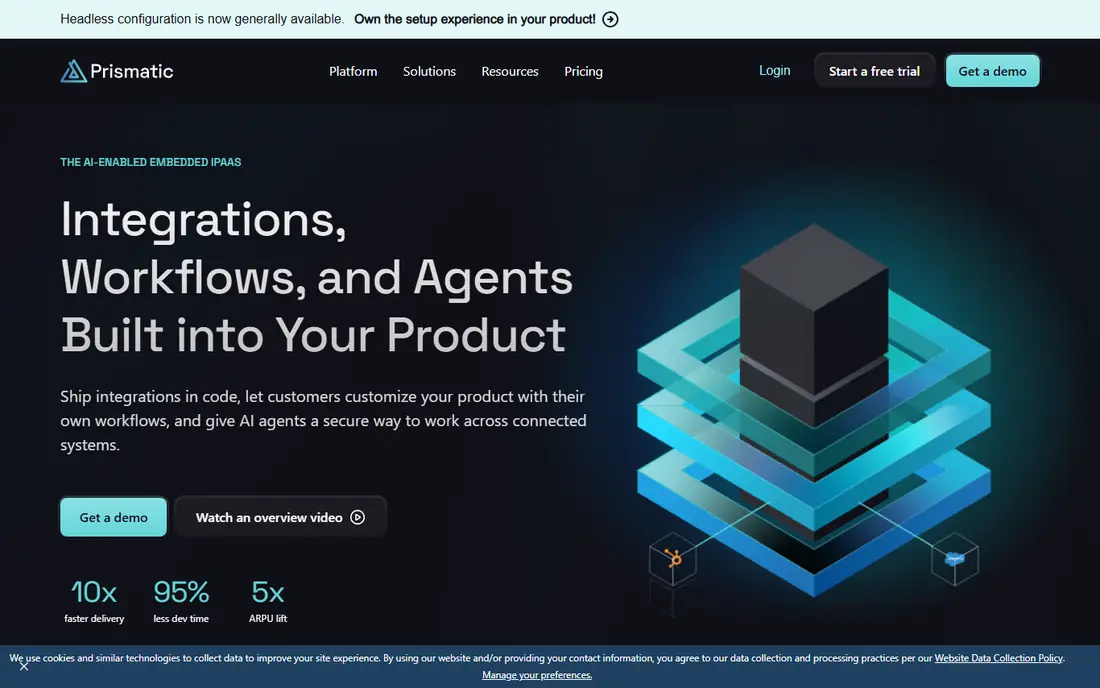
Prismatic is a natively embedded integration platform built for B2B SaaS, offering a visual workflow builder, per customer deployment with tenant keys, a TypeScript SDK for custom workflows and connectors beyond its prebuilt catalog, and MCP support for AI agent workflows. Its developer first design suits teams that need deep custom workflows per customer, not just standard syncs.
Prismatic uses enterprise tiered pricing based on active customer instances, its builder carries a learning curve for custom connectors, and its catalog of around 120 connectors is smaller than Workato. For a B2B SaaS team that wants the most complete embedded platform, Prismatic is the best choice.
What we like- Visual workflow builder
- Per customer deployment
- TypeScript SDK
- MCP support
Watch out for- Enterprise pricing
- Learning curve for custom connectors
- Smaller catalog than Workato
Starting priceSee website
Free planNo
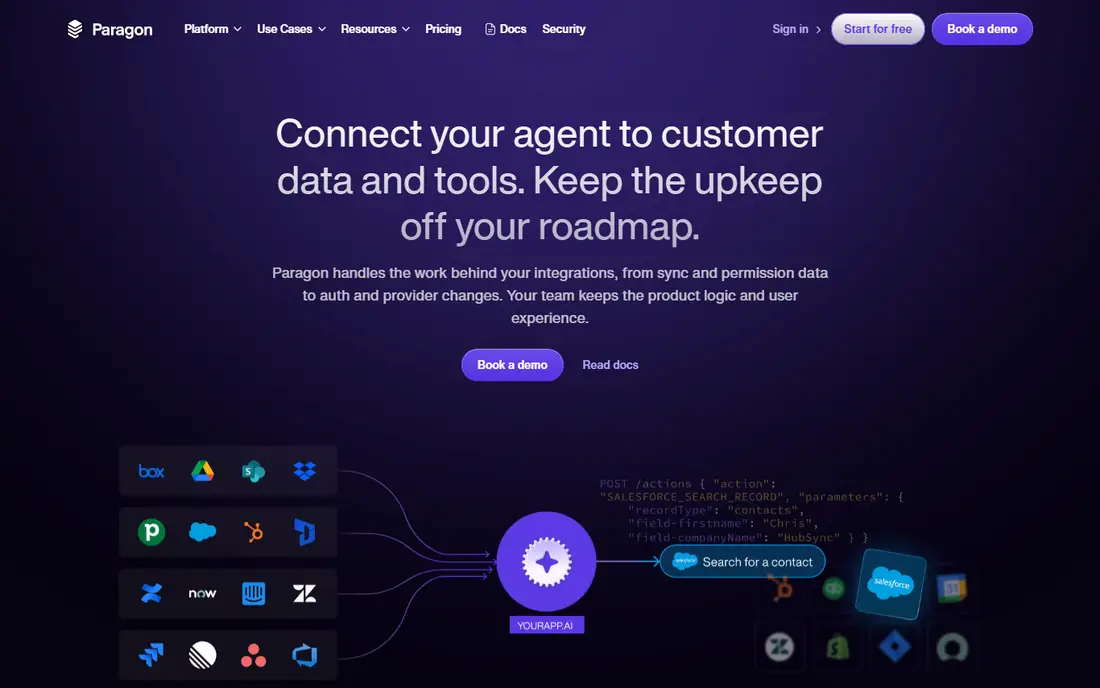
Paragon offers a fully white labeled Connect Portal that drops into your product with JavaScript, automatic per tenant OAuth refresh, a native MCP server with ActionKit agent tools, and real time synchronous actions alongside high volume data sync. That combination suits product teams that want fast time to market with a polished customer facing integration experience.
Its connector count sits around 100, pricing is usage based on connected users and workflow volume, and code first depth trails Nango. For a product team that wants the fastest polished embedded integration experience, Paragon is the best choice.
What we like- White labeled Connect Portal
- Automatic OAuth refresh
- Native MCP server
- Real time actions
Watch out for- Connector count around 100
- Usage based pricing
- Less code first depth than Nango
Starting priceFree
Free planYes
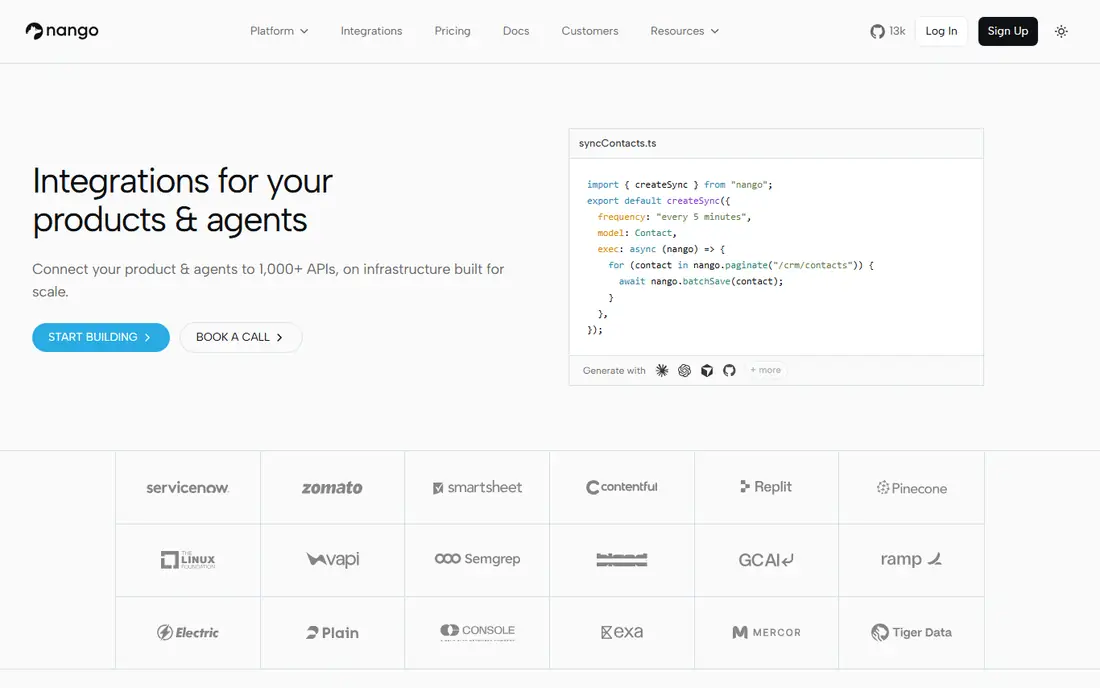
Nango is a developer first, code first embedded integration platform with a self hostable Connect UI, a catalog covering over 1000 APIs, webhooks, data syncs, and code level customization for customer facing SaaS and agent integrations. Its open source components and self hosting option on Enterprise suit engineering led teams that want full control over integration logic.
Code first means more engineering work than low code builders, some reviewers note gaps in published GDPR confirmation, and pricing scales with connections and usage. For engineering led teams that want code first control, Nango is the best choice.
What we like- Code first with open source components
- 1000 plus APIs
- Self hosting on Enterprise
- Webhooks and syncs
Watch out for- Code first means more engineering work
- GDPR confirmation gaps noted by reviewers
- Pricing scales with usage
Starting priceSee website
Free planNo
Workato Embedded brings the enterprise Workato platform into SaaS products, with branded access and fully embedded options, over 1200 enterprise connectors, enterprise MCP support, and Workato Copilots for AI assisted building. That scale suits large software vendors already committed to the Workato ecosystem who need deep enterprise connector coverage.
Pricing is high tier enterprise with annual contracts based on recipe usage, the architecture is heavy for standard SaaS products, and complexity exceeds purpose built embedded platforms. For enterprises already on Workato, Workato Embedded is the natural choice.
What we like- 1200 plus enterprise connectors
- Branded access and fully embedded options
- Enterprise MCP and copilots
Watch out for- High tier enterprise pricing
- Heavy for standard SaaS products
- Complex architecture
Starting priceSee website
Free planNo
Pandium is a code first embedded integration platform for teams that want full control in any language, with a customer facing integration marketplace where customers self serve and activate integrations. Its developer centric design suits teams that treat integrations as code and want marketplace style discovery for customers.
Reviewers note no native incremental data sync primitive and no documented MCP or LLM tool call runtime, and pricing combines a platform fee with per customer usage. For code first teams that want a customer marketplace, Pandium is a strong choice.
What we like- Code first control in any language
- Customer self serve marketplace
- 210 connectors
Watch out for- No native incremental sync primitive noted by reviewers
- No documented MCP runtime
- Platform fee plus usage
Starting priceSee website
Free planNo
Cyclr offers white labeled embedded integrations with over 600 fully managed connectors, per client branded consoles, deployment across shared, private, or self hosted cloud, and a multi tenant MCP PaaS with OAuth 2.1 support. Its security posture includes SOC 2 Type II and GDPR compliance, which suits regulated and enterprise SaaS.
Connector based costs add up, reviewers note a comparatively dated builder experience, and tiered pricing takes care to model. For teams that need white label embedding with deployment flexibility, Cyclr is a strong choice.
What we like- 600 plus managed connectors
- White label consoles
- Private cloud and self hosted options
- MCP PaaS
Watch out for- Connector based costs
- Dated builder experience noted by reviewers
- Tiered pricing complexity
Starting priceSee website
Free planNo
Merge is a unified API rather than a workflow platform, giving teams one normalized API per category such as HRIS, ATS, accounting, or CRM, so a single integration covers many apps in that category. That model suits teams that need broad standard data access fast, without building each app integration separately.
Merge is not a workflow platform, so deep custom logic outside standard schemas is limited, and category coverage varies. For broad standardized data access rather than custom workflows, Merge is the best choice, often paired with an embedded iPaaS for workflow depth.
What we like- One normalized API per category
- Fast broad coverage
- Usage based category pricing
Watch out for- Not a workflow platform
- Limited deep custom logic
- Category coverage varies
#8
Tray Embedded
Best for: Workflow automation embedding
Visit tray.io
Starting priceSee website
Free planNo
Tray Embedded offers workflow automation embedding with over 700 connectors, a low code builder, regional hosting in the US, EU, and APAC, and an agent gateway for MCP workflows. Its strength is general automation depth for mid to enterprise apps that need both internal and customer facing workflows.
Tray does not automatically refresh end user OAuth tokens, instead sending expiry warning webhooks that require re prompting users, its cost is enterprise oriented, and code first control is weaker than Nango or Pandium. For teams that prioritize low code automation breadth, Tray Embedded is a solid choice.
What we like- 700 plus connectors
- Low code workflow builder
- Regional hosting
- Agent gateway for MCP
Watch out for- No automatic OAuth refresh
- Enterprise oriented cost
- Weaker code first control
How we chose
We ranked platforms by embedding quality, connector breadth, developer experience, multi tenant management including OAuth refresh, security compliance, and pricing transparency, favoring platforms built for embedding from the start over retrofitted internal tools. We gave extra weight to automatic OAuth refresh and per customer deployment, since those decide operational burden once integrations ship, and to MCP and agent support, since AI products increasingly call integrations as tools. Prices are enterprise or usage based throughout, so starting prices are listed as See website except where a free tier applies.
Buying guide
Start by naming the integration job: deep custom workflows per customer fit Prismatic or Pandium, fast standard connections fit Paragon or Nango, broad category data fits Merge, and enterprise scale fits Workato Embedded or Tray. Matching the platform to the job matters more than connector counts, since a large catalog of shallow connectors helps less than deep control over the ten your customers actually use.
Next, trial with a real customer scenario. Build one integration end to end, including OAuth, a webhook, an error case, and a customer facing setup flow, and measure how long it takes and how much engineering it needs. Check OAuth refresh behavior, logging, and per customer monitoring, since those operational details decide support load after launch.
Finally, model pricing at scale. Price per connected customer, per workflow, and per API call differently, so forecast costs at your expected customer count before committing. The best embedded integration platform is the one whose builder your team enjoys, whose OAuth and monitoring reduce support tickets, and whose pricing stays sane as your customer count grows.
Frequently asked questions
What is an embedded integration platform?
An embedded integration platform lets you build native API integrations directly into your SaaS product, so customers connect their tools through your UI under your brand, rather than through a third party account.
How is embedded iPaaS different from Zapier?
Zapier customers connect apps through their own Zapier accounts, and you do not control the experience or per customer deployment. An embedded iPaaS runs inside your product, under your brand, with per customer monitoring and management.
What is a unified API and how does it differ?
A unified API gives you one normalized API for an entire category of apps, such as all HRIS systems, so one integration covers many apps. Embedded iPaaS gives you a builder and runtime for deep custom workflows per customer. Many teams use both.
Why does automatic OAuth refresh matter?
OAuth tokens expire, and without automatic refresh, customers must reconnect manually, which creates support tickets and broken integrations. Platforms like Paragon and Nango refresh automatically, while Tray sends expiry warnings instead.
How much does an embedded integration platform cost?
Costs range from free tiers on Nango to enterprise annual contracts on Workato Embedded, with most platforms charging per connected customer, per workflow, or per API call. Model pricing at your expected customer count before committing.
Sources we checked (0)
Is your product missing or out of date?
We review this list regularly. Vendors can request a listing, send updated pricing or ask about featured placement.

Shihab Mia · Founder, Rankite
Shihab has 5+ years in B2B and SaaS SEO. He writes Rankite's software buying guides from pricing pages, documentation and public user reviews. More about Shihab.