How we make this list: we compare pricing pages, product documentation and public user reviews. Ratings come from G2, Capterra or Trustpilot, with the date we checked them.
Key takeaways
- Workato and MuleSoft are the enterprise defaults, but neither publishes pricing, so budget for a sales cycle and five-figure-plus annual contracts.
- Boomi is the only enterprise iPaaS here with a self-serve entry price: $99 a month pay-as-you-go.
- Celigo is the NetSuite specialist, Jitterbit wins implementation surveys, SnapLogic sells AI-assisted build speed.
- n8n is the outlier: free to self-host, code-friendly, and billed per workflow run instead of per step.
Quick comparison
| Tool | Best for | Starting price | Free plan |
|---|
 Workato Workato | Business-led automation with IT governance | See website (custom quotes) | Free trial |
 MuleSoft MuleSoft | API-led integration in Salesforce estates | See website (custom quotes) | Free trial |
 Boomi Boomi | Enterprise iPaaS with a published entry price | $99/month (pay-as-you-go, plus $0.05 per message) | Free trial (30 days) |
 Tray.ai Tray.ai | AI-first orchestration for SaaS-heavy teams | See website (custom quotes) | Free trial |
 Jitterbit Jitterbit | Hybrid integration with endpoint pricing | See website (quoted by endpoint) | Free trial |
 Celigo Celigo | NetSuite-centric mid-market automation | See website (quoted) | Free trial (30 days) |
 SnapLogic SnapLogic | Fast pipeline building with AI assistance | See website (custom pricing) | Free trial |
 n8n n8n | Technical teams wanting self-hosting and code | €20/month (Cloud Starter, billed annually) | Yes (Community Edition, self-hosted) |
Is your product missing or out of date?
We review this list regularly. Vendors can request a listing, send updated pricing or ask about featured placement.
Starting priceSee website (custom quotes)
Free planFree trial
Workato is the platform business teams buy when IT says no to another six-month project. The recipe model, trigger plus actions in plain language, lets a RevOps manager automate Salesforce-to-Slack flows without filing a ticket. Underneath, IT keeps role-based access, environments, audit logs and SSO, so the freedom does not turn into shadow IT.
In 2026 Workato repositioned around agentic AI with its Workato One edition, adding agent orchestration, Recipe IQ and MCP support. The connector library is among the largest in the category. The catch is cost opacity. Independent buyer data puts typical contracts in the tens of thousands a year and up, and the per-recipe model means a successful rollout gets more expensive exactly when it proves its value. Negotiate usage caps before you scale.
What we like- Recipes that business users can build without waiting on IT
- 1,200-plus enterprise connectors including Salesforce, SAP and Workday
- Agent Studio and governance controls for AI workflows
Watch out for- No public pricing at all, which makes early budgeting guesswork
- Recipe-based costs accumulate fast as automation spreads
Starting priceSee website (custom quotes)
Free planFree trial
Nobody gets fired for buying MuleSoft, and the price reflects it. The Anypoint Platform is the deepest API-led integration product here: API Designer for specs, API Manager for policies and SLAs, DataWeave for heavy transformations, CloudHub for deployment. If your company runs Salesforce and treats APIs as products, this is the formal program the others approximate.
Salesforce ownership cuts both ways. Integration with the Salesforce stack is excellent, and the 2026 Agent Fabric launch extends the platform into governing AI agents. But contract negotiations after the acquisition are widely reported as painful, and infrastructure costs sit on top of an already steep license. This is a platform you buy with a multi-year plan and a dedicated team, not a tool you trial on a credit card.
What we like- Full API lifecycle in one platform, from design to monitoring
- Anypoint Exchange makes APIs reusable across teams
- Hybrid deployment covers cloud and on-prem
Watch out for- Highest cost of entry in this list
- Genuinely needs specialists, with a steep learning curve for new teams
#3
Boomi
Best for: Enterprise iPaaS with a published entry price
Visit boomi.com
Starting price$99/month (pay-as-you-go, plus $0.05 per message)
Free planFree trial (30 days)
Boomi is the only enterprise iPaaS here with a price on the website, and that alone makes it worth a look. The pay-as-you-go tier is $99 a month plus $0.05 per message, billed monthly with no contract, and a 30-day free trial comes with full platform access. For a team testing whether an iPaaS fits, that is a radically easier start than a six-week sales cycle.
Underneath, Boomi is a serious platform: 1,500-plus connectors, the lightweight Atom runtime for hybrid deployment, and a December 2024 Rivery acquisition that added ELT and change data capture. More than 30,000 organizations use it. The honest caveat is that Boomi stopped calling itself an integration company in 2026 and now leads with AI agents and data activation, so make sure the product you evaluate matches the workload you actually have.
What we like- The only enterprise vendor here with self-serve entry pricing
- Atom runtime deploys in cloud, on-premises or at the edge
- Named a Leader 12 times in the Gartner iPaaS Magic Quadrant
Watch out for- Everything above pay-as-you-go is quote-only
- The 2026 repositioning as a "data activation company" muddies the integration message
#4
Tray.ai
Best for: AI-first orchestration for SaaS-heavy teams
Visit tray.ai
Starting priceSee website (custom quotes)
Free planFree trial
Tray.ai, formerly Tray.io, rebuilt its story around AI while competitors were still bolting chatbots onto old canvases. The pitch is a single AI-native platform: integration, automation, AI agents and MCP governance together, with 700-plus connectors. Merlin, the AI builder, generates workflows from plain descriptions, and Tray Headless lets developers drive it from coding assistants like Claude Code.
The product is genuinely modern, with SOC 1 and SOC 2 Type 2 audits plus HIPAA and GDPR compliance. The commercial side is less modern: no published prices, three tiers described by workspaces and log retention, and usage metered in tasks. Expect an enterprise sales conversation. For SaaS-heavy teams that want AI agents wired into real systems with governance, it belongs on the shortlist next to Workato.
What we like- Merlin AI builds workflows from natural-language descriptions
- 700-plus connectors with MCP governance baked in
- Visual builder plus pro-code escape hatches for developers
Watch out for- No published pricing at any tier
- Cloud-only, with no on-premises option for strict data residency needs
Starting priceSee website (quoted by endpoint)
Free planFree trial
Jitterbit Harmony quietly wins implementation surveys while louder competitors win analyst slides. Five straight quarters atop G2's enterprise implementation index suggests something real: faster setup, better adoption, fewer stalled projects. The platform covers integration, workflow automation and low-code app development under one roof, with private agents for hybrid deployments that need to touch systems behind the firewall.
Pricing is endpoint-based rather than transaction-based, which some buyers prefer for predictability: you pay for the systems you connect, not every message that flows. The vendor does not publish the tiers, though third-party sources describe Standard, Professional and Enterprise bands. If your estate mixes cloud SaaS with on-premises ERP and you want one vendor for integration plus lightweight apps, Jitterbit deserves a demo.
What we like- Ranked number one in G2's Fall 2026 Enterprise Implementation Index
- Private agents reach on-premises systems cleanly
- Harmony bundles integration, automation and app development in one system
Watch out for- The vendor publishes no price list, so early comparisons rely on third-party reports
- Complex configurations still demand technical skill
Starting priceSee website (quoted)
Free planFree trial (30 days)
If NetSuite is your ERP, start your shortlist with Celigo. The company was founded by ex-NetSuite developers, and it shows: hundreds of prebuilt integration apps map to NetSuite's data model, from Shopify order sync to Salesforce customer flows, with SuiteApp connectivity that processes inside NetSuite. Ecommerce and retail teams routinely go live in weeks rather than quarters.
Celigo has expanded well beyond its iPaaS roots into API management, EDI and AI agents, all under one governance model, and it now calls itself an intelligent automation platform. The homepage claims the top G2 rating for iPaaS, and a 30-day trial gives full platform access. Pricing is quote-based and estimated in the mid five figures annually by third parties, which positions it below Workato and MuleSoft but firmly above self-serve tools. Outside NetSuite-centric use cases, verify the connector depth before committing.
What we like- Prebuilt Integration Apps for NetSuite, Shopify, Salesforce and more
- Marketplace templates cut weeks off common flows
- Flat-rate plans without per-transaction fees
Watch out for- Weaker fit outside the NetSuite ecosystem
- Quote-only pricing slows down early evaluation
Starting priceSee website (custom pricing)
Free planFree trial
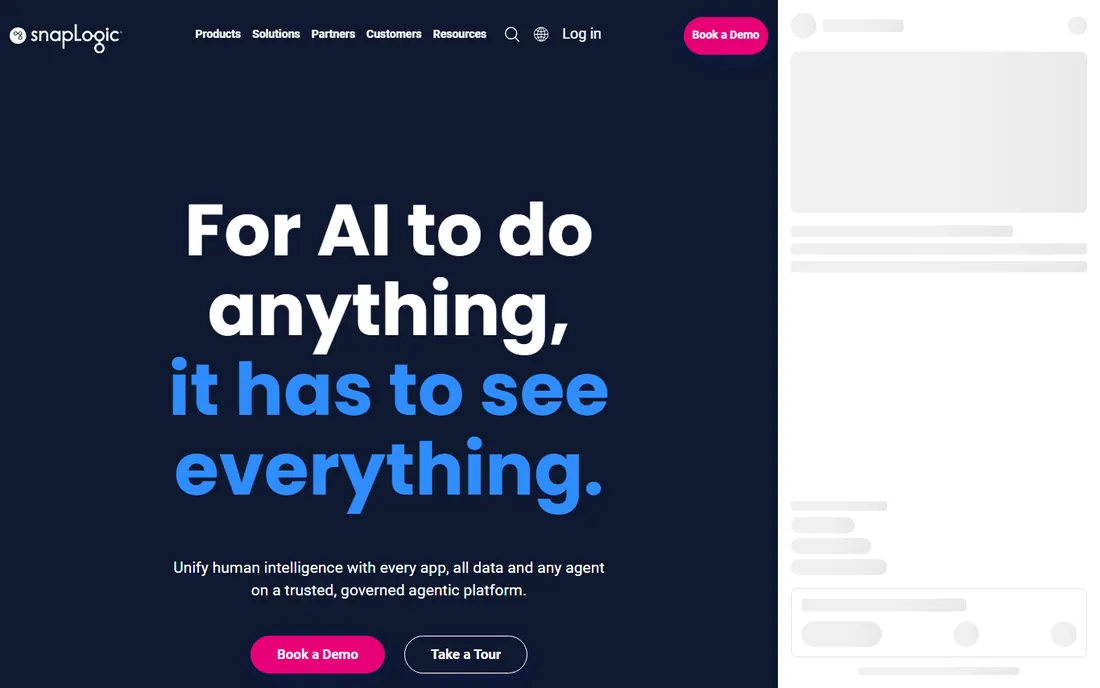
SnapLogic sells speed. Describe what you need in plain language and the AI generates a working pipeline; the visual canvas then lets you refine it. With 1,000-plus prebuilt connectors and the Snaplex execution architecture, which runs in the cloud, on-premises or both, it covers data integration, application integration and API management without forcing you into separate products.
The 2026 positioning centers on agentic integration: governed AI agents, multi-LLM support and an MCP server that turns any connector into an agent tool. Gartner named it a Visionary in the 2026 enterprise iPaaS Magic Quadrant. The commercial reality is enterprise-standard: custom quotes, no free tier, free trial available. Teams choosing between SnapLogic and Boomi usually decide on build speed versus deployment flexibility; run the same pipeline in both trials and time it.
What we like- AI assistance plans and builds pipelines from natural-language descriptions
- 1,000-plus prebuilt connectors on the vendor's count
- Handles streaming, real-time and batch in one platform
Watch out for- Custom pricing only, with no free plan
- The visual pipeline logic still takes training to master
#8
n8n
Best for: Technical teams wanting self-hosting and code
Visit n8n.io
Starting price€20/month (Cloud Starter, billed annually)
Free planYes (Community Edition, self-hosted)
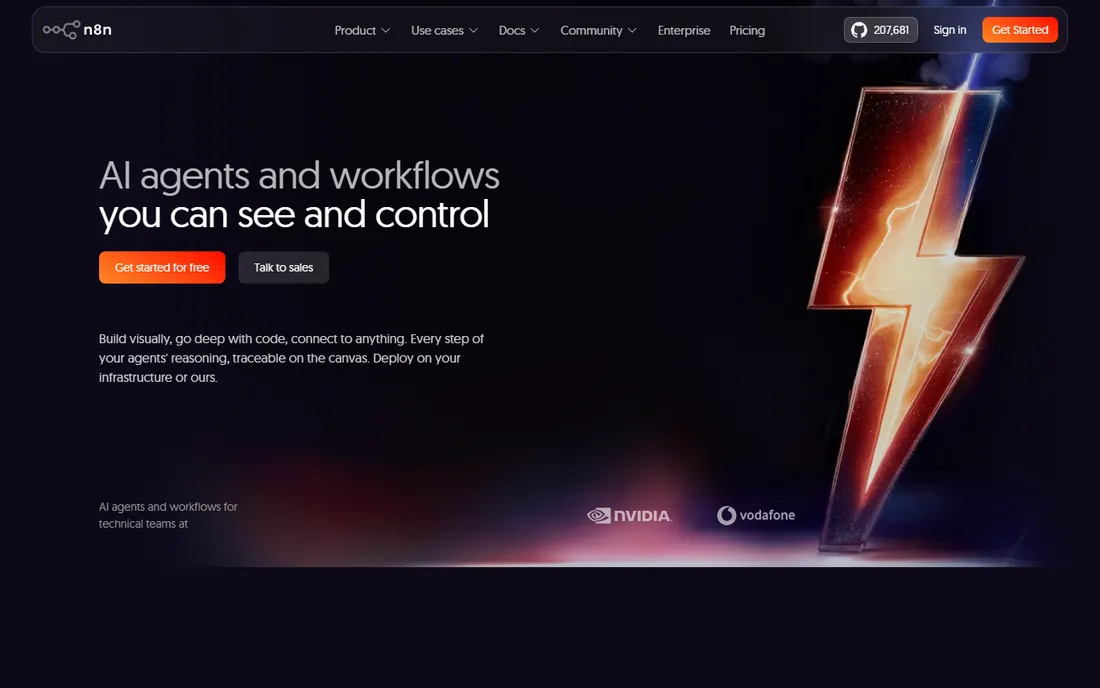
n8n is the outlier, and proud of it. Where every other tool here is closed SaaS with sales-led pricing, n8n is fair-code licensed, self-hostable, and developer-first. The Community Edition is free forever on your own server with unlimited executions; you pay only for the VPS underneath. The cloud Starter is €20 a month billed annually for 2,500 executions, and the billing unit is generous: one run of a 20-node workflow counts as one execution.
The product fits technical teams that find Zapier-style tools constraining. Every node accepts code, AI agent and MCP nodes ship in every plan, and the GitHub repository has over 200,000 stars with a genuinely active community. The trade-offs are real: no vendor SLA on the free tier, you handle upgrades and backups, and regulated buyers will need the paid tiers for SSO and audit features. For prototypes, internal tools and AI workflows, it is the cheapest serious option here.
What we like- Free self-hosted Community Edition with no execution meter
- Write JavaScript or Python inside any node
- Cloud billing counts workflow runs, not steps, so long workflows stay cheap
Watch out for- Self-hosting means you own uptime, patching and security
- The connector library is smaller than enterprise rivals at around 400 nodes
Forget the feature checklists; every vendor claims every feature. The real differences are who builds, where it runs, and how it bills. Workato and Celigo let business users build under IT governance. MuleSoft, Boomi and Jitterbit assume integration specialists. n8n assumes developers. Tray.ai and SnapLogic are betting that AI does most of the building soon.
Deployment matters just as much. Boomi, Jitterbit and MuleSoft reach on-premises systems through local runtimes or agents. Tray.ai is cloud-only. n8n runs wherever you put it, which is the whole point. If your ERP sits behind your firewall, that single fact eliminates half this list.
How we chose
We did not run hands-on trials. We read each vendor's pricing page, documentation and published architecture, then checked claims against public reviews on G2, Capterra and PeerSpot, plus technical discussions on Reddit and GitHub. We kept only platforms that exist today under their current names, which is why Tray appears as Tray.ai, not Tray.io. Enterprise tools with quote-only pricing stayed in because that is how the category actually buys; we marked them "See website" rather than inventing numbers.
The billing models, decoded
This category has at least five billing units, and comparing sticker prices across them is meaningless. Workato bills by recipes and tasks. MuleSoft licenses by capacity in a vCore-style model. Boomi meters messages. Jitterbit prices by endpoint. n8n counts workflow executions. A workload that is cheap on one can be ruinous on another.
The only honest comparison is your own workload priced three ways. Take your ten most important integrations, estimate monthly runs, and get quotes from your two enterprise finalists plus one transparent-priced alternative. Most teams discover the cheapest quote is not the cheapest platform once implementation services, premium connectors and overages are added. Budget the first year, not the first month.
Frequently asked questions
What is a cloud integration platform?
It is software that connects your cloud apps, on-premises systems, databases and APIs so data flows automatically between them. The category is usually called iPaaS, integration platform as a service. Typical jobs include syncing orders from Shopify to NetSuite or keeping Salesforce and your data warehouse in agreement.
How much does an iPaaS cost?
It ranges from free (n8n self-hosted) to $99 a month (Boomi pay-as-you-go) to quote-only enterprise contracts that independent buyer data places from tens to hundreds of thousands a year. Mid-market teams usually land between $1,000 and $5,000 a month once implementation is included.
Do I need an iPaaS, or is Zapier enough?
Zapier and Make handle simple app-to-app triggers well and cost far less. You need an iPaaS when you have hybrid systems behind a firewall, need API governance, run high-volume data pipelines, or must prove compliance with audit trails. If none of those apply, start cheaper and upgrade later.
What is the difference between iPaaS and API management?
An iPaaS connects systems and moves data between them. API management governs the APIs themselves: design, security policies, rate limits, developer portals and monitoring. MuleSoft and Boomi do both; Workato, Celigo and n8n lean toward integration and automation.
Can business users really build integrations themselves?
On Workato, Celigo and Tray.ai, yes, for standard flows, with templates and AI assistance doing the heavy lifting. Complex transformations, error handling and hybrid deployments still benefit from technical review. Plan for a center of excellence, not a free-for-all.
Is self-hosting n8n safe for production?
It can be, if you treat it like production infrastructure: backups, monitoring, restricted network access and prompt upgrades. Regulated industries usually need the paid tiers for SSO, audit logs and support. Do not self-host the Community Edition and then skip the maintenance.
Sources we checked (8)
- https://www.workato.com/pricing
- https://www.mulesoft.com
- https://boomi.com/
- https://tray.ai/
- https://www.jitterbit.com/
- https://www.celigo.com/
- https://www.snaplogic.com/
- https://n8n.io/pricing/
Is your product missing or out of date?
We review this list regularly. Vendors can request a listing, send updated pricing or ask about featured placement.

Shihab Mia · Founder, Rankite
Shihab has 5+ years in B2B and SaaS SEO. He writes Rankite's software buying guides from pricing pages, documentation and public user reviews. More about Shihab.