How we make this list: we compare pricing pages, product documentation and public user reviews. Ratings come from G2, Capterra or Trustpilot, with the date we checked them.
Key takeaways
- LaunchDarkly remains the most complete enterprise option, but its pricing model needs careful review before you scale connections and audience size.
- Flagsmith, ConfigCat and GrowthBook give smaller teams a clear starting point, with free tiers and simpler pricing than enterprise platforms.
- Open source and self hosted options such as Unleash and Flagsmith matter most for teams with strict data control or compliance needs.
- Experimentation is not the same as flagging, so teams that run frequent A/B tests should shortlist GrowthBook and Statsig ahead of flag only tools.
- Start with SDK coverage for your stack, because a flag system that lacks a solid SDK for your main language will slow every release.
Quick comparison
| Tool | Best for | Starting price | Free plan |
|---|
 LaunchDarkly | Large engineering orgs | See website | Yes |
 Flagsmith | Open source teams | $45 per month | Yes |
 ConfigCat | Simple, reliable flagging | $110 per month | Yes |
 Unleash | Self hosted enterprise flagging | See website | Yes |
 GrowthBook | Flags plus experimentation | $20 per user per month | Yes |
 Split by Harness | Experimentation led delivery | See website | Yes |
 Statsig | Product analytics plus flags | See website | Yes |
 DevCycle | Small teams that want speed | See website | Yes |
Is your product missing or out of date?
We review this list regularly. Vendors can request a listing, send updated pricing or ask about featured placement.
The best feature flag management software
Starting priceSee website
Free planYes
LaunchDarkly is the reference point in this category for a reason. It covers a wide range of languages and platforms, it handles percentage rollouts, targeted segments and scheduled releases in one place, and it gives platform teams the audit trail and permissions they need in a large org. When many services and teams share flags, that consistency matters more than any single feature.
The honest catch is cost and complexity. Pricing is tied to usage dimensions that grow with your product, so a team that starts small can face a larger bill as connections and monthly active users rise. LaunchDarkly fits best when you have a platform owner, clear flag hygiene rules, and enough services to justify enterprise governance.
What we like- Broad SDK coverage across server, mobile and edge
- Progressive rollouts and targeting in one workflow
- Strong governance, audit logs and enterprise security controls
Watch out for- Pricing scales with service connections and audience size, which can surprise teams
- Setup and governance take time to do well
- Smaller teams may pay for depth they do not use
Starting price$45 per month
Free planYes
Flagsmith suits teams that want control without building a flag system from scratch. The open source core means you can self host if data control matters, while the hosted version gives you a fast start with a free tier that covers early products. Remote config is a useful bonus, because it lets product teams change values such as copy or limits without a deploy.
The trade off is that Flagsmith is not the strongest choice for heavy experimentation programs. If your main need is simple, safe rollouts with clear targeting, it fits well. If you run constant A/B tests with advanced statistics, pair it with an experimentation tool or shortlist GrowthBook instead.
What we like- Open source core with SaaS, private cloud and self hosted options
- Free tier includes 50,000 API requests per month
- Remote config alongside flags
Watch out for- Experimentation depth is thinner than dedicated experimentation platforms
- Enterprise features sit behind higher tiers
- Smaller community than LaunchDarkly for some SDKs
#3ConfigCat
Best for: Simple, reliable flagging4.7/5 on
G2 (45 reviews, checked Oct 2026)
Visit configcat.com
Starting price$110 per month
Free planYes
ConfigCat is a good pick when you want flagging to be boring in the best sense: fast, predictable and easy to explain to a new developer. The free tier lets small teams start without a sales call, and the hosted service is designed to serve flag values quickly around the world. For many web and mobile products, that is all the flag system needs to do.
Where ConfigCat falls short is experimentation. It handles targeting and rollouts well, but teams that want built in statistical analysis and experiment management will need another tool. It is also worth checking seat and config limits on the Pro plan against your team size before you commit.
What we like- Fast global delivery through a content delivery network
- Clear pricing and a free tier with 10 config JSON files
- SDKs for many platforms with OpenFeature support
Watch out for- Less experimentation depth than GrowthBook or Statsig
- Advanced enterprise governance is thinner than LaunchDarkly
- Pricing jumps as flag and team needs grow
#4Unleash
Best for: Self hosted enterprise flagging4.7/5 on
G2 (137 reviews, checked Oct 2026)
Visit getunleash.io
Starting priceSee website
Free planYes
Unleash fits orgs that need to run flagging inside their own infrastructure or that want open source control with enterprise support. It supports gradual rollouts, targeting and environment separation, and it has a long track record in larger engineering teams. For regulated industries, the ability to self host can be the deciding factor.
The cost of that control is operations. Self hosting means you manage upgrades, backups and availability, and the paid cloud tier is priced per user at an enterprise level. Unleash is best when you have platform engineering capacity and a clear reason to host the system yourself.
What we like- Open source platform with self hosted and cloud options
- Strong progressive delivery and governance for larger teams
- Flexible strategies for gradual rollouts
Watch out for- Enterprise cloud pricing is high per user
- Self hosting adds operational work
- Setup takes more effort than a simple SaaS flag tool
#5GrowthBook
Best for: Flags plus experimentation4.6/5 on
G2 (26 reviews, checked Oct 2026)
Visit growthbook.io
Starting price$20 per user per month
Free planYes
GrowthBook is the strongest pick in this list for teams that want flags and experiments in one system. You can roll a feature out gradually, then run a controlled test on the same audience without stitching two tools together. The open source version and the free cloud tier make it easy to try with a small team before you pay.
The catch is that experimentation value depends on your data. GrowthBook works best when you already send clean events or connect a warehouse, because weak event data leads to weak experiment results. It also lacks some of the enterprise governance depth of LaunchDarkly, so very large orgs should check permissions and audit needs during a trial.
What we like- Combines feature flags with A/B testing and a strong statistics engine
- Open source with self hosted and cloud options
- Free tier for up to 3 users
Watch out for- Flag governance is less deep than LaunchDarkly
- Experimentation setup needs data warehouse or event data to shine
- Pricing rises with team size on cloud plans
#6
Split by Harness
Best for: Experimentation led delivery
Visit split.io
Starting priceSee website
Free planYes
Split, now part of Harness, is built for teams that treat every release as a chance to learn. Its experimentation features, metrics and targeting go deeper than a simple on and off flag, which suits growth stage companies that test pricing, onboarding and feature changes often. Being part of Harness also helps teams that already use Harness for delivery.
The downside is price and packaging. Public pricing is limited, and smaller teams may find the entry cost hard to justify when simpler tools cover basic flagging. Split fits best when experimentation is a core product habit, not an occasional test, and when you have budget for a platform rather than a single tool.
What we like- Strong experimentation and analytics focus
- Targeting and rollout controls built for product teams
- Now part of the Harness platform for wider delivery workflows
Watch out for- Pricing is quote based and can be high for smaller teams
- Feature flagging may sit inside a larger Harness purchase
- SaaS only hosting limits self hosted options
#7Statsig
Best for: Product analytics plus flags4.7/5 on
G2 (348 reviews, checked Oct 2026)
Visit statsig.com
Starting priceSee website
Free planYes
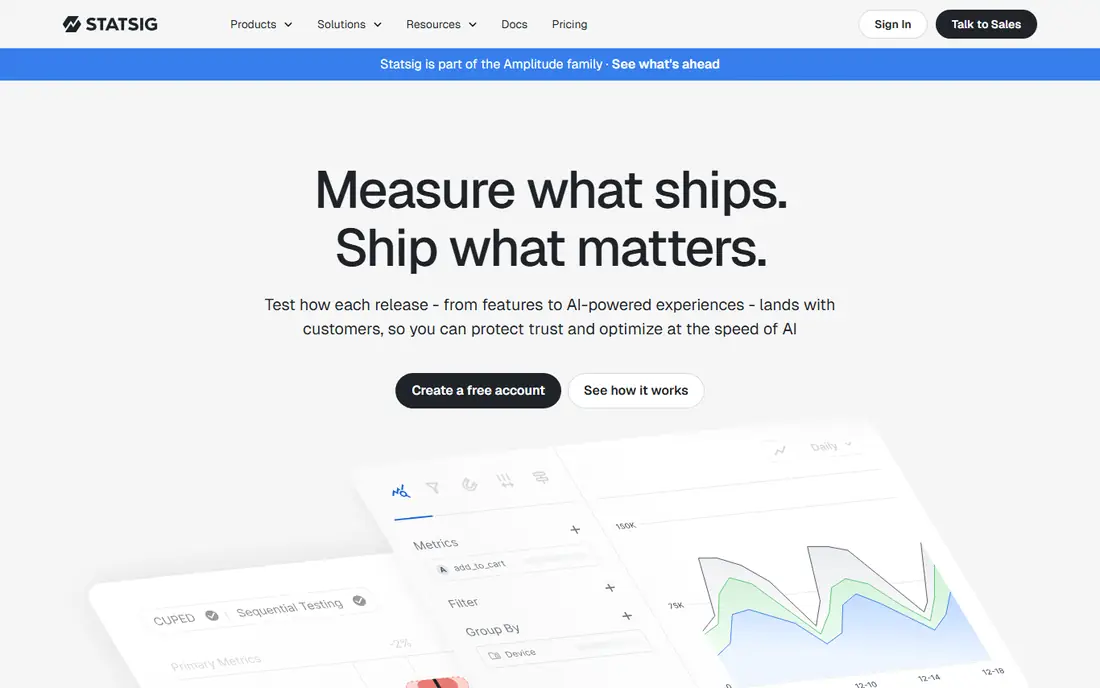
Statsig appeals to product led teams that want flags, experiments and analytics in one place. Instead of sending flag data to a separate analytics tool, you can see how a flagged feature changes usage in the same system. That closeness helps teams move from a rollout decision to a product decision without extra reporting work.
The trade off is scope and cost. If you only need flags, Statsig can feel larger than necessary, and analytics pricing based on events needs review as your product grows. It fits best for teams that already track product events and that want experimentation tied directly to those events.
What we like- Combines flags, experimentation and product analytics
- Free tier for feature flags in many cases
- Strong for teams that already measure product usage closely
Watch out for- Analytics event volume can drive cost on paid plans
- Flag only teams may find the platform broader than needed
- Setup needs care around event naming
#8DevCycle
Best for: Small teams that want speed4.5/5 on
G2 (36 reviews, checked Oct 2026)
Visit devcycle.com
Starting priceSee website
Free planYes
DevCycle is a practical choice for teams that want to start flagging this week without a long evaluation. The dashboard is straightforward, targeting covers the common cases, and the free tier is enough to prove value on a small product. For startups and small product teams, that speed matters more than enterprise features they will not use yet.
The limit appears as you scale. Larger orgs with complex permissions, audit needs and many services will likely outgrow DevCycle sooner than they outgrow LaunchDarkly or Unleash. Treat it as a strong starting tool, and plan a migration checkpoint when team size or service count doubles.
What we like- Fast setup for small and mid size teams
- Clean dashboard and targeting for common rollout cases
- Free tier for getting started
Watch out for- Enterprise governance and scale depth trail LaunchDarkly and Unleash
- Smaller ecosystem of integrations
- Advanced experimentation is limited
How we chose
We compared flag systems using vendor pricing pages, documentation, SDK lists and public reviews on G2, Capterra and Reddit, plus checks for OpenFeature support, hosting options and company size fit. We favored tools that are actively maintained, that cover common server and mobile SDKs, and that offer a free tier or clear paid entry point. Tools were left out when they were discontinued, when they were only a small library rather than a managed flag service, or when pricing and hosting details could not be confirmed.
Start with your stack, not with the feature list. List every language and platform you ship to, then confirm each shortlisted tool has a maintained SDK for those platforms and supports OpenFeature if your team wants to avoid lock in. A missing SDK is a daily tax on developers, while a missing dashboard feature is usually a weekly annoyance.
Test targeting, rollout and cleanup in a trial
Create a test flag, target it to a small internal group, roll it to 10 percent of users, then turn it off and remove it from code. That short loop reveals more than a demo, because it shows how targeting, caching and cleanup actually work. Pay attention to how the tool handles stale flags, because flag debt is the most common long term cost in this category.
Price for your second year, not your first month
Flag costs grow with users, connections and seats, so model pricing at twice your current size. Ask vendors how service connections, monthly active users and seats are counted, and get renewal terms in writing for paid plans. A tool that is cheap for five developers can become expensive for fifty, and that change often arrives at renewal time.
Frequently asked questions
What is feature flag management software?
It is software that lets teams turn features on or off without deploying new code. Teams use flags for gradual rollouts, testing with a small group, turning off a faulty feature quickly, and targeting features to specific users or plans. Good flag tools also track who changed a flag, when it changed, and which users saw each version.
Which feature flag tool is best for small teams?
Flagsmith, ConfigCat and GrowthBook are strong starting points for small teams, because they offer free tiers and clear paid plans. DevCycle is also worth a trial for teams that want a fast setup. Pick the one with the best SDK for your stack, and check that its free tier covers your expected API or user volume.
Is LaunchDarkly worth the cost?
For large orgs with many services, teams and compliance needs, LaunchDarkly often justifies its cost through governance, audit logs and broad SDK coverage. For a small team with one service and simple rollouts, the same depth may be more than needed, and a simpler tool will cost less. Model pricing at your expected scale before you decide.
Can I self host a feature flag tool?
Yes, Flagsmith, Unleash and GrowthBook offer self hosted or open source options. Self hosting gives you more control over data and availability, but it also adds operational work for upgrades and monitoring. Choose self hosting when data control or compliance requires it, not only to save on a SaaS fee.
Do feature flag tools replace A/B testing tools?
Not always. Basic flag tools handle rollouts and targeting, but they may lack statistical analysis for experiments. GrowthBook and Statsig combine flags with experimentation, while Split focuses heavily on experimentation. If you run frequent tests, shortlist a tool with built in experiment analysis rather than adding a separate testing tool later.
How do I avoid flag debt?
Set an expiry or review date for every flag, assign an owner, and remove the flag from code once the rollout is complete. Review the flag list each sprint, and treat stale flags as technical debt in planning. Tools with flag cleanup reports and code references make this habit easier to keep.
Sources we checked (9)
- https://www.launchdarkly.com
- https://www.flagsmith.com
- https://www.configcat.com
- https://www.getunleash.io
- https://www.growthbook.io
- https://www.split.io
- https://www.statsig.com
- https://www.devcycle.com
- https://www.flagsmith.com/blog/top-7-feature-flag-tools
Is your product missing or out of date?
We review this list regularly. Vendors can request a listing, send updated pricing or ask about featured placement.

Shihab Mia · Founder, Rankite
Shihab has 5+ years in B2B and SaaS SEO. He writes Rankite's software buying guides from pricing pages, documentation and public user reviews. More about Shihab.