How we make this list: we compare pricing pages, product documentation and public user reviews. Rankite is independent; if a vendor ever pays for a featured spot, that listing is clearly labeled Partner.
Key takeaways
- TestRail and Tricentis qTest lead enterprise test management with comprehensive case organization and reporting.
- PractiTest offers flexible, modern test management with good customization for agile teams.
- Zephyr integrates natively with Jira for teams wanting test management inside their existing workflow.
- Testmo and Qase provide contemporary alternatives with clean interfaces and straightforward pricing.
- TestMonitor and aqua serve teams wanting visual test management with strong collaboration features.
Testing without management is chaos
Software testing generates enormous organizational complexity: thousands of test cases across features, multiple test cycles per release, results from manual and automated execution, defects linked to requirements, and the eternal question of whether the software is ready to ship. Without test management, this lives in spreadsheets that diverge, get lost, and cannot answer basic questions about coverage or quality.
Test management tools provide the system of record for QA. Test case repositories with versioning, test plan organization, execution tracking across cycles, defect integration with Jira and similar tools, and the reporting that tells stakeholders the real quality status. The best tools make the testing process visible and manageable.
We compared eight test management platforms on case organization, execution workflows, integrations, reporting depth, and fit for different team sizes and methodologies. The evaluation focused on how tools perform in real QA operations rather than demo scenarios, since test management succeeds or fails on daily usability.
Quick comparison
| Tool | Best for | Starting price | Free plan |
|---|
 Tricentis qTest Tricentis qTest | Enterprise test management | See website | Free trial |
 PractiTest PractiTest | Flexible modern management | See website | Free trial |
 Zephyr Zephyr | Jira-native testing | See website | Free trial |
 Testmo Testmo | Contemporary unified testing | See website | Free trial |
 Qase Qase | Simple modern management | See website | Yes |
 TestRail TestRail | Comprehensive test cases | See website | Free trial |
 TestMonitor TestMonitor | Visual test management | See website | Free trial |
 aqua aqua | Collaborative QA platform | See website | Free trial |
Is your product missing or out of date?
We review this list regularly. Vendors can request a listing, send updated pricing or ask about featured placement.
Starting priceSee website
Free planFree trial

Tricentis qTest provides enterprise-grade test management with comprehensive test case organization, execution tracking, and reporting. The platform scales to large QA organizations with complex requirements, and integration with Tricentis's automation tools creates a unified testing ecosystem. Enterprises with serious QA processes rely on qTest's depth.
The enterprise orientation brings complexity and cost that smaller teams cannot justify. But for large organizations, the governance, traceability, and reporting capabilities are essential. qTest handles the test management needs that simpler tools cannot.
The Tricentis ecosystem integration is the strategic advantage. Test management connected to automation, performance, and data integrity provides the complete quality picture that enterprise QA demands. Organizations standardizing on Tricentis get a coherent toolchain rather than disconnected point solutions.
What we like- Comprehensive enterprise, Good Tricentis integration, Strong reporting, Scalable
Watch out for- Enterprise pricing, Complex, Can feel heavy
Starting priceSee website
Free planFree trial

PractiTest offers flexible test management that adapts to how teams actually work rather than forcing rigid processes. The customization handles diverse methodologies, from traditional waterfall to modern agile, and the interface is contemporary. Teams appreciate the ability to configure fields, workflows, and reports to their needs.
Per-user pricing adds up for large teams. But the flexibility is the value: PractiTest molds to your process instead of demanding process change. Agile teams particularly value the adaptability.
The platform's continued development adds AI-assisted features and improved integrations. For teams wanting modern test management without enterprise heaviness, PractiTest hits the sweet spot. The custom dashboards let different stakeholders see the quality metrics relevant to their decisions.
What we like- Highly customizable, Good for agile, Modern interface, Flexible workflows
Watch out for- Pricing per user, Can feel complex, Smaller ecosystem
Starting priceSee website
Free planFree trial
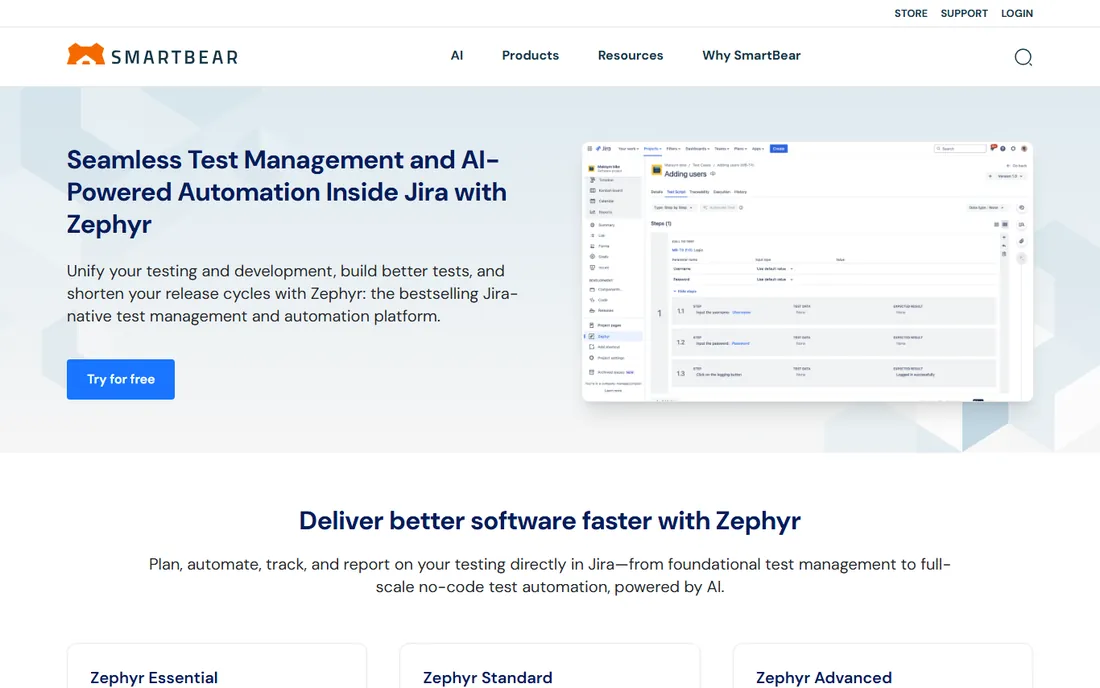
Zephyr, part of SmartBear, brings test management inside Jira where development teams already work. Test cases, execution, and defects live alongside user stories and tasks, eliminating the context switching that plagues separate tools. Atlassian shops get testing without new platforms.
The Jira dependence limits standalone appeal. But for the vast Jira user base, native integration is transformative. Testing becomes part of development workflow rather than a separate silo.
Teams committed to Atlassian should evaluate Zephyr first. The workflow continuity improves both QA efficiency and developer collaboration. The traceability from requirements through tests to defects satisfies audit needs in regulated industries.
What we like- Native Jira integration, Good for Atlassian shops, Familiar workflow, Solid features
Watch out for- Jira dependent, Less standalone, SmartBear owned
Starting priceSee website
Free planFree trial
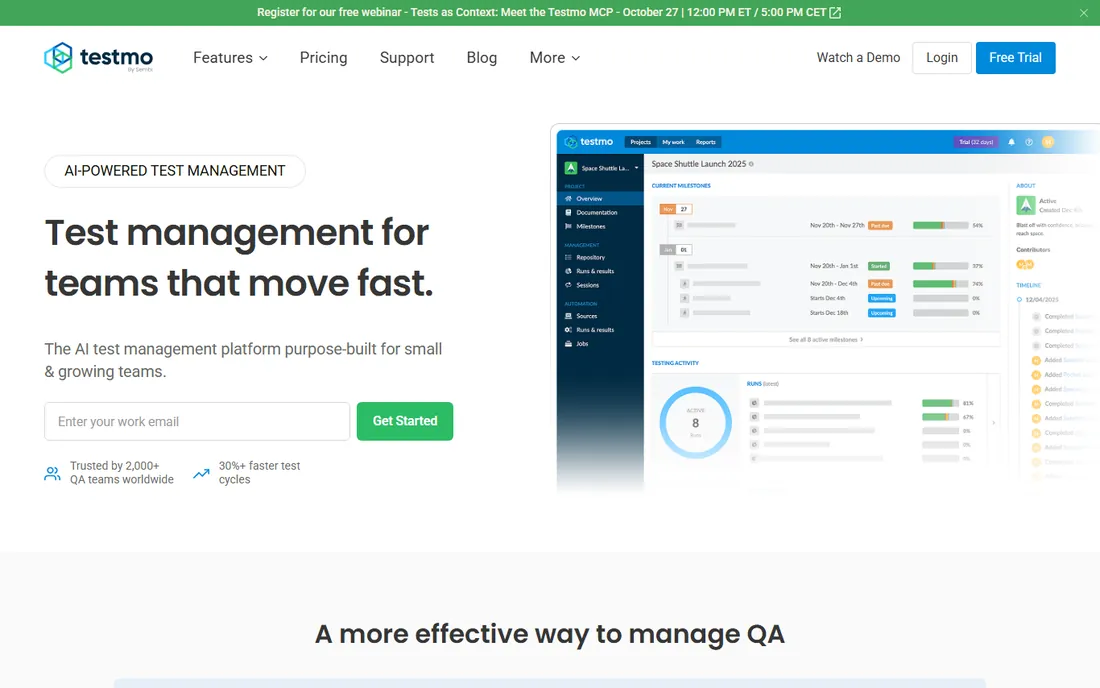
Testmo provides a modern, unified test management platform handling manual cases, exploratory sessions, and automated results in one system. The user experience reflects contemporary design, and the unified approach eliminates the tool fragmentation that complicates QA reporting. Pricing is accessible.
As a newer vendor, enterprise proof points are fewer. But the product quality impresses, and the unified vision addresses real QA pain. Teams tired of stitching tools together find Testmo refreshing.
For modern QA teams wanting one platform for all testing activities, Testmo's unified approach is compelling. The exploratory testing session management is particularly well designed, capturing the unstructured testing that finds the bugs scripted cases miss.
What we like- Modern unified platform, Good UX, Handles manual and automated, Reasonable pricing
Watch out for- Newer vendor, Smaller ecosystem, Less enterprise proof
Starting priceSee website
Free planYes

Qase offers straightforward test management with a clean interface and generous free tier. Teams get case organization, execution tracking, and reporting without complexity. The simplicity encourages adoption, which is half the battle in test management.
Enterprise depth trails the leaders. But most teams do not need enterprise depth; they need the basics done well. Qase's focus on simplicity over features is deliberate and effective.
For small to mid-size teams wanting modern test management without overhead, Qase is the accessible choice. The free tier makes trying it easy. The API enables integration with CI pipelines, so automated results flow into the same system as manual testing.
What we like- Clean and simple, Good free tier, Easy to adopt, Modern design
Watch out for- Less enterprise depth, Smaller company, Limited advanced
Starting priceSee website
Free planFree trial
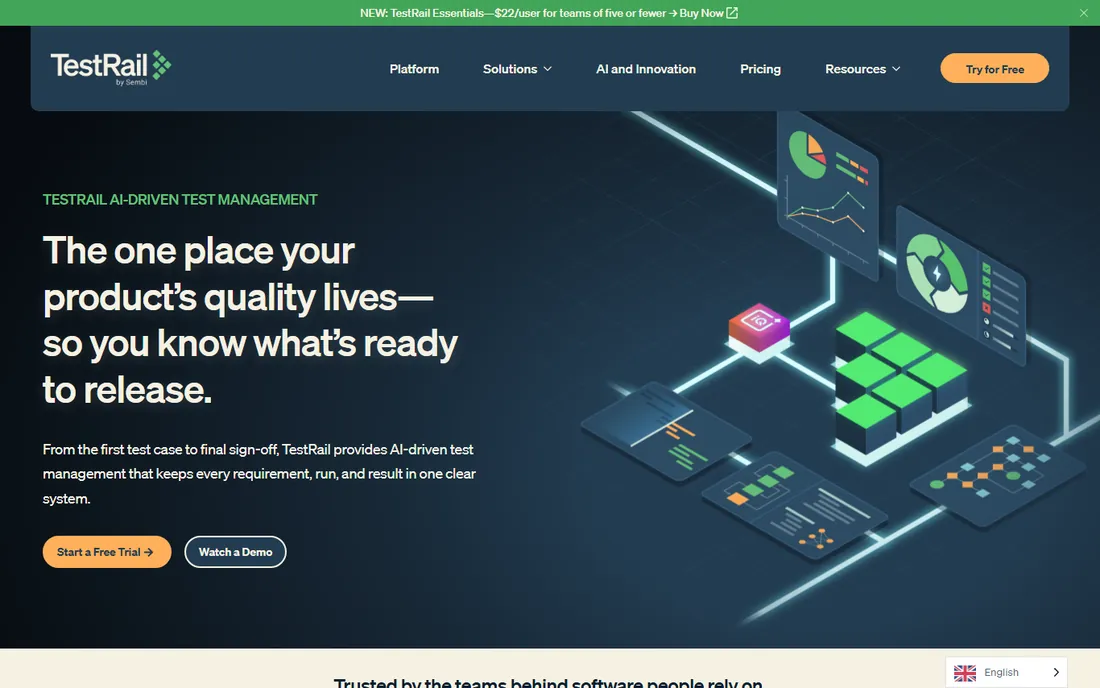
TestRail has organized test cases for thousands of teams with its straightforward, effective approach. The case repository, test plans, and execution tracking cover the essentials thoroughly. Wide adoption means community knowledge and integrations abound.
The interface feels dated compared to modern alternatives. But the functionality is proven over years of production use. Teams value reliability over novelty in test management.
For organizations wanting the safe, established choice, TestRail's track record reassures. The product does the core jobs dependably. The extensive integration library connects TestRail to virtually every development and automation tool teams use.
What we like- Excellent case organization, Widely adopted, Good reporting, Trusted
Watch out for- Interface dated, Pricing per user, Less modern feel
Starting priceSee website
Free planFree trial
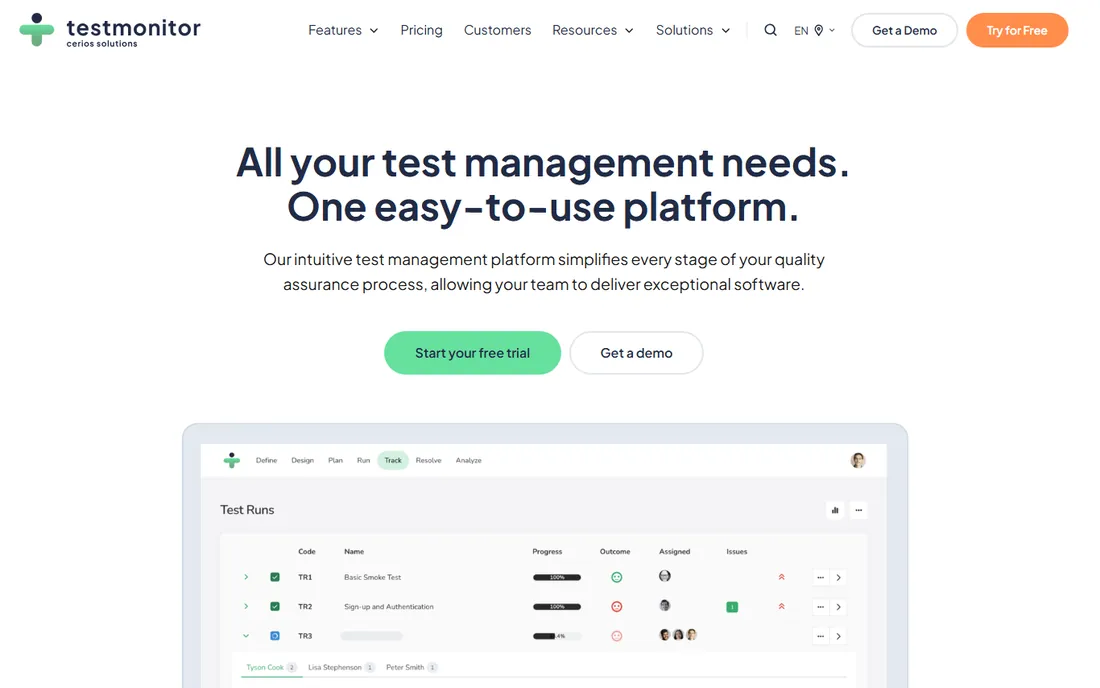
TestMonitor emphasizes visual, intuitive test management that teams learn quickly. The collaboration features help distributed QA teams work together, and the reporting presents quality status clearly to stakeholders. The approachable design reduces training needs.
Automation integration depth trails the leaders. But the visual clarity is the differentiator: stakeholders understand test status without QA translation. Teams value the communication improvement.
For QA teams prioritizing clarity and collaboration, TestMonitor's visual approach works well. The milestone tracking helps teams communicate progress toward release readiness in terms stakeholders understand intuitively.
What we like- Visual and intuitive, Good collaboration, Easy to learn, Nice reporting
Watch out for- Smaller vendor, Less automation depth, Limited ecosystem
Starting priceSee website
Free planFree trial
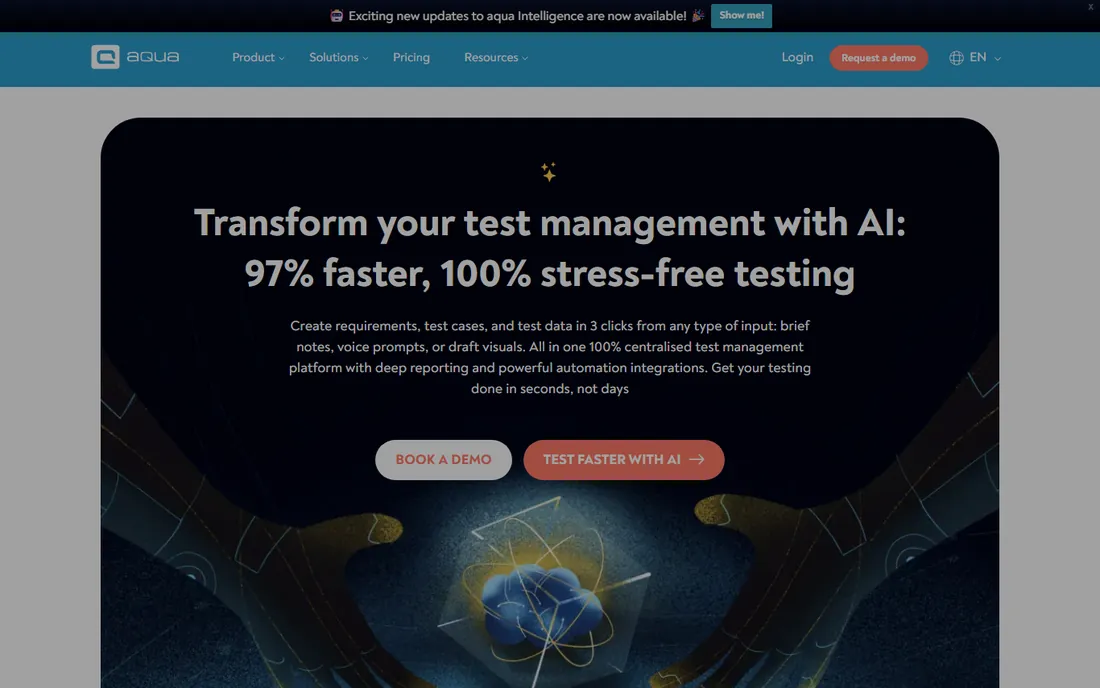
aqua provides a collaborative QA platform handling test management across methodologies. The modern architecture supports both traditional and agile teams, and the collaboration features connect QA with development effectively.
Brand recognition is limited. But the product capabilities impress those who evaluate it. Growing adoption suggests positive trajectory.
For teams wanting a fresh, collaborative approach to test management, aqua deserves consideration. The AI-assisted test case generation helps teams build comprehensive coverage faster than manual authoring alone.
What we like- Good collaboration, Modern platform, Handles diverse testing, Growing
Watch out for- Less known, Smaller ecosystem, Newer
How we chose
We evaluated test organization effectiveness, execution workflow quality, and reporting usefulness. Integration with development tools, particularly Jira, mattered significantly. We weighted real QA team feedback over feature lists.
We considered methodology fit, since agile and traditional teams need different things. Pricing accessibility and ease of adoption counted. We also evaluated mobile testing support and the ability to manage testing across web, mobile, and API in unified workflows.
Implementing test management
Start with case organization. Import or create your test cases with clear structure before worrying about advanced features. The repository is the foundation; everything else builds on organized cases. Resist the urge to customize extensively before the basics work smoothly. Teams that nail the fundamentals first adopt more successfully than those chasing advanced features prematurely. The simple discipline of organized test cases pays dividends long before any advanced reporting matters. Start simple, prove value, then expand the implementation based on demonstrated needs and team feedback over time together successfully.
Then integrate with development. Connect to Jira or your tracker so defects flow naturally. The integration eliminates the manual linking that consumes QA time and introduces errors. Bi-directional sync ensures developers see test context without leaving their workflow.
Finally, report meaningfully. Use the dashboards to communicate quality status to stakeholders regularly. The visibility builds trust in QA and informs release decisions with data rather than gut feel. Establish a regular quality review cadence so the data drives continuous improvement, not just release gates.
A final note on pricing: always verify the latest plans on the vendor's own page, as packaging changes are common. If a free trial is offered, run it against your actual workflow for a week or two. That real-world test is the most reliable buying signal you have.
Frequently asked questions
What is test management software?
Software that organizes test cases, plans test execution, tracks results, and reports on quality. It provides the system of record for QA activities, replacing spreadsheets with structured workflows.
Do agile teams need test management?
Yes, though lighter weight than traditional. Agile teams need case organization, execution tracking, and coverage visibility. Modern tools like Qase and Testmo suit agile better than heavyweight enterprise platforms.
How is this different from test automation?
Test management organizes the testing process; automation executes tests. They complement each other: management tracks what to test and results, automation performs the execution. Most teams need both. The management layer becomes more valuable as automation grows, since someone must organize the expanding test suites.
Should test management live in Jira?
For Jira-centric teams, Zephyr's native integration is compelling. Others prefer dedicated tools with Jira integration. The choice depends on how central Jira is to your workflow. Consider whether your QA team thinks in Jira issues or in test cases; the mental model should drive the tool choice.
How much does test management cost?
From free tiers to $30-50 per user monthly for professional tools. Enterprise platforms cost more. The ROI comes from QA efficiency and better release decisions. Factor in the cost of poor quality, escaped defects, delayed releases, when justifying the investment to stakeholders.
Sources we checked (8)
- https://www.tricentis.com/
- https://www.practitest.com/
- https://www.getzephyr.com/
- https://www.testmo.com/
- https://www.qase.io/
- https://www.testrail.com/
- https://www.testmonitor.com/
- https://www.aqua-cloud.io/
Is your product missing or out of date?
We review this list regularly. Vendors can request a listing, send updated pricing or ask about featured placement.

Shihab Mia · Founder, Rankite
Shihab has spent more than a decade helping SaaS and e-commerce brands grow through search. He writes Rankite's software buying guides from pricing pages, documentation and public user reviews. More about Shihab.