How we make this list: we compare pricing pages, product documentation and public user reviews. Rankite is independent; if a vendor ever pays for a featured spot, that listing is clearly labeled Partner.
Key takeaways
- Cypress reports more than 6 million weekly downloads and 50,000-plus GitHub stars, showing how central automated testing has become to development.
- Selenium, Playwright, Cypress, and Appium are all free and open source; enterprise tools like Tosca, TestComplete, and mabl are quote-based.
- Katalon starts free with no credit card and now ingests Playwright results alongside its own, making it a bridge between open source and commercial.
- The biggest decision is philosophy: code-first frameworks (Selenium, Playwright) versus low-code or no-code platforms (Katalon, Tosca, TestComplete).
- Mobile app testing narrows the field fast: Appium is the open source standard, while Katalon and TestComplete cover mobile as part of larger suites.
Quick comparison
| Tool | Best for | Starting price | Free plan |
|---|
 Selenium Selenium | Open source web automation standard | Free | Yes |
 Playwright Playwright | Modern cross-browser end-to-end testing | Free | Yes |
 Cypress Cypress | Developer-friendly browser testing | Free (Cypress Cloud paid) | Yes |
 Katalon Katalon | All-in-one low-code testing platform | See website | Yes |
 TestComplete TestComplete | Desktop, web, and mobile in regulated environments | See website | No |
 Appium Appium | Open source mobile app testing | Free | Yes |
 Tricentis Tosca Tricentis Tosca | Scriptless enterprise test automation | See website | No |
 mabl mabl | Agentic AI-powered quality assurance | See website | No |
Is your product missing or out of date?
We review this list regularly. Vendors can request a listing, send updated pricing or ask about featured placement.
Cypress reports more than 6 million weekly downloads and 50,000-plus GitHub stars. When a testing framework gets those numbers, it is not a niche tool anymore: automated testing is now a standard part of shipping software.
Automation testing tools fall into two camps. Open source frameworks like Selenium, Playwright, Cypress, and Appium are free and code-driven, loved by developers and SDETs. Commercial platforms like Tosca, TestComplete, Katalon, and mabl add low-code authoring, management, and AI features for mixed-skill teams. In 2026, AI is reshaping both camps, with agentic test generation appearing everywhere.
Here are eight tools worth comparing.
Starting priceFree
Free planYes
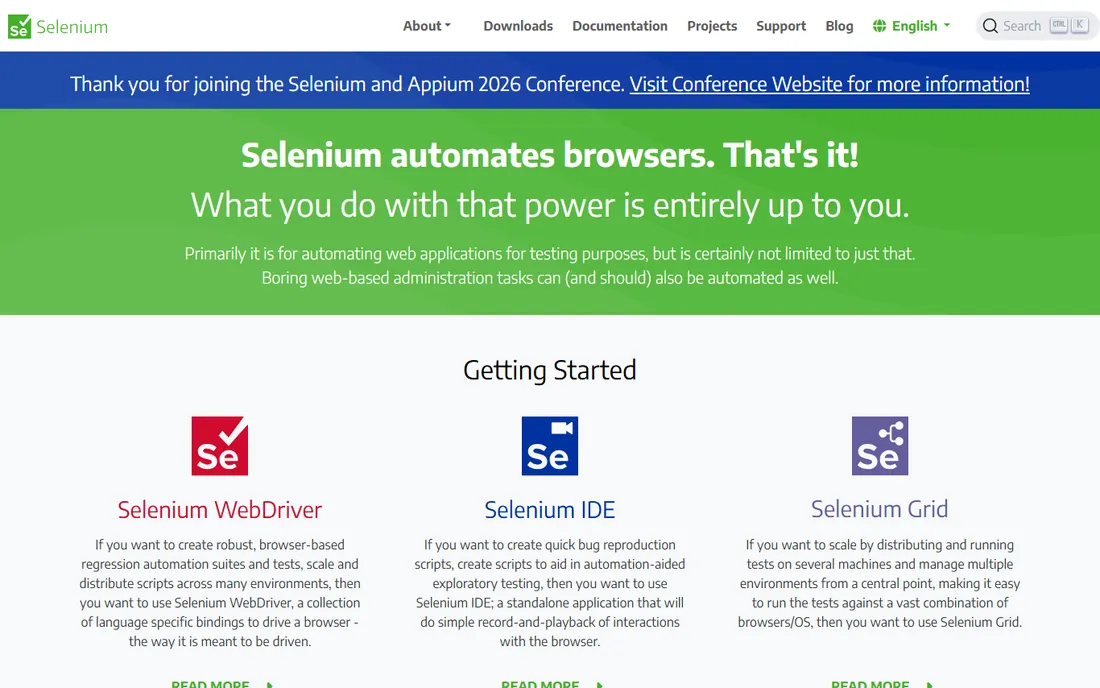
Selenium is the foundation of web test automation: a set of language bindings that drive browsers the way they are meant to be driven. WebDriver builds reliable regression suites, the IDE records quick bug-reproduction scripts, and Grid distributes tests across browsers and operating systems from a central point.
Two decades of adoption mean answers exist for nearly every problem, plus integrations with every CI system and cloud grid. The cost is skill: teams need programmers to write and maintain suites, and test stability requires discipline around waits and locators. If you have engineering capacity and want maximum control at zero license cost, Selenium remains the default.
What we like- Largest ecosystem and community of any test framework
- Supports every major language and browser
- Selenium Grid scales tests across machines
Watch out for- Requires real programming skill
- Flaky tests need careful wait handling
Starting priceFree
Free planYes
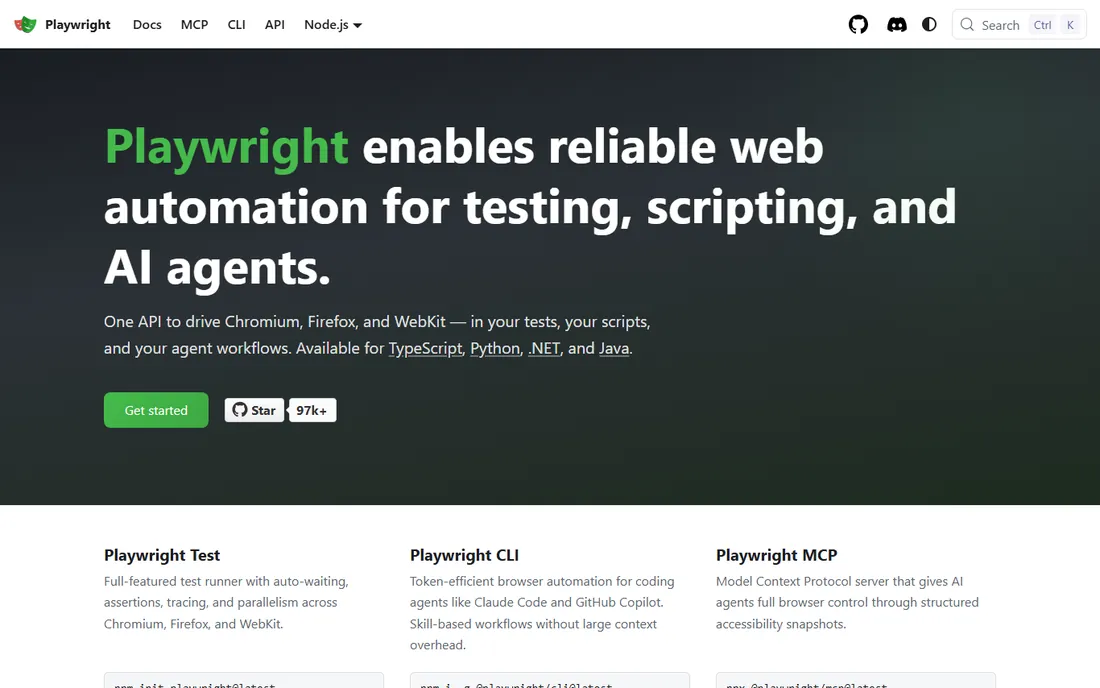
Playwright, from Microsoft, has become the modern answer to end-to-end web testing. It auto-waits for elements to be actionable, retries assertions until conditions are met, and gives each test an isolated browser context, which removes the biggest sources of flaky tests. Tests run in parallel across Chromium, Firefox, and WebKit on Linux, macOS, and Windows.
It ships with a test generator that records actions into code, a trace viewer for debugging failures without re-running, and a VS Code extension. Recent additions target AI coding agents: an MCP server and a token-efficient CLI let agents like Claude Code drive browsers directly. For new projects, it is usually the framework to beat.
What we like- Auto-waiting and web-first assertions kill flakiness
- Tests Chromium, Firefox, and WebKit with one API
- Built-in tools for AI coding agents
Watch out for- Newer than Selenium, so some legacy integrations lag
- JavaScript-first community with thinner coverage elsewhere
Starting priceFree (Cypress Cloud paid)
Free planYes
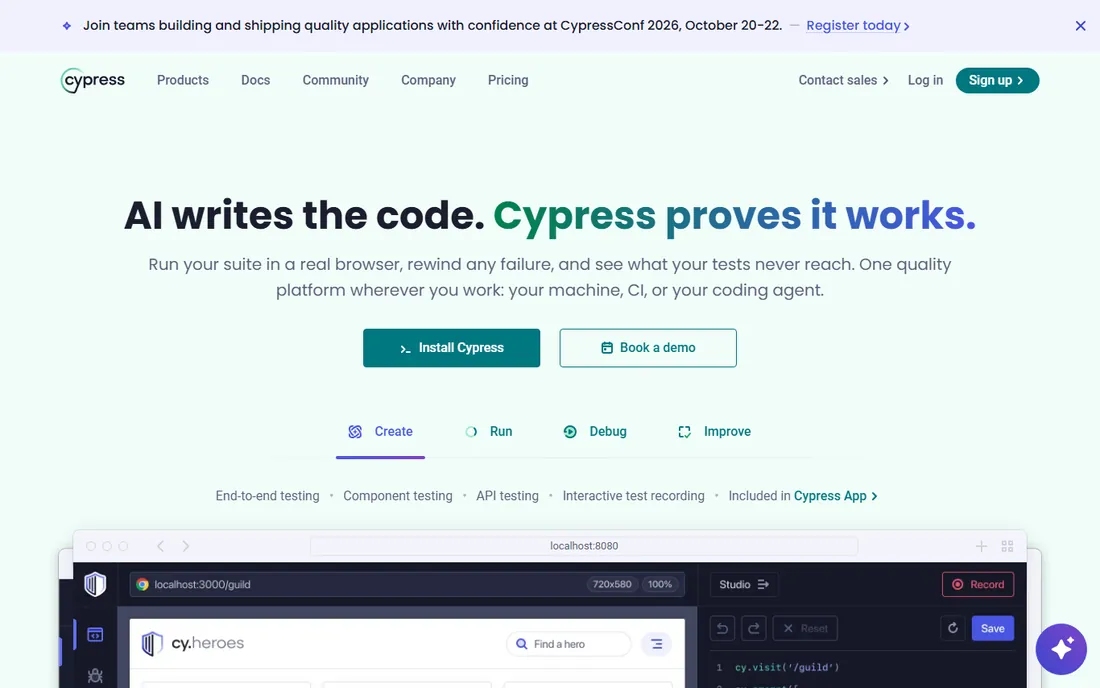
Cypress made end-to-end testing feel like development: tests run directly in the browser, failures can be rewound and inspected with familiar dev tools, and Cypress Studio turns plain-English descriptions into runnable test code. The API is simple, the documentation is famously good, and the community is enormous.
The open source app is free, while Cypress Cloud adds parallelization, load balancing, flaky-test detection, and AI-powered failure summaries for teams running serious CI. If your team is JavaScript-heavy and wants the fastest path from zero to a working test suite, Cypress is hard to beat.
What we like- Runs in the browser with real-time reload and time-travel debugging
- 6M-plus weekly downloads
- Cypress Cloud adds parallelization and analytics
Watch out for- Limited to Chromium-family browsers for much of its history
- Multi-tab and native mobile support lag competitors
Starting priceSee website
Free planYes
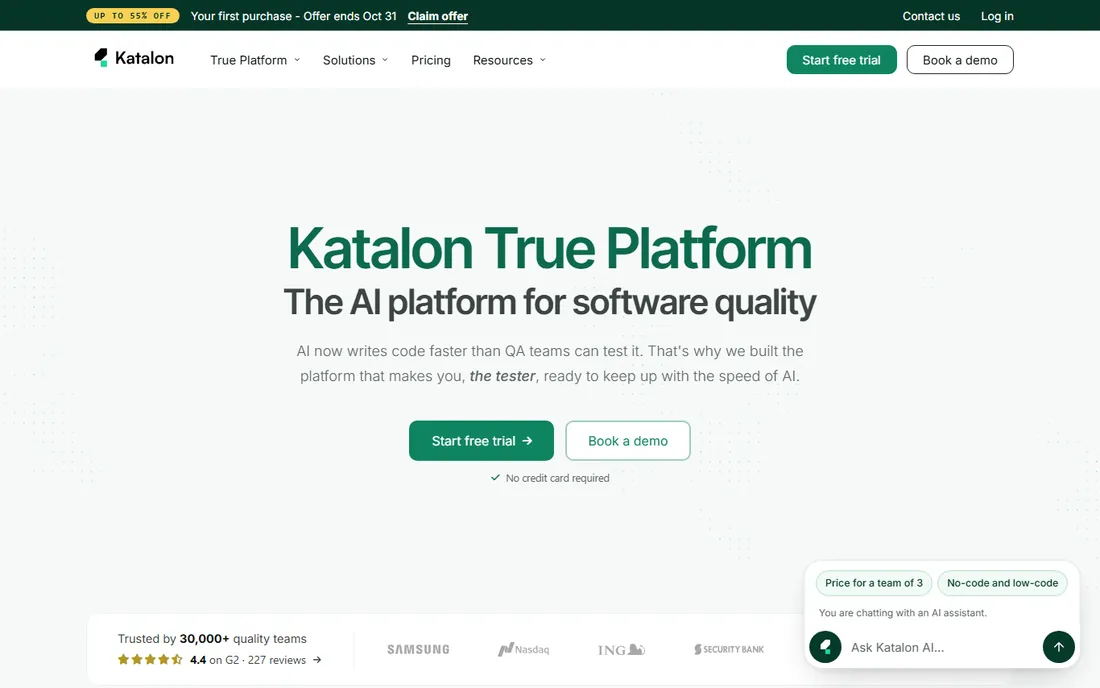
Katalon's True Platform unifies test authoring (Studio), management (TestOps), cloud execution (TestCloud), and production insights (TrueTest). Studio supports no-code, low-code, and full-code authoring across web, mobile, API, and desktop apps, with an AI agent that generates tests in plain language and self-heals broken locators.
A pragmatic strength: Katalon is built on Selenium and Appium, so existing scripts keep working, and TestOps ingests Playwright results for unified reporting. It starts free with no credit card, and pricing scales with execution needs. Named a Visionary in Gartner's 2025 Magic Quadrant for AI-augmented testing, it fits mixed-skill QA teams that want one system of record.
What we like- Free to start with no credit card
- Covers web, mobile, API, and desktop in one platform
- Ingests Selenium, Appium, and Playwright results
Watch out for- Quote-based pricing for serious use
- AI features add complexity for small teams
#5
TestComplete
Best for: Desktop, web, and mobile in regulated environments
Visit smartbear.com
Starting priceSee website
Free planNo
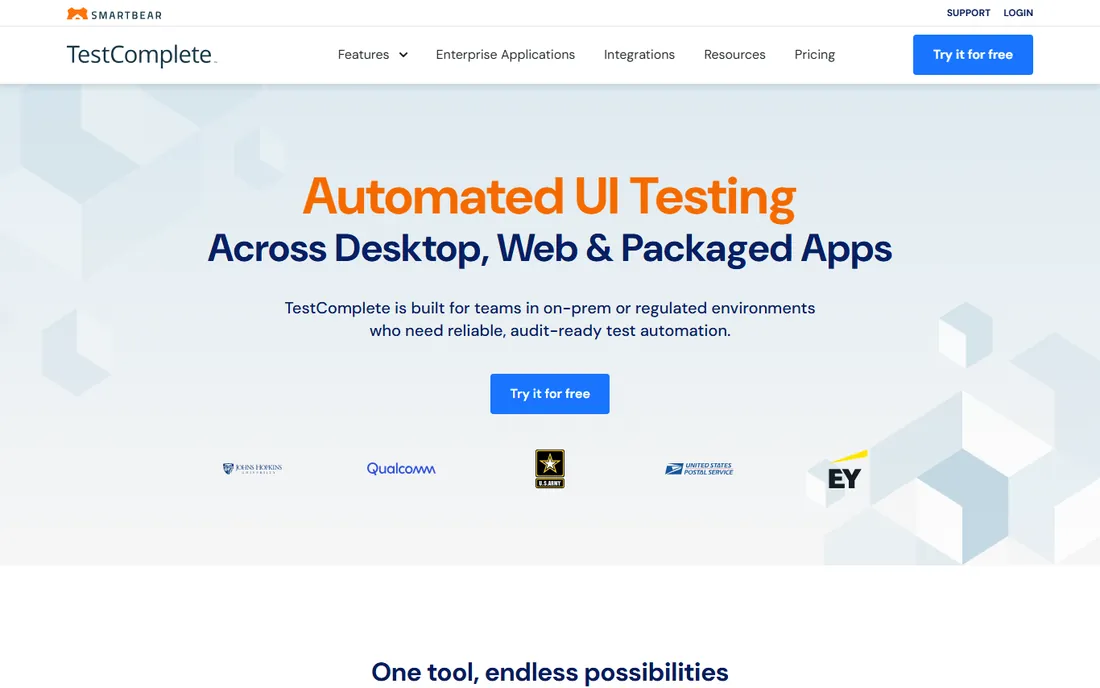
TestComplete is built for teams in on-prem or regulated environments that need reliable, audit-ready test automation. It automates desktop applications (Windows, Java, .NET), web apps across all major browsers, and native mobile apps, with record-and-replay for non-scripters and scripting in JavaScript, Python, and VBScript for engineers.
Because it is a thick-client application, it works offline or in secure local networks, and data can stay local for sensitive environments. AI features include self-healing tests, AI test-data generation, OCR for PDFs and scanned documents, and visual testing. If your testing targets legacy desktop software or packaged enterprise apps, TestComplete is purpose-built for it.
What we like- Tests desktop, web, and mobile from one tool
- Thick-client app works offline in secure networks
- AI self-healing and OCR for complex apps
Watch out for- Quote-based enterprise pricing
- Windows-centric heritage
Starting priceFree
Free planYes
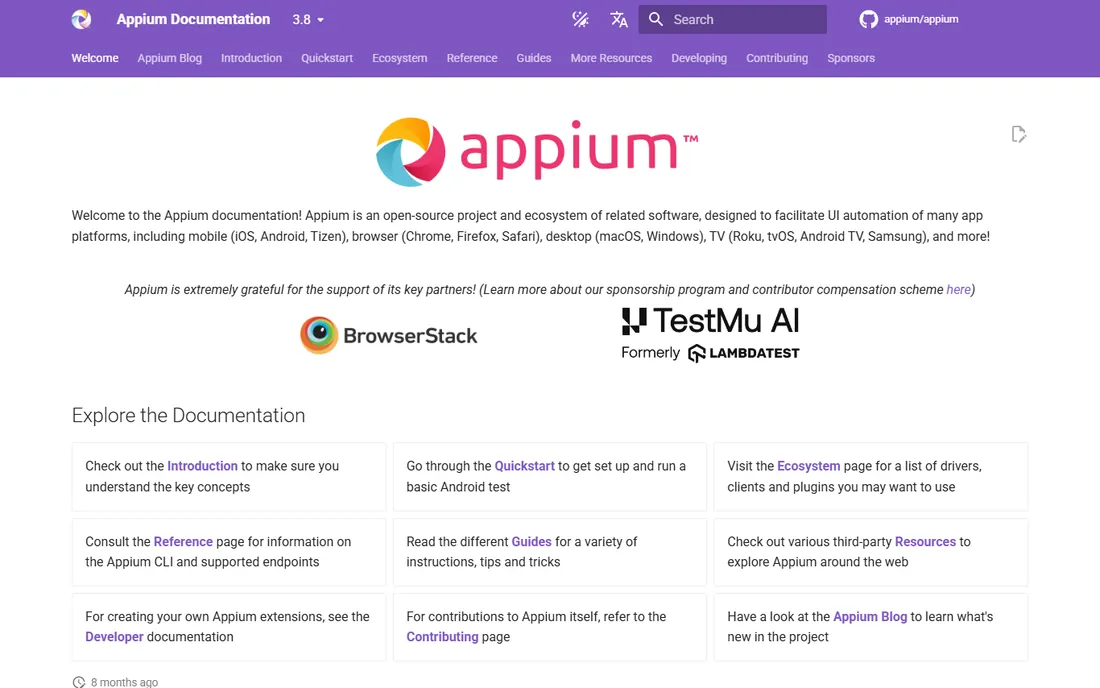
Appium is the open source standard for automating native, hybrid, and mobile web apps. One WebDriver-compatible API drives iOS, Android, and Windows applications, and it works with any programming language and test framework, so teams can reuse their existing skills and CI pipelines.
Being open source and free, it is the default for teams that need mobile coverage without licensing costs. The trade-offs are real: setting up drivers, emulators, and device farms takes work, and mobile tests are inherently slower and flakier than web tests. For serious mobile automation on a budget, it pairs well with cloud device farms or Katalon Studio, which is built on it.
What we like- The open source standard for mobile automation
- One API for iOS, Android, and Windows apps
- Works with any language and framework
Watch out for- Setup and driver management take effort
- Mobile test infrastructure is inherently complex
Starting priceSee website
Free planNo
Tricentis Tosca pioneered model-based test automation: instead of writing scripts, testers model the application and generate test cases, which slashes maintenance when the UI changes. The broader Tricentis platform now covers the full quality lifecycle, and the company acquired Tabnine to deepen its AI testing agents.
Gartner named Tricentis a Leader in its 2026 Magic Quadrant for AI-augmented software testing, and Forrester recognized it in its Wave for autonomous testing platforms. Pricing is enterprise and quote-based. It fits large organizations, especially in regulated industries, that need business-readable tests and governance over speed of adoption.
What we like- Model-based, scriptless testing for business users
- Named a Leader in Gartner's 2026 Magic Quadrant
- AI Workspace orchestrates agentic quality engineering
Watch out for- Enterprise pricing with no public rates
- Heavier than developers need for simple web apps
Starting priceSee website
Free planNo
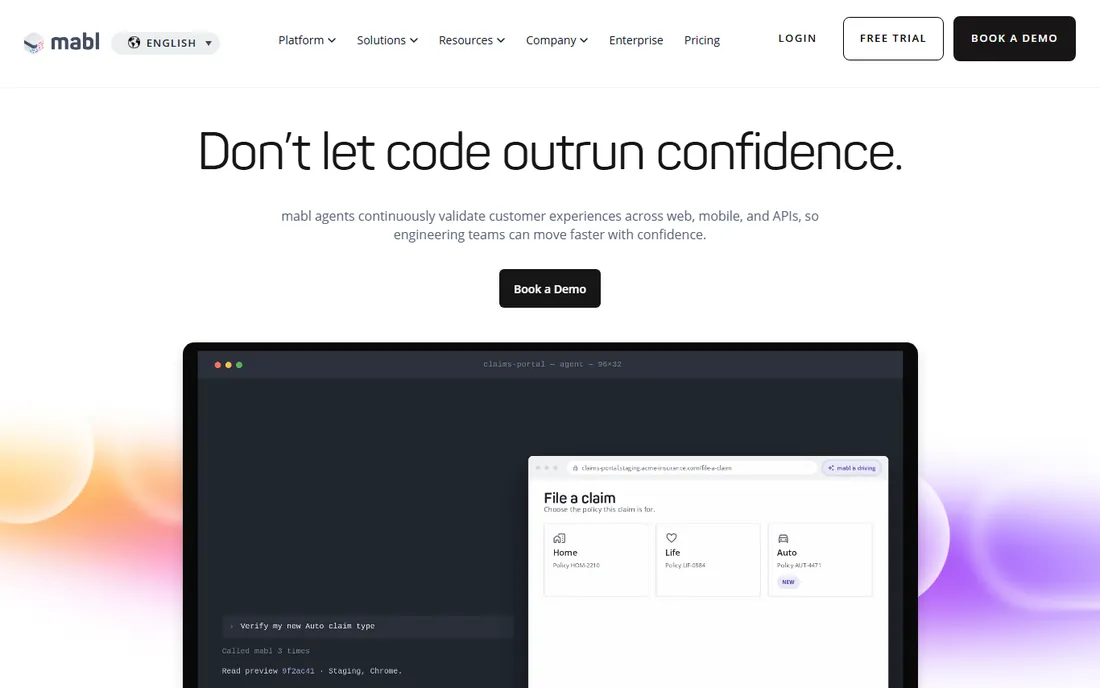
mabl takes a different stance for the AI era: instead of making you write tests, its agents independently verify your application and declare pass or fail on each release, with the harness and application context strengthening over time. Integrations span GitHub, GitLab, Bitbucket, Jenkins, CircleCI, Jira, Slack, and AI coding tools.
Gartner named mabl a Challenger in its 2026 Magic Quadrant for agentic software quality assurance platforms. Customers include JetBlue, LendingClub, and Panasonic. Pricing is quote-based through a demo-led process. It suits teams that want testing to keep up with AI-written code without hiring an army of QA engineers.
What we like- Agentic testing that verifies releases independently
- Named a Challenger in Gartner's 2026 Magic Quadrant
- Deep CI and dev-tool integrations
Watch out for- Quote-based pricing
- Demo-led sales process
How we chose
We compared automation testing tools using official vendor pages, documentation, and industry research, focusing on supported platforms, authoring approach, language support, CI integration, AI capabilities, community strength, and pricing transparency. We checked evaluations from Gartner and Forrester where cited, plus public reviews on G2 and developer communities. We did not claim hands-on testing; assessments reflect documented features and reported user experience.
Match the tool to your team's skills first. If you have developers or SDETs, code-first frameworks like Playwright, Cypress, or Selenium give the most power for free. If your testers are less technical, low-code platforms like Katalon, Tosca, or TestComplete let them contribute. Mismatching the tool to the team is the most common reason test automation fails.
Define what you actually need to test
Web-only testing has the most options and the lowest costs. Mobile testing narrows the field to Appium, Katalon, TestComplete, and mabl. Desktop and legacy apps point at TestComplete or Tosca. API testing is covered by all eight but is often better served by dedicated API tools. Buy for your real application mix, not the vendor's feature list.
Treat flakiness as the main cost
The license is cheap compared to the hours spent chasing flaky tests. Prefer tools with auto-waiting (Playwright), in-browser determinism (Cypress), or self-healing (Katalon, TestComplete, mabl). Run candidate tools against your actual application during evaluation and measure how often tests pass without babysitting.
Plan for CI and scale early
Tests that only run on one laptop do not protect releases. Confirm the tool integrates with your CI system, supports parallel execution, and produces reports your team will read. Open source frameworks need you to build or buy the grid; commercial platforms usually include execution environments.
Why AI is changing test automation now
AI writes code faster than QA teams can test it, as Katalon puts it. Every vendor here has responded: agentic test generation, self-healing locators, plain-language failure explanations, and AI coding agents driving browsers directly. The practical effect is that test creation and maintenance, historically the expensive parts, are getting cheaper. Evaluate the AI features against your real app, because demos are always more impressive than production.
Frequently asked questions
What is the best automation testing tool for beginners?
Cypress is the easiest on-ramp for web testing, with a simple API and excellent docs. Katalon's no-code options suit non-programmers, and Selenium IDE handles quick record-and-playback. For a team learning automation, start with Cypress or Playwright and graduate to heavier tools only if needed.
Is Selenium still relevant in 2026?
Yes. Selenium remains the most widely used web automation framework, with the largest community and broadest language support. Playwright and Cypress have taken the mindshare lead for new projects, but Selenium's ecosystem, Grid infrastructure, and enterprise adoption keep it central.
Should I use Playwright or Cypress?
Both are excellent. Playwright supports more browsers (Chromium, Firefox, WebKit) and has stronger auto-waiting and parallelism, making it better for large cross-browser suites. Cypress has a simpler developer experience and real-time browser debugging. JavaScript teams split fairly evenly; pick based on browser needs and CI setup.
Can I automate mobile app testing for free?
Yes, with Appium. It is free and open source and automates iOS, Android, and Windows apps. You will still need devices or emulators and CI infrastructure, which is where costs appear. Cloud device farms and Katalon's TestCloud can host the infrastructure if you prefer not to.
What is scriptless test automation?
Scriptless (or model-based) testing lets you define tests as models or flows instead of code, and the tool generates the automation. Tosca pioneered it, and Katalon and TestComplete offer low-code variants. It lowers the skill barrier and reduces maintenance, at the cost of flexibility compared to code.
How much do enterprise test automation tools cost?
Tosca, TestComplete, and mabl are all quote-based, and enterprise test automation typically runs from tens of thousands of dollars per year upward depending on users, environments, and support. Katalon starts free and scales with execution. Open source frameworks cost nothing in licenses but need engineering time.
Sources we checked (8)
- https://www.selenium.dev/
- https://playwright.dev/
- https://www.cypress.io/
- https://katalon.com/
- https://smartbear.com/product/testcomplete/overview/
- https://appium.io/
- https://www.tricentis.com/
- https://www.mabl.com/
Is your product missing or out of date?
We review this list regularly. Vendors can request a listing, send updated pricing or ask about featured placement.

Shihab Mia · Founder, Rankite
Shihab has spent more than a decade helping SaaS and e-commerce brands grow through search. He writes Rankite's software buying guides from pricing pages, documentation and public user reviews. More about Shihab.