How we make this list: we compare pricing pages, product documentation and public user reviews. Rankite is independent; if a vendor ever pays for a featured spot, that listing is clearly labeled Partner.
Key takeaways
- Mabl and Testim lead AI-native test automation with self-healing tests that survive UI changes.
- Applitools dominates visual AI testing, catching visual regressions humans miss.
- Katalon and Testsigma offer accessible automation with AI assistance for teams without deep coding.
- Functionize and Virtuoso bring natural language test creation to non-technical testers.
- Sauce Labs provides the cloud testing infrastructure that AI tools run on at scale.
Tests that break when the UI sneezes
Traditional test automation has a maintenance problem: every UI change breaks tests, and teams spend more time fixing tests than finding bugs. The promise of AI test automation is tests that adapt. Self-healing locators find elements even when attributes change. Visual AI catches regressions pixel-perfectly. Natural language lets non-programmers create tests. The maintenance burden drops dramatically.
The category spans approaches: codeless record-and-playback with AI healing, visual testing platforms, natural language test creation, and cloud execution grids. We compared eight tools on test stability, ease of creation, AI effectiveness, and fit for different team types. The evaluation prioritized production results over marketing claims, because AI washing is rampant in testing tools.
Quick comparison
| Tool | Best for | Starting price | Free plan |
|---|
 Mabl Mabl | AI-native test automation | See website | Free trial |
 Testim Testim | Self-healing tests | See website | Free trial |
 Applitools Applitools | Visual AI testing | See website | Yes |
 Katalon Katalon | Accessible automation platform | See website | Yes |
 Testsigma Testsigma | Codeless with AI | See website | Yes |
 Functionize Functionize | Natural language testing | See website | No |
 Virtuoso Virtuoso | Codeless at scale | See website | No |
 Sauce Labs Sauce Labs | Cloud testing infrastructure | See website | Free trial |
Is your product missing or out of date?
We review this list regularly. Vendors can request a listing, send updated pricing or ask about featured placement.
Starting priceSee website
Free planFree trial
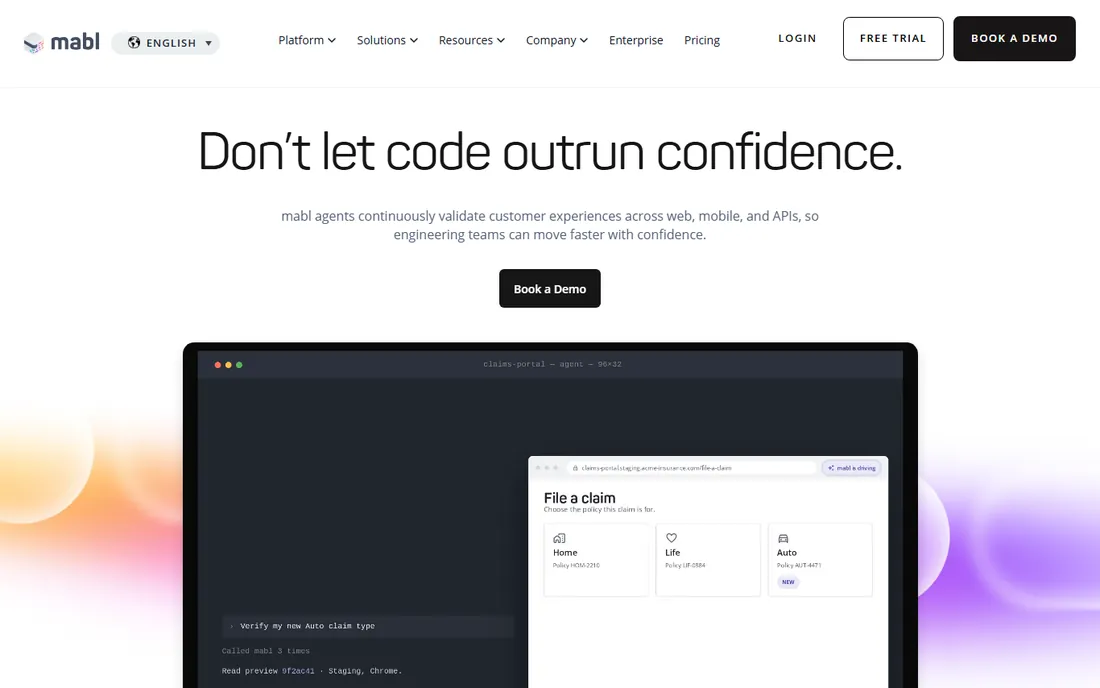
Mabl built test automation around machine learning from the start. Tests self-heal when UI elements change, the auto-healing reports show what adapted, and test creation is accessible to QA without deep coding. Teams report dramatic reductions in test maintenance, which is the entire value proposition.
Pricing is quoted, and the focus is web applications. But for web QA teams drowning in flaky tests, Mabl's AI effectiveness is the differentiator. The platform learns application patterns, making tests more stable over time rather than less.
The unified approach, functional testing, visual validation, and performance in one, reduces tool sprawl. Mabl represents what test automation should have been all along. Teams migrating from fragmented toolchains particularly appreciate having the full quality picture in one dashboard rather than correlating results across systems.
What we like- Excellent self-healing, Easy test creation, Good CI/CD integration, Strong for web apps
Watch out for- Pricing not published, Web-focused, Less for mobile native
Starting priceSee website
Free planFree trial
Testim, part of Tricentis, uses AI to stabilize automated tests with smart locators that survive UI changes. Agile teams create tests quickly through recording, and the AI handles the maintenance that traditionally consumed QA time. The Tricentis backing provides enterprise credibility.
The learning curve is real, and pricing requires conversation. But the self-healing effectiveness is proven in production use. Teams migrating from Selenium find Testim's stability transformative.
For organizations standardizing on Tricentis, Testim fits naturally. For others, the AI test stability justifies evaluation independently. The smart locator technology means tests reference elements by multiple attributes intelligently, so single-attribute changes no longer cascade into failures.
What we like- Strong self-healing, Good for agile teams, Tricentis backed, Smart locators
Watch out for- Pricing quoted, Learning curve, Web and mobile focus
Starting priceSee website
Free planYes
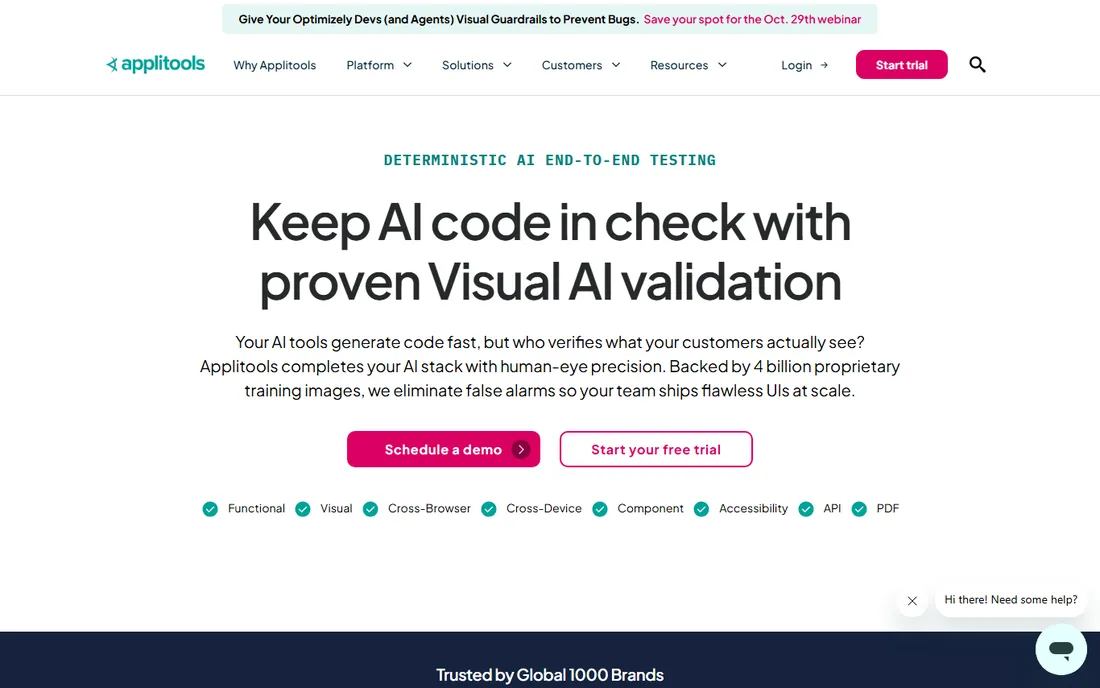
Applitools' Visual AI catches the bugs functional tests miss: layout shifts, styling regressions, and visual inconsistencies across browsers and devices. The AI distinguishes meaningful changes from noise, reducing false positives that plague pixel-comparison tools. It integrates with existing frameworks rather than replacing them.
The visual focus means pairing with functional tools for complete coverage. But visual regressions are the bugs users actually see, making Applitools essential for customer-facing applications. The free tier lets teams validate the value.
For any team shipping UI, visual AI testing is no longer optional. Applitools defines the category. The cross-browser visual validation catches rendering differences that functional tests cannot detect, which matters enormously for brand consistency.
What we like- Best visual testing, Catches visual bugs, Works with any framework, Strong AI
Watch out for- Visual focus, Pricing scales, Needs baseline management
Starting priceSee website
Free planYes
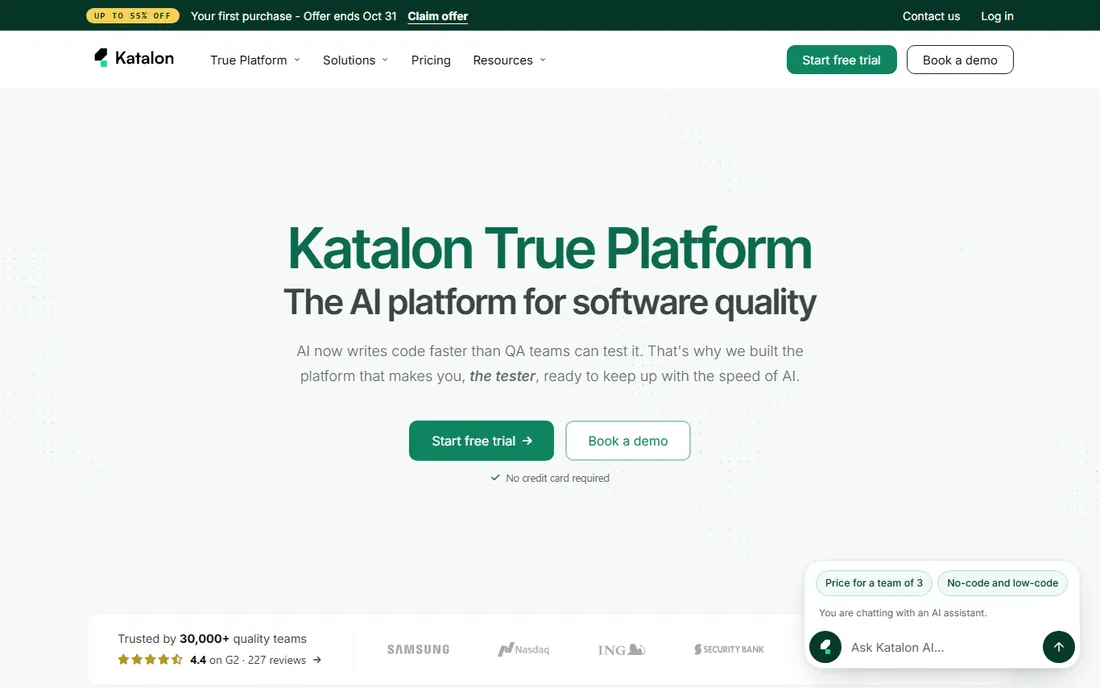
Katalon makes test automation accessible with a generous free tier and approachable interface. Web, mobile, and API testing in one platform suits teams starting automation. The AI features, smart healing and visual testing, add modern capabilities.
AI depth trails Mabl and Testim. But accessibility is the strategy: teams new to automation succeed with Katalon where complex tools overwhelm. The free tier removes budget barriers.
For QA teams beginning automation, Katalon is the friendly on-ramp with room to grow. The active community provides tutorials and shared test artifacts that accelerate learning. Many testers start with Katalon's recorder and graduate to scripted tests as skills develop.
What we like- Generous free tier, Good for beginners, Web/mobile/API, Growing AI features
Watch out for- Less AI depth, Can feel limited, Enterprise features paid
Starting priceSee website
Free planYes
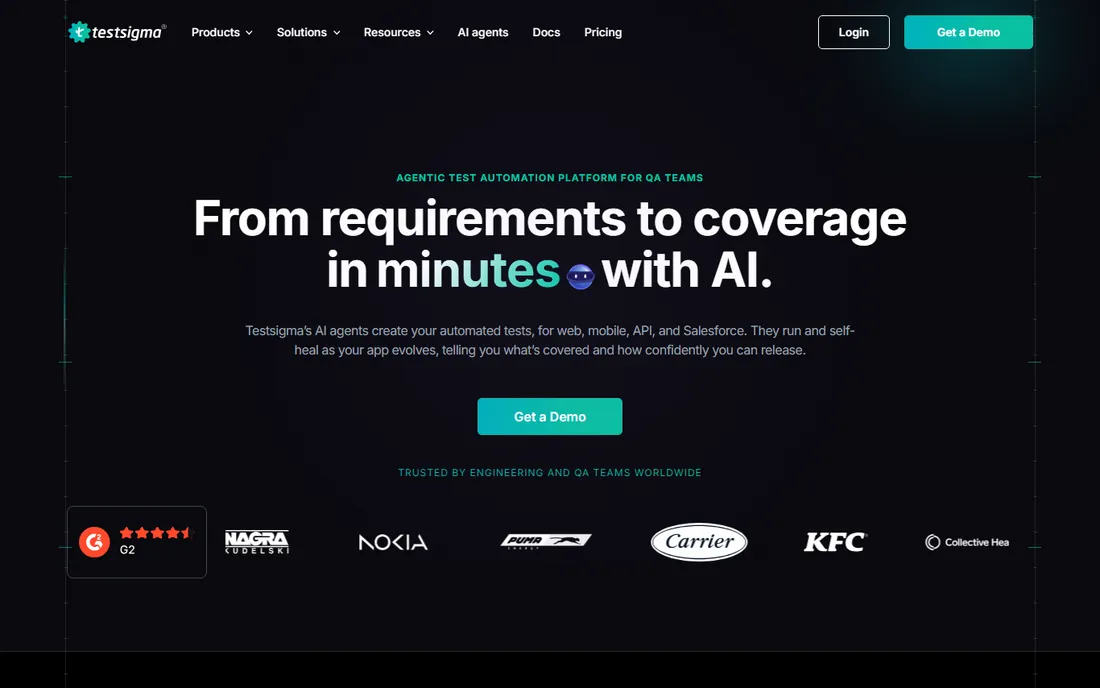
Testsigma lets testers write automated tests in plain English, with AI handling the underlying automation. Non-programmers create real test coverage, which expands QA capacity dramatically. The cloud platform needs no infrastructure.
Complex coded scenarios fit less well. But most test cases are not complex; they are repetitive validations that natural language expresses perfectly. Testsigma's approach democratizes automation.
For teams with manual testers wanting automation without coding, Testsigma is the bridge. The AI-powered maintenance means tests created by non-programmers stay working, which is the critical factor for sustainable codeless automation.
What we like- Natural language tests, Good free tier, Easy for non-coders, Cloud-based
Watch out for- Less for complex code, Newer vendor, Limited advanced
Starting priceSee website
Free planNo
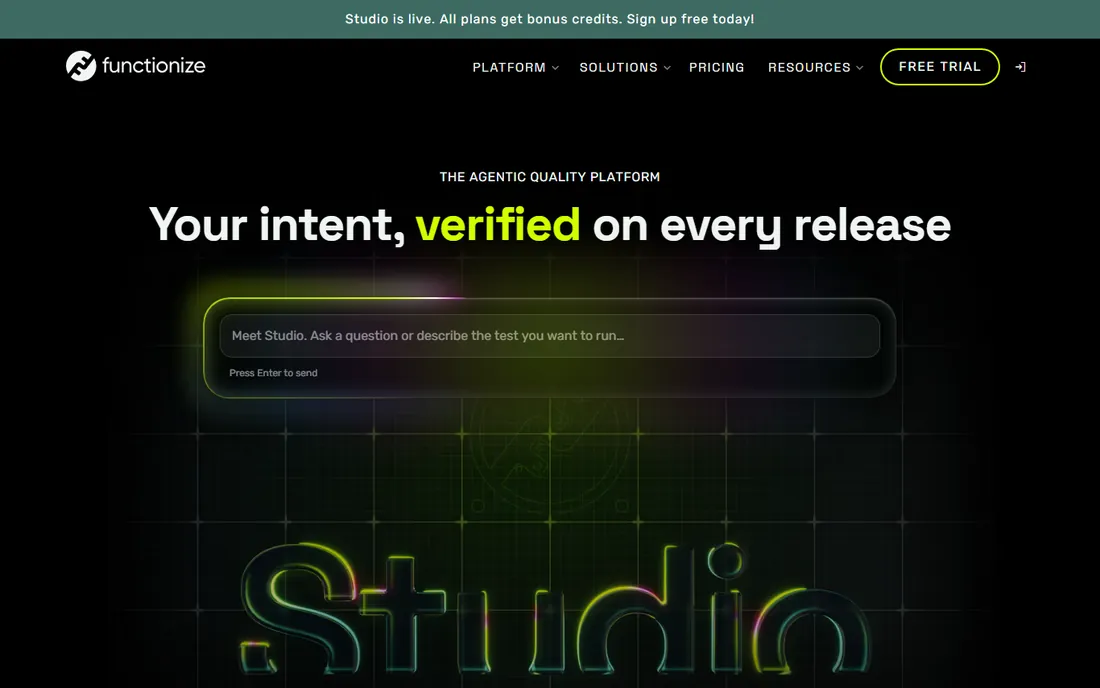
Functionize uses natural language processing for test creation and machine learning for maintenance. Testers describe tests conversationally, and the platform maintains them through UI changes. Cloud execution scales without infrastructure.
The brand is less known, and pricing requires discussion. But the NLP approach suits organizations wanting testers to work in language rather than code. The self-healing reduces the maintenance tax.
For enterprises valuing natural language test authoring, Functionize deserves evaluation. The machine learning models improve with usage, meaning the platform gets smarter about your specific application over time rather than remaining static.
What we like- NLP test creation, Good self-healing, Cloud execution, Enterprise features
Watch out for- Pricing not published, Niche brand, Learning curve
Starting priceSee website
Free planNo
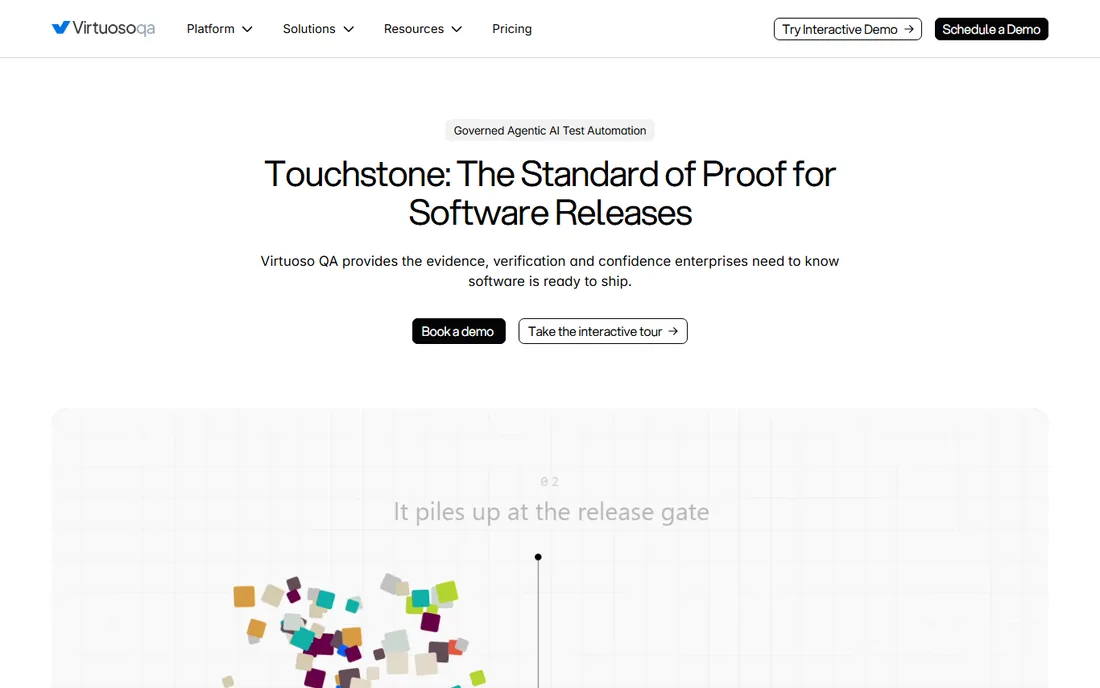
Virtuoso enables codeless test automation through natural language, with AI maintaining tests at enterprise scale. Large organizations report significant QA productivity gains. The platform handles the complexity of enterprise applications.
Pricing and implementation reflect the enterprise focus. But the results at scale are proven. For large QA organizations, Virtuoso's combination of accessibility and power is compelling.
The natural language approach means business analysts can contribute to automation, expanding test coverage beyond QA teams. This collaboration between business and QA produces tests that better reflect actual user workflows and requirements.
What we like- Natural language authoring, Good healing, Enterprise scale, Proven results
Watch out for- Enterprise pricing, Less known in US, Implementation effort
Starting priceSee website
Free planFree trial
Sauce Labs provides the cloud infrastructure AI test tools run on: thousands of browser and device combinations for execution at scale. The AI tools create the tests; Sauce Labs runs them everywhere. The integration ecosystem connects the pieces.
It is infrastructure rather than AI test creation. But reliable execution at scale is essential, and Sauce Labs' device cloud is unmatched. Most AI test strategies include Sauce Labs or similar for the execution layer.
For teams needing comprehensive cross-browser and mobile coverage, Sauce Labs is the foundation. The real device cloud catches issues that emulators miss, particularly around performance and device-specific behaviors that affect real users.
What we like- Massive device cloud, Good for execution, Integrates with AI tools, Reliable
Watch out for- Infrastructure not AI, Costs scale, Less test creation
How we chose
We evaluated AI effectiveness specifically: do the self-healing and intelligent features work in production, not just demos. Test stability improvement, creation ease, and maintenance reduction mattered most.
We weighted real user reports over vendor AI claims, since the category suffers from hype. Integration with CI/CD and existing workflows counted. We also assessed the quality of test reporting and failure analysis, because AI-generated tests are only useful when failures are diagnosable quickly.
Adopting AI test automation
Start with your flakiest tests. The maintenance burden is the pain AI solves; apply it where the pain is worst. Measure the maintenance time before and after to validate the investment. A pilot on one test suite provides the evidence needed for broader rollout decisions. Track the results for a full sprint cycle to account for normal variation in UI changes and release patterns over time.
Then expand thoughtfully. Not every test needs AI; stable API tests may not benefit. Focus AI automation on UI tests where change breaks traditional automation. The hybrid approach optimizes cost and benefit. Keep your existing framework for what works and add AI tools where they solve real pain.
Finally, keep humans in QA. AI handles maintenance and execution; humans handle test strategy, exploratory testing, and judgment. The goal is QA teams doing more valuable work, not fewer QA people. The most successful AI testing adoptions free engineers from test maintenance to focus on exploratory testing and quality advocacy, which machines cannot replicate.
Pricing and plan limits shift over time, so double-check the details on the vendor's website before signing anything. Where a free trial or free tier is available, use it with realistic data; a week of hands-on use reveals more about fit than a dozen review sites.
Frequently asked questions
What is self-healing in test automation?
AI that adapts tests when UI elements change: if a button's ID changes, the tool finds it by other attributes and updates the test. This reduces the maintenance that traditionally consumed QA time.
Will AI replace QA engineers?
No. AI handles test maintenance and execution; humans handle strategy, exploratory testing, and quality judgment. The roles evolve toward higher-value work.
Do we need coding skills for these tools?
Less than traditional automation. Natural language and codeless tools enable non-programmers. But technical understanding helps maximize any tool. The best implementations pair domain-expert testers with automation-savvy engineers who handle the complex scenarios.
How do we measure ROI?
Track test maintenance hours before and after, defect escape rates, and release velocity. The maintenance reduction usually justifies the investment alone. Also measure the opportunity cost: QA time freed from maintenance can shift to exploratory testing that finds bugs automation misses.
Can AI tools test mobile apps?
Yes, most support mobile web and native apps to varying degrees. Verify your specific platforms during evaluation, as mobile support depth differs. Real device testing matters for mobile; emulator-only validation misses device-specific issues that affect users.
Sources we checked (8)
- https://www.mabl.com/
- https://www.testim.io/
- https://www.applitools.com/
- https://www.katalon.com/
- https://www.testsigma.com/
- https://www.functionize.com/
- https://www.virtuosoqa.com/
- https://www.saucelabs.com/
Is your product missing or out of date?
We review this list regularly. Vendors can request a listing, send updated pricing or ask about featured placement.

Shihab Mia · Founder, Rankite
Shihab has spent more than a decade helping SaaS and e-commerce brands grow through search. He writes Rankite's software buying guides from pricing pages, documentation and public user reviews. More about Shihab.