How we make this list: we compare pricing pages, product documentation and public user reviews. Rankite is independent; if a vendor ever pays for a featured spot, that listing is clearly labeled Partner.
Key takeaways
- Tulip and Dozuki lead for manufacturers that want a full connected-worker platform, not just digitized SOPs.
- Azumuta and VKS focus tightly on work instructions with strong ERP integration for discrete manufacturing.
- Poka and Augmentir emphasize AI that captures tribal knowledge and turns it into reusable guidance.
- Proceedix, now part of SymphonyAI, suits regulated industries needing GxP compliance and audit trails.
- Pricing is quote-based across the board: budget for implementation services, not just licenses.
Quick comparison
| Tool | Best for | Starting price | Free plan |
|---|
 Tulip Tulip | Manufacturers that want to build custom frontline applications | See website (quote-based) | No |
 Dozuki Dozuki | Industrial companies turning tribal knowledge into standard work | See website (quote-based) | No |
 Azumuta Azumuta | Discrete manufacturers that need ERP-synchronized instructions | See website (quote-based) | No |
 Poka Poka | Large industrial firms scaling operator knowledge globally | See website (quote-based) | No |
 Augmentir Augmentir | Operations teams that want AI-native workforce intelligence | See website (quote-based) | No |
 VKS VKS | Shop floors that need visual instructions deployed quickly | See website (quote-based) | No |
 Proceedix Proceedix | Regulated manufacturers needing compliant digital instructions | See website (quote-based) | No |
Is your product missing or out of date?
We review this list regularly. Vendors can request a listing, send updated pricing or ask about featured placement.
The best digital work instruction software
Paper SOPs fail in three predictable ways: nobody can find the current version, nobody follows the outdated one on the wall, and the expert who actually knows the process retires. Digital work instruction software fixes all three by putting interactive, always-current guidance on the device in the operator's hands. These seven platforms cover the real market, from composable app builders to focused instruction tools.
#1
Tulip
Best for: Manufacturers that want to build custom frontline applications
Visit tulip.co
Starting priceSee website (quote-based)
Free planNo
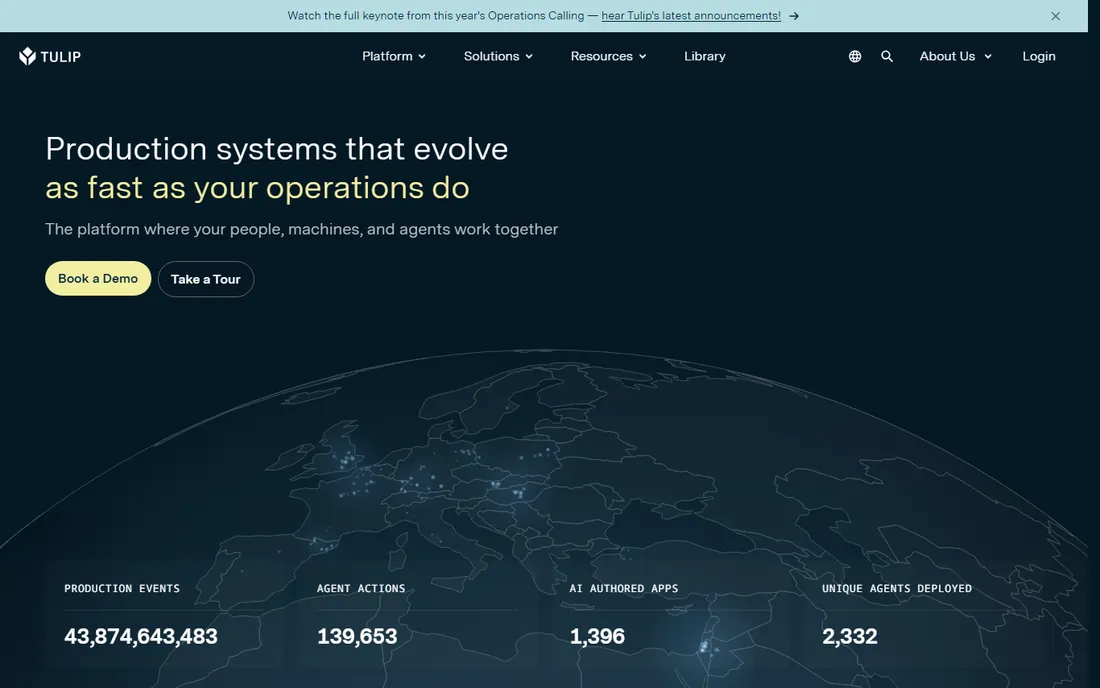
Tulip is the most flexible platform here. Rather than just digitizing SOPs, it lets operations teams build connected apps that combine work instructions with machine data, quality checks and workflow logic. Generative AI accelerates authoring, and the connector library links to CNC machines, ERPs and warehouse systems. For manufacturers with the internal skill to build, Tulip becomes an operating system for the frontline.
That flexibility is also the cost. Tulip is not a quick SOP digitization tool; it is a platform that rewards investment. Smaller manufacturers without app-building capacity may find focused tools faster to deploy. But for enterprises standardizing operations across sites, Tulip's composability is unmatched.
What we like- Composable platform lets you build apps, not just instructions
- Native AI for translation, insights and agents
- Strong edge connectivity to machines and enterprise systems
Watch out for- Platform breadth means longer time to value than focused tools
- Pricing is enterprise-grade
- Requires internal capability to build and maintain apps
#2
Dozuki
Best for: Industrial companies turning tribal knowledge into standard work
Visit dozuki.com
Starting priceSee website (quote-based)
Free planNo
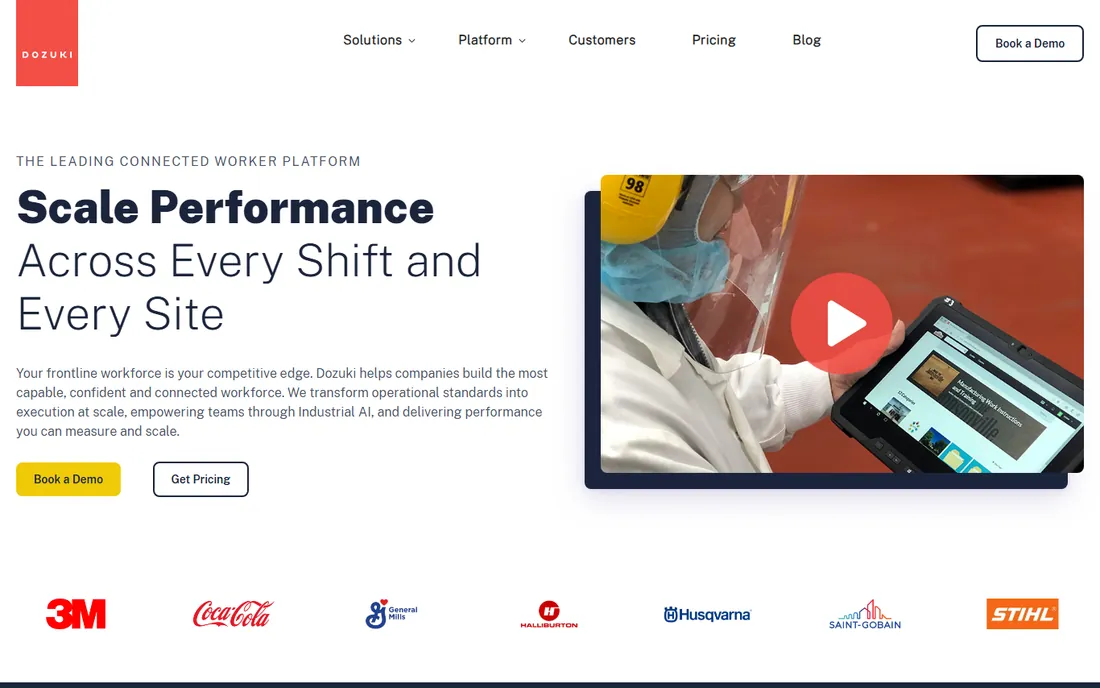
Dozuki built its name on a specific problem: the expert operator whose knowledge lives only in their head. The platform structures that knowledge into visual work instructions, training paths and certification workflows, then distributes updates instantly across shifts and sites. Case studies cite 75 percent reductions in training time and measurable drops in downtime.
Dozuki is an enterprise sale with enterprise implementation. It works best when a company commits to standardizing processes, not just digitizing documents. For manufacturers serious about institutionalizing frontline knowledge, Dozuki is the reference platform.
What we like- Purpose-built for capturing frontline expertise at scale
- Strong training and certification workflows
- Recognized by Frost and Sullivan for innovation
Watch out for- Enterprise focus means high entry cost
- Implementation requires process discipline
- Less app-building flexibility than Tulip
#3
Azumuta
Best for: Discrete manufacturers that need ERP-synchronized instructions
Visit azumuta.com
Starting priceSee website (quote-based)
Free planNo
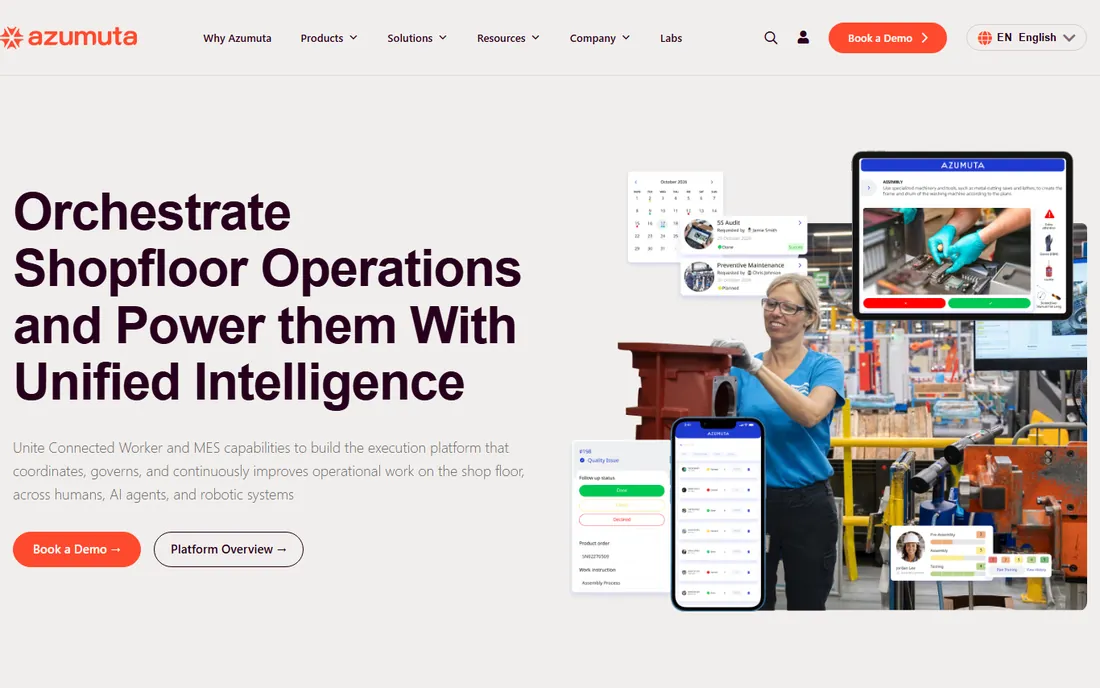
Azumuta focuses on the discrete manufacturing shop floor, where work instructions must match the specific product order running on the line. ERP integration ensures operators always see the right instruction for the right order, with videos, images and 3D files embedded. In-line quality controls and issue ticketing turn instructions into a quality system, not just a document viewer.
As a smaller vendor, Azumuta cannot match the global scale of Poka or the platform breadth of Tulip. But for mid-size discrete manufacturers that live in their ERP, the synchronization between orders and instructions is the feature that matters most.
What we like- Tight ERP integration keeps instructions synced with production orders
- Digital instructions with video, 3D and in-line quality checks
- Skill matrix for workforce development
Watch out for- Smaller vendor with less global presence than Poka or Tulip
- Focused on discrete manufacturing, less suited to process industries
- Pricing requires a quote
#4
Poka
Best for: Large industrial firms scaling operator knowledge globally
Visit poka.io
Starting priceSee website (quote-based)
Free planNo
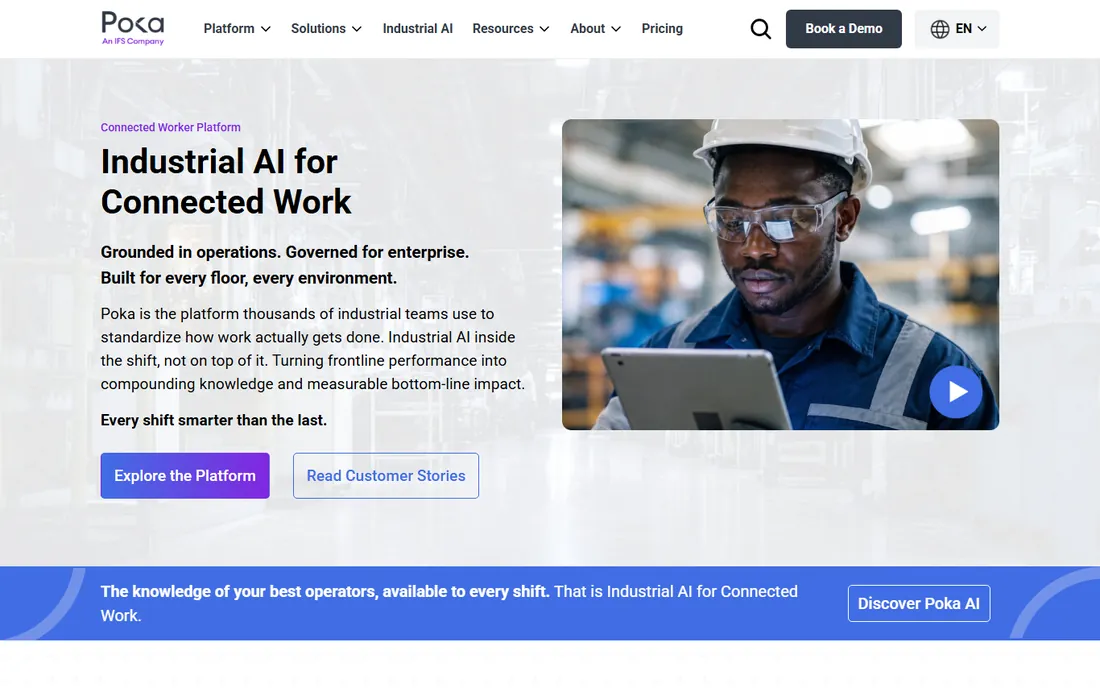
Poka is the scale leader. With deployments at Coca-Cola, Bosch, Tetra Pak and L'Oreal across 70 plus countries, it has proven that connected-worker platforms work at global manufacturing scale. The pitch is compounding knowledge: every issue resolved and every skill gained feeds back into the system, making each shift smarter than the last.
This is enterprise software with enterprise commitments. Poka makes the most sense for multi-site manufacturers ready to invest in a knowledge platform. Smaller single-site operations will find the entry cost hard to justify. But for global industrial firms, Poka is the safe, proven choice.
What we like- Proven at massive scale with 1 million plus users across 3,000 sites
- Industrial AI captures and compounds knowledge
- Strong results in food, automotive and packaging
Watch out for- Enterprise pricing out of reach for small manufacturers
- Implementation is a program, not a project
- Best value requires multi-site rollout
#5
Augmentir
Best for: Operations teams that want AI-native workforce intelligence
Visit augmentir.com
Starting priceSee website (quote-based)
Free planNo
Augmentir bets that the future of frontline operations is AI-native, not AI-bolted-on. The platform connects skills management, work execution and workforce data, then applies agentic AI to turn that intelligence into action. Operators interact in natural language; the system handles the complexity underneath.
The AI-native pitch is compelling but newer than competitors' track records. Manufacturers that just need digitized SOPs may find Augmentir's scope excessive. But for operations leaders who believe workforce intelligence is the next competitive edge, Augmentir is built for that future.
What we like- AI-native architecture with agentic AI for frontline operations
- Connects skills data, work execution and workforce analytics
- Natural language interface for operators
Watch out for- Newer AI positioning means less long-term track record
- Platform scope can overwhelm simple instruction needs
- Pricing is quote-based
#6
VKS
Best for: Shop floors that need visual instructions deployed quickly
Visit vksapp.com
Starting priceSee website (quote-based)
Free planNo
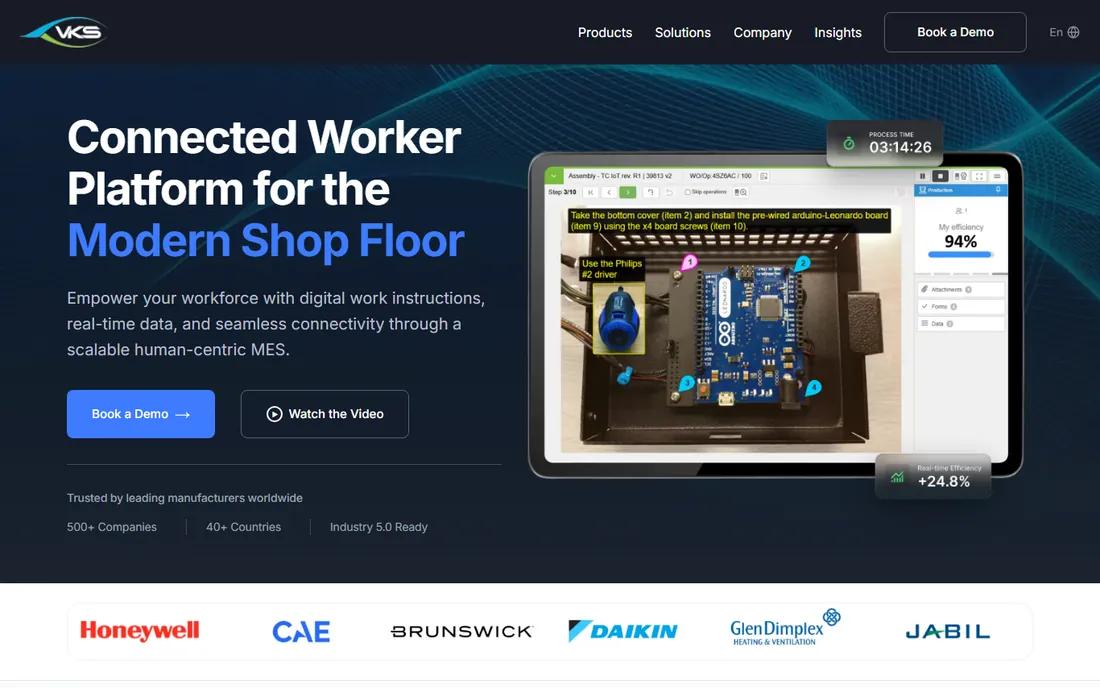
VKS takes a practical approach: replace paper SOPs with rich, visual digital guides that operators actually follow, and do it fast. The platform emphasizes deployment within days, not months, with ERP and MES integration that keeps instructions synchronized. Compliance credentials including ITAR and CMMC readiness make it viable for aerospace and defense.
VKS is less ambitious on AI than Augmentir or Poka, focusing on execution excellence rather than workforce intelligence. For manufacturers that want proven, visual work instructions without a multi-year digital transformation program, VKS delivers.
What we like- Visual, paperless instructions with quick deployment
- Strong ERP and MES integration
- Trusted in regulated industries including aerospace and defense
Watch out for- Less AI emphasis than newer rivals
- Focused on execution rather than broad workforce management
- Pricing requires consultation
#7
Proceedix
Best for: Regulated manufacturers needing compliant digital instructions
Visit proceedix.com
Starting priceSee website (quote-based)
Free planNo
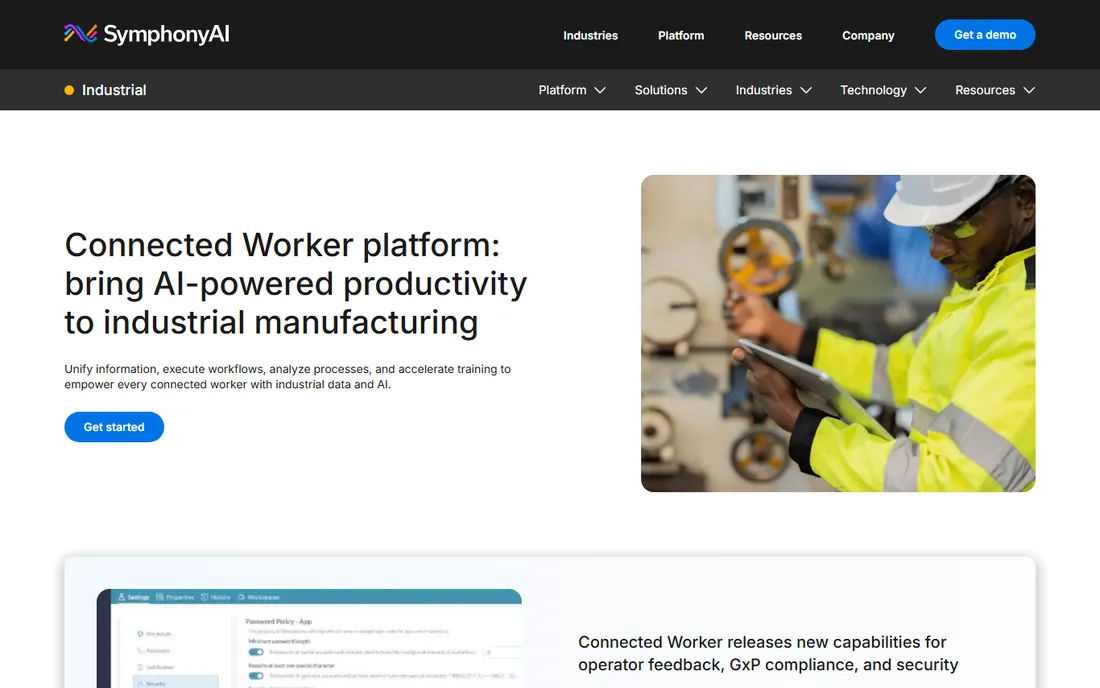
Proceedix, now part of SymphonyAI, serves the most demanding end of the market: pharmaceutical, chemical and other regulated manufacturers where instructions are compliance documents. Digital work instructions come with complete audit trails, electronic signatures and GxP validation. Offline-first architecture keeps operators working with no connectivity.
The SymphonyAI acquisition brings industrial AI capabilities but also roadmap uncertainty during integration. Non-regulated manufacturers may find the compliance machinery unnecessary. But for life sciences and other validated environments, Proceedix is one of the few options built for the regulatory burden.
What we like- GxP compliance with 21 CFR Part 11 support and audit trails
- Offline-first for challenging environments
- Now backed by SymphonyAI's industrial AI platform
Watch out for- Acquisition by SymphonyAI means product roadmap is evolving
- Compliance focus adds complexity for non-regulated users
- Enterprise pricing
Start with the authoring experience, because instructions are only as good as their upkeep. Ask who creates instructions in your organization and watch them build one during the demo. If it takes an engineer to publish a simple procedure, updates will lag and operators will revert to tribal knowledge. The best platforms let supervisors and experienced operators author directly.
Next, test the operator experience on the actual device your people use. A tablet on a greasy shop floor is different from a demo on a laptop. Check offline capability, glove-friendly touch targets, and whether instructions adapt to the specific work order. Ask operators, not managers, whether they would actually use it.
Finally, verify integration with your systems of record. Work instructions that do not sync with the ERP or MES become another silo. Ask which integrations are native versus custom, who maintains them, and what happens when the ERP updates. The value of digital instructions multiplies when they are connected; it evaporates when they are standalone.
Paper to digital: making the switch stick
The technology is the easy part; the hard part is the transition. Start with a pilot line and a respected operator champion, not a corporate mandate. Digitize the ten most-used procedures first, not the entire SOP library. Quick wins build credibility faster than comprehensive rollouts.
Involve operators in authoring from day one. The people who do the work know where the paper SOP is wrong, and their corrections make the digital version trustworthy. A top-down instruction that contradicts shop-floor reality will be ignored, digital or not.
Measure what matters: training time for new hires, first-pass yield, audit findings and operator feedback. These numbers justify the investment and guide expansion. Most successful rollouts expand line by line, with each wave funded by the savings of the last.
How we chose
We started with the searches manufacturing buyers run: digital work instruction software, connected worker platform and paperless manufacturing. For each candidate we opened the vendor's own site, confirmed digital work instructions are a core capability today, and compared authoring, operator experience, integrations and compliance based on vendor documentation and industry reviews. We excluded SwipeGuide, which was acquired by L2L and no longer operates independently. Where a price could not be verified on the vendor's own pages we wrote "See website" rather than guessing, which reflects this quote-based enterprise market.
Frequently asked questions
What is digital work instruction software?
It replaces paper SOPs with interactive, step-by-step guidance delivered on tablets, phones or wearables at the point of work. Instructions can include video, images, 3D models and decision logic, and they update instantly across all devices when procedures change.
How much does it cost?
Vendors do not publish prices; expect a quote based on users, sites and modules. Budget for implementation services alongside licenses, since successful deployments require process work. Enterprise platforms typically start in the five figures annually for a single site.
Can operators use it offline?
Most leading platforms offer offline capability, which matters on shop floors with poor connectivity. Proceedix is explicitly offline-first. Always verify offline behavior during the pilot, including how data syncs when connectivity returns.
How long does implementation take?
Focused instruction tools can deploy in weeks; enterprise connected-worker platforms typically take months for multi-site rollouts. The timeline depends more on your process readiness than the software. Piloting on one line first is the fastest path to value.
Does it integrate with our ERP?
All seven platforms offer ERP integration, but depth varies. Azumuta and VKS emphasize real-time synchronization with SAP, Oracle and Microsoft Dynamics. Ask whether the integration is native or custom-built, and who supports it long-term.
Is it suitable for regulated industries?
Yes, with the right platform. Proceedix offers GxP compliance and 21 CFR Part 11 support. Tulip is GxP-ready and FedRAMP Moderate equivalent. VKS carries ITAR and CMMC credentials. Verify the specific certifications your auditors require before committing.
Sources we checked (8)
- https://tulip.co/
- https://dozuki.com/
- https://azumuta.com/
- https://poka.io/
- https://augmentir.com/
- https://vksapp.com/
- https://proceedix.com
- https://www.g2.com/categories/manufacturing-execution
Is your product missing or out of date?
We review this list regularly. Vendors can request a listing, send updated pricing or ask about featured placement.

Shihab Mia · Founder, Rankite
Shihab has spent more than a decade helping SaaS and e-commerce brands grow through search. He writes Rankite's software buying guides from pricing pages, documentation and public user reviews. More about Shihab.