How we make this list: we compare pricing pages, product documentation and public user reviews. Rankite is independent; if a vendor ever pays for a featured spot, that listing is clearly labeled Partner.
Key takeaways
- The global CMMS market is projected to grow from $1.54 billion to $2.67 billion by 2032 (MarketsandMarkets, via clickmaint.com), driven by the shift to predictive strategies.
- MaintainX (free, paid from $20 per user per month) and Fiix (free, paid from $45) let small teams start predictive work at zero cost.
- True predictive capability needs sensor data and condition triggers; most tools here do preventive well and predictive through integrations.
- IBM Maximo and eMaint serve the asset-intensive enterprise; everyone else should start with the mid-market tools and grow.
Quick comparison
| Tool | Best for | Starting price | Free plan |
|---|
 Fiix Fiix | Data-driven maintenance for industrial teams | $45 per user/month (Basic) | Yes |
 UpKeep UpKeep | Mobile-first maintenance for growing teams | $24 per user/month (Essential) | Free trial |
 MaintainX MaintainX | Frontline teams starting from paper | $20 per user/month (Essential, billed annually) | Yes |
 Limble Limble | Fast-adopting mid-market maintenance crews | See website | No |
 eMaint eMaint | Configurable CMMS for regulated industries | See website | No |
 Fracttal Fracttal | Visual planning with IoT and sensor integrations | See website | Yes |
 IBM Maximo IBM Maximo | Enterprise asset management at scale | From under $40,000 per year (Maintenance module) | No |
 Tractian Tractian | Sensor-driven monitoring for industrial assets | See website | No |
 ClickMaint ClickMaint | Affordable single-plan CMMS | $35 per user/month (billed yearly) | No |
Is your product missing or out of date?
We review this list regularly. Vendors can request a listing, send updated pricing or ask about featured placement.
The best predictive maintenance software
Starting price$45 per user/month (Basic)
Free planYes
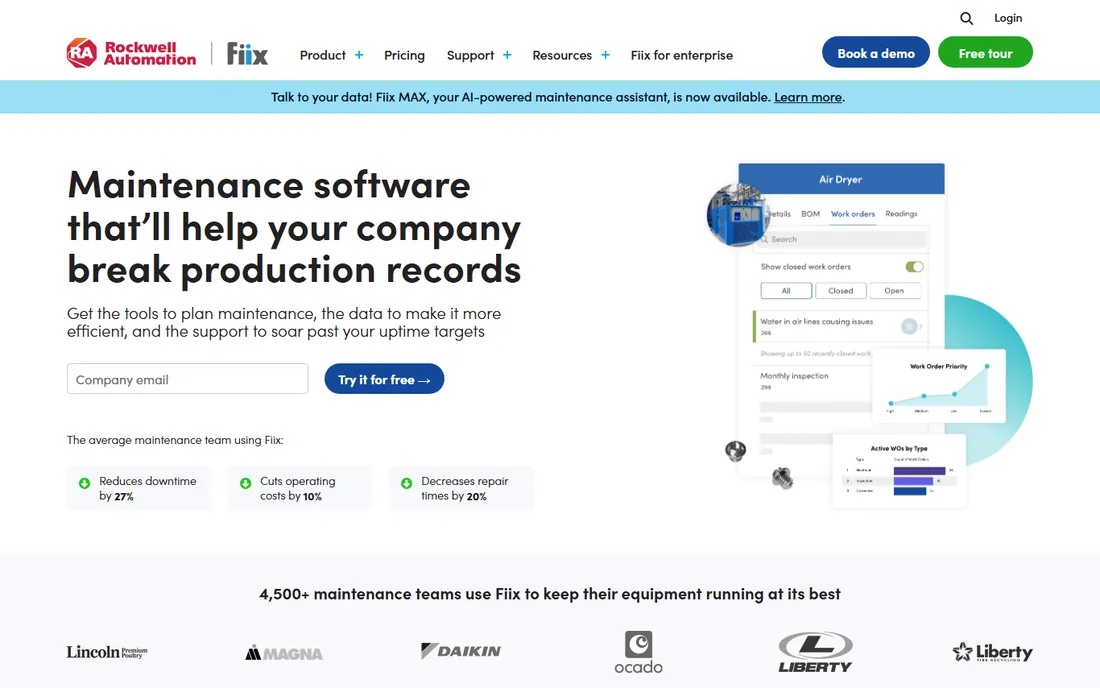
Fiix, now part of Rockwell Automation, is the CMMS for the team that wants to run maintenance on data instead of gut feel. The free tier covers the fundamentals with limited users, and Basic at $45 per user per month opens up unlimited preventive maintenance tasks, reporting, resource-based scheduling and inventory tracking. Downtime tracking and metrics come standard, which is where the predictive journey actually starts: you cannot predict failures you do not measure.
The honest limitation is that Fiix is a CMMS with predictive integrations, not a sensor platform. Condition monitoring arrives through partner sensors and integrations rather than native hardware. For the industrial team moving from reactive to planned maintenance with an eye on predictive, Fiix is the most data-serious starting point.
What we like- Free tier with no credit card to start
- Unlimited preventive maintenance tasks on Basic
- Strong reporting and metrics from the start
Watch out for- Predictive features lean on integrations rather than native sensors
- $45 per user per month adds up for large technician crews
- Advanced modules cost more
Starting price$24 per user/month (Essential)
Free planFree trial
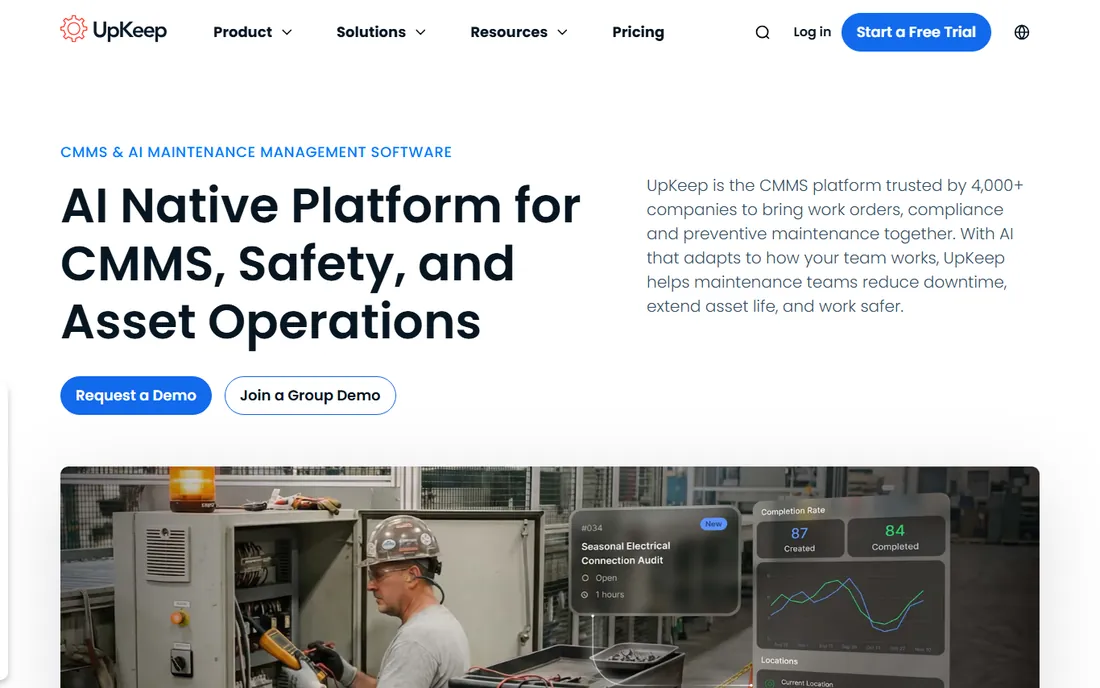
UpKeep won its following by building the CMMS around the technician's phone instead of the manager's desktop. Work orders, asset histories, photos and parts lookups all work where the work happens. Essential starts at $24 per user per month with unlimited work orders and locations, and Premium at $55 adds more for growing teams. A free trial with no credit card gets crews testing fast.
The predictive story is tiered. Condition-based triggers and deeper integrations live on higher plans, and multi-site control is partial at the entry level. For the single-site or growing operation getting off spreadsheets and paper, UpKeep's mobile-first design drives the adoption that makes every other feature work.
What we like- Excellent mobile experience technicians actually use
- Essential starts at $24 per user per month
- AI assistant (Nova) included on plans
Watch out for- Advanced predictive and IoT features need higher tiers
- Multi-site management is partial on lower plans
- Per-user pricing punishes large crews
Starting price$20 per user/month (Essential, billed annually)
Free planYes
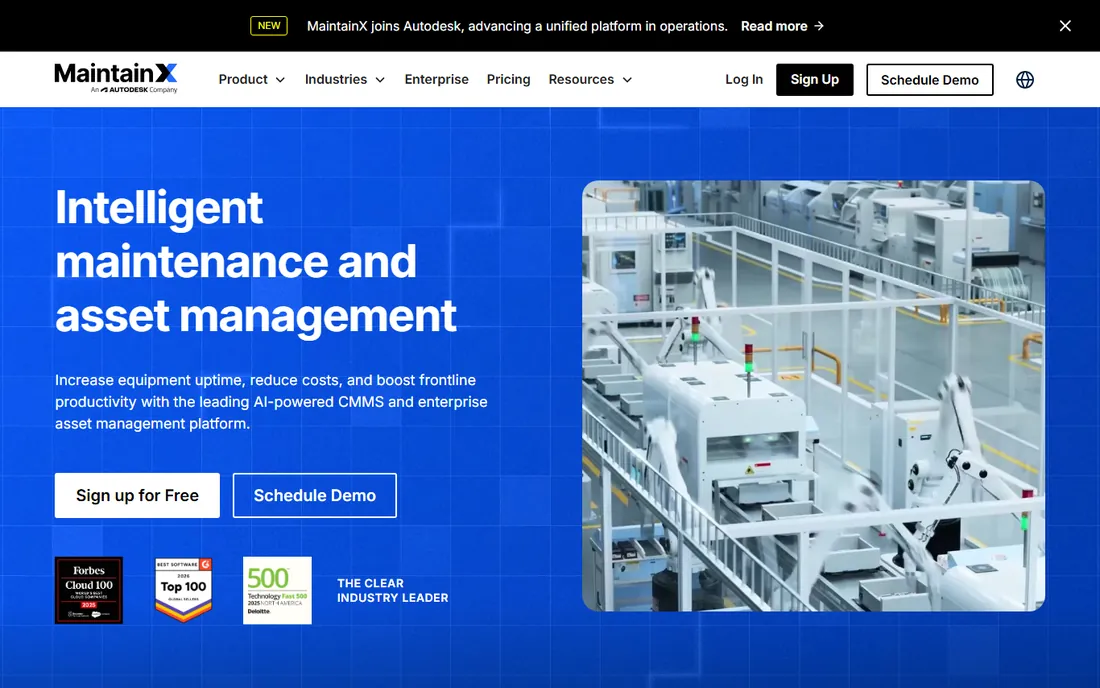
MaintainX is the fastest way to get a maintenance operation off paper. The free Basic plan covers work orders and messaging, and Essential at $20 per user per month billed annually ($25 monthly) adds unlimited work orders with images, repeating work orders and procedures. The checklist-driven design means frontline workers actually complete the PMs instead of pencil-whipping them.
Predictive depth arrives on Premium at $65 per user per month, with parts inventory, advanced analytics and meter-based PM, and IoT integrations sit on Enterprise. That tiering is fair: most teams need disciplined preventive execution long before they need sensor analytics. For the operation starting from clipboards, MaintainX is the easiest yes.
What we like- Free Basic plan for getting started
- Essential at $20 per user per month annual is the cheapest serious tier here
- Checklist-driven workflows frontline workers adopt
Watch out for- Meter-based PM and advanced analytics need Premium at $65
- IoT integrations are enterprise-tier
- The simplicity ceiling appears at complex operations
Starting priceSee website
Free planNo
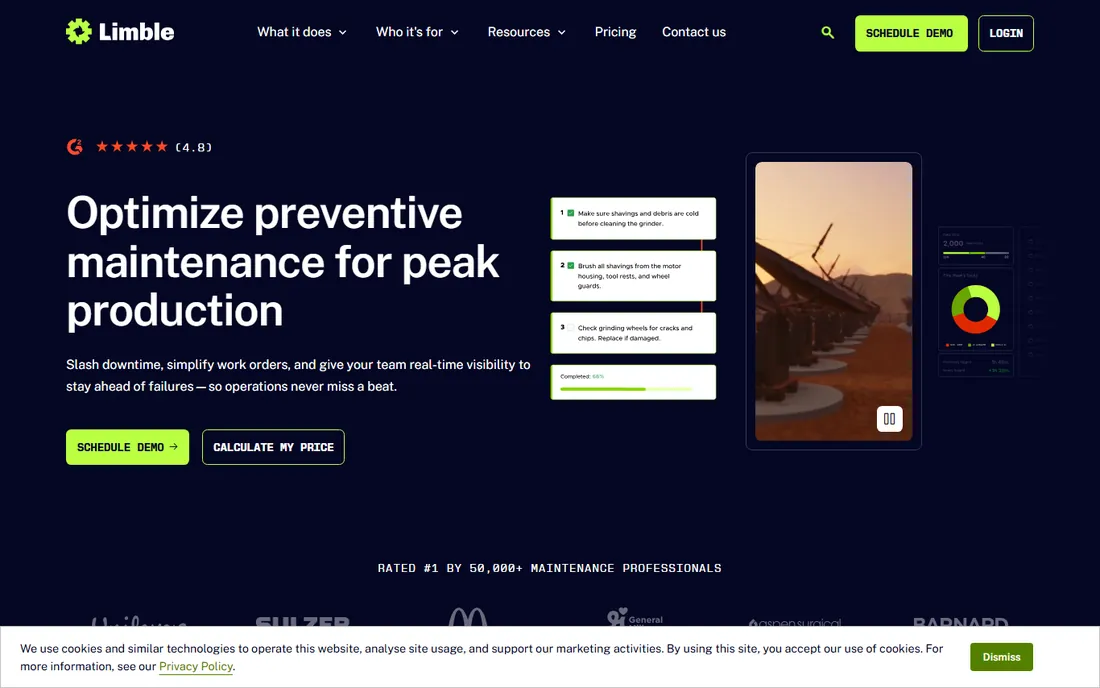
Limble's reputation is built on one thing: maintenance teams actually use it, quickly. Implementation is famously fast, the mobile app with QR code scanning fits technician workflows, and users rate it 4.8 out of 5 on Capterra across hundreds of reviews. Time and usage-based PM triggers cover the preventive core, with condition-based work through sensor integrations.
The frustration is pricing opacity. Limble prices by quote through a calculator, so budgeting requires a conversation, and ERP integrations can add cost. For the mid-market operation that has been burned by shelfware CMMS implementations, Limble's adoption-first design is the antidote.
What we like- Exceptionally fast implementation and adoption
- Strong mobile experience with QR scanning
- Highly rated by users (4.8 on Capterra)
Watch out for- Pricing is quote-based with no public figures
- Condition monitoring arrives via integrations
- ERP integrations can cost extra
Starting priceSee website
Free planNo
eMaint, part of Fluke, is the CMMS for the operation where assets are complex and compliance is non-negotiable. Custom triggers, configurable workflows and reporting adapt to pharmaceutical, food processing and heavy industrial requirements. The Fluke connection matters: sensor data flows into condition-based maintenance without third-party middleware.
The buying experience is enterprise: quote-based pricing with a three-user minimum and implementation measured in weeks. Smaller teams will find it heavy. For the regulated, asset-intensive operation that needs the CMMS to match its processes rather than the reverse, eMaint's configurability justifies the effort.
What we like- Deep configurability for complex asset hierarchies
- Fluke sensor integration for condition monitoring
- Strong in regulated, asset-intensive industries
Watch out for- Quote-based pricing with a 3-user minimum
- Configurability means longer setup
- The interface reflects its enterprise heritage
Starting priceSee website
Free planYes
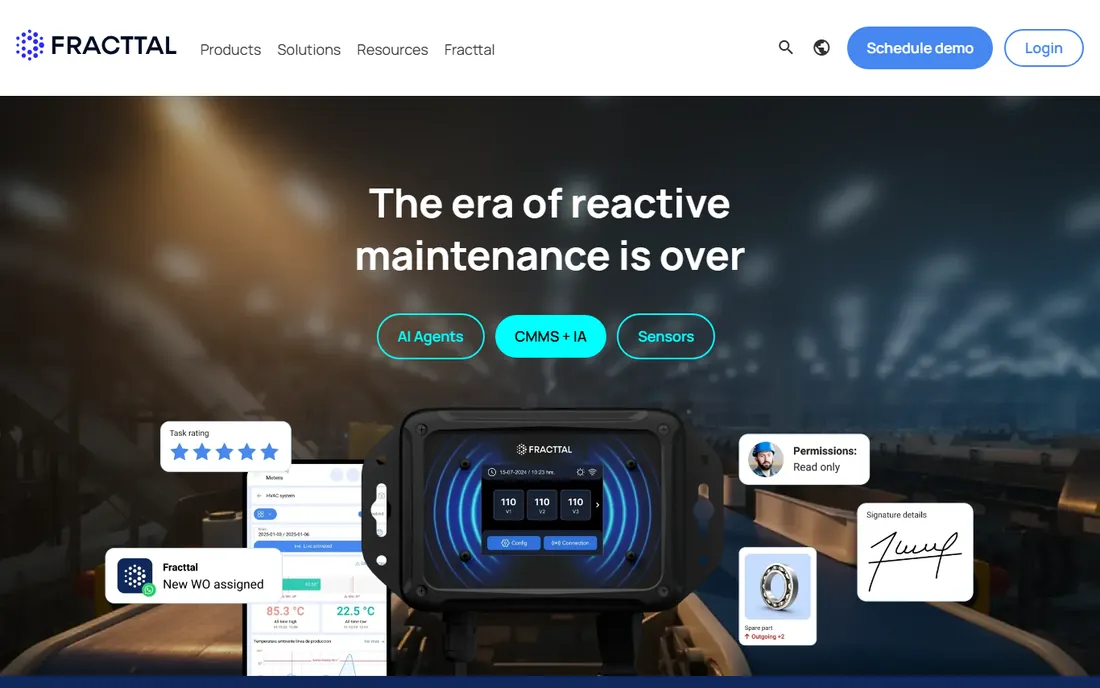
Fracttal brings a modern, visual sensibility to maintenance management. Kanban boards and calendar views make scheduling accessible to planners who never liked Gantt charts, while IoT and sensor integrations support genuine condition-based maintenance programs. A free plan lets teams evaluate the real product before any conversation.
The caveats are transparency and depth. Paid pricing is not published, reporting output options are limited for teams needing deep custom analytics, and the initial setup of locations and warehouses takes care. For the team that wants modern UX with real sensor integration, Fracttal is the most approachable predictive-capable option.
What we like- Free plan for evaluating the platform
- Visual Kanban and calendar planning
- IoT and sensor integrations for condition-based maintenance
Watch out for- Paid pricing not published
- Reporting customization is limited
- Initial location and warehouse setup takes configuration
#7
IBM Maximo
Best for: Enterprise asset management at scale
Visit ibm.com
Starting priceFrom under $40,000 per year (Maintenance module)
Free planNo
IBM Maximo is the enterprise asset management standard for a reason: no other platform here handles the same complexity of assets, sites, regulations and integrations. Advanced condition-based maintenance, IoT monitoring, and modules spanning maintenance, inspection, and inventory serve utilities, oil and gas, transportation and manufacturing giants. IBM publishes starting points under $40,000 per year for modules like Maintenance.
Everything about Maximo is enterprise scale: pricing, implementation timelines, and the administrative expertise required. A mid-size manufacturer would drown in it. For the asset-intensive enterprise where downtime costs millions, Maximo is the proven choice.
What we like- The deepest enterprise asset management platform here
- Advanced condition-based maintenance with IoT
- Handles the most complex asset estates
Watch out for- Enterprise pricing and implementation measured in months
- Overkill for anything under serious scale
- The complexity demands dedicated administrators
Starting priceSee website
Free planNo
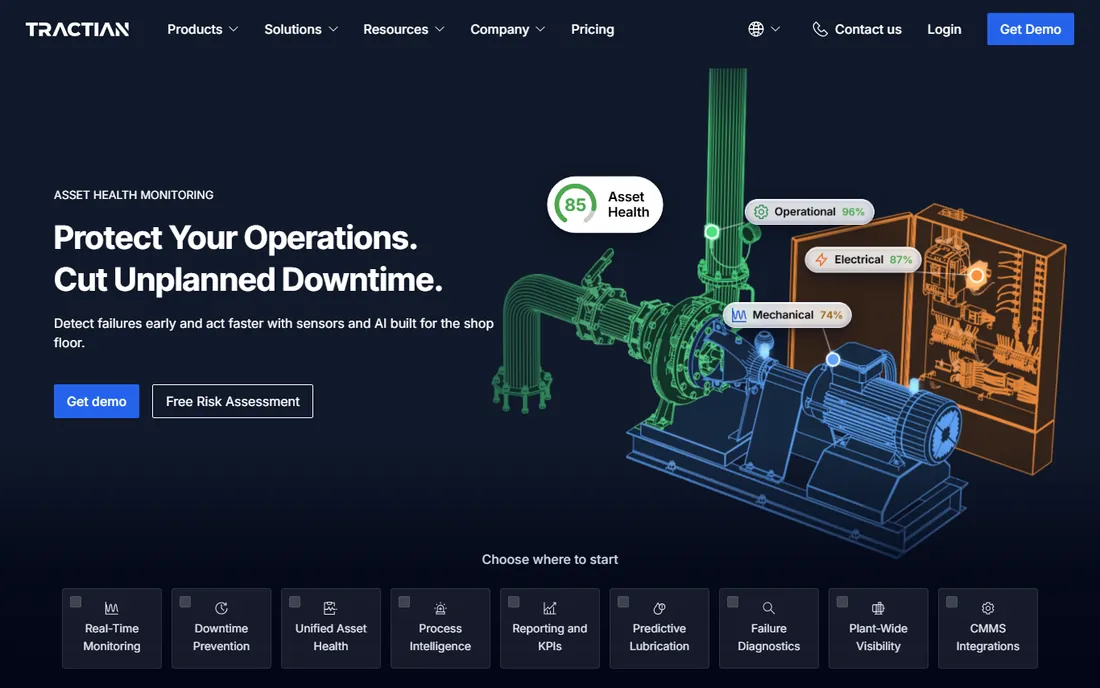
Tractian comes at predictive maintenance from the hardware side: proprietary sensors monitor vibration, temperature and energy consumption on industrial assets, and the software turns that data into failure predictions. This is actual predictive maintenance, detecting bearing failures weeks out, rather than preventive maintenance with a predictive label.
The model means buying sensors as well as software, and pricing is quote-based. The CMMS depth around work orders and inventory is thinner than Fiix or UpKeep. For the manufacturer whose problem is unplanned downtime on critical rotating equipment, Tractian's sensor-first approach is the most direct answer.
What we like- Hardware-plus-software approach with proprietary sensors
- Genuine predictive monitoring, not just scheduled PMs
- Strong in manufacturing
Watch out for- Quote-based pricing
- The sensor hardware is a separate investment
- Narrower CMMS depth than the full-suite platforms
Starting price$35 per user/month (billed yearly)
Free planNo
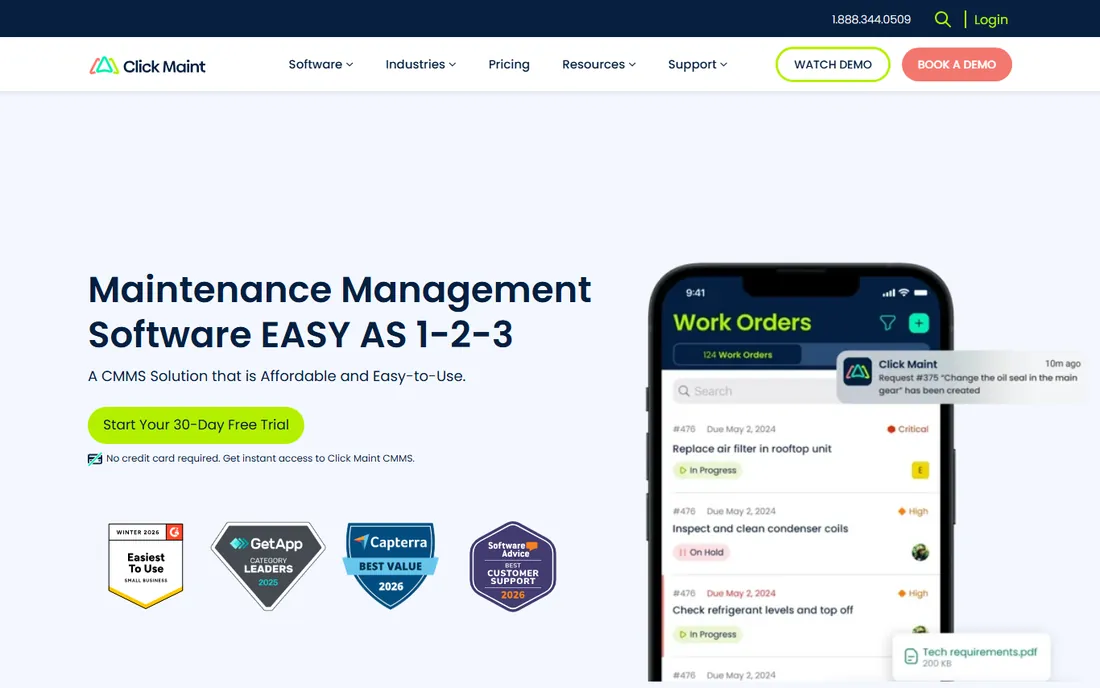
ClickMaint keeps it simple: one Professional plan with all the essentials, $35 per user per month billed yearly ($42 monthly). Work orders, preventive triggers, QR code scanning, approval workflows and notifications are all in the single plan, which makes evaluation refreshingly quick. For the small team that wants honest pricing without a sales process, that simplicity sells.
The trade is ceiling and company size. There is no free tier for extended evaluation, advanced predictive analytics are limited, and ClickMaint lacks the market presence of the bigger names. For straightforward preventive maintenance at a fair published price, it delivers.
What we like- Single plan with everything included, no tier games
- $35 per user per month yearly is affordable
- QR code scanning and mobile workflows
Watch out for- No free tier
- Smaller vendor with less market presence
- Advanced predictive features are limited
How we chose
We selected CMMS and predictive maintenance platforms with real adoption in 2026, verified each product exists today, and used only the vendors' own pricing pages for figures, captured in October 2026. Several enterprise vendors do not publish pricing, so those listings say so. We distinguished true predictive capability (sensor data, condition triggers, failure prediction) from preventive maintenance marketed as predictive, because the category blurs that line constantly.
Preventive is not predictive: know what you are buying
The category's most abused word is "predictive." Preventive maintenance does work on a schedule: inspect this pump every 90 days. Predictive maintenance does work on condition: this pump's vibration signature says the bearing fails in three weeks. Most tools on this list do preventive excellently and predictive through sensor integrations, which is honest as long as you know it.
Buy in the right order. If your operation still runs reactive maintenance, the win is disciplined preventive work orders, and MaintainX or Fiix will transform you. If preventive is mature and unplanned downtime persists on critical assets, add condition monitoring through Tractian-style sensors or the IoT integrations in Fracttal, eMaint or Maximo. Buying sensors before you have work-order discipline is putting a jet engine on a bicycle.
The data discipline that makes prediction work
Predictive maintenance fails without data discipline, and the software cannot supply it. Sensors need baseline readings, work orders need accurate failure codes, and meter readings need to be recorded consistently. The organizations that succeed treat data quality as a maintenance task in itself, with audits and accountability.
Start with the assets that justify it. Instrument the ten machines whose failure stops production, not the two hundred that do not matter. Run the sensors for three months before trusting predictions, because the models need history. And keep the human in the loop: a prediction is a recommendation for inspection, not an automatic work order, until the system has earned trust.
Frequently asked questions
What is the difference between preventive and predictive maintenance?
Preventive maintenance is scheduled: tasks performed at time, meter or usage intervals regardless of condition. Predictive maintenance is condition-based: sensors and analytics detect the early signs of failure so work happens only when needed. Predictive reduces both unplanned downtime and unnecessary maintenance, but it requires sensor data and history.
How much does predictive maintenance software cost?
CMMS platforms run free to about $75 per user per month at the mid-market level: MaintainX from $20, UpKeep from $24, ClickMaint at $35, Fiix from $45. Enterprise platforms like IBM Maximo start in the tens of thousands annually. Sensor hardware for true predictive monitoring is a separate investment on top.
Do we need IoT sensors to start?
No. Start with disciplined preventive maintenance in a CMMS, which most organizations have not mastered. Add sensors on critical assets once work-order discipline is solid. The software earns its keep in the preventive phase long before prediction becomes relevant.
How long until predictive maintenance pays off?
The preventive phase pays off in months through fewer emergency work orders. True predictive programs typically need three to six months of sensor baselines before predictions are trustworthy, and twelve to eighteen months to show clear ROI. Pilot on critical assets where one avoided failure funds the program.
Can small teams use these tools?
Yes. MaintainX and Fiix both offer free tiers, and paid plans from $20 to $45 per user per month fit small budgets. The constraint for small teams is rarely money; it is the discipline to log work orders consistently, which no software can automate away.
What integrates with our existing systems?
Most platforms offer ERP integrations (SAP, Oracle, Viewpoint for construction), BMS connections at the enterprise tier, and APIs for custom work. Sensor integrations vary: eMaint syncs with Fluke sensors natively, others connect through partners. Confirm your specific systems during evaluation, not after purchase.
Sources we checked (9)
- https://fiixsoftware.com/pricing
- https://upkeep.com/pricing
- https://www.getmaintainx.com/pricing
- https://limble.com/
- https://www.emaint.com/
- https://www.fracttal.com/
- https://www.ibm.com/products/maximo/pricing
- https://tractian.com/en
- https://www.clickmaint.com/pricing
Is your product missing or out of date?
We review this list regularly. Vendors can request a listing, send updated pricing or ask about featured placement.

Shihab Mia · Founder, Rankite
Shihab has spent more than a decade helping SaaS and e-commerce brands grow through search. He writes Rankite's software buying guides from pricing pages, documentation and public user reviews. More about Shihab.