How we make this list: we compare pricing pages, product documentation and public user reviews. Ratings come from G2, Capterra or Trustpilot, with the date we checked them.
Key takeaways
- Large enterprises already on Adobe should evaluate Adobe Experience Manager first; everyone else should get a quote before falling in love with the demo.
- Mid-market teams wanting content, commerce, and experimentation in one place should shortlist Optimizely and Acquia (for Drupal shops).
- Engineering-led teams building headless experiences should compare Contentstack and Magnolia; both have free community or evaluation paths.
- Every vendor here except the open-source editions prices by custom quote, so budget planning starts with a sales call, not a pricing page.
Quick comparison
| Tool | Best for | Starting price | Free plan |
|---|
 Adobe Experience Manager Adobe Experience Manager | Large enterprises already invested in the Adobe stack | Custom quote (Adobe publishes no list pricing) | Not confirmed on the vendor site |
 Optimizely Optimizely | Mid-market to enterprise teams wanting content, commerce, and experimentation together | Custom quote (no public pricing on the vendor site) | No |
 Acquia Acquia | Organizations committed to Drupal at enterprise scale | Custom quote (no public pricing on the vendor site) | No |
 Sitecore Sitecore | Large enterprises needing headless delivery plus personalization and search | Custom quote (no public pricing on the vendor site) | No |
 Liferay Liferay | Customer portals, intranets, and authenticated B2B experiences | Custom quote (no public pricing on the vendor site) | Yes (free open-source Community Edition) |
 Contentstack Contentstack | Product and engineering-led teams running headless content operations | Custom quote (no public pricing on the vendor site) | No public free plan on the vendor site |
 Magnolia Magnolia | Mid-market companies wanting headless flexibility with usable editing | Custom quote (no public pricing on the vendor site) | Yes (free open-source Community Edition) |
 Kentico Kentico | Mid-market .NET teams wanting CMS, marketing automation, and commerce in one license | See website (no prices published on the vendor's own site) | Trial availability not confirmed on the vendor site |
Is your product missing or out of date?
We review this list regularly. Vendors can request a listing, send updated pricing or ask about featured placement.
Nobody buys a digital experience platform casually. These are six- and seven-figure decisions with multi-month implementations, and every vendor in the category prices by custom quote. That opacity is the first thing to understand: there is no pricing page to compare, so the comparison has to happen on architecture, fit, and total cost of ownership.
The eight platforms below represent the real market in 2026, from Adobe's all-encompassing suite to pure headless specialists. Treat every "custom quote" below as a prompt to get numbers in writing early, because the demo never mentions the renewal uplift.
#1
Adobe Experience Manager
Best for: Large enterprises already invested in the Adobe stack
Visit adobe.com
Starting priceCustom quote (Adobe publishes no list pricing)
Free planNot confirmed on the vendor site
AEM is the default answer for global enterprises that already run Adobe Analytics, Target, or Creative Cloud. Sites, Assets, Forms, and personalization share one governed platform, and the Assets module is genuinely the best DAM among CMS vendors. If your organization manages content across dozens of markets with strict governance, the breadth pays off.
The honest catch is total cost. License, implementation partner, and hosting (Adobe-managed or otherwise) stack into one of the largest bills in enterprise software, and the product is rarely the right answer for mid-market budgets. Setup is a multi-month implementation project, not a rollout. Get the quote early, confirm support SLAs and renewal terms in writing, and make sure the modules in the demo match the modules in the quote.
What we like- Deepest enterprise DXP suite with content, assets, and personalization in one
- Strongest digital asset management in the category
- Native integration with Adobe Analytics and Target
Watch out for- Pricing is a black box and among the highest in the category
- Implementations are long and usually need a certified partner
#2
Optimizely
Best for: Mid-market to enterprise teams wanting content, commerce, and experimentation together
Visit optimizely.com
Starting priceCustom quote (no public pricing on the vendor site)
Free planNo
Optimizely's pitch is consolidation: instead of a CMS from one vendor, commerce from another, and testing from a third, you get one platform and one contract. The experimentation engine, inherited from the original Optimizely, remains genuinely best-in-class, and pairing it with a real CMS means tests ship without engineering tickets. .NET-based teams and B2B commerce operations are the sweet spot.
The catch is portfolio complexity. Years of acquisitions and edition changes mean you must verify that the quote maps to exactly what you evaluated; legacy product names still float around. Setup runs moderate to heavy depending on commerce requirements. Confirm what is in the bundle versus what is an add-on before signing, and get the annual contract terms, including renewal uplift, in writing.
What we like- CMS, commerce, experimentation, and personalization in one platform
- Strong for .NET teams and B2B commerce
- Best-in-class A/B testing heritage
Watch out for- No published pricing, so budget planning is hard
- Product portfolio can confuse new buyers
#3
Acquia
Best for: Organizations committed to Drupal at enterprise scale
Visit acquia.com
Starting priceCustom quote (no public pricing on the vendor site)
Free planNo
Acquia is the enterprise answer for Drupal, full stop. If your organization runs on Drupal and needs cloud hosting, deployment pipelines, security, and multi-site governance at scale, Acquia's operations layer is mature and proven. The Marketing Cloud additions bring customer data and personalization on top of content.
The trade is ecosystem lock-in. This is a Drupal platform; if your team wants to move to another CMS later, migration is a project, not a switch. Pricing is fully custom, so confirm the usage metrics in the contract: sites, users, and page views all typically meter. Setup is moderate, usually with an agency partner building the site itself. For committed Drupal shops, there is no better-managed option. For everyone else, it is not an option at all.
What we like- Enterprise-grade Drupal cloud hosting and management
- Strong governance, security, and multi-site tooling
- Marketing Cloud adds CDP and personalization
Watch out for- Locked into the Drupal ecosystem
- Fully custom pricing with no public reference points
#4
Sitecore
Best for: Large enterprises needing headless delivery plus personalization and search
Visit sitecore.com
Starting priceCustom quote (no public pricing on the vendor site)
Free planNo
Sitecore spent years modernizing from its classic .NET CMS into a composable SaaS portfolio led by XM Cloud. For large enterprises that want headless content delivery plus personalization, site search, digital asset management, and a customer data platform, the breadth is the selling point, and regulated industries trust the track record.
The diligence burden is real. After many acquisitions, the catalog is wide, and you must pin down which modules the demo used and what the quote actually covers; names change and bundles shift. Expect premium pricing, a systems integrator for implementation, and annual contracts. Confirm renewal uplift terms. If you want one vendor for the whole composable stack and have the budget, Sitecore belongs on the shortlist. If you want simplicity, look at the pure headless players below.
What we like- XM Cloud is a true headless SaaS DXP
- Composable portfolio spans content, search, DAM, and CDP
- Deep adoption in regulated industries
Watch out for- Premium pricing with opaque packaging
- Acquisition-driven product sprawl demands verification
#5
Liferay
Best for: Customer portals, intranets, and authenticated B2B experiences
Visit liferay.com
Starting priceCustom quote (no public pricing on the vendor site)
Free planYes (free open-source Community Edition)
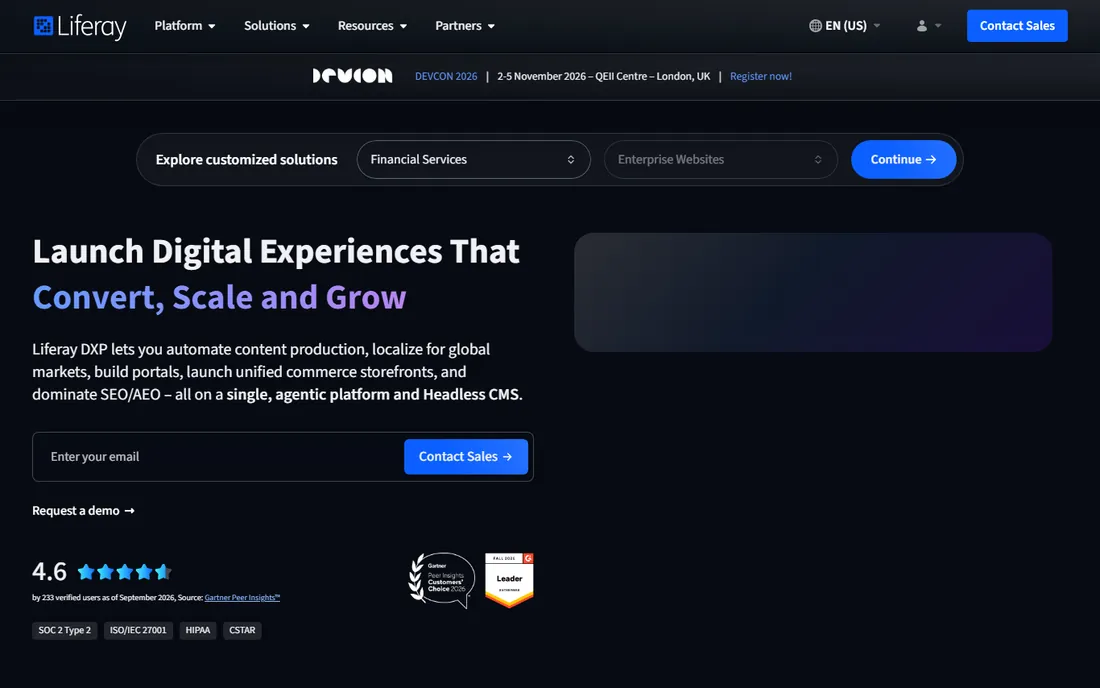
Liferay is not really a marketing CMS; it is a portal platform, and that distinction matters. Organizations building customer portals, partner extranets, or intranets where roles, permissions, and authenticated content delivery matter get a platform designed exactly for that. The free open-source Community Edition means capable in-house teams can evaluate deeply or even self-host without a license.
The audience is developers, specifically Java teams. Marketers expecting drag-and-drop page building will be disappointed. Commercial contracts are quote-based and annual; the Community Edition is the no-cost route. Setup is significant and needs real engineering capacity. If your problem is "thousands of logged-in users with different permissions," Liferay fits. If it is "our marketing team needs to publish pages," it does not.
What we like- Portal-grade platform built for authenticated experiences
- Free Community Edition for evaluation or self-hosting
- Granular permissions on an enterprise Java stack
Watch out for- Developer-heavy, not a marketer-friendly CMS
- Commercial pricing is quote-based
#6
Contentstack
Best for: Product and engineering-led teams running headless content operations
Visit contentstack.com
Starting priceCustom quote (no public pricing on the vendor site)
Free planNo public free plan on the vendor site
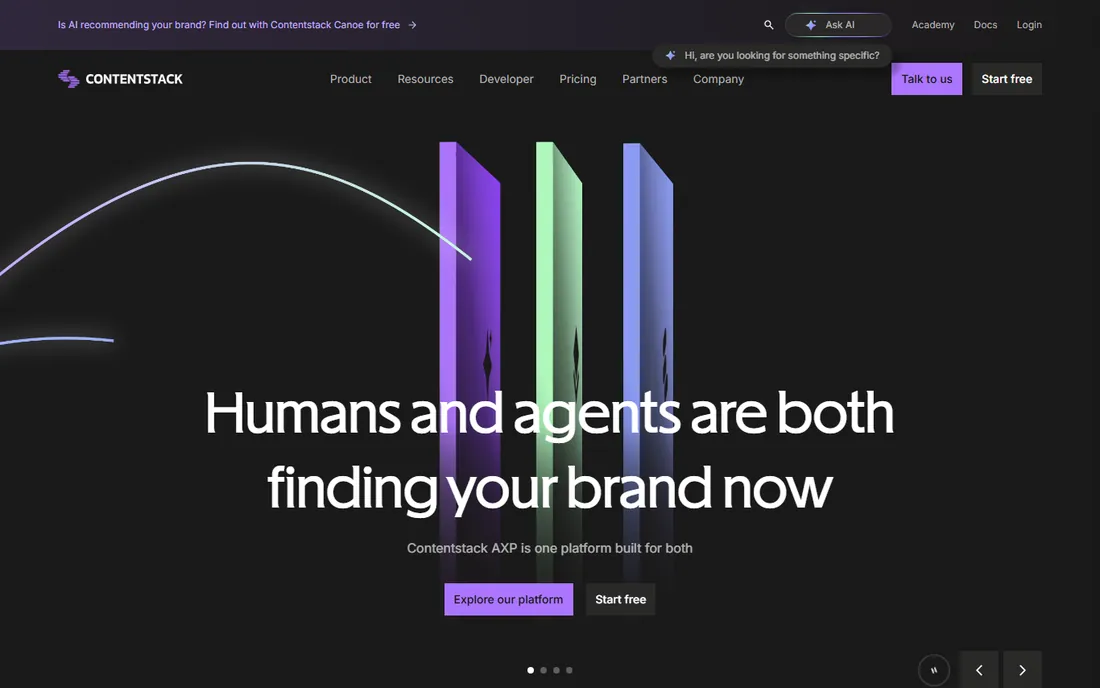
Contentstack is the headless purist's choice. Content lives in one hub, delivered by API to websites, apps, and any other channel; the automation layer and AI-assisted workflows handle the content operations side. Developer experience is a genuine strength, with solid APIs and a marketplace of apps.
The honest math: headless means you own the front end entirely. The CMS stands up fast; the custom front end is the real project, and teams without front-end capacity will need an agency or new hires. Pricing is quote-based with no public tiers, so confirm the metered dimensions: users, locales, and API usage typically count. For engineering-led organizations building omnichannel experiences, the architecture is right. For marketing teams wanting pages without developers, it is the wrong shape.
What we like- Pure headless CMS with automation and AI-assisted workflows
- Strong developer experience with APIs and marketplace apps
- Enterprise governance for multi-brand operations
Watch out for- Headless-only means you build and maintain the front end
- Quote-based pricing with no public tiers
#7
Magnolia
Best for: Mid-market companies wanting headless flexibility with usable editing
Visit magnolia-cms.com
Starting priceCustom quote (no public pricing on the vendor site)
Free planYes (free open-source Community Edition)
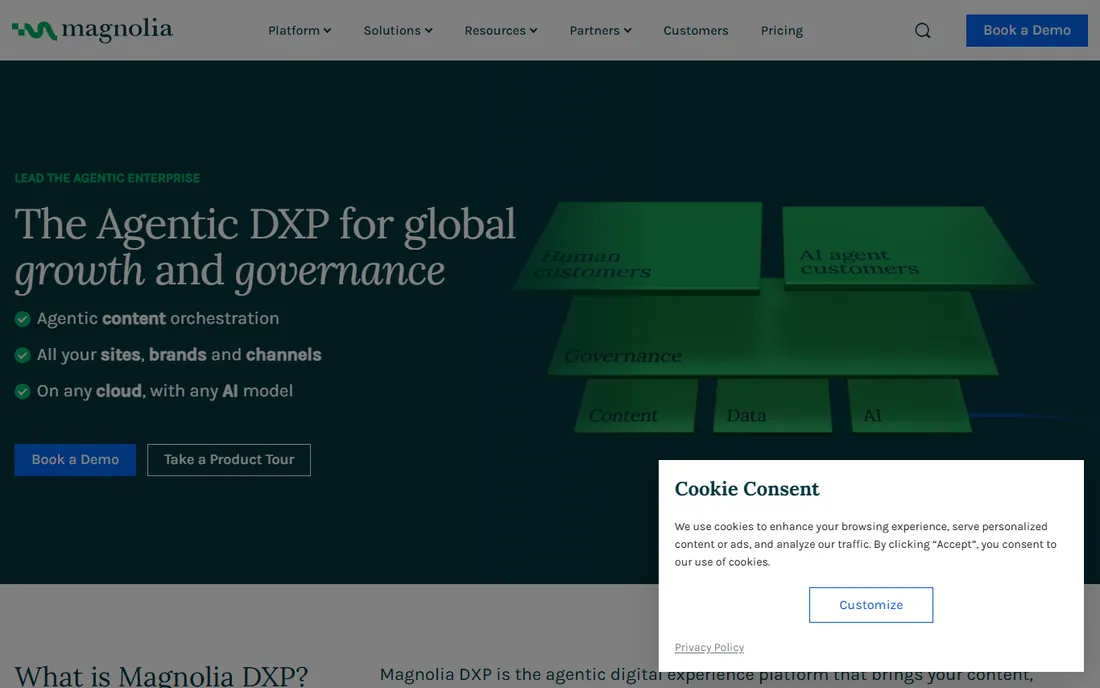
Magnolia answers the main complaint about headless CMS: that editors get a blank API and a prayer. Its visual editing layer sits on top of headless content delivery, so marketing teams get an interface they recognize while developers get the architecture they want. Multi-brand and multi-channel management is solid, and the free Community Edition allows real evaluation.
The ecosystem is the limitation. Fewer agencies and partners know Magnolia than know the giants, so vet implementation partners carefully and check references. Commercial pricing is fully quote-based. Setup is moderate, usually with a partner for the first build. For mid-market companies that want headless without abandoning their editors, Magnolia threads the needle well.
What we like- Headless CMS with a visual editor marketers can actually use
- Free Community Edition for evaluation and self-hosting
- Solid multi-brand, multi-channel management
Watch out for- Smaller ecosystem means fewer ready-made agencies
- Commercial pricing fully quote-based
#8
Kentico
Best for: Mid-market .NET teams wanting CMS, marketing automation, and commerce in one license
Visit kentico.com
Starting priceSee website (no prices published on the vendor's own site)
Free planTrial availability not confirmed on the vendor site
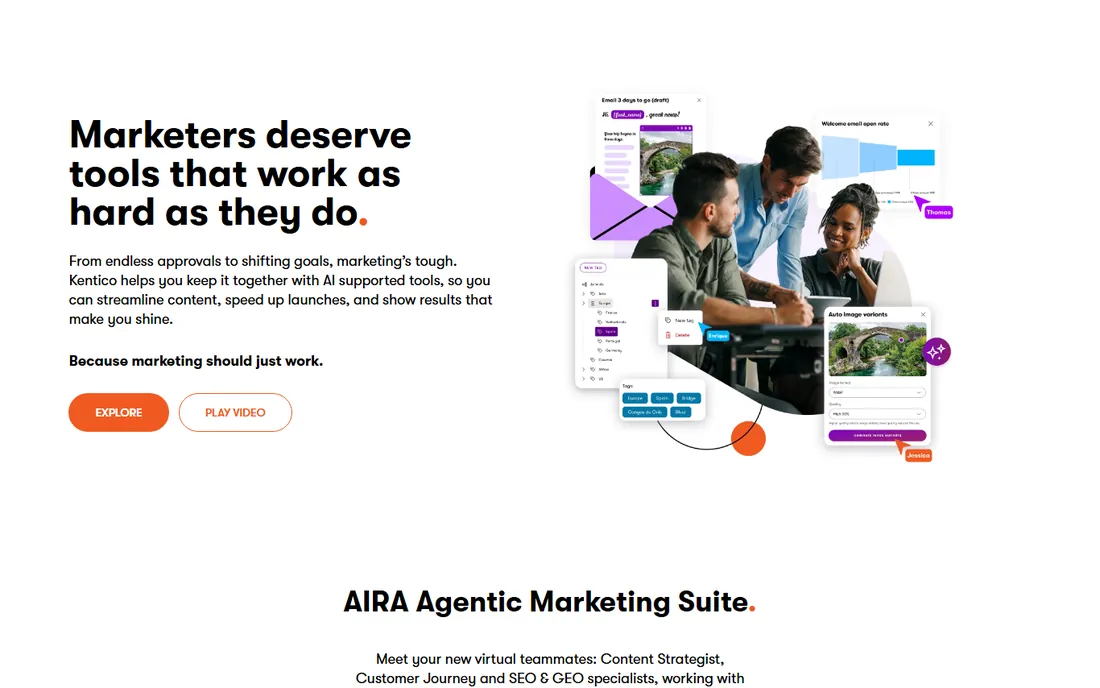
Kentico's argument is consolidation for the Microsoft world. One license covers the CMS, marketing automation, and commerce, which means one vendor relationship instead of three and no integration middleware between content and storefront. The SaaS edition, Xperience by Kentico, modernizes the historically self-hosted stack.
The fit is narrow by design. Teams on the Microsoft stack get the most value; everyone else has cheaper, better-fitting paths. And because the vendor publishes no prices, every evaluation starts with a sales conversation; confirm edition, user counts, and SaaS-versus-self-hosted terms in the quote. Setup runs moderate to heavy with commerce in scope. For the right .NET shop, the single-license breadth is compelling. For others, it is a detour.
What we like- All-in-one license covering content, personalization, and e-commerce
- Strong for Microsoft-stack shops
- SaaS option modernizes the stack
Watch out for- Budgeting starts with a sales call since nothing is published
- Best fit is narrow to .NET teams
Frequently asked questions
What is a digital experience platform?
A DXP combines content management with the surrounding capabilities: digital asset management, personalization, experimentation, and often commerce or customer data. Where a CMS manages content, a DXP manages the whole digital experience across channels. In practice, the line is marketing as much as architecture; evaluate what is actually included in the quote.
How much does a digital experience platform cost?
Expect custom quotes and six-to-seven-figure annual totals for the enterprise suites here. License fees are only part of it: implementation partners, hosting, and add-on modules stack up. The open-source editions of Liferay and Magnolia are the only no-license-cost paths, and even those need engineering investment. Get the full three-year cost in writing before committing.
Do we need a DXP or just a CMS?
If your need is publishing pages and blog posts, a CMS is enough and a DXP is expensive overkill. You need DXP capabilities when personalization, experimentation, multi-brand governance, or commerce integration are core requirements rather than nice-to-haves. Be honest about which of those you will actually use in year one.
What does headless mean for our team?
Headless separates content management from front-end presentation; content is delivered by API to whatever channel needs it. It gives developers freedom and omnichannel reach, but your team owns the front end completely. Do not choose headless unless you have, or will hire, front-end engineering capacity.
How long does implementation take?
Months, not weeks, for the enterprise platforms. AEM, Sitecore, and Liferay implementations are major projects, usually with a systems integrator. The headless specialists stand up faster on the CMS side, but the custom front end sets the real timeline. Plan the content migration separately; it is always bigger than expected.
Can we migrate off a DXP later?
Technically yes, practically it is a replatforming project. Content exports are usually feasible, but personalization rules, templates, and integrations do not transfer. The deeper you go into a vendor's ecosystem, the higher the switching cost. Negotiate data export terms and avoid proprietary lock-in on critical content before you sign.
The enterprise pricing reality
Every commercial platform in this roundup prices by custom quote. That is not an accident; it lets vendors price to your budget and bundle modules opaquely. Your defense is process. Get at least two competing quotes. Demand line-item pricing for each module, user tier, and usage meter. Ask what the renewal uplift cap is, and get it in the contract. Ask what happens to your content and data if you leave.
The two open-source editions, Liferay Community and Magnolia Community, change the economics completely: no license cost, but you supply the engineering. For organizations with strong in-house teams, that trade often wins. For everyone else, the license is the smaller number next to implementation and operations. Budget the whole picture, not the quote's first page.
How we chose
We started with the searches buyers actually run: best digital experience platform and its variants. For each candidate we opened the vendor's own homepage, checked for published pricing (and marked "custom quote" or "see website" where none exists rather than repeating third-party figures), and compared architecture, company-size fit, and ecosystem against practitioner discussion and public reviews. The shortlist spans enterprise suites and headless specialists because a global bank and a mid-market manufacturer are not buying the same thing.
Sources we checked (8)
- https://www.adobe.com/marketing/experience-manager.html
- https://optimizely.com/
- https://acquia.com/
- https://sitecore.com/
- https://liferay.com/
- https://contentstack.com/
- https://magnolia-cms.com/
- https://kentico.com/
Is your product missing or out of date?
We review this list regularly. Vendors can request a listing, send updated pricing or ask about featured placement.

Shihab Mia · Founder, Rankite
Shihab has 5+ years in B2B and SaaS SEO. He writes Rankite's software buying guides from pricing pages, documentation and public user reviews. More about Shihab.