How we make this list: we compare pricing pages, product documentation and public user reviews. Rankite is independent; if a vendor ever pays for a featured spot, that listing is clearly labeled Partner.
Key takeaways
- Nexthink and Lakeside SysTrack lead on endpoint-depth DEX, with real-time telemetry, experience scoring and automated remediation; both are Gartner-recognized leaders.
- TeamViewer DEX (formerly 1E) brings real-time endpoint automation to the TeamViewer portfolio after the 2025 acquisition, aimed at EUC and service desk teams.
- ControlUp and Riverbed Aternity cover the middle ground between endpoint and network visibility, with strong virtual desktop (VDI/DaaS) heritage.
- Cisco ThousandEyes is the network-side pick: it maps the path from user to application across the internet, which endpoint agents cannot see.
- Omnissa and Ivanti bundle DEX into broader platforms (Workspace ONE and Ivanti Neurons), which suits teams consolidating tools rather than buying point solutions.
Quick comparison
| Tool | Best for | Starting price | Free plan |
|---|
 Nexthink Nexthink | large enterprises wanting the most mature DEX platform | See website | No |
 Lakeside SysTrack Lakeside SysTrack | IT teams that want the deepest endpoint data set | See website | No |
 TeamViewer DEX TeamViewer DEX | EUC teams wanting real-time remediation inside the TeamViewer ecosystem | See website | No |
 ControlUp ControlUp | VDI and DaaS shops that want DEX in the same console | See website | Free trial (21 days) |
 Riverbed Aternity Riverbed Aternity | measuring actual application performance from the user's perspective | See website | Free trial (30 days) |
 Cisco ThousandEyes Cisco ThousandEyes | diagnosing experience problems caused by networks and the internet | See website | Free trial |
 Omnissa DEX Omnissa DEX | Workspace ONE and Horizon customers consolidating DEX into their platform | See website | No |
 Ivanti Neurons for DEX Ivanti Neurons for DEX | IT teams wanting DEX with self-healing inside the Ivanti stack | See website | No |
Is your product missing or out of date?
We review this list regularly. Vendors can request a listing, send updated pricing or ask about featured placement.
The best digital employee experience software
#1
Nexthink
Best for: large enterprises wanting the most mature DEX platform
Visit nexthink.com
Starting priceSee website
Free planNo
Nexthink defined this category and still sets its pace. The Infinity platform collects real-time data from every endpoint, scores the digital experience per user and device, and pairs it with automation that fixes common issues before employees notice. The Digital Experience Score gives IT a single metric to manage against, and experience-level agreements (XLAs) turn that metric into accountability with the business.
Scale is the differentiator: more than 1,000 organizations and 18 million endpoints run Nexthink, which feeds benchmarking data smaller vendors cannot match. Third-party pricing research puts enterprise deals around $6 to $10 per endpoint per month billed annually, but Nexthink publishes no prices and every deal is negotiated. This is a platform for organizations with dedicated EUC teams; a 500-person company will find faster value elsewhere.
What we like- Deepest real-time endpoint analytics
- Experience scoring and XLAs
- 18M+ endpoints under management
Watch out for- Enterprise pricing only
- Implementation is a project, not a signup
- Overkill below a few thousand endpoints
Starting priceSee website
Free planNo
Lakeside's pitch is data depth. The SysTrack agent captures more than 10,000 data points per endpoint every 15 seconds, including offline periods, building the richest telemetry set in the category. The 2025 launch of SysTrack AI added an agentic layer: IT engineers ask plain-language questions like "why is this device slow" and get evidence-backed diagnoses with clickable audit trails, while end users get conversational self-service for common issues.
That depth cuts both ways. Teams with the skills to query it can answer questions no other tool can, from patch compliance to Windows 11 readiness to the true cost of a misbehaving app. Teams without analyst capacity may find themselves paying for data they never use. Lakeside was named a Leader in the 2026 Gartner Magic Quadrant for DEX Management Tools, and pricing is custom-quoted per endpoint.
What we like- 10,000+ data points per endpoint every 15 seconds
- SysTrack AI for natural-language diagnosis
- Named a 2026 Gartner Magic Quadrant Leader
Watch out for- No published pricing
- Data depth requires skilled analysts to exploit
- Agent footprint to manage
#3
TeamViewer DEX
Best for: EUC teams wanting real-time remediation inside the TeamViewer ecosystem
Visit teamviewer.com
Starting priceSee website
Free planNo
TeamViewer DEX is the new name for 1E's DEX platform after TeamViewer acquired 1E in 2025. The core is the Tachyon architecture: real-time diagnosis, remediation and automation across the endpoint estate, with self-service and self-heal capabilities that put employees in control and sentiment monitoring that captures how people actually feel about their IT. More than 500 organizations managing 11 million endpoints used the platform as 1E.
The acquisition logic is clear: pair 1E's autonomous remediation with TeamViewer's remote connectivity and its massive installed base. The product story is still settling as the two portfolios merge, so ask pointed questions about roadmap and naming during evaluation. Pricing is custom-quoted, and the strongest value case is for organizations already standardized on TeamViewer.
What we like- Real-time diagnosis and remediation architecture
- Self-service and sentiment monitoring
- TeamViewer remote connectivity built in
Watch out for- Product line still integrating after the 2025 acquisition
- Enterprise quotes only
- Best value for existing TeamViewer customers
Starting priceSee website
Free planFree trial (21 days)
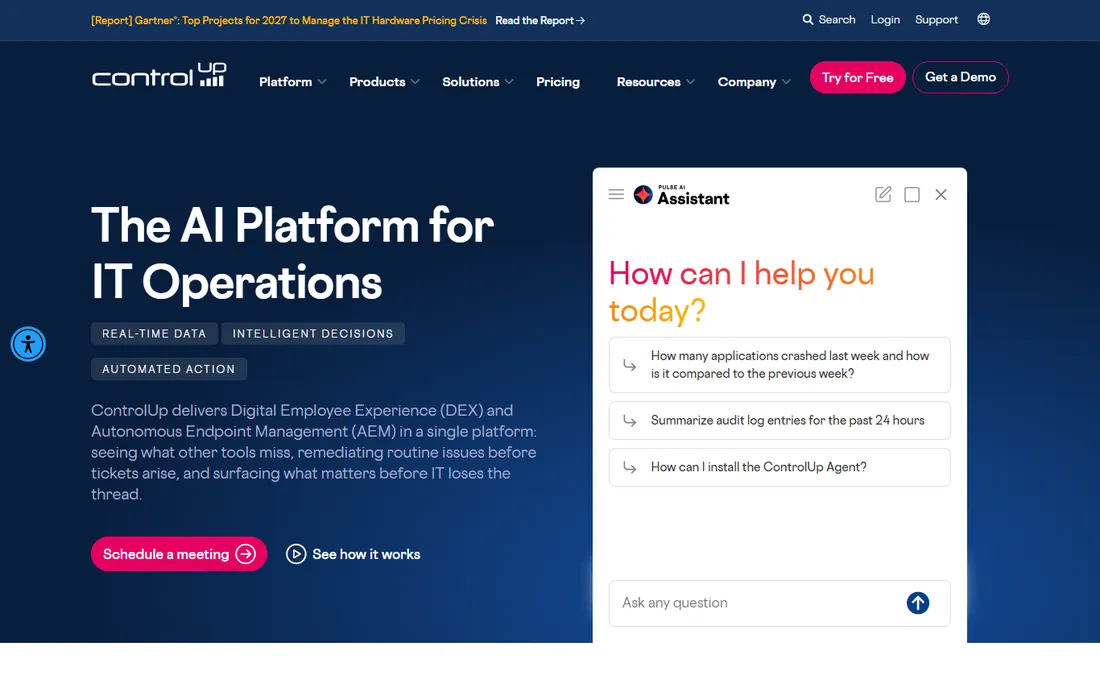
ControlUp grew up in virtual desktops and it shows: no DEX vendor manages Citrix, Azure Virtual Desktop and VMware Horizon environments with the same fluency. The platform unifies real-time monitoring, DEX scoring, remote control and automated remediation for physical endpoints, virtual desktops and applications in one console, which matters because most enterprises run all three and hate swivel-chair management.
The 21-day free trial covers up to 50 endpoints or VDIs with full real-time metrics and DEX scoring, which is genuinely useful for evaluation. ControlUp claims nearly 2,000 customers including more than a third of the Fortune 100. Pricing is not published; third-party estimates put the DEX tier around $4.50 to $6 per user per month, but verify with a quote. Teams with heavy VDI estates should shortlist this first.
What we like- Real-time monitoring across physical and virtual desktops
- 21-day trial up to 50 endpoints
- Strong in Citrix, AVD and VMware environments
Watch out for- Pricing not published
- VDI heritage shows in physical-endpoint depth
- Enterprise sales motion
#5
Riverbed Aternity
Best for: measuring actual application performance from the user's perspective
Visit riverbed.com
Starting priceSee website
Free planFree trial (30 days)

Aternity, Riverbed's DEX product, answers the question employees actually ask: is the app slow for me right now. Its signature metric is click-to-render timing, the real time between a user clicking and the application responding, measured on the device rather than inferred from servers. Combined with device health and user satisfaction data, it pinpoints whether a bad experience comes from the app, the device or the network.
Riverbed positions Aternity inside a wider AI observability platform spanning networks, infrastructure and digital experience, with a 30-day trial covering up to 50 endpoints. The platform story is the pitch: Aternity alone is strong application monitoring, but the autonomous remediation vision needs Riverbed's other components. Pricing is enterprise-quoted. Organizations already running Riverbed network products get the most natural fit.
What we like- Click-to-render application timing
- Device and network context per issue
- Part of the broader Riverbed observability platform
Watch out for- Custom quotes only
- Full value needs the wider Riverbed platform
- Network heritage biases toward infrastructure teams
#6
Cisco ThousandEyes
Best for: diagnosing experience problems caused by networks and the internet
Visit thousandeyes.com
Starting priceSee website
Free planFree trial
ThousandEyes looks where endpoint agents cannot: the network path between the user and the application. For hybrid workers on home Wi-Fi and VPNs, most bad experiences are network problems, and ThousandEyes visualizes every hop, correlates loss, latency and jitter, and distinguishes app slowdowns from network disruptions. Its Internet Insights product detects global outages from collective data, so IT knows about a SaaS outage before users report it.
This is a complement to, not a replacement for, endpoint DEX tools like Nexthink or SysTrack. Pairing the two gives the full picture: endpoint health on one side, delivery path on the other. ThousandEyes offers a free trial and sells through Cisco's enterprise licensing, which means pricing depends on test volume and contract structure. Network teams evaluating DEX should start here.
What we like- Unmatched internet and WAN path visibility
- Endpoint agents for remote workers
- Collective intelligence on global outages
Watch out for- Network-centric, not a full endpoint DEX suite
- Cisco licensing complexity
- Priced per test, which needs modeling
#7
Omnissa DEX
Best for: Workspace ONE and Horizon customers consolidating DEX into their platform
Visit omnissa.com
Starting priceSee website
Free planNo
Omnissa is the company formed from VMware's end-user computing business, and its DEX story is inseparable from Workspace ONE and Horizon. Experience Management collects telemetry from Horizon infrastructure and user sessions, logon duration, session performance, application health, and feeds it into the Omnissa Intelligence platform for scoring and automated remediation via Playbooks and QuickFlows. For physical devices, the Workspace ONE Intelligent Hub carries the DEX agent.
The value proposition is consolidation: one vendor for UEM, VDI and DEX, with the Platinum tiers bundling the complete experience solution. That is compelling for existing VMware shops and weak for everyone else. As a standalone DEX purchase, Nexthink or Lakeside offer more depth. Pricing is bundled into platform licensing with no standalone list price, so evaluation runs through Omnissa's sales team.
What we like- Native integration with Horizon VDI and Workspace ONE UEM
- AI-guided root cause for virtual desktops
- Single-vendor EUC stack
Watch out for- Best value locked to the Omnissa ecosystem
- Standalone DEX buyers have better options
- Pricing bundled into platform tiers
#8
Ivanti Neurons for DEX
Best for: IT teams wanting DEX with self-healing inside the Ivanti stack
Visit ivanti.com
Starting priceSee website
Free planNo
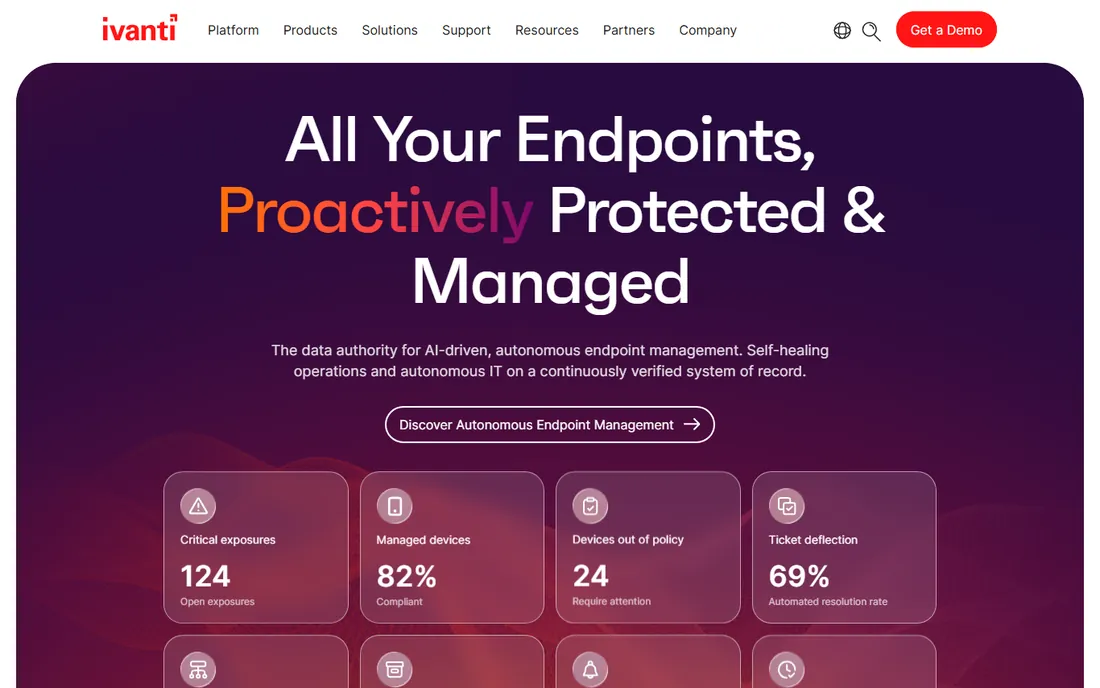
Ivanti Neurons for DEX is the experience module of the Ivanti Neurons hyperautomation platform, alongside discovery, patch management, edge intelligence and healing. It tracks, measures and scores digital experience from device and application telemetry, collects employee sentiment through interactive automation bots, and applies self-healing to resolve problems before they reach the service desk. The 360-degree monitoring and synthetic SaaS testing round out the picture.
The platform argument is Ivanti's strength and its caveat. Organizations already running Ivanti for patching or service management get DEX as a natural extension with shared data and workflows. Buying Neurons for DEX alone rarely makes sense against pure-play vendors. Ivanti serves over 40,000 customers including 85 of the Fortune 100, and was named a Visionary in Gartner's 2025 Magic Quadrant for DEX Management Tools. Pricing is custom-quoted.
What we like- Self-healing automation resolves issues before users notice
- Sentiment bots collect contextual feedback
- 40,000+ customer installed base
Watch out for- DEX is one module of a large platform
- UI consistency across modules varies
- Enterprise quotes only
How we chose
We focused on platforms that Gartner, IDC and enterprise buyers recognize as DEX management tools in 2026, prioritizing breadth of capability: endpoint telemetry, experience scoring, automation and remediation. We verified each vendor's current homepage and product positioning, and noted major corporate changes, notably TeamViewer's 2025 acquisition of 1E and Omnissa's emergence from VMware's EUC business.
We did not evaluate pricing beyond confirming that none of these vendors publish list prices; every deal is quoted per endpoint or per user. We also did not test the products hands-on. DEX platforms require enterprise pilots to evaluate properly, which is why several vendors offer structured trials and proofs of concept.
How to evaluate DEX software
Match the tool to your blind spot
DEX platforms see different things. Nexthink and SysTrack see endpoints in forensic detail. ThousandEyes sees the network path. ControlUp and Aternity bridge endpoints and virtual desktops. Before shortlisting, identify where your experience problems actually live: slow devices, bad applications, flaky networks, or painful VDI logons. The vendor whose visibility matches your blind spot will deliver value fastest.
Score the automation, not just the dashboards
Every DEX vendor shows impressive dashboards. The economic value is in what happens without human intervention: self-healing scripts, automated remediation playbooks, and employee self-service that deflects tickets. Ask each vendor for their automated resolution rate with reference customers, and confirm which remediations run without approval versus which need sign-off. A dashboard that only reports problems is an expensive mirror.
Plan the pilot like a purchase
DEX pilots are the real evaluation, and vendors know it. Nexthink runs guided proofs of concept, ControlUp and Aternity offer trials up to 50 endpoints, and ThousandEyes offers a free trial. Run the pilot on your worst-performing user population, not your best, and define success metrics up front: ticket deflection, mean time to resolution, or experience score improvement. A pilot on happy users proves nothing.
Price per endpoint, then model growth
All eight platforms price per endpoint or per user per month, billed annually, with volume tiers. Third-party estimates range from roughly $4.50 to $10 per endpoint per month across this list, but treat those as negotiation starting points, not quotes. Model three years of endpoint growth, including contractors and seasonal workers, because the per-unit price you negotiate in year one rarely survives a 40 percent headcount increase.
DEX vs. traditional monitoring: what is actually different
Traditional IT monitoring watches infrastructure: server CPU, network uptime, application availability. DEX watches the employee's experience of that infrastructure: how long the laptop takes to boot, whether Teams calls drop, how the CRM feels at 9 AM on Monday. The data sources overlap, but the questions differ, and infrastructure can be green while employees are miserable.
The practical difference is the agent. DEX platforms install lightweight agents on endpoints (or use existing UEM agents, as Omnissa does) to measure what the user experiences directly. Traditional monitoring infers experience from server-side metrics. Both matter, and mature IT organizations run both, but only DEX tells you why the help desk phone keeps ringing when every dashboard is green.
The second difference is action. DEX platforms pair measurement with remediation: automated fixes, self-service portals and sentiment-driven prioritization. Traditional monitoring mostly alerts humans. That automation is where DEX ROI comes from, typically framed as ticket deflection and reclaimed productivity rather than infrastructure savings.
Frequently asked questions
What is digital employee experience software?
DEX software measures and improves how employees experience workplace technology. It collects telemetry from endpoints, applications and networks, scores the experience, and automates fixes for common problems. The goal is fewer IT issues reaching employees and fewer tickets reaching the service desk.
How is DEX different from endpoint management (UEM)?
UEM manages devices: provisioning, patching, policy enforcement and security. DEX measures the experience on those devices and fixes experience problems. The two overlap, which is why Omnissa and Ivanti bundle them, but a well-managed device can still deliver a bad experience, and that gap is what DEX addresses.
Do I need DEX if I already have monitoring tools?
If your monitoring covers servers and networks but nobody measures the endpoint experience, yes, you have a blind spot. ThousandEyes-style network visibility and Nexthink-style endpoint telemetry answer different questions. Most enterprises in 2026 run both infrastructure monitoring and DEX, with the DEX layer focused on ticket deflection and productivity.
What does DEX software cost?
None of the leading vendors publish list prices. Enterprise deals are quoted per endpoint or per user per month, billed annually, with third-party estimates ranging from roughly $4.50 to $10 per endpoint per month depending on the vendor and modules. Expect volume discounts at scale and multi-year commitments. Always get at least two competing quotes.
Can small businesses use DEX software?
These platforms are built for enterprises with thousands of endpoints, and pricing reflects that. A company under 500 employees will struggle to justify the cost and the implementation effort. Smaller teams get most of the value from their existing RMM or UEM tools plus basic monitoring, and should revisit DEX when ticket volume or endpoint count makes the ROI case.
How long does DEX implementation take?
Expect 4 to 12 weeks for agent deployment and baseline scoring, plus another quarter to tune automations and build XLAs. Cloud-native platforms like ControlUp deploy faster; data-heavy platforms like SysTrack take longer to reach full value. The pilot phase is part of implementation, not separate from it, so start measuring success metrics from day one.
Sources we checked (12)
- https://nexthink.com
- https://lakesidesoftware.com/
- https://www.teamviewer.com
- https://www.controlup.com
- https://riverbed.com/
- https://thousandeyes.com/
- https://www.omnissa.com
- https://ivanti.com/
- https://github.com/ishandutta2007/awesome-digital-experience-monitoring/blob/HEAD/README.md
- https://en.wikipedia.org/wiki/Lakeside_Software
- https://www.globenewswire.com/news-release/2025/11/18/3189957/0/en/Lakeside-Software-Launches-SysTrack-AI-Bringing-Agentic-Digital-Employee-Experience-to-Every-Device.html
- https://www.omnissa.com/glossary/digital-employee-experience/
Is your product missing or out of date?
We review this list regularly. Vendors can request a listing, send updated pricing or ask about featured placement.

Shihab Mia · Founder, Rankite
Shihab has spent more than a decade helping SaaS and e-commerce brands grow through search. He writes Rankite's software buying guides from pricing pages, documentation and public user reviews. More about Shihab.