How we make this list: we compare pricing pages, product documentation and public user reviews. Rankite is independent; if a vendor ever pays for a featured spot, that listing is clearly labeled Partner.
Key takeaways
- TensorFlow, PyTorch, Keras, JAX, fastai, and DeepLearning4J are free and open source, so framework choice costs nothing but engineering time.
- PyTorch dominates research and Keras offers the gentlest learning curve, while JAX appeals to teams chasing performance on accelerators.
- MATLAB Deep Learning Toolbox fits engineering teams already invested in MATLAB who want low-code design apps and code generation.
- Amazon SageMaker handles the expensive part, training and deployment infrastructure, with pay-as-you-go pricing.
- Weights and Biases and Ultralytics solve adjacent problems: experiment tracking and production computer vision.
Quick comparison
| Tool | Best for | Starting price | Free plan |
|---|
 TensorFlow TensorFlow | Production ML pipelines | Free (open source) | Yes |
 PyTorch PyTorch | Research and flexible model building | Free (open source) | Yes |
 Keras Keras | Fast prototyping and learning | Free (open source) | Yes |
 JAX JAX | High-performance accelerator computing | Free (open source) | Yes |
 fastai fastai | Rapid model building on PyTorch | Free (open source) | Yes |
 Eclipse DeepLearning4J Eclipse DeepLearning4J | Deep learning on the JVM | Free (open source) | Yes |
 MATLAB Deep Learning Toolbox MATLAB Deep Learning Toolbox | Engineers using MATLAB | See website | Free trial |
 Amazon SageMaker Amazon SageMaker | Managed training and deployment | See website (pay-as-you-go) | Free tier credits |
 Weights and Biases Weights and Biases | Experiment tracking and MLOps | See website | Yes (personal) |
 Ultralytics Ultralytics | Computer vision with YOLO | See website | Yes |
Is your product missing or out of date?
We review this list regularly. Vendors can request a listing, send updated pricing or ask about featured placement.
The best deep learning software
Starting priceFree (open source)
Free planYes
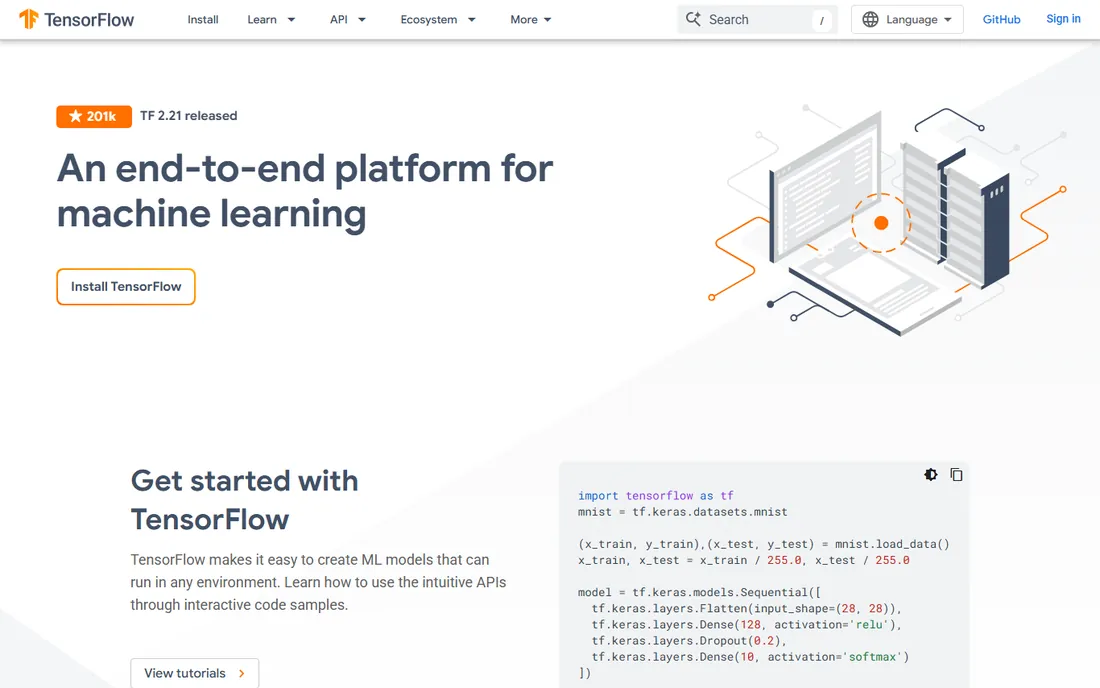
TensorFlow remains the default choice when the goal is a model running in production. Google built it for its own workloads, and the ecosystem reflects that: training, serving, mobile deployment, and a model zoo all live under one roof. Keras ships as its high-level API, so teams get both the friendly interface and the production machinery.
The honest catch is complexity. TensorFlow can do everything, which means new engineers face a bigger surface to learn, and some older APIs still linger in documentation. For a small team shipping its first model, starting with Keras on TensorFlow is usually the right balance.
What we like- Full ecosystem from training to deployment
- Strong mobile and edge support via LiteRT
- Huge community and hiring pool
Watch out for- Steeper learning curve than Keras alone
- API history carries some legacy complexity
Starting priceFree (open source)
Free planYes
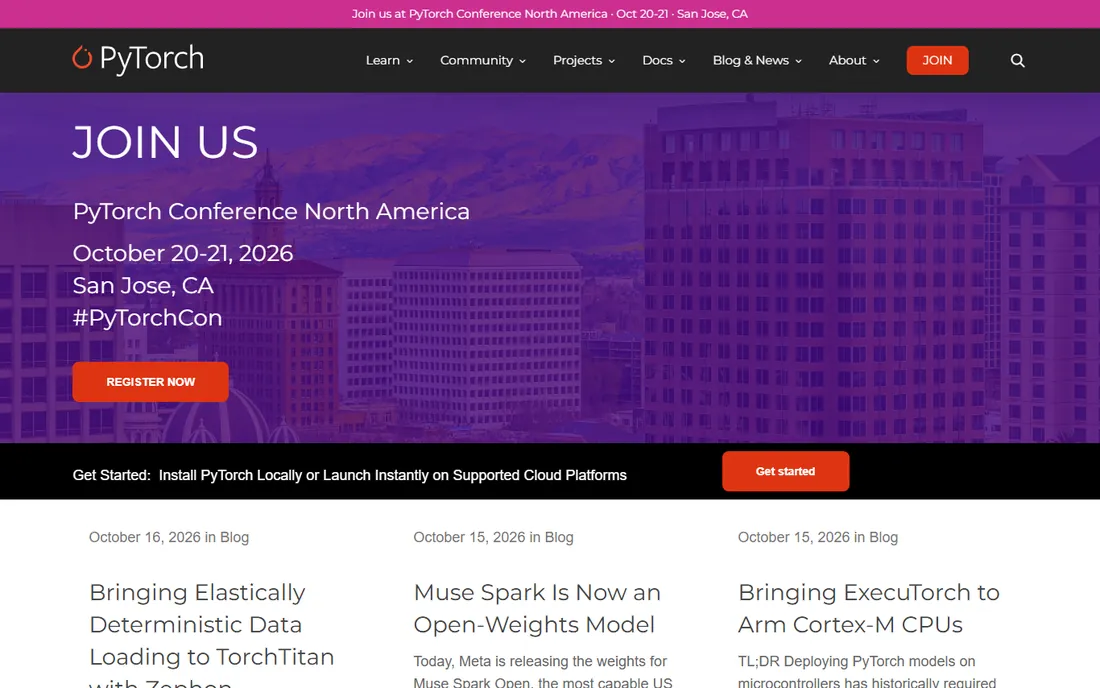
PyTorch won the research community with an API that feels like normal Python. Models are easy to build, debug, and modify, which is why most papers and new techniques ship in PyTorch first. If your team hires ML engineers, they almost certainly know PyTorch already.
For production, PyTorch has closed much of the gap with TorchServe, ONNX export, and strong cloud support, but it still takes more assembly than TensorFlow's integrated pipeline. Teams that prototype in PyTorch and deploy carefully do fine. Teams that need deployment to be turnkey should weigh that cost.
What we like- Intuitive dynamic computation graphs
- Dominant in research, so new techniques appear here first
- Excellent debugging experience
Watch out for- Production deployment needs extra tooling like TorchServe
- Mobile story is thinner than TensorFlow's
Starting priceFree (open source)
Free planYes
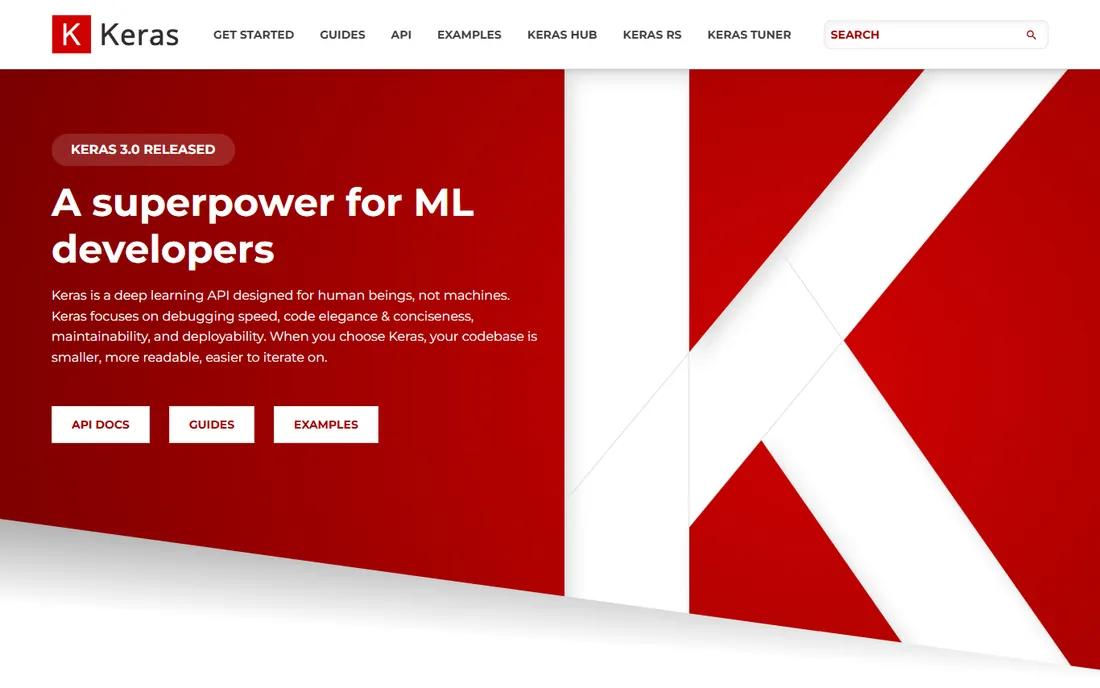
Keras is where most people should start. Its API is deliberately designed for humans, and Keras 3 runs the same model code on JAX, TensorFlow, or PyTorch backends, so you are not locked into one stack. Pretrained models through KerasHub make transfer learning a few lines of code.
Experienced practitioners sometimes outgrow it for exotic architectures, dropping into backend APIs for full control. That is fine. Keras gets a team from zero to a working model faster than anything else, and that speed is usually the bottleneck, not framework power.
What we like- Cleanest API of any major framework
- Multi-backend support for JAX, TensorFlow, and PyTorch
- Strong pretrained model library
Watch out for- Advanced custom architectures eventually need the backend API anyway
- KerasHub ecosystem is smaller than the big frameworks'
#4
JAX
Best for: High-performance accelerator computing
Visit jax.dev
Starting priceFree (open source)
Free planYes
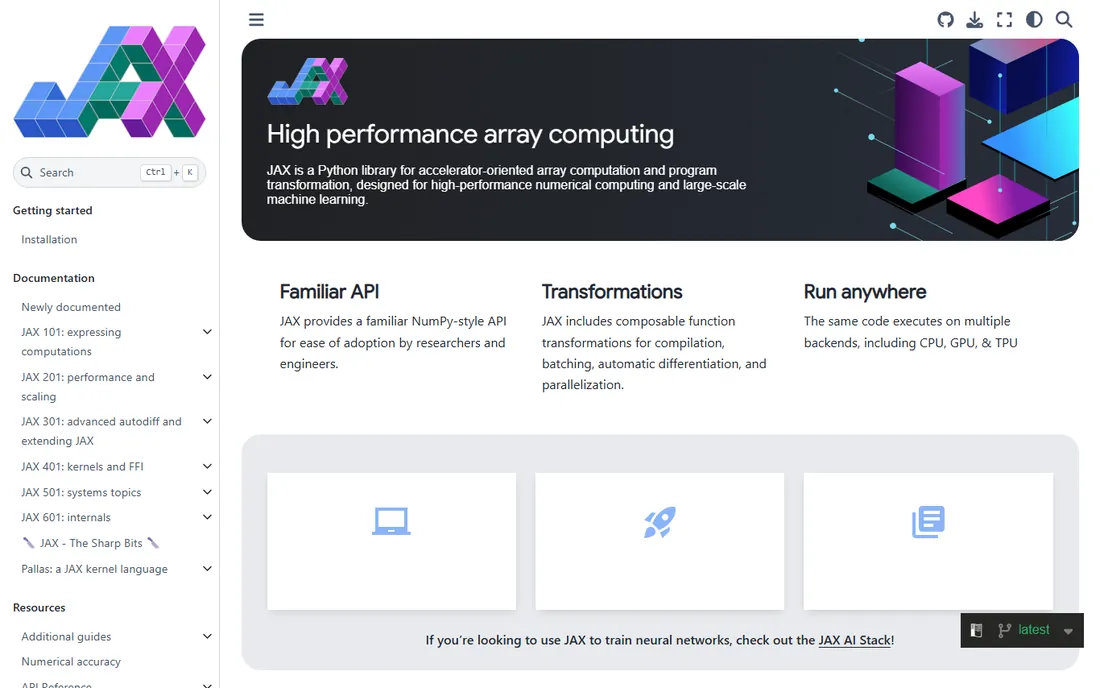
JAX is Google's answer to high-performance machine learning research. It feels like NumPy with superpowers: automatic differentiation, just-in-time compilation, and vectorization as composable transformations. On GPUs and especially TPUs, well-written JAX is extremely fast.
The tradeoff is style. JAX is functional and stateless, so engineers used to object-oriented frameworks need to rethink how they manage model state. Libraries like Flax and Equinox help, but the learning curve is real. Pick JAX when performance or TPU access justifies it, not as a first framework.
What we like- Exceptional speed via JIT compilation and XLA
- NumPy-like API that researchers learn quickly
- First-class TPU support
Watch out for- Functional programming style is unfamiliar to many engineers
- Smaller ecosystem than PyTorch or TensorFlow
Starting priceFree (open source)
Free planYes
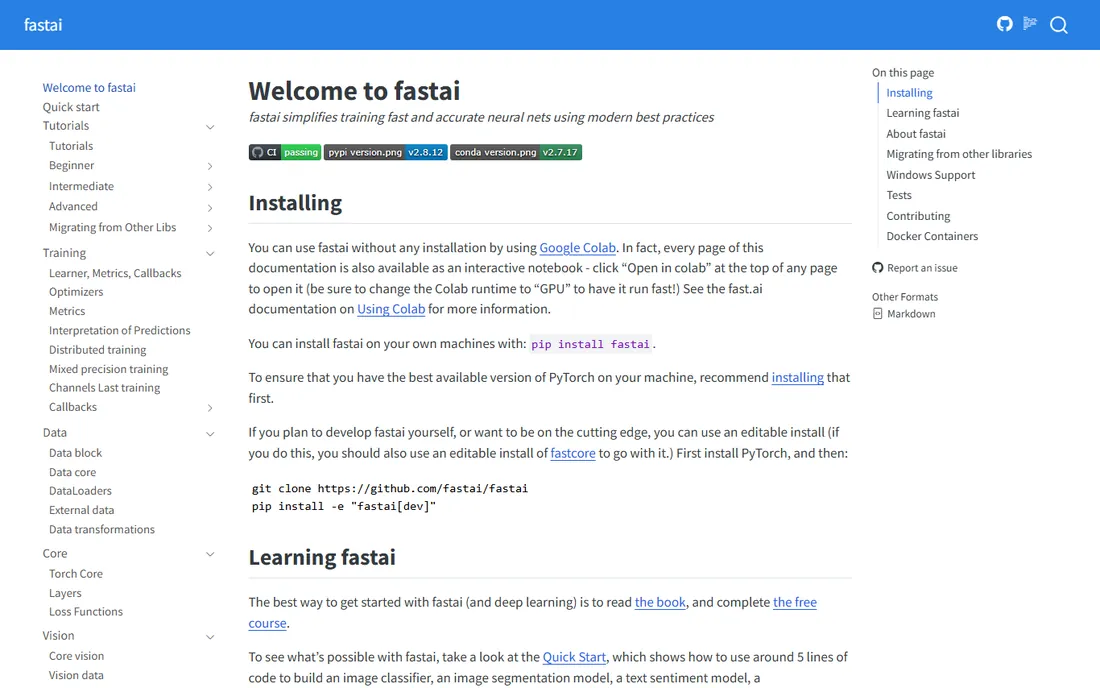
fastai sits on top of PyTorch and gives practitioners battle-tested best practices out of the box. An image classifier, a text model, or a tabular model each takes a handful of lines, and the defaults encode years of competition-winning technique. The free course is genuinely one of the best ways to learn deep learning.
Because it is opinionated, teams doing unusual things sometimes fight the abstractions. The library is layered precisely so you can drop down when needed, but that requires understanding the design. For standard vision, text, and tabular problems, fastai is the fastest route to a good model.
What we like- State-of-the-art results with minimal code
- Excellent free course and book
- Layered API stays hackable underneath
Watch out for- Opinionated defaults can confuse when you need custom behavior
- Smaller community than raw PyTorch
Starting priceFree (open source)
Free planYes
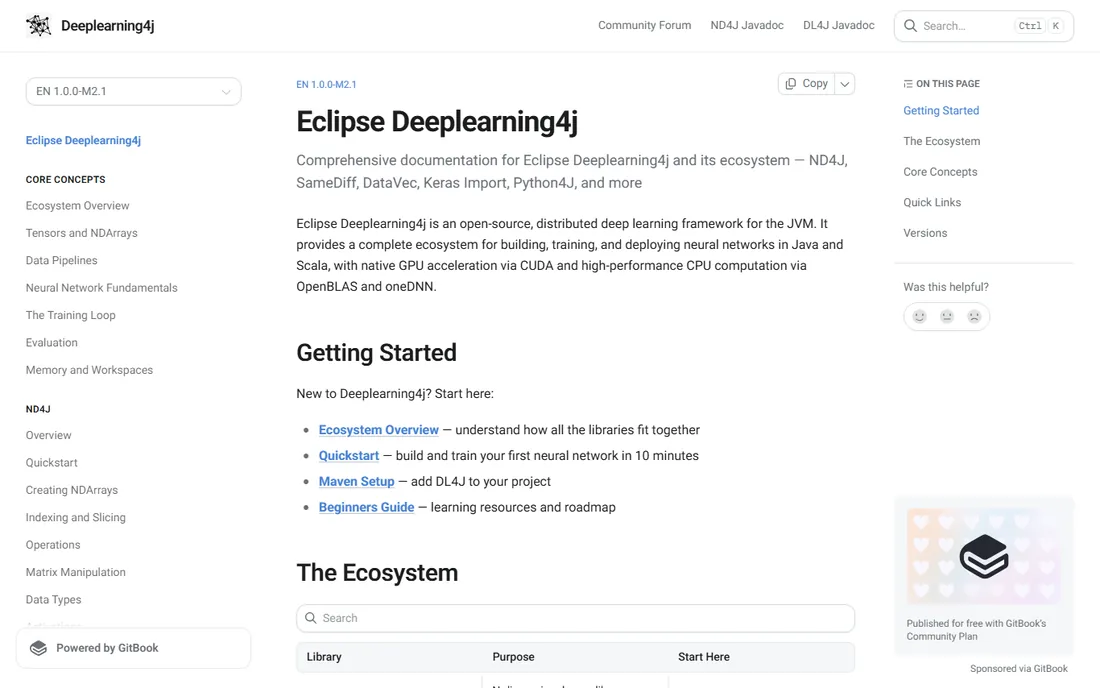
DeepLearning4J exists for one reason: some companies run on Java. If your production systems, data pipelines, and team skills are all JVM-based, DL4J lets you train and deploy neural networks without bolting on a Python stack. Model import from Keras, TensorFlow, and ONNX bridges the two worlds.
The ecosystem is much smaller than PyTorch or TensorFlow, and finding engineers with DL4J experience is harder. For JVM-heavy organizations, that tradeoff beats maintaining a parallel Python infrastructure. Everyone else should pick a Python framework.
What we like- Native Java and Scala support for JVM shops
- Imports Keras, TensorFlow, and ONNX models
- Distributed training on Spark
Watch out for- Community and documentation trail the Python frameworks
- Java ML talent is harder to hire
Starting priceSee website
Free planFree trial
If your team already lives in MATLAB, the Deep Learning Toolbox is the path of least resistance. Engineers can design networks in a visual app, train on GPUs, and generate deployment code for CPUs, GPUs, and FPGAs without leaving the environment. Interop with PyTorch and TensorFlow models keeps it connected to the wider ecosystem.
The cost is the obvious issue: MATLAB is commercial software, and the toolbox needs a license on top. For engineering teams in manufacturing, automotive, or signal processing that already pay for MATLAB, that is a sunk cost. For software teams starting fresh, open-source frameworks are the cheaper route.
What we like- Visual apps like Deep Network Designer reduce coding
- Imports PyTorch and TensorFlow models
- Generates C, CUDA, and HDL code for deployment
Watch out for- Requires a MATLAB license, so it is not free
- Smaller ML community than open-source frameworks
Starting priceSee website (pay-as-you-go)
Free planFree tier credits
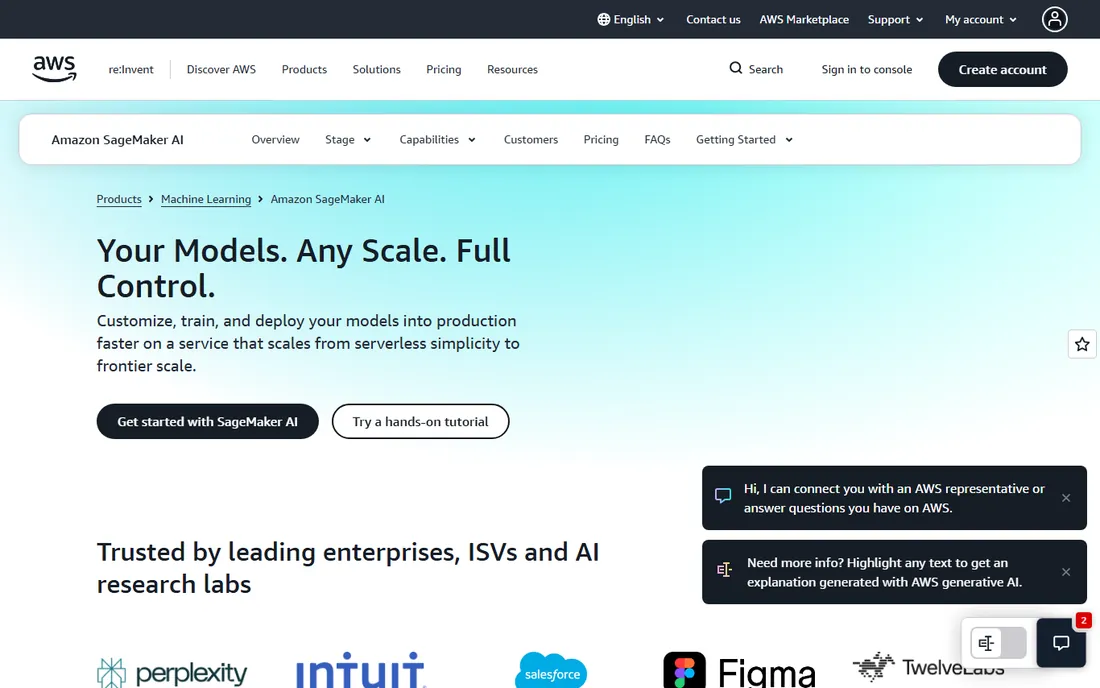
SageMaker answers the question frameworks leave open: where do models train and run? It is a managed platform covering notebooks, distributed training, hyperparameter tuning, and deployment endpoints, and it works with PyTorch, TensorFlow, and JAX. For teams without infrastructure expertise, that managed layer is the product.
Pricing is usage-based, which is flexible but demands cost discipline. Idle endpoints and oversized instances are the classic way small teams overspend. Use SageMaker when your bottleneck is infrastructure, not modeling, and set billing alerts on day one.
What we like- Full lifecycle from data prep to deployment
- Scales from one GPU to thousands
- Brings your own framework or use built-ins
Watch out for- Pay-as-you-go costs add up fast without monitoring
- AWS complexity leaks into the ML workflow
#9
Weights and Biases
Best for: Experiment tracking and MLOps
Visit wandb.ai
Starting priceSee website
Free planYes (personal)

Once a team runs more than a handful of training experiments, tracking becomes the problem. Weights and Biases logs hyperparameters, metrics, and artifacts with a few lines of code, and the dashboards make comparing runs trivial. Sweeps automate hyperparameter search, and the model registry versions what you ship.
The personal tier is free, and the company was acquired by CoreWeave in 2025, folding into its Forge platform. Paid team pricing is quote-based, so check the site for current numbers. Any team training models seriously should adopt experiment tracking early; W&B is the standard choice.
What we like- Best-in-class experiment tracking and visualization
- Hyperparameter sweeps and model registry included
- Free for personal and academic use
Watch out for- Team and enterprise pricing is quote-based
- Another service to integrate into your stack
Starting priceSee website
Free planYes
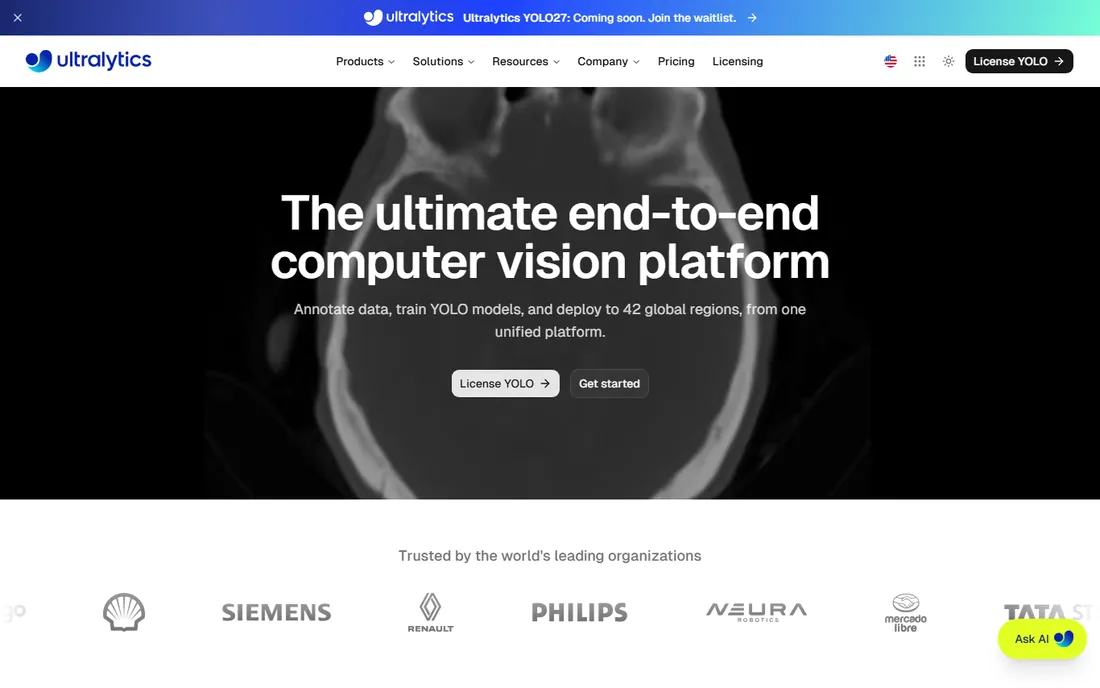
For object detection, segmentation, and pose estimation, Ultralytics YOLO is what most teams actually deploy. The open-source library trains and runs models with minimal code, and the platform adds annotation, cloud GPU training, and deployment endpoints. The FAQ confirms a free plan covering annotation, training, and deployment basics.
Ultralytics is a vision specialist, not a general framework, so it complements rather than replaces PyTorch or TensorFlow. If your deep learning use case is cameras and images, start here. If it is language or tabular data, look elsewhere.
What we like- YOLO models are the practical standard for real-time vision
- Simple Python API and CLI
- Platform covers annotation, training, and deployment
Watch out for- Focused on vision, so not a general deep learning tool
- Advanced platform features are paid
How we chose
We evaluated tools on maturity and community support, documentation quality, fit for small and mid-size teams, pricing from each vendor's own pages, and coverage of the full workflow from prototyping to deployment. We drew on framework documentation, vendor pricing pages, and public discussion on GitHub, Reddit, and G2. We did not claim hands-on testing; every fact comes from the sources listed below.
What to weigh before committing to a deep learning stack
Start with the framework your team can actually use. A brilliant framework nobody on staff knows is worse than a simpler one they can ship with. For most small teams, that means PyTorch or Keras, with fastai as an accelerator for standard problems. Framework choice is nearly free, so optimize for team skill, not theoretical performance.
Next, separate modeling from infrastructure. Frameworks are free; GPUs are not. If you have no ML infrastructure, budget for cloud compute or a managed platform like SageMaker before worrying about which framework is fastest. A clear-eyed compute budget matters more than the framework debate.
Finally, plan for the boring parts early. Experiment tracking, model versioning, and deployment pipelines are where deep learning projects stall after the prototype works. Adopting tools like Weights and Biases and deciding on a deployment path during the pilot saves painful rewrites later.
Open-source frameworks give you full control and zero license cost, but you own everything: environments, GPU provisioning, monitoring, and deployment. That is a good deal when you have ML engineering talent and a reason to customize.
Managed platforms like SageMaker and the Ultralytics platform trade money for time. You pay per hour of compute or per seat, and in return you skip infrastructure work. For small teams whose core business is not machine learning, that trade is usually worth it. Many companies land in the middle: open-source frameworks for modeling, managed services for training and serving.
Frequently asked questions
Which deep learning framework should a beginner start with?
Keras is the most beginner-friendly, with a clean API and multi-backend support. fastai is also excellent, especially paired with its free course. Both get you to a working model faster than raw PyTorch or TensorFlow.
Is deep learning software free?
The major frameworks are free and open source: TensorFlow, PyTorch, Keras, JAX, fastai, and DeepLearning4J cost nothing to use. The real costs are compute for training, engineering time, and optionally managed platforms or commercial tools like MATLAB.
PyTorch or TensorFlow for a small business?
PyTorch is easier to learn and dominates current research and hiring, making it the safer default. TensorFlow has a more complete production and mobile deployment story. If you plan to deploy to phones or edge devices, TensorFlow deserves a closer look.
Do I need a GPU to start with deep learning?
For learning and small prototypes, no. Free cloud notebooks with GPUs are enough to get started. For training production models on real datasets, GPU access becomes necessary, either in the cloud or on local hardware.
What is the difference between deep learning software and MLOps tools?
Deep learning software like PyTorch and TensorFlow builds and trains models. MLOps tools like Weights and Biases and SageMaker handle what happens around training: experiment tracking, deployment, monitoring, and infrastructure. Most real projects need both.
Can non-programmers use deep learning software?
Mostly no, with exceptions. MATLAB's visual apps and the Ultralytics platform lower the barrier, and no-code annotation plus AutoTrain features help. But building custom models still requires programming and ML knowledge.
Sources we checked (11)
- https://www.tensorflow.org/
- https://pytorch.org/
- https://keras.io/
- https://jax.dev/
- https://docs.fast.ai/
- https://deeplearning4j.konduit.ai/
- https://www.mathworks.com/products/neural-network/
- https://aws.amazon.com/sagemaker/ai/
- https://aws.amazon.com/sagemaker/ai/pricing/
- https://wandb.ai/
- https://www.ultralytics.com/
Is your product missing or out of date?
We review this list regularly. Vendors can request a listing, send updated pricing or ask about featured placement.

Shihab Mia · Founder, Rankite
Shihab has spent more than a decade helping SaaS and e-commerce brands grow through search. He writes Rankite's software buying guides from pricing pages, documentation and public user reviews. More about Shihab.