How we make this list: we compare pricing pages, product documentation and public user reviews. Rankite is independent; if a vendor ever pays for a featured spot, that listing is clearly labeled Partner.
Key takeaways
- Schneider Electric EcoStruxure and Vertiv lead with vendor-backed DCIM ecosystems.
- Nlyte and Sunbird are the pure-play DCIM specialists with deep data center focus.
- Device42 unifies DCIM with IT asset discovery and dependency mapping.
- FNT, RF Code, Modius, Hyperview and Cormant cover planning, RFID, monitoring and cabling niches.
- DCIM buying is really about which data center problems hurt most: capacity, power, assets or uptime.
Quick comparison
| Tool | Best for | Starting price | Free plan |
|---|
 Schneider Electric EcoStruxure IT Schneider Electric EcoStruxure IT | Schneider-powered monitoring | See website | Free trial |
 Vertiv Vertiv | Critical infrastructure management | See website | No |
 Nlyte Nlyte | Pure-play DCIM depth | See website | No |
 Sunbird Sunbird | Focused DCIM simplicity | See website | Free trial |
 Device42 Device42 | DCIM plus IT discovery | See website | Free trial |
 FNT FNT | Infrastructure planning and documentation | See website | No |
 RF Code RF Code | RFID asset tracking | See website | No |
 Modius Modius | Real-time power monitoring | See website | No |
 Hyperview Hyperview | Modern cloud DCIM | See website | Free trial |
 Cormant Cormant | Cabling and connectivity management | See website | No |
Is your product missing or out of date?
We review this list regularly. Vendors can request a listing, send updated pricing or ask about featured placement.
The best DCIM software
#1
Schneider Electric EcoStruxure IT
Best for: Schneider-powered monitoring
Visit se.com
Starting priceSee website
Free planFree trial
EcoStruxure IT is Schneider Electric's DCIM: monitoring, management and planning for data centers running substantially on Schneider power and cooling. The integration between the software and the physical infrastructure is the advantage; alarms, capacity and efficiency draw from the same vendor's devices. Both cloud and on-premises deployment exist.
Shops without Schneider hardware get less of the magic, pricing is quote-based, and the EcoStruxure branding spans many products. But for Schneider-heavy data centers, the native integration beats third-party monitoring bolted on afterward.
EcoStruxure IT Expert's cloud monitoring aggregates multiple sites into one dashboard, which matters for distributed edge estates: hundreds of small sites managed like one data center. The mobile app puts alarms in technicians' pockets. Asset management tracks the full lifecycle. For Schneider-heavy estates, the vendor-native integration means monitoring that understands the equipment deeply.
What we like- Deep integration with Schneider power and cooling
- Cloud and on-prem options
- Huge installed base
Watch out for- Best with Schneider hardware
- Pricing is quote-based
- Portfolio breadth confuses
Starting priceSee website
Free planNo
Vertiv manages the critical infrastructure itself: UPS, thermal, racks and the software tying them together. The service organization, technicians who maintain what the software monitors, differentiates it from pure software vendors. Global enterprises with critical facilities standardize on Vertiv.
The culture is hardware-first; software sometimes feels secondary. Deals are enterprise and comprehensive. For organizations where uptime is existential and the infrastructure is Vertiv's, the combined hardware-software-service story is compelling.
Vertiv's Trellis platform and LIFE Services combine monitoring with the service organization that maintains the gear: the people watching the alarms can dispatch the technicians. Thermal management analytics optimize cooling efficiency measurably. The global service footprint covers multinational estates. For critical facilities where downtime is measured in millions, the integrated service story justifies the premium.
What we like- Critical power and thermal expertise
- Strong service organization
- Global presence
Watch out for- Hardware-centric culture
- Software is part of bigger deals
- Pricing is enterprise
Starting priceSee website
Free planNo
Nlyte is DCIM without a hardware agenda: asset management, capacity planning, power monitoring and workflow for heterogeneous data centers. The depth in cabinet-level planning and what-if capacity modeling suits large operators. Carrier and enterprise data centers run on it.
Pricing and implementation are enterprise-grade, and the interface reflects its history. But for vendor-neutral DCIM depth, Nlyte remains the specialist benchmark.
Nlyte's workflow engine automates the move-add-change process: requests route for approval, capacity checks run automatically, work orders generate. The energy management module tracks PUE and drives efficiency initiatives. Integration with ITSM tools like ServiceNow connects facilities to IT processes. For large data center operators, the workflow automation is where the ROI lives.
What we like- Deep DCIM functionality without hardware bias
- Strong asset and capacity management
- Proven at scale
Watch out for- Enterprise pricing
- Implementation needs expertise
- Interface is traditional
Starting priceSee website
Free planFree trial
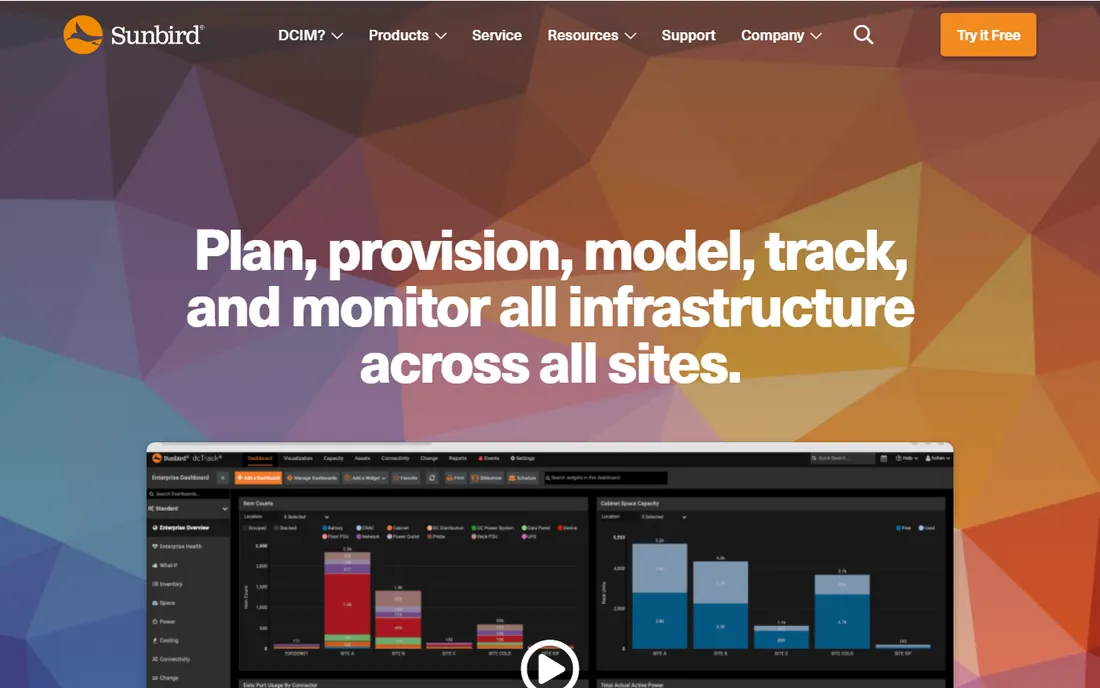
Sunbird, spun from Raritan, offers DCIM without the enterprise project: faster deployment, intuitive 3D floor views, and the core asset, power and capacity features data center managers actually use. Mid-size data centers get organized without a year-long implementation.
The ceiling is lower than Nlyte's for massive estates, and the smaller company means fewer resources. But the time-to-value is the argument: Sunbird gets a data center managed in weeks, which is what most operators need.
Sunbird's Power IQ integration brings intelligent rack PDU data into the DCIM views: outlet-level power monitoring without separate tools. The 3D visualization helps non-technical stakeholders understand capacity. The dashboard builder customizes views per role. For mid-size data centers wanting DCIM without the enterprise project, the time-to-value, often weeks, is the argument.
What we like- Easier to deploy than enterprise suites
- Good 3D visualization
- Practical feature set
Watch out for- Less depth than Nlyte
- Smaller company
- Advanced analytics are thinner
Starting priceSee website
Free planFree trial
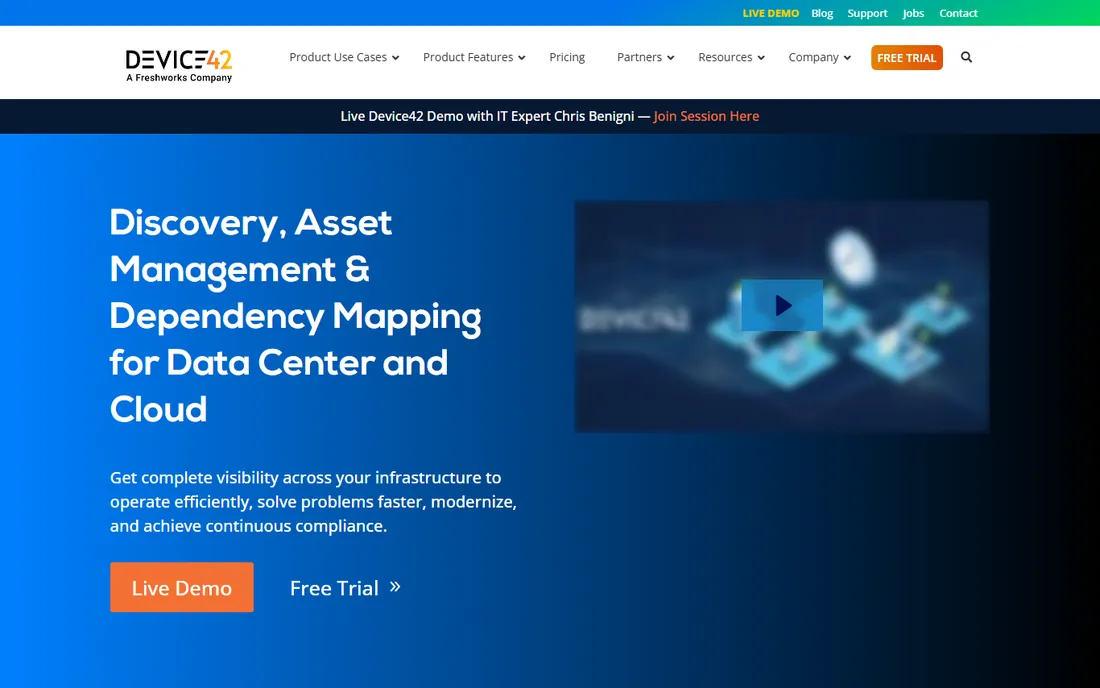
Device42 auto-discovers the infrastructure: servers, network devices, power chains and dependencies mapped without manual entry. That discovery feeds DCIM views, capacity planning and impact analysis. Organizations whose CMDB is fiction get truth from the network.
Discovery needs tuning to stay accurate, device-based pricing scales with estate size, and it can overlap existing ITAM tools. But the auto-discovered accuracy is the differentiator: DCIM is only useful if the data is true, and Device42 starts from reality.
Device42's auto-discovery, using SNMP, WMI, SSH and APIs, builds the asset database from the network truth: the CMDB populates itself. Dependency mapping shows blast radius for changes and outages. The certificate management tracks SSL expirations. For organizations whose documentation is fiction, starting from discovered truth transforms operations.
What we like- Auto-discovery builds the asset database
- Dependency mapping
- Bridges DCIM and ITAM
Watch out for- Discovery needs tuning
- Pricing scales with devices
- Can overlap existing tools
Starting priceSee website
Free planNo
FNT Software documents infrastructure meticulously: every cable, port and asset recorded, planned changes simulated before execution. Telcos and large enterprises with complex plants rely on it. The planning discipline prevents the undocumented changes that cause outages.
It is documentation-first rather than monitoring-first; pair it with real-time tools for operations. Pricing is enterprise and the US presence is smaller. For organizations where knowing exactly what is connected to what matters most, FNT's rigor is unmatched.
FNT's planning workflows simulate changes before execution: model the new rack layout, verify power and cooling, then implement. The cable management tracks every connection in the plant. Telco customers use it for outside plant as well as data centers. For organizations where undocumented changes cause outages, the planning discipline is the product.
What we like- Excellent infrastructure documentation
- Strong planning and cabling
- Good for telcos and enterprises
Watch out for- Documentation-heavy approach
- Pricing is enterprise
- Smaller US presence
Starting priceSee website
Free planNo
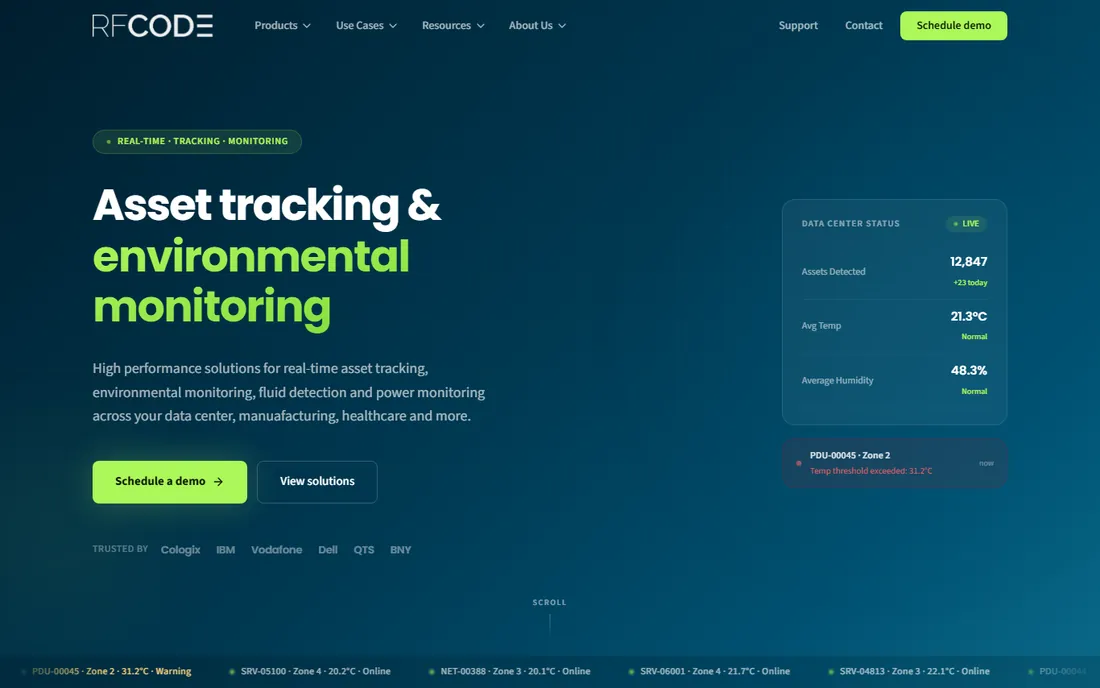
RF Code puts RFID on assets and tracks them in real time: no more manual audits, no more missing servers. Compliance-driven data centers prove asset location continuously. Integration with DCIM platforms feeds location truth into capacity systems.
The RFID tags and readers are infrastructure to deploy, the focus is narrow, and pricing is quote-based. But for the specific pain of asset audits and ghost servers, RF Code's automation pays for itself.
RF Code's wire-free sensor tags monitor temperature and humidity at the rack level without cabling: environmental visibility where it matters. The real-time location feeds asset audits continuously. Integration with major DCIM platforms is mature. For compliance-driven environments, the continuous audit trail replaces the annual scramble.
What we like- Real-time RFID asset location
- Excellent for audits and compliance
- Integrates with DCIM platforms
Watch out for- Requires RFID infrastructure
- Niche focus
- Pricing is quote-based
Starting priceSee website
Free planNo
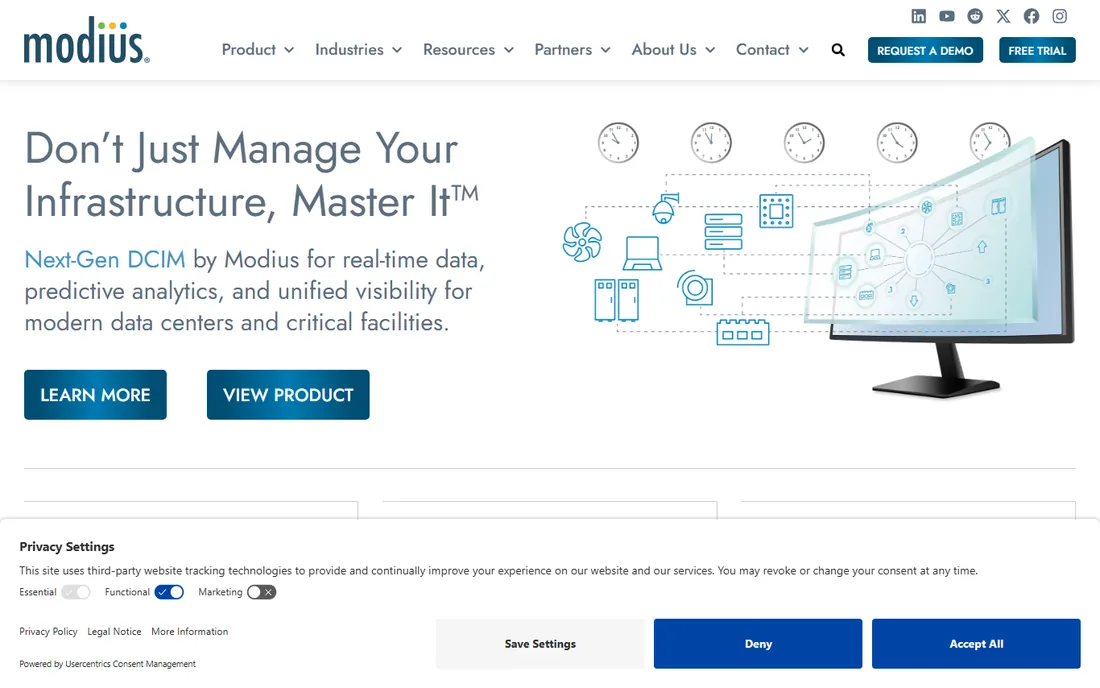
Modius OpenData monitors infrastructure in real time: power, cooling, environmental and equipment performance with alarming and analytics. The vendor-neutral approach works across hardware brands. Operators who live in the NOC appreciate the depth.
Asset management and capacity planning are thinner than pure DCIM suites. The smaller vendor means careful diligence. For monitoring-first buyers who need to see everything happening right now, Modius delivers.
Modius' alarming engine, with escalation and notification rules, ensures the right people learn about problems immediately. The capacity analytics forecast when power or cooling runs out. Multi-site aggregation serves distributed estates. For NOC teams living in the monitoring screens, the real-time depth is the daily driver.
What we like- Deep real-time infrastructure monitoring
- Strong alarming and analytics
- Vendor-neutral
Watch out for- Monitoring-focused, less asset depth
- Smaller vendor
- Implementation needs expertise
Starting priceSee website
Free planFree trial
Hyperview brings DCIM to the cloud era: modern interface, fast deployment, and pricing that undercuts the enterprise incumbents. Smaller data centers and edge sites get real DCIM without the enterprise project. The free trial lets teams evaluate quickly.
Youth means less depth and a growing ecosystem; massive estates still suit the incumbents. But the modern approach, cloud delivery, sensible pricing, transparent UX, is where the category is heading, and Hyperview is already there.
Hyperview's cloud delivery means no servers to maintain and updates without projects: DCIM as SaaS. The modern UI reduces training time for new operators. Asset and capacity features cover the essentials well. For edge sites and smaller data centers, the SaaS model finally makes DCIM accessible.
What we like- Cloud-native modern interface
- Quick to deploy
- Good value pricing
Watch out for- Younger company
- Less depth than incumbents
- Ecosystem is growing
Starting priceSee website
Free planNo

Cormant-CS manages connectivity: every port, cable and patch panel documented, moves and changes tracked. Data centers where cabling chaos causes outages get order. The focus is narrow but the execution is solid.
It is not full DCIM; pair it with monitoring and capacity tools. The smaller vendor needs diligence. For the specific discipline of connectivity management, Cormant's specialization beats generic DCIM cabling modules.
What we like- Excellent port-level cabling management
- Practical and focused
- Good for moves and changes
Watch out for- Narrow focus
- Not full DCIM
- Smaller vendor
How we chose
We selected established DCIM and adjacent infrastructure management vendors with real data center deployments. We reviewed product documentation and industry coverage, verified each vendor's current status, and replaced Rackwise, whose site is no longer reachable, with the actively maintained Cormant. We included specialists because DCIM buying is use-case driven.
Buying for your actual problem
DCIM fails when bought as a platform instead of a solution. Name the pain: capacity planning mistakes, failed audits, power incidents, undocumented changes, or phantom assets. Each pain maps to different strengths: Nlyte and Sunbird for capacity, RF Code for audits, Modius for power events, FNT and Cormant for documentation.
Start with a pilot in one facility, prove the data accuracy, then expand. DCIM with wrong data is worse than no DCIM; it creates false confidence. Budget the ongoing data hygiene, because every DCIM deployment decays without someone keeping it true.
Frequently asked questions
What is DCIM software?
Data Center Infrastructure Management: software monitoring and managing data center assets, power, cooling, capacity and connectivity. It bridges facilities and IT operations.
How much does DCIM cost?
Enterprise suites are quote-based, typically from tens of thousands to hundreds of thousands annually. Focused tools like Sunbird and Hyperview cost less. Always budget implementation and ongoing data maintenance.
Do I need DCIM for a small server room?
Probably not full DCIM. Monitoring tools and good documentation suffice. DCIM pays off with real data center scale: dozens of racks or multiple sites.
Can DCIM prevent outages?
It reduces them: capacity planning prevents overloads, monitoring catches failures early, documentation prevents change errors. It does not replace redundant design and good operations.
What is the difference between DCIM and ITAM?
DCIM manages the data center facility: power, cooling, space, connectivity. ITAM manages IT assets lifecycle: procurement to disposal. They overlap on asset data and often integrate.
How long does DCIM implementation take?
Weeks for focused tools like Sunbird or Hyperview; months for enterprise suites like Nlyte. The data population, not the software, determines the timeline.
Sources we checked (10)
- https://www.se.com/ww/en/
- https://www.vertiv.com/
- https://www.nlyte.com/
- https://www.sunbirddcim.com/
- https://www.device42.com/
- https://www.fntsoftware.com/
- https://rfcode.com/
- https://modius.com/
- http://www.hyperview.com/
- https://cormant.com/
Is your product missing or out of date?
We review this list regularly. Vendors can request a listing, send updated pricing or ask about featured placement.

Shihab Mia · Founder, Rankite
Shihab has spent more than a decade helping SaaS and e-commerce brands grow through search. He writes Rankite's software buying guides from pricing pages, documentation and public user reviews. More about Shihab.