How we make this list: we compare pricing pages, product documentation and public user reviews. Rankite is independent; if a vendor ever pays for a featured spot, that listing is clearly labeled Partner.
Key takeaways
- Non-technical users should start with Octoparse or ParseHub: point-and-click scraping with free tiers, no code needed.
- Developers who want infrastructure should look at Apify and ScraperAPI: APIs and actors that handle proxies, browsers and scaling.
- Diffbot is the pick when you need structured data from the whole web via AI, not just one site you configured.
- UiPath fits enterprises that need extraction inside a larger automation program, not a standalone scraping tool.
- Bright Data is the heavyweight for large-scale collection with compliance controls, priced accordingly.
Quick comparison
| Tool | Best for | Starting price | Free plan |
|---|
 Octoparse Octoparse | Business users who need scraping without code | See website (freemium plans) | Yes |
 ParseHub ParseHub | Visual scraping with a genuinely useful free tier | See website (freemium plans) | Yes |
 Apify Apify | Developers building scraping into products and pipelines | See website (usage-based platform credits) | Yes |
 Diffbot Diffbot | AI-structured data from any web page | See website (custom plans) | Free trial |
 ScraperAPI ScraperAPI | Developers who want scraping without proxy management | See website (usage-based) | Free trial |
 Import.io Import.io | Business teams needing managed web data at scale | See website (custom quote) | No |
 Bright Data Bright Data | Large-scale collection with compliance infrastructure | See website (usage-based) | Free trial |
 UiPath UiPath | Enterprises extracting data inside automation workflows | See website (custom quote) | Yes (Community edition) |
Is your product missing or out of date?
We review this list regularly. Vendors can request a listing, send updated pricing or ask about featured placement.
Here is the blunt version: most teams do not need "data extraction software," they need one website's data in a spreadsheet, and they overbuy. But when the job is real, hundreds of pages, daily refreshes, sites that fight back with bot detection, the right tool is the difference between a working pipeline and a broken script. These eight cover the real spectrum, from no-code scrapers to enterprise platforms.
Starting priceSee website (freemium plans)
Free planYes
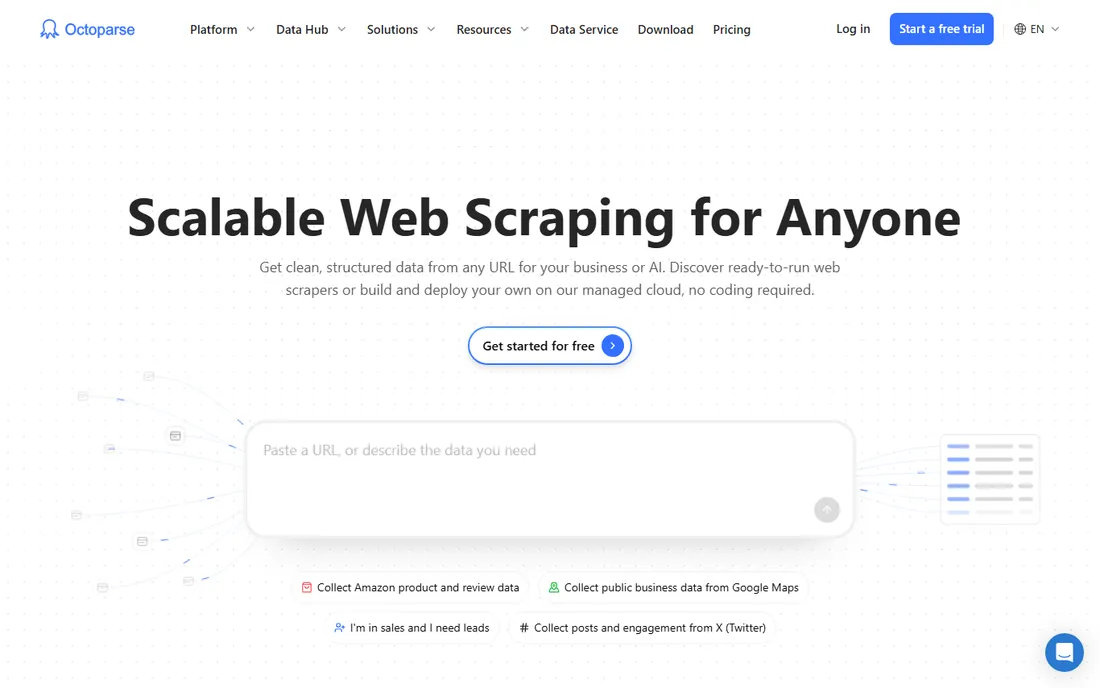
Octoparse is the standard answer for "I need data from a website and I do not code." You click the elements you want in a built-in browser, and it builds the extraction workflow: pagination, infinite scroll, login flows and scheduled cloud runs included. For price monitoring, lead list building and content aggregation, it gets non-technical users productive in an afternoon.
The limits show on difficult sites. Heavy JavaScript, aggressive bot protection and CAPTCHAs push you toward workarounds or the paid tiers. The free plan caps tasks and pages, which is fine for evaluation and small jobs. When the target site fights back hard, developer tools like Apify or ScraperAPI take over.
What we like- True point-and-click interface, no coding
- Handles pagination, logins and AJAX
- Cloud extraction runs on a schedule
Watch out for- Desktop app is Windows-centric
- Complex sites still need workarounds
- Free tier has task limits
Starting priceSee website (freemium plans)
Free planYes
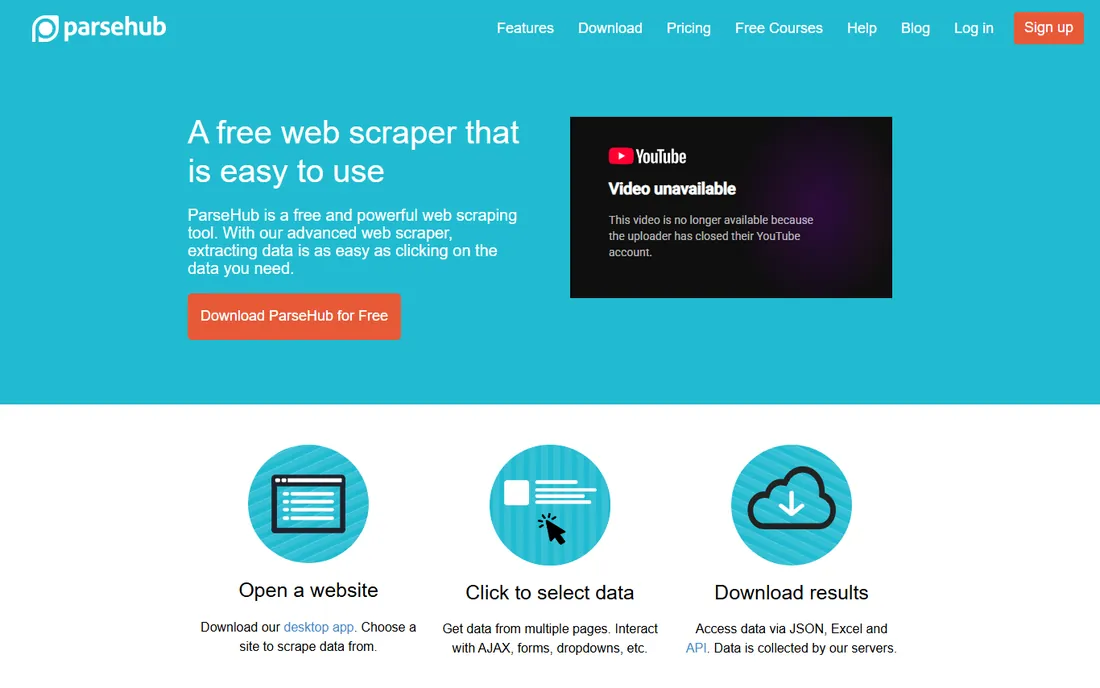
ParseHub takes the same no-code approach as Octoparse with a desktop app where you click page elements to define what gets extracted. It handles JavaScript-heavy pages, dropdowns and maps reasonably well, and results can go to CSV, JSON or its API. The free tier is genuinely usable for small projects, which makes it the classic recommendation for trying web scraping.
It is desktop software at heart, so large scheduled jobs push you to paid cloud plans. Lower tiers throttle speed. For one-off extractions and learning the ropes, the free tier carries you far; for production pipelines, compare the paid plans against Apify's usage pricing.
What we like- Generous free tier for getting started
- Visual selector handles complex page structures
- API access for pulling results into other tools
Watch out for- Desktop-based project building
- Speed limits on lower tiers
- Support response times vary
#3
Apify
Best for: Developers building scraping into products and pipelines
Visit apify.com
Starting priceSee website (usage-based platform credits)
Free planYes
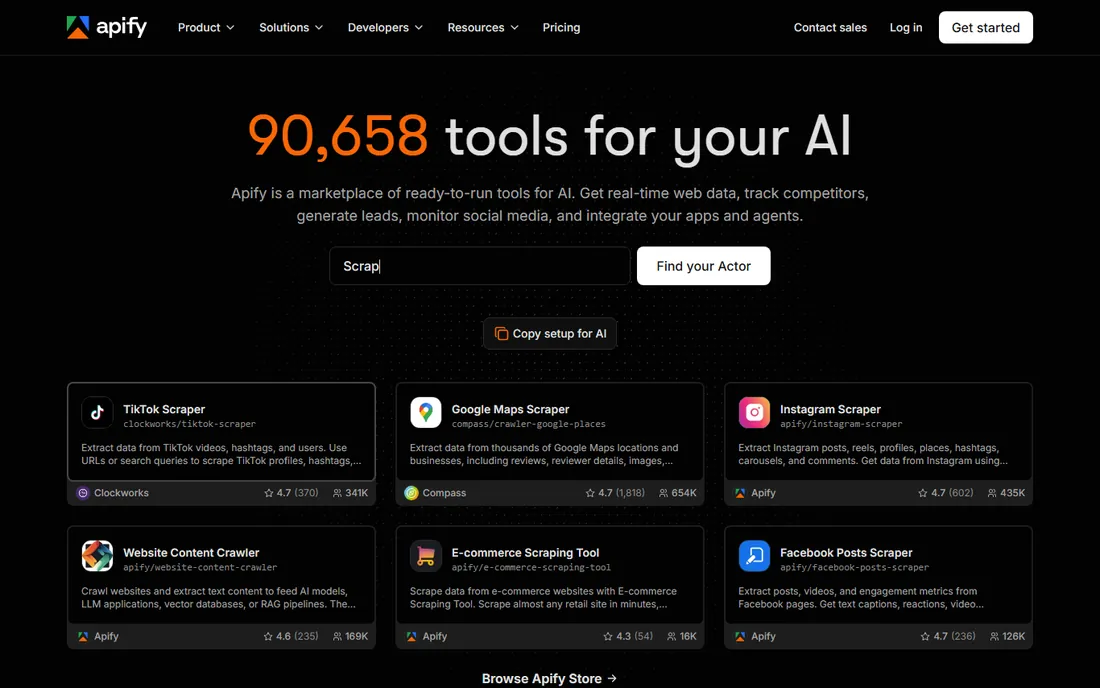
Apify is infrastructure for people who build with scraped data. Instead of maintaining proxies, headless browsers and anti-bot workarounds yourself, you run Actors, prebuilt or custom scrapers, on their platform with scheduling, storage and APIs. The marketplace has thousands of Actors for common sites, which often means the scraper you need already exists.
Pricing is usage-based platform credits, which is fair but demands attention; a misconfigured Actor can burn budget. Non-developers will find it technical. But if scraped data feeds a product, a dashboard or a regular report, Apify is the most complete platform for running it reliably.
What we like- Actor marketplace with thousands of prebuilt scrapers
- Handles proxies, browsers and CAPTCHAs as infrastructure
- Clean APIs and scheduling
Watch out for- Usage-based pricing needs monitoring
- Learning curve for non-developers
- Costs scale with volume
Starting priceSee website (custom plans)
Free planFree trial
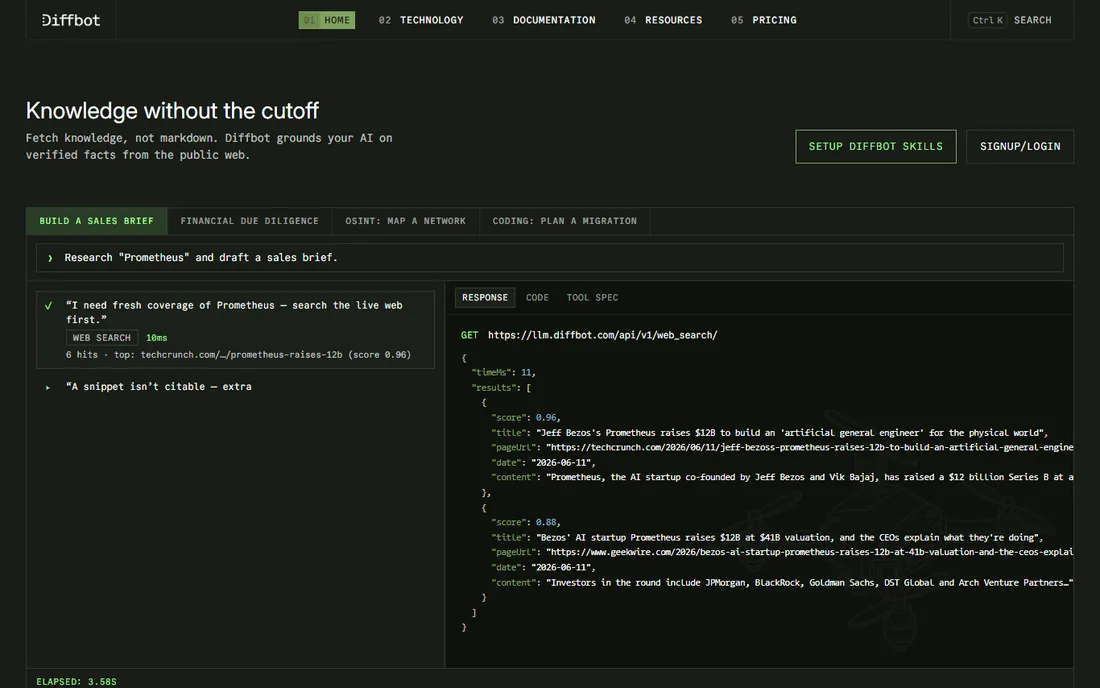
Diffbot approaches extraction backwards from everyone else: instead of configuring a scraper per site, its AI reads pages like a human and returns structured data. Point the Extract API at product pages or articles across thousands of domains and get clean fields back. The Knowledge Graph offers entity data on companies, people and products without scraping at all.
This is enterprise-grade in both capability and price; custom plans assume serious volume. For scraping one site you know well, it is overkill and a configured scraper is cheaper. For normalizing data across the open web, news monitoring, product intelligence, Diffbot's approach is unmatched.
What we like- Extract API structures any article or product page automatically
- Knowledge Graph for entity data
- No per-site configuration for standard page types
Watch out for- Custom enterprise pricing
- Overkill for scraping one known site
- The AI structuring needs verification on unusual layouts
Starting priceSee website (usage-based)
Free planFree trial
ScraperAPI solves the most annoying part of scraping: getting blocked. You send it a URL through its API and it returns the rendered HTML, handling proxy rotation, headless browsers and CAPTCHAs behind the scenes. Your code does the parsing; ScraperAPI does the fetching. It drops into existing Python or Node scripts with minimal changes.
It is not a full platform like Apify: no scheduling UI, no storage, no marketplace. Heavy sites need the pricier tiers with JavaScript rendering. But for developers with working scrapers that keep getting blocked, it is the fastest fix, and the usage pricing is transparent enough to budget.
What we like- Single API call handles proxies, browsers and CAPTCHAs
- Straightforward usage-based pricing
- Easy to retrofit into existing code
Watch out for- You still write the parsing logic
- Heavy JavaScript sites need the higher tiers
- Support is developer-grade, not hand-holding
#6
Import.io
Best for: Business teams needing managed web data at scale
Visit import.io
Starting priceSee website (custom quote)
Free planNo
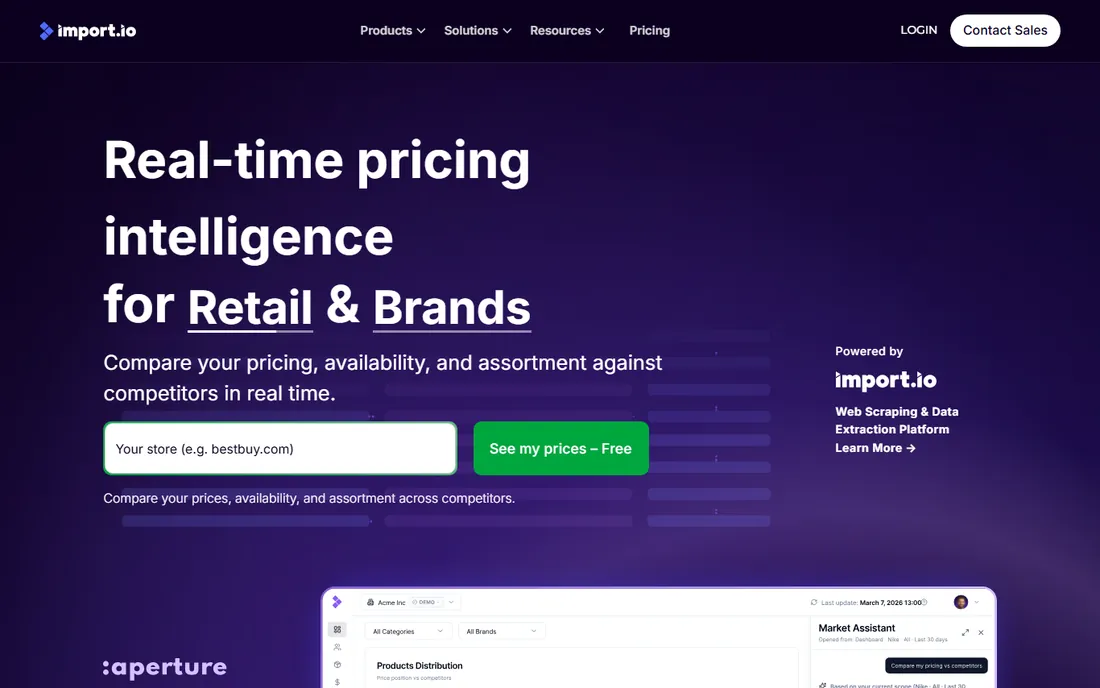
Import.io targets the business buyer who wants data, not a scraping project. Beyond the platform, it offers managed services where their team builds and maintains the extractors for you. That matters when the data feeds decisions and nobody in-house wants to own scraper maintenance. Delivery is structured, scheduled and supported.
The commercial model is enterprise: custom quotes, annual conversations, no meaningful free tier. Individuals and small teams get better value from Octoparse or Apify. But for a company that needs reliable web data with a vendor accountable for it, Import.io's managed angle is the differentiator.
What we like- Managed service option with human support
- Handles complex enterprise requirements
- Data delivery in structured formats on schedule
Watch out for- Quote-only pricing
- Aimed at teams with budget, not individuals
- Less self-serve than competitors
Starting priceSee website (usage-based)
Free planFree trial
Bright Data, formerly Luminati, is the heavyweight infrastructure provider: one of the largest proxy networks in the world, plus scraping tools, a Web Scraper IDE and a dataset marketplace. Enterprises doing price intelligence, brand protection or market research at scale run on it. The compliance tooling around consent and data rights is more developed than most competitors'.
It is not a casual tool. Pricing and onboarding assume real budgets, and the residential proxy model means you should be clear on the legal basis for your collection. For small jobs it is a cannon aimed at a fly. For serious scale with legal review in the loop, it is the infrastructure standard.
What we like- Massive proxy network and scraping infrastructure
- Compliance and consent frameworks
- Dataset marketplace for common data needs
Watch out for- Enterprise pricing and sales process
- Complexity for small jobs
- The proxy business draws scrutiny, check your use case
#8
UiPath
Best for: Enterprises extracting data inside automation workflows
Visit uipath.com
Starting priceSee website (custom quote)
Free planYes (Community edition)
UiPath is robotic process automation first, and data extraction rides along: screen scraping, document understanding and web extraction feeding into automated workflows. The Document Understanding AI handles invoices, forms and contracts, turning unstructured documents into structured data inside a larger process. For enterprises already automating finance or operations, extraction is a feature of the platform they own.
Nobody should buy UiPath just to scrape websites; the price and complexity assume an automation program. But when extraction is step three of a ten-step workflow that posts into SAP, UiPath is the enterprise answer, with governance and audit trails the standalone tools cannot match.
What we like- Extraction as part of full RPA workflows
- Strong document understanding with AI
- Enterprise governance and support
Watch out for- Quote-only enterprise pricing
- Heavyweight for pure scraping
- Real value needs the broader platform
How we chose
We started with the searches buyers use: best data extraction software, best web scraping tools and web data extraction platform. For each candidate we checked the vendor's own site for current plans and pricing approach, read developer and business reviews, and compared ease of use, scale, anti-bot handling and fit by user type. Where pricing could not be confirmed on the vendor's page, we wrote "See website".
The legality question you cannot skip
Scraping public web data is broadly practiced, but the rules are not simple. Terms of service, copyright, database rights in the EU, and computer-access laws all potentially apply, and they vary by jurisdiction and by what you scrape. High-profile court cases have gone both ways, and the legal picture keeps shifting.
The practical guidance: scrape public data, respect robots.txt as a starting signal, do not circumvent technical barriers aggressively, do not republish copyrighted content wholesale, and get legal review before building a business on someone else's data. Tools handle the technical work; the legal judgment is yours. When in doubt, use official APIs where they exist.
What to check before you buy
Start with the target sites: list them, note which use heavy JavaScript or bot protection, and test the tool against the hardest one during the trial. Check the data freshness you need: one-off research, daily refreshes and real-time feeds are different products with different prices. Check export and integration: CSV and JSON are table stakes, but confirm the API, webhooks or direct database connections your pipeline needs.
Check the cost model at your volume. Seat-based, usage-based and custom-quote pricing behave very differently as you scale; model a realistic month, including retries and failed requests. And check support: when a critical site changes its layout on a Tuesday, how fast does the vendor respond, and does your plan include extractor maintenance?
Frequently asked questions
What is the difference between web scraping and data extraction?
Web scraping usually means pulling data from websites specifically. Data extraction is broader: it includes documents, PDFs, emails and databases. Most tools here do both web and document extraction to some degree; UiPath and Diffbot lean document and AI, the rest lean web.
Do I need to know how to code?
No, for the visual tools. Octoparse and ParseHub are built for non-coders. Apify, ScraperAPI and Bright Data assume developers. Import.io offers managed service so nobody on your team touches a scraper. Match the tool to the skills you actually have.
Will these tools get blocked by websites?
Sometimes. Anti-bot technology is an arms race, and no tool wins permanently. The infrastructure tools (Apify, ScraperAPI, Bright Data) handle blocking as their core job and do it best. If a site is critical, test extraction against it during the trial, not after you pay.
How much does data extraction software cost?
It ranges from free tiers (Octoparse, ParseHub, Apify) through usage-based plans that scale with volume, to custom enterprise contracts (Diffbot, Import.io, Bright Data, UiPath). Model your monthly page or request volume first; that number decides which pricing model is cheapest.
Can I scrape data behind a login?
Technically yes with most of these tools, but scraping authenticated sessions raises sharper legal and terms-of-service questions than public pages. Get explicit permission or legal review before extracting data from behind someone else's login.
Sources we checked (8)
- https://octoparse.com
- https://parsehub.com
- https://apify.com
- https://diffbot.com
- https://scraperapi.com
- https://import.io
- https://brightdata.com
- https://uipath.com
Is your product missing or out of date?
We review this list regularly. Vendors can request a listing, send updated pricing or ask about featured placement.

Shihab Mia · Founder, Rankite
Shihab has spent more than a decade helping SaaS and e-commerce brands grow through search. He writes Rankite's software buying guides from pricing pages, documentation and public user reviews. More about Shihab.