How we make this list: we compare pricing pages, product documentation and public user reviews. Rankite is independent; if a vendor ever pays for a featured spot, that listing is clearly labeled Partner.
Key takeaways
- Most credit repair platforms charge per active client, so your cost grows with revenue; price each tool against your average monthly fee per client.
- Client portals, dispute letter automation, and recurring billing are table stakes; the real differentiators are compliance support, white-label options, and onboarding quality.
- CreditDetailer is the outlier here: a one-time desktop license with no monthly fee, which changes the math for solo operators.
- Credit repair is a regulated industry under federal law; software can help with workflows, but it cannot replace proper legal setup for your business.
Quick comparison
| Tool | Best for | Starting price | Free plan |
|---|
 CreditRepairCloud CreditRepairCloud | Industry-standard all-rounder | See website | Free trial (30 days) |
 DisputeFox DisputeFox | Simple onboarding for small teams | From $129/month | Free trial |
 Client Dispute Manager Client Dispute Manager | Budget starter option | From $107/month | Free trial (30 days) |
 DisputeSuite DisputeSuite | Scaling agencies | From $300/month (Silver) | Free trial |
 ScoreCEO ScoreCEO | Growth and marketing focus | From $149/month (Kickstart) | Free trial |
 Credit Admiral Credit Admiral | Arbitration tools and mobile app | See website | Free trial |
 CreditDetailer CreditDetailer | Lifetime license desktop app | $399 (one-time) | Free trial (7 days) |
 Credit Money Machine Credit Money Machine | One-click dispute automation | See website | No |
Is your product missing or out of date?
We review this list regularly. Vendors can request a listing, send updated pricing or ask about featured placement.
The best credit repair software for small business
Starting priceSee website
Free planFree trial (30 days)
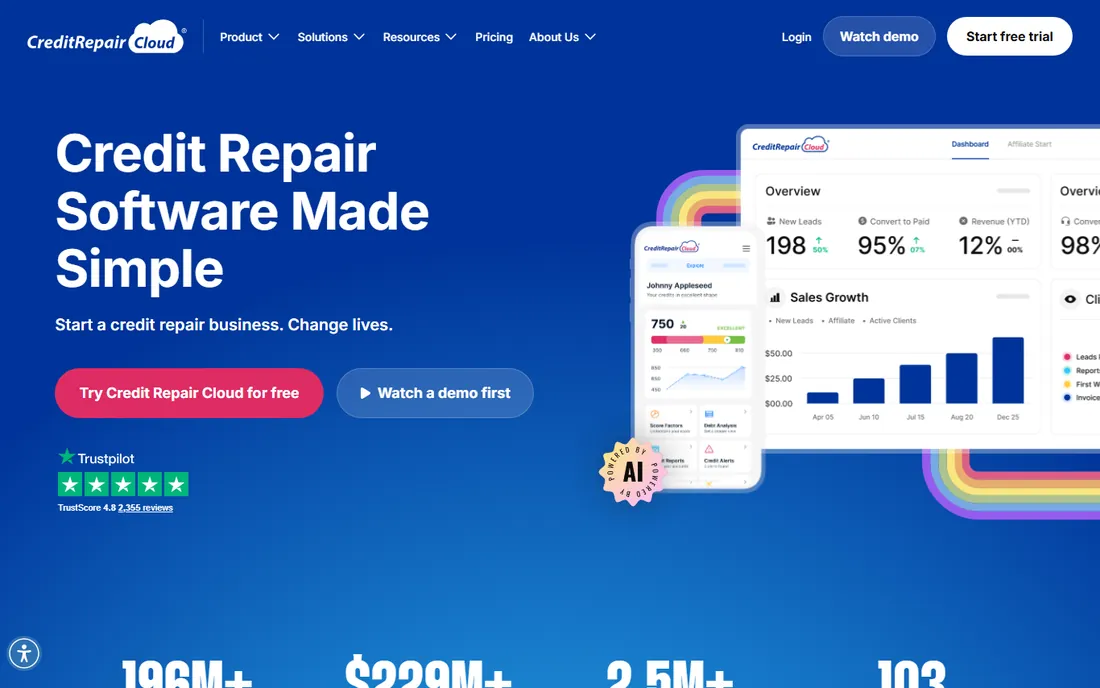
CreditRepairCloud is the name most credit repair entrepreneurs hear first, and there is a reason. It bundles dispute workflows, client management, billing, and a client portal into one cloud system, and it has been refined over years of feedback from working repair businesses. If you are starting your first credit repair company, this is the default choice because so much of the industry has already standardized around it.
The platform's biggest advantage is the ecosystem around it. Training programs, a founder-led education brand, and an active user community mean you are rarely the first person to run into a problem. Support quality and onboarding are consistently rated as strengths, which matters when you are juggling your first twenty clients by yourself.
The honest catch is that this maturity comes with complexity and cost. Small teams may find the feature set wider than what they use day to day, and pricing is not published openly, so you will need to sit through a sales process or start a trial to see real numbers. For owners who want the safe, established pick and plan to grow past 50 clients, it is still hard to beat.
What we like- Long-established platform with a large user base
- Strong training and community resources
- White-label client portal and automated billing
Watch out for- Pricing requires contacting the vendor or starting a trial
- Can feel like more platform than a solo operator needs
Starting priceFrom $129/month
Free planFree trial
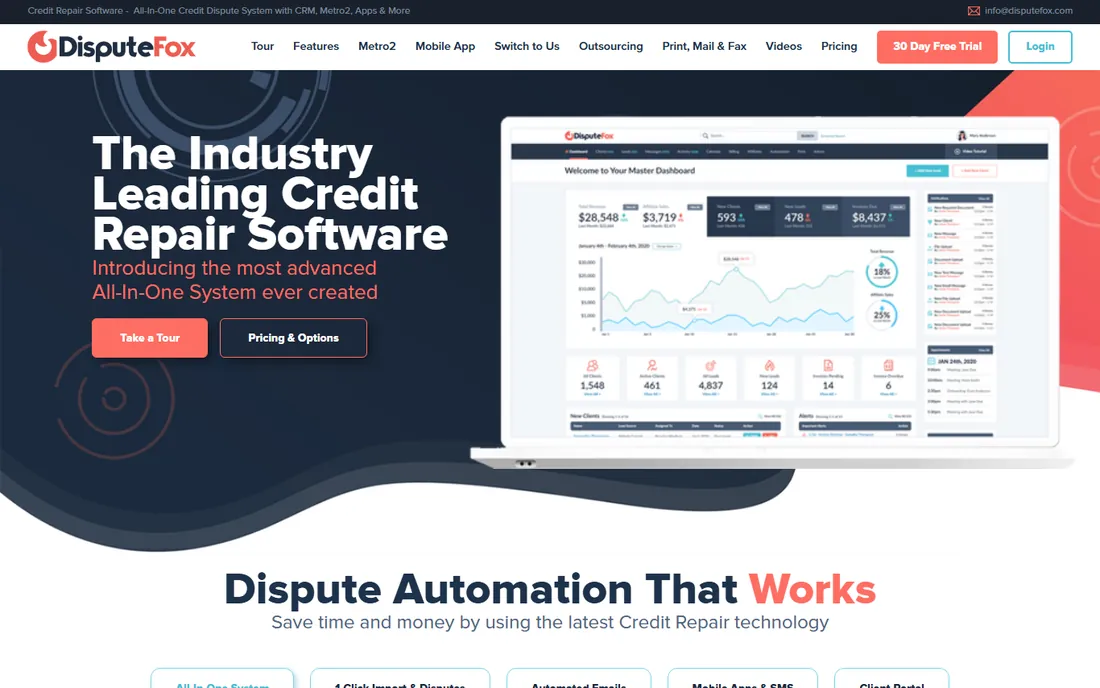
DisputeFox positions itself as the credit repair tool that does not make you watch hours of training before your first dispute. The workflow from importing a credit report to generating dispute letters is direct, and the interface is deliberately lean. For a small team that wants to get clients onboarded and disputes out the door quickly, that simplicity is a real asset.
The platform includes API access, which is unusual at this price point and opens the door to connecting with your own marketing site or internal tools. Document management and round tracking are handled without the nested menus that heavier platforms tend to accumulate. Third-party comparison listings put entry pricing around $129 per month, making it one of the more affordable cloud options.
The tradeoff is depth. If your business model depends on advanced billing structures, multi-branch reporting, or a big library of letter templates, you may outgrow DisputeFox faster than the larger platforms. It is best treated as a tool for small, focused teams that value speed over configurability.
What we like- Clean, straightforward workflow from client intake to dispute
- Lower learning curve than enterprise-grade tools
- API access for custom integrations
Watch out for- Smaller feature set than the biggest platforms
- Fewer third-party integrations
Starting priceFrom $107/month
Free planFree trial (30 days)
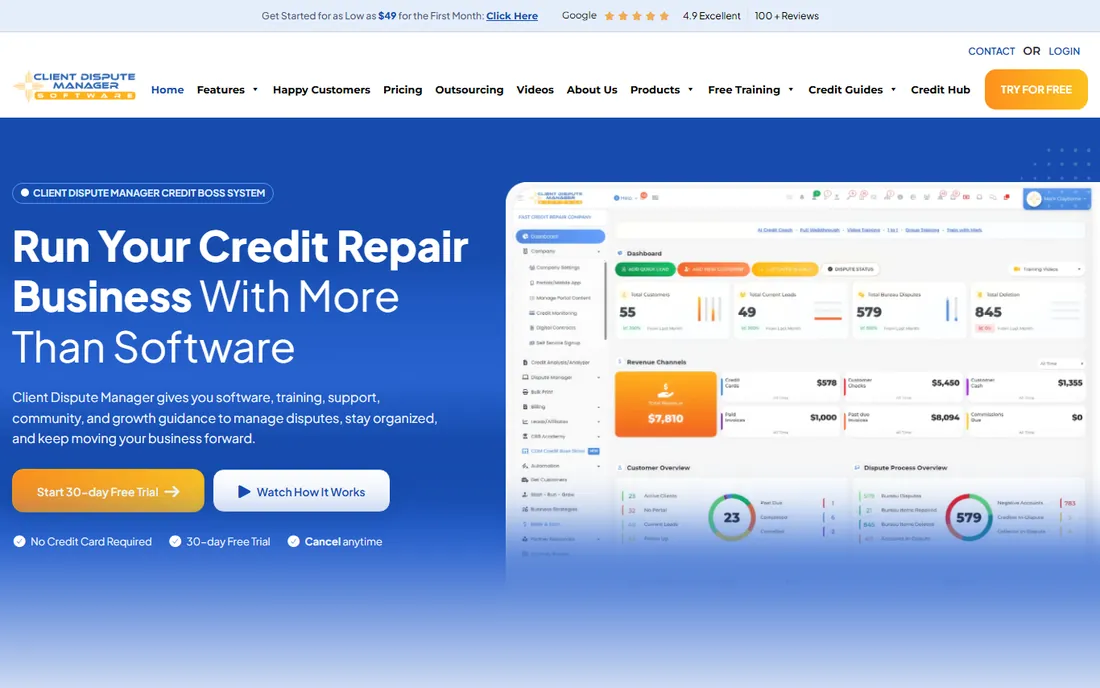
If budget is the deciding factor, Client Dispute Manager deserves a look. Its vendor pricing page lists a Beginners plan starting at $107 per month, the lowest published entry point among the cloud platforms reviewed here, and the homepage advertises a 30-day free trial. For a new operator still signing the first clients, that low barrier matters.
The tool covers the essentials: client dispute tracking, letter generation, and client management in one place. It is not trying to be an all-in-one marketing and growth platform, and for many small businesses that is fine. You get the operational core without paying for extras you will not touch for months.
The honest catch is that you give up some of the polish and depth of the bigger names. Automation options are thinner, and because it is less widely reviewed, you have less community feedback to lean on. As a starter platform to get your first clients serviced while cash flow builds, though, it is a practical choice.
What we like- Lowest published starting price in this roundup
- 30-day free trial on the homepage
- Core dispute and client management included
Watch out for- Fewer advanced automation features
- Brand is less widely reviewed than top competitors
Starting priceFrom $300/month (Silver)
Free planFree trial
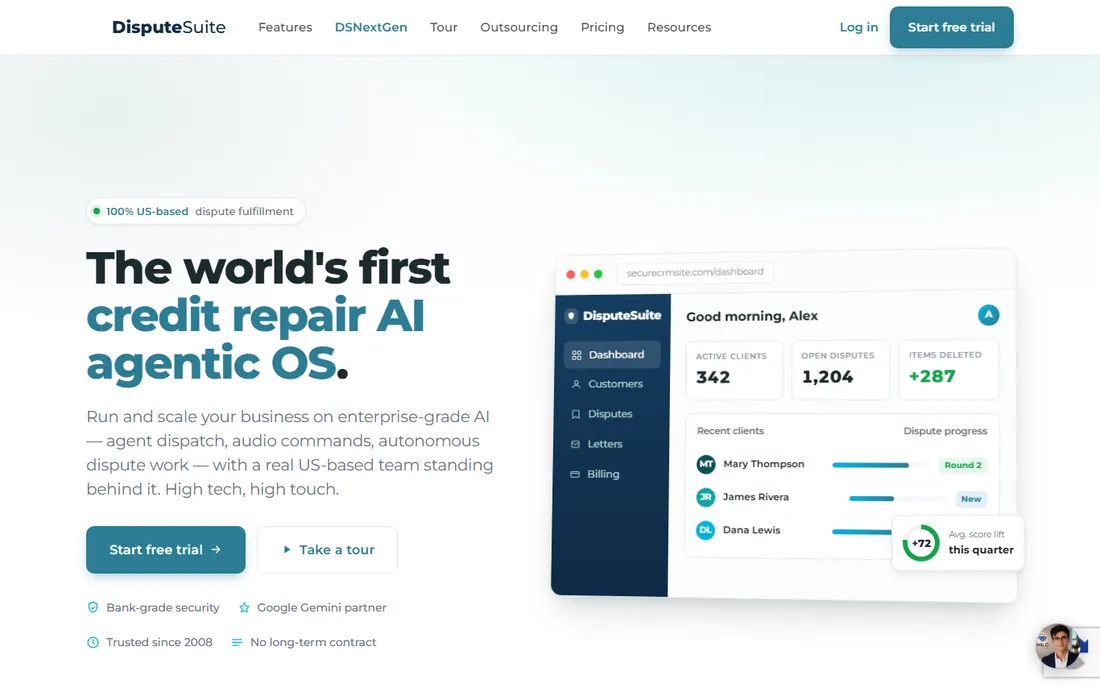
DisputeSuite is built for the company that already knows it is going to scale. Its tiered Silver, Gold, and Platinum plans grow with your client roster, and the platform includes API access and integrations with credit monitoring partners. The vendor lists Silver at $300 per month, which puts it at the top of this price range, but the positioning is deliberate.
What you get for the money is a compliance-minded, full-featured operation system. Dispute tracking, client portals, document storage, and billing are all present, and the platform emphasizes the audit trails and record-keeping that regulators expect from credit repair organizations. If your business handles high client volumes, the per-client cost math works out.
The honest catch is that this is the wrong tool for testing the waters. A solo operator with five clients will not need what DisputeSuite offers, and the price reflects that. Shortlist it when you are processing enough disputes that process reliability and compliance documentation are worth the premium.
What we like- Tiered plans that scale with client volume
- Strong compliance-oriented workflows
- API access for deeper integrations
Watch out for- Highest starting price in this roundup
- May be overkill for solo operators
Starting priceFrom $149/month (Kickstart)
Free planFree trial
ScoreCEO leans into the side of credit repair that most software ignores: getting clients. Its plans page lists tiers starting with a Kickstart option at $149 per month, and the platform folds marketing automation, lead capture, and affiliate tracking into the same system as dispute management. For owners who spend as much time acquiring clients as servicing them, that combination saves tool sprawl.
The credit repair core is all there: client management, dispute letter workflows, billing, and a client portal. But the differentiator is the growth layer, with built-in referral tracking and communication automation that nudges new clients through onboarding without manual follow-up. Small businesses that run on referrals will appreciate this.
The tradeoff is that some of its marketing features overlap with what a dedicated CRM or email tool does better, so larger teams may still stack it alongside other software. Pricing transparency is also limited; expect to engage with the vendor for exact numbers. For a growth-minded small shop, it is a strong pick.
What we like- Marketing and lead-focused features baked in
- Tiered plans from Kickstart up
- Affiliate and referral tracking
Watch out for- Pricing details sit behind a demo or signup wall
- Feature overlap with general CRMs
Starting priceSee website
Free planFree trial
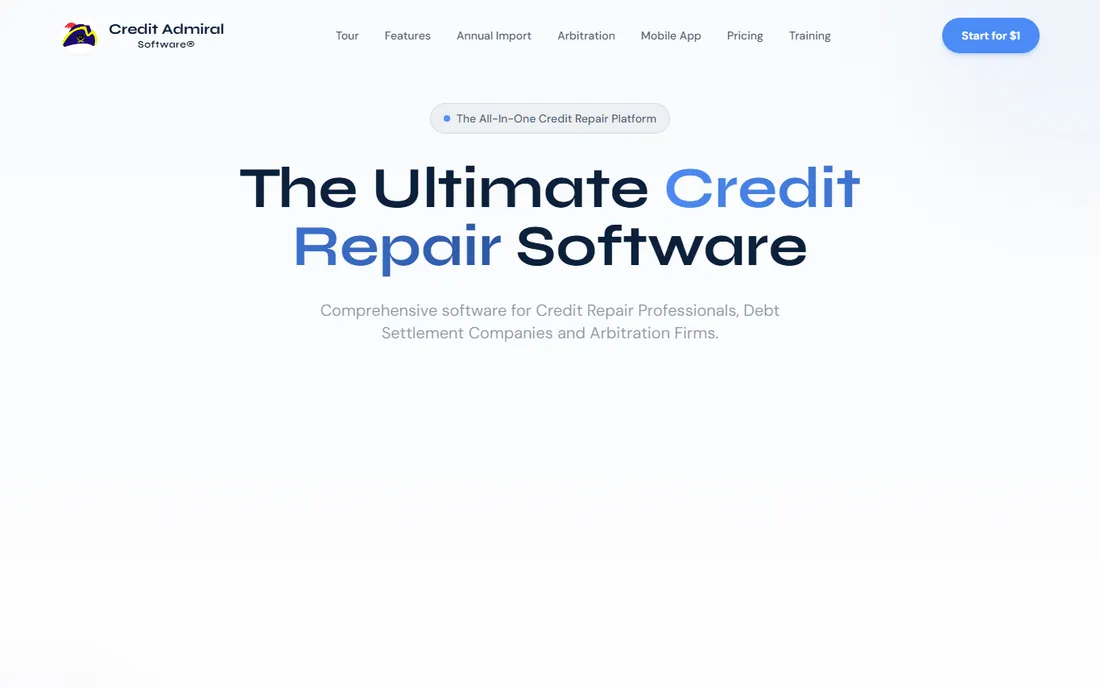
Credit Admiral is the newcomer with the boldest feature claims. It bills itself as the only credit repair software with built-in arbitration tools, including AAA and JAMS workflows, online notary, and debt settlement features alongside standard dispute automation. It also lets clients import reports directly from annual credit report sources, cutting out the monitoring account step for day-one disputes.
AI-powered dispute letter generation with customizable opening and closing paragraphs is the other headline feature, and every plan includes a free client mobile app with white-label upgrade options. Billing automation covers pay-per-deletion and scheduled charging, so the operational side is well thought out.
The honest catch is transparency. Pricing is not published on the website; all plans start with a $1 trial, but actual monthly costs require talking to the vendor. The platform is also newer than the established names, so there is less community history to check. If arbitration workflows and a modern mobile experience are what you want, ask for a demo and put the pricing question first.
What we like- Built-in arbitration workflows, the platform's signature feature
- AI-powered dispute letter generation
- White-label client portal and free mobile app
Watch out for- Pricing is not published on the site
- Newer brand with a smaller user community
Starting price$399 (one-time)
Free planFree trial (7 days)

CreditDetailer takes a completely different pricing approach from everyone else in this roundup. You pay once: the Professional Edition is listed at $399 as a one-time lifetime license, and there are no monthly fees ever again. For a solo operator who hates subscriptions, that single fact can outweigh every cloud feature you give up.
The pitch is ownership. Your client data stays on your computer, not on a vendor's server, and you are never paying rent to access your own business. The software includes auto-populating dispute letters, automatic progress tracking against legal response timelines, and a fully functional 7-day trial that requires no signup or credit card. It also claims to be the only bilingual English and Spanish credit repair software, which is a real advantage for businesses serving Spanish-speaking clients.
The honest catch is that it is desktop software from another era. There is no cloud client portal, the interface looks dated, and you are responsible for your own backups and data security. It is also primarily a dispute tool, not a full business suite with marketing automation. But for cost control and data ownership, nothing else here comes close.
What we like- Lifetime license with no monthly fees
- Data stays on your own computer
- Fully functional 7-day trial with no signup
Watch out for- Desktop software with no cloud portal
- Interface shows its age
Starting priceSee website
Free planNo
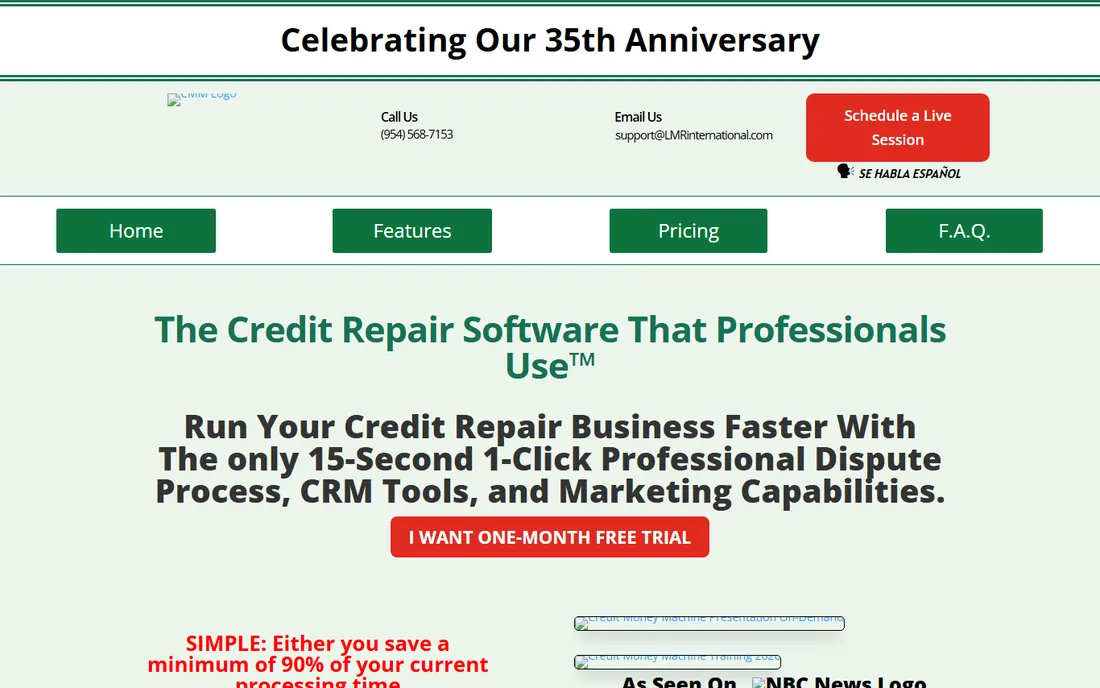
Credit Money Machine is the automation maximalist of the group. Its headline claim is that one click imports credit reports and generates freeze letters, collection validation letters, personal information letters, and dispute letters with FCRA violation tables in about 15 seconds. Whether you believe the speed or not, the depth of the built-in dispute logic is genuinely unusual, with Metro 2 discrepancy detection and round-by-round strategy guidance.
The company says it has served credit repair businesses for over 25 years, and the site reads like a compliance manual: detailed explanations of freeze strategies, certified mail tactics, and legal response handling. Third-party listings put pricing near $180 per month, though the vendor does not publish prices on the homepage.
The honest catch is that heavy automation still needs a human eye. Dispute letters that look automated can trigger stall letters from bureaus, and the vendor's own FAQ acknowledges this risk. Treat it as a powerful engine that requires a careful operator, not a set-and-forget machine. Ask for pricing and a walkthrough before committing.
What we like- Extreme automation, including one-click letter generation
- FCRA violation and discrepancy tables built in
- Extensive compliance guidance on the site
Watch out for- Pricing not published on the homepage
- Automation-heavy approach requires you to verify letters yourself
How we chose
We reviewed the pricing pages, feature lists, and documentation of the leading credit repair platforms, along with public reviews on sites like G2, Capterra, Slashdot, and SourceForge, plus Reddit discussions from credit repair business owners. We prioritized tools that are built for businesses running client disputes, rather than consumer DIY apps, and we checked that each vendor's homepage was live and current. We did not run hands-on tests or claim demo access; the comparison reflects what each vendor publishes and what business owners report publicly.
What to weigh before you pick one
Match the platform to your business model, not just your budget.
Client volume and pricing model
Most cloud platforms price per active client or per tier of client count. A solo operator with 10 clients and an agency with 200 clients pay very different bills on the same tool. Before you sign up, estimate what each platform costs you at your current client count and at double that number. The tool that looks cheapest on day one is not always cheapest at month twelve.
Portals and billing
Your clients judge you partly on the portal they log into. A white-label portal with progress tracking reduces the "what is happening with my credit" emails that eat your week. Automated recurring billing is equally important; chasing failed payments is unbillable time. Make sure whatever you choose handles both.
Compliance posture
Credit repair businesses operate under the Credit Repair Organizations Act and the Fair Credit Reporting Act, plus state licensing rules. No software makes you compliant by itself, but some platforms help more than others with audit trails, disclosure templates, and dispute record-keeping. If a vendor's marketing glosses over compliance entirely, treat that as a warning sign.
Onboarding and support
Your first month with any platform is the expensive part, in time if not money. Look for real onboarding help, not just a knowledge base link. Vendors with active communities and live training give small teams a faster path to their first successful dispute rounds.
The two letters most beginners send wrong
New operators obsess over dispute letters to the bureaus and neglect the two that often matter more. Personal information letters, which clean up stale addresses and name variations on file, remove the anchors that link old derogatory items to your client. Freeze letters to secondary bureaus, which the big three buy data from, cut off the information supply at the source. Platforms that automate these two workflows, like Credit Money Machine and CreditDetailer, tend to produce better early results than tools that only generate bureau disputes.
Frequently asked questions
Is credit repair software legal?
Credit repair itself is legal under federal law, and the software is simply a tool for managing disputes and client records. What is regulated is how you run the business: the Credit Repair Organizations Act sets rules on contracts, disclosures, and fees, and many states require registration or licensing. Software cannot make your business compliant; you still need to understand the rules.
How much does credit repair software for small business cost?
Cloud platforms in this roundup run roughly $100 to $300 per month at entry level, scaling with your client count. CreditDetailer is the outlier at a $399 one-time license with no monthly fee. Budget for mailing costs and any credit monitoring subscriptions separately, since those sit outside the software.
Can I run a credit repair business from just one tool?
You can run the dispute workflow from one platform, but most businesses end up adding at least a bookkeeping tool and a marketing channel. Platforms like ScoreCEO and CreditRepairCloud reduce that sprawl by folding marketing and billing in, but expect to add specialized tools as you grow.
Do these platforms include client portals?
Most cloud platforms here include some form of client portal, often white-labeled with your branding. CreditDetailer, as desktop software, does not offer a cloud portal. If client self-service matters to your business model, confirm the portal features during a demo rather than assuming.
What is the difference between dispute automation and done-for-you services?
Software generates and tracks dispute letters for you to send and manage. Done-for-you services hire someone else to do the work. The platforms in this article are tools for your business, not services you outsource to; you stay responsible for your clients' files and compliance.
Sources we checked (10)
- https://www.creditrepaircloud.com
- https://www.disputefox.com/
- https://clientdisputemanagersoftware.com
- https://disputesuite.com/
- https://scoreceo.com
- https://creditadmiral.com/
- https://www.creditdetailer.com
- https://creditmoneymachine.com
- https://slashdot.org/software/comparison/Credit-Money-Machine-vs-DisputeFox/
- https://slashdot.org/software/comparison/Credit-Admiral-vs-CreditDetailer/
Is your product missing or out of date?
We review this list regularly. Vendors can request a listing, send updated pricing or ask about featured placement.

Shihab Mia · Founder, Rankite
Shihab has spent more than a decade helping SaaS and e-commerce brands grow through search. He writes Rankite's software buying guides from pricing pages, documentation and public user reviews. More about Shihab.