How we make this list: we compare pricing pages, product documentation and public user reviews. Ratings come from G2, Capterra or Trustpilot, with the date we checked them.
Key takeaways
- Continuous deployment means every passing change can reach production automatically, while continuous delivery keeps a manual approval before release.
- GitOps tools such as Argo CD suit Kubernetes teams, while pipeline tools such as Jenkins and CircleCI suit broader application types.
- Rollback, approvals, canary releases, and audit trails matter more than pipeline speed alone, because a fast bad release helps no one.
- Open source tools cost less in licences but more in operations, while managed platforms cost more and reduce platform work.
- Start with one service, one environment, and a tested rollback, then expand to more services and environments.
Quick comparison
| Tool | Best for | Starting price | Free plan |
|---|
 Argo CD | GitOps for Kubernetes | See website | Yes |
 Spinnaker | Multi cloud delivery pipelines | See website | Yes |
 Jenkins | Flexible self hosted pipelines | See website | Yes |
 GitHub Actions | CI and CD inside GitHub | See website | Yes |
 CircleCI | Fast cloud CI and CD | See website | Yes |
 Harness | Enterprise delivery with governance | See website | Free trial |
 Octopus Deploy | Deployment focused delivery | See website | Free trial |
Is your product missing or out of date?
We review this list regularly. Vendors can request a listing, send updated pricing or ask about featured placement.
The best continuous deployment software
Starting priceSee website
Free planYes
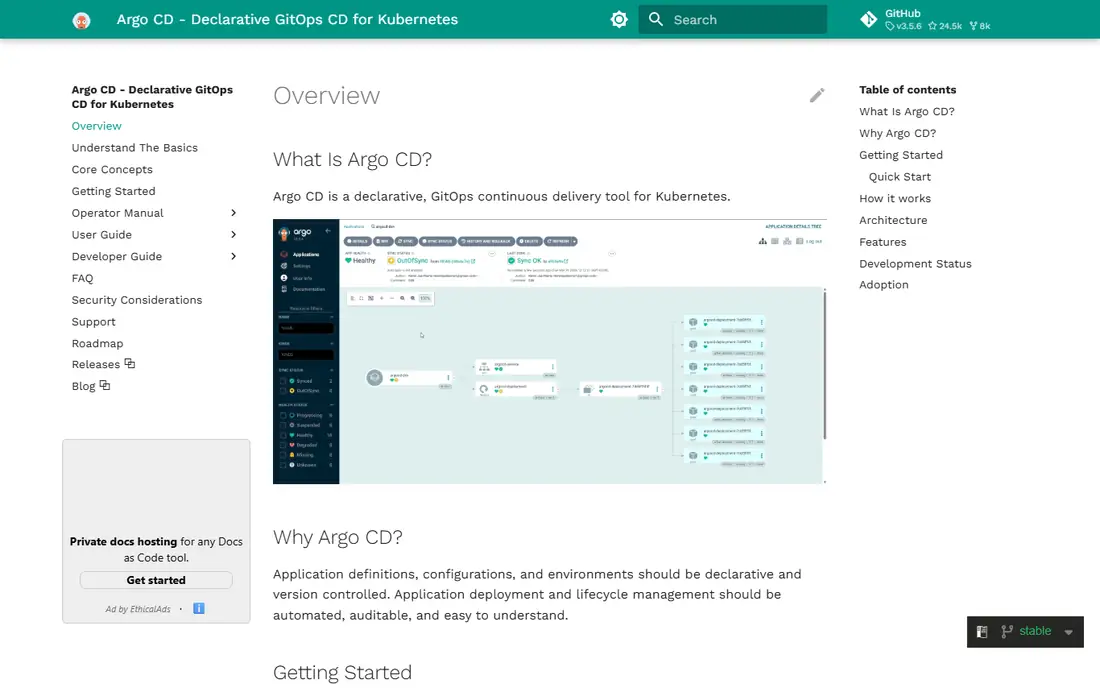
Argo CD suits Kubernetes teams that want GitOps: the desired state lives in Git, and Argo CD continuously compares live cluster state with that desired state. When they differ, it reports the drift and can sync automatically or on approval, with rollback to any committed configuration. That model makes deployments auditable, because every change is a Git commit with a history, an author, and a review.
The honest catch is scope. Argo CD deploys to Kubernetes, so teams with virtual machines, servers, or other targets need another tool alongside it. It also needs a platform team to operate, upgrade, and secure it. For a Kubernetes first organisation, those costs are worth it. For a mixed estate, pair Argo CD with a broader deployment tool rather than forcing every target into Kubernetes.
What we like- Git as source of truth for Kubernetes state
- Drift detection and visual sync status
- Supports Helm, Kustomize, and plain manifests
Watch out for- Kubernetes only
- Operating Argo CD itself needs platform skill
#2Spinnaker
Best for: Multi cloud delivery pipelines3.9/5 on
G2 (22 reviews, checked Oct 2026)
Visit spinnaker.io
Starting priceSee website
Free planYes
Spinnaker suits organisations that deploy across several clouds and want one standard release process. Created at Netflix and used for millions of deployments, it combines pipeline management with integrations to major cloud providers and Kubernetes, and it supports blue green, canary, and manual approval stages. For a platform team standardising releases across many services, that consistency is valuable.
The trade off is operations. Spinnaker is a set of services, not a single install, and running it well takes platform engineering time. Small teams with one cloud and a few services will usually move faster with GitHub Actions, CircleCI, or Argo CD. Large, multi cloud teams that already have platform capacity will get more from Spinnaker than a simpler tool can offer.
What we like- Multi cloud pipelines with canary and blue green strategies
- Mature deployment practices
- Open source
Watch out for- Operating Spinnaker is a significant project
- User interface and setup feel heavy for small teams
#3Jenkins
Best for: Flexible self hosted pipelines4.4/5 on
G2 (570 reviews, checked Oct 2026)
Visit jenkins.io
Starting priceSee website
Free planYes
Jenkins suits teams that want full control over CI and CD, including on premises or air gapped environments. As an automation server with thousands of plugins, it can build, test, and deploy almost any project, distribute work across agents, and integrate with nearly every tool in the delivery chain. For teams with unusual requirements or strict hosting rules, that flexibility is hard to match.
The honest catch is maintenance. Jenkins needs upgrades, plugin management, agent management, and security patching, and a neglected controller becomes a risk. Teams should standardise on shared pipeline libraries, limit plugins to those they truly need, and assign an owner for the platform. Without that discipline, Jenkins pipelines grow messy and slow, even though the tool itself remains capable.
What we like- Free and open source
- Huge plugin ecosystem
- Runs anywhere, including on premises
Watch out for- You operate, upgrade, and secure it
- Plugin sprawl can make pipelines hard to maintain
Starting priceSee website
Free planYes
GitHub Actions suits teams whose code already lives on GitHub and who want CI and CD without a separate platform. Workflows run on hosted runners for Linux, macOS, and Windows, or on self hosted runners, and they can build, test, and deploy with matrix builds, secrets at repository and environment level, and approval gates. The marketplace of reusable actions speeds up common tasks, from language setup to cloud deployment.
The trade off is vendor fit and cost. Teams not on GitHub gain less, and hosted runner minutes can grow with large test suites or frequent deploys. Use caching, run only affected tests where possible, and set environment approvals for production. For GitHub native teams, Actions is often the fastest path to reliable continuous deployment, because code, review, and delivery live in one place.
What we like- Built into GitHub with hosted runners
- Large action marketplace
- Matrix builds and environment approvals
Watch out for- Costs scale with hosted runner minutes
- Deepest value is for teams already on GitHub
#5CircleCI
Best for: Fast cloud CI and CD4.4/5 on
G2 (510 reviews, checked Oct 2026)
Visit circleci.com
Starting priceSee website
Free planYes
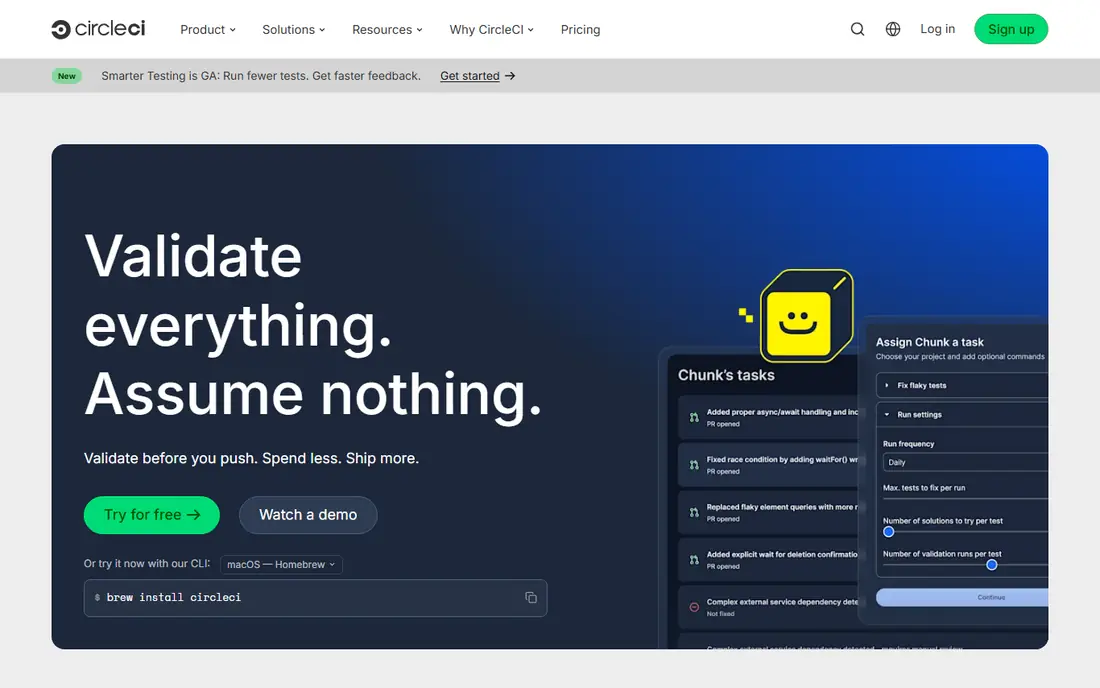
CircleCI suits teams that want fast, cloud based CI and CD with strong test optimisation. Its platform runs builds and deploys at scale, with features such as running only tests affected by a change, which shortens feedback time on large codebases. It supports many languages and deployment targets, and it now offers GitHub Actions YAML support in preview on Linux, which helps teams reuse workflow definitions.
The catch is cost control. Cloud CI pricing grows with minutes, parallelism, and test volume, so teams should monitor usage and optimise slow or flaky tests. CircleCI also shines most as a cloud service, so teams that must run everything on premises may prefer Jenkins. For cloud native teams that value speed and reliability, CircleCI is a strong, practical choice.
What we like- Fast cloud pipelines with smart test selection
- Supports many languages and targets
- GitHub Actions YAML support in preview
Watch out for- Cloud pricing scales with usage
- Self hosted options are less central than cloud
#6Harness
Best for: Enterprise delivery with governance4.6/5 on
G2 (336 reviews, checked Oct 2026)
Visit harness.io
Starting priceSee website
Free planFree trial
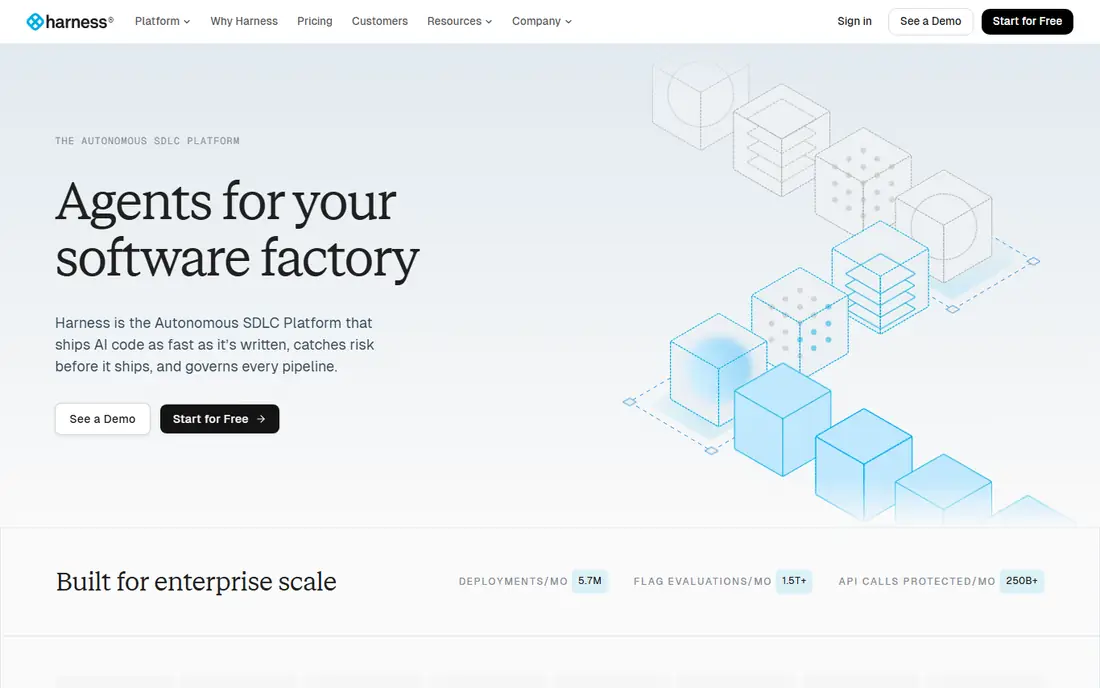
Harness suits enterprises that need governed, repeatable delivery across many teams. Its platform covers continuous delivery with templates that replace thousands of hand written pipelines, plus security, cost, and feature management in a broader software delivery system. Audit trails, role based access, and policy controls help regulated teams show who deployed what, when, and with what approvals.
The honest limit is scope and price. Harness is an enterprise platform, so pricing is discussed with sales and implementation benefits from a platform team. Small teams with a few services will usually move faster with GitHub Actions or CircleCI. Large teams that struggle with pipeline sprawl, inconsistent releases, or audit demands will find Harness templates and governance worth the investment.
What we like- Governed delivery templates and pipelines
- Broad deployment targets
- Audit trails and policy controls
Watch out for- Enterprise platform with quoted pricing
- Smaller teams may find it more than they need
#7Octopus Deploy
Best for: Deployment focused delivery4.4/5 on
G2 (58 reviews, checked Oct 2026)
Visit octopus.com
Starting priceSee website
Free planFree trial

Octopus Deploy suits teams that already have CI, such as GitHub Actions, Jenkins, or Azure DevOps, but want a dedicated deployment tool. It handles environment promotion, reusable deployment processes, dashboards, logs, and manifests across Kubernetes, multi cloud, and on premises targets, with role based access and audit logs for compliance. That separation keeps CI focused on building and testing, while Octopus owns safe, repeatable releases.
The trade off is that Octopus is not a full CI replacement, so teams still need a build tool. It also adds a second platform to learn and operate. For teams with complex deployment needs, many environments, or strict compliance rules, that separation is a benefit. For a small team with one environment and a simple release, a single CI and CD tool will be simpler.
What we like- Deployment first design with environment promotion
- Works with many CI tools
- Strong dashboards and audit logs
Watch out for- It complements CI rather than replacing it
- Pricing needs a quote for larger use
How we chose
We compared vendor documentation and pricing pages, open source project pages, and public reviews, and we opened each official homepage or project site to confirm it belongs to that tool. We favoured tools with a distinct delivery model, from GitOps to multi cloud pipelines to deployment focused delivery, and we mixed free open source options with managed enterprise platforms. Where pricing is quoted or usage based, we wrote See website rather than presenting a single figure as a total cost.
Deploying safely, not just quickly
Speed without safety creates incidents. Before enabling automatic production deploys, define what must pass: tests, security scans, and a health check after deploy. Add a rollback plan that has been tested, not just documented, and make sure someone can run it at night. Start with canary or blue green releases for user facing services, so a bad change affects a small share of traffic first.
Approvals, environments, and audit
Use environment approvals for production, even in a continuous deployment setup, by gating on automated checks rather than only on a human click where that fits your risk. Keep environments consistent, promote the same artifact through each stage, and never rebuild for production from a different commit. Keep an audit log of who deployed what, and review failed deploys as a team, because patterns in failures usually point to a process fix, not a person to blame.
Choosing by target and team size
Kubernetes teams should start with Argo CD, possibly with Octopus or Harness for governance. Multi cloud platform teams should evaluate Spinnaker or Harness. GitHub native teams should start with GitHub Actions. Cloud teams that value test speed should test CircleCI. Teams that must self host should evaluate Jenkins. The right tool is the one your team can operate well, not the one with the longest feature list.
Frequently asked questions
What is the difference between continuous delivery and continuous deployment?
Continuous delivery means every change is tested and ready to release, but a person approves the final production deploy. Continuous deployment goes further: every passing change reaches production automatically, with no manual approval. Many teams start with delivery and move to deployment for low risk services once tests and rollback are trusted.
Which continuous deployment tool is best for Kubernetes?
Argo CD is a strong default for Kubernetes, because it uses Git as the source of truth and detects drift between Git and the cluster. Octopus Deploy and Harness also support Kubernetes with added governance and dashboards, while Spinnaker suits multi cloud Kubernetes plus virtual machine targets. Choose by how much governance and multi target support you need.
Is Jenkins still a good choice?
Yes, for teams that want free, flexible, self hosted automation and can operate it well. Jenkins has a huge plugin ecosystem and runs almost anywhere. It is less attractive for teams that want a managed service with no platform operations, who will usually prefer GitHub Actions, CircleCI, or Harness.
Do I need a separate deployment tool if I already use GitHub Actions?
Not always. GitHub Actions can build, test, and deploy many applications well, especially for GitHub native teams. A separate tool such as Octopus Deploy helps when deployments span many environments and targets, need detailed audit and promotion controls, or must be managed separately from CI by a platform team.
How do canary and blue green deployments reduce risk?
A canary release sends a new version to a small share of traffic first, so problems affect few users and can be rolled back quickly. A blue green release runs old and new versions side by side, then switches traffic once the new version proves healthy. Both patterns need good health checks and a tested rollback to work well.
What should I test before enabling automatic production deploys?
Test your full pipeline on a staging environment that mirrors production, verify rollback, check security scans and approvals, and confirm monitoring alerts fire on failure. Run a game day where a deploy fails on purpose and the team rolls back. If rollback is slow or unclear, fix that before automating production releases.
Sources we checked (7)
- https://argo-cd.readthedocs.io
- https://spinnaker.io
- https://www.jenkins.io
- https://github.com/features/actions
- https://circleci.com
- https://www.harness.io
- https://octopus.com
Is your product missing or out of date?
We review this list regularly. Vendors can request a listing, send updated pricing or ask about featured placement.

Shihab Mia · Founder, Rankite
Shihab has 5+ years in B2B and SaaS SEO. He writes Rankite's software buying guides from pricing pages, documentation and public user reviews. More about Shihab.