How we make this list: we compare pricing pages, product documentation and public user reviews. Rankite is independent; if a vendor ever pays for a featured spot, that listing is clearly labeled Partner.
Key takeaways
- If you want zero infrastructure, Snowflake and MongoDB Atlas lead on the managed cloud side, with free tiers to start on.
- If the database must stay in your building, PostgreSQL, MySQL and SQL Server are the proven on-prem choices, and two of them cost nothing to start.
- Oracle and Couchbase cover the widest ground: the same engine runs on-prem, in the cloud and at the edge.
- CockroachDB is the pick when one database must span regions and survive a data center going dark.
- Watch licensing, not just sticker price. Oracle and SQL Server meter extras by use, and cloud bills scale with your queries.
Quick comparison
| Tool | Best for | Starting price | Free plan |
|---|
 MongoDB Atlas MongoDB Atlas | Cloud-first teams that want an on-prem option too | From $0.08/hour (M10 dedicated, pay as you go) | Yes (M0, free forever) |
 PostgreSQL PostgreSQL | Teams that run their own servers | Free (open source) | Yes |
 MySQL MySQL | Web apps already on the LAMP stack | $5,000 per server/year (Enterprise Edition, 1-4 sockets) | Yes (Community Edition) |
 Microsoft SQL Server Microsoft SQL Server | Windows-centric enterprises with compliance needs | $3,945 per 2-core pack (Standard, list) | Yes (Express and Developer editions) |
 Oracle Database Oracle Database | Large enterprises with Oracle estates | $47,500 per processor (Enterprise Edition, list) | Yes (23ai Free edition) |
 Snowflake Snowflake | Analytics teams that want zero infrastructure | Usage-based (credit model) | Free trial (30 days, $400 credits) |
 Couchbase Couchbase | Apps that need data at the edge and in the cloud | See website | Yes (Capella free tier) |
 MariaDB MariaDB | Teams migrating off Oracle or MySQL | See website | Yes (Community Server) |
 CockroachDB CockroachDB | Apps that must survive region failures | See website | Yes (cloud free tier; self-hosted Enterprise free under $10M revenue) |
Is your product missing or out of date?
We review this list regularly. Vendors can request a listing, send updated pricing or ask about featured placement.
The best deployment options for database software
#1
MongoDB Atlas
Best for: Cloud-first teams that want an on-prem option too
Visit mongodb.com
Starting priceFrom $0.08/hour (M10 dedicated, pay as you go)
Free planYes (M0, free forever)
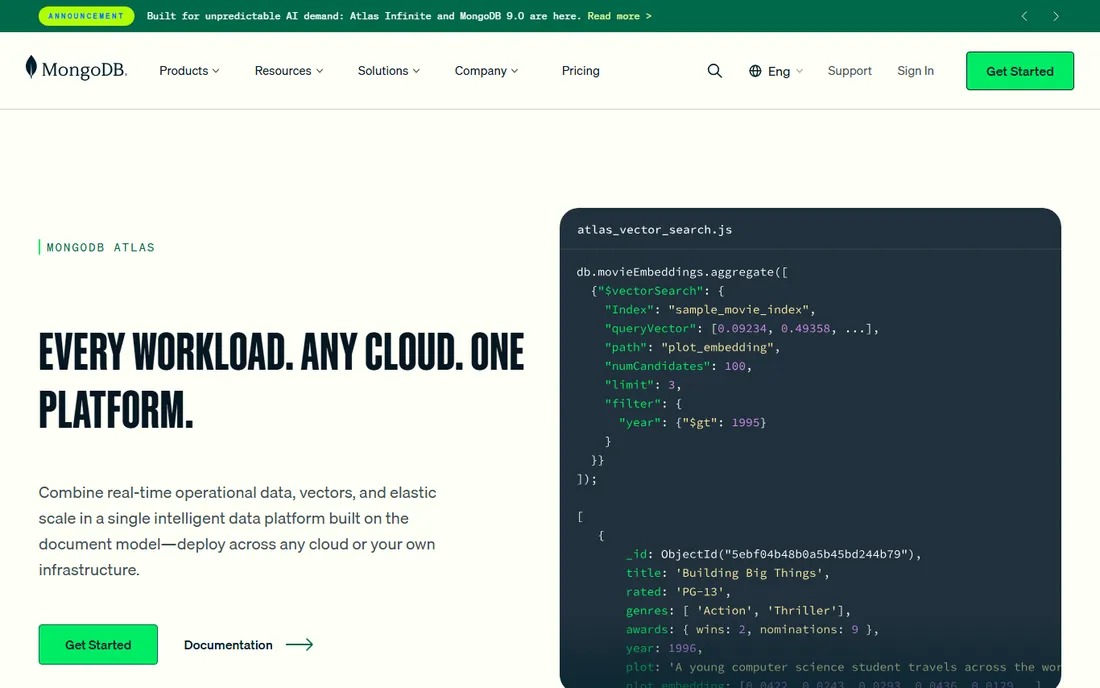
MongoDB sells you the database two ways. Atlas is the fully managed cloud service: pick a cloud provider and a region, choose a cluster size, and MongoDB handles patching, backups and scaling. Enterprise Advanced is the self-managed stack for your own data center, with Ops Manager, a Kubernetes operator and commercial support. Both speak the same document API, so an app built on Atlas can move on-prem without a rewrite.
Pricing is unusually transparent. The vendor pricing page lists the M0 cluster at free forever, shared tiers at $9 and $25 per month, and dedicated clusters starting at $0.08 per hour for an M10. The honest catch is the slope: an M30 runs about $0.54 per hour and large production clusters can cost thousands a month. On-prem, Enterprise Advanced pricing requires a sales conversation, which slows down procurement teams that need a number this week.
What we like- Managed service on AWS, Azure and GCP
- Free tier with 512 MB that never expires
- Same document API on-prem and in the cloud
Watch out for- Costs climb fast past the M10 tier
- Self-managed Enterprise Advanced is quote-only
Starting priceFree (open source)
Free planYes
PostgreSQL is the default answer for self-hosted relational data. Install it on a bare-metal server, a VM or a Kubernetes cluster, and it behaves the same everywhere. If you later want the managed route, every cloud offers it: Amazon RDS, Azure Database, Google Cloud SQL, plus independent services like Neon and Supabase.
The price is zero under an open-source license, including replication, partitioning and the pgvector extension many teams use for AI search. The tradeoff is operational: no vendor does your patching on a self-hosted install, and old versions eventually stop receiving fixes, so upgrades are your job. Small teams without DBA experience often do better on a managed Postgres service, where the monthly bill replaces the staffing cost.
What we like- No license fees on any deployment
- Runs identically on-prem, in containers and at the edge
- Managed versions exist on every major cloud
Watch out for- Self-hosted patching, backups and failover are your job
- Real high availability needs experienced DBAs
Starting price$5,000 per server/year (Enterprise Edition, 1-4 sockets)
Free planYes (Community Edition)
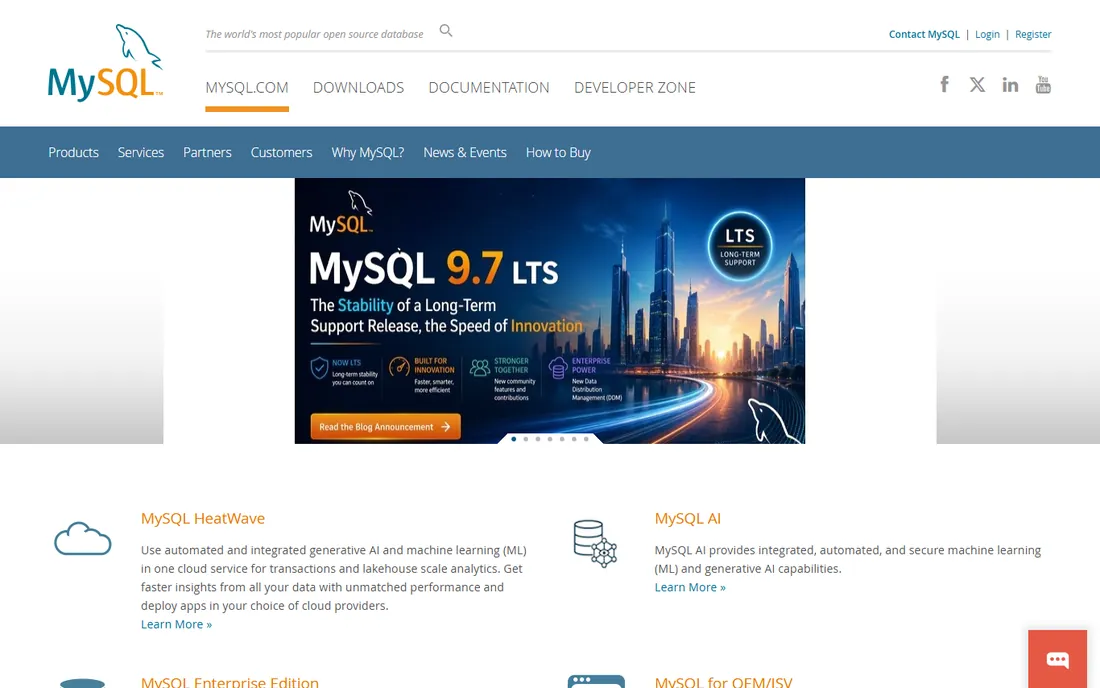
MySQL remains the workhorse of the web, and Oracle now pushes two deployment stories for it. The classic one is self-hosted: download Community Edition, run it on your own hardware or cloud VMs, and pay nothing for the software. The newer one is HeatWave, a managed cloud service on AWS, Azure and Oracle Cloud that adds in-database machine learning and analytics.
Community Edition is free and capable for most web workloads. Enterprise Edition, with the firewall, transparent data encryption and enterprise monitor, is an annual subscription Oracle lists at $5,000 per server per year for one to four sockets.
What we like- Free Community Edition for self-hosting
- HeatWave adds in-database analytics as a managed service
- Enormous pool of engineers who know it
Watch out for- Enterprise pricing is per server and adds up
- Advanced security and monitoring sit behind the subscription
#4
Microsoft SQL Server
Best for: Windows-centric enterprises with compliance needs
Visit microsoft.com
Starting price$3,945 per 2-core pack (Standard, list)
Free planYes (Express and Developer editions)
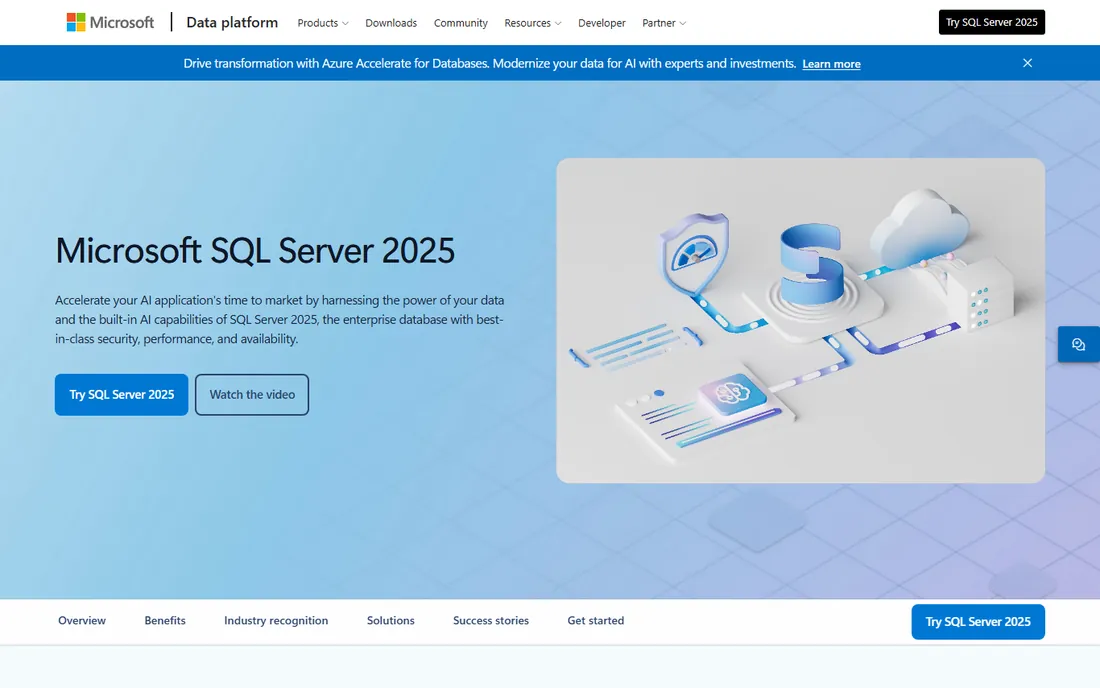
SQL Server 2025 is the on-prem enterprise database, with Azure Arc as the bridge to hybrid. You license it per core for your own servers, or connect those servers to Azure Arc and pay monthly instead: $73 per core per month for Standard, $274 for Enterprise. In the cloud, Azure SQL Database is the fully managed equivalent. The three share authentication, failover and disaster recovery, which is why Microsoft shops with data residency rules stay even when they move everything else to the cloud.
Microsoft publishes list prices openly: Standard at $3,945 per two-core pack, Enterprise at $15,123 per two-core pack, plus a server-plus-CAL model for Standard. Express is free for small databases and Developer is full Enterprise functionality for dev and test. The honest catch is the licensing guide, which runs to dozens of pages of per-core minimums and CAL obligations, so most buyers go through a reseller for the real number.
What we like- Deep Windows and Active Directory integration
- Azure Arc pay-as-you-go avoids upfront licenses
- Free Express and Developer editions for small and dev workloads
Watch out for- Licensing is genuinely complex
- The ecosystem assumes Windows even though Linux is supported
#5
Oracle Database
Best for: Large enterprises with Oracle estates
Visit oracle.com
Starting price$47,500 per processor (Enterprise Edition, list)
Free planYes (23ai Free edition)
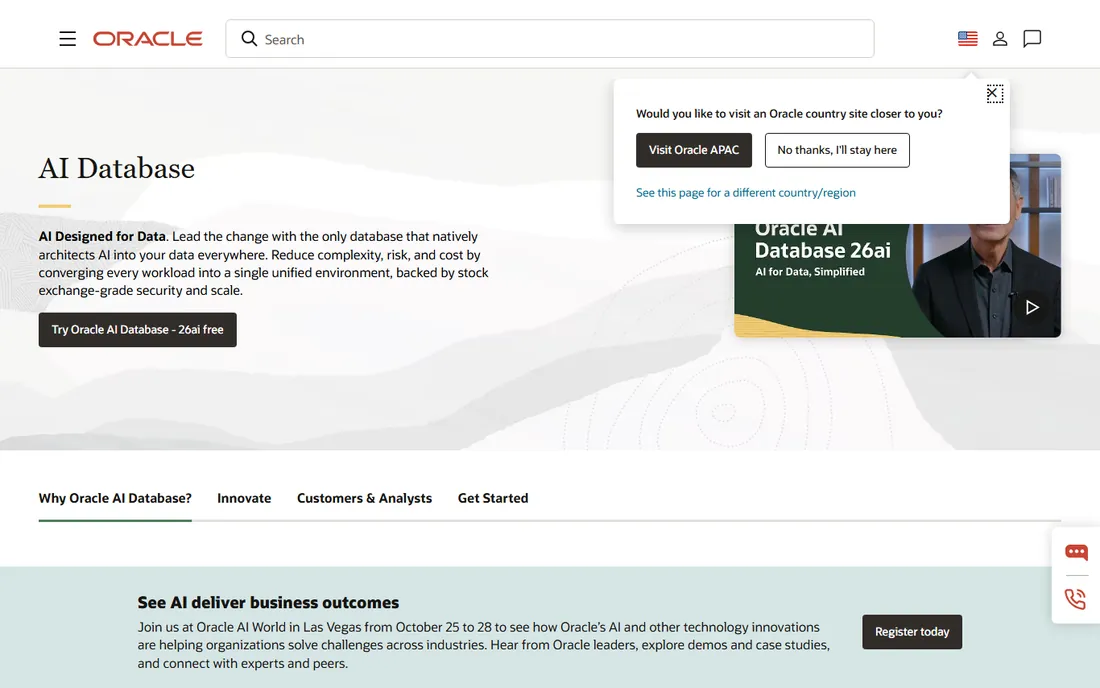
Oracle now brands it the AI Database, but the deployment menu is what matters. Run it on your own servers, on Exadata, as Autonomous Database on Oracle Cloud, across AWS, Azure and Google Cloud through multicloud partnerships, or in your own data center with Cloud@Customer for the hybrid model. Oracle Database 23ai Free is a no-cost edition for development and small production use, and the Autonomous service patches and tunes itself.
The free edition is genuinely free, and Always Free Autonomous instances exist on Oracle Cloud. Enterprise Edition lists at $47,500 per processor, with extras like partitioning and Advanced Security licensed separately. Here is the part buyers miss: the options install with Enterprise Edition and are metered by use, not by purchase. The database logs feature usage, so a DBA who clicks through a tuning advisor can create a license obligation months before procurement notices.
What we like- One engine across on-prem, OCI, Autonomous and Cloud@Customer
- Autonomous removes patching and tuning
- Free edition covers dev and small apps
Watch out for- Licensing is the most feared in the industry
- Paid options are metered by use, and the database records it
Starting priceUsage-based (credit model)
Free planFree trial (30 days, $400 credits)
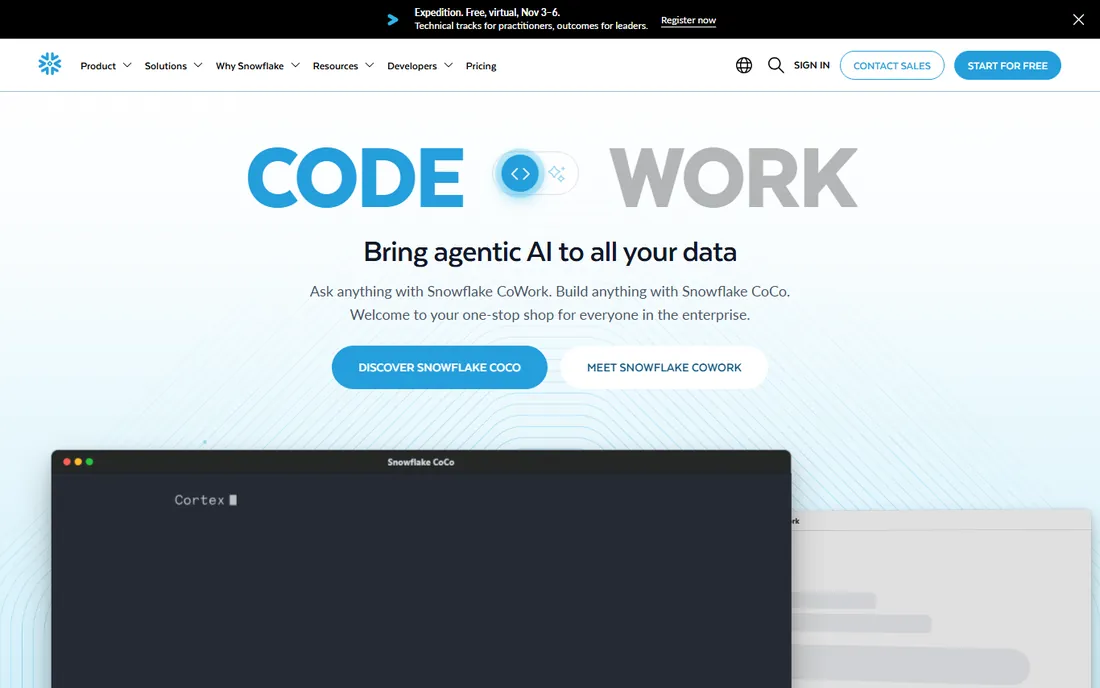
Snowflake only exists in the cloud, which is both its pitch and its limit. There is no server to install, no version to upgrade, no storage to provision. Compute and storage scale separately, so a burst of queries does not force you to buy disks and a pile of data does not force you to buy compute. It runs on all three major clouds, and data sharing lets two companies query the same data without copying it.
Pricing is pure consumption: credits for compute, dollars per terabyte for storage, billed per second. The 30-day trial includes $400 in usage credits, enough for a real evaluation.
What we like- Compute and storage scale independently
- Runs on AWS, Azure and GCP
- No servers to patch, back up or size
Watch out for- No on-prem option exists
- Bills can climb fast without monitoring
- Consumption pricing makes budgeting harder
Starting priceSee website
Free planYes (Capella free tier)
Couchbase covers the widest deployment surface in this list. Capella is the managed database-as-a-service with a perpetual free tier. The self-managed server runs on your hardware, in your cloud accounts or on Kubernetes. Couchbase Mobile and edge deployments sync data to devices that go offline, which is why retail, hospitality and field-service apps pick it. The same JSON document model and SQL++ queries work across all of them.
The strength that matters for deployment planning is placement: you can keep latency-sensitive data near users at the edge while the system of record sits in the cloud, without running two different databases. The honest weakness is ecosystem size. Fewer engineers know Couchbase than know Postgres, and SQL++ looks like SQL but has enough differences to slow new hires down for a few weeks.
What we like- Sub-millisecond latency design for operational workloads
- Offline-first mobile and edge sync
- One platform from cloud to device
Watch out for- Smaller hiring pool than Postgres or MySQL
- SQL++ query language has a learning curve
Starting priceSee website
Free planYes (Community Server)
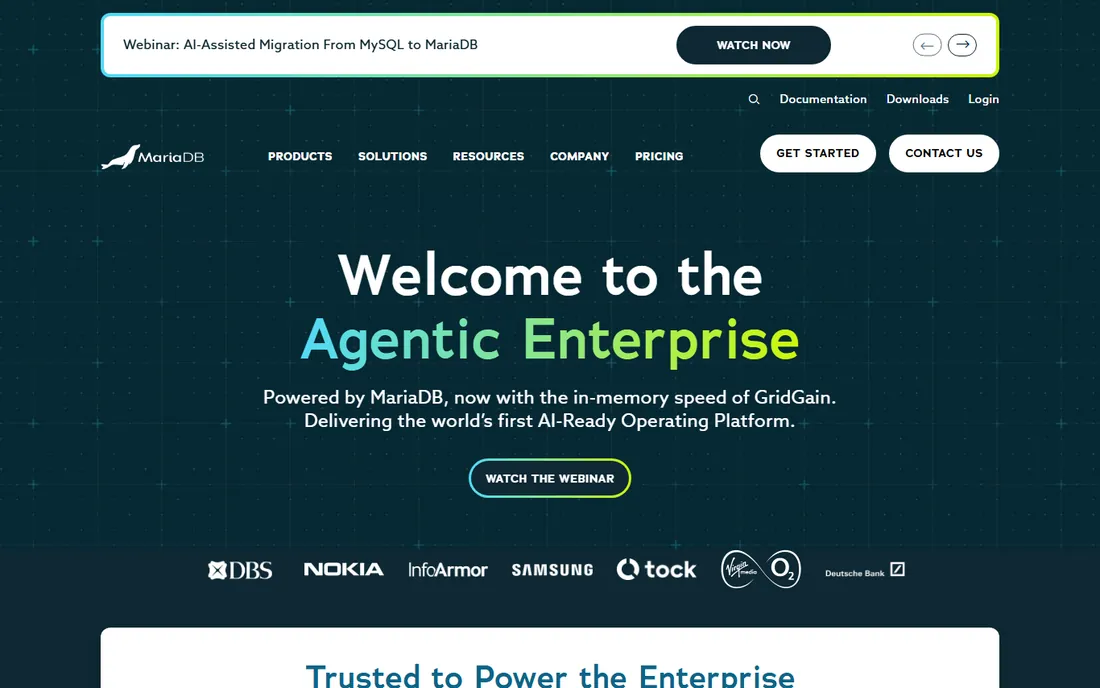
MariaDB began as the community fork of MySQL and now ships as a full enterprise platform. Community Server is free and runs on your own infrastructure. The Enterprise Platform adds the hardened server build, MaxScale for proxying and high availability, and ColumnStore for analytics. The managed cloud service covers teams that want MariaDB without operating it. For MySQL shops facing Oracle subscription pressure, MariaDB is the lowest-friction exit.
The deployment pitch is compatibility: applications written for MySQL generally run on MariaDB without changes, and Oracle compatibility features help larger migrations. The weakness is visibility. Enterprise pricing requires a sales call, which frustrates teams comparing options on a deadline, and the managed cloud offering gets less attention than Atlas or RDS. If you already operate MySQL and want to keep self-hosting with a support option, it fits well.
What we like- MySQL and Oracle compatibility ease migration
- Free Community Server is genuinely capable
- MaxScale proxy and ColumnStore ship with the platform
Watch out for- Enterprise pricing is quote-only
- Cloud mindshare lags behind Atlas and RDS
Starting priceSee website
Free planYes (cloud free tier; self-hosted Enterprise free under $10M revenue)
CockroachDB was built for distributed deployment from day one. Run it self-hosted across your data centers, or use the managed cloud where a serverless tier gives you 5 GB of storage and 250 million request units a month free. The company retired the old Core edition and made Enterprise free for companies under $10 million in annual revenue, removing the feature gap that used to push small teams toward the paid tier.
The deployment advantage is survival: the database stays consistent across regions and keeps serving reads and writes when a whole data center goes dark, without the manual sharding that distributed Postgres setups demand. It speaks the Postgres wire protocol, so most Postgres drivers and ORMs connect without changes. The catch is fit. For a simple app in one region, CockroachDB is more machinery than you need. Choose it for the multi-region problem it was designed to solve.
What we like- Distributed SQL with global consistency and no manual sharding
- Postgres-compatible wire protocol
- Generous free tiers on both cloud and self-hosted
Watch out for- Heavy for simple single-region apps
- Managed cloud bills per vCPU-hour, which adds up at scale
How we chose
We compared database platforms on the deployment models they actually support today. We checked each vendor's pricing page and documentation for cloud, on-prem and hybrid options, free tiers and trial terms, then cross-checked claims against public reviews on G2 and Capterra and technical discussions on Reddit. No hands-on testing was performed; this is a research comparison built for buyers choosing where their data will live.
Cloud, on-prem or hybrid: how to make the call
The deployment model is a business decision first and a technical one second. Get it wrong and you pay twice: once for the migration and once for the regret.
When cloud wins
Choose a managed cloud database when your team is small, your traffic is unpredictable, or you do not want to hire database administrators. Snowflake for analytics, MongoDB Atlas for operational document workloads and managed Postgres for relational apps all remove patching, backups and capacity planning from your week. The bill scales with use, which suits growing companies better than a six-figure license paid upfront. The price of this convenience is trust: your data lives on someone else's infrastructure, and egress fees apply when it leaves.
When on-prem still wins
Keep the database in your own data center when regulators, contracts or customers require it. Banks, hospitals and government suppliers often have no choice. On-prem also wins on predictable cost: a PostgreSQL or MySQL cluster on servers you own costs the same no matter how many queries you run, while a busy cloud database bills you for every one of them. The tradeoff is staffing. You need people who can patch, back up, monitor and fail over the system, and those people are expensive.
When hybrid is the honest answer
Most mid-size companies end up hybrid: sensitive data on-prem, everything else in the cloud, or production in the cloud with disaster recovery on their own hardware. Oracle's Cloud@Customer, SQL Server with Azure Arc and Couchbase's edge-to-cloud model all exist for this buyer. Hybrid is the most complex option to run, so only choose it if you have a concrete reason, like a data residency rule for one workload and elastic scale for another.
Mistakes teams make when they pick a deployment model
The most common mistake is choosing the database first and the deployment model second. A team picks Snowflake for the demo, then discovers the compliance team needs data on-prem, and the whole project restarts. Decide where the data must live before you shortlist vendors.
The second mistake is underestimating cloud bills. Usage-based pricing looks cheap in a trial and gets expensive at production scale. Run the vendor's pricing calculator with your real query volume before you commit, and set up billing alerts on day one.
The third is ignoring the exit. Ask every vendor how you get your data out, in what format, and what it costs. Open-source databases make this trivial. Proprietary cloud services make it possible but slower. The best time to negotiate your exit is before you sign.
Frequently asked questions
Can I start on the cloud and move on-prem later?
Yes, with the right database. MongoDB, Couchbase, MariaDB and PostgreSQL run the same engine in both places, so the application barely notices. Snowflake cannot move on-prem at all, and moving off any managed service takes planning around backups, connection strings and data transfer costs.
Which database is cheapest to run on my own servers?
PostgreSQL and MySQL Community Edition cost nothing in license fees, so your only costs are hardware and staffing. MariaDB Community Server is in the same position. SQL Server Express is free for small databases, and Oracle's free edition covers development and small production use.
Do I need a DBA for a managed cloud database?
You need far less of one. Managed services handle patching, backups, failover and most tuning. You still need someone who understands indexes, query performance and access control, but that can be a developer with database experience rather than a full-time DBA.
What does hybrid deployment actually mean in practice?
It means the database runs in two places under one management story. Examples include SQL Server on-prem connected to Azure through Arc, Oracle running in your data center with Cloud@Customer, or Couchbase syncing between cloud clusters and edge devices. The point is one set of tools and policies across both locations.
How do I compare a per-core license with usage-based cloud pricing?
Model three years of your real workload. Price the license plus hardware and staffing for on-prem, then price the cloud option with the vendor's calculator at the same workload. Most teams find on-prem cheaper at steady high utilization and cloud cheaper at variable or low utilization.
Sources we checked (8)
- https://www.mongodb.com/pricing
- https://cdn-dynmedia-1.microsoft.com/is/content/microsoftcorp/microsoft/bade/documents/products-and-services/en-us/security/644401-sql-server-2025-pricing.pdf
- https://www.oracle.com/a/ocom/docs/dc/mysql_featurematrix_subscriptions_v34.pdf?source=:pm:cl:::LPD400002721&elqTrackId=2c7799d2738f4b30a12802086c1489f4b30a12802086c1489
- https://www.oracle.com/jp/a/ocom/docs/corporate/pricing/technology-price-list-070617.pdf
- https://aws.amazon.com/marketplace/pp/prodview-3gdrsg3vnyjmo?trk=129bbf9e-a6f9-4df1-a575-582b379dcf4e&sc_channel=el&pscd=get.awsaffiliate.com&ps_partner_key=YjYxNzFiNjg1YzNk&ps_xid=8QoACeCIH0ERrg&gsxid=8QoACeCIH0ERrg&gspk=YjYxNzFiNjg1YzNk
- http://couchbase.com/blog/free-tier-capella-columnar-mobile-vector-search-and-more/
- https://www.sdtimes.com/os/cockroachdb-retires-self-hosted-core-offering-makes-enterprise-version-free-for-companies-under-10m-in-annual-revenue/
- https://mariadb.com/downloads/enterprise/enterprise-server/
Is your product missing or out of date?
We review this list regularly. Vendors can request a listing, send updated pricing or ask about featured placement.

Shihab Mia · Founder, Rankite
Shihab has spent more than a decade helping SaaS and e-commerce brands grow through search. He writes Rankite's software buying guides from pricing pages, documentation and public user reviews. More about Shihab.