How we make this list: we compare pricing pages, product documentation and public user reviews. Rankite is independent; if a vendor ever pays for a featured spot, that listing is clearly labeled Partner.
Key takeaways
- Google Cloud Vision at $1.50 per 1,000 images excels at OCR and general labeling with zero training.
- Amazon Rekognition at $1.00 per 1,000 images suits AWS shops needing face and video analysis.
- Microsoft Azure AI Vision at $1.00 per 1,000 transactions fits enterprises already on Azure.
- Roboflow at $79 per month is the developer platform for training and deploying custom models.
- Clarifai at $1.20 per month plus usage offers visual model building without deep ML expertise.
Quick comparison
| Tool | Best for | Starting price | Free plan |
|---|
 Google Cloud Vision Google Cloud Vision | OCR, labeling, and moderation without training | $1.50 per 1,000 images | Yes |
 Amazon Rekognition Amazon Rekognition | face analysis and video on AWS | $1.00 per 1,000 images | Yes |
 Microsoft Azure AI Vision Microsoft Azure AI Vision | enterprises standardized on Microsoft | $1.00 per 1,000 transactions | Yes |
 Clarifai Clarifai | building custom vision models visually | $1.20 per month + usage | Yes |
 Roboflow Roboflow | developers training and deploying custom models | $79 per month | Yes |
 Viso Suite Viso Suite | enterprises deploying vision across sites | See website | No |
 Hive Hive | content moderation at scale | $3.00 per 1,000 images | Yes |
 Landing AI Landing AI | manufacturing visual inspection | See website | No |
Is your product missing or out of date?
We review this list regularly. Vendors can request a listing, send updated pricing or ask about featured placement.
The best computer vision software
Starting price$1.50 per 1,000 images
Free planYes
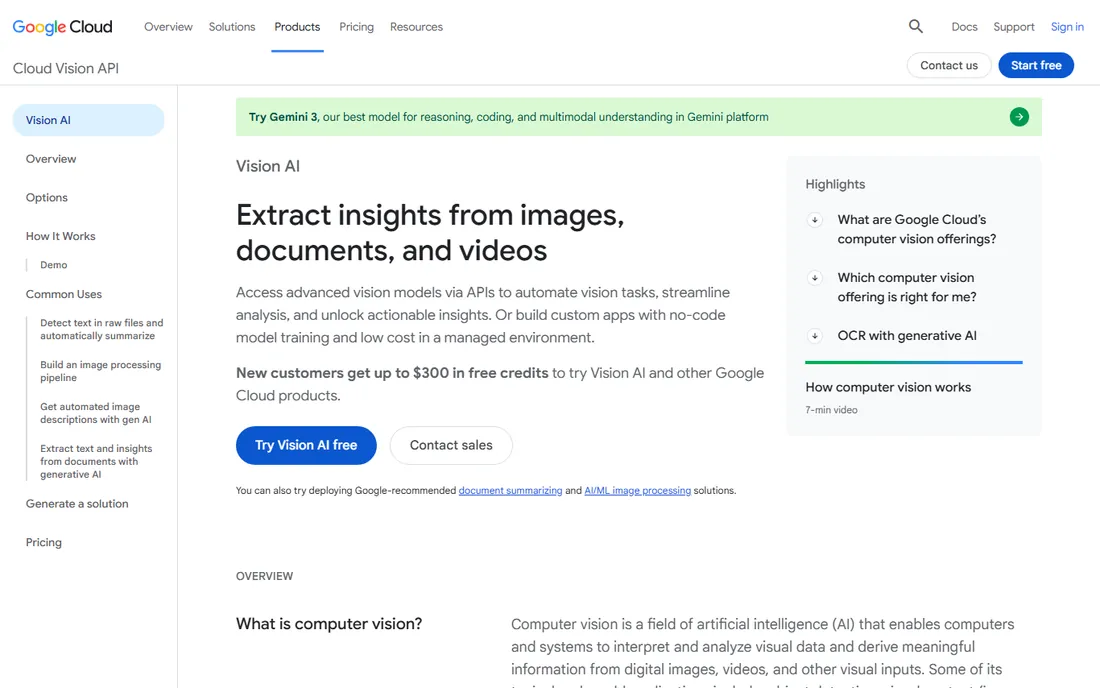
Google Cloud Vision is the default API when you need to understand images without building models. Send an image, get labels, detected text, faces, landmarks, and explicit content flags. The OCR is the best in the business, handling documents, handwriting, and dense text that defeats lesser engines. Pricing is pay-as-you-go at $1.50 per 1,000 images, with 1,000 feature requests free every month.
The zero-training design is the point: no datasets, no labeling, no model tuning. If your problem matches what the API detects, you ship in a day. Content moderation, document processing, and media tagging are the classic wins.
The catch is fit. If your objects are unusual, custom, or domain-specific, pretrained labels will miss them, and the per-image cost adds up at millions of images monthly. For standard vision tasks on Google Cloud, though, this is the fastest path from idea to production.
What we like- Strongest OCR in the category
- Broad labeling with zero training data
- 1,000 free requests monthly forever
Watch out for- Pay-as-you-go costs scale with volume
- Less control than custom models
Starting price$1.00 per 1,000 images
Free planYes
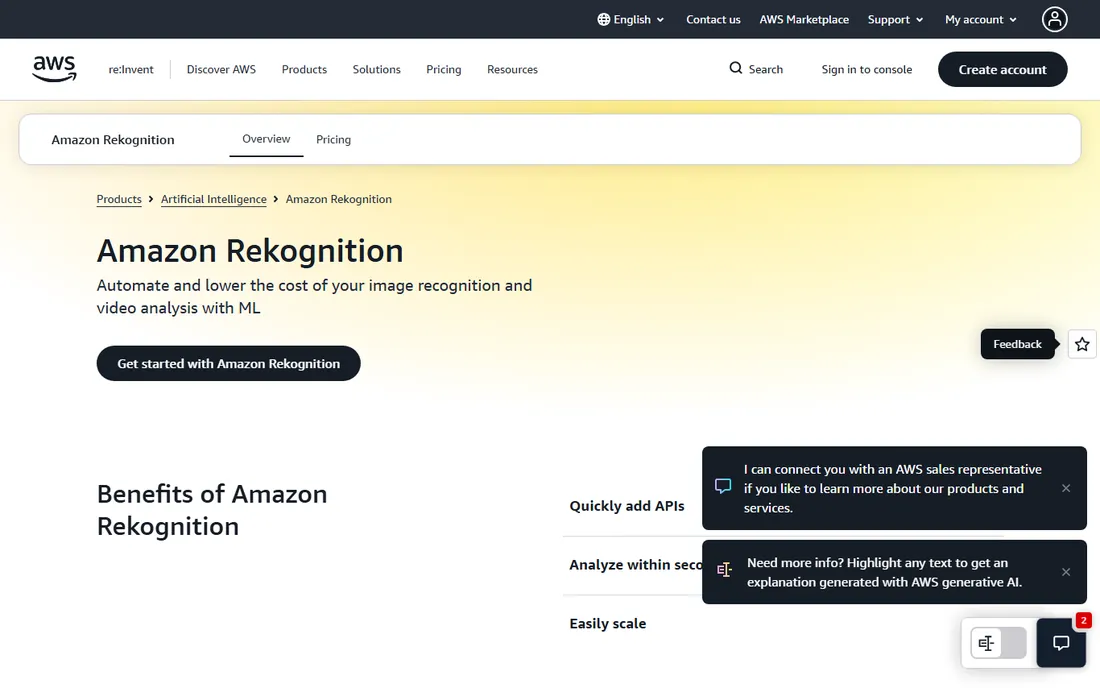
Amazon Rekognition is the vision API for organizations already on AWS. Beyond standard label detection, it offers facial analysis, face search across collections, person tracking in video, and text detection, plus Custom Labels for training classifiers on your own images without ML expertise. Pricing runs $1.00 per 1,000 images for standard features, with a free tier of 5,000 images monthly for new accounts.
Video analysis is the differentiator: tracking people, detecting activities, and moderating content across video streams, which the other cloud APIs handle less completely. For industrial and safety use cases, the combination of detection plus custom training covers most needs.
The API is less beginner-friendly than Google's, and the pay-per-use pricing with multiple feature groups makes cost estimation genuinely tricky. For AWS-native teams, the integration advantages outweigh the learning curve.
What we like- Strong facial analysis and video tracking
- Custom labels for your own classifiers
- AWS Free Tier of 5,000 images monthly for 12 months
Watch out for- API is harder for beginners
- Cost estimation is complex
Starting price$1.00 per 1,000 transactions
Free planYes
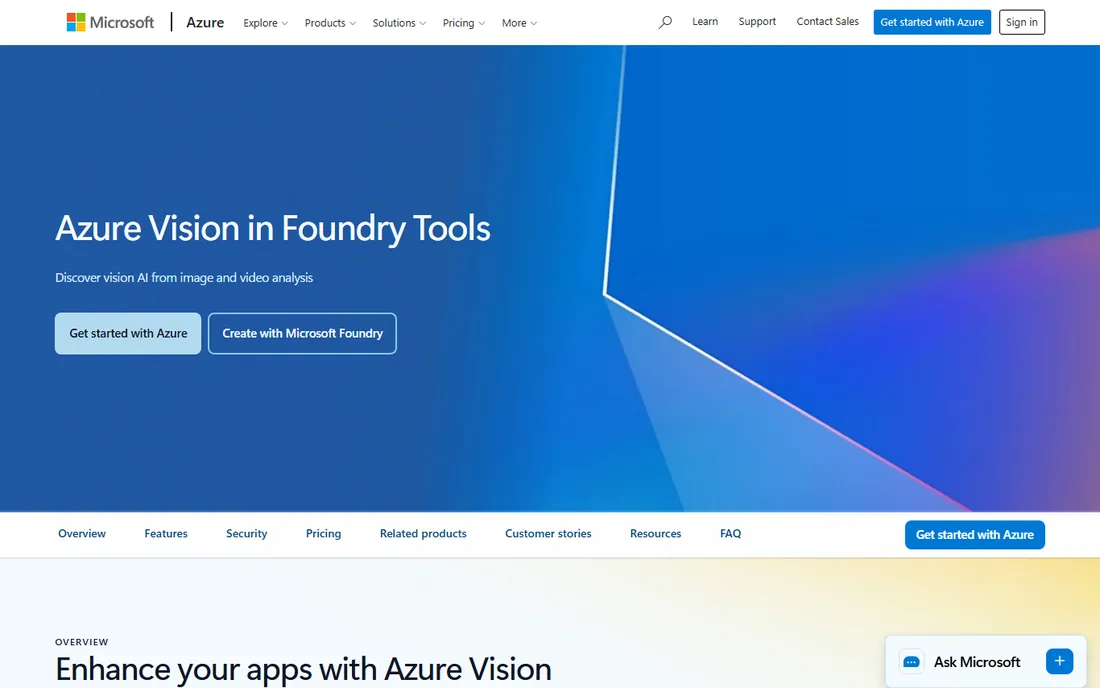
Azure AI Vision is the enterprise Microsoft choice: OCR, image analysis, visual tagging, face verification, and spatial analysis as managed services inside the Azure AI Services family. Pricing is $1.00 per 1,000 transactions on the S1 Standard tier, with a free F0 tier of 5,000 transactions monthly.
The integration story is the selling point. Organizations running on Azure, Microsoft 365, and Power Platform get vision capabilities inside their existing governance, identity, and billing frameworks, which matters enormously in regulated industries. Spatial analysis adds capabilities for physical-space understanding that the other clouds lack.
Outside the Microsoft ecosystem, there is little reason to choose it over Google or AWS. Inside the ecosystem, it is the path of least resistance, and that counts for a lot in enterprise procurement.
What we like- Clean integration with Azure and Microsoft 365
- Strong OCR and image analysis
- Free tier of 5,000 transactions monthly
Watch out for- Smaller third-party ecosystem than Google or AWS
- Best value only inside Azure
Starting price$1.20 per month + usage
Free planYes
Clarifai is the full-stack AI platform for teams that want custom vision without a data science department. The visual interface builds custom classifiers from your own images, and workflows chain multiple steps, detect objects, classify them, moderate the results, into automated pipelines through REST and gRPC APIs. Pricing starts at $1.20 per month base plus usage, with 1,000 free operations monthly.
The sweet spot is teams with domain expertise but limited ML skills: quality inspectors, moderators, or catalog managers who can label examples but not train models. Clarifai turns their labeled examples into working models.
Heavy usage can surprise on cost if you do not monitor, and the community is smaller than the cloud providers'. For custom vision built by non-specialists, though, the visual approach is unmatched.
What we like- Visual interface for custom classifiers
- Chain detection, classification, and moderation into workflows
- 1,000 free operations monthly
Watch out for- Usage-based pricing needs monitoring
- Smaller community than cloud giants
Starting price$79 per month
Free planYes
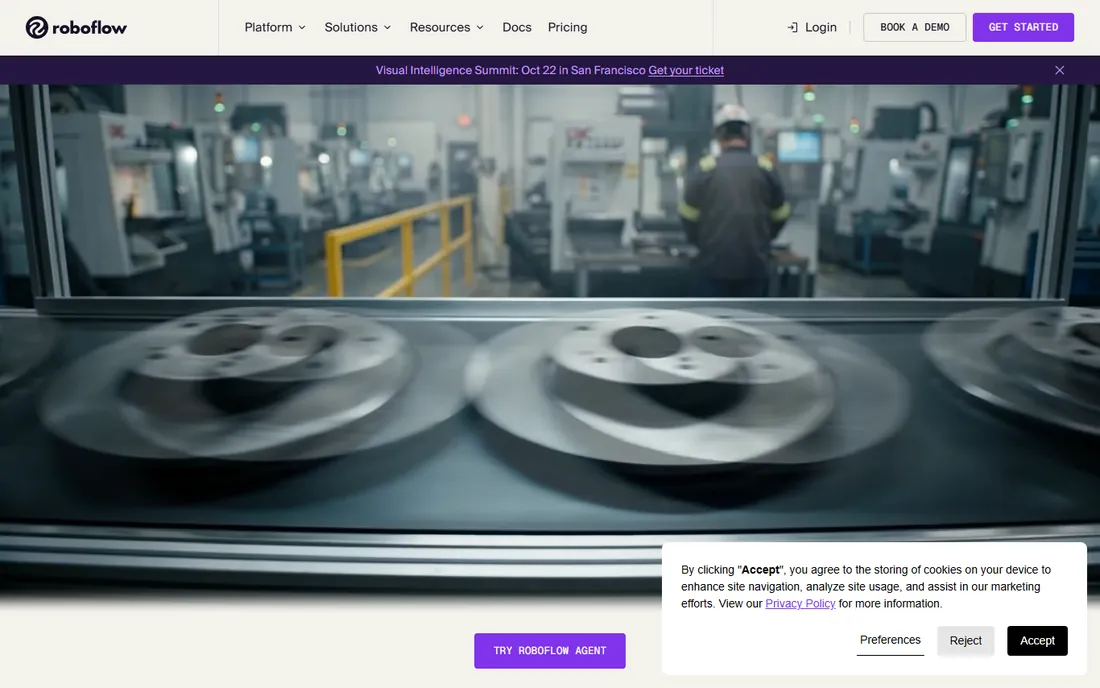
Roboflow is the developer platform for real computer vision work: dataset management, annotation, model training, and deployment in one workflow. The open-source inference layer runs pre-trained or custom models anywhere, and the Core plan at $79 per month billed annually adds training and hosting. The free tier is generous enough for serious experimentation.
The data-centric approach is the differentiator. Most vision projects fail on data quality, not model architecture, and Roboflow's tooling for dataset curation, augmentation, and versioning addresses the actual bottleneck. Deployment spans cloud and edge with self-hosted options.
This is a tool for teams with ML comfort, not a plug-and-play API. If you just need labels on images, use Google Cloud Vision. If you need your own model detecting your own objects in production, Roboflow is the natural starting point.
What we like- End-to-end vision workflow from dataset to deployment
- Generous free tier
- Open-source inference layer
Watch out for- Requires more ML comfort than API-only options
- $79 Core plan needed for training and hosting
#6
Viso Suite
Best for: enterprises deploying vision across sites
Visit viso.ai
Starting priceSee website
Free planNo
Viso Suite is the vision operations platform for enterprises deploying computer vision across many locations. Beyond model development, it provides the operational infrastructure: device management, monitoring, model updates, and integration with existing camera systems. Ready-made applications cover common industrial use cases like safety monitoring and occupancy analytics.
The pitch is deployment at scale. A manufacturer rolling out defect detection across twelve plants needs fleet management, not a better API, and Viso provides it. The platform integrates with existing camera infrastructure rather than demanding rip-and-replace.
Pricing is enterprise and quote-based, which rules out small projects. For single-use-case needs, the cloud APIs are cheaper and faster. For enterprises making vision a company-wide capability, Viso's operational layer is the missing piece.
What we like- End-to-end operational infrastructure for vision at scale
- Camera infrastructure integration
- Ready-made industrial applications
Watch out for- Enterprise pricing
- Overkill for single-use-case projects
Starting price$3.00 per 1,000 images
Free planYes
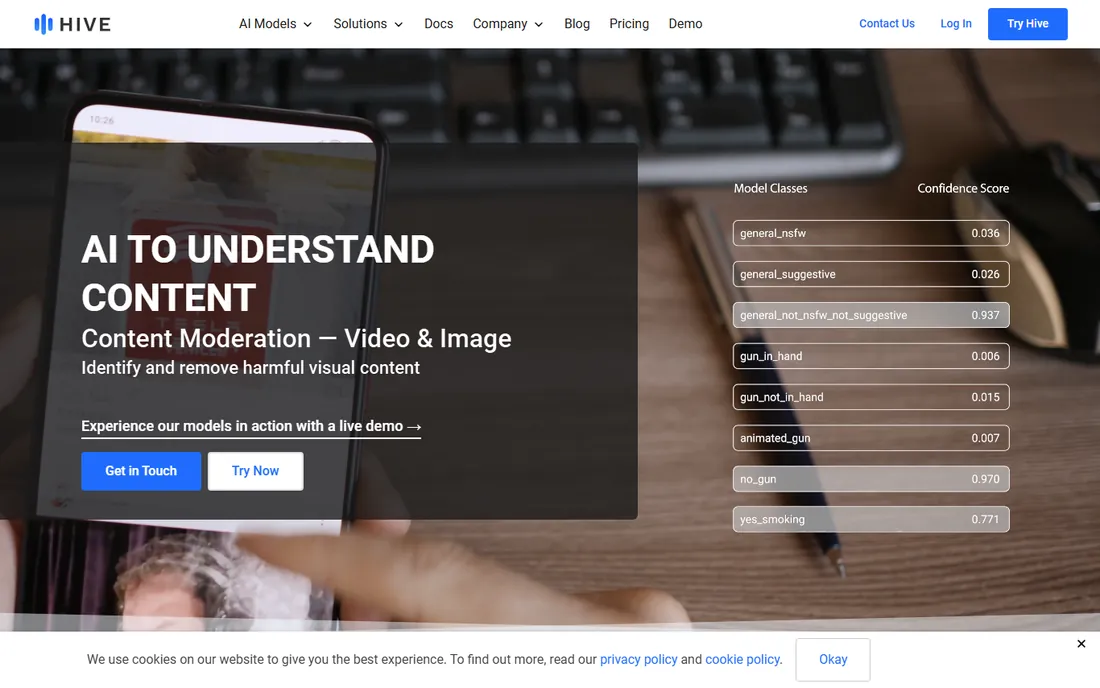
Hive is the specialist for one job: keeping bad content off platforms. The visual moderation API covers the standard categories plus specialized ones like deepfakes, hate symbols, and drug paraphernalia, with video intelligence for moving content. Pricing is $3.00 per 1,000 images for visual moderation, with a developer free tier of 100 requests daily.
When moderation accuracy is the business requirement, specialists beat generalists. Hive's models are trained specifically for safety categories, and the accuracy shows in the categories where mistakes are costly: false negatives that let harmful content through, or false positives that anger users.
For general image understanding, the cloud APIs are broader and cheaper. For platforms where trust and safety is a core function, Hive's specialization justifies the premium per-image price.
What we like- Specialized moderation categories including deepfakes and hate symbols
- High accuracy on safety tasks
- 100 free requests daily
Watch out for- Narrower than general vision APIs
- $3 per 1,000 images is premium pricing
Starting priceSee website
Free planNo
Landing AI, founded by Andrew Ng, builds computer vision for manufacturing. The platform's data-centric approach lets domain experts, quality engineers and line managers, build defect detection models without data science backgrounds, which is exactly the skill profile factories actually have. Manufacturing-specific features address the realities of production lines.
The value proposition is economic: visual inspection that catches defects early pays for itself in reduced waste and rework, and the platform is designed around that ROI calculation. Organizations where production efficiency directly impacts profitability find the premium pricing justifiable.
This is not a general vision platform, and it does not pretend to be. For manufacturers automating quality control, the specialization is the point. Everyone else should look at the broader tools above.
What we like- Purpose-built for manufacturing quality control
- Domain experts build models without data science
- Data-centric approach
Watch out for- Enterprise pricing
- Narrow industry focus
How we chose
We compared computer vision platforms on recognition accuracy, OCR quality, custom model support, pricing transparency, free tier generosity, deployment options, and fit for different team profiles. We checked each vendor's pricing page and current 2026 comparisons, read developer reviews on Reddit and GitHub, and weighed the total cost of real projects including training and inference. We did not train or benchmark models ourselves; assessments reflect current documentation and practitioner consensus as of October 2026.
When to train your own model vs use a pretrained API
Use a pretrained API when your problem is generic: reading text, detecting common objects, moderating standard content, recognizing faces. The cloud APIs handle these better than anything you will build, at a fraction of the cost and time. If the API's label set covers your needs, stop there.
Train your own model when your objects are specific: your product's defects, your equipment's failure modes, your custom parts, your proprietary categories. No pretrained API knows what your widget looks like, and this is where Roboflow, Clarifai, or Landing AI earn their keep.
The common mistake is training when an API would do, which burns months and budget for worse accuracy. The rarer mistake is forcing an API onto a custom problem, which produces confident wrong answers. Test the API on 100 of your real images first. If accuracy suffices, ship it. If not, you have your training dataset ready.
How to price a computer vision project before you commit
Start with volume: images per month times the per-image price. A million images monthly costs $1,500 on Google Cloud Vision, $1,000 on Rekognition, $3,000 on Hive. That arithmetic decides the API tier question immediately, and it is the number most teams skip.
Then add the hidden costs. Custom model projects need labeled data: budget for annotation, either staff time or a labeling service, before any training happens. Edge deployment needs hardware. Enterprise platforms need implementation services. A $79 monthly Roboflow plan can sit inside a $30,000 project once data and integration are counted.
Finally, price the alternative. Human review costs per image are often higher than people assume, and humans do not scale. The honest comparison is not API versus free, it is API versus the manual process, and on that basis computer vision usually wins quickly.
Frequently asked questions
What is computer vision software?
Computer vision software lets computers interpret images and video: detecting objects, reading text, recognizing faces, and flagging content. It ranges from pay-per-image APIs like Google Cloud Vision to platforms like Roboflow for training custom models to enterprise suites like Viso for operating vision across facilities.
How much does computer vision software cost?
Cloud APIs charge per image: roughly $1.00 to $1.50 per 1,000 images on Google, AWS, and Azure, $3.00 on Hive, all with free tiers. Roboflow starts at $79 per month for training and hosting. Enterprise platforms like Viso Suite and Landing AI are quote-based. Custom projects add data labeling and integration costs.
Google Cloud Vision vs AWS Rekognition: which is better?
Choose Google Cloud Vision for the best OCR and general image labeling, especially outside AWS. Choose Amazon Rekognition for facial analysis and video, especially inside the AWS ecosystem. Both offer free tiers; test each on your actual images, since accuracy on your specific content matters more than benchmark scores.
Do I need machine learning expertise to use computer vision?
Not for pretrained APIs: Google Cloud Vision, Rekognition, and Azure AI Vision work with simple API calls. Clarifai and Landing AI let domain experts build custom models visually. Roboflow assumes some ML comfort. Only Viso-scale enterprise deployments truly require dedicated ML engineering.
What is Roboflow used for?
Roboflow is the developer platform for custom computer vision: managing datasets, annotating images, training detection and classification models, and deploying them to cloud or edge devices. Teams use it when pretrained APIs cannot recognize their specific objects, such as product defects or custom parts.
Can computer vision run on edge devices?
Yes. Roboflow supports edge deployment, Viso Suite manages device fleets, and the major clouds offer edge-optimized model formats. Edge deployment suits low-latency needs like production lines or offline locations, while cloud APIs suit variable workloads where per-image pricing beats hardware investment.
Sources we checked (5)
- https://mixpeek.com/curated-lists/best-image-recognition-apis
- https://github.com/ishandutta2007/awesome-computer-vision-api/blob/HEAD/README.md
- https://www.analyticsinsight.net/artificial-intelligence/best-computer-vision-apis-and-ai-models-in-2026
- https://www.inventiva.co.in/trends/computer-vision-saas-tools-in-2026/
- https://thefutureofthings.com/29947-platforms-for-deploying-computer-vision-models/
Is your product missing or out of date?
We review this list regularly. Vendors can request a listing, send updated pricing or ask about featured placement.

Shihab Mia · Founder, Rankite
Shihab has spent more than a decade helping SaaS and e-commerce brands grow through search. He writes Rankite's software buying guides from pricing pages, documentation and public user reviews. More about Shihab.