How we make this list: we compare pricing pages, product documentation and public user reviews. Ratings come from G2, Capterra or Trustpilot, with the date we checked them.
Abridge is the best choice for a large health system on Epic, with deep EHR integration. Freed is the best alternative for a solo clinician or small practice that wants a published price and same-day setup, starting at 39 dollars per clinician per month.
Key takeaways
- This guide covers ambient scribes only, not CDI coding tools. The live Rankite guide on clinical documentation improvement software covers those tools, so none of them appear here.
- Only Freed publishes a price. The other seven tools are quote-only, so budget from a written quote.
- EHR fit decides most purchases. Epic shops should shortlist Abridge, Ambience Healthcare, and Nuance DAX Copilot first, while browser-based EHR users can start with Freed.
- A 10-clinician practice should expect roughly 800 to 4,800 dollars per month.
- Every note still needs clinician review and sign-off.
What is ambient clinical documentation software, and how is it different from CDI software
Ambient clinical documentation software listens to the conversation between a clinician and a patient, then drafts a structured clinical note from that conversation. The clinician reviews the draft, edits it, and signs it into the record. The goal is to cut the hours clinicians spend typing after clinic ends.
CDI software is different. CDI stands for clinical documentation improvement, and those tools review notes after they are written, check them against coding and billing rules, and flag gaps that could affect reimbursement or audit risk. If your main need is coding review, use the Rankite guide on clinical documentation improvement software instead.
How much does clinical documentation software cost in 2026
Only Freed publishes a price, from 39 dollars per clinician per month. The other seven tools route buyers to sales. Abridge is third-party reported at roughly 208 to 500 dollars per clinician per month. Ambience Healthcare is third-party reported at roughly 233 to 267 dollars for its base module. DeepScribe is third-party reported at roughly 350 to 500 dollars. Suki is third-party reported at roughly 299 dollars for Compose and 399 dollars for Assistant. Nuance DAX Copilot is third-party reported at roughly 369 to 600 dollars through resellers. Notable and Augmedix publish no usable per-clinician figure at all.
Treat every third-party figure as a planning range, not a price. Ask for the full cost in writing before you sign. Several enterprise tools carry implementation fees of 500 to 2,000 dollars per practice or per user, and annual contracts of 12 to 36 months are common.
Epic users have the widest choice in this guide. Abridge, Ambience Healthcare, Suki, DeepScribe, and Nuance DAX Copilot all describe deep Epic integration, with notes landing in the encounter workflow. Oracle Health is covered by Abridge, Ambience Healthcare, Suki, and Nuance DAX Copilot.
Freed works through a Chrome extension on browser-based EHRs such as athenahealth, eClinicalWorks, Elation, and SimplePractice, which suits practices that do not run Epic or Oracle Health. Augmedix reports integration with more than 50 EHRs, including Epic, Oracle Health, and MEDITECH. Ask each vendor whether the note writes back into your exact EHR version without copy and paste, and how long the integration takes.
Start with a short pilot. Pick two or three clinicians from different specialties, run the tool on real visits for two to four weeks, and measure three things: minutes saved per day on documentation, note quality as judged by the clinicians themselves, and the share of visits where the draft needed heavy edits. A tool that saves time in one specialty and fails in another has a narrow fit.
Check compliance before the pilot starts. Every tool in this guide should sign a business associate agreement, and confirm HIPAA compliance, SOC 2 Type II certification, where audio is stored, and whether audio trains vendor models. Also plan for adoption. Industry reports put typical clinician uptake at 20 to 50 percent, so budget for training.
Work the numbers before you buy. The table below uses Freed at its published Core price, Suki at its third-party reported Assistant price, and Abridge at a third-party reported mid-range price.
| Practice size | Suggested starting point | Monthly cost, 10 clinicians | Why it fits |
| Solo clinician | Freed Core | 790 dollars | Published price, same-day setup |
| Small practice, 2 to 10 | Freed Premier or DeepScribe | 790 to 5,000 dollars | Price and speed, or specialty templates |
| Mid-size group, 10 to 50 | Suki or DeepScribe | 2,990 to 5,000 dollars | Voice commands and specialty depth |
| Large health system | Abridge, Ambience, or DAX Copilot | 2,080 to 6,000 dollars or more | Deep Epic integration, coding features |
| Emergency department | Augmedix Go or Live | Quote only | ED templates and human support |
Ten clinicians on Suki Assistant at 399 dollars each cost 3,990 dollars per month, or 47,880 dollars per year. Ten clinicians on Freed Core at the vendor-published 79 dollars cost 790 dollars per month, or 9,480 dollars per year. Ten clinicians on Abridge at 300 dollars cost 3,000 dollars per month, or 36,000 dollars per year. The gap is about 38,400 dollars per year. If each clinician saves two hours per day across 20 clinic days, ten clinicians save 400 hours per month, worth 40,000 dollars at 100 dollars per hour. If they save only 30 minutes a day, the same group saves 100 hours, worth 10,000 dollars.
Quick comparison
| Tool | Best for | Starting price | Free plan |
|---|
 Abridge | Large Epic-based health systems that want deep EHR integration | quote; third-party reported roughly 208 to 500 dollars per clinician per month | No free plan and no self-serve trial |
 Ambience Healthcare | Large health systems that want documentation plus real-time coding checks | quote; third-party reported roughly 233 to 267 dollars per clinician per month for AutoScribe | No free plan and no self-serve trial |
 Freed | Solo clinicians and small practices that want a published price and same-day setup | 39 dollars per clinician per month for Starter, from the vendor pricing page checked 11 November 2026 | No permanent free plan; 7-day free trial with no credit card, and Core free for 12 months for eligible trainees |
 DeepScribe | Specialty practices, especially oncology and cardiology, that need specialty-tuned notes | quote; third-party reported roughly 350 to 500 dollars per clinician per month | No free plan and no free trial |
 Suki | Multi-specialty groups that want voice commands as well as ambient notes | quote; third-party reported roughly 299 dollars per clinician per month for Compose and 399 dollars for Assistant | No free plan and no self-serve trial |
 Nuance DAX Copilot | Large health systems already invested in Microsoft and Dragon dictation | quote; third-party reported roughly 369 to 600 dollars per clinician per month through resellers | No free plan and no self-serve trial |
 Notable | Health systems that want documentation inside a wider workflow automation platform | quote; no reliable third-party per-clinician price found | No free plan; evaluation is through a demo and pilot |
 Augmedix | Health systems that want a choice between fully automated notes and human-supported documentation | quote; third-party reported roughly 800 dollars or more per clinician per month, with wide disagreement | No free plan; every new partnership starts with a pilot |
Is your product missing or out of date?
We review this list regularly. Vendors can request a listing, send updated pricing or ask about featured placement.
Best clinical documentation software
#1Abridge
Best for: Large Epic-based health systems that want deep EHR integration4.2/5 on
G2 (16 reviews, checked Oct 2026)
Visit abridge.com
Starting pricequote; third-party reported roughly 208 to 500 dollars per clinician per month
Free planNo free plan and no self-serve trial
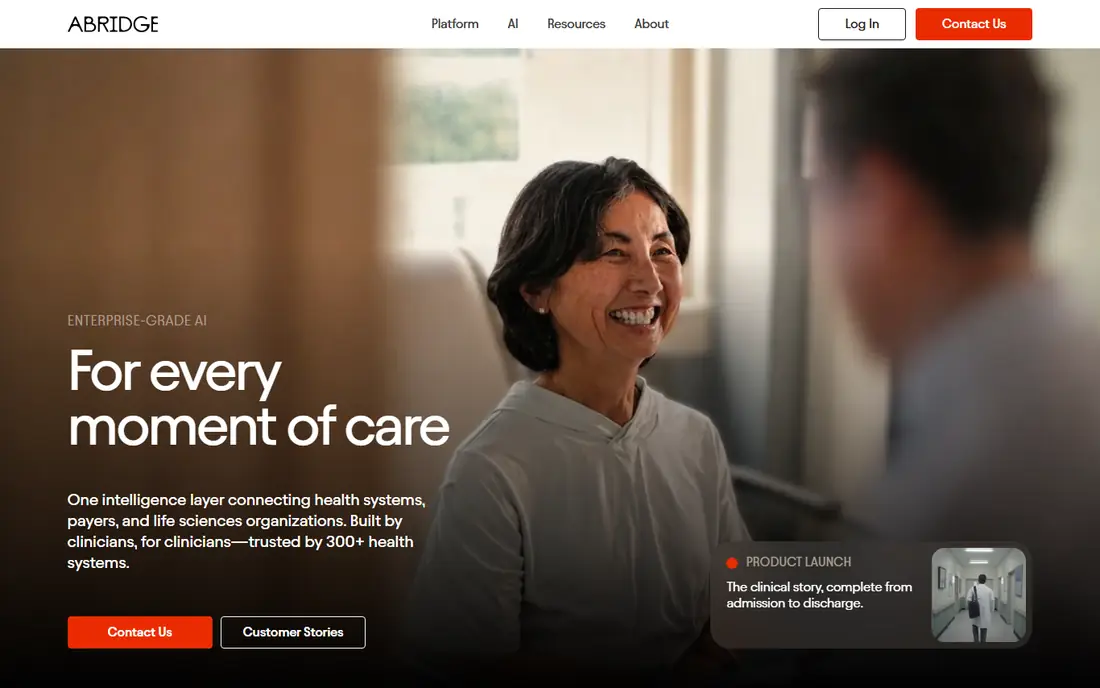
Abridge is an ambient AI scribe built for enterprise health systems. It listens to the encounter, drafts a structured note in near real time, and pushes it into the EHR for review. Third-party sources conflict on price: one source puts Abridge at 149 dollars per clinician per month, while most others report roughly 208 to 500 dollars. Abridge reports more than one million conversations per week.
What we like- Deep Epic integration with notes written into the encounter workflow
- Now suggests codes alongside the note
Watch out for- Enterprise-only sales with no self-serve signup
- Pricing is not published, which makes budgeting hard
Starting pricequote; third-party reported roughly 233 to 267 dollars per clinician per month for AutoScribe
Free planNo free plan and no self-serve trial
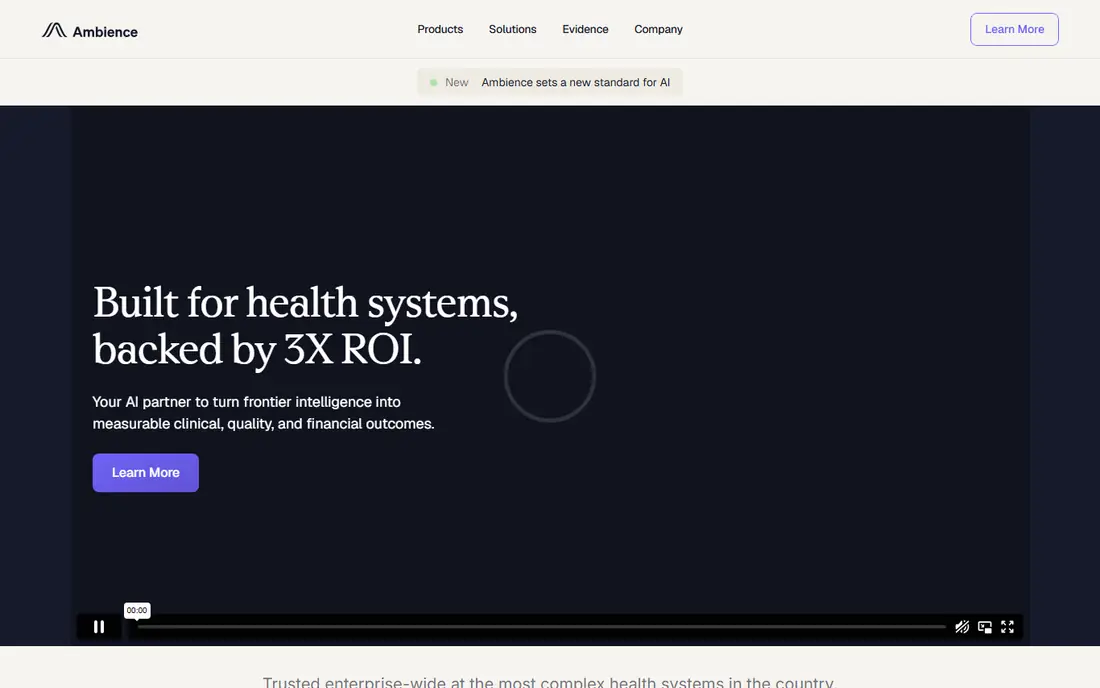
Ambience Healthcare sells an enterprise platform that pairs ambient documentation with coding and workflow automation. Its core product, AutoScribe, listens to the visit and generates a structured note, while AutoCDI checks it against coding requirements in real time. Third-party sources conflict on price: base AutoScribe is third-party reported at 2,800 to 3,200 dollars per provider per year, while the full suite is third-party reported at 4,000 to 5,000 dollars per year.
What we like- AutoScribe drafts notes in about 90 seconds, and AutoCDI checks the note against ICD-10 and CPT rules
Watch out for- Enterprise-only sales with a multi-month pilot cycle
- No public price, and the full suite costs far more than the base module
#3
Freed
Best for: Solo clinicians and small practices that want a published price and same-day setup
Visit getfreed.ai
Starting price39 dollars per clinician per month for Starter, from the vendor pricing page checked 11 November 2026
Free planNo permanent free plan; 7-day free trial with no credit card, and Core free for 12 months for eligible trainees
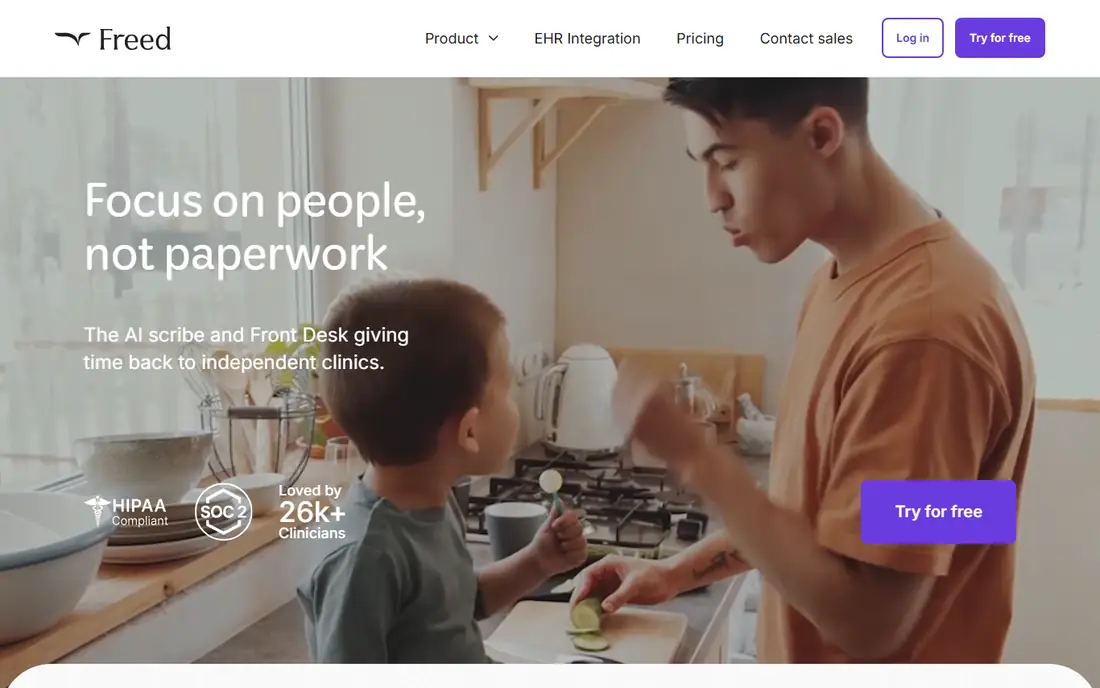
Freed is the only tool in this guide with a price on the vendor site. Starter costs 39 dollars per clinician per month for up to 40 notes, Core costs 79 dollars for unlimited notes, and Premier costs 119 dollars per month, or 104 dollars per month billed annually, and adds EHR push and ICD-10 coding. Its vendor help page confirms the same three tiers as of 10 November 2026.
What we like- Transparent published pricing with no sales call
- Setup takes minutes
- Premier adds EHR push, ICD-10 coding, and referral letters
Watch out for- EHR integration runs through a Chrome extension rather than a native API write-back, so it is not built for large health systems
- Starter caps notes at 40 per month
#4DeepScribe
Best for: Specialty practices, especially oncology and cardiology, that need specialty-tuned notes4.1/5 on
G2 (26 reviews, checked Oct 2026)
Visit deepscribe.ai
Starting pricequote; third-party reported roughly 350 to 500 dollars per clinician per month
Free planNo free plan and no free trial
DeepScribe is an ambient AI scribe tuned for complex specialty visits, with templates for specialist visits. It drafts a structured note and adds E and M coding suggestions and context from prior documentation. Third-party sources conflict sharply on price: some report 225 to 375 dollars per clinician per month, others report 350 to 500 dollars, and one vendor comparison lists 750 dollars per clinician per month.
What we like- Specialty-specific templates for oncology, cardiology, and other complex specialties
- Built-in E and M coding suggestions
Watch out for- No public pricing and no free trial, so buyers must commit to a sales demo first
- Enterprise pricing puts it out of reach for most small practices
#5
Suki
Best for: Multi-specialty groups that want voice commands as well as ambient notes
Visit suki.ai
Starting pricequote; third-party reported roughly 299 dollars per clinician per month for Compose and 399 dollars for Assistant
Free planNo free plan and no self-serve trial
Suki combines ambient scribing with spoken EHR control. It listens to the encounter, drafts the note, and lets the clinician pull chart data, stage prescriptions and lab orders, and suggest ICD-10 and HCC codes by voice. Third-party sources mostly agree on 299 dollars per clinician per month for the documentation-only Compose tier and 399 dollars for the full Assistant tier, so confirm which tier your quote covers.
What we like- Voice-first design for dictation, EHR commands, staged orders, and chart questions by voice
- Native integration with Epic, Oracle Health, athenahealth, and MEDITECH Expanse
Watch out for- Price is high for small practices at a third-party reported 299 to 399 dollars per clinician per month
- No public pricing page, so every deal needs a sales conversation and an annual contract
#6
Nuance DAX Copilot
Best for: Large health systems already invested in Microsoft and Dragon dictation
Visit microsoft.com
Starting pricequote; third-party reported roughly 369 to 600 dollars per clinician per month through resellers
Free planNo free plan and no self-serve trial
Microsoft folded DAX Copilot with Dragon Medical One into Microsoft Dragon Copilot in 2025. It drafts the note with Azure OpenAI models and pushes it into Epic, Oracle Health, or other integrated EHRs. Third-party sources conflict on price. Reseller pricing is third-party reported at 600 dollars per provider per month for small groups, about 369 dollars on an annual commitment, and 444 dollars at 76 or more providers, while other reports put the range at 369 to 830 dollars or more.
What we like- Deepest history in clinical speech recognition, with native Epic integration through Hyperdrive
- Now merged with Dragon Medical One, so dictation and ambient notes sit in one product
Watch out for- Among the most expensive tools in this guide, with a one-time setup fee of about 650 to 700 dollars for the first user
- The rebrand to Dragon Copilot has left pricing and licensing terms confused across resellers
#7
Notable
Best for: Health systems that want documentation inside a wider workflow automation platform
Visit notablehealth.com
Starting pricequote; no reliable third-party per-clinician price found
Free planNo free plan; evaluation is through a demo and pilot
Notable sells clinical documentation as part of a wider workflow automation platform, not as a standalone scribe. It uses AI to capture the encounter, draft documentation, and connect the note to intake and follow-up steps. That breadth suits a health system that wants one vendor for several workflows. No reliable third-party per-clinician price was found, so this guide lists the price as quote only.
What we like- Documentation sits inside a broader platform that automates intake, scheduling, and follow-up
- Enterprise support and EHR integration are scoped to the buyer
Watch out for- No published price and no usable third-party per-clinician figure, so buyers cannot benchmark the cost before a sales conversation
- Documentation is not the standalone focus, so a buyer who only needs a scribe may pay for platform breadth they do not use
#8Augmedix
Best for: Health systems that want a choice between fully automated notes and human-supported documentation4.4/5 on
G2 (16 reviews, checked Oct 2026)
Visit augmedix.com
Starting pricequote; third-party reported roughly 800 dollars or more per clinician per month, with wide disagreement
Free planNo free plan; every new partnership starts with a pilot
Augmedix Go drafts the note automatically, Augmedix Assist adds specialist support, and Augmedix Live is a full-service offering with a dedicated specialist. Third-party sources conflict sharply on price: one guide reports about 800 dollars or more per clinician per month, and another reports about 2,000 dollars per month. None of these figures is a vendor price, so get a product-specific quote for Go, Assist, or Live.
What we like- Widest service range in this guide, with Go for automated notes, Assist for hybrid support, and Live for full-service documentation
- Strong emergency department offering with Augmedix Go ED
Watch out for- No public price, and third-party estimates range from about 800 dollars to about 2,000 dollars per clinician per month, which is too wide to plan from
- Now a wholly owned subsidiary of Commure, so buyers should confirm the product roadmap and support terms in writing
Comparison table
| Tool | Starting price per month | Free plan or trial | EHR integration | Best for |
| Abridge | Quote; 208 to 500 dollars reported | No | Epic, Oracle Health, athenahealth | Large Epic health systems |
| Ambience Healthcare | Quote; 233 to 267 dollars reported for AutoScribe | No | Epic, Oracle Health, athenahealth | Documentation plus coding checks |
| Freed | 39 dollars Starter | 7-day trial, no credit card | Browser-based EHRs, Chrome extension | Solo and small practices |
| DeepScribe | Quote; 350 to 500 dollars reported | No | Epic, athenahealth, eClinicalWorks | Oncology and cardiology |
| Suki | Quote; 299 dollars Compose, 399 Assistant | No | Epic, Oracle Health, athenahealth, MEDITECH | Voice commands and orders |
| Nuance DAX Copilot | Quote; 369 to 600 dollars reported | No | Epic, Oracle Health | Microsoft and Dragon shops |
| Notable | Quote; no reliable figure found | Demo and pilot only | Scoped to buyer EHR | Workflow automation buyers |
| Augmedix | Quote; 800 dollars or more reported | Pilot only | More than 50 EHRs | Automated or human-supported |
Frequently asked questions
Is clinical documentation software the same as CDI software
No, the two categories solve different problems. Ambient clinical documentation software listens to the visit and drafts the note, while CDI software reviews notes after they are written and checks them against coding and billing rules. This guide covers ambient scribes only. If your main need is coding review, use the Rankite guide on clinical documentation improvement software, which covers Solventum, Waystar, Dolbey, Streamline, AGS, Optum, and IMO.
How much does the best clinical documentation software cost
Only Freed publishes a price in this guide, starting at 39 dollars per clinician per month for Starter, with Core at 79 dollars and Premier at 119 dollars, or 104 dollars billed annually. The other seven tools are quote-only. Third-party reported ranges run from roughly 208 dollars to 600 dollars per clinician per month for most enterprise tools, with Augmedix reported higher, so get a written quote before you budget.
Which clinical documentation tool is best for a small practice
Freed is the best pick for most solo clinicians and small practices, because it publishes its price, sets up in minutes, and needs no sales call. Starter costs 39 dollars per clinician per month for up to 40 notes, and Core costs 79 dollars for unlimited notes. The main limit is EHR integration through a Chrome extension rather than a native API, so confirm it works with your exact EHR before you pay.
Do I still need to review AI-generated clinical notes
Yes, every note needs clinician review and sign-off. No tool in this guide removes that duty, and the clinician remains responsible for the medical record. Use the draft as a starting point, check facts, doses, and plans against the visit, and edit before you sign. A pilot should measure how much editing each tool needs, because heavy editing erases the time the tool was meant to save.
Can I try clinical documentation software before I buy it
Freed offers a 7-day free trial with no credit card, which is the easiest way to test a scribe in this guide. The enterprise tools do not offer self-serve trials. Abridge, Ambience Healthcare, DeepScribe, Suki, Nuance DAX Copilot, Notable, and Augmedix all require a demo and a sales-led pilot, which usually takes weeks to arrange. Plan for that timeline, and ask what the pilot costs before you agree to it.
Sources we checked (12)
- https://www.abridge.com
- https://www.ambiencehealthcare.com
- https://www.getfreed.ai
- https://help.getfreed.ai/en/articles/9242518-freed-pricing-discounts
- https://www.deepscribe.ai
- https://www.suki.ai
- https://www.microsoft.com/en-us/microsoft-cloud/healthcare
- https://patientnotes.ai/compare/nuance-dax
- https://www.notablehealth.com
- https://www.augmedix.com
- https://www.commure.com/press-releases/augmedix-awarded-vizient-contract-for-ambient-ai-documentation-solutions
- https://rankite.com/blog/best-clinical-documentation-improvement-software
Is your product missing or out of date?
We review this list regularly. Vendors can request a listing, send updated pricing or ask about featured placement.

Shihab Mia · Founder, Rankite
Shihab has 5+ years in B2B and SaaS SEO. He writes Rankite's software buying guides from pricing pages, documentation and public user reviews. More about Shihab.