How we make this list: we compare pricing pages, product documentation and public user reviews. Ratings come from G2, Capterra or Trustpilot, with the date we checked them.
Key takeaways
- Veeva and Medidata suit large sponsors and CROs running complex, multi-country trials, while Castor and RealTime suit smaller teams and site networks.
- Florence Healthcare is the strongest pick when site documents, investigator files and remote monitoring are the main bottleneck.
- Oracle Health fits organisations already using Oracle systems for care delivery and operations, rather than a standalone trial team.
- Suvoda stands out for randomisation, trial supply and participant payments, and WCG adds ethical review and study enablement services alongside software.
- Every platform here is priced by quote, so budget on implementation, validation, training and support, not just a licence fee.
Quick comparison
| Tool | Best for | Starting price | Free plan |
|---|
 Veeva | large life sciences sponsors | See website | No |
 Medidata | unified trial data and operations | See website | No |
 Castor | self-service study building | See website | No |
 Florence Healthcare | site documents and monitoring | See website | No |
 Oracle Health | health system operations | See website | No |
 RealTime | site networks and CTMS | See website | No |
 Suvoda | randomisation, supply and payments | See website | No |
 WCG | review, feasibility and enablement | See website | No |
Is your product missing or out of date?
We review this list regularly. Vendors can request a listing, send updated pricing or ask about featured placement.
Starting priceSee website
Free planNo
Veeva is the industry cloud choice for sponsors that run many studies at once and need clinical, regulatory and quality work to share the same foundation. Its clinical operations tools cover trial management, electronic trial master files, site collaboration and study startup, with a data model designed for inspection and audit. For a large sponsor, that breadth reduces the need to stitch together separate vendors for each function.
The trade-off is scale. Veeva implementations are projects, not quick sign-ups, and they work best when a sponsor has internal clinical operations, data management and IT teams to run them. Smaller biotech firms can still use Veeva, but they should ask which modules are essential for their first study and which can wait. If your portfolio is growing and audit readiness matters from day one, Veeva is a safe long-term base.
What we like- Broad suite across clinical, quality and regulatory
- Strong sponsor adoption
- Consistent data model across products
Watch out for- Enterprise pricing and implementation effort
- Smaller teams may use only a fraction of the suite
- Change management takes time
Starting priceSee website
Free planNo
Medidata, part of Dassault Systemes, offers one of the broadest trial platforms in the market, covering electronic data capture, clinical trial management, randomisation, patient tools and central monitoring. Its newer AI companion and trial orchestration features aim to help teams find issues earlier, such as slow enrolment or data quality problems, rather than discovering them at a monitoring visit.
Medidata states that a large share of recent FDA novel drug approvals used its technology, which helps explain its adoption among sponsors and CROs. The platform suits teams that want data review, monitoring and operations in one place, with a single vendor to hold accountable. The cost and setup effort mean it is best evaluated on a real study protocol, with a clear list of required modules, rather than on a feature brochure alone.
What we like- Unified platform for data, monitoring and patient tools
- Wide trial history
- Strong analytics and AI features
Watch out for- Enterprise scope and cost
- Some modules need specialist configuration
- Smaller studies may find it heavy
#3Castor
Best for: self-service study building4.6/5 on
G2 (126 reviews, checked Oct 2026)
Visit castoredc.com
Starting priceSee website
Free planNo
Castor is built for research teams that want to build and adapt studies without waiting weeks for vendor configuration. Its platform covers electronic data capture, electronic patient-reported outcomes, electronic consent and an AI tool that proposes structured values from source documents for human review. Academic teams, medical device firms and smaller biotech companies often pick Castor for that speed.
The company reports thousands of studies and hundreds of customers, with strong review scores on Capterra and G2. That track record fits mid-size trials well. Large sponsors with complex global supply, safety and regulatory workflows should still run a pilot and check integration with their existing CTMS and safety systems. For a team that needs a study live in weeks, Castor is one of the most practical options here.
What we like- Self-service study building
- EDC, eCOA, eConsent and AI data extraction in one platform
- Faster deployment for smaller studies
Watch out for- Less suited to the largest global sponsor programmes
- Enterprise governance needs checking for complex trials
- Pricing is by quote
Starting priceSee website
Free planNo
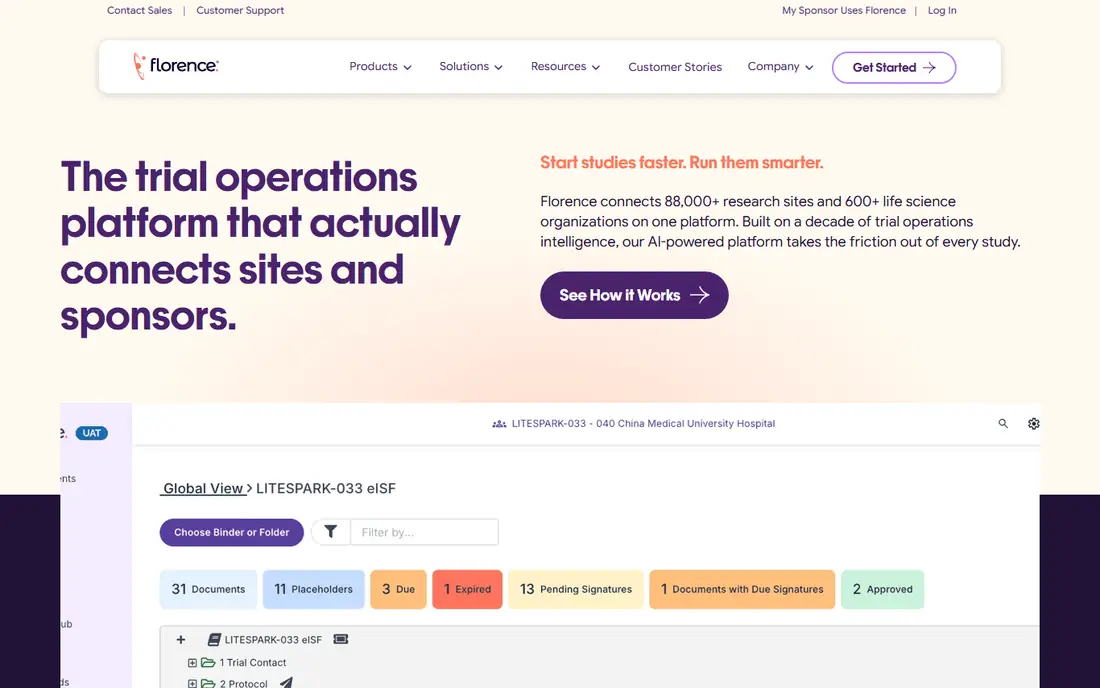
Florence Healthcare focuses on the document and workflow gap between sponsors and sites. Its eBinders product digitises investigator site files, participant binders and logs, while its eTMF product gives sponsors a configurable, audit-ready trial master file. SiteLink connects sponsors and CROs with a large site network, and contracting tools aim to shorten clinical trial agreement cycles.
That focus makes Florence a strong choice when startup delays, missing documents and monitoring travel are the real problems. Sites like a single place to manage study files, and sponsors gain visibility without chasing email attachments. Florence is less of a full replacement for a sponsor CTMS or EDC system, so buyers should map which functions Florence will own and which stay in their existing stack before signing.
What we like- Strong eISF and eTMF tools
- Large connected site network
- Remote monitoring and audit-ready archives
Watch out for- Site-focused scope means sponsors may still need a separate CTMS
- Pricing is by quote
- Rollout across many sites needs coordination
#5Oracle Health
Best for: health system operations3.5/5 on
G2 (239 reviews, checked Oct 2026)
Visit oracle.com
Starting priceSee website
Free planNo
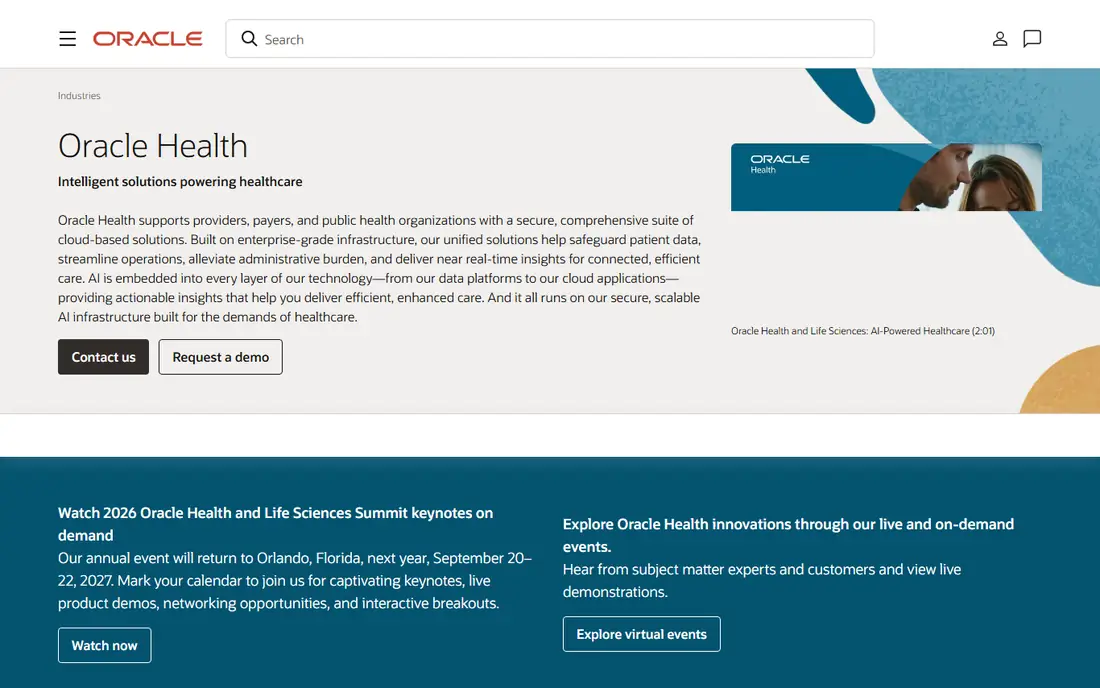
Oracle Health is best understood as a health system platform, not a narrow trial tool. It covers clinical, financial and operational workflows for providers, payers and public health organisations, with a clinical operations section aimed at coordination, communication and resource use across a health system. For an academic medical centre or hospital system that already runs Oracle systems, that integration can matter more than a standalone trial feature.
A sponsor or CRO looking only for CTMS, EDC or site tools will usually find a tighter fit elsewhere in this list. Oracle Health makes sense when trial operations must sit inside hospital operations, with shared identity, data governance and reporting. Buyers should ask Oracle to map the trial-specific workflows they need, such as study startup, site management and monitoring, against the broader suite, and confirm which parts are included in the proposed contract.
What we like- Broad health system suite including EHR, operations and analytics
- Strong interoperability focus
- Enterprise cloud infrastructure
Watch out for- Clinical trial operations is one part of a much larger suite
- Implementation is enterprise scale
- Less focused on standalone sponsor trials
Starting priceSee website
Free planNo
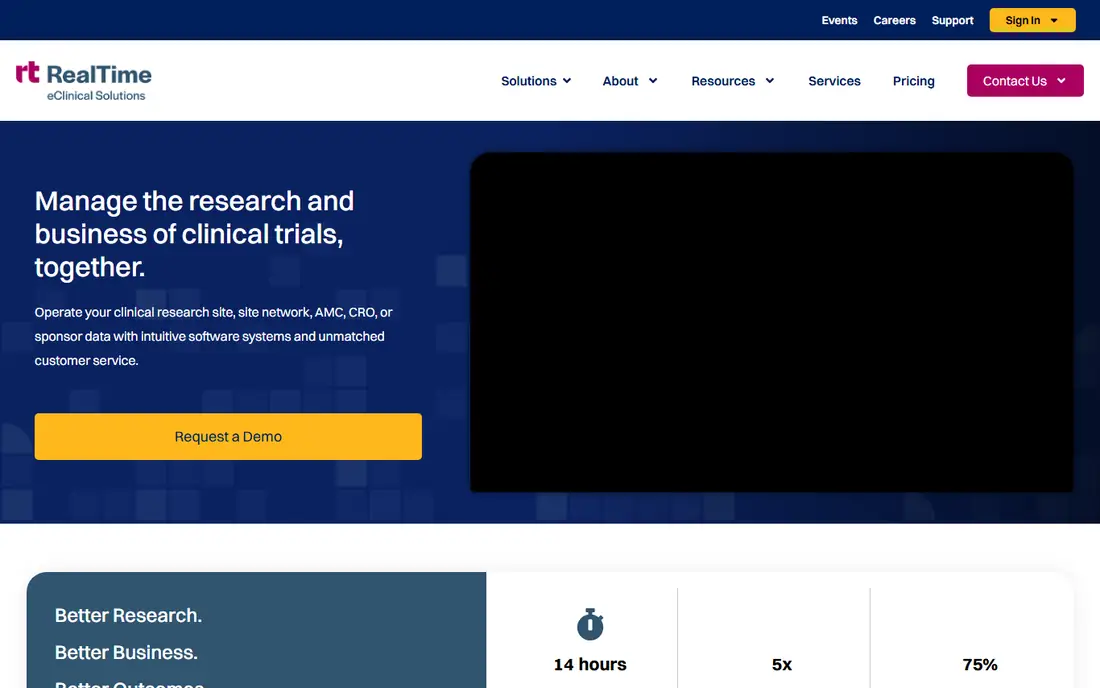
RealTime, also known as RealTime eClinical Solutions, builds software for research sites, site networks, academic medical centres, CROs and sponsors. Its core CTMS manages studies, staff, finances, documents and workflows, while add-on products cover electronic source, regulatory documents, site performance visibility and global site payments. The pitch is simple: one login, one training path and one invoice instead of several disconnected tools.
That site-first design is the reason to choose it. A site network that juggles many sponsors and protocols needs consistent workflows, staff tracking and finance visibility more than a sponsor-grade analytics suite. RealTime is less well known than the enterprise leaders, so buyers should check references from organisations of a similar size and confirm how data flows to sponsor systems. For site operations, it is a focused and practical pick.
What we like- CTMS, eSource, eReg and payments in one site system
- Built for sites and site networks
- Practical reporting for operations
Watch out for- Sponsor-side depth varies by use case
- Smaller vendor footprint than Veeva or Medidata
- Integration checks needed for sponsor systems
Starting priceSee website
Free planNo
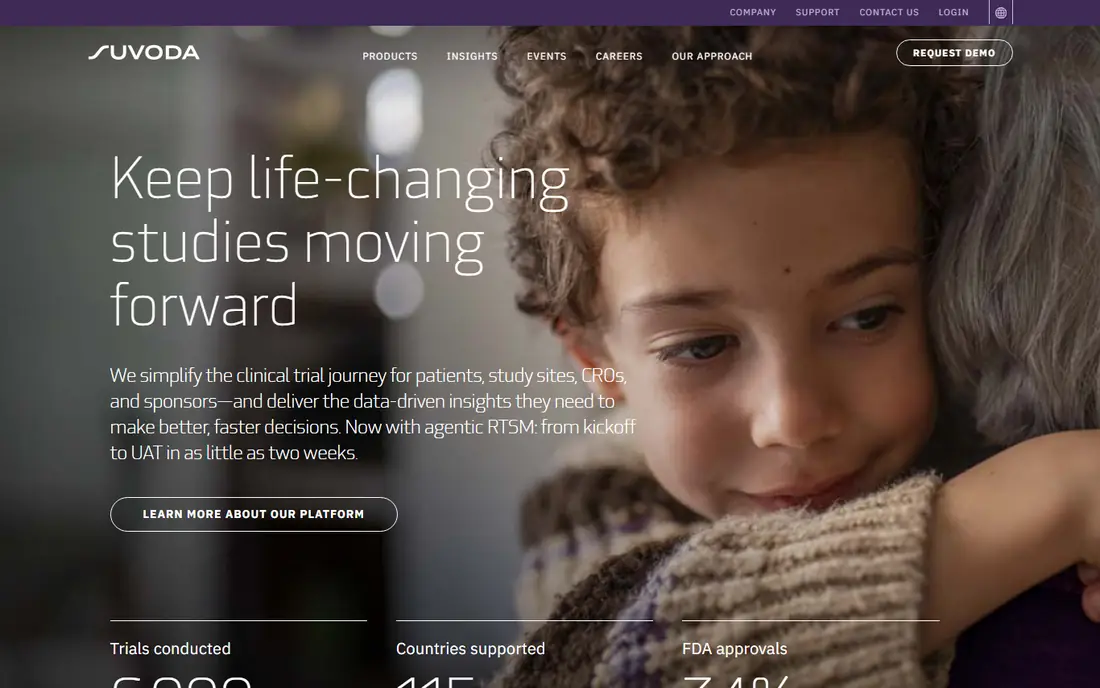
Suvoda, which now includes the former Greenphire clinical finance suite, focuses on the parts of a trial that directly affect participants and sites: randomisation, trial supply, eCOA, travel and payments. Its platform aims to keep studies moving at moments that matter, such as enrolment, dosing, visit scheduling and site payment, with a patient app that brings visits, receipts, questionnaires and reminders together.
Suvoda reports thousands of trials across more than 100 countries, with a strong share in oncology, rare disease and central nervous system studies. That profile suits sponsors and CROs that need reliable randomisation and supply control, plus timely participant payments. Teams that need a full data capture or trial management system should plan how Suvoda will integrate with their EDC and CTMS, rather than assuming it replaces them.
What we like- Strong randomisation and trial supply management
- Participant payments and travel tools
- Patient app for visits and questionnaires
Watch out for- Not a full EDC or CTMS replacement on its own
- Enterprise pricing by quote
- Implementation timelines vary by study complexity
Starting priceSee website
Free planNo
WCG Clinical Services combines services and technology for clinical research, with a legacy in independent ethical review. Its work covers ethical and scientific review, planning, design and feasibility, study and site enablement, and solutions for sites and research institutions, all supported by its ClinSphere technology platform. That blend suits sponsors that need expert judgement as well as software.
The distinction matters for buyers. WCG is not a like-for-like swap for a pure CTMS or EDC vendor, and the right comparison is on the full engagement: review timelines, feasibility quality, site activation support and platform reporting together. For a sponsor entering a new therapeutic area or facing a complex protocol, that combined support can remove bottlenecks that software alone would not fix. For a team that only needs a database, a narrower platform will be simpler.
What we like- Independent ethical and scientific review
- Study design and feasibility support
- Site enablement and technology platform
Watch out for- Service-led model, so software scope differs from pure platforms
- Pricing is by engagement
- Best for teams that also need review services
How we chose
We compared pricing pages, product documentation and public reviews on G2, Capterra and Reddit, and checked each homepage to confirm the product still exists and matches its category. This guide covers software and services for research teams, not medical advice for patients. We favoured platforms with clear trial operations coverage, audit trails, site usability and integration with EDC, safety and finance systems. Where a vendor does not publish a price, we wrote See website rather than guessing a number, since clinical trial pricing depends on study count, sites, countries and validation needs.
What to check before you sign
Start with the study, not the feature list. Map the protocol to the platform: how many sites, countries and participants, what data capture is needed, how randomisation and supply will work, and how sites will be paid. Ask each vendor to walk through that exact study, including startup, enrolment, monitoring, closeout and archiving, rather than a generic demo.
Then check validation, security and audit. Confirm 21 CFR Part 11 and GDPR or HIPAA handling as relevant, audit trail depth, role-based access, data export formats and what happens to data at contract end. Ask about implementation time, training for sites, help desk hours across time zones, and the cost of change requests after go-live. A platform that looks cheap on licence fees can become expensive if every protocol amendment needs paid vendor work.
Sponsor, CRO or site
Sponsors should prioritise portfolio visibility, data quality and inspection readiness. CROs should prioritise multi-sponsor workflows, monitoring efficiency and client reporting. Sites should prioritise ease of use, single sign-on, payment speed and support during clinic hours. The same product can rank differently for each buyer, so score vendors against your own role.
Integration and data ownership
Confirm integrations with your EDC, CTMS, safety, finance and EHR systems, and whether data moves automatically or by manual export. Get data ownership, retention and archiving terms in writing, including how long records stay accessible after a study closes and what format they take.
Frequently asked questions
What is a clinical operations platform?
A clinical operations platform is software that helps plan, run and oversee clinical trials, covering study startup, site management, documents, monitoring, payments and reporting. Some platforms cover the full trial, while others focus on one area such as data capture, site documents or randomisation and supply.
How much does a clinical operations platform cost?
Pricing is almost always by quote and depends on study count, sites, countries, participants and required modules. Implementation, validation, training and support often add a large share of total cost, so ask for a full first-year figure, not just a licence rate.
Do I need CTMS, EDC and eTMF in one system?
Not always. Large sponsors often prefer a unified suite for consistency, while smaller teams may combine a CTMS, an EDC system and a site document tool from different vendors. The key test is whether data flows cleanly between them and whether audit trails stay complete across systems.
Which platform is best for research sites?
Florence Healthcare and RealTime are strong site-focused choices, with document management, regulatory files and site workflows at the centre. Suvoda also helps sites through participant payments, travel and visit tools. Sites should test the system with real clinic staff before committing.
Can a small biotech use Veeva or Medidata?
Yes, but implementation effort and cost are higher than with a self-service platform such as Castor. A small team should ask which modules are needed for its first study, what a pilot would cost, and how long deployment would take.
How long does implementation take?
It varies widely, from weeks for a self-service study build to months for an enterprise suite with validation and integrations. Ask each vendor for a timeline tied to your protocol, including site training and data migration, and get it in the contract.
Sources we checked (8)
- https://www.veeva.com
- https://medidata.com/
- https://castoredc.com/
- https://florencehc.com
- https://www.oracle.com/health/
- https://realtime-ctms.com/
- https://suvoda.com/
- https://wcgclinical.com/
Is your product missing or out of date?
We review this list regularly. Vendors can request a listing, send updated pricing or ask about featured placement.

Shihab Mia · Founder, Rankite
Shihab has 5+ years in B2B and SaaS SEO. He writes Rankite's software buying guides from pricing pages, documentation and public user reviews. More about Shihab.